X-Ray the Idol Hunter Rumored to Make a Showing at 2013 Gospel Coalition in Orlando
 “As Powlison brings the latest findings from Westminster’s research and development team on idol hunting, it only makes sense that X-Ray would want to be briefed.”
Those of you who have been a part of PPT since its beginning in 2009 are aware of who X-Ray the Idol Hunter is. She is kind of the Big Foot of New Calvinism. Her possible existence surfaced in 2010 during John Piper’s sabbatical. Piper said he was taking the sabbatical because he had observed several “species of pride” in his soul. According to other statements he made, he had consulted Tim Keller and Paul David Tripp on how to peel away several different levels of idolatry in order to find these “species.” Piper never identified the different species with biblical nomenclature.
Piper shared these things prior to beginning his sabbatical which had a predetermined length of eight months. The question soon became the following: how did Piper know that the eradication of these “species,” and all of the peeling away of many levels of idolatry in the soul, would take exactly eight months? If the species where wreaking enough havoc on his soul to cause him to step down for eight months, one must assume that eliminating these creatures would be efficacious.
Well, sure enough, Piper returned to the ministry eight months later. That’s when the rumors started. Obviously, Piper had an ace in the hole. It is doubtful that Sonship theology, the primary doctrine that promotes idol hunting in the heart would have been enough to guarantee such a victory. The doctrine was concocted by Dr. John “Jack” Miller in the 80’s and articulated by David Powlison and Paul David Tripp. David Powlison oversees a research and development team at Westminster Seminary that endeavors to come up with better and better ways to hunt down idols in the heart. Miller was able to identify twenty-five species of idols to get the ball rolling.
Powlison and Tripp devised what they call “X-Ray questions” that help people detect these idols which manifest themselves in our desires. All and all, Powlison has devised around 135 such questions. The questions reveal desires, and the desire leads to the species.
But after the return of Piper, people started asking questions, and strange manifestations began to be noticed at New Calvinist conferences where Piper, Powlison, Keller, and Tripp appeared. Powlison and Keller are self-proclaimed mentorees of John Miller. One such manifestation was seen on a conference website and appears below:
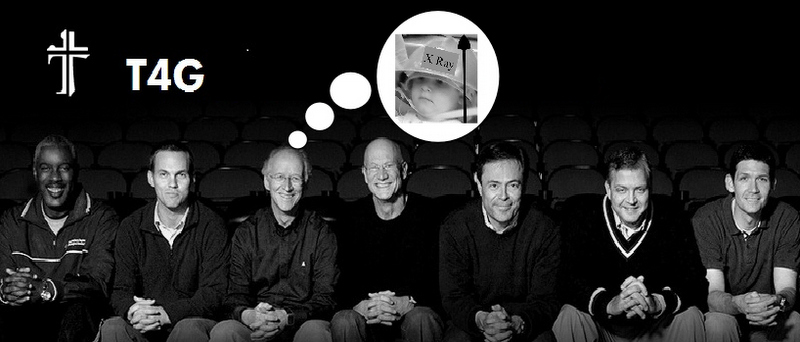
Furthermore, the following spears were found at yet another conference:

Putting it in a way that David Powlison would, X-Ray is kinda, perhaps, like a parody, but then again, kinda not to demonstrate the mindless New Calvinist following of mysticism on the issue of change. As Jay E. Adams well noted in his treatise against Sonship theology, idol hunting seems to be a kissing cousin to species of demons that supposedly cause Christians to sin. Hence, a different demon for each sin, and as Piper noted just prior to his last sabbatical, Tim Keller informs us that some levels of idol hunting are only obtained by fasting and prayer. Yet, someone had to know that the extraction of the “species” that were hounding Piper would only take exactly eight months to extract. PPT was sent a top secret picture of X-Ray, and we neither vouch for this picture nor deny it. Like Big Foot, the jury is kinda still out:

With Powlison, Keller, Tripp, and Piper all coming to this year’s Gospel Coalition conference in Orlando, a manifestation of X-Ray is very possible. As Powlison brings the latest findings from Westminster’s research and development team on idol hunting, it only makes sense that X-Ray would want to be briefed.
Stay tuned.
paul
Why David Powlison is a Liar
 Cultists are all the same. First, they believe they understand a higher knowledge that most Christians are not “ready for.” Example: in an interview with John Piper conducted by someone who asked him what he would say to the Pope if he had two minutes with him, Piper stated in no uncertain terms that most Christians are not ready for the true Reformation gospel of justification by faith alone [in sanctification]. Secondly, this mentality allows them to condone the hijacking of familiar Christian terms/phrases and use them to deceive. Example: when they use the term progressive sanctification they really mean progressive justification and they know it grade-A well. It’s deliberate deception.
“Cult” is a loosely used term and it should be. Cults are defined as any group that seeks to control others through deception. They are also defined by being sectarian; in other words, their false doctrine divides relationships of various kinds. New Calvinism has its roots in ancient spiritual caste systems that are defined by those characteristics. Much of today’s religion finds its origins in those ancient philosophies. So “cult” is going to be a term often used, and rightfully so.
This post was instigated by an email I received from a reader regarding a recent article by David Powlison in the revamped The Journal of Biblical Counseling. I believe Powlison to be, for many documented reasons, an unrepentant, habitual liar. The article that was referred to me, as you can tell, has ruffled my feathers. I’m just fed up with all of the deception. The link was a review written by John Piper puppet Justin Taylor. What is the gist of the article? Powlison is going to explain why being sanctified by justification is only one small part of the full counsel of God that he pretends to proffer. In one promotion for the article we read,
David Powlison challenges the popular views on sanctification that take one strand in Scripture and present it as the be all and end all of Christian growth. He specifically engages the strengths and weaknesses of the view that asserts, “You are sanctified by remembering that you are justified.”
Um, excuse me, but first of all, the idea that Christian growth comes from preaching the gospel to ourselves every day or revisiting the gospel isn’t even “one strand” of Scripture to begin with. That strand isn’t there period. It’s a lie directly from the pit of hell itself. According to Taylor, Powlison will address the following in part 2 of the article:
In an article planned for the next issue of the journal, Powlison plans to look at several related questions:
Is sanctification essentially the activity of remembering and rebelieving that Jesus died for your sins? Is self-justification by your own performance the chief problem that sanctification must deal with? When the Bible says to “make every effort,” is the hard work chiefly the struggle to remember and believe again that we are saved by the achievement of our Savior? “In each case,” he writes, “I will say No, and will seek to widen both our personal approach to sanctification and the scope of ministry to others.”
Powlison chooses his words carefully. He is going to “teach” us how to “widen” our “approach to sanctification.” But the “approach” is still singular, and as this blog has exhaustively documented, his approach is exclusively Christocentric. Powlison’s language is also continually saturated with nuance such as, “I will say no.” Why not just say NO and be done with it? Because the answer is not really “no,” that’s why. That’s the usual Powlison speak for, “It’s kinda ‘no’ but then again it’s kinda ‘yes’”
Let me make my point with this excerpt from Taylor’s blog:
Is self-justification by your own performance the chief problem that sanctification must deal with?
Um, excuse me, but if you are a Christian, self-justification in sanctification is a complete impossibility. But notice that it is conceded that such is a possibility by referring to it as a question of being the “chief problem.” Also note that the concern isn’t those who attempt to be saved by their works which then cannot be called sanctification to begin with, but that self-justification in and of itself is possible in sanctification. The very question verifies what Powlison really believes. Works justification CANNOT take place in sanctification. Where works justification is present, sanctification cannot exist. The very framing of the question shows that Powlison doesn’t believe that the two are mutually exclusive. Moreover, we need them to guide us through the very tricky business of figuring out what is our “own performance” in sanctification resulting in “self-justification” verses what isn’t our own efforts in sanctification. Again, their very premise is a biblical impossibility, but reveals what they really believe.
Powlison is a cultist extraordinaire. That’s what he is. Like all New Calvinists.
paul
The Laity Must Seize Biblical Counseling From the Spiritually Inept Reformed Clergy
“If you haven’t received ‘proper training’ don’t try to counsel; you will do more harm than good.” Really? And many laymen buy it: “I don’t try to counsel people; if I told them the wrong thing I could do more harm than good.” How? Have you looked around at the mess called American Christianity in this country? After more than thirty years of an unprecedented biblical counseling movement spearheaded by David Powlison’s “research and development” center at Westminster Seminary, the American church has never been more unimpressive and disrespected. It’s so bad that there are at least three organizations that try to broker reconciliation in order to keep churches out of civil and criminal courts, and it is my understanding that business is booming. The country is saturated with “trained” biblical counselors and training centers, albeit mostly in upper income areas—to the tune of just under 100% according to our research. NANC and CCEF counselors are virtually nonexistent in lower income areas.
Moreover, NANC and CCEF (these two organizations comprise 90% of contemporary biblical counseling) are predicated on progressive justification. This is a gospel that posits the idea that people don’t change. In 1970, the father of the biblical counseling movement, Dr. Jay E. Adams, founded the movement on the idea that Christians can change and are competent to counsel each other. Though the results where dramatic, heretic David Powlison hijacked the movement with Westminster’s version of progressive justification, Sonship Theology. It is perplexing to me that many counselors who saw the results of Adams’ revival now refer to the movement in its present form as a “second generation” biblical counseling that is more “mature.” But where are the results? We now “need” Peacemaker Ministries and G.R.AC.E more than ever.
An example of that is Powlison comrade Pastor Mark Driscoll who claims to see visions regarding those that he counsels. Trust me, we can do better. And the time is ripe because we cannot possibly do worse. Granted, not all are inept, but where ineptness lacks, cowardliness and cronyism fills the void. Said another way; for the most part, they are either heretics or cowards. While the cowards don’t hold to the false gospel of progressive justification, they stand by silent as thousands of people are referred to these counselors daily. Plainly, the gospel really doesn’t matter. Plainly, they lack a deep love for the truth. While they sell their souls to the god of peer acceptance, they preach to others about not having idols in their heart.
Since the Scriptures teach that the average parishioner is competent to counsel, and the clergy have had their chance and completely blown it, the laity needs to get back to “encouraging one another unto good works.” Let’s start there. We are able. Here is what the apostle Paul said about our ability to counsel one another:
Romans 15:14 – I myself am satisfied about you, my brothers, that you yourselves are full of goodness, filled with all knowledge and able to instruct one another.
In contrast, the spiritual brain trust of our day teach that we are still totally depraved, and for some reason, people are perplexed that the totally depraved are acting like they are totally depraved. This has been pounded in the heads of American Christians for almost forty years now. The present-day biblical counseling movement is completely indifferent to this reality because, “It’s not about us being better, it’s about what Jesus has done—not anything we do.” Contrary to this, Paul stated that we are “full of goodness” and able to instruct on one another. It’s all there, when you were saved, you didn’t get a portion of the Holy Spirit—you got all of Him. You have His mind. You have His wisdom. You have His love. You have His goodness. You must appropriate it. That’s our role: learn and apply.
1. You are able.
2. You must learn and apply.
3….
You must trust God’s word as being sufficient. You must never waver from that:
Psalm 1:1 – Blessed is the man who walks not in the counsel of the wicked nor stands in the way of sinners, nor sits in the seat of scoffers; 2 but his delight is in the law of the Lord, and on his law he meditates day and night. 3 He is like a tree planted by streams of water that yields its fruit in its season, and its leaf does not wither. In all that he does, he prospers. 4 The wicked are not so, but are like chaff that the wind drives away.
We have two kinds of counsel here and the results. Where is the third option? Where is the pure milk cut with something as good as Scripture? (1Peter 2:2). Where is the alternative foundation in Matthew 7:24-27? Why is the word “alone” in Matthew 4:4? What great counselor of the day did Jesus cite apart from Scripture? If you have resolute confidence in the word of God—you can help people.
4. You won’t have all of the answers readily available in the beginning. It’s a process. You will lay the foundation, and then work together in the new way. This is discipleship. This is a vessel for building deep friendships. Here is what James stated in regard to this:
James 1:5 – If any of you lacks wisdom, let him ask God, who gives generously to all without reproach, and it will be given him. 6 But let him ask in faith, with no doubting, for the one who doubts is like a wave of the sea that is driven and tossed by the wind. 7 For that person must not suppose that he will receive anything from the Lord; 8 he is a double-minded man, unstable in all his ways.
There can be no thought that there is another way other than God’s word. This is double mindedness. This is hedging your bets. As you pray together, there must be confidence that God shows the way, and that it is the only acceptable way. No answer to prayer for wisdom in the situation should be expected without complete confidence in God’s word. All the other ways are instability in “all his [different] ways.” There are not alternate paths to God’s way.
5. You must know that the trial will end:
James 4:4 – And let steadfastness have its full effect, that you may be perfect and complete, lacking in nothing…. 12 Blessed is the man who remains steadfast under trial, for when he has stood the test he will receive the crown of life, which God has promised to those who love him.
6. You must know that your friend will benefit from the trial, or be separated from the faith. Here is where formal counseling is a great evil in our day. An appointment is made with the uppity pastor’s “counseling secretary.” Your session will be an hour, and then you are sent home till next week’s appointment. Few in the congregation, if any, will be involved in the situation. They aren’t “experts.” They aren’t “trained.” But by and large, the “experts” don’t really take God’s word seriously.
Any Christian who is in a trial is in grave danger of being separated from the faith. While God wants to use the trial to mature you (James 1:3 – for you know that the testing of your faith produces steadfastness), the kingdom of darkness wants to use it to separate you from the faith: “Blessed is the man who remains steadfast under trial, for when he has stood the test he will receive the crown of life, which God has promised to those who love him” (James 1:12). This doesn’t mean we can lose our salvation, but it means that we could end up on a path with an uncertain eternal future:
2Peter 1:9 – For whoever lacks these qualities is so nearsighted that he is blind, having forgotten that he was cleansed from his former sins. 10 Therefore, brothers, be all the more diligent to confirm your calling and election, for if you practice these qualities you will never fall. 11 For in this way there will be richly provided for you an entrance into the eternal kingdom of our Lord and Savior Jesus Christ.
Our goal is a rich entry, not one shrouded with doubt and fear concerning an uncertain eternity. This will cripple us in our faith. Before Peter’s trial of denying Christ after He was taken into custody, Christ told him that Satan had sought permission from God to separate Peter from the faith (a Job-like event). Trials will either make you a stronger Christian, or separate you from the faith. The words “trial” and “temptation” are therefore used interchangeably in the Scriptures. Hence, one should not be confused by what James stated in context:
James 1:13 – Let no one say when he is tempted, “I am being tempted by God,” for God cannot be tempted with evil, and he himself tempts no one. 14 But each person is tempted when he is lured and enticed by his own desire. 15 Then desire when it has conceived gives birth to sin, and sin when it is fully grown brings forth death.
7. You must know that your friend will desire to get out of the trial quickly, and even though God’s wisdom often ends a trial quickly, and circumvents some trials altogether, the world’s way of ending a trial will be crouching at the door:
“…. let steadfastness have its full effect” (James 1:4).
You must stand with your friend against the world’s shortcuts in the midst. Why does it take an expert to understand these things? The last thing a Christian in trial needs is a professional motif with an uppity secretary, a bunch of formal paperwork, and contemporary décor. They need real friends full of goodness. They need real friends who know what’s at stake. This is where true discipleship is set on fire. This is where the rubber of love meets the road.
8. You must not be surprised at the trial type. Christians can find themselves in any kind of trial:
“….when you meet trials of various kinds” (James 1:2).
1Peter 4:12 – Beloved, do not be surprised at the fiery trial when it comes upon you to test you, as though something strange were happening to you.
9. You must not doubt God. The most astounding trials must not be allowed to shake our confidence in God’s purposes and trust in His wisdom to resolve the trial. We must consider doubt an affront to God’s power, promises, and purposes. We must not have a form of godliness while denying the power thereof.
10. You must joyfully anticipate the deepening of relationship between all involved and God:
“….Count it all joy, my brothers, when you meet trials of various kinds” (Ibid).
Go. Go to your friend. Work together with them in encouragement. Discuss what you know, and pray together for wisdom in the rest. Wait on God together. Obey together. Cry together. Trust together, and defend God’s sufficiency together. Study the word together. Make a friendship deeper, and look forward to the day when you can comfort others with the comfort you have been comforted by. These are deep waters. This is where Christ comes in power. This is no place for outsiders.
This is no place for bloviated academics propagating a false gospel.
paul
The Brilliant Dr. Ed Welch and Gospel-Driven Failure
As the resurgence of the Authentic Calvinism pandemic spreads across this country, the absurdity becomes easier to write about every day. In the name of faith, the way Christians are being led into turning off their minds is astounding. But it is a rheostat modus operandi, so those who are being gradually assimilated into this philosophy don’t see it happening. Unfortunately, the lost world and Christian producers are perplexed by all of this.
CCEF is the counseling education wing of Westminster Seminary. Dr. David Powlison, Paul David Tripp, and Dr. Ed Welch, among others, have effectively spread this philosophy throughout the rest of the biblical counseling world. An indifferent attitude toward humanity in general is the result. Different world philosophies will perceive humanity differently. But more and more, Christianity is in league with nihilism which is a kissing cousin to authentic Reformed theology.
It has its roots in Gnosticism which has always been an elitist philosophy among the upper class. Philip J. Lee classifies Gnosticism as an upper socioeconomic phenomenon in his book, Against the Protestant Gnostics. It is no accident that New Calvinism is primarily an upper class phenomenon. Those who have to live in the real world to survive are perplexed by the logic; i.e., those who have to maintain a real job (or three jobs) in a horrible economy to survive. They have to trust Christian academia to deliver up the deeper things of God’s truth that they don’t have time to study, and pay good hard-earned money for it. Perhaps in all of church history, this sacred trust has never been violated in a greater way than in our day. Lee also classifies it as driven by hopelessness with the solution being an escape from realty. At the crux of Reformed theology is the idea that all reality is perceived from understanding how worthless we are as the way to understand God’s holiness. This enables us to abandon the pain and reality of the present world. Happiness is replaced by resurrection experiences that bring joy in understanding our utter worthlessness because we are completely free from the consequences. Hence, as one New Calvinist stated it:
What, then, is the subjective power of this message? Firstly, we find that there is real, objective freedom, the kind that, yes, can be experienced subjectively. We are freed from having to worry about the legitimacy of experiences; our claims of self-improvement are no longer seen as a basis of our witness or faith. In other words, we are freed from ourselves, from the tumultuous ebb and flow of our inner lives and the outward circumstances; anyone in Christ will be saved despite those things. We can observe our own turmoil without identifying with it.
This is really the primarily appeal of Reformed theology: sanctified escapism through worm theology. Dr. Welch recently posted Being a Loser and the Freedom to Fail on CCEF’s blog. It begins this way:
After accepting a CEO position at a non-profit, in which he could make or break the organization’s future, he said, “I believe that one of the great comforts of the gospel is the freedom to fail.” I heard this echoed recently by a friend when he made a somewhat risky vocational decision. Though he struggles with the opinions of others, he was able to say: “the worst I can do is fail.” He smiled as he said it, and I rejoiced in his spiritual maturity, which clearly surpasses my own.
There are so many benefits available in the death and resurrection of Jesus. The freedom to fail is a fine one, given how most of us feel like a failure.
The metaphysical stupidity of this is revealed in the following rhetorical question: Who would like to have a gospel-centered heart surgeon scheduled to perform your quadruple bypass? As you’re being wheeled into the operating room, he looks at you with a smile on his face as says: “I believe that one of the great comforts of the gospel is the freedom to fail.”
This philosophy is wreaking havoc on the church en masse, and then Christians are going to these guys to fix the problem! It’s like going to Dr. Kevorkian for the following presentation problem: “I’m suicidal.” The brilliant Dr. Welch continues:
Then listen to Scripture. You’ll find a number of divine responses. Here are just two.
The brother in humble circumstances ought to take pride in his high position. But the one who is rich should take pride in his low position, because he will pass away like a wild flower. (James 1:9-10)
Consider how you, as a brother in humble circumstances, have been singled out from the beginning of time to belong to God and, as you throw your lot in with Jesus, you have all of Christ’s inheritance. Your stature, indeed, is quite high.
I appreciate those words, and sometimes they are helpful, but I find more comfort— and some humor—in these:
For consider your calling, brothers: not many of you were wise according to worldly standards, not many were powerful, not many were of noble birth. But God chose what is foolish in the world to shame the wise; God chose what is weak in the world to shame the strong; God chose what is low and despised in the world, even things that are not, to bring to nothing things that are, so that no human being might boast in the presence of God. (1 Cor.1:26-29)
In context, the apostle Paul is actually speaking to the problem of false teachers like Ed Welch that intimidate Christians of the lower uneducated socioeconomic class with vain philosophy. Paul’s point is that God uses those of the lower class to refute puffed-up intellectuals with His wisdom. Welch uses these same verses to make the case that we should glory in our ineptness. Not so. The opposite is true.
I am presently in a deep study concerning God’s wilderness Tabernacle. He had specific plans concerning the Tabernacles construction, but also left much of the project to the creativity of the Israelites. He also demanded a skillful performance. All that was instructed was to be performed, “skillfully.” And our sanctification is no different. We are to make the best of the talents we have been given. Christ had no comforting words for those who do not approach our duties in sanctification with all zeal. The Tabernacle wasn’t built by spiritual slackers. Drawing from Welch’s last paragraph, these are NOT the words that I will be speaking to Susan as they are wheeling her in for surgery next month:
(Speaking softly, while stroking her hair softly): now Susan, I have chosen a gospel-centered surgeon for you. He has freedom in Christ, so he is not judged by the world’s standards—he has the freedom to fail. And you know sweety, we all fail every day. He also told me that like most of us, he feels like a failure. So my dear, let’s give this man the freedom to be human—after all, it’s not about what we do, but what Jesus has done. There are more important things in life than boasting about a successful surgery.
Though we may find humor in what is ridiculous, these are the chief surgeons of the biblical counseling movement in our day. And that’s not funny—it’s terrifying.
paul

 Paul's Passing Thoughts
2 comments