David Powlison’s Gnostic Counseling Paradigm
David Powlison is the major figure representing the counseling wing of Westminster Theological Seminary: the Christian Counseling and Educational Foundation (CCEF). Powlison was mentored by Dr. John Miller who was a professor at Westminster. Miller was the father of Sonship Theology which was his own twist on the rediscovery of the doctrine of perpetual justification (Gospel Sanctification) via the Australian Forum think tank formed in 1970.
Powlison took the concept of progressive justification and used it to develop his Dynamics of Biblical Change project which is the foundation of counseling education at Westminster. Two former students of his, Paul David Tripp, and Timothy Lane, wrote a book entitled “How People Change”(HPC) which is a treatise on the “practical application” of Gospel Sanctification (the doctrine of the present-day New Calvinist movement). The title of the book is a lie; as we shall see, New Calvinists do not really believe that people change.
This is most evident when one reads pages 64 and 65 of HPC. Tripp and Lane describe Christians as “powerless,” “enslaved,” and “dead.” They further elaborate by writing, “When you are dead, you can’t do anything” (p. 64, HPC). How do dead Christians change? Obviously, they don’t. Hence, this is why the vast majority of present-day biblical counseling controlled by the CCEF machine is a farce: the counseling is not about change.
So what’s going on? Basically, it starts with Plato and what was later known as Gnosticism. Some refer to Gnosticism as “Platonism for Dummies,” but the basics are easier to explain through fundamental Platonism. Plato believed man was unable to know reality. The following excerpt is a good explanation of Platonism 101:
Plato, the most creative and influential of Socrates’ disciples, wrote dialogues, in which he frequently used the figure of Socrates to espouse his own (Plato’s) full-fledged philosophy. In “The Republic,” Plato sums up his views in an image of ignorant humanity, trapped in the depths and not even aware of its own limited perspective. The rare individual escapes the limitations of that cave and, through a long, tortuous intellectual journey, discovers a higher realm, a true reality, with a final, almost mystical awareness of Goodness as the origin of everything that exists. Such a person is then the best equipped to govern in society, having a knowledge of what is ultimately most worthwhile in life and not just a knowledge of techniques; but that person will frequently be misunderstood by those ordinary folks back in the cave who haven’t shared in the intellectual insight….the Allegory also attacks people who rely upon or are slaves to their senses (Analysis of The Allegory of the Cave by Plato Online source:123helpme.com/view.asp?id=135077).
Because the common man is enslaved to his own senses and can only comprehend what he can sense from the material world which is merely shadows of reality, Plato devised what we now call a cybernetic loop. This is a process that evaluates the outcomes of experience/circumstances/data for the purposes of making adjustments or reaching goals. Since the common man is not enlightened, the next best thing is to devise a system that gives him guidance from the criteria that he can experience with his senses. The enlightened ones, who should lead and govern the common man, develop these cybernetic loops to help guide mankind in their world of dark shadows. Plato believed in a world ruled by philosopher kings. Below are some illustrations of cybernetic loops:
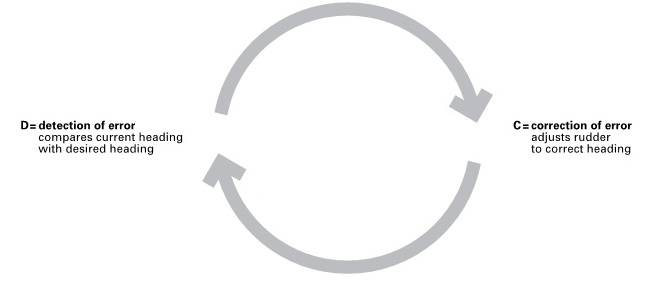

These loops can be complicated and may involve loops that evaluate other loops. Below is another illustration in regard to Plato’s philosophy:
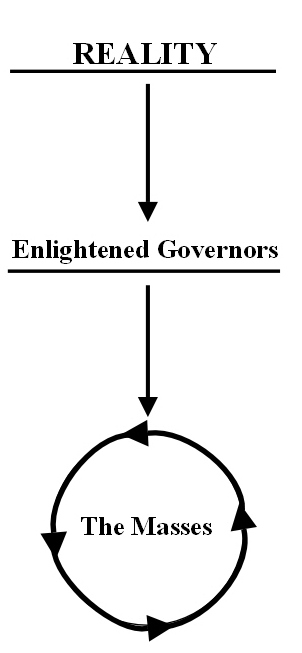
Plato had a vast influence on Augustine who is primarily responsible for the total depravity of the saints tenet found in Reformed theology. This prism had a profound influence in the forming of the gospel of perpetual atonement, or the idea that the effects of Christ’s death on the cross wasn’t a finished work, but was progressive for the purpose of maintaining a righteous standing for the saints. See illustration below:

This is opposed to the gospel that rejects the total depravity of the saints and propagates an enablement through the new birth:

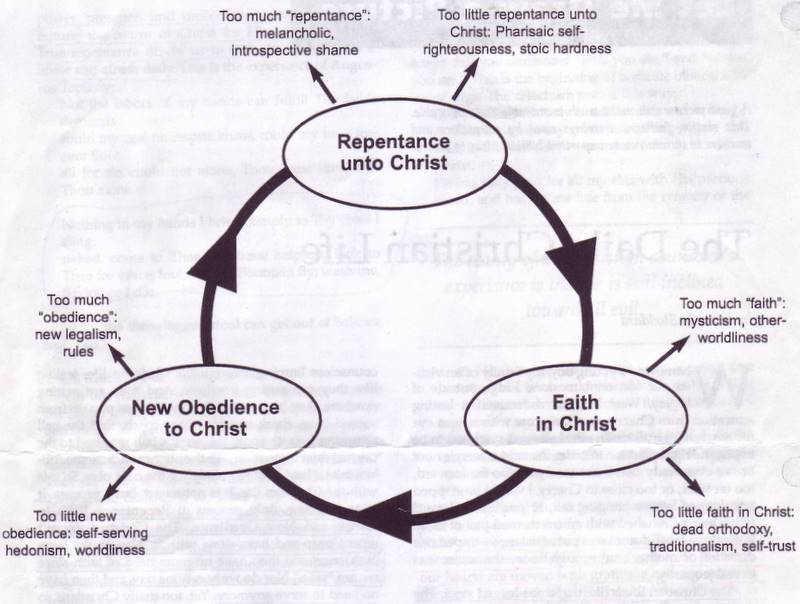
In the second model, the believer has the responsibility to learn and apply the word of God to their lives. But the first model, because it relies mostly on Platonist philosophy, also borrows the cybernetic loop for its “practical application.” Therefore, New Calvinists merge progressive justification into various cybernetic loops for “practical application.” Since the saints are supposedly unable to keep the law because they are still totally depraved, there has to be a way for the saints to continually partake in the same gospel that saved us. In order to come up with a way to do this, the New Calvinists went back to the basics: Plato. The first illustration of this is from CCEF’s The Journal of Biblical Counseling vol. 18, number 1, Fall 1999:
The following are illustrations from HPC and Powlison’s Dynamics of Biblical Change:


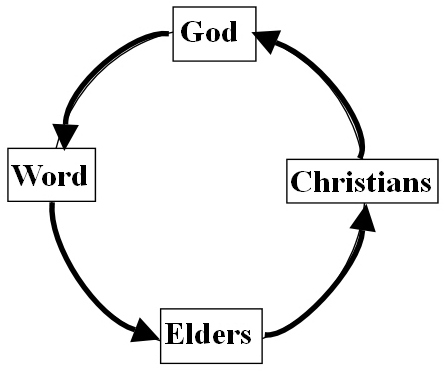
In the following excerpt from Dr. Devin Berry’s “How to Listen to a Sermon,” Berry uses a C-loop concept to explain the New Calvinist theory on how the saints receive the word of God. The illustration following the excerpt is mine:
Note this cycle: Paul, from the Word, delivers words. The Bereans, from Paul’s words, go to the Word. The Word cycles from God, through the preacher, to the people, back to the Word, and this, verse 12 tells us, produced belief in the God of the Word. An important thing to note is that this happened daily – suggesting a regular interaction between preaching, personal study, and the Word.
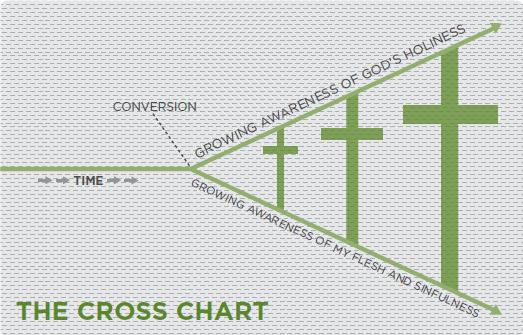
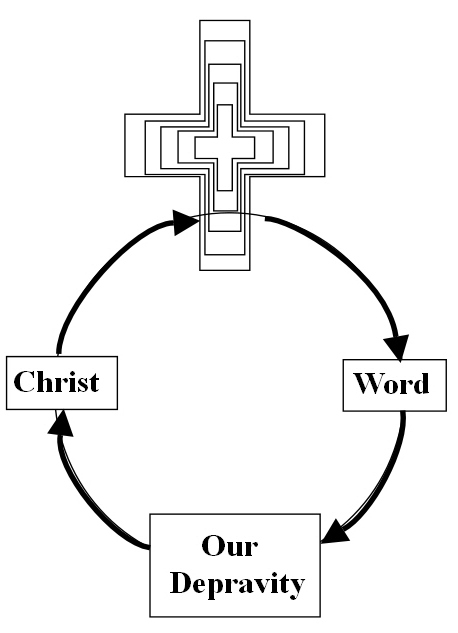
The goal of all of this is not change in the believer which is impossible anyway according to their theology because Christians are still totally depraved. The goal is to make the cross (or, the works of Christ) bigger by a deeper and deeper knowledge of how totally depraved we supposedly are. This is illustrated by the following chart produced by a New Calvinist organization:
 Below is a C-loop that can illustrate the above chart:
The Cat is Out of the Bag: Biblical Counseling Isn’t About Change
 As The Coalition Against New Calvinism is forming, one of my goals as a member is to publish a pdf report to be distributed among churches en mass. The first is almost complete and will be an introduction, but the second will address what is now apparent. David Powlison and the Christian Counseling & Educational Foundation have perpetrated a huge fraud upon the church. In the early 70’s many evangelical leaders adopted the doctrine and motif of the Australian Forum, a project that systematized Progressive Adventism. The base doctrine was the centrality of the objective gospel outside of us, and its primary focus was a call to semper reformanda. This was the idea (and still is) that the Reformation didn’t end with Luther, and the Forum had rediscovered the lost gospel of the Reformation (documentation on this and what follows is now ample and convincing).
Church leaders bought into the frenzy wholesale, especially many at Westminster Seminary where the Forum’s theological journal was widely distributed. One of those leaders at Westminster was the mentor of David Powlison and Tim Keller (Dr. John Miller). The movement spawned a massive takeover mentality among its proponents which sought to “reform” the American church with this new rediscovered Reformation gospel. Powlison is on record saying that the fundamental difference between CCEF and NANC (National Association of Nouthetic Counselors) was a traditional view of sanctification verses John Miller’s theology (which he got from the Forum). Therefore, it is no surprise that CCEF sought to assimilate the semper reformanda into NANC, which they have been very successful in doing.
One of the major themes promoted by Jay Adams when he was involved with NANC was the idea that counseling was about biblical change. Though unclear at this time whether the following came directly from the Forum or was added later, a significant portion of the NANC/CCEF counseling culture believes no such thing. Rather, they believe that people do not change (but remain totally depraved whether believers or not), and that the primary goal of counseling is to teach Christians how to manifest one of two realms or spheres. We don’t change, but we can experience and manifest the realm of the Holy Spirit or the flesh/worldly/law realm. This prism enables them, as you can imagine, to use orthodox sounding verbiage to promote this doctrine. In fact, they do just that. Spiritual growth is now, “spiritual formation.” Repentance is now, “deep repentance,” etc.
CCEF has been a lost cause from the beginning, but it is unfortunate that the leadership of NANC shows no intestinal fortitude in dealing with this problem. In fact, they refer hundreds of people daily to these counselors with complete indifference. Daily, hundreds of troubled people seek to be helped by these counselors while totally unaware of what they believe.
It is the coalition’s duty to change that. The second newsletter will be aggressively circulated to churches worldwide. It is our goal to be servants of those who struggle with full disclosure.
paul
The Answer to Rachel’s Question Highlights the Vile Hopelessness of New Calvinism
“New Calvinism’s answer to troubled people is a continual revisiting of our salvation which results in, note carefully, a ‘transformation.’”
I had other plans this morning. Then I thought I would visit http://frombitterwaterstosweet.blogspot.com/ to see what was going on over there before I began my day. The first thing I saw was a question from “Rachel” and an invitation by the author of the blog for somebody to answer her question. Rachel framed her question in regard to the subject of depression; you know, the kind where you wake up in the morning and everything in you doesn’t want to get out of bed and face another day. Why? Because it’s hard to function in life when your soul is stripped of joy on the one hand, and full of torment on the other. Sleep with narcotic (medication) induced dreams are the only relief—at least the horrible dreams are being observed and not experienced in real life.
Yes, I will answer the question because this is deeply personal and plunges the depths of why I hate the doctrine of New Calvinism. Yes, I hate New Calvinism because I love hope, and hope has no greater enemy in our day than New Calvinism. Rachel’s inquisition follows:
Can someone answer this question for me? (I’m trying to fit some puzzle pieces together about NC)…
I see from the example in the post (that of a woman being abused “partaking in Christ’s suffering”) that NCs can come off as ambivalent about helping/stopping suffering when it rears its ugly head.
Do they take it a step further and actually emphasize suffering as a goal/way of life?
In other words, it’s one thing to tell a suffering person that they shouldn’t seek to change their situation. It’s another thing to tell a happy person that they should actively aspire to be suffering.
I am starting to see this attitude in my church and it really bothers me. For one thing, I know very few well-adjusted people who actually aspire towards suffering as a way of life (plenty of people who give lip service to that, mind you, but I see them out having fun and smelling the roses just like everyone else). Also, as someone who has struggled with depression and anxiety, I’ve had to hold onto God’s promise of mercy, joy and hope in order to get myself to a place of health and healing…and I see people in my church who have never struggled with these things decreeing quite confidently that trying to escape suffering is not what we want. (I wonder if any of them have ever found themselves truly unable to get out of bed in the morning, and how they justified that this was necessary for them to serve God….don’t know about you all, but I always serve God better when I get up, go about my day, and interact with other humans).
Anyway…thoughts?
Yes Rachel, I have some thoughts. Let me use these comments by you to begin:
Do they take it a step further and actually emphasize suffering as a goal/way of life?
In other words, it’s one thing to tell a suffering person that they shouldn’t seek to change their situation. It’s another thing to tell a happy person that they should actively aspire to be suffering.
No, they don’t do that, but they clearly teach that it is wrong for you to rectify your condition “in your own efforts.” As one depressed follower of New Calvinism said to me: “It’s not about anything that I can do, It’s about what Jesus has done.” Sounds spiritual, no? But let me tell you my precious sister, those are words of death. Put another way by a New Calvinist friend of demons:
Jesus comes to transform our entire being, not just our mind. He comes as a person, not as a cognitive concept we insert into a new formula for life.
Note the subtle devaluing of obedience with the words, “a cognitive concept we insert into a new formula for life.” Elsewhere, this vile false teacher states:
Along with deep repentance, Scripture calls us to faith that rests and feeds upon the living Christ. He fills us with Himself through the person of the Holy Spirit and our hearts are transformed by faith.
And that is the counsel that the depressed will receive from today’s New Calvinists: “rest and feed.” Rachel, compare the statement above with the New Calvinist illustration I posted in the article that provoked your question. And remember, this is their illustration, not mine:

New Calvinism’s answer to troubled people is a continual revisiting of our salvation which results in, note carefully, a transformation. New Calvinists don’t believe that we change, they believe that through a continual revisiting of salvation, we manifest one of two realms; flesh or spirit, but I will stick to the basics for now and not delve too deeply into their denial of the new birth. What they call the new birth has nothing to do with real personal change. This should be evident from the visual illustration. But the concept enables them to deceive with doublespeak. Hence, another quotation by the aforementioned satanic minion who poses as a biblical counselor:
Instead, even the Christian version of this approach [following biblical commands] separates the commands of Scripture from their Christ-centered, gospel context.
In both phases of his Christian life, the work of Christ on the cross was radically minimized by Andy’s own efforts. The first three years evidenced a Christ-less activism that produced pride and self-sufficiency.
This whole concept can also be observed if you note carefully the words of this New Calvinist:
Where we land on these issues is perhaps the most significant factor in how we approach our own faith and practice and communicate it to the world. If not only the unregenerate but the regenerate are always dependent at every moment on the free grace of God disclosed in the gospel, then nothing can raise those who are spiritually dead or continually give life to Christ’s flock but the Spirit working through the gospel. When this happens (not just once, but every time we encounter the gospel afresh), the Spirit progressively transforms us into Christ’s image. Start with Christ (that is, the gospel) and you get sanctification in the bargain; begin with Christ and move on to something else, and you lose both.
New Calvinism’s Onslaught Against the Hope of Obedience
“Andy’s own efforts” are the difference between life and death in our Christian life. As I continue to state, New Calvinism got its doctrine from Robert Brinsmead and the Australian Forum. The Forum was established in 1970-71, and roughly the same time, a problem occurred named Jay Adams. In his book, “Competent to Counsel,” he offered an alternative to the hopelessness left by the hyper-grace theology of the first gospel wave. Proponents of the Forum’s new twist on hyper-grace considered Adams a threat. But if you talk to Adams, he relates his experience in churches across the land as he answered invitations to speak: “They were surprised that someone was teaching that we could do something in the Christian life. They thought it was some kind of new teaching [paraphrase from memory].”
Exactly. New Calvinists teach that obedience must always flow from an exultation induced by gospel contemplationism. Hence, a depressed person shouldn’t do anything that is not motivated by a gratitude for their original salvation. And it’s not really us doing it—it’s a manifestation of the Spirit (or the spirit realm verses the flesh real). In other words, it’s a sanctified obedience since “totally depraved Christians” cannot really obey in and of themselves. The New Calvinist born again individual is one who merely manifests one realm or the other at any given time. At a time in my life when I was almost drawn into this theology and it was thought that I could be spoken to openly, a fairly well-known New Calvinist concurred with this realm approach in an email to me. However, you can only see it in his writings if you know what to look for. I have never read the debates between Jay Adams and Dr. Ed Welch on the heart/flesh issue, but I assume this philosophy could probably be seen in Welch’s response. At any rate, one must ask: “If we are still totally depraved, where does the obedience come from?” Again, look at the New Calvinist illustration, our goal is to make the cross bigger by plunging the debts of understanding in regard to our own depravity. This approach can also be seen in the writings of New Calvinist Terry Rayburn:
There are several problems with that essentially Legalistic view of Sanctification, as reflected in the following observations:
1) Our flesh cannot get better. In Romans 7:18 Paul wrote, “For I know that NOTHING good dwells in me, that is, in my flesh…” Your flesh cannot be improved. Flesh is flesh, and spirit is spirit.
2) Our new nature, on the other hand cannot get better, because it has already been made new and perfect through regeneration. We have been given a “new heart” (new nature, or new spirit), and not a defective one, which would be absurd. This new spirit has been made “one spirit with Him” (1 Corinthians 6:17), such that when we “walk according to the Spirit” (i.e., the Holy Spirit), we also walk according to our own new spirit.
3) Those who deal with Sanctification by zeroing in on so-called “Progressive” Sanctification as the main point of Sanctification, are at best in Kindergarten.
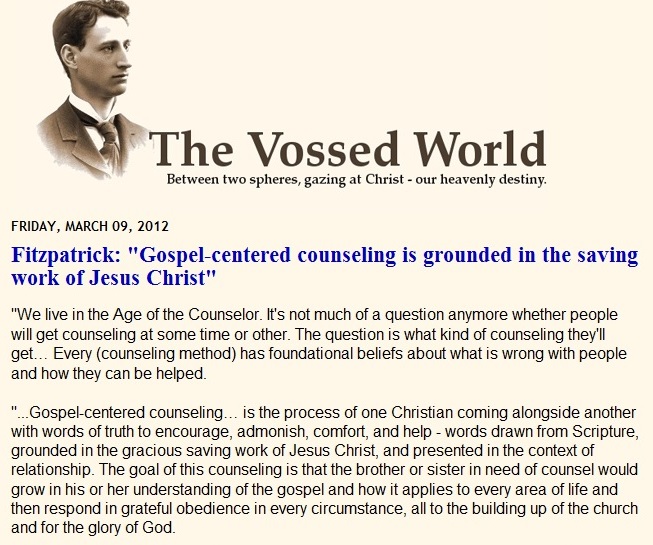
What could be clearer? We, in and of ourselves as born again believers, do not change, we manifest one realm or the other, and anything more than that is “legalism.” This is what is often meant by the New Calvinist slogan, “between two realms, “ or “between two worlds,” or “between two spheres.” In fact, I couldn’t remember one of the exact phrases, so I went to a New Calvinist blog to check, and behold, there was a newly posted article by New Calvinist Elyse Fitzgerald that states exactly what I have said here about gospel contemplationism. The following screen shot encompasses all of my thoughts on this one point:
These New Calvinists are exactly the same as the imposters before them. As one author said of the 4th century heretic Arius:
More important, the unfavorable ruling of the council provoked Arius to alter his strategy in a significant way. Without actually modifying his views, he worked hard to refine his language to make himself sound as orthodox as possible. He insisted that he had been misunderstood and misrepresented. He continued to profess his adherence to all the major creeds and apostolic doctrinal formulae. He even occasionally claimed that he had no major disagreement with the Nicene Council’s position. The actual difference between them was very slight, he insisted.
This reminds me of a written response by Dr. Albert Mohler in which he ignored all of my specific concerns, said he didn’t know anybody that believed what I was stating, and made a general statement about holding to all of the beliefs contained in the Southern Baptist Convention’s statement of faith. Which is a lie, and you can quote me on that.
There is no doubt that all of salvation is of God. But there is something very evident about God that he makes clear in his word. He delights in colaboring with his children. We can see this in the creation account and in specific statements throughout the New Testament (1Cor.3:9, 1Thess.3:2, 2Cor.6:1). God delighted in letting Adam name the animals, and it was really Adam that named them. And it is really us doing the work in sanctification. For crying out loud, we will even be rewarded for our work! Words mean things, and Christ knows how to communicate with His created beings. When He will say, “Well done faithful servant,” He didn’t mean to say that we really won’t be doing what was “well done.” A beautiful picture of how we colabor with our Savior can be seen in John 14:12-16. Christ said He was going away to the Father so that He could do greater works, or us? We are here working in greater numbers, but the Lord said He would be with the Father so that if we asked anything in His name, He would do it to glorify the Father. He also said to love Him by keeping His commandments, and in the NEXT sentence, Christ said he would send us a “HELPER.” What’s a “helper”? Get it? He “helps” us. If Christ does it all, why do we need help? Our efforts and the Holy Spirit’s help is seamless. It’s not either/or. This can be seen throughout the Scriptures: “The fruit of the Spirit is…. self –control.” Who is doing the controlling? Answer: self (that would be you). Who’s fruit? Answer: the Holy Spirit. We are to “pursue” the Holy Spirit’s fruit, but if we don’t pursue—no fruit. And no reward. And no blessings. RC Sproul said it best before he was afflicted with New Calvinist dementia:
Sanctification is cooperative. There are two partners involved in the work. I must work and God will work. If ever the extra-biblical maxim, “God helps those who help themselves,” had any truth, it is at this point. We are not called to sit back and let God do all the work. We are called to work, and to work hard. To work something out with fear and trembling is to work with devout and conscientious rigor. It is to work with care, with a profound concern with the end result (Pleasing God p. 227).
The only time we work in a way that displeases God is when we work according to arrogant ideas that do not align with God’s word, like the New Calvinesque woman who said that Mary was blessed because she gave birth to the Savior. Did anybody know the personhood of Christ better than Mary? Yet, Christ rebuked the woman publicly and said that it was the ones who hear His commands and obey that are blessed (Lk. 11:27). In 2Samuel chapter 7, king David assumed that it wasn’t right that he lived in a palace and God dwelled in a tent. God rebuked him, and for all practical purposes asked him where he found such an idea in the Scriptures. Likewise, New Calvinists assume that anything we do in sanctification is a slight against God getting all the glory. God is the judge of what gives Him glory, not man.
The apostle Paul’s counsel
So what would the apostle Paul say about all of this? Well, do depressed people need “peace”? Say yes. They need it in the worst way. In Philippians 4:9, Paul wrote the following:
What you have learned and received and heard and seen in me—practice these things, and the God of peace will be with you.
That’s what you call a promise. And trust me, if God is with you, all is well. And Paul makes it a point to state that he is the God of “peace.” But the promise is contingent on what? Answer: doing our part, and doing it the right way. What we have “learned,” and “received,” and “heard,” and “seen,” implies more than the gospel and what Christ did to save us. If that’s what Paul wanted to say, he would have simply stated it. Prior to this statement in verse 9, Paul said that the pathway to “peace” is putting off worry and replacing it with specific prayer (verse 6), and right thinking (verse 8), and right doing (verse 9).
Christ promised the same thing in the conclusion of the Sermon on the Mount. A house built on a rock hears the word of God and “puts it into practice” with the Holy Spirit’s help. And remember, Christ said that the Spirit would help, that’s a promise also.
New Calvinists are the servants of the Quietist Grinch that steals hope. They are clouds without water. They serve a false God that supposedly only wants to be gazed upon rather than obeyed as Lord. Be not deceived. Chooses life instead. Choose hope.
paul
An Open Letter to the President of the National Association of Nouthetic Counselors
“This is the apostle Paul’s disparaged 3-verse system to fix a lack of peace. It is the wonderful hope that obedience to God’s word seizes upon His promises. And that’s why many NANC counselors strip their victims of hope.”
“The cited letter reflects the same things often taught by many board members of NANC and BCC. Because this doctrine combines justification and sanctification, it makes sanctification like a minefield because what we do in sanctification can affect the justification that supposedly powers it. This does not lay a healthy foundation for counseling”
Dr. Street,
The National Association of Nouthetic Counselors website states the following about your organization:
NANC exists to help pastors and those who would be ministers of the Word of God by providing help and encouragement. NANC is first and foremost a certifying organization. The certifying process is rigorous but attainable by even the busiest pastor. The process consists of the completion of an approved training course, the completion of a theological and a practical counseling test, several references, and a minimum of 50 hours of supervised counseling experience.
Furthermore, your organization refers hundreds of “counselors” certified by your organization. The purpose of this letter is to publically confront you in regard to the fact that NANC has board members, Fellows, and hoards of certified counselors who openly promote a blatant false gospel. I will first establish this fact, in case you are not aware of it, and then beseech you to tell me why this acceptable.
Much data could be provided as I have been sent several articles written by NANC Fellows that contain outrageous teachings; and apparently, NANC thinks nothing of sending troubled people to antinomian mystics. But I only need to quote one of your present board members, David Powlison. Powlison performed a lecture at John Piper’s church while Piper was on a sabbatical to eradicate “several species of heart idols” that he saw in his heart. Apparently, they were of the 8-month type because he was able to return to ministry at the pre-appointed time. Powlison stated the following at Piper’s church:
This might be quite a controversy, but I think it’s worth putting in. Adams had a tendency to make the cross be for conversion. And the Holy Spirit was for sanctification. And actually even came out and attacked my mentor, Jack Miller, my pastor that I’ve been speaking of through the day, for saying that Christians should preach the gospel to themselves. I think Jay was wrong on that.
Jack Miller was the father of Sonship Theology, a false gospel that is presently wreaking havoc on Presbyterian churches. It has also been known as Gospel Sanctification and is the primary catalyst for the present-day New Calvinist movement which has turned orthodoxy completely upside down. The doctrine is best explained by a theological journal that was its source:
Unless sanctification is rooted in justification and constantly returns to justification, it cannot escape the poisonous miasma of subjectivism, moralism or Pharisaism…. Since the life of holiness is fueled and fired by justification by faith, sanctification must constantly return to justification. Otherwise, the Christian cannot possibly escape arriving at a new self-righteousness. We cannot reach a point in sanctification where our fellowship with God does not rest completely on forgiveness of sins…. Christian existence is gospel existence. Sanctification is justification in action.
Miller adopted the theology and coined the phrase, “We must preach the gospel to ourselves every day.” “The same gospel that saved us also sanctifies us” is the New Calvinist mantra of our day. I receive many links to articles written by NANC Fellows who clearly hold to this doctrine. In fact, How People Change, written by Timothy Lane and Paul David Tripp (and based on Powlison’s Dynamics of Biblical Change) is a Sonship/Gospel Sanctification treatise. Tripp and Lane are also on the board of the upstart Biblical Counseling Coalition. That board is the who’s who of Sonship/GS/ NC, including hyper-antinomian Elyse Fitzpatrick.
On a church level, here is the fruit of this doctrine:
To the Ruling Elders of Southwood:
On September 4, 2011, our daughter and her family from Atlanta were here and we attended the Sunday worship at Southwood. After the service, our 13 year old granddaughter, who is well grounded in scripture, stated that she was very confused by the message. She had come away hearing that every good thing she does is wrong. Why would she believe that? We have gone back and listened again to that message, entitled “Duh,” and here is what we found:
The message is from Galatians 3:1-6. Paul is chastening the church for falling prey to the persuasion of the Judaizers, exhorting them again that God’s love for them was not by any of their own works but through the miraculous work of Christ and the Holy Spirit. Jean seems to take the written word beyond its intent. He subtly changes ‘God’s love’ to ‘God’s favor.’ He changes legalism to performance. He takes Jewish law and extends it to almost any action one does. Here are some paraphrased quotes from the sermon. “To keep God’s favor, the Galatians were believing they needed Christ and a dash of obedience which looks like those things called Christian disciplines. Christian walk Christianity is from the Devil. Faithfulness is feeling condemned for work you haven’t finished (as contrasted with faith: resting completely in Christ). Faith is a litmus test for teachers and leaders; the difference between faith in Christ alone and faithfulness is like the difference between truth and falsehood, between Heaven and Hell. Faith alone is all we will teach.” (Here Jean says this is what Paul is teaching but he gives no supporting scriptures to support his interpretation.) “Discern as false any book, sermon, or Bible study where you hear a dash of self justifying obedience. Self justifying obedience is from Satan.
Jean’s statements, combined with the tone and inflections in his delivery, imply that he is scornful of Christian disciplines, preachers, Christian writers, the Christian walk, obedience, faithfulness, good works, and an individual’s efforts. This message can lead to the conclusion that everything we do is evil and, by extension, that God and the Holy Spirit can do nothing through us. The message lacks balance and leaves sanctification out of the equation. A new believer under this teaching would be moribund after accepting Christ, hidebound in fear that he can do nothing right. While it is true none of us have all pure motives, it is also true that God commands us to go forward and that the Holy Spirit will be with us. God says we are His instruments for spreading the Truth. We cannot do this if we are strapped by guilt; we can do this if we seek partnership with the Holy Spirit.
From here Jean goes back to Paul saying “…since you were 100% depraved when you were brought into the Kingdom by the Holy spirit and by no works of your own, why are you trying to be perfected by your own human efforts? You are being deceived by the Devil.” I believe Jean is paralleling Paul in this. Jean then goes on to “We are like alcoholics ; we use Bible study, prayers, small groups, etc. as a crutch and the church rewards our ‘addiction’ with its approval. How would you know if you were addicted? Stop everything. If you feel anxiety, then you are afraid of leaving your ‘fix.’” So we ask: what does God have us do? Jean’s answer is “rest totally in Jesus.” So in turn we ask, what does Scripture say about resting totally in Jesus? But we hear no clear answer from the pulpit.
The cited letter reflects the same things often taught by many board members of NANC and BCC. Because this doctrine combines justification and sanctification, it makes sanctification like a minefield because what we do in sanctification can affect the justification that supposedly powers it. This does not lay a healthy foundation for counseling, and as Timothy F. Kauffman recently stated in the Trinity Review, when justification and sanctification are combined, anything we do in sanctification is works salvation—even doing nothing. It’s eerily reminiscent of Christ’s parable concerning the slothful servant. When such a parable is considered and compared to statements by Elyse Fitzpatrick and her spiritual big brother Tullian Tchividjian, it should make the hair stand up on a deceased person.
Moreover, the unfortunate results of counseling that comes from this doctrine can be seen in the following statement by a pastor who oversees a NANC counseling center:
We read this quote from Paul Tripp in last week’s Biblical Theology Study Center. Amazingly, part of the quote was used again the following evening during testimony time from someone not in our class…someone who resonated with the quote in the midst of personal crisis. For those who are involved in biblical counseling, it can be really easy (and tempting) for the Bible to become little more than a 12-verse system designed to fix a life. Tripp reminds us that the Bible isn’t a how-to manual, but a place where we find hope in a Person.
Compare that statement with what the apostle Paul said:
Do not be anxious about anything, but in every situation, by prayer and petition, with thanksgiving, present your requests to God. And the peace of God, which transcends all understanding, will guard your hearts and your minds in Christ Jesus.
Finally, brothers and sisters, whatever is true, whatever is noble, whatever is right, whatever is pure, whatever is lovely, whatever is admirable—if anything is excellent or praiseworthy—think about such things. Whatever you have learned or received or heard from me, or seen in me—put it into practice. And the God of peace will be with you.
This is the apostle Paul’s disparaged 3-verse system to fix a lack of peace. It is the wonderful hope that obedience to God’s word seizes upon His promises. And that’s why many NANC counselors strip their victims of hope. That, and confusing children who love the Lord.
So tell me Dr. Street, why is this acceptable? Why not come out from among them? Besides, the evidence that this doctrine was concocted by a Seventh-Day Adventist who is now an atheist is overwhelming. The truth will come out, and will eventually be accepted as truth. Why stick around and look stupid? Or, you could fix the problem. I beseech you Dr. Street, stop sending troubled people to false teachers. This is something that none of us want on our resume.
Paul Dohse
Biblical Counseling as Cover-up: Professional Courtesy Among Reformed Pastors is Epidemic
“Why do sharks refuse to eat attorneys? ‘I don’t know, tell me.’ Professional courtesy.”
Doctors, lawyers, and especially policeman (the blue wall of silence) are often known to stick together. Such professional courtesy should not be known among God’s chosen men, but the New Calvinist movement threatens to take such courtesy to new heights not even known among professional pagans. Such professional courtesy enabled Jack Hyles to remain in the pulpit until his death despite behavior that gangsters would even find intolerable. Never before in church history has cowardliness and cronyism seen a greater day among those who call themselves pastors.
The Biblical Counseling Dichotomy
Let there be no doubt about it: biblical counseling for the sheep is different than counseling for the shepherds. Reformed churches, especially New Calvinist churches, have completely integrated a Matthew 18 discipline model into counseling, and without full disclosure. After all, if the sheep knew, they wouldn’t come—this almost obligates them to accept whatever they hear in counseling as gospel (no pun intended). No matter how bad a situation is for a Christian, they are never to turn off their discernment lest they find themselves in worse shape than counseling found them.
Nevertheless, counselees routinely come to a counseling session and are surprised to see one additional elder or two sitting in the room. Tag, counselee is it:
“Hi Bill, I’m sure you know elder John and elder Joe from our church. They are here because the counseling isn’t going very well. Actually, they are here as witnesses because we are placing you under church discipline.”
Bill: “But shouldn’t you have confronted me first before it came to this?”
Counselor: “Bill, I have confronted you about many things in our appointments.”
Bill: “Yes, but I didn’t know that it was in the context of a first step of church discipline!”
Counselor: “Bill, according to Galatians 6:1 and other passages dealing with church discipline, they are both for the purpose of restoring you, so they are the same.”
Bill: “I see. Well, I agree, I have been stubborn in regard to some issues. No need for the discipline, I will follow your instruction on the major point we disagree on.”
Counselor: “Uh, Bill, that’s not exactly how it works. You will be under church discipline until you are released from counseling.”
Five months later:
Bill: “Look, this counseling is going nowhere. I have decided to leave this church and enter into counseling somewhere else.”
Counselor: “I’m afraid that’s unacceptable Bill. You can’t vacate membership here to avoid church discipline. The elders will not find that acceptable.”
Bill: “What are they going to do about it?”
Counselor: “You will be excommunicated and declared an unbeliever before the congregation Bill.”
Notice that “Bill” was not immediately dismissed from the discipline process upon verbal repentance according to Luke 17:4. Not only is this present-day biblical counseling protocol unbiblical, but in most states it is a first degree felony to control any person in any way under threat of financial loss or loss of reputation. Under most State law, it is called “Coercion” under the “Kidnapping” statutes. This type of counseling/discipline is a criminal act, and also unbiblical. Furthermore, in most of these cases, the counselor is looking for a conversion to Gospel Sanctification; that’s why this process is often referred to as “redemptive church discipline.” The counseling will entail a lot of “showing forth of the gospel” without any instruction which over time confuses the counselee. This leads to a stalemate, further steps of discipline, and in many cases, excommunication.
Once a parishioner is under church discipline or excommunicated in Reformed/Neo-Calvinistic circles, professional courtesy is on steroids. Other pastors will not intervene, no matter how grievous the situation. Here is a snippet of the types of pleas this ministry hears from time to time:
“I don’t know what you can do if anything, however, we are contacting anyone possible in an attempt for help. The governmental system of the Presbyterian church, designed to protect us, is now being used as a weapon.”
But the biblical prescription for sinning, abusive pastors is not even taken seriously:
1 Timothy 5:20
But those elders who are sinning you are to reprove before everyone, so that the others may take warning.
When it comes to the sheep—by the letter, and then some. But regarding elders, professional courtesy kicks into high gear. What better example than the present “counseling” of CJ Mahaney by well-known New Calvinists? Mahaney was finally forced to step down from his position as president of Sovereign Grace Ministries because layman took action by erecting websites exposing his significant shortcomings as a leader. He was not confronted by his New Calvinist pals who often wax eloquent about transparency, humbleness, and confession, but with millions on the line in regard to conference revenues from T4G and Resolved, Mahaney is on a New Calvinist sponsored sabbatical to “reflect on his shortcomings.” It is obviously an image rebuilding project. Mahaney is still officially listed as the president of SGM and will still be a part of the “core four” at this year’s T4G conference.
But on the one hand, these pastors will not overstep their supposed bounds to help distressed parishioners in the local church, while on the other hand, a Presbyterian and two Southern Baptists have come to Mahaney’s (a Charismatic) rescue against people he has sinned against!
To put the icing on this sickening hypocrisy, CCEF, who counsels people for $85.00 per hour, does not invoke church discipline on their counselees because they are paying customers!
Damage Control Organizations
Organizations spawned by the Reformed counseling movement such as Peacekeepers International and G.R.A.C.E are clearly damage control organizations paid for by the laity to protect pastors and church organizations. A point in case is a situation that I have firsthand knowledge of involving Peacekeepers International. A parishioner was brought up on church discipline that was obviously bogus, and Peacekeepers was asked to intervene by a well-known pastor in biblical counseling circles. Peacekeepers declined because according to them, they only enter into mediation between Christians, and since said individual was under church discipline and declared an unbeliever, it was technically not a matter between Christians. Words cannot describe how lame this excuse is as a ploy to avoid mediating the cause of a wronged believer against elders.
Yet another case is the involvement of G.R.A.C.E in the Bangladesh Missionary Kids affair. Here is what I wrote concerning that situation in another post:
If the ABWE Former Missionary Children (Hereafter FMC, not “MKs”) put some stock in GRACE, the parachurch organization that “teaches” the Christian community how to deal with child abuse in a “Godly” way, then so will I, but not totally. I have some concerns…. That brings me to the latest “investigation update” by GRACE concerning the ABWE horror story. It begins as follows:

First phase? How many phases are there going to be? Why is more than one phase needed? The document, throughout, invokes all kinds of questions of this sort. And, “GRACE plans to schedule additional interviews….” Why do they have to “plan” to schedule? Is it really that complicated? Once again, the FMC are waiting for somebody “important” to do something. My grandmother had a word for it and often scolded us with it: “lollygagging.”
The report continued….

Huh? GRACE “hoped” to gather information? The document is full of tentative, overcautious language. The interviews succeeded in “beginning” to “help” “build” (how big is the building going to be and how long is it going to take to build it?) an understanding? For crying out loud, the FMC have already built the case with all kinds of documentation! The job is more than half done! And GRACE’s proclamation that God put his stamp of approval on it all regarding their interviews is just classic, and arrogant. But I will again mention that where GRACE will hopefully have some value is in their final ”thorough,” “balanced,” “independent” report; if it gets completed before the second coming. And we certainly don’t want any victims muddying up the waters with their own assessment of getting molested by the ABWE icon, Donn Ketcham—that just wouldn’t be “independent” and “balanced.”
Then, GRACE concluded the snail race report with the news that they are expanding the investigation to “non-MKs” in addition to the FMC they presently don’t have time to interview. Good grief! In addition, they are going to spend time singing Pat a Cake, Pat a Cake, with a “new” ABWE “liaison” regarding ABWE’s lack of cooperation with full disclosure—unlike Penn State which has committed to full disclosure—day one.
In my estimation, G.R.AC.E is simply going to counsel this situation to death until it goes away. This is nothing more than damage control. It reminds me of a big-name church leader who responded to a molestation victim regarding her insistence that her attacker be removed from the ministry in his denomination: “ What do you want me to do, shoot him?”
I would say, “No, we want you to practice 1Timothy 5:20. We want you to take some of your book royalties, buy a ticket, get on a jet Saturday night, go to his church the next morning, wait till he is into his sermon for about ten minutes, then get up, walk down the aisle, and rebuke him in front of the congregation. Somehow, that is more radical than molestation.
paul

 Paul's Passing Thoughts
2 comments