Albert Mohler Has the Audacity to Lament Bible Illiteracy
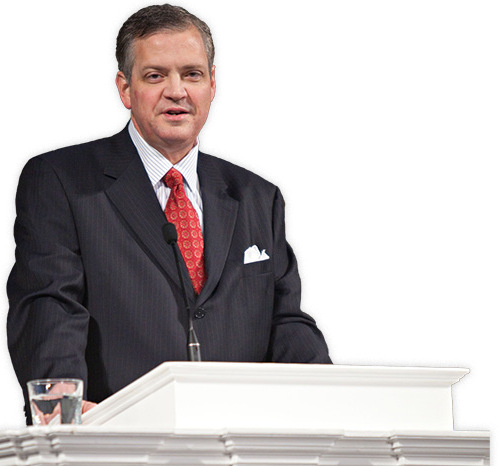 In an article written by Albert Mohler, President of The Southern Baptist Theological Seminary in Louisville, Kentucky and posted on Christian Headlines.com, he bemoans Bible illiteracy among Christians. It begs the question: is he really this blinded by orthodoxy, or is he just gaming the herd?
You can read the article for yourself which chronicles examples of how bad it is, but I think it’s common knowledge for the most part, no pun intended. Even among Christians that are regarded as knowledgeable, including those with university degrees from religious institutions, they know little that is beneficial. Orthodox Christianity is the blind leading the blind and always will be.
First of all, his bemoaning defies the very major tenets of the Protestantism that he claims to represent as a leading authority. Protestantism is predicated on a loathing of human reason and a faith exemplified by blind trust in those whom God has supposedly “appointed to save His people from ignorance”; this according to Mohler at a 2011 pastors conference (mark 1:14:00). This same mentality came from the Catholic Church that gave birth to the Reformers and believes that Bibles in the hands of the great unwashed is like a loaded gun held by a toddler.
Secondly, Mohler’s admission that Protestantism at large is biblically illiterate is a stunning admission and revelation regarding his real belief in the herd’s aptitude. If a vampire is a pastor and says he advocates daylight saving time, that is apparently good enough for the herd, and raises no questions in their minds whatsoever. Mohler knows he can get away with verbalizing these metaphysical absurdities. Al Mohler is a leading figure in the evangelical industrial complex that makes billions of dollars from the massive distribution of Christian teachings via books, church events, conferences, the internet, printed media, recorded media, movies, and radio. How could Christians possibly be biblically illiterate? This is proof positive that content is indeed the issue. REAL knowledge empowers people and would threaten the authority of the Protestant church. The harlot that gave birth to Protestantism merely outlawed knowledge; Protestant leaders have to skin the cat another way because people started printing Bibles upon pain of death.
Go to any Catholic Church, the parishioners don’t have any Bibles with them. Go to any Protestant church and watch the people carefully during the sermon; they refer to their Bibles little if there is any need to open them at all. The general mentality is that they are not qualified to understand it anyway. In fact, there is no reasonable difference between Catholic ex cathedra and elder authority according to the likes of Mohler himself and the Protestant hierarchy in general.
Lastly, Mohler has the audacity to suggest that lack of knowledge is the issue when Protestant academia denies that the Bible is for the express purpose of knowledge to begin with. Pastors continually fustigate those who read the Bible to gain knowledge because “Jesus is a person, not a precept.” Simply stated from a true Protestant perspective, the Bible is a metaphysical narrative about salvation and EVERY verse is about the gospel/justification/salvation. Few parishioners deem themselves as able to see Jesus in every verse, so they merely close their Bibles and listen.
Mohler calls Biblical illiteracy a “scandal.” And why not? After all, a popular mantra in today’s Protestant church refers to their faith as a “scandalous gospel.” And what is the scandal? That God would save sinners and fill His church full of them. But alas, our temptation is to think that we can actually do a good work, and the primary purpose of the Bible is to keep us grounded in faith which seeks to see ourselves more and more for the sinners that we are which results in a deeper and deeper gratitude for our salvation. That’s why every verse in the Bible is supposedly about salvation.
So what knowledge is Al Mohler talking about exactly? With all things Protestant, it depends on what the definition of “is” is.
paul
Identity
 TANC Ministries is presently working on a book project leading up to our 2016 conference in August. I guess my name will be on the book as the author, but the book is really a group project. Maybe the author should be “TANC Ministries.”
Why this project? I will cite some excerpts from the project objective:
“Those who are disillusioned with Christianity, but haven’t given up on God and are looking for answers, often ask, ‘Where do I start?’ Such people who come to PPT, and are overwhelmed by the mass of information often ask, ‘Where is the best place to start?’ Andy Young recently remarked about the multiple layers of misinformation and the question of where this ministry should start with people on our end of the question…The target audience are those looking for real and truthful answers amongst the confusion; they are those trying to make sense out of life in the confusion of Christianity as we know it in our day. The book will have a theological and philosophical bent. Protestants and Catholics alike are dumbed-down by design, think that the Reformation was a theological debate, are confused about basic elements of metaphysics and being, and need a place to start on their truth journey. Those who buy the book will have this in common: they assume reason is a necessary pathway to finding truth.”
At first, it looked like the project was off to a fast start, but what seemed like great ideas were shot down by the group, so it was suggested that I start submitting free-writing articles to the group based on the usual ministry themes, and this will result in an articulation of objectives that the group agrees with. This article is one such submission to the group.
I am not crazy about Facebook, but on the other hand, it is valuable to our ministry, and yesterday was no exception. I am not going to copy and paste the whole debate here between myself and a couple of Catholics, but I am very tempted to think that it will be the crux of our project. The excerpt that encapsulates the main point follows:
“You act as if the Pope speaking ex cathedra or the council of Bishops as an authority of truth is so absurd. I understand that you disagree with it, and you are entitled to the right to disagree. But the concept in and of itself is certainly not absurd. I have to say, if it comes down to which is less absurd, a church authority instituted by Christ is much more plausible than Jesus giving us a Bible and telling everyone they can discern truth completely (error free) by themselves. (Not saying we are completely void of discerning truth, but we will never be perfect at it). Look around you: if everyone could perfectly discern truth for themselves, then why do non-catholic churches continue to split up each and every day? I think there are like over 30,000 denominations now? We are not trying to attack you, Paul M. Dohse Sr. We are just trying to get to the truth. And I have felt misrepresented by your points, so I have to ask the tough questions.”
To me, this absolutely says it all; perhaps the project group will agree. It boils down to man’s (mankind) identity and his ability to interpret reality. Universally, the goal is man’s well-being. Is the key to well-being a proper identity? What does man’s identity have to do with evaluating truth? EVERYTHING. Suppose you identify man as a being that cannot know truth? I think that makes the point.
Now, this necessarily involves a discussion about philosophy and its four major tenets: metaphysics (state of being), epistemology (how we know), ethics (the moral application of how we perceive reality), and politics (how the ethics are communicated). But what about the Bible? From my own perspective, I see the Bible as God’s philosophical statement to mankind. If you are able to defend God’s truth, or the Gospel, you must know what the Bible states about these four tenets of philosophy. No? Really? Consider the following fact: this stream of conversation on Facebook was extremely long, and complete with Scripture stacking and citation wars, but to no avail. Why? Because truth is interpreted through the philosophical prism. A Chinese person might as well be attempting to convince an English person that Chinese is better (anything Chinese) while arguing in their perspective languages. The example that astounds me the most follows: people who seek counsel and assume the counselor shares their view of reality. No wonder so few people are helped by counseling accordingly. Another example makes its own point because few Christians will even know what I am talking about. Pastors in our day view reality from two different perspectives, redemptive or grammatical, and most parishioners are clueless in regard to where their pastors stand on that issue. They assume they know what the pastor is teaching from the pulpit, but really they are clueless.
What is the philosophy of the person that I was having the discussion with? Metaphysics: man cannot know truth PERFECTLY. Epistemology: “ex cathedra or the council of Bishops as an authority of truth.” Ethics: prevention of chaos. Politics: expected obedience to authority. Words mean things, so lets examine his words carefully. The issue with man, according to this person, is he cannot know truth “perfectly.” That’s key. So then, what is the ethic? Christ has appointed an authority on earth to prevent chaos because no man can know the truth perfectly.
But wait a minute, neither can the men whom Christ appointed as an authority; likewise, they cannot know the truth perfectly because they are also men, so what gives? This is what gives: authority for the sake of UNITY is the goal, not truth per se. In fact, UNITY defines truth itself. And where does that come from? Yep, P-l-a-t-o. Among most of the classic sophists, unity itself was truth. At least in Plato’s case, this was the definition of social justice as well. Does that ring any bells in regard to churchianity, or Western society in general? Let me further the point. What was this person’s primary argument for the authority of the Catholic Church? Right, to prevent the chaos of “30,000 denominations” the inevitable result of men being free to discern truth for themselves.
But it gets better when one considers biblical metaphysics. Again, via this person’s own words, the issue is INDIVIDUAL interpretation. But wait a minute, I thought a believer is a totally new creature indwelled by the Holy Spirit? What a minute, I thought the Bible said that the Spirit will lead us in ALL truth. So, why would members of one body with one mind in Christ, and striving for that one mind in Christ be lacking in unity? Why is such a notion “absurd.” Answer: because Catholics and Protestants both fundamentally deny the new birth, that’s why. And consequently, we also hear things from Protestant pastors such as Mark Driscoll saying, “Just keep your damn mouth shut and obey.” As Pastor Chad Bresson is fond of saying, Whether an elder is right or wrong is irrelevant to unity. For those who have the audacity to question an elder, Pastor James MacDonald suggests that they be tied to a catapult and “launched into the next county.” Why are they so passionate about being agreed with? Because obedience to authority is what unifies, not truth—authority is truth.
Moreover, with Believers, “perfection” is not the issue, but LOVE is the issue. Law as condemnation versus law as love is also the difference the new birth makes, but enough said for now. I will see if any of this gets some traction with the project group.
paul
Election and the Real Golden Chain of Salvation: Part 1
Let’s discuss yet another Reformed doctrine; the ordo solutis, or “order of salvation.” This is also known as the “golden chain of salvation” and the proof text is Romans 8:29,30.
For those whom he foreknew he also predestined to be conformed to the image of his Son, in order that he might be the firstborn among many brothers. 30 And those whom he predestined he also called, and those whom he called he also justified, and those whom he justified he also glorified.
It goes something like this: God fore-loved certain individuals and not others. He then predestined them to salvation. He then at some point in time calls them, and then justifies them resulting in glorification. Here is a Reformed illustration below:
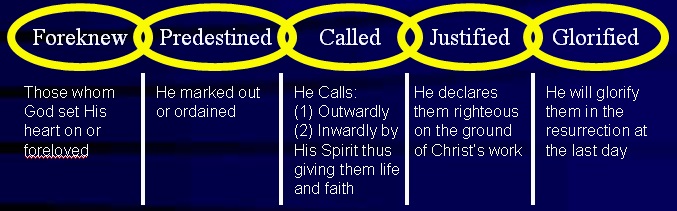
Catholic theologians often object to this take on Romans 8:29,30 because they reject once saved always saved, but they misunderstand, authentic Protestantism does NOT hold to OSAS. More to the point here, the golden chain of salvation is seen as individual, rather than a means of salvation. And that’s what election is: it chooses the means of salvation, and chooses individuals who have roles in the various purposes of salvation. God chose Christ to die on the cross, therefore Christ is elect; He chose the holy angels for certain roles in the salvation process, therefore they are elect; He chose the nation of Israel as part of the process, therefore the nation of Israel is elect, and He chose certain individuals throughout history to contribute to the process of salvation, therefore they are chosen as well to play a part in the means of salvation. That does not mean that they did not have a choice to follow God prior to that choosing for a role in God’s salvific plan. For instance, obviously, God chose the virgin Mary to bear and give birth to Christ as part of the salvation plan. It is also obvious that Mary was saved prior to that choosing. It is obvious that Christ chose the 12 disciples for a role in the slavific plan, but that doesn’t mean they had no choice in choosing God prior to that, hence,
You did not choose me, but I chose you and appointed you so that you might go and bear fruit—fruit that will last—and so that whatever you ask in my name the Father will give you. This is my command: Love each other.
In context, Christ is referring to their election as apostles, not some inability to choose God. As we shall see in the future parts, the REAL golden chain of salvation is a mode of salvation and those used by God to execute it, not a golden chain of salvation that pertains to individual salvation through determinism. Let me now make a beginning case for your consideration. Let me create some reasonable doubt in regard to the Reformed ordo solutis.
First, if you will note once again the Reformed illustration posted in this first part, it illustrates a past tense that preludes present continuous action. This, of course, is necessary for a deterministic conclusion. However, if you carefully examine Romans 8:29,30 it is strictly past tense. Paul is speaking of something that has already taken place. Any other conclusion is presumptuous at best. Paul is writing about something that has been established in the past, or a group of people who have already been glorified. This clearly casts reasonable doubt on the ordo solutis.
Secondly, the ordo solutis would indicate that all of those who are called are also justified, or saved. This is clearly not the case.
Matthew 22:1 – And again Jesus spoke to them in parables, saying, 2 “The kingdom of heaven may be compared to a king who gave a wedding feast for his son, 3 and sent his servants to call those who were invited to the wedding feast, but they would not come. 4 Again he sent other servants, saying, ‘Tell those who are invited, “See, I have prepared my dinner, my oxen and my fat calves have been slaughtered, and everything is ready. Come to the wedding feast.”’ 5 But they paid no attention and went off, one to his farm, another to his business, 6 while the rest seized his servants,treated them shamefully, and killed them. 7 The king was angry, and he sent his troops and destroyed those murderers and burned their city. 8 Then he said to his servants, ‘The wedding feast is ready, but those invited were not worthy. 9 Go therefore to the main roads and invite to the wedding feast as many as you find.’10 And those servants went out into the roads and gathered all whom they found, both bad and good. So the wedding hall was filled with guests.11 “But when the king came in to look at the guests, he saw there a man who had no wedding garment. 12 And he said to him, ‘Friend, how did you get in here without a wedding garment?’ And he was speechless. 13 Then the king said to the attendants, ‘Bind him hand and foot and cast him into the outer darkness. In that place there will be weeping and gnashing of teeth.’ 14 For many are called, but few are chosen.”
In this passage, the “called” are defined: the called are all peoples who are invited to believe in the gospel of the kingdom, and those who except the invitation are of the elect group. Not all of the called are elect. This throws a very large monkey wrench into the Reformed golden chain/order of salvation. Hence, John Calvin came up with three categories of individual preselection: the non-elect; the called; or those temperately chosen/illumined/born again, and those who persevere; or those who are both called and elected in the final analysis. Therefore, assurance of salvation is absolutely impossible in context of the ordo solutis. NO ONE can really know for certain that they are saved until they are “manifested” in the “final tribunal” where “final justification” is determined.
Yet, the apostle John wrote an epistle so that we may “know” presently that we are born again (1John 5:13). The Reformed order of salvation seems apparent based on its deterministic presuppositions, but further investigation is needed.
paul



 Paul's Passing Thoughts
5 comments