The Potter’s House: Our Justification Crisis, Perseverance, and Assurance: Part 1


Tonight we will be looking at the present justification crisis, perseverance, and assurance. The relationship between these three is causing much confusion in our day. This is another topical subject related to our Romans study as we have been fluctuating between specific verses in Romans and topics related to Romans. We will look at the crisis tonight, introduce perseverance, and address the remainder of perseverance and assurance next week. Then the following week is our annual conference.
First, the crisis.
Those who love God simply want to know the truth; they want wisdom; they want to know the way; they want to be at peace with God; they want to please God, and they want to be able to share God with others according to the truth. They want hope; they want to know for certain that they will live with God for eternity. I recently watched a disturbing video that was a Q and A excerpt from the 2010 “Shepherds” Conference hosted by Dr. John MacArthur’s church. In light of the supposed Calvinistic view of election, an attendee asked what should be said to people when we evangelize. MacArthur’s answer was somewhat snarky; in essence, “Tell them what the Bible says, duh!” MacArthur then went on to explain that the Bible was full of paradoxes and tensions that couldn’t be understood. Therefore, just obey Scripture and leave all of the logic to God. In essence, understanding is none of our business. Dr. Michael Horton seems to parrot the same idea by stating that the law “gives us something to do.” It would seem that the totally depraved Christian masses need something to keep them focused while God does whatever He is going to do despite ourselves.
Let me just pause here a moment and clarify “supposed” in regard to Calvinists believing in election. Election should give Christians complete confidence that they are going to heaven which is the headquarters for His Tabernacle Project. Chew on that awhile; heaven is not our eternal dwelling place, that’s a Protestant fairytale, to name just one among many others. More would be done for God in the here and now if we understood that it is preparation for much bigger tasks that we will be doing for God in the future. The apostle Paul said that whether here in our present bodies, or present with the lord, we make it our “goal” to please Him. What! In heaven we will have a “goal” to please God? Woe! Perhaps we are not getting the whole story about our future with God. Perhaps our future with God is a lot more definitive than we have been taught. And does this affect our present service for God. Absolutely. Lack of information never facilitates action. Never.
Granted, election is a mystery. But what is important is that election and justification go hand in hand. Romans 8:29,30 makes that clear. Our justification was sealed before the foundation of the world. Our justification was before time, as in, space of time. That’s why in those verses we were also considered glorified. Now look, there are a lot of theories on election, and I don’t care which one who hold to just so you agree with me that our salvation was settled before time, and if we were justified before we were born, we can’t do anything to mess that up.
Unless you’re a Calvinist. If you’re a Calvinist, you can mess that up by unwittingly doing something in sanctification that is a “work” and thereby making sanctification the “ground of your justification.” Reformed elders are the experts in regard to what is a work in sanctification and what isn’t a work in sanctification. Be sure of this: the crux of Calvinism is the following: “We can’t know anything for certain so your best shot at heaven is listening to God’s anointed who save us from ignorance as much as that can be done. Though they don’t claim to know anything for certain either, they have been given the keys to the kingdom and have the authority to declare us unbelieving. They can’t give us assurance of our salvation, because living by faith alone in sanctification is very tricky business, but they can declare the contrary. Be a good Calvinist, keep your mouth shut, obey the elders, and hope for the best. That’s Calvinism, and I will debate anyone who tries to say otherwise. Words mean things, and I have the black and white of their words in abundance.
Unfortunately, Calvinism must be harped on in our day because this ideology has been ruling the American church since 1995. Its contemporary form was launched in 1970 and grew at a very fast pace, but circa 1995 marked a beginning of dominance culminating in the fact that this movement crosses all denominational lines and is the only option available in many US cities. And its view of justification has profound implications for the Christian—utterly profound. If revival is possible in America, Calvinism must be used as an example to highlight the way to real sanctified life; it must be stripped of its deceptive costume because the case has been well presented—evil and brilliance are not mutually exclusive. The leaven that blinds must be rooted out as learning progresses.
I find my discussions with Susan regarding her material for this year’s conference disturbing. On the one hand, Calvinists, including John MacArthur, proudly claim St. Augustine as the father of Reformation doctrine. On the other hand, Augustine flaunted his Platonism in broad daylight and stated in no uncertain terms that the Bible has no credibility without Plato. Pardon me if I am extremely uncomfortable with a justification formed by a committee of which Plato was a contributor. Moreover, the results speak for themselves.
Although the New Calvinists have dominated the American church for eighteen years now, things are not better, they are worse. John Piper, while announcing his future post-retirement plans from Geneva, stated that wherever the Reformation doctrine has sprung forth, that same geography is saturated with the blessed light of God. Well then, where’s the beef? Socially, there were over 333,000 abortions in America last year. Divorce in the church has surpassed secular statistics and is approaching an astounding 60%. Spiritual abuse blogs, mostly focused on New Calvinist leaders, have exploded in number over the past two years. In the past ten years, at least two organizations have been formed to keep New Calvinist churches out of civil and criminal court. This is all unprecedented. Where’s the beef? And where are the NEW converts associated with real revival? Polls have clearly indicated that new sheep are not coming in; they are merely being relocated and rearranged at the cost of split churches.
Yet, New Calvinists constantly talk as if they have arrived on the scene recently and their “revival” is just now getting into second gear. This is nonsense! They have been in solid control of the American church for at least eighteen years. And please, please, do not miss this: they continue to blame the mess they have created on “evangelical subjectivism.” This is the religious equivalent to the political, “Blame it on Bush.” Don’t miss this either: the problems with evangelicalism to begin with are due to the fact that the Reformers gave birth to them resulting in an overemphasis on salvation to the detriment of sanctification.
I say all of that to say this: when the Australian Forum launched Neo-Calvinism in 1970, they highlighted the idea that the church was in a “justification crisis.” That isn’t true, the church was actually in a sanctification crisis, not a justification crisis. But the reason for its crisis was the root that it came from: the belief that justification and sanctification are the same thing. Hence, getting people saved continued to be the obsession along with a woeful devaluing of discipleship. Basically, New Calvinism offered the full dose of the cancer as a cure.
But this is a very good thing. It is especially good because the theological dream team of the Australian Forum systematized this doctrine in a way that gives it staying power. These guys were right in a wrong way (they absolutely did rediscovery the authentic Reformation gospel), but nevertheless, they had brilliant theological minds coupled with personalities capable of strong persuasion. What this will do, finally, is force the church into revisiting the subject of justification in an in-depth way. It will force the American church to come to grips with their long held mentality regarding justification. And here is the crisis of confusion in our present day: what is the relationship between the two?
Here at the Potter’s House we have looked at that deeply. For instance, how could Christ have come stating that he didn’t come to abolish the law while the apostle Paul stated the exact opposite? We conclude that Christ was speaking of sanctification and Paul was referring to justification. Here is a statement for you: “The law is for those under it and those being sanctified, but not the justified.” Or how about this statement: “The law has a relationship to unregeneration and progressive sanctification, but has no relationship to definitive sanctification and justification.” The first one may incite the following conversation:
But I thought anyone who is justified is sanctified. “That’s absolutely true.” So how can you say the law has no relationship to your justification? “Because I didn’t need the law for my justification, but I need it for my sanctification. In fact, I couldn’t be justified with the law.” Then why do you need it for your sanctification? “Because being justified without the law resulted in being enslaved to the law.” So then, what was your relationship to the law before justification? “It was my enemy.” How so? “Because the desires of the flesh are contrary to the law, and the law provoked sinful desires within me. That doesn’t mean the law is bad, the law is holy, and unfortunately while provoking sinful desires within me, a judgment awaited me by that same law in the future. But now the law is my friend, and instead of provoking me to sin, it provokes me to righteousness. I am not sanctified apart from the law (John 17:17), but I am justified apart from the law (Romans 3:21).” But that verse states that the righteousness of God was MANEFESTED apart from the law. That righteousness is Jesus, not you in regard to justification. “Well, if that righteousness manifested was Jesus, that would teach that His righteousness was manifested apart from the law as well, so what’s your point? My point is that justification is apart from the law. If you look at verse 19 prior, and verse 22 after, the point is a righteousness manifested by faith in Christ alone. That’s my point.”
This brings us to Perseverance. Granted, there are verses in the Bible that seem to say that our salvation is contingent on persevering till the end. I have done a lot of reading on this from the Reformed perspective, and clearly, the belief is that the promise of salvation is “conditional.” Sanctification is a race from which we can be disqualified, but if we aren’t, the prize spoken of in Scripture is salvation. Salvation is the prize for finishing the race. The Reformed refer to this as “already-but-not-yet.” This would eliminate any rewards for obedience and service in sanctification. The reward is salvation itself. So, election (already) qualifies us for the race, but we have to finish in a way that doesn’t disqualify us (not yet). The obvious problem here is, if the focus is staying saved by faith alone, or persevering in our salvation, this keeps us focused on staying saved and not serving! No wonder sanctification is so weak in Protestantism, if salvation is not a done deal, that’s where our focus is going to be if we are smart. In fact, we are warned not to “obey in our own efforts” or “live by do’s and don’ts.” This is all very confusing to say the least.
I want to address one particular passage they cite regarding this:
Matthew 10:21 – Brother will deliver brother over to death, and the father his child, and children will rise against parents and have them put to death, 22 and you will be hated by all for my name’s sake. But the one who endures to the end will be saved. 23 When they persecute you in one town, flee to the next, for truly, I say to you, you will not have gone through all the towns of Israel before the Son of Man comes.
Here is what I want to point out: in this passage, “saved” doesn’t mean “salvation.” This is where I keep saying that eschatology is not “secondary.” Eschatology is gospel. Remembering what we have learned in the past makes it obvious that Christ is giving directions for staying alive during the tribulation period. Verse 23 is the point; if you flee from town to town, you options are not going to run out before my return. The obvious implication is that they will remain alive. This is so very important. If you do not understand eschatology, this passage means our salvation is not a finished work; it means we have to persevere to finish our salvation. This passage also adds much weight to the argument for the millennial kingdom following the tribulation period which begins with the judgment of the nations.
Let’s look at what this all boils down to in the following visual illustrations:
As we have discussed before, sanctification is missing from Romans 8:29,30, but what follows is Paul’s point to what he stated in verses 29 and 30:
31 What then shall we say to these things? If God is for us, who can be against us? 32 He who did not spare his own Son but gave him up for us all, how will he not also with him graciously give us all things? 33 Who shall bring any charge against God’s elect? It is God who justifies. 34 Who is to condemn? Christ Jesus is the one who died—more than that, who was raised—who is at the right hand of God, who indeed is interceding for us. 35 Who shall separate us from the love of Christ? Shall tribulation, or distress, or persecution, or famine, or nakedness, or danger, or sword? 36 As it is written,
“For your sake we are being killed all the day long; we are regarded as sheep to be slaughtered.”
37 No, in all these things we are more than conquerors through him who loved us. 38 For I am sure that neither death nor life, nor angels nor rulers, nor things present nor things to come, nor powers, 39 nor height nor depth, nor anything else in all creation, will be able to separate us from the love of God in Christ Jesus our Lord.
This cannot be deviated from. Paul is stating here that trials cannot separate us from the love of God. Something else is being communicated in passages that seem to say that we are required to persevere in life for some kind of “final justification.” Lord willing, we will take a much closer look at this next week
Law: Calvinism’s Achilles Heel
Request free DVD of this message here: Free Offers Link
 The Potter’s House 6/2/2013: Law’s Relationship to Justification and Sanctification
I think if there has ever been a Dark Age in Christianity we are in it. If you think about it, Christ wasn’t concerned with a bunch of ism’s, He continually warned about the traditions of men. I only now understand how powerful that is. I have been a Christian since 1983, and since then I have been functioning as a Christian on rudimentary information. And often in my life, it has shown. And the following is frightening: I was often considered to be an annoying zealot who dared to proclaim that he knew something.
Contemporary Christianity functions on the traditions of men. When people write me to make a theological case, it is made with a long list of quotations from men. “Orthodoxy” is a word that has become synonymous with truth itself. How can this be when orthodoxy is the creeds, confessions, and catechisms written by men? One advertisement for a Seminary boasts that they are “confessional.” We refer to it as “subordinate truth” to the Bible while we wait with bated breath for its next contemporary addition to be available at the Christian book store. While there, we will often pick up a little plaque or bumper sticker to add to our orthodoxy. “What! What do mean when you say that ‘Footsteps in the Sand’ is not in the Bible? That’s blaspheme!”
Truthfully, even though I have learned more in the past six months than my whole Christian life, I now see that I am really just beginning to learn, this is all new to me and I am rethinking everything. But this I do know: Christians in our culture really struggle with a biblical understanding of law. And here we are, Romans 10:4;
For Christ is the end of the law for righteousness to everyone who believes.
This is what is really difficult for us to understand. I had to learn it on my own with the help of the Holy Spirit. I went to Bible college—they didn’t teach it to me. I went to Seminary—never learned it there either. I have been to countless Bible conferences—ditto. No wonder that John said that we have no need for anyone to teach us; that is a good thing, because apparently, they aren’t going to do that anyway. But here it is:
For the believer, law and righteousness are mutually exclusive. Shock and dismay now equals traditions of men. This verse states that the law had to end in order for us to be declared righteous. The law “ended” “for” righteousness. This is to everyone who believes in Christ—that’s why Paul states that He is the end of the law.
As Christians, we don’t obey the law perfectly. That’s unfortunate, but in regard to our just position and present righteousness—it doesn’t matter. The law can no longer condemn us or judge us. Our salvation is lawless. The law doesn’t exist, so there is no sin (ROM 5:13), and it has nothing that it can say to us (ROM 3:19).
Because the apostle Paul knew that law being a standard for our justification would completely sap our salvation power in sanctification, he drives the point home in many different ways. Let’s start with Christ. Turn to Romans chapter seven and we will begin reading in verse one:
Romans 7:1- Or do you not know, brothers—for I am speaking to those who know the law—that the law is binding on a person only as long as he lives? 2 For a married woman is bound by law to her husband while he lives, but if her husband dies she is released from the law of marriage. 3 Accordingly, she will be called an adulteress if she lives with another man while her husband is alive. But if her husband dies, she is free from that law, and if she marries another man she is not an adulteress.
4 Likewise, my brothers, you also have died to the law through the body of Christ, so that you may belong to another, to him who has been raised from the dead, in order that we may bear fruit for God. 5 For while we were living in the flesh, our sinful passions, aroused by the law, were at work in our members to bear fruit for death. 6 But now we are released from the law, having died to that which held us captive, so that we serve in the new way of the Spirit and not in the old way of the written code.
Who is the spouse that died in this case so that we are no longer under the law? Christ, and we died with Him. We are also the other spouse who was resurrected with Christ and is now free to remarry another so that we can serve in the new way of the Spirit. Christ bore our sin on the cross (imputation) so that we could die with Him and be resurrected with Him in the new way of the Spirit—not the old marriage covenant. The old us died with Christ, and our sin died with Him. The new us is no longer under that covenant—the covenant of the law. If we remarry, that law cannot condemn us. The dead are never prosecuted and brought to court. If a cold case is solved and the suspect is dead, he is not indicted by a grand jury. The dead are not exhumed and brought to court. Do you believe that a perfect keeping of the law is required in your Christian life for your just standing? Then the old you is still alive and you are an adulteress.
Paul explains this another way. The law was a will.
Hebrews 9:15 – Therefore he is the mediator of a new covenant, so that those who are called may receive the promised eternal inheritance, since a death has occurred that redeems them from the transgressions committed under the first covenant. 16 For where a will is involved, the death of the one who made it must be established. 17 For a will takes effect only at death, since it is not in force as long as the one who made it is alive. 18 Therefore not even the first covenant was inaugurated without blood.
The law was a will, and like any other will it promised an inheritance. Like any other will, those named in the will are partakers in that promissory note. And before Christ went to the cross all who believed in Him were heirs of the promise. It was a covenant inaugurated with blood because all of the sins of those who believed on Christ were imputed to that covenant. This is yet another thing that I have never been taught before in regard to the subject of imputation. There is the imputation of the Father’s righteousness to us, the imputation of our sin to Christ, and the imputation of the believer’s sins prior to the cross. Our sins were imputed to that covenant/will with the promise of the inheritance upon the death of the testator, forgiveness of sins and eternal life. I am convinced that Old Testament believers were completely aware of this and understood it. Undoubtedly, this fact also opens up an additional wealth of understanding while reading the Old Testament with this in mind.
Let’s look at this a little deeper. Please go with me to Galatians chapter three and let’s start at verse 19:
Why then the law? It was added because of transgressions, until the offspring should come to whom the promise had been made, and it was put in place through angels by an intermediary. 20 Now an intermediary implies more than one, but God is one.
21 Is the law then contrary to the promises of God? Certainly not! For if a law had been given that could give life, then righteousness would indeed be by the law. 22 But the Scripture imprisoned everything under sin, so that the promise by faith in Jesus Christ might be given to those who believe.
23 Now before faith came, we were held captive under the law, imprisoned until the coming faith would be revealed. 24 So then, the law was our guardian until Christ came, in order that we might be justified by faith. 25 But now that faith has come, we are no longer under a guardian, 26 for in Christ Jesus you are all sons of God, through faith. 27 For as many of you as were baptized into Christ have put on Christ. 28 There is neither Jew nor Greek, there is neither slave nor free, there is no male and female, for you are all one in Christ Jesus. 29 And if you are Christ’s, then you are Abraham’s offspring, heirs according to promise.
Notice that Paul said that sin was imprisoned in the Scriptures. As we have discussed before, the law is the same thing as the Bible. Again, we see that here in verse 22. Many teach in our day that this passage means that the law continually shows us our need for Christ and a perpetual forgiveness. The law is a “schoolmaster” that continually leads us to Christ. That’s not what this passage means at all. Ironically, the ESV has this right: the old covenant was a “guardian” that kept us safe from the eternal consequences of sin until the death of the testator. The full inheritance was received when Christ died. Now the law serves a different purpose which we will look at later.
But herein lays the Achilles heel of the Reformed gospel. Herein lays the reason that Calvin’s gospel is a doctrine of demons. It teaches that Christ fulfilled the law for us so that we could be declared righteous. It teaches that Christ is the end of the law in regard to us keeping it. Hence, there is really no END to the law. But worse yet, let’s compare this reasoning with a few texts in the same vicinity of where we are presently:
Galatians 3:10 – For all who rely on works of the law are under a curse; for it is written, “Cursed be everyone who does not abide by all things written in the Book of the Law, and do them.” 11 Now it is evident that no one is justified before God by the law, for “The righteous shall live by faith.” 12 But the law is not of faith, rather “The one who does them shall live by them.” 13 Christ redeemed us from the curse of the law by becoming a curse for us—for it is written, “Cursed is everyone who is hanged on a tree”— 14 so that in Christ Jesus the blessing of Abraham might come to the Gentiles, so that we might receive the promised Spirit through faith.
15 To give a human example, brothers: even with a man-made covenant, no one annuls it or adds to it once it has been ratified. 16 Now the promises were made to Abraham and to his offspring. It does not say, “And to offsprings,” referring to many, but referring to one, “And to your offspring,” who is Christ. 17 This is what I mean: the law, which came 430 years afterward, does not annul a covenant previously ratified by God, so as to make the promise void. 18 For if the inheritance comes by the law, it no longer comes by promise; but God gave it to Abraham by a promise.
19 Why then the law? It was added because of transgressions, until the offspring should come to whom the promise had been made, and it was put in place through angels by an intermediary. 20 Now an intermediary implies more than one, but God is one.
21 Is the law then contrary to the promises of God? Certainly not! For if a law had been given that could give life, then righteousness would indeed be by the law. 22 But the Scripture imprisoned everything under sin, so that the promise by faith in Jesus Christ might be given to those who believe.
To believe that Christ fulfilled the law for us is to also contradict what our beloved brother has said here in the following ways:
1. It relies on the works of the law; who does the perfect work is not the point. If Christ fulfilled the will perfectly, and we could have received the promised inheritance by His fulfilling of the law, why did He have to die? That’s the Hebrew writer’s point: IT’S A WILL—somebody had to die.
2. The law cannot justify because it is not of faith. It doesn’t matter who keeps it. “The law is not of faith.” If Christ fulfilled the law, that fulfillment makes us righteous and we are then indeed justified by the law. Christ’s perfect obedience is transferred to us and then we are in fact justified by its perfect keeping. By the way, this is exactly what Luther himself propagated. He stated that Christ’s obedience becomes our obedience and that obedience is transferred to us by faith alone. It’s backdoor law-keeping. Said Luther,
Mine are Christ’s living, doing, and speaking, His suffering and dying; mine as much as if I had lived, done, spoken, and suffered, and died as He did . . .(Luther’s Works (Philadelphia: Muhlenberg Press; St. Louis: Concordia Publishing House, 1955), Vol. xxxi, pp.297,298).
This makes an imputation of law-keeping the standard for righteousness. The law is therefore not ENDED. For all practical purposes, we are credited with keeping it for our justification albeit by faith in Christ.
3. Furthermore, if the fulfilling of the law by Christ brings righteousness, that means that the law has life. Note verse 21:
For if a law had been given that could give life, then righteousness would indeed be by the law.
This brings us yet to another way that our brother Paul wants us to get this; OFFSPRING. If the law could give life, there is more than one offspring:
Galatians 3:15 -To give a human example, brothers: even with a man-made covenant, no one annuls it or adds to it once it has been ratified. 16 Now the promises were made to Abraham and to his offspring. It does not say, “And to offsprings,” referring to many, but referring to one, “And to your offspring,” who is Christ. 17 This is what I mean: the law, which came 430 years afterward, does not annul a covenant previously ratified by God, so as to make the promise void. 18 For if the inheritance comes by the law, it no longer comes by promise; but God gave it to Abraham by a promise.
This is also why the promise could not come through Ishmael; it had to come through Isaac because the promise concerned Sarah and not Hagar. Hagar represents the Mt. Sinai law, and Sarah represented the promise:
Galatians 4:21 – Tell me, you who desire to be under the law, do you not listen to the law? 22 For it is written that Abraham had two sons, one by a slave woman and one by a free woman. 23 But the son of the slave was born according to the flesh, while the son of the free woman was born through promise. 24 Now this may be interpreted allegorically: these women are two covenants. One is from Mount Sinai, bearing children for slavery; she is Hagar. 25 Now Hagar is Mount Sinai in Arabia; she corresponds to the present Jerusalem, for she is in slavery with her children. 26 But the Jerusalem above is free, and she is our mother. 27 For it is written,
“Rejoice, O barren one who does not bear; break forth and cry aloud, you who are not in labor! For the children of the desolate one will be more than those of the one who has a husband.”
28 Now you, brothers, like Isaac, are children of promise. 29 But just as at that time he who was born according to the flesh persecuted him who was born according to the Spirit, so also it is now. 30 But what does the Scripture say? “Cast out the slave woman and her son, for the son of the slave woman shall not inherit with the son of the free woman.” 31 So, brothers, we are not children of the slave but of the free woman.
Pray tell, why would Christ come to fulfill a covenant with Hagar so that we could be righteous? Christ is the end of that covenant. He came to ABOLISH it—not to fulfill it:
Ephesians 2:11 – Therefore remember that at one time you Gentiles in the flesh, called “the uncircumcision” by what is called the circumcision, which is made in the flesh by hands— 12 remember that you were at that time separated from Christ, alienated from the commonwealth of Israel and strangers to the covenants of promise, having no hope and without God in the world. 13 But now in Christ Jesus you who once were far off have been brought near by the blood of Christ. 14 For he himself is our peace, who has made us both one and has broken down in his flesh the dividing wall of hostility 15 by abolishing the law of commandments expressed in ordinances, that he might create in himself one new man in place of the two, so making peace, 16 and might reconcile us both to God in one body through the cross, thereby killing the hostility.
“But Paul, what then was Christ talking about in the Sermon on the Mount when He said He didn’t come to abolish the law?” Well, he wasn’t talking about that law, He was talking about the law of love. Same words, different law. Hence:
Galatians 5:1 – For freedom Christ has set us free; stand firm therefore, and do not submit again to a yoke of slavery. 2 Look: I, Paul, say to you that if you accept circumcision, Christ will be of no advantage to you. 3 I testify again to every man who accepts circumcision that he is obligated to keep the whole law. 4 You are severed from Christ, you who would be justified by the law; you have fallen away from grace. 5 For through the Spirit, by faith, we ourselves eagerly wait for the hope of righteousness. 6 For in Christ Jesus neither circumcision nor uncircumcision counts for anything, but only faith working through love.
Now, look at what he says in the very next verse:
Galatians 5:7 – You were running well. Who hindered you from obeying the truth?
So, what are we to conclude? We are to conclude that faith working through love….
1. Works (“working”).
2. Runs.
3. Obeys.
4. Is guided by an objective truth.
5. Defines love as truth (2Thessilonoians 2:10).
6. Can be hindered from obeying the truth.
This gives new meaning to Christ’s words, “If you love me, keep my commandments.” In Matthew 5:18 Christ isn’t talking about the Mosaic Law, He’s talking about the law of love. He didn’t say that our righteousness needed to surpass that of Pharisees as a challenge for us to let Him fulfill the Mosaic Law for us because the Pharisees were really, really good at obeying the Mosaic Law, why would He do that? That’s of Hagar and not Sarah; it’s a law that has no life. He fulfilled that law perfectly by virtue of who He is, but not for the purpose of justifying us because after its inherent fulfillment there is still nothing but the dead letters of that law. His problem with the Pharisees is that they sought righteousness in the law rather than in Him. This is why Paul wrote the following just prior to our text at hand:
Romans 10:1-3 – Brothers, my heart’s desire and prayer to God for them is that they may be saved. 2 For I bear them witness that they have a zeal for God, but not according to knowledge. 3 For, being ignorant of the righteousness of God, and seeking to establish their own, they did not submit to God’s righteousness.
Christ’s indictment against the Pharisees was that they sought the Mosaic Law rather than faith working through love. They put faith in the Mosaic Law instead of Christ (JN 5:39). Said another way: they sought the Mosaic Law rather than the law of love. And since love fulfills the law (GAL 5:14, ROM 13:10, EPH 3:14-21, DUE 6:5, LEV 19:18), that is the righteousness that surpasses the righteousness of the Pharisees. It is a righteousness APART from the law (ROM 3:21).
So in what way did Christ come to fulfill the law of love? Not by fulfilling the Mosaic Law—that is certain. It has no life! He came to fulfill the law of love. I would say His death on the cross would be a description of that. But the idea here is a constant fulfilling of the law. As Susan brilliantly pointed out two Sundays ago, the law is not completely fulfilled because of all of the things in the law that haven’t happened yet. Not only that, all of the references in the Bible that pertain to the fulfilling of the law by single acts of truthful love are in the present tense. If Christ fulfilled the law completely, how is that possible? (GAL 5:14, ROM 13:10, EPH 3:14-21, DUE 6:5, LEV 19:18).
Romans 8:3,4 makes it absolutely clear how Christ is fulfilling the law; He is fulfilling it through us as we walk in love. To say otherwise deprives us of our ability to love Christ and others and creates cold-heartedness in the vacuum. Wherever anti-law of love reins, cold-heartedness makes its abode (PS 119:70, MATT 24:12).
Anyone who uses the imperfect law-keeping of the Christian to prove that the law is still the standard for our justification also proves that they believe in a vicarious law keeping of a law that has no life for our salvation. It teaches salvation on Mt. Sinai rather than salvation at Galgotha. Christ was the end of that law because he put it to death along with the sin that held us captive to it (GAL 3:23). He did not end it by fulfilling it. He abolished it on the cross and raised us to a new life that is sanctified by obedience to the perfect law of liberty. Be careful to note James 1:25 on that. The blessings are in the “doing,” not meditation on Christ’s obedience to the dead letter of the law. The standard for that law is a perfect keeping of every letter (GAL 5:3, ROM 10:5) while the Christian fulfills the whole law perfectly with every act of obedience. We are blameless before Him in love (EPH 1:4).
Our Lord’s yoke is a light one for the impossible demands of Mt. Sinai do not terrorize us. We are free to love God aggressively. We bemoan our sin, but the old us who would be judged by that failure according to justification died with Christ (ROM 7:20), and the new us is under grace and not under law (ROM 6:14). There are relational consequences, but not eternal ones.
This is my prayer for the Potter’s House: as we strive to walk in loving obedience to Christ more and more, that our brother Paul’s prayer would be answered:
Ephesians 1:16 – I do not cease giving thanks for you, while making mention of you in my prayers; 17 that the God of our Lord Jesus Christ, the Father of glory, may give to you a spirit of wisdom and of revelation in the knowledge of Him. 18 I pray that the eyes of your heart may be enlightened, so that you will know what is the hope of His calling, what are the riches of the glory of His inheritance in the saints, 19 and what is the surpassing greatness of His power toward us who believe. These are in accordance with the working of the strength of His might 20 which He brought about in Christ, when He raised Him from the dead and seated Him at His right hand in the heavenly places, 21 far above all rule and authority and power and dominion, and every name that is named, not only in this age but also in the one to come. 22 And He put all things in subjection under His feet, and gave Him as head over all things to the church, 23 which is His body, the fullness of Him who fills all in all.
Now, how does this all relate to the perseverance of the saints? Is our perseverance necessary to confirm or salvation? Does salvation require God’s call and our perseverance? I am going to address this next week because there is much confusion in regard to this subject, and I will tie it in with the issue of assurance—that’s next week.
SGM Case Dismissed: Cross Made Bigger
 As the blogosphere’s newly appointed “rabid anti-Calvinist,” I figured I would weigh in on the dismissal of the SGM lawsuit and live up to my new name by blaming this vile injustice on Calvinism.
It’s not a huge stretch; after all, the former primary defendants are Calvinists, and even in light of the horrific accusations, CJ Mahaney continues to be supported by the Calvinist community at large via speaking engagements, and silence. I understand that Kevin DeYoung, who has been silent on the issue, was quick to announce the dismissal on Twitter. The case also exemplifies the hilarious notion that these are men of the Word. The Bible states that accusations against an elder should only be heard by two or three witnesses; in this case, there were eleven, and on the record. Yet, NO Calvinist anywhere will take note of the accusations. Besides, the Bible states clearly that elders are to be beyond reproach, and CJ is hardly that.
The contemporary Calvinist resurgence movement known as New Calvinism has been getting massive press on its spiritual abuse for about ten years now. How bad is it? There are now two organizations formed for the express purpose of keeping Reformed churches out of court, and paid for by the sheep through donations! I will make this as simple as possible by once again commenting on a popular Neo-Calvinist illustration, published by them—not me:
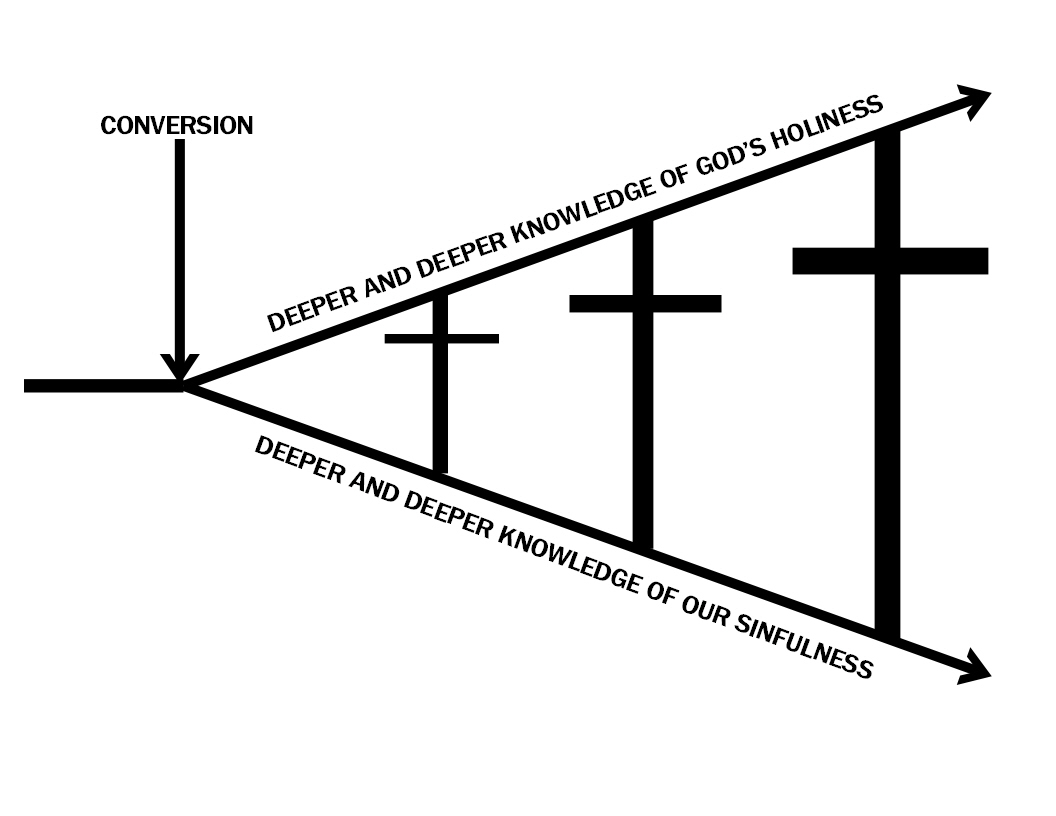
Click on to Enlarge
This illustration is Calvinist epistemology. This is a visual description of Calvin’s first sentence in 1.1.1 of the Calvin Institutes: wisdom is deducted by knowledge of God and man; i.e., the top and bottom trajectories. That makes the cross bigger. That’s a good thing, right? In Luther’s epistemology, this illustration is known as the Theology of the Cross or the Cross Story as opposed to the glory story. Any possible contribution of good by us makes the cross smaller. That’s a bad thing, right?
Now think about this epistemology as set against these horrific abuses. Do I really have to do the math on this? How are people with this worldview going to look at the subject of justice? If we deserve justice, our trajectory goes up and the cross gets smaller. What about the victims? If they were totally innocent in the situation the trajectory again goes up and the cross gets smaller. What about any pure outrage concerning the actions? Why outrage? That’s a deeper knowledge of how evil we are which makes the cross bigger.
And to a Calvinist, that’s a good thing.
paul
American Clergy Brilliance: “The Gospel of Jesus Christ: An Evangelical Celebration”
 “Look, think about this: even an adolescent Sunday school student can see it; if the righteousness of God is revealed apart from the law (Romans 3:21), why would Christ need to keep it for our justification? For crying out loud, what does ‘apart’ mean?”
My theses for this year’s TANC conference highlights the fact that the Reformers taught from a totally different reality than a normative reality that draws logical conclusions from the arrangement of verbs, nouns, prepositions, adjectives, conjunctions, etc. taken at face value. The Reformers created their own metaphysical premise for interpreting reality. The authentic Reformed gospel is predicated on a contra reality.
This is one of four reasons that the authentic Reformed gospel experiences a social death periodically throughout church history, and then periodic resurgence movements like the one we are presently in via New Calvinism. There have been five of these resurgence movements sense Calvin’s theocracy in Geneva. They will be documented in volume two of The Truth About New Calvinism. As Christians read their Bibles, they are naturally drawn away from the authentic Reformed gospel because the human tendency is to interpret reality from the normative perspective. They become uncomfortable with the contradictions.
However, as each resurgence dies a social death, Protestant traditions of men continue to be a significant part of what emerges from the ashes. A Reformed hybrid emerges that apes the anemic sanctification spawned by Reformed thought. This lays the ground work for the resurgences that follow. Protestantism, historically, oscillates between the weak sanctification of the hybrid and the despotic resurgence movements that temporarily replace the hybrid. Basically, the vicious cycle must be stopped if revival is going to be possible. God sanctifies with truth, not the traditions of men.
Part and parcel is a dumbed-down Christianity saturated with the traditions of Reformed men—primarily dead ones. Men of old that are deemed geniuses are often mindless Kool-Aid drinking followers of John Calvin and his ugly stepchildren, the murdering despotic Puritans. Part of the Protestant tradition that carries on is the big “O,” ORTHODOXY. A synonym for “truth” in American churchianity, it is really the repackaging of truth interpreted by the Protestant elite for consumption by the unenlightened masses. The American church follows the tradition of Protestantism when the arrogant, elitist who’s who of evangelicalism come together and publish declarations, i.e., the confessions and creeds of traditional Reformed thought.
A recent example of this is the third edition of The Gospel of Jesus Christ: An Evangelical Celebration (1994, 1997, 1999) signed and/or endorsed by, for example, the following:
John Ankerberg, Kay Arthur, Tony Evans, Jerry Falwell, Bill Hybels, David Jeremiah, D. James Kennedy, Max Lucado, Woodrow Kroll, Tim & Beverly LaHaye, Erwin Lutzer, Bill McCartney, Luis Palau, Pat Robertson, Ronald Sider, Charles Stanley, John Stott, Joseph Stowell, Chuck Swindoll, Bruce Wilkinson, Ravi Zacharias, Jack Hayford, Steven Strang, John MacArthur Jr., RC Sproul, Charles Colson, Bill Bright, and JI Packer.
Only problem is, the document denies the new birth and describes Christians as being under the law as opposed to being under grace. In other words, the authentic gospel of the Reformation. First, the document speaks from the perspective of the authentic Reformed gospel that only recognizes the possibility of a linear gospel, ie., the “golden chain of salvation.” Because sanctification is the links of a chain that stretches from justification to glorification, the links must stay intact by the same gospel that saved us. Hence, grace cannot be inside of the believer because that makes him/her a participant in the completion of justification. Justification is only a finished work if we live among the sanctification links in the same way we were saved—by faith alone.
The Reformers only recognized this reality, and judged all other gospels from the same reality. Grace is either infused within the believer, making him/her a participant in finishing justification, or grace remains completely outside of the believer. The alternative that sanctification is completely separate, a parallel gospel, is not considered to be a possible reality. Accordingly, note the following statement in said GEC document:
We deny that we are justified by the righteousness of Christ infused into us or by any righteousness that is thought to inhere within us.
The Reformers believed that ALL grace and righteousness must remain OUTSIDE of the believer or it by default made him/her a participant in the completion of justification. They got around the mass of prepositions throughout Scripture that clearly state that grace is within us by utilizing the emphasis hermeneutic (the redemptive historical hermeneutic). This hermeneutic is a Gnostic concept derived from Plato’s theory of forms. I will delve into this in detail during my second session at this year’s TANC conference. Granted, many of the signers probably didn’t, and still don’t understand what the Reformers believed, and I believe other signers such as RC Sproul deliberately play on that confusion.
Secondly, the doctrine propagates the Reformed mainstay of Christ’s perfect obedience to the law being imputed to our sanctification so that “sanctification is not the ‘ground’ of our justification.” See the chain thing going on there? Our enablement in sanctification necessarily makes sanctification the GROUND of our justification because sanctification finishes justification. It’s a “chain.” Here is what the document states:
God’s justification of those who trust in him, according to the Gospel, is a decisive transition, here and now, from a state of condemnation and wrath because of their sins to one of acceptance and favor by virtue of Jesus’ flawless obedience culminating in his voluntary sin-bearing death.
And….
We affirm that Christ’s saving work included both his life and his death on our behalf (Gal. 3:13). We declare that faith in the perfect obedience of Christ by which he fulfilled all the demands of the Law of God on our behalf is essential to the Gospel. We deny that our salvation was achieved merely or exclusively by the death of Christ without reference to his life of perfect righteousness.
Look, think about this; even an adolescent Sunday school student can see it: if the righteousness of God is revealed apart from the law (Romans 3:21), why would Christ need to keep it for our justification? For crying out loud, what does ‘apart’ mean? Worse yet is the idea that this perfect obedience is imputed to our sanctification if we live our Christian lives by faith alone because sanctification is a progressive process that finishes justification. James refuted this idea in no certain terms, which is why the Reformers questioned its rightful place in the New Testament canon.
Moreover, this idea keeps Christians “under the law,” which is the biblical designation for the unregenerate. I don’t know much about the theologian William R. Newell, but with that disclaimer, I will say that I agree with his opinion in regard to this issue:
The fatal result of this terrible error is to leave The Law as claimant over those in Christ: for, “Law has dominion over a man as long as he liveth” (7.1). Unless you are able to believe in your very heart that you died with Christ, that your old man was crucified with Him, and that you were buried, and that your history before God in Adam the first came to an utter end at Calvary, you will never get free from the claims of Law upon your conscience (William R. Newell: Verse by Verse Commentary on Romans).
Hence, the law remains a claimant over the believer at any point where he/she stops living their life by faith alone in the same gospel that saved them rather than belief in the new birth followed by the death of the old us that died with Christ and is no longer under the law. We must now fear that our obedience in sanctification is making the law the “ground” of our justification. Likewise, Calvin stated the following:
Another principal part of our reconciliation with God was that man, who had lost himself by his disobedience, should by way of remedy oppose to it obedience, satisfy the justice of God, and pay the penalty of sin.
Editor’s note: For our redemption, Christ kept the Law for us and died upon the Cross. By this, Christ obtained forgiveness of sins for us (Calvin on the Mediator: Chapel Library press, 2009).
This is also known as “vicarious law-keeping.” A definition of vicarious is:
Adjective
Experienced in the imagination through the feelings or actions of another person: “vicarious pleasure.” Acting or done for another: “a vicarious atonement”.
Christians need to stop following men in general, and Reformed men in particular. God only sanctifies with truth, and Reformed doctrine does not save or sanctify accordingly. It calls for a salvation by law-keeping and who keeps it is not the issue. The law as a standard for justification is the issue. It also denies the different relationship of the law to believers as opposed to unbelievers: the law provokes the former to righteousness, and provokes the latter to sin. It skews the very biblical definition of the regenerate.
paul

 Paul's Passing Thoughts
10 comments