Calvinism: The Root of All Evil in the American Church
 Show me the Money.
Why has New Calvinism taken the American church by storm? Because the American church was already primed for it. Before authentic Calvinism was rediscovered by a Seventh-Day Adventist in 1969, America was, and always has been half-pregnant with the Puritan form of Calvin’s Geneva.
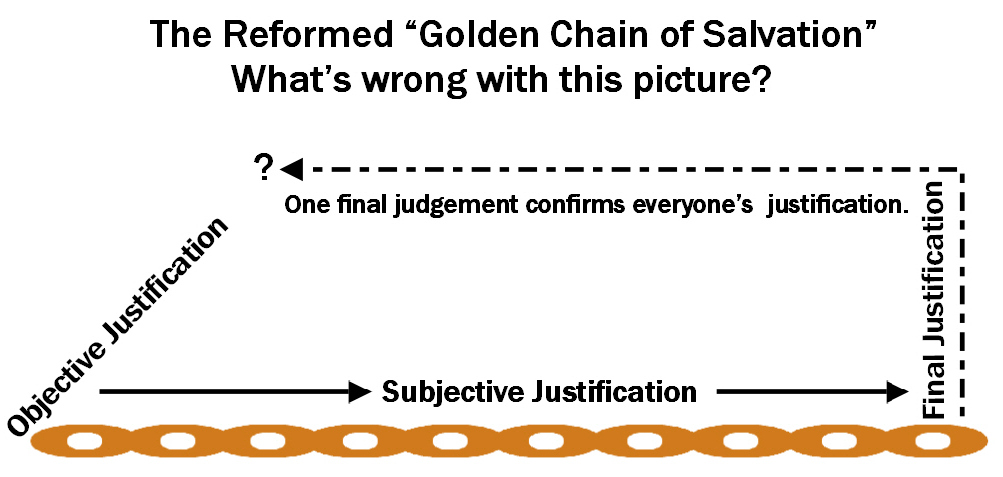
Calvinism makes everything about justification while excluding sanctification for a very simple reason: control. If justification is a finished work, and all that is at stake is eternal rewards in heaven, the church would not be nearly the institution that it is today. Why is there big money in religion? Why is there a church every two miles in America with a 500,000 dollar annual budget? Why did 3,000,000 people show up on a beach to see the new Pope? Why does the Catholic Church have so much power? Because salvation is big business my friend. If salvation is found in an institution, it will all but rule the world.
Plain and simple: the Reformers taught that the same forgiveness for sin that saved you needs to be continually sought out to maintain salvation (justification), and that forgiveness can only be found in the Protestant church. Sola Fide indeed, there is no money in sanctification; the big bucks are in justification. From a worldly perspective, Christ had a horrible business plan:
Go therefore and make disciples of all nations, baptizing them in the name of the Father and of the Son and of the Holy Spirit, teaching them to observe all that I have commanded you. And behold, I am with you always, to the end of the age.
There is no money or power in making disciples; the money is in making saved people and requiring them to be faithful to the institution in order to stay saved. In business, we call that RMR (reoccurring monthly revenue).
A finished justification and focus on discipleship empowers the individual, not the institution. Who the Master is—is a settled issue and the focus is preparing for His return by making maximum use of the individual talents given by grace. But when keeping our justification is the focus, individual responsibility to the Master is relegated to the closets. Come now, let’s be honest, how many Christians in the American church even know what their spiritual gifts are? How often do we see church “services” where we “encourage each other unto good works” as opposed to being there to “receive more Jesus.”
The Parable of the Talents is teaching about a servant who sought to only give back to the Master what he had originally received. And that is exactly what the Reformers promoted. Calvin et al believed that sanctification replaced the Old Testament Sabbath. We will make it to heaven if we “rest” in our salvation.
Enter a conversation I had with a brother not but two days ago:
Ya know Paul, this New Calvinism stuff is supposedly so great, but I have been a member of this church for ten years now, and what? Maybe five people have been saved in that time.
Exactly. Let’s face another fact, people aren’t being saved, if anything, they are just being shuffled around or convinced they were never saved to begin with. The reason for this is simple: Christ said to let our good works shine before men so that our Father in heaven would be glorified. That concept was anathema to Calvin. The fact that sanctification is a Sabbath rest should speak for itself.
The double myth of Arminianism.
Arminianism is another Protestant myth. It centers on the election debate, a doctrine that Calvinists don’t even believe to begin with. The Arminian/Calvinist debate is a double myth. Start thinking for crying out loud, what power and control would there be in election? There is no money in election either. Election portends a settled eternal destiny. If there is election, what do we need the institutional church for? “Election” only gets you into the race for “final justification,” but the race must be run in the church so that you can get your perpetual forgiveness that keeps you in the race. My friend, always follow the money. Always.
While arguing for free will versus total depravity, Arminians have always functioned like Calvinists. Since the Pilgrims Puritans landed on our Eastern shores, we have had Calvinism Lager and Calvinism Light. Arminianism is closet Calvinism. Both devalue sanctification. Calvinism completely rejects sanctification as “subjective justification.” Arminians give tacit recognition to sanctification while completely rejecting it by the way they function. The lager form proudly shows forth Calvin’s doctrine of ecclesiastical justification while Arminians live by John Calvin bumper stickers:
We are all just sinners saved by grace.
This is Calvin’s view of Christians remaining totally depraved while receiving justification in the present-continuance tense.
Just this week, I saw the following John Calvin bumper stickers posted by people who would vehemently deny that they are Calvinists:

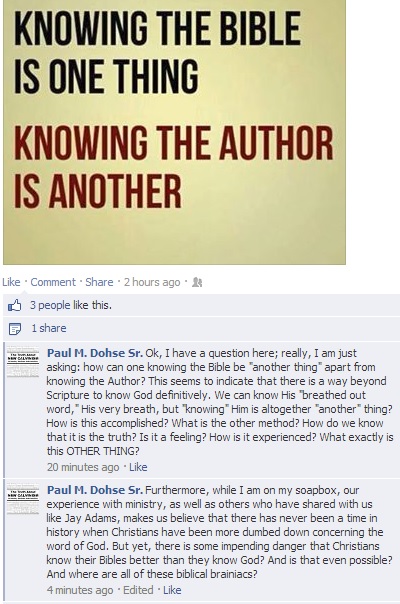
This is based on Calvin’s Redemptive Historical hermeneutic and Luther’s Cross Story epistemology. The idea is that the Bible was not written for the purpose of grammatical exegesis, but rather to contemplate the redemptive narrative only leading to subjective, perpetual justification that is necessary to achieve “final justification.” Knowing the Bible factually is Luther’s Glory Story, knowing the Author is Luther’s Cross Story. In other words, every verse in the Bible is about justification and not wisdom for sanctification, the proverbial, “living by lists” and “do’s and don’ts.”
And….

Right, because sanctification is “subjective justification.” Any concern with our outward behavior is, as Calvinist hack Dr. Michael Horton states it, “trying to BE the gospel rather than preaching the gospel.” This fosters the very thing that makes Christianity contemptible to the world—preaching the gospel and not living it. It is the Sabbatical sanctification fostered by John Calvin himself and promoted by Arminians wholesale.
Calminianism is the real reality.
Sanctification?
So ok, the Bible has much to say about justification by faith alone, but where is this standalone subject of sanctification that is a different matter of Christian living altogether? One place among many would be 1Thessalonians 4:3ff:
3 For this is the will of God, your sanctification: that you abstain from sexual immorality; 4 that each one of you know how to control his own body in holiness and honor, 5 not in the passion of lust like the Gentiles who do not know God;
Obviously, sanctification is all about KNOWing HOW to control our bodies. And even more obvious is the fact that justification has nothing to do with that at all. And also obvious is the fact that the two aforementioned Calminian metaphysical bumber stickers totally reject this biblical definition. Let’s have another moment of honesty. How many Christians know more about controlling their body today than they did yesterday? And does that affect how the world sees us, and God?
Fusion and dichotomy.
Sanctification is a continued endeavor to learn more and more how to control our bodies from the Scriptures. Calvinism rejects that as the Glory Story. A focus on controlling our own bodies makes life about us and “eclipses the Son.” It fuses justification and sanctification together while dichotomizing anthropology. The opposite should be true in regard to both categories. Calminianism is an upside down Christian life.
Anthropological concepts; i.e., what makes people tick, are deemed pragmatic and unspiritual. Rather than seeing these subjects as wisdom where Christians ought to be outdoing the world, they are rejected as “living by lists” and “living by do’s and don’ts.” I like what one pastor had to say about those truisms:
They are telling us the following: “Don’t live by do’s and Don’ts.”
A prime example is something that everyone is born with: a conscience. The only Psychiatrist in history that really had a track record of helping people was O. Hobart Mowrer. The main thrust of his therapy was an emphasis on keeping a clear conscience. He believed that most mental illness was caused by a guilty conscience. He cured people by insisting that they deal with unresolved issues of guilt. Mowrer, once the President of the APA along with a long list of distinguished awards and appointments, wrote The Crisis in Psychiatry and Religion. The book rejected the medical model of Psychology and fustigated Christianity for relegating the care of the “mentally ill” to Freudian Psychology. Mowrer was not a Christian.
Nevertheless, he is the one who most inspired the father of the contemporary biblical counseling movement, Dr. Jay E. Adams, who applied Mowrer’s practical approach to biblical counseling. Adams did this because he observed Mowrer’s astounding results while doing an internship with him in the summer of 1965.
This only makes sense. The apostle Paul instructed Christians to “keep a clear conscience before God.” The Bible has much to say about the subject of conscience. Christians should use the Bible to be wiser in all areas of human practicality and should excel at it far beyond those who live in the world. Let’s have another honesty moment: how many sermons do we hear on the importance of practicality in the Christian life? Subjects such as, planning, accountability, etc. Unfortunately, these biblical subjects are dichotomized from the “spiritual” and deemed pragmatic.
At the same time, justification and sanctification are fused together in an effort to live out a Sabbatical sanctification; i.e., sanctification by faith alone. This is nothing new, James rejected the concept in his epistle to the 12 tribes of Israel that made up the apostolic church. It is also a Gnostic concept that sees the material as evil and only the spiritual as good. Therefore, since anthropology is part of the material realm, any practicality thereof cannot benefit the spiritual. Supposedly.
Another concept, along with conscience, is that of habituation. Through discipline, habit patterns can be formed that lead to change, ask anyone who has been in the military. People who inter the military come out as changed people. Because of our Protestant heritage and conditioning, these concepts seem grotesquely pragmatic. But according to the Bible, we are to make use of them.
Sanctification is a many-faceted colaboring with the Holy Spirit, and the Spirit’s power is unleashed through wisdom and obedience (James 1:25). We must know assuredly that justification is a finished work, and absolutely nothing that we do in sanctification can affect it for better or worse. This is what purifies our motives in our love for Christ in sanctification. “If you love me, keep my commandments” has absolutely nothing to do with our justification. It’s for love only, not a working for justification. We are thankful for our justification, but that thankfulness doesn’t save us or keep us saved. Only Christ saves—the new creature now loves Christ because that’s who he/she is. Christ’s love made it possible for us to love Him in sanctification, but nothing in sanctification keeps us saved. Sanctification looks not for a “final justification,” but readies itself for the Master’s return and longs to hear the words, “Well done faithful servant!”
When I was a young boy, I often lived with my grandparents during the summer. My grandfather was a real-life John Wayne type. He worked as a construction foreman for a large company. And he was my hero. Before he left for work in the morning, I would sheepishly await for him to depart before beginning a flurry of tasks around their small farm. I would always have the tasks done well before his arrival home and waited at the end of the drive to hear his truck’s humming wheels come down State Route 125. I would then take him around the property and show him the finished tasks. His smile and compliments were my reward. These are tasks that I didn’t have to do; our love for each other was always something totally different from those tasks. I knew assuredly that he would love me whether I did those tasks or not because I was his grandson—his pride and joy. Some idea that the withholding of serving him in order to elevate the reality of his love for me would have been a ridiculous notion.
Justification and sanctification must be separate. Anthropology and the spiritual must be fused. Our bodies must be controlled and set apart for good works. This will lead to the showing forth of our good works and the glorification of the Father leading to salvation for others, not sheep redistribution.
Spiritual abuse and disdain for justice.
A devaluing of our own holiness for fear that it will eclipse the holiness of God, coupled with salvation being sought in the institutionalized Calminian church, has led to the same indecencies seen in the mother of the Reformers; the Roman Catholic Church. Rome has never repented of its abject thirst for blood, and the fruit does not fall far from the tree.
The family split for the time being, but the Reformers never departed from Rome’s ecclesiastical justification found through absolution by church leaders. When this is the case, any vehicle going to heaven will suffice for heaven’s sake alone. The institution will never be threatened for the sake of the few. To the leaders, their existence and power is threatened, to the parishioners, their salvation is threatened. The institution must be preserved.
This is no new thing, in the minds of the Jewish leaders; Jesus Christ was sacrificed to preserve the Jewish religious system. If even Christ Himself was expendable in this mentality, what will be of the molested and raped? Besides, we are all just sinners saved by grace anyway, right? Is justice therefore anywhere on the radar screen in this discussion? Hardly. Besides, the raped and spiritually abused should be thankful because what they deserve is hell anyway, right? Once this is understood, the landscape we see today in the American church should be no surprise whatsoever.
What is the answer?
The church is a sanctified body and not an institution for final justification. We are in the business of making disciples and not keeping people justified by faith alone in sanctification. The sanctified body doesn’t justify, it is God who justifies. Men must stop worshiping at the altar of ecclesiastical justification. Justification is free to us and finished, sanctification isn’t. Sanctification is where we show our love to the savior as servants, not leaches. Evil men like Paul David Tripp who posit the idea that the Christian’s whole duty is to “rest and feed” and wait for “new and surprising fruit” because Christians only “experience” fruit and don’t participate in it must be rejected with extreme prejudice. Their evil seed was spawned in 1970, but they have been in firm control of the American church for 25 years while proclaiming each year a “resurgence.” What do we have to show for it?
It is time for men and women to recognize their calling, their new birth, their indwelling counselor, their gifts, and the authority of Christ and His word alone. There is NO traceable lineage back to the apostolic church like the genealogy documents burned by Titus. Murdering mystic despots have no claim on any authority of the church.
Godly authority is continued wherever a spirit-filled Christian picks up a Bible and obeys its words. A church is a sanctified, obedient fellowship, not a justified institution drunk with its own visions of grandeur.
paul
Sanctification: Romans 12:1,2; Introduction

What is the gospel? The “gospel” means “good news.” All of God’s word is “good news.” This became a term that was used interchangeably with, “truth,” “word,” “law,” etc. (Paul Dohse: The Gospel; Clarification in Confusing Times pp. 9-39 Online source: http://wp.me/Pmd7S-1Jn lessons 1-4).
The gospel includes the gospel of first importance (1COR 15:3) which is the death, burial and resurrection of Christ, and the full counsel of God (Acts 20:20, 27, 32) which includes justification and sanctification.
When Paul stated that he wanted to come to Rome in order to preach the gospel to them (ROM 1:15), he was speaking of the whole counsel of God, not the gospel of first importance that they had already received. Paul was hindered from coming there to do so, and was afraid that would reflect a bias on his part because the church at that time was predominately Jewish (ROM1:13-14). We see the same mindset also that likens to the apostle John that prefers face to face teaching rather than letters (2JN 12). That is why 2John is so short, John hoped to teach them face to face. Paul couldn’t wait any longer to teach the Romans the full counsel of God, so he begins to do so in Romans 1:16, that’s why his letter is so long!
Romans is an in-depth treatise concerning God’s plan for reconciling mankind to Himself. The first eleven chapters concern justification, or how God justifies mankind which makes reconciliation possible. This is mostly informative and wisdom based as opposed to sanctification which is mostly instructive and imperative based. And knowing the will of God for the Christian is very easy:
1Thessalonians 4:3 – For this is the will of God, your sanctification: that you abstain from sexual immorality; 4 that each one of you know how to control his own body in holiness and honor, 5 not in the passion of lust like the Gentiles who do not know God; 6 that no one transgress and wrong his brother in this matter, because the Lord is an avenger in all these things, as we told you beforehand and solemnly warned you. 7 For God has not called us for impurity, but in holiness. 8 Therefore whoever disregards this, disregards not man but God, who gives his Holy Spirit to you.
9 Now concerning brotherly love you have no need for anyone to write to you, for you yourselves have been taught by God to love one another, 10 for that indeed is what you are doing to all the brothers throughout Macedonia. But we urge you, brothers, to do this more and more,
This is the clear definition of sanctification (a setting apart for holy purpose). We call it progressive sanctification. Definitive sanctification is the initial setting apart at justification. Context will determine which of these is being spoken of in any given Bible text. Progressive sanctification entails gaining wisdom on “how to” “control” our bodies in “holiness and honor.” Sanctification is a how to endeavor; get over it. It is about a bunch of do’s and don’ts—get over it. It is about living by lists—get over it. Sanctification is the science of controlling our bodies to God’s honor. Proverbs 18:4 and 20:5 state that the issues of life are deep waters—the gospel of first importance is simplistic, but the gospel of sanctification is far from it. Listen to how the book of Proverbs begins:
Proverbs 1:2 – To know wisdom and instruction, to understand words of insight, 3 to receive instruction in wise dealing, in righteousness, justice, and equity; 4 to give prudence to the simple, knowledge and discretion to the youth—5 Let the wise hear and increase in learning, and the one who understands obtain guidance, 6 to understand a proverb and a saying, the words of the wise and their riddles. 7 The fear of the Lord is the beginning of knowledge; fools despise wisdom and instruction.
Wisdom does not pertain to justification per se, Justification is the beginning of knowledge, but mark it, those who despise wisdom and understanding for sanctification are fools. Those who park on salvation are also fools—they despise wisdom and instruction. A prime example are those who request prayer “for patience.” Prayer is easy, “Lord, give me patience!” But what does Proverbs say about obtaining patience?
Proverbs 19:11 – A man’s wisdom gives him patience; it is to his glory to overlook an offense (NIV).
It takes wisdom to obtain patience. Prayer alone will not bring you patience. Justification is free by faith alone; sanctification is not free; if you get any, you will work for it. As I said yesterday in a conversation, “People want to be happy, but they don’t want to do anything to get happiness. The Bible promises that we can be happy, but unlike justification, happiness in sanctification is not unconditional—there are conditions. Paul made it clear, especially in Chapters 9-11 that justification is completely unconditional, but that is not what we see in the first verse of Chapter one:
Romans 12:1 – I appeal to you therefore, brothers, by the mercies of God, to present your bodies as a living sacrifice, holy and acceptable to God, which is your spiritual worship.
The word for “mercies” is literally (oiktirmos) “compassion.” A call to obedience is not burdensome, it is the compassion of God. Paul is making his appeal on behalf of God according to His compassion. It is the antithesis of depraved indifference. God is not the parent that lets a child grow up without wisdom and in the way that he/she would naturally go. Knowing this wisdom is a good start for patience. Like God, we should compel people to obey because it is the way of life, and not because we are inconvenienced by their wayward ways. I am not saying that it is never about us, because what is simply right and just does matter, but it should mostly be about caring for others. Our appeal should be by God’s mercy. Therefore, remember this: silence can qualify as depraved indifference. Our appeals should be with compassion, but no appeal at all is far from such—it is often depraved indifference.
The appeal to present our bodies as a living sacrifice harkens back to God’s acceptable sacrifices in the Old Testament. They had to be sacrifices without blemish. Our sacrifice is living, and the sacrifice is our service. Let’s reread Romans 12:1 without the added words that make it flow in the English translation:
Romans 12:1 – I appeal to you therefore, brothers, by the mercies of God, to present your bodies as a living sacrifice, holy and acceptable to God, which is your spiritual worship.
“Worship” (latreia) carries the idea of service to God according to the Levitical law. It also has the idea of service for hire. We serve God by continually presenting ourselves to Him as blameless. This harkens back to the definition of sanctification in 1Thessalonians 4:4. We are to control our bodies in holiness and honor. We are to be vessels fit for the Master’s use:
2Timothy 2:20 – Now in a great house there are not only vessels of gold and silver but also of wood and clay, some for honorable use, some for dishonorable. 21 Therefore, if anyone cleanses himself from what is dishonorable, he will be a vessel for honorable use, set apart as holy, useful to the master of the house, ready for every good work. 22 So flee youthful passions and pursue righteousness, faith, love, and peace, along with those who call on the Lord from a pure heart.
One way this is to be performed is to change the way we think as opposed to the way the world thinks. Agreeing with the world makes you like the world. This would be regarding, “life and godliness” (2Peter 1:3). There is the wisdom of the world and the wisdom of God. Hence, the “Christian” idea of “plundering the Egyptians” which came from Augustine is a really bad idea. What we believe makes us who we are:
Romans 12:2 – Do not be conformed to this world but be transformed by the renewal of your mind, that by testing you may discern what is the will of God, what is good and acceptable and perfect
Sanctification is God’s will. By transforming our mind according to God’s wisdom we become more like Him. By His word we discern sanctification and how to apply it to our lives. This is what leads to change: transforming our ways of thinking from the worldly to the truth. Only truth sanctifies (John 17:17). Christians are to serve the law with their minds (ROM 7:25). The word “heart” in the Bible is more often than not an idiom for the mind (ZECH 8:17, MATT 9:4, MATT 13:15, MK 7:21). We are to guard our minds with all vigilance because it is the wellspring of life (Proverbs 4;23). Paul brings this issue into clarity in 2Corinthinas 10:5;
We destroy arguments and every lofty opinion raised against the knowledge of God, and take every thought captive to obey Christ,
To say that Christians play fast and loose with ideas is an understatement. They simply don’t understand that ideas make us who we are (PROV 23:7). Every thought is to be taken captive and brought into conformity to the word of Christ. An exchange Susan and I had last week is indicative of where Christians go astray on this issue:

The Pauline approach to sanctification is an affront to contemporary Christianity. That’s the dilemma we face. Protestantism, which includes Baptists et al, is dumbed down by ecclesiastical design. On April 25, 1518, Martin Luther declared war on the priesthood of believers and sanctification via his declaration of Reformed theology in Heidelberg, Germany. The 95 Thesis was a moral treatise against Rome six months prior, but the Heidelberg Disputation was the very foundation of Reformed ideology. It called on theologians to interpret all of reality from a dual perspective: the glory story or the cross story.
True theology (the cross story) would look at man as worthless and empty with eyes of faith that can only see outward to the glory of God. This made all reality good as the sum equation of God’s goodness and man’s evil. So, tragedy only reflects man’s worthlessness and his deserved plight and the glorification of God following. The glory story was anything that recognized anything IN man at all. No goodness or grace is infused into man. True theology is a purely outward look, and only looks within to find reason for repentance that then glorifies God (“deep repentance”). Luther believed that man can experience the grace of God, but cannot participate in it. That would be works salvation. Man must empty himself to be saved and remain empty till the final judgment.
Hence, any notion that man could become good through salvation was deemed heretical, and a damning false gospel. In many ways, it was predicated on the Platonist idea that all matter is evil, and that would of course include man. The first sentence of the Calvin Institutes (CI 1.1.1) is based on Luther’s dual construct, and then the rest of the Institutes build a full metaphysical statement on the foundation of that first sentence. Pretty impressive. In that sentence, Calvin states that all wisdom is derived from a knowledge of us and knowledge of God. The two opposites define each other. Both Calvin and Luther were followers of Augustine who was the undisputed first and foremost integrationist in Western culture. Plato integrated Eastern mysticism with Western science, and Augustine integrated Platonism with the Bible. A cursory observation of world history makes this plain.
Therefore, the good Luther/Calvin cross theologian heartily agrees with, “study to show thyself approved, a workman that need not be ashamed.” But in the Protestant construct that redefines sanctification (and actually rejects it totally), what does “study” mean? What does “approved” mean? And what does “workman” mean? The Reformers did not believe anybody is approved. They believed work in sanctification (the Christian life) was equivalent to works salvation. Augustine, Luther, and Calvin believed baptism replaced circumcision, and sanctification replaced the Old Testament Sabbath Rest. Working on the Sabbath would bring death, and in the same way, working in sanctification also brings death (John King: The Complete Bible Commentary Collection of John Calvin; Genesis, Ch.2 sec.3, Ch.17 sec.13. Ibid: The Harmony of the Law, Due. 5:12-15, sec. 15). A good example how this demonstrates itself in the contemporary mindset follows. It was sent to me by a reader of the PPT blog:

Of course, as we have discussed many times, statements like this make no distinction between sanctification and justification.
So, “study” is really a focus on what ANY Bible text says about mankind’s wretched, sinful existence as opposed to God’s holiness. When the equation is seen, a steady flow of Christ’s obedience is imputed to our account and we remain justified. These manifestations may, or may not be experienced, but if they are, it is in the realm of the subjective where even the experience cannot be somehow attributed to us. This selfless, daily bearing of the cross and dying to self will lead to joy, but we do not know if this joy is directly linked to a Christ manifestation. The gospel is objective and remains outside of us, but is experienced subjectively. Any inward focus leads to inward subjectivity and as John Piper stated it, “imperils the soul.” It is merely an application of Eastern Mysticism to make sanctification by justification possible.
This is why Luther despised reason and called it a prostitute that should have “dung” rubbed in her face to “make her ugly.” Reason is the glory story. Our ability to reason has to do with an inner ability apart from God. Our “study” is limited to seeing the cross more by a greater and greater realization of our God unlikeness. Our “work” is this study and contentment in the ruin that God has sovereignly placed us in. But of course, “Contentment with godliness is great gain.” That is knowing our own place in the caste system which is sovereignly determined by birth. Supposedly, working hard at being content in our own wretched station of life is not work—it’s faith. Problem is, Luther et al considered that to be saving faith as long as it is practiced in sanctification. You do the math. There is a standard for what isn’t work in sanctification and what is work in sanctification for the purpose of remaining justified.
That is why we argue that justification must be a finished work separate from our Christian life. The conclusion of Paul’s treatise on justification in chapters 1-11 should lead to a free and aggressive sanctification. Though the Scripture has much to say about the colaboring of the Holy Spirit with us in sanctification and the reality that He makes it possible, I think the following quote by RC Sproul during a moment of sanity sums up the point well:
Sanctification is cooperative. There are two partners involved in the work. I must work and God will work. If ever the extra-biblical maxim, “God helps those who help themselves,” had any truth, it is at this point. We are not called to sit back and let God do all the work. We are called to work, and to work hard. To work something out with fear and trembling is to work with devout and conscientious rigor. It is to work with care, with a profound concern with the end result” (RC Sproul: Pleasing God p. 227).
If I am not mistaken, this is the only citation from Christian academia in this whole series on Romans, but again, I think it is worth getting in for the way it is stated. Though Paul was no less dependent on the power of the Spirit than anyone who has ever lived, he at times was brutally practical:
2Corinthians 9:1 – Now it is superfluous for me to write to you about the ministry for the saints, 2 for I know your readiness, of which I boast about you to the people of Macedonia, saying that Achaia has been ready since last year. And your zeal has stirred up most of them. 3 But I am sending the brothers so that our boasting about you may not prove empty in this matter, so that you may be ready, as I said you would be. 4 Otherwise, if some Macedonians come with me and find that you are not ready, we would be humiliated—to say nothing of you—for being so confident. 5 So I thought it necessary to urge the brothers to go on ahead to you and arrange in advance for the gift you have promised, so that it may be ready as a willing gift, not as an exaction.
Much can be learned from this passage about sanctification—not least of all in regard to the issue and application of accountability. Sanctification is a many-faceted, aggressive endeavor. It is full of practical and wise life application, and the Holy Spirit is ever willing to aid us accordingly.
Susan Dohse on Plato, Augustine, Calvin, and the Reformation
 TANC 2013 Conference on Gospel Discernment and Spiritual Tyranny
Transcript: Susan D. Dohse MEd.
Plato
I’m Susan Dohse. I’m married to Paul Dohse for two years, and it has been an adventure. My role in this year’s conference has changed. This year I became Paul’s research assistant. The pay stinks, but the fringe benefits are really nice. Unlike last year when I spoke from personal experience, which though difficult and emotional at times, was easier than this year’s assignment. This year I was asked to step outside my preschool box and share what I’ve learned through not personal experience but personal study and research. And I am thankful for the World Wide Web, computers, and the Internet even though I fuss and say unkind things to the computer, I am thankful that the Lord created those on the eighth day. If I had to find answers to the questions that I had in the old-fashioned way, by using the card catalog and the Dewey Decimal system, I wouldn’t be here this morning. I would still be at the library roaming the stacks. My role in this year’s conference is to share my research. My goal though is to provoke you to think. What I want to share is only an introduction. It’s not even a scratch on the surface of what there is to know about these historical figures. It’s up to you though to continue the research project. So you do have an assignment. I want you to think of me as just a grain of sand, an irritant in the oyster that over time though yields a pearl.
Matthew 7:24-27, Jesus is speaking here. “Therefore, whosoever hears these sayings of mine and does them, I will liken him unto a wise man who built his house upon a rock. And when the rains descended and the floods came and the winds blew and beat upon that house, it fell not, for it was founded upon a rock. And everyone that hears these sayings of mine and does them not shall be likened then to a foolish man who built his house upon the sand, and the rains descended and the floods came and the winds blew and beat upon that house, and great was the fall of it.”
The foundation of thought that I want to illustrate is built upon a historical figure that I just knew initially in a Jeopardy quiz show fashion, you know. Student of Socrates, Greek philosopher, The Republic. Who is Plato? Well, if I were to ask you to tell me something that you know or you’ve been taught about this man, I’m certain I would get classic textbook answers. Greek philosopher, student of Socrates, established the first university called The Academy, wrote The Republic, I would give you credit for being correct. For over 2,500 years, Plato has been studied, admired, modified, personalized, and deified. He has been described as a great thinker, lover of wisdom, a crusader against error, and an enemy of falsehood. Well, after reading hundreds of pages about him, I cannot help but agree that he was a man of great intelligence. He was a mathematical genius, an advocate of education. In your list of trivia facts, would you also include pagan, polytheist, crusader against individuality, founder of communistic, socialistic, and Darwinian evolutionary thought, enemy of God, hero of the reformers?
Born in 427 BC, the son of noble and wealthy Athenian parents with the blood of ancient kings of Attica flowing through his veins. It was this status in life that gave him the way and the means to pursue his quests. Unlike others of his day, he didn’t have to earn a living and go to school at night or hold two jobs to pay for his education. He was of the ruling class of Athens, a privileged elite.
At the age of 20, Plato came to Socrates and asked to be his pupil. And Socrates saw before him a handsome youth, broad shoulders of an athlete, a noble brow of a philosopher, the limpid eyes of a poet. Those aren’t my descriptive terms. This is how Socrates described him. Socrates accepted him as a student, and this became the beginning of a tender and an intimate relationship that lasted until Socrates’ death. The respect and admiration of the student for his teacher was profound and lasting.
Well, after Socrates was executed, Plato and the other disciples of Socrates took to the world, and they traveled the ancient world. Now whether of fear that they would be arrested and also executed because of their association with Socrates or because they wanted to be foreign exchange students is not really well documented. Plato went to Cyrene where Theodorus instructed him in mathematics. He went to southern Italy where he studied the science of numbers under three of the most learned doctors of the Pythagorean mathematical system of his day, went to Egypt to receive instruction from those learned doctors and priests of that ancient land. Some records say he visited Persia, Babylonia, and even India. So he returns to Athens and establishes his Academy, the first university in Europe where he taught until the age of 81.
So up until his return to Athens, we can say letter P for professional student, P for pagan polytheist. Plato regarded the sun, moon, stars, and planets as the visible gods. These heavenly bodies do not come into beings and then pass away. Plato attributed divine souls to the sun, moon, stars, and planets because they followed that intelligible course through the sky. He also held [SOUNDS LIKE] the invisible gods, the gods of the civilized life where the king was Zeus. These gods care about humans. They’re aware of whether we are good or evil. Though invisible, they can reveal them themselves when they want to. They are not standards of justice, beauty, truth, and goodness, but they were living beings who have the perfect knowledge of those standards. Plato wrote, “I do believe that there are gods, and that in a far higher sense than that which any of my accusers believe in them.”
P for platonic wisdom which unites with methodology. P for philosopher ruler. Plato referred to himself as a philosopher ruler. He stressed the importance of living the life of a philosopher by worshipping ideas. The search of ideas, the appreciation of ideas, the participation of the ideas—that’s the life of a philosopher, and that’s what he taught, and that’s what he believed. So the life of Plato was a tireless quest for those ideas. His life is a sustained effort to live by those ideas and to teach others to do so.
P, political scientist, his political philosophy was explained in his writing The Republic. The ideal state, he says, should be divided into three classes of citizens, and each class has its own particular duty to be performed and a special virtue to be developed. The lower class, the laborers and the artisans, their immediate task, acquire skill. The second class, that’s the warriors, and they’re given the opportunity to develop courage and fortitude at their stage of evolution. And the ruling class, those are those men who have learned how to govern themselves and are therefore fit to govern others. I quote from Plato, “Unless philosophers become rulers or rulers become true and thorough students of philosophy, there will be no end to the troubles of the state and humanity.” When each state concentrates upon its own duty and virtue, there will be a well-balanced and harmonious state in which all of the citizens will work, but not for the interest of self but for the common good of the whole. The state will be in charge of production and that sphere of physical goods and life.
And according to Plato, the state would regulate marriages and the breeding of children. In his Republic, we have a foreshadowing of the modern theory of eugenics. There will be selective breeding as with animals. Bad specimens of humanity will be ruthlessly destroyed. There will be no individual families because there’s only one family, and that’s the state. The state will control mating among the sexes. And when children are born, they will be brought up by the state. Thus both breeding and rearing of children will be in the hands of the community. The community of wives and children is part of more ambitious program, however. And that is the abolishment of self. Plato’s ideal is that we shall cease to use a pronoun: mine. These are the foundational ideas as you study history of Nazism, communism, socialism.
Plato was a mystic pagan. He respected and defended Greek mythology even though he recognized that mythology was a myth. He referred to it as a belief, not reason. His metaphysics is confined to the existence of eternal ideas of which the supreme eternal idea is that of the good, the true, the beautiful. Plato, pagan, polytheistic, philosopher ruler, political scientist.
So do we build a biblical doctrine upon his philosophical recommendations? Well, one block does not a foundation make, and one letter doesn’t spell the name. So let’s go to L, link. To understand the place of Plato in Greek civilization, you have to have a snapshot of what Athens was like in his time. Before Athens had produced any great figure of thought, the Greek colonies had a full quota of poets and philosophers and mathematicians. But when the Persians and the Lydians began their advance westward, the Ionian colonists were compelled to return to the mainland. Pericles, the leader of Athens, offered them protection and liberty of expression. So what was created in Athens was a cultural babble [SOUNDS LIKE]. So the significance of Plato lies in the fact that he took this cultural babble and converted it into his beloved city. And he welded it into a system of thought. So in his philosophy these miscellaneous cults and doctrines from all over the known world were fused into a whole new concept of the universe.
Plato claimed no originality for his ideas. He was the world’s interpreter. By giving unity to scattered ancient truisms, Plato’s word took on the appearance of a string, a string which tied together a bundle of ideas that he had gone to this garden of the world’s best thinkers and plucked them and tied them together. With Plato, the Socratic method of education would have been unknown. The abstruse [SOUNDS LIKE] numerical system of Pythagoras would have remained unintelligible to the average mind. Without Plato, the philosophical and psychological systems of the Hindu sages, the Laws of Manu and Buddhist doctrines would have remained hidden from the Western world. Plato was the link between the East and the West. As Emerson wrote, “The excellence of Europe is in its brain.” So his philosophies then were the links between paganism and Western Christian thought.
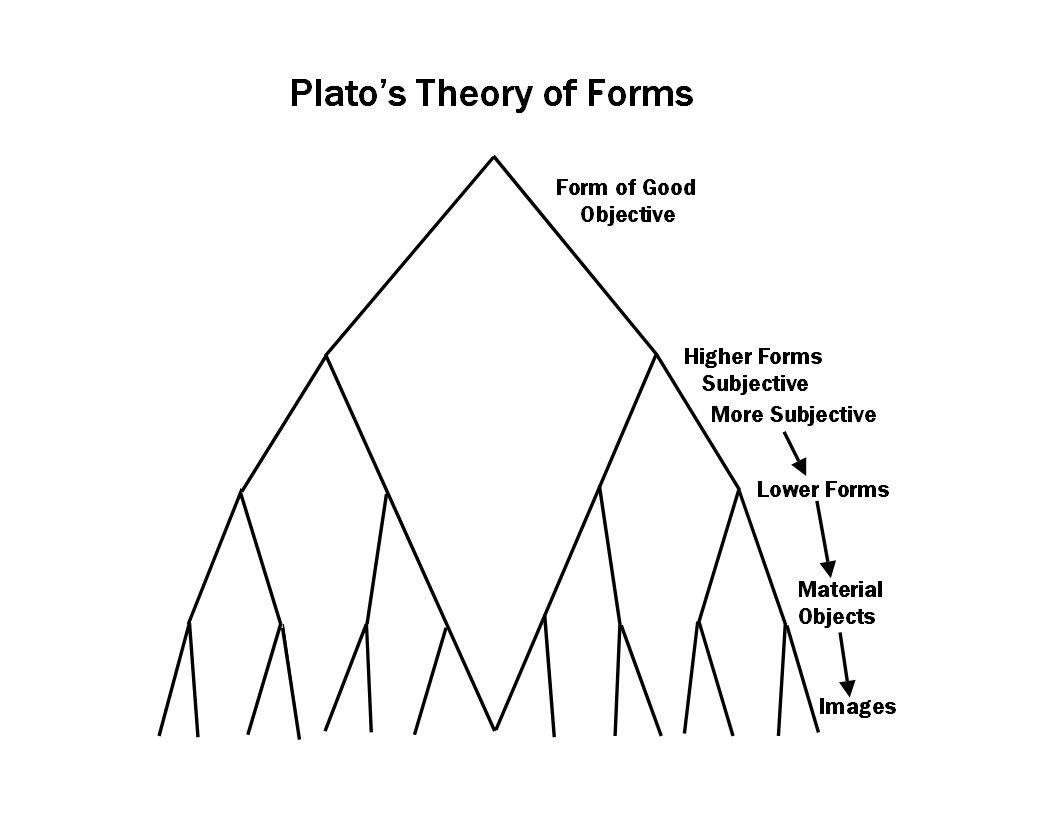
A, atheist. Plato was a worshipper of many gods. So why do I refer to him as an atheist? Well, he didn’t believe in Yahweh, Jehovah, the God of the Christians. There’s none of it in Plato. The God of the Bible did not exist in Plato or in any ancient Greek literature. Plato writes of the gods, and in some cases he does write a god or god, but he does so in the same way we would talk of man, in a generic name. Contrary to what some scholars write, including Saint Augustine, Plato’s The Good was not a reference to God. It’s a reference to Plato’s perfect idea of good. In another of Plato’s writings, he says that love is divine. When Plato referred to the craftsmen or the artisan of the universe who formed sensible things by using the forms as blueprint, he was speaking metaphorically. According to Plato, there was no creator of the universe. There were principles and according to how things emanate from the One. Now be careful, the word “one” used by Plato is not a reference to the one true God. You can click on my third slide.
The One refers to the forms of the true, the good, and the beautiful. The One does not pay any attention to the universe, but it simply emanates, okay? Do you like that word, “emanate”? There it is. You see it? You have the forms. Does not pay any attention to the universe but simply emanates a lower being that emanates a lower being that emanates a lower being, so on and so forth, oh like a ladder, until the lowest of all matter that comes to be.
Our foundation now is taking shape, isn’t it? The foundation of Christian doctrine is going to be built on a pagan polytheistic philosopher’s ideas created from links made from welding miscellaneous cults and doctrines all emanating from an atheistic belief system.
T, I’m doing the sign language for Heather. T for theory. Plato had a trinity. Huh, he had a trinity. But it is not to be equated with God the Father, God the Son, and God the Holy Spirit, although there are some writers who try to make that assumption because they want to make Platonic ideas palatable to Christian students. His trinity were the forms: the good, the true, and the beautiful. Now these forms are not spirit as God is spirit and they that worship him does worship him in spirit and in truth. These forms are ideals. Humans have access to them through the mind, through reason. Forms are ultimate reality. They are the causes of all knowledge. And they’re interconnected. Plato felt that they were one. Truth is good and beautiful, and good is true and beautiful. And the beautiful is true and good. So how do we know them? Well, Plato thought that we know these pure, perfect forms intuitively. It is only through intuition that fundamental truth can be known. There are some scholars that say Plato’s theory of the forms has the greatest influence in the philosophy of religion. This exaltation of the spiritual over the physical in Platonism carried over into Judaism, and the writings of Philo influenced the Neo-Platonists, astounded the apologists, and the early Christian fathers.
O for ontology. Now that’s a fifty-cent word. It means the philosophy of existence, being. To Plato, true reality was the world of being. We don’t live in this word; we live in an approximation or a shadow of this world. True reality can only be discovered by the mind. Ideas are the patterns that participate in the shadows of our everyday world. So what we have is Plato’s ontological impact on other important Christian doctrines. What we have is an oxymoron, you know, like white chocolate, jumbo shrimp. Christian Platonism, that’s the oxymoron. It’s a philosophy that has blended Platonism with Christianity. Author Randy Alcorn describes what Christian Platonism has done. He says it’s a poison that has caused many Christians to resist other biblical truths—the bodily resurrection of the dead, life on the new earth, specific activities we will engage in heaven such as eating and drinking, walking and talking, living in dwelling places, traveling down the streets, going through gates from one place to another, ruling, working, playing, engaging in earthly culture and that new heaven and new earth.
Okay, so what? So what? I talked for 20 minutes. So what? What do you need to take from this essay that I read to you on Plato? See the sand? The foundation of Reformed doctrine is built on the ideas of a pagan, polytheist who linked other pagan ideas into an atheistic framework that he called his Theory of Forms, and by doing so has ontologically affected the way Christians understand truth, and it robs them of hope. Jesus said, “Everyone that hears these sayings of mine and does them not shall be likened into a foolish man who builds his house upon the sand.”
Augustine
This morning I talked about our dear friend Plato, and John gave more embellishment upon the man. I was looking through the lens of the foundation of Christian doctrine and what contributions that Plato made to what we’re hearing and seeing and being forced to believe in our Christian churches. Just a quick overview for Pastor Robert there, I made a way for me to get a handle on what this man believed in the most concise way that I could. I said that he was a pagan polytheist, philosopher ruler, political scientist. That’s the letter P that linked other philosophies and cults together and welded them into an understandable way of thinking. He was an atheist because he did not believe in the Christian God and the God that we believe in. His T for theory was the forms, the universal, good, true, and the beautiful. And then his ontology was his philosophy of existence or being that there was the reality, the real world and then the world of shadows that we live in.
Now I’m going to talk about Augustine. If you look, he has lots of letters in his name, so I have lots of things to say about him. You can tell my sixth grade teacherhood is coming out here. The letter A is for accolades for Augustine. Aurelius Augustine, or we know him lovingly as Augustine. He was born in November 13, 354 in a small town near the eastern border of what is now Algeria, Thagaste. He is so venerated. He has his own day. His birthday is celebrated in the Roman Catholic Church. His father was a Roman official. His father was a Roman pagan, but his mother, Monica, was a Catholic Christian. In 386 after studying law and philosophy and the classics and a year of teaching grammar and a brief career as a rhetorician—I don’t know if I pronounced that right, in rhetoric—he embraced Christianity. His known writings, the Confessions, part of it autobiographical, part of it not, is a collection of articles, letters that he wrote that talk about his conversion.
He entered what was essentially the Roman Catholic Church of his day. He established the monastery when he moved to Hippo, North Africa after being appointed its bishop. He actually created the monastic lifestyle when he created or established his monastery. Wearing the dark black robes, the celibate lifestyle, the whole monastic bearing came from Augustine and passed down then to other monastic sects of the Roman Catholic Church. His Catholic epitaph would read, “Great Sinner, Great Saint,” North African bishop, father of the Roman Catholic doctrine, his teachings heavily influenced later philosophers, and his teachings have a great influence even among evangelicals today. We could add a second line to that plaque [SOUNDS LIKE]: Father of the Inquisition, Father of the Reformation, Christian Neo-Platonist, teacher of heresy. And both of those epitaphs would be true.
His life was marked by passion, sexual passion in his early life which was encouraged by his pagan father, educational passion which was encouraged by his mother, and a pursuit for wisdom. That pursuit for wisdom blurred the boundaries between philosophy, religion, and psychology. And then upon his conversion he had a passion for the Roman Catholic Church. Like his hero, Plato, he was intelligent, and he pursued with a focused-purpose philosophy as Plato did. His enamorment with the Latin classics led him to Cicero’s Hortensius, which was the catalyst for that passion for philosophy. That passion for philosophy centered on coming up with the answer to the problem of evil or how we make sense of and live within a world that seems so adversarial and dangerous, a world which matters much and everything we love is easily lost. And he expresses those ideas in Book 4 of his Confessions.
Now nine years he spent with, and I’m going to mispronounce this group, the Manicheans, M-A-N-I-C-H-E-A-N-S. He was with that particular group for nine years and really thought that he had found the truth, but then he became disenchanted with them particularly because of their beliefs in astrology. He became acquainted with Ambrose of Milan, a bishop of the Roman Catholic Church who introduced him to the books of the Platonists. While in Milan, his encounter with Platonism provided the major turning point which reoriented his thought among the basic things that were consistent till his death. Augustine himself makes it clear the that it was his encounter with the books of the Platonists that made it possible for him to view both the church and its scriptural tradition—the key word there is tradition—as having an intellectually satisfying and indeed resourceful content.
He was one of the four doctors of the Roman Catholic Church, Jerome, Ambrose, Gregory the Great being the other three. Pope John II called Augustine the common father of the Christian civilization, and some even place him in this little T trinity—Jesus, Paul and Augustine—as being the most influential figure in the history of Christianity. The Catholic Encyclopedia calls Augustine the founder of Western Christianity and the first real Roman Catholic. So accolades to Augustine: thinker, theologian, prolific writer. However, conversion to Christianity and writing volumes of material does not guarantee that the doctrines generated will be correct. Now remember this when you read and study prolific Christian writers of our day such as John Piper and MacArthur. Just be careful.
U, unity. One of the decisive developments in the Western philosophical tradition that was widespread during his day was the merging of Greek philosophy and Greek philosophical tradition and the Judeo-Christian religious and scriptural tradition, and I want to emphasize that word “tradition.” Augustine is one of the main figures through and by whom this merging was accomplished. “Never did man unite in one and the same soul such stern rigor of logic with such tenderness of heart.” That’s the opinion of the research scholar Harnack and other scholars. Great intellectuality admirably fused with enlightened mysticism, that’s Augustine distinguishing characteristics.
Augustine is referred to as one of the great Christian Platonists. And there’s that oxymoron again. In particular, Augustine’s interpretation of Plato dominated Christian thought for the next thousand years after his death in the 5th century. In his Confessions, Augustine openly describes the help he received from the Platonists. Platonism colored the whole future thought of Augustine, and thus this gift of Plato’s writing set a current in the thought of Western Christendom. Augustine believed that Plato lifted him to a true and almost worthy knowledge of God. And early in his Christian career he declared, “I am convinced that I shall discover among the Platonists nothing repugnant to our religion.” The Platonists are therefore the only serious antagonists just because they need so slight a change to make them Christians. Augustine’s physical, logical and moral philosophy, all this learned first and most thoroughly from Plato, and many a formula of Platonic ethics have been passed down through Augustine and Christian literature.
What happens when this unity of thought occurs? You have pagan philosophy and Christian doctrine. Pagan philosophy becomes Christianized, and Christian doctrine becomes paganized. And that is what Augustine did. He took pagan philosophy, changed some terminology, definitions, tweaked the vocabulary so that it took on an acceptable Christian format that was palatable to the church. And in doing so, he paganized Christian doctrine. If paganism was conquered by Christianity, it is equally true that Christianity was corrupted by paganism. Many of the pagan tenets invented by the Egyptians and idealized by Plato were retained and held worthy of belief by Augustine.
In the Catholic Encyclopedia I quote: “The great majority of the Christian philosophers down to Saint Augustine were Platonists. They appreciated the uplifting influence of Plato’s psychology and metaphysics and recognized in that influence a powerful ally of Christianity in the warfare against materialism and naturalism.” I’m going to quote Augustine in one of his books called Retractions, book 1 part 12. “That which is known as the Christian religion existed among the ancients, and never did not exist from the beginning of the human race until the time when Christ came in the flesh, at which time the true religion, which already existed, began to be called Christianity.” In this statement Augustine that Christianity existed before Christ’s sojourn on the earth, and Saint Augustine not only was a student of both Plato and Plotinus, but he also read and studied some ancient Egyptian hermetic writings. He obviously had read the hermetic text because he quotes one extensively in his own work called The City of God.
So the unifying of Plato’s philosophies and Christian thought was foundational to Augustine’s teachings and from his Confessions to his later works. So should a believer, such as we are, study Augustine? Absolutely. But alongside his writings, the Word of God needs to be opened. Over time the Catholic Church has given his writings powerful authority, even making his writings equal in authority as Scripture, and in doing so gives church authority to the pagan philosophy of Plato and other Neo-Platonists Augustine credits as the source of his knowledge.
I’m going to quote Augustine from his writing on Christian doctrine. “If those who are called philosophers, and especially the Platonists, have said aught that is true and in harmony with our faith, we are not to shrink from it. We are to claim it for our own use from those who have unlawful possession of it.” Now I want you to know that that looks good on the surface. You find something true, and you claim it. But I want you to note his phrase, “harmony with our faith,” the faith in the Roman Catholic Church, not in harmony with Scripture but harmony in the faith that he found in the Roman Catholic Church.
G, genius. Augustine, he was a genius. He was not simple-minded, and he was not an idiot. He loved logic. He loved rhetoric and philosophy. He was not a simple-minded man. His genius made it possible to unify and combine the powerful and penetrating logic of Plato. His intellectual genius took the deep scientific concepts of Aristotle, the knowledge and intellectual suppleness of Origen, the grace and eloquence of Basil and then meld them into Christianized acceptable belief systems. And it’s because of his genius that he is considered a philosopher, theologian, and an exegetist. He is given the name Master of all the centuries. He’s admired above all for giving the church a rare union of the speculative talent of the Greek and practical spirit of a Latin church. Great intellectuality, enlightened mysticism. You fuse them together and you have the characteristics of Augustine’s genius. This is why people do not have a problem describing him and using the term Christian Platonist.
Hegel, the modern day philosopher, believed that Christian theology was significantly influenced by Neo-Platonism. The German philosopher Martin Heidegger agreed with Nietzsche that Christianity is Platonism for the people. Friedrich Nietzsche, if I’m saying his name right, and Martin Heidegger, they were raised as Christians. Nietzsche was raised Lutheran, Heidegger Catholic, and both concluded that Christianity was basically, and I’m quoting, a dumbed down, simplified version of Platonism altered to make it understandable and popular with the uneducated masses. That’s their words, not mine. Augustine was a genius.
Oh, we have two U’s in his name. The second, unity. And that was Augustine’s unity of church and state. Please bear with me because what happens here and how he worked for this unity of church and state to me was just baffling as to the spiritual tyranny and control that the church wants to have today. Based upon what John has already said, you will see some of this Greek philosophy coming through Augustine’s. Number one, he felt the human will was weak and subject to all sorts of temptations and had no external support, so the individual was helpless in his battle against Satan. So because his world was in crisis at the time and the Christian-hating bands of robbers were constantly raping, pillaging, and burning Catholics and their property, he felt that compulsory measures on behalf of Christian ideals was called for, and so the right thing to do to help bring order to the Roman Empire was to use the wrong reason, take the civil government as an extension of the church to accomplish this.
Now you have to understand Augustine’s thinking here and what his teaching was about the Holy Roman Empire and the perilous time in which he lived. Augustine thought that the Roman Empire had been prophesied in the Old Testament and was a fulfillment of Old Testament prophecies. The Church’s unity and authority reveals who the true church is. It affirms that the unity of the church, its expansion and recognition throughout the empire, was fulfillment of Old Testament prophecy. So since the churches spread, according to prophecy, the true church then is the Catholic Church. Now Augustine claimed that the empire that’s now Christian by God’s providence and its emperor who is divinely appointed has full rights or authority to correct those who opposed the unity and authority of the church.
Secondly, unity achieved by forced conversion through the authority that the church has according to Scripture [UNINTELLIGIBLE] from Augustine’s unity, seemed to be more important than sincere conversion. He believed if you forced them to convert that they would be sitting among true believers and perhaps eventually get truly converted. But he did have a proof text for forced conversion, and that was Paul’s conversion on the road to Damascus. Christ used violence against Paul, Augustine said. I can’t help but laugh that he was a teacher of logic and this is so illogical, okay? Christ used violence against Paul, and Augustine said that the church is just following Christ in coercing the heretics. By using force, Augustine argues, Christ made Paul a far better disciple than the others who came to Christ by their own wills, so Augustine expected the same in cases of forced conversion in order to keep the unity of the church. He felt that the church should have the authority to enforce unity with the help of the civil government which he always referred to civil government as the Christian state. And I quote, “And these times when the whole world became a choir praising Christ is different from the time of the early church when the Christians were being persecuted by the state.” These Christian times gave him support and encouragement to assert that Christian unity should be imposed through the authority of the church because to do so was fulfilling Scripture. Scripture prophesied what the emperor’s duties were as the head of the empire and as a Christian because he had been baptized in the Catholic Church. So as a Christian, the emperor was divinely appointed to defend the church and oppose heresy.
So the Catholic Church looked to Augustine for help with this whole idea of the church really being disunified because of different heresies being promoted, so he took the attitude that if verbal persuasion didn’t work, then force might be necessary to combat heresy and bring unity back to the church. His political and social views flowed directly from his theology. As a philosopher, he states his arguments using Platonic traditions that he learned probably from the Neo-Platonists at Alexandria. As a citizen of the city of Rome, he states that the Roman Empire is a divine origin through which the truths of the Catholic Church are to be safeguarded and spread.
Augustine believed that the state is a divinely ordained punishment for fallen men with its armies, its power to command, coerce, punish and even put to death as well as its institutions of slavery and private property. God shapes the ultimate ends of man’s existence through the divinely appointed government. Although he did oppose the death penalty for heresy, he provided all of the rationale for the Spanish Inquisition. His rationale came from the parable of Christ, the Great Banquet. Augustine used this parable because it contains the line “compel them to come” to justify using force to bring the unconverted into the church. So by taking Scripture out of context and using it to justify his philosophical and political justification to yoke together church and state, Augustine’s unity was a political unity. It depended upon human resources. But when the Apostle Paul talked of church unity in Ephesians 4:3, he speaks of spiritual fellowship, and Jesus explicitly commands his followers not to use force in the conversion process, Mark 10, and Paul’s call to universalism is not an invocation to the church to conquer more territory, Ephesians 4.
In Sermon 46 Augustine commented to his parishioners that while in the beginning the apostles were fishers of men, now Christians must be hunters, [UNINTELLIGIBLE] beating the thickets and driving – this is crucial. Beating the thickets and driving the wandering sheep into the nest that will save them. He believed that identifying the civil authorities as the servants who were sent out by the Lord of the banquet to gather the recalcitrant guests was also suggested in Psalm 81:11. The historian J. A. Neander accurately perceived that Augustine’s heresy contains the germ of the whole system of spiritual despotism, intolerance, persecution even to the court of the Inquisition. The fact that Augustine was doctrinally incorrect on so many things even to the point of persecuting those who disagreed with him should be cause for alarm. For if he was so wrong on so much, why would anyone think he would be correct on other doctrines particularly predestination?
Take a breath. We’re in the middle of his name. S, soteriology. For Augustine, Matthew 24:13 becomes the sine qua non of eternal salvation, without which it could not be. One can genuinely believe but cannot be elect. It is indeed to be wondered at and greatly to be wondered at that to some of his own children whom he has regenerated in Christ, to whom he has given faith, hope, and love God does not give the perseverance also. One can be regenerated but not elect. “Some are regenerated but not elect since they do not persevere,” direct quotation from Augustine.
The only way, according to Augustine, to validate one’s election was to persevere until the end of his physical life on earth. And if you did, this was the ultimate sign that you were elected. However, Augustine did not think anyone could know that he was elected until he died and stood before the Lord. So no matter how righteous, pious, good a life the believer might be living, he could always fall away from the faith before he died, and such a falling away would prove that this former believer was never elect to begin with. It would also prove that any assurance derived from the righteousness of his former life was false assurance. Augustine believes that no one could be certain that he was saved until death.
So with this understanding of Matthew 24:13 as the driving force behind his doctrine of salvation, Augustine had to also reason that justification was a lifelong process. No one could know if you were justified until his physical death since no one could know if he would persevere in the Christian faith and practice until his physical death. Thus, members of the Roman Catholic Church have no assurance if their life of perseverance is actually good enough to be accepted by God.
One consequence to this approach to soteriology is a life of self-denial and asceticism so as to help ensure that the believer is not seduced from the straight and narrow by the sirens of this world, Augustine said. Self-denial then becomes a requirement for eternal salvation. Augustine, I quote, “Self-denial of all sorts, if one perseveres to the end of his life, will bring salvation.” This is a works-based salvation.
Augustine could not explain how God can graciously give some baptized, regenerate believers the gift of eternal life, perseverance to the end but doesn’t give it to others. He always had a fallback position. I quote, “If you could not explain something from Scripture,” he said, “it’s a mystery.” When the theologian can transform obvious contradictions into mysteries, one can easily explain the unexplainable, solve the insoluble and unscrew the inscrutable. The soteriology of Augustine is gloomy, full of contradictions, and was used by Calvin as a framework for his systematic theology.
T, we’re getting to the end, theology. Converting to Christianity, I’m going to repeat this because it’s important, writing volumes of material does not guarantee that a person’s theology is correct. Augustine is called the Father of Orthodox Theology—and John talked about that word “orthodox”—yet many of his theological premises depart from Scripture, but they’re accepted by the Roman Catholic Church as being biblical, and even Protestants, accept some of his doctrines as biblically acceptable. On baptism, he not only departed from the Bible but became an innovator of this doctrine, came the infant baptism. Infants dying without baptism are consigned to limbus infantium, limbo. An infant who is not baptized into the Roman Catholic Church and dies will be resigned to the outskirts of hell, Augustine believed and taught, and there they receive a lighter punishment. “It may therefore be correctly affirmed that such infant that’s quit the body without being baptized will be involved in the mildest condemnation of all.” The only thing that Augustine said that can take the place of baptism is martyrdom. This is why he was hesitant about the death penalty for heresy because the Donatists who were his conflict for years, he did not want them to be executed because he was afraid they would gain heaven through martyrdom. This is why he was very reluctant to use the death penalty for heretics because you could stand before God as somebody who had been executed and God may say, “Hark, you receive salvation because I claim you are a martyr,” so Augustine was reluctant. But then he did concede in the end that there were certain times when off with the head or burning at the stake was appropriate.
Augustine is regarded in a true sense as the founder of Roman Catholicism. There are other theological heresies that he claimed were biblical. Mary was sinless. He promoted her worship. He allowed for the intercession of saints, the adoration of relics. He was the first to ascribe that the so-called sacraments were visible sign of invisible grace, and he adds confirmation, marriage, and ordination to the Lord’s Supper and baptism. He believed in the apostolic succession of bishops starting with Peter as being one of the marks of the true church, and his doctrine on the church leads on to the papal supremacy over secular governments. Augustine was the one who gave the doctrine of purgatory its first definite form. The most relevant aspect of Augustine’s theology is his belief in the predestination of the elect and the related doctrines that accompany it. He asserted that the number of the elect was fixed. Predestination was synonymous with foreknowledge, and no one can be sure of his predestination or salvation.
There are those of us sitting here at the Protestant ilk, we sit and nod at the ridiculous notion of some of Augustine’s theology. We shake our heads and tsk, tsk, tsk, tsk, tsk and, because these doctrines are foundational to the Roman Catholic Church. We wipe our Baptist brows and thank the Lord that we don’t believe or practice those heresies. But I do have a Baptist friend who brags that her husband who when they first got married was not a Calvinist, but now she has set him straight. Where did Calvin get his theology? From our dear little friend Augustine. Christ said a little leaven leavens the whole lump. So how much false doctrine do we allow in a systematic theology before the whole of one’s theology is affected?
I, interpretation. And I do apologize, but it’s not my fault that he has a long name. Since the Scripture are the final authority for Christians, since the Scripture is the final authority, it’s important to discuss Augustine’s view of the Bible. On the surface his view on inspiration and authority seems quite satisfactory. Regarding the New Testament, he accepted the 27 books as being part of the canon of Scripture, but when it came to the Old Testament, which was settled long before the time of Christ, he accepted the apocrypha which he admitted as being inspired Scripture that even the Jews reject it as being a part of the canon of Scripture. Augustine quoted from the apocryphal books of Baruch, Bel and the Dragon, Susanna and the Song of Three Children, and he believed the Septuagint, the Greek translation of the Pentateuch, that it was the Septuagint that was divinely inspired, and he wrote to Jerome and told him to translate the Old Testament from it instead of from the Hebrew. Augustine confessed that he didn’t know Hebrew, and he was pretty weak on the Greek. So on the testimony of Augustine’s work, he had a limited knowledge of biblical Greek, a very slight knowledge of patristic Greek, and no working knowledge of classical Greek. So although he professed orthodoxy on the inspiration of Scripture, his acceptance of apocrypha as authoritative and coupled with his faulty hermeneutics should make him suspect.
He had a broad and flexible view of interpretation of the Bible, and he based it on the allegorical method. And I want you to perk up your ears here because this is part of this hermeneutics that New Calvinists use as, what is it, honey?
PAUL: Christocentric.
Christocentric, you know, you have to find Jesus in every verse. He was so intent on drawing spiritual lessons out of every single word in the Bible that he resembled a magician pulling rabbits out of a hat. He produced the Gospel message from the unlikeliest passages of Scripture. I’ll give you some examples. The five porches at the pool of Bethesda, those were the five books of Moses according to Augustine. The water in that pool represented the Jews, and when the water was troubled, that was the suffering of Christ. That’s how he taught that passage of Scripture from an allegorical point of view. Nathaniel’s victory stood for his sins because the leaves reminded him of Adam and Eve, you know, when God made clothes out of the leaves. Zacchaeus’ sycamore tree is the cross of Jesus because if you climb the tree or the cross, you will see Jesus. In the psalms the expression sons of Korah meant Christian because Korah means baldness, and Jesus was crucified at the place of the skull. You see the ridiculousness of some of his allegorical method of trying to find a gospel message in every passage of Scripture. You could get dizzy following his logic on interpreting the significance of the 153 fish in John 21 or the 40 days Jesus, Moses, and Elijah fasted in the wilderness. He went so far as to interpret Noah’s drunkenness as a symbol of Christ’s passion. Noah and Jesus both suffered. They both drank the cup, Noah literally, Jesus figuratively. The ark and the cross were both made of wood.
So the bishop of Hippo believed that the Bible is so far above and beyond human minds that if it is to be made available to us all, it has to be done in a series of signs and allegory. Figurative language sometimes difficult to comprehend, according to Augustine, is the way God communicates with his children.
N, narrow. Augustine held to a very narrow view of the church. In my research I studied article after article on Augustine and his views on the church, and I deleted many lines that I had taken from selected articles because he has a long name and I’ve talked a lot about him. How was I to support my statement that Augustine had a narrow view of the church when he had such a broad and flexible view on interpreting Scripture? So I’m going to just let Augustine speak for himself. I quote, “No man can find salvation except in the Catholic Church. Outside the Catholic Church one can have everything except salvation. One can have honor. One can have sacraments. One can sing hallelujah. One can answer amen. Once have faith in the name of the Father and of the Son and of the Holy Ghost, and preach it too. But never can one find salvation except in the Catholic Church.” Ah, that’s narrow.
In another one of his writings, Saint Augustine and the Council of Cirta, he said, “He who is separated from the body of the Catholic Church, however laudable his conduct may seem, will never enjoy eternal life, and the anger of God remains on him by reason of the crime of which he is guilty in living separated from Christ because he was separated from the Catholic Church.” Another one, “He who does not have the church as his mother does not have God as his father.” Augustine held to a narrow, exclusive Roman Catholic view of the church and how important the church was to salvation.
We’re to the last letter, E, eschatology. Augustine claimed to have once adhered to premillennialism, that he taught from a millennialist [SOUNDS LIKE] framework. He reinterpreted the millennial, the thousand-year reign of Christ, to refer to the church, and he equated the thousand-year reign of Christ and his saints with the whole duration of this world. So this is how he interpreted Revelation 20. Jesus has bound Satan and restrained him from seducing the nations at Calvary. Don’t listen to the news tonight because there’s still a lot of evil out there in the world that I personally believe Satan is responsible for, but Augustine believed that Jesus bound Satan at Calvary. The saints are currently reigning with Christ in the millennial kingdom which presently exists. So we are living in the millennial kingdom. Satan will be loosed for a three-and-a-half-year period of time during which the church will be severely persecuted, and then after this Christ will return. He also equated the church with the kingdom and had the church reigning now. I quote from him, “Therefore the church even now is the kingdom of God and the kingdom of heaven, accordingly, even now, his saints praying with him.” Augustine stated that the literal view of the scope of the millennium would not be objectionable. If the nature of the millennial kingdom was a spiritual one rather than a physical, that was okay. Augustine’s doctrine, his dominant eschatology here has been dominant for centuries. Premillennialism, with a few exceptions, soon became the view of the outcasts and heretics.
In summary, we have Augustine who created his own doctrines, misinterpreted God’s Word, holds church authority in equality with God’s Word, built his framework of theology upon a Greek philosopher’s belief system, taught eschatology with those Platonist ideas as his foundation. The interpretive errors of the early Christian fathers, Augustine as well as others, were made because of the circumstances in which these men found themselves. So they were living in hard times. The church was, it was in uproar. The Roman Empire was falling apart. Evil men were invading. It was a horrible time. It was actually a precursor to the Dark Ages. But unfortunately, Augustine took the circumstances in which he found himself and interpreted the Bible according to current events, and you can’t do that. We have to continually go back to the Scripture as our source for doing theology. As much as we may respect and admire the early church fathers or the Reformers or the Puritans or a particular modern spiritual leader, we must always remember to be Bereans, checking their conclusions and reasoning against the plumb line of God’s word. In closing, I’m going to use Matthew 7 again. And Jesus said, “Whosoever hears my words and does them not shall be likened to a man who built his house upon sand.”
Calvin
I have to really confess that Plato, Augustine, and Calvin, I had rudimentary knowledge of them. You know, I have a master’s degree. I graduated from Cedarville University, and I only had the jeopardy answers for this man, you know, just little Greek philosopher, saint in the Catholic Church. TULIP is all I knew about John Calvin, didn’t know what TULIP meant, but I knew his acronym TULIP.
Okay, building up on Augustine, we have our friend, Calvin. C for character. Does character mean anything to you when you choose a pastor for your church? In the interview process and candidating that occurs in our churches today, does not the character of the man matter? You know, your church committee gathers character references, recommendations, qualifications, and they ask the men to present themselves through the congregation, you know, this pastoral candidate, right? Does character matter? Or just credentials? Calvin was abusive, derisive, contentious, insulting, disparaging, harsh, and sarcastic in his writings and in his opinions expressed of others, not only in his language but frequently in how he actually treated people who dared to disagree with him. Calvin lived in Geneva and he envisioned his city as a model Christian community that would be based on the Bible, patterned after the early church, and it got lots of nicknames. Geneva was to be a theocracy, a bibliocracy, a clericocracy [SOUNDS LIKE] or the Christocracy, whichever one you want to peg on to the town’s son [SOUNDS LIKE].
From the very beginning of his ministry in Geneva, Calvin was intimately involved in both church and state. Ahhh! I wonder where that idea came from. Well, you know, John Calvin was baptizing the Roman Catholic Church, okay? So he was well aware of Saint Augustine’s teachings on church and state. So he accounted among the duties of civil government to cherish and protect the outward worship of God. “The civil government was to defend its sound doctrine of piety and the position of the church. The civil government was to adjust our life to the society of men, to form our social behavior to civil righteousness, to reconcile us one with another, and to promote general peace and tranquility,” quote from John Calvin. The civil government was also to prevent idolatry, sacrilege using God’s name, blasphemies against his truth, and other public offenses against religion. The rules and regulations introduced in Geneva during Calvin’s ministry left no area of life untouched. And this is why Calvin has been called the Genevese Dictator. He would tolerate in Geneva the opinions of only one person: his own.
So here’s some examples of his regulations. Besides the usual laws against dancing, profanity, gambling, and immodesty, the never [UNINTELLIGIBLE] eating of a meal was regulated. Attendance at public worship was made mandatory, and watchmen were directed to see that people went to church. He had his own church police to make sure that you were in church. Press censorship was instituted. Any book judged to be heretical or immoral was burned. The naming of children was regulated. If you were named after a saint, you had a penal offense, a fine, or imprisonment. During the plague, over 20 people were burned alive for witchcraft, and Calvin was involved in all 20 of those prosecutions. He was involved in every conceivable aspect of city life, and he was particularly severe with adulterers. And for that sin, he favored the death penalty. Those found guilty of adultery though were fined or/and imprisoned. The civil government did disagree with his harsh rule there. Well, these laws obviously didn’t stamp out adultery for Calvin’s own sister-in-law and stepdaughter were found guilty of adultery. Calvin virtually made every sin a crime and did not hesitate to make use of the civil power for the execution of church discipline. His view of the subordination of the civil power to the ecclesiastical is no different than what the papal authority was in the church.
Sadly, here is a man who put into effect in Geneva the very principles of punishment, coercion, and death that Augustine advocated and the Roman Catholic Church followed consistently for centuries. Augustinianism was worked into a still more rigid and uncompromising system by the severe intellect of John Calvin. And Calvin justified himself by the same erroneous interpretation of Luke 14 as Augustine did: “Compel them to come.” He took that word out of that verse to give legitimacy for his severe laws.
So here is a man standing before your church for the position of pastor, and his character references reveal that he’s a tyrant. He has vindictive tendencies. He’s abusive in word and deed, judgmental and opinionated. So you want to vote him in?
MAN: Sure.
Sure. Well, there are a lot of Calvinist-believing pastors that are voted in, and we all know by personal experience that punishment, coercion, and threats were used against us by those Calvinist pastors because they felt they had the authority to do so. So one cannot separate character from doctrinal beliefs. Doesn’t God’s words say in Proverbs, as a man thinks in his heart so is he?
A, Augustinian. Here’s that man’s name again. The main features of Calvin’s theology are found in the writings of Saint Augustine to such an extent that many theologians regard Calvinism as just a more fully developed form of Augustinianism.
MAN: A more violent form.
So as not to be accused of being biased or selective in my research, because you know you can be that way. You can only pick research that supports your point of view and just not quote people that don’t support your – letter A, okay? So I’m going to quote Calvin in regard to his connection to Augustine. “Augustine is so holy with me that if I wish to write a confession of my faith, I could do so with all fullness and satisfaction to myself out of his writing.” That’s from John Calvin.
Confirmed by the authority of Augustine, Calvin often credits Augustine with having formulated his key concepts. Calvin called himself an Augustinian theologian. Of Augustine, Calvin said, “And we quote frequently as being the best and most faithful witness of all Antiquity.” “We have all come into this way of faith,” says Augustine. And then Calvin says, Let us continually constantly adhere to it.” John Calvin: “I say with Augustine that the Lord has created those who,” as he certainly foreknew, “were to go to destruction.” And he did so because he so willed. “I say with Augustine that the Lord created those to go to destruction.” “If your mind is troubled, decline not to embrace the counsel of Augustine.” Those are quotes from John Calvin.
There are many other examples of Augustine’s influence upon Calvin from the scores of times that Calvin quotes Augustine in his writings. Leading Calvinists admit that Calvin’s basic beliefs were formed when he was still a devout Roman Catholic. Calvinists praise Augustine and claimed that he is one of the greatest theological and philosophical minds that God has ever seen fit to give his church. The greatest Christian since New Testament times, greatest man who ever wrote Latin. His labors and writings more than those of any other man in the age of which he lived contributed to the promotion of sound doctrine and the revival of true religion. These aren’t my words. These are quotes taken from scholars and other people who research Augustine. This is what they say. “Did not these men forget that Augustine believed that grace came through the Roman Catholic Church? Calvinists shower such praise upon Augustine it becomes easier to understand why they heap the same praise upon Calvin. If Calvin heaped all of these praise on Augustine, can you not understand why the Calvinists heap all this praise upon these men?
Calvin drew from a polluted stream when he embraced the teachings of Augustine. But this speculation and formative Roman Catholicism has acknowledged to be the source of Calvinism and is praised by the evangelicals.
I don’t have time, but I have lots of quotes from people who hate him. I’ll leave you with one. Those who hate him say this about him. The Oxford Dictionary of the Christian Church: “Calvin was the unopposed dictator of Geneva.” I have to share this one. The Yale professor of history, Roland Bainton: “If Calvin ever wrote anything in favor of religious liberty, it was a typographical error.”
L, legacy. Calvin left behind a global legacy, and it was due to his missionary work in France, his program of reform eventually reached out to the French-speaking provinces of The Netherlands. Calvin was adopted under Frederick III, which led to the Heidelberg Catechism in 1563, leading [UNINTELLIGIBLE] sympathetic to Calvinism, settled in England and Scotland. And during the English Civil War the Calvinistic Puritans produced the Westminster Confession, which became the confessional standard for the Presbyterians in the English-speaking world. Now having established itself in Europe, the movement continued to spread to other parts of the world including North America, South Africa, and Korea. Calvin did not live to see the foundation of his work grow into this international movement, but his death allowed his ideas to break out of Geneva and succeed far beyond their borders. Calvinists recognized as a renewer of the Church, that’s what the Lutheran churches call Calvin, Renewer of the Church. And then the Church of England, he is a saint. Saint John Calvin.
V, who’s going to guess what V is? Villain? No. Vigilante? No. Roman numeral 5, V, for the five points of Calvinism. The acronym TULIP, T-U-L-I-P is used to summarize the five points of Calvinism. To the uninformed, when you say TULIP, you think of this beautiful flower growing out in your garden. But in religious circles, you say TULIP and you know what it refers to: Total depravity, Unconditional election, Limited atonement, Irresistible grace and Perseverance of the saints. Now Calvinists are adamant in their insistence of these five points. TULIP is the Gospel according to Calvinists. These five doctrines form the basic framework of God’s plan for saving sinners. I quote, “God’s plan of salvation, rebuilding the scriptures consists of what is popularly known as the five points of Calvinism.” I didn’t make that up. These are quotes from Calvinistic authors. Of the ten words that make up that acronym, four of them are not even found in the Bible. Total, depravity, unconditional, and irresistible, you won’t find those words in God’s Word. Two were only found once—limited and perseverance. And as for the phrases that are expressed by each of these letters—total depravity, unconditional election, limited atonement, irresistible grace, and perseverance of the saints—none of them appear anywhere from the beginning of Genesis to the end of Revelation. So we need to be cautious in approaching these key Calvinistic concepts. The burden is upon them to show that these ideas in spite of their absence from Scripture are indeed taught in Scripture. It’s not our burden to disprove them; it’s their burden to prove them. I’ll give you an example. Scripture does not use the word “trinity” in there. But Trinity is taught, the Trinity is taught in the Bible. It’s clearly taught. The word “trinity” is not there, but it is clearly taught in God’s Word. So it’s up to the Calvinists to take these five points that they claim is the gospel in God’s plan for saving sinners and prove to us that that is true.
Calvinism has a special definition of total depravity. It’s called inability. This definition of inability necessitates both unconditional election and irresistible grace. But this declaration of inability expresses human opinion, and it’s never stated in the Bible. Calvinism insists that all, being totally depraved, are unable to repent. But they also teach that man is a cannibal for failing to repent. So how can a person be unwilling to do what he is unable to do? So there is no way to prove or disprove this statement of total depravity through Scripture.
The heart of Calvinism is unconditional election. That’s another phrase that’s not found in the Bible. Limited atonement is a Reformed Calvinistic doctrine and should not be equated with biblical Christianity. How does one know if one is saved or not? It is difficult to understand and defend that many Calvinists reject this point of the five points, the limited atonement. Although salvation is unquestionably we would say by grace, irresistible grace is salvation by another gospel. Perseverance of the saints is at enmity [SOUNDS LIKE] with the eternal security of the believer. Thousands of pages have been written about these five points of Calvinism. I have read about these five points. And I read about those who only hold four-point Calvinism and three-point Calvinism. And so we could spend the rest of our conference debating these doctrinal points, but we won’t.
I, we’re getting to the end, Institutes. The importance of Calvin’s Institutes to the development of the Reformed faith is monumental. The Institutes have been translated into other languages and made the name Calvin a household word among Protestants. It’s called the masterpiece of Protestant theology, one of the ten or twenty books in the world of which we may say without exaggeration that they have determined the course of history and have changed the face of the earth. The best and most reliable witness to Calvin’s Institutes is none other than Augustine. Calvin and Augustine are inseparable. They are inseparably conjoined because Augustine was so strongly Calvinistic and John Calvin refer to himself as an Augustinian theologian. One cannot read five pages in the Calvin Institutes without seeing the name Augustine. Calvin quotes him over 400 times. He even called Augustine holy father and holy man. And he closes his introduction to the Institutes with a quote from Augustine. So when you study the Institutes, Augustine’s philosophies, and the Word of God, you need to be utilizing, again open up God’s Word, one to compare the philosophies and the other to determine truth.
N, not know nothing. 1 Corinthians 1, I’m going to read two portions of Scripture here. “Now this I say that every one of you saith, I’m of Paul and I’m of Apollos or I am of Cephas and I of Christ. Is Christ divided? Was Paul crucified for you? Or were you baptized in the name of Paul?” I am of John Calvin. I am of John Wesley. I am of Martin Luther. I am of John Piper. “I thank God that I baptized but Crispus and Gaius lest any should say that I had baptized in the name of Paul. For Christ sent me not to baptize but to preach the Gospel, not with wisdom of words lest the Cross of Christ be made of no effect. For the preaching of the Cross is to them that perish foolishness, but unto us who are saved it is the power of God. For it is written, I will destroy the wisdom of the wise and bring to nothing the understanding of the prudent.” I’m going to go down some verses. “Because the foolishness of God is wiser than men, and the weakness of God is stronger than men.” The preaching of the Cross, the philosophies of Plato, Augustine, the theology of Calvin, not with man’s wisdom, lest the cross be of no effect. “For it is written, I will destroy the wisdom of the wise and bring to nothing the understanding of the prudent.”
If you could go to my last slide. If we return to Matthew 7, do you see that? Plato, Augustine, Calvin, the Reformation Church. Matthew 7, Jesus said, “Any man who hears my words and does them not shall be likened to a man who builds his house upon sand and the rains came down and the floods came up, the rains came down and floods came up, and the house on the sand went splat. This is a structure built on the sand of man’s wisdom. Pagan philosophies melded with Christian ideas and honored as biblical truth.
My question for us one, two, three, four, five, six, seven, and whoever is on the Internet watching, my question for us, where’s the storm? Where’s the flood? We can be the storm. We can be the flood. And we have a promise. Great will be the fall thereof.
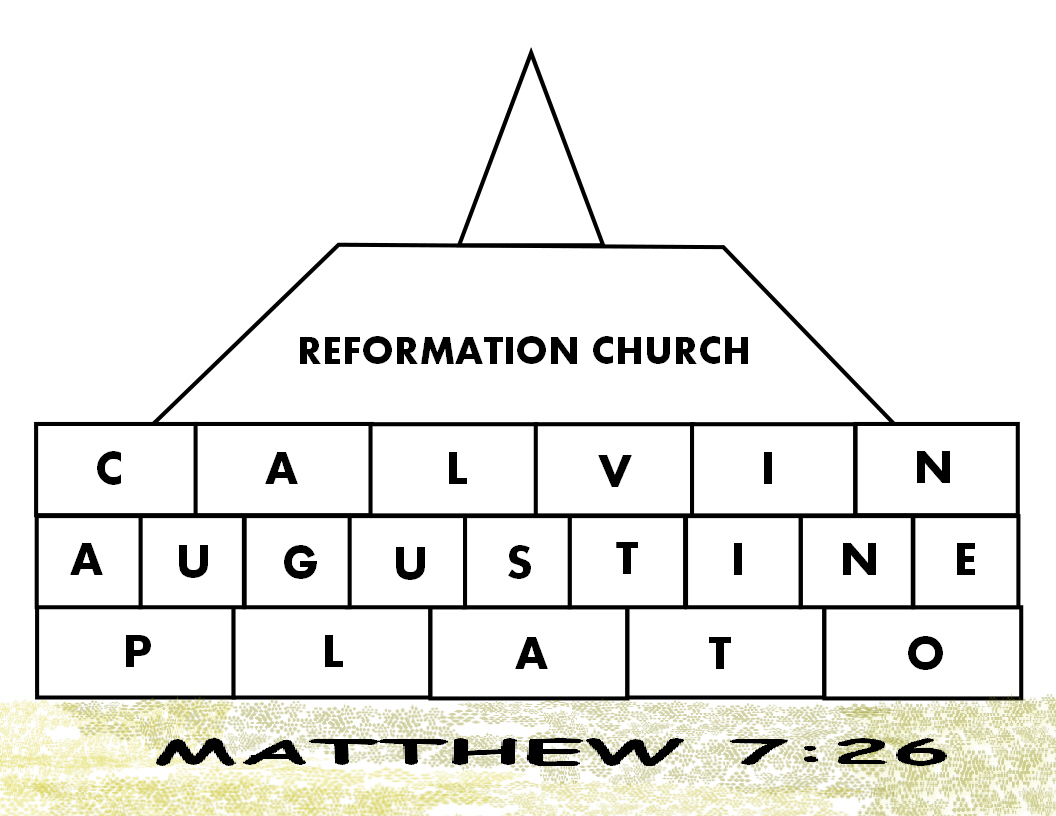

 Paul's Passing Thoughts
7 comments