Prelude to Louisville: Calvinism’s Life Application

Thanks for joining us today as we take a deeper look at the doctrine of Calvinism and its life application. From time to time, I look through the site stats of Paul’s Passing Thoughts blog and examine what people are reading. Much of it is older posts, and one particular post caught my attention. In the comment section of the post, I referred a reader to a post on The Gospel Coalition Blog titled Imperatives – Indicatives = Impossibilities: Justin Taylor; 11:11 pm CT | May 3rd, 2010. I referred the reader to a comment on that post, and as I reread it yesterday, the implications hit me right between the eyes. The comment follows:
It’s not that complicated: the ground of all Christian obedience is the faithfulness of Jesus Christ. Justification occurs EACH time a believer confesses and receives forgiveness for his sins. The pattern of justification is illustrated by Paul in Romans 4. Abraham believes in the God who justifies the ungodly (in this case gentile Abraham), David is forgiven for his adultery and murder. God’s condemnation for sin has reached into history at the cross, glorification has reached into history at conversion where believers experience a foretaste of glory. Neither Old or New Covenant obedience require moral perfection, they both require obedience of faith….so, having been justified from faithfulness we have peace with God! (Bruce Russell: May 4, 2010 | 11:02 am).
Of course, I pointed out the problem with justification reoccurring every time a Christian repents, but a second look at this comment opened my eyes up to something else that I couldn’t see before: in the seven years that I have been researching the Reformation gospel, I have never seen a more concise statement concerning Calvinism. Other than our often heard outcry against perpetual resalvation, no distinction between repentance as a son and repentance unto salvation, and the necessity of Christ’s obedience to the law being applied to the Christian life, and thereby keeping Christians under law rather than under grace,* we see the perpetual experience of glorification in the here and now.
This was a major eye-opener for me because it connected the dots accumulated over the past seven years: prior, I thought Calvinism was only guilty of fusing justification and sanctification together; now I see that Calvinism fuses justification, sanctification, and glorification together into an initial salvation experience, and then propagates the idea that the experience of the three is perpetually magnified until the day of judgment IF we live the Christian life by faith alone. That’s Calvinism. We will demonstrate this by using their own contemporary illustrations and will also explain the supposed life application as well.
Let’s start with the well-known Cross Chart illustration:

Obviously, the cross getting bigger is the good thing. Calvinists have another chart they use that demonstrates the deficient Christian life:

What does the cross symbolize in these two charts? It symbolizes “the glory of the gospel” as opposed to the glory of man; viz, any man including Christians. In Calvinism, there is no in-between; to the degree that we are recognized in any way, the cross is diminished. This is right out of Martin Luther’s Disputation to the Augustine Order which is the foundation of the Reformed gospel. Calvinism is founded on the principles that flow from Luther’s cross story verses man’s story, or the glory story.
If mankind, including Christians do not remain totally depraved (the T in TULIP), the cross (“Christ’s doing and dying”) is diminished. Hence, as you can see, the bottom trajectory of the cross chart must keep going down or the gospel is diminished before the world. Let’s now look at one of our own illustrations that explains this further:

Starting at the left, we basically have the Cross Chart. By using the Bible to see our depravity in a deeper and deeper way, it shows us our continued need for the same faith and repentance that originally saved us. As we see our depravity more and more, it amplifies the holiness of God (the upward trajectory). This leads to a deeper and deeper realization, and appreciation of how much we still need God’s grace (salvation). This leads to “rebirth” symbolized at the top of the cycle by the cross. This is part of Calvinism’s systematic theology known as mortification and vivification. The larger crosses exemplify vivification as we will demonstrate with the next illustration:
 So, with vivification, an increased joy is experienced along with an increased experience of our future glorification. This is a perpetual “living out of our baptism”** It “requires a daily dying and rising.” † This is why Calvinists like John Piper are adamant that the Christian life is predicated by joy; if not, it could mean vivification is not being experienced. Note that “obedience” is redefined as “faith” or the “obedience of faith.” Legitimate faith is narrowed down to living the Christian life by the same faith alone that saved us, or “living by the gospel.” Preaching the gospel to ourselves every day is not just a better way to be sanctified; it’s a critical practice in order to “stand in the judgment.” Note in the above chart that we will supposedly be judged on how well we did in living out our baptism in order to keep ourselves saved. Notice also that this reduces the Christian life to an EXPERIENCE only. We will summarize this point with the following illustration:

Calvinists would base assurance of salvation on the degree to which vivification is experienced in the Christian life. To the degree that you experience the future glory, you are convinced that you will in fact be glorified.
This necessarily encompasses a discussion on perseverance of the saints (the P in TULIP). Calvinists believe that the race of faith is a race for the reward of salvation as opposed to many Christians, if not most, who believe the race of the Christian life is for rewards, not salvation. In Reformed thought, the reward is clearly salvation and not rewards for work done on behalf of the kingdom. This is expressed in the already and not yet doctrine of Reformed theology. The full potential of glorification awaits us at the end of the race, IF we run the race by faith alone; viz, mortification and vivification. They would deny that this is works salvation because we are living by the same gospel that saved us, and we were saved by “faith alone.” Calvin believed that there are the elect, and then within the elect, there are those gifted by God to persevere by faith alone. So called “election” only qualifies you for the race, and the ability to finish the race is a gift.††
I would like to now enter in another Calvinist illustration into the discussion:

This is the Cross Chart turned up. The left slope is the downward trajectory on the Cross Chart; i.e., mortification and deep repentance. The right slope is Christ’s doing and dying.
Vivification is illustrated by the cross staying the same size, but likened to “changed heart.” This is a major element that we will soon examine. We have discussed double imputation (see right slope), and the “union with Christ” remains as long as we live by mortification and vivification. This is what “keeps us in the love of Christ.” The next Calvinist Illustration will help us understand the heart change angle on vivification:
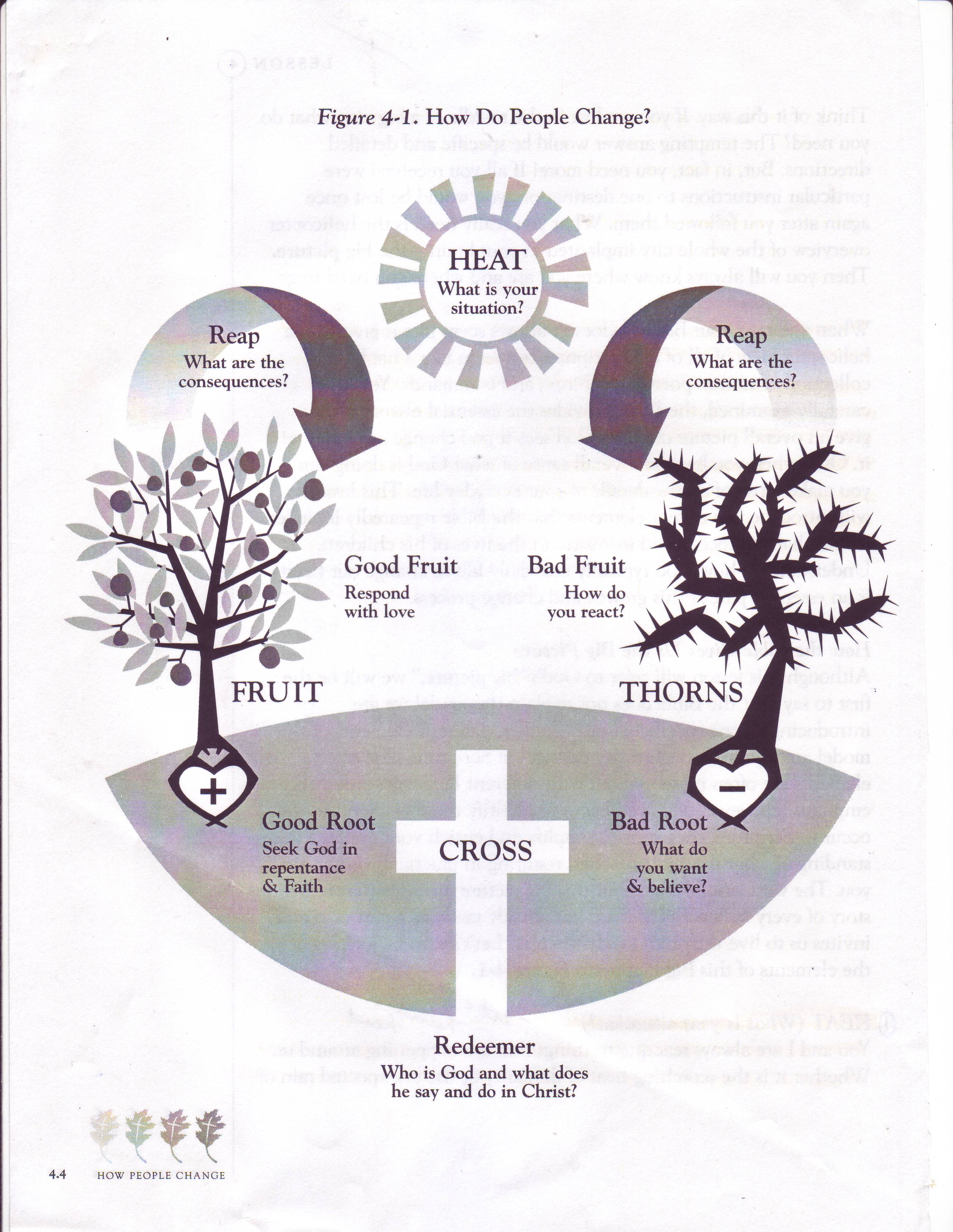
Notice the two hearts that represent the two trees in this illustration. These two trees represent the regenerate heart and the unregenerate heart, but in BOTH cases the hearts are still totally depraved and utterly wicked. The ONLY difference is the ability to EXPERIENCE vivification. Behavior or the “fruit” is determined by the root of the tree. But in both cases, the soundness of the root is determined by either the glory story or the cross story. The root of the left tree is still wicked and sees the need for, “repentance and faith” regarding the redemptive work of Christ illustrated by the cross at the bottom of the illustration. The tree on the left still needs redemption. This is Luther’s Simul iustus et peccator: “At the same time righteous and a sinner.” You remain a totally depraved sinner, but you are considered righteous because you live by the same gospel that saved you resulting in perpetual justification.
The tree on the left is concerned with, “What do you want & believe?” In other words, the glory story. But please note: the determining factor of both trees is RESPONSE. Vivification is our rebirth experience, but the cross is glorified (made bigger while we are made smaller) when the world sees our responses to the HEAT illustrated by the sun at the top of the chart. The vivification experience is for us, the response to the sun (representing the sovereign will of God) glorifies the gospel to the world.
This seems to make perfect sense because in Reformed thought all of history is a gospel narrative. In other words, all events from the major to the minor are for the express purpose of glorifying God and His gospel. All of these events are predetermined by God and totally out of our control. In essence, all of reality is a gospel narrative. This enables “Christians” to disassociate themselves with reality and view it as a preordained redemptive narrative which is signified by the sun in the above illustration. When the world sees our astounding RESPONSE to the tragedies of life, God is supposedly glorified, but what is really going on is a mentality that doesn’t take reality seriously because it is merely a narrative preordained to glorify God. Hence, life is mostly an illusion. An example is the quotation following:
What, then, is the subjective power of this message? Firstly, we find that there is real, objective freedom, the kind that, yes, can be experienced subjectively. We are freed from having to worry about the legitimacy of experiences; our claims of self-improvement are no longer seen as a basis of our witness or faith. In other words, we are freed from ourselves, from the tumultuous ebb and flow of our inner lives and the outward circumstances; anyone in Christ will be saved despite those things. We can observe our own turmoil without identifying with it. We might even find that we have compassion for others who function similarly. These fluctuations, violent as they might be, do not ultimately define us. If anything, they tell us about our need for a savior (David Zahl and Jacob Smith: The Subjective Power of an Objective Gospel; Mockingbird blog | July 12, 2011).
Since we are totally depraved and can do no good, we are released from all responsibility other than seeing our need to be saved in a deeper and deeper way. This is much easier than real change. As for the rest of life, I think the prior quotation speaks for itself. As far as the milieu of life in general, Luther and Calvin both prescribed an attending to good works with fear lest we think that the good work was done by us. All good works are only experienced by us in the same way that we experience the rain; it is all a work of God totally beyond our control—we only experience it. This is why some Calvinists even recommend a “repentance from good works.” Indeed, according to Calvinists, our own efforts will be mingled and confused with God’s work, but that is ok if we fearfully repent of any thought that we did the work, hence…
What must we do, then, to be saved? To find God we must repent of the things we have done wrong, but if that is all you do, you may remain just an elder brother. To truly become a Christian we must also repent of the reasons we ever did anything right. Pharisees only repent of their sins, but Christians repent for the very roots of their righteousness, too. We must learn how to repent of the sin under all our other sins and under all our righteousness – the sin of seeking to be our own Savior and Lord (Tim Keller: The Prodigal God).
And…
When we think, desire, speak, or act in a right way, it isn’t time to pat ourselves on the back or cross it off our To Do List. Each time we do what is right, we are experiencing [underline added] what Christ has supplied for us. In Chapter 11, we introduced some of the fruit Christ produces. We will expand the discussion here (Paul David Tripp: How People Change Punch Press 2006; p. 215).
So, the “Heart Changed” nomenclature on the Up the Slope of Faith chart is connected to the cross via dotted lines because the “changed” heart is in regard to the amplified experience of vivification. Our hearts remain wicked, and are only “transformed” in regard to a capacity to experience vivification. The milieu of life is a preordained gospel narrative that aids us in these vivification experiences. The fruits of life come from one tree or the other, the cross story or the glory story. So, the Bible and life events are the two things that increase vivification which is the Calvinist definition of change.
What is specifically wrong with all of this? First and foremost, it fuses justification, sanctification, and glorification together and makes all three progressive. As you can see by the following illustrations, that necessarily involves us in the justification process.


If we are involved in the center links of justification, sanctification becomes a spiritual minefield that could keep us from finishing the race of salvation. This installs the Reformed elder in a strategic position that is critical to our salvation; viz, Calvin’s power of the keys doctrine. Calvin believed that sins committed in the Christian life separate us from grace, but forgiveness that reinstates justification can be found by elder absolution within the institutional church. Hence, faithfulness to the institutional church greatly enhances your chances to stand in the judgment.‡ That’s the problem, a linear gospel is a salvation by works gospel even if Calvinists have come up with a formula that redefines certain works as faith alone. Furthermore, as with all works salvation gospels, an additional mediator is tossed in other than Christ.
Unless salvation is a FINISHED work totally separate from sanctification, the Christian must live in fear of the coming judgment, and that is exactly what Calvin and Luther both prescribed. Calvin taught that the Christian life must be attended with “grief of soul and terror” in regard to the coming judgment (mortification).‡‡ Clearly, the Apostle John and the Hebrew writer refuted the idea that fear of judgment has a place in the life of the Christian. This becomes the focus and not the utilization of gifts granted to the believer in service to the Master. Christ addresses this very approach to salvation in the Parable of the Talents. A right perspective on justification leads to aggressive obedience in sanctification because justification is a settled issue.
Calvinism is nothing new. One can see its like tenets being addressed throughout the New Testament as false; e.g., the issue of faith without works that we perform (James 2:14ff). Calvinism virtually upsets every element of biblical truth and redefines the new birth as mortification/vivification, obedience as new obedience, repentance as deep repentance, the finished work of salvation as progressive, and makes no distinction between repentance as a son versus that of the unregenerate.
Therefore, its life application will not glorify God in any way, shape, or form.
Notes
*If the law had to be kept perfectly in our stead, we are still under it. Who keeps it is beside the point. Furthermore, it implies that the law can give life in regard to justification. Both of these points are the antithesis of Pauline theology. This is a deadly take on double imputation by the Reformed camp.
**Dr. Michael Horton: The Christian Faith, A Systematic Theology; p. 661. Other terms for mortification/vivification are “deep repentance” and “new obedience.”
† Ibid.
†† The Calvin Institutes 3.24.6
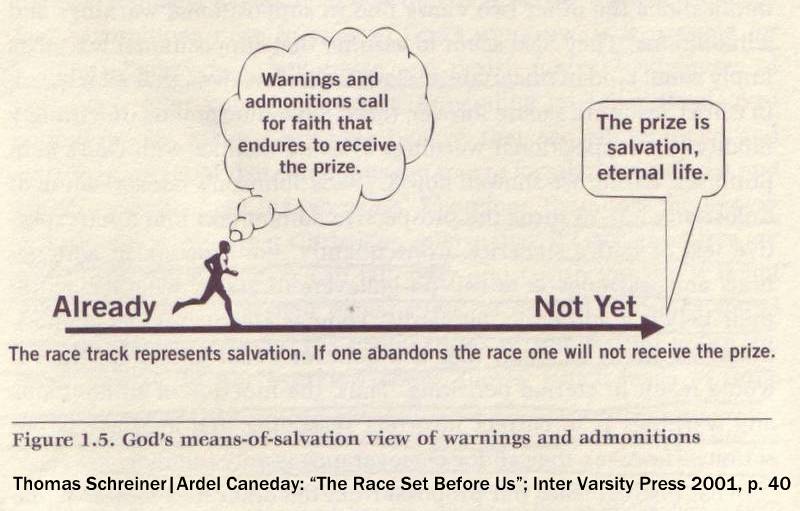
‡ “…by new sins we continually separate ourselves, as far as we can, from the grace of God… Thus it is, that all the saints have need of the daily forgiveness of sins; for this alone keeps us in the family of God” (John Calvin: Commentaries on the Catholic Epistles; The Calvin Translation Society 1855. Editor: John Owen, p. 165 ¶4). Also, The Calvin Institutes: 4.1.22.
‡‡ The Calvin Institutes 3.3.3-7.
Something More Virtuous than Reason and the Road to Holocaust
 Words mean things. This truism often espoused by the political icon Rush Limbaugh is a stalwart against holocaust that is much underestimated. The horrors of history are always paved with something more virtuous than reason and common sense. After all, in this world of shadows reason has an alien pure form, so why make much of reason?
We know the drill; the law was written on cold, hard tablets of stone while the “New Covenant” is an epistle written on the soft, fleshly heart. If you are really spiritual, you don’t live by “a bunch of do’s and don’ts.” The pure is beyond what we can examine with the five senses; “streets of gold” do not really suggest that there will be material objects in heaven, only the unlearned believe such things.
This is why pithy sayings vomited out by Calvinists dressed in the demeanor of Mr. Rogers should make our blood run cold. “Christ is not a precept, He’s a person.” “It’s not a riddle, it’s a redeemer.” Take note of these statements by Calvinist Paul David Tripp in the book, How People Change:
Jesus comes to transform our entire being, not just our mind. He comes as a person, not as a cognitive concept we insert into a new formula for life.
That good work begins in relationship to Jesus and is brought to completion within an ever-deepening union with him. This is the most unique aspect of a biblical view of change. It is not less than cognitive change; it is so much more…The Bible gives us more than exhortations and rules for change. The great gift Christ gives us is himself!
These truths are not just cognitive tools to adjust your thinking; they are intended to increase your love for Christ!
One of the first steps of any totalitarian state is to disarm the public. This is why in most countries the citizens can do nothing but watch when acts of unimaginable brutality are performed on innocent people. In fact, they are often forced to watch. But such governments first seek to disarm the public of their abilities to reason as well. In this respect, Calvinism and Islam have always led the way. Robert Ley, the Internal Education Minister for Adolf Hitler, stated the following in his famous speech, “Fate—I Believe!”:
Understanding sometimes is not enough to explain something. Only faith is sufficient. The Führer in Nuremberg said: “Woe to him who does not believe!” He who does not believe has no soul. He is empty. He has no ideals. He has nothing to live for. He has no sunshine, no light, no joy in life. He is a poor, poor man. What is wealth? What are possessions? What does it all mean? Problems come despite them, only faith is left. Woe to him who does not believe!
All of this is best summarized by the words of Rudolf Hess in his speech, “The Oath to Adolf Hitler”:
Do not seek Adolf Hitler with your mind. You will find him through the strength of your hearts!
Indeed. Before the mass graves can be filled, the public and the church must be disarmed of their reason.
paul
Has a Particular Path Unfolded for TANC?

My journey into the “justification by faith alone” doctrine of the Reformation started in 2006. By 2012, I established that it is far from being a justification by faith alone. I believe the Reformation is the biggest hoax ever perpetrated on mankind by the traditions of men and the kingdom of darkness. This is a simple matter of theological math. Calvin et al knew the doctrine doesn’t add up, so they implemented a system of orthodoxy to keep Christians dumbed down. I believe Calvinism has become the epic evangelistic mission field of our day.
Thanks to my wife Susan who has been the leading supporter of this ministry for three years, I have been able to devote myself to this ministry fulltime since 2011. I am undoubtedly the idea guy, while Susan and others associated with our ministry help me sort through those ideas and categorize them. We have tossed around numerous ideas in regard to getting the word out that we must repent of fearing man and turn to the Chief Shepherd. Glory to His great name. There is NO mediator between God and man other than Christ. As the Calvinist tsunami intensifies in our day, its leaders are becoming bolder in exemplifying Calvin’s power of the keys. This is a major concern.
I am also concerned with how this movement has turned up the heat recently in regard to aggressively promoting this doctrine through conferences that target the bread and butter of Christianity. These conferences draw thousands from all over America who then go back to local churches with these ideas. And these conferences are funded by God’s people. Most of the pastors who go to these conferences do so on the local church’s coin. Never before in church history has so much money been poured into a false cause.
Though seven years of research has been necessary in order to articulate the problems with this doctrine, our Lord also said to “go.” I was motivated to do just that in regard to the “Cross” conference in Louisville that targets Christian youth. I cannot stand by and let that happen without a fuss. This will be a test in regard to a possible path going forward for TANC; an evangelistic/educational ministry that takes this message directly to where people have gathered for these conferences. It’s a start; to make even one pastor stop and think before he takes these ideas back to the local church. And pastors are usually members of local church fellowships; even one pastor could make a huge difference. When will we begin to plead that Chrsitians start applying the brakes in order to think about where they are going? This takes the message from the blogosphere to the streets.
Furthermore, I am concerned with another upcoming pastor’s conference in February of 2014 that focuses on “the vine and the branches.” I believe this conference will turn up the volume on Calvin’s power of the keys doctrine. It will convince many young pastors that they are key mediators between their parishioners and Christ. This is greatly increasing instances of spiritual tyranny in the church. Consider the mentality being conveyed by notable Calvinist leaders to their younger understudies:
The spiritual life of any congregation and its growth in grace will never exceed the high-water mark set by its pulpit.
~ Steven J. Lawson
TANC receives many encouraging letters from people who stand with us. They rightly assess that it must be “a very lonely ministry.” However, that’s changing. People also write that they “feel powerless” to do anything about the tyranny of this movement. That is changing also. Let us be a voice for you in Louisville and Minneapolis.
The truth is a very powerful thing, and a little of it will bring down any formidable stronghold. We need your support for Louisville; ie., the printing of materials and travel expenses for the missionary team. If we can pull this off, Minneapolis is next.
TTANC, a nonprofit LLC
PO Box 583
Xenia, Ohio 45385
PayPal: mail@ttanc.com
Contact: mail@ttanc.com
Join the team!
paul

 Paul's Passing Thoughts
2 comments