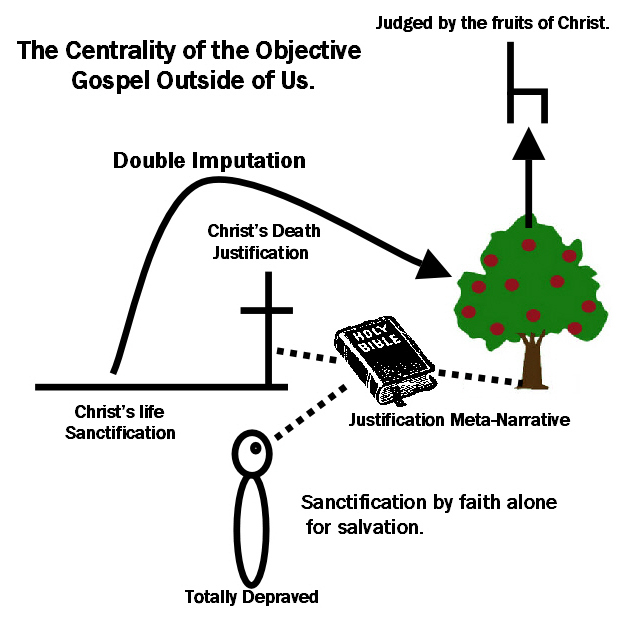

A Question of Law
I am pleased that the exodus gang is no longer bewildered by the discussion of law and gospel; obviously, this post has generated 106 comments and counting. The laity has begun dialoging full throttle on this issue, and that is really, really bad news for the New Calvinists—pun intended.
However, I would like to shortly address a hefty question by one of the participants. This question will be addressed in more detail at a later date along with the subject of atonement which we find to be another serious Achilles’ heel for Calvinism—new and old. Here is the question:
Ok, not to throw a monkey wrench into the mix but I would love to hear from folks here what they think this passage is telling us in context of the entire book:
12 All who sin apart from the law will also perish apart from the law, and all who sin under the law will be judged by the law. 13 For it is not those who hear the law who are righteous in God’s sight, but it is those who obey the law who will be declared righteous. 14 (Indeed, when Gentiles, who do not have the law, do by nature things required by the law, they are a law for themselves, even though they do not have the law. 15 They show that the requirements of the law are written on their hearts, their consciences also bearing witness, and their thoughts sometimes accusing them and at other times even defending them.) 16 This will take place on the day when God judges people’s secrets through Jesus Christ, as my gospel declares.
Especially verse 15!!!
Ok, I have to go meet someone shortly in regard to the facility we will be renting for TANC 2014, but I am compelled to address this question with at least a short volley.
When we get past Calvinist propaganda about the Jewish leadership of that day, and also have a working understanding of justification and sanctification, this passage is fairly easy to understand. The subject is Jewish religious academia as set against the Gentiles Paul is writing to. The Jews are the ones who have the law. The unsaved Gentiles will parish without the law and will be judged by the law written on their hearts. ALL people born into the world have the works of God written on their hearts. Unsaved people who know nothing of the Bible will be judged by that law.
However, the Jews will be judged by both. And, and this is a big AND, the Jewish rendition of the law, especially among the Pharisees, was antinomian in nature. They were experts at relaxing the law. While priding themselves at, “We have the law” and looking up their noses at the Gentiles, the Gentiles were better at following the law written on their own hearts than the Jews were at obeying the law God entrusted them with. The Jews believed, like Calvinists, that the law was the standard for justification/righteousness; therefore, they dumbed it down with their tradition because obviously it can’t be kept perfectly (primarily salvation by circumcision).
But, and this is a big, BUT, what they missed is that when the law is separated from righteousness, the saved person zealously pursues the “law of liberty” in love. So, and this is a big, SO…
For it is not those who hear the law who are righteous in God’s sight, but it is those who obey the law who will be declared righteous.
The Pharisees were only hearers of the law and not doers, just like the Calvinist prognosticators of gospel contemplationism in our day. A believer will be justified apart from the law because his/her life zealously pursues its truth out of love.
Moreover, the unsaved will be judged by law because they are still under it. The saved will not be judged by the law, their works will be evaluated to determine rewards. The Jews will be judged by both laws; those without the law will be judged for violating their consciences that administer the law written on their hearts.
Gotta go. Sorry for the typos.
paul
Calvin’s False Gospel: On the Wrong Side of the Law; Galatians 3:15-25
 “If Christ had to keep the law perfectly, or if you will, fulfill it, the inheritance no longer depends on The Promise, but God in His grace gave it to Abraham through The Promise.”
“In a manner of speaking, Moses’ law was useless until Christ died. It was a will that promised an inheritance, but without the death of its testator, there is no inheritance; namely, eternal life. So why would Christ have to fulfill the law through obedience? His death alone resulted in the inheritance. Obedience to a will does not fulfil it, only death fulfills it. A will is a promise fulfilled by death only.”
The reason Calvinism is a false gospel is simple and glaring; Calvin was on the wrong side of the law. In fact, Calvin constructed the exact soteriology that the apostle Paul continually railed against. Simply stated, Paul sought to separate law from justification while Calvin sought to fuse law with justification.
Calvin condoned this by making Christ’s perfect obedience to the law part of the “atonement.” This is another caveat we will be discussing: Calvin also misused the word “atonement” and seems to have had a fundamental misunderstanding about what it is. As good Protestants we think of atonement as being central to the cross, and indeed it is VERY important, but not central. I will explain this further along—how Calvin’s understanding of atonement makes the L in TULIP an oxymoron.
Calvin made perfect law-keeping justification’s standard; Paul said, NO! law has nothing to do with being justified whatsoever! Calvin said Christ fulfilled the law for us, and His perfect obedience was imputed to us along with His personal righteousness. Hence, we are righteous positionally, and also righteous factually. Therefore, the “atonement” is a “covering”—no matter what the Christian does, when the father of wrath looks at us, He only sees Christ’s “doing and dying” and not anything we do. This is part and parcel with Martin Luther’s alien righteousness construct as well. It seems logical until you start reading the Bible. But this makes the concept of “covering” very important to the Reformation.
Also, this construct leads to various and sundry formulas for sanctification in which we conduct ourselves in a way that continually reapplies the “doing and dying” of Christ to our lives as opposed to “anything that we do”…and a lot of confusion following. And unfortunately, the elder’s soft whispering in our ear that says, “just trust us” as well. That’s not a good idea.
Let us now examine Galatians 3:15-25 to make these points:
15 Brothers and sisters, let me take an example from everyday life. Just as no one can set aside or add to a human covenant that has been duly established, so it is in this case (NIV).
Really, the crux of Christianity is the covenant God made with Abraham. EVERYTHING goes back to that. God’s complete plan for the ages is bound up in “The Promise.” That is another name, really the formal one, for the Abrahamic Covenant: “The Promise.” One must understand that Reformed theology and Calvinism in particular, is a complete deconstruction of biblical truth and the gospel. Reformed theology holds to the idea that The Promise was conditional. The idea, especially among renowned Southern Baptists, that common ground can be found with Calvinism is the epitome of biblical illiteracy, and this is just one point among many: Paul makes it clear in verse 15 that The Promise cannot be changed or annulled. Furthermore, it does not depend on anything that man does as demonstrated by the fact that God put Abraham in a deep sleep during the ceremony that consummated this covenant.
16 The promises were spoken to Abraham and to his seed. Scripture does not say “and to seeds,” meaning many people, but “and to your seed,” meaning one person, who is Christ (NIV).
Verse 16 is very helpful in understanding something basic about all biblical covenants, here referred to by Paul as “promises.” In the Bible, “promise” is an idiom for “covenant.” The two words are used interchangeably. All of the “promises,” plural, are built upon the one “promise,” singular. All of the covenants build one big historical picture, much of it future, but all based on the one Promise. It is interesting to note that Paul identifies the formally unregenerate Gentiles of his day as alienated from the Promises (plural) of Israel (Eph 2:12).
Verse 16 also makes a distinction in Abraham’s national descendants and spiritual descendants. Abraham is the father of Israel, but not all descendants of Israel are of the “seed of the woman” which is Abraham’s spiritual seed. But be sure of this: that does not negate the promises to national Israel (see Jer 31:31ff.) and those who are of “faith” within national Israel. The point of verse 16 is that belief in Christ denotes the only seed that can give life by “faith” alone apart from anything else. That’s why Paul continues in this way:
17 What I mean is this: The law, introduced 430 years later, does not set aside the covenant previously established by God and thus do away with the promise (Ibid).
The Promise is by faith alone and is the only seed that can give life. The law, which came 430 years later, does not CHANGE anything in regard to The Promise. ALL life is in faith alone, or the seed of faith. One must simply believe. Faith gives life completely separate from the law. Let us expedite the point with verse 21:
… For if a law had been given that could impart life, then righteousness would certainly have come by the law (Id).
You may argue that law can further define righteousness after the fact, but it cannot give life. The law is completely separate from justification/righteousness. The fulfillment of the law by anybody, including Christ, does not impart life—only faith imparts life. A keeping of the law for “atonement” changes the promise:
18 For if the inheritance depends on the law, then it no longer depends on the promise; but God in his grace gave it to Abraham through a promise (Id).
If Christ had to keep the law perfectly, or if you will, fulfill it, the inheritance no longer depends on The Promise, but God in His grace gave it to Abraham through The Promise. So, why the law? Paul will tell us:
19 Why, then, was the law given at all? It was added because of transgressions until the Seed to whom the promise referred had come. The law was given through angels and entrusted to a mediator. 20 A mediator, however, implies more than one party; but God is one (Id).
Moses was the mediator of the covenant of the law given at Mt. Sinai, and the angels enforced its inauguration. This was the unimaginable apocalyptic scene that guaranteed lack of interference from the forces of darkness. In the book of Revelation, we have a description of how angels will be used of God to once again enforce this covenant. Even though the law was added, this was not the addition of another seed of faith; ie., Moses, but there is only one seed that signifies The Promise and the only seed that can give life. Moses’ covenant cannot give life.
So why the law? Now we can talk about, “atonement,” well, sort of. The law was a covering of sorts by way of a will. Under the Old Covenant, if you believed God, you were in the will and guaranteed the inheritance. Remember what Paul said in verse 18?
For if the inheritance depends on the law…
The Old Testament law was a will that protected believers until Christ came and died for our sins. In that sense, they were “covered” until Christ came. Christ is the mediator of a “better” covenant because Moses’ covenant only protected believers from the consequences of sin until Christ came. Moses was the mediator of the will, but Christ is the testator:
22 But Scripture has locked up everything under the control of sin, so that what was promised, being given through faith in Jesus Christ, might be given to those who believe [Note what we have discussed in prior essays: “Scripture” and “law” are synonyms].
23 Before the coming of this faith, we were held in custody under the law, locked up until the faith that was to come would be revealed. 24 So the law was our guardian until Christ came that we might be justified by faith. 25 Now that this faith has come, we are no longer under a guardian.
Hebrews 9:15 – For this reason Christ is the mediator of a new covenant, that those who are called may receive the promised eternal inheritance—now that he has died as a ransom to set them free from the sins committed under the first covenant.
16 – In the case of a will, it is necessary to prove the death of the one who made it, 17 because a will is in force only when somebody has died; it never takes effect while the one who made it is living. 18 This is why even the first covenant was not put into effect without blood. 19 When Moses had proclaimed every command of the law to all the people, he took the blood of calves, together with water, scarlet wool and branches of hyssop, and sprinkled the scroll and all the people. 20 He said, “This is the blood of the covenant, which God has commanded you to keep.” 21 In the same way, he sprinkled with the blood both the tabernacle and everything used in its ceremonies. 22 In fact, the law requires that nearly everything be cleansed with blood, and without the shedding of blood there is no forgiveness (Id).
In a manner of speaking, Moses’ law was useless until Christ died. It was a will that promised an inheritance, but without the death of its testator, there is no inheritance; namely, eternal life. So why would Christ have to fulfill the law through obedience? His death alone resulted in the inheritance. Obedience to a will does not fulfil it, only death fulfills it. A will is a promise fulfilled by death only.
Moreover, in regard to justification, it would seem that the point of the Old Testament law was the temporary imputation of sin, and not the need for a righteous fulfillment. The law imputes NO righteousness, but in regard to justification was a “covenant of death” (2Cor 2:12, 3:6,7). More than likely, the idea is a will of death because it required a death, and can only bring death to those who attempt to be justified by it. Therefore, Christ was the “end of the law for righteousness.” If the definition of “sin” is lawlessness (and it is, see 1John), Christ didn’t merely cover sin—He ended it.
This brings us to “atonement” and the whole “covering” idea. First of all, it is likely that Christ was not crucified on the Day of Atonement because that day has exclusive Jewish cogitations for the future. It’s Jewish eschatology. It is the day when the sins of Israel are cleansed and they are restored as a nation:

(Online source: http://www.hebrew4christians.com/Holidays/Fall_Holidays/Yom_Kippur/YomKippur.pdf )
Secondly, atonement doesn’t allude primarily to “covering,” but rather an exchange:
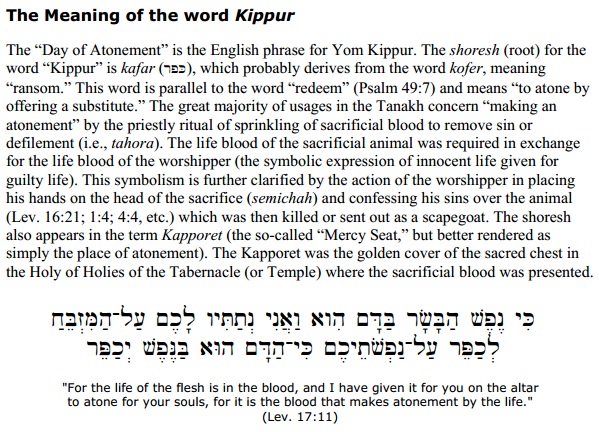
(Ibid).
Therefore, the idea of a “limited atonement” makes no sense at all. First of all, the limitation would only pertain to Israel. Secondly, in regard to Calvin’s overall soteriology, “covering” is only a plausible rendering of atonement; covering versus exchange must be weighed in the balance. In Calvinism, a covering over of our wickedness by the righteousness of Christ is feasible, but what about an exchange of death for life, and sin for righteousness? In the end, what is the passing from death to life? (1Jn 3:14). If we are only covered and not changed, that must be interpreted as mere realm transformation that is only experienced, or the allegory of choice that fits a preferred presupposition.
It’s ironic, even camps that reject the Calvinist label buy into the Calvinist idea of atonement. More buy into the idea that Christ had to keep the law for us. Even more buy into the idea that we are merely covered and not changed: “We are all just sinners saved by grace.” “When God looks at us, He only sees Christ.” We have all said these things.
This is a fundamental misinterpretation of the law’s relationship to grace. And that must change; we mustn’t be on the wrong side of the law.
paul
Why ACBC Christian Counseling Cannot Help People: Bad Soteriology; Revised and Edited
Note: ACBC; Association of Certified Biblical Counselors
Predominate in Christian circles is the idea that Christ’s death on the cross “covers” the sins that we commit as Christians. This not only sounds logical, but is something I bought into most of my Christian life. One of my favorite Christian songs, formally, states the following:
I know someday I will be free
The weight of sin shall be released
But for now He covers me
In a lesson taught by counseling guru Martha Peace (ACBC advocate and speaker), she states the following:
The Bible teaches us that when God saves someone, he cleanses them from their sin – past sin, present sin, and future sin as the Lord Jesus Christ “bore our sins in His body on the cross” (1 Peter 2:24).
Let’s think about this for a moment. If Christ died for our future sins, does this not necessitate the reapplication of His death to sins committed by Christians? Whether your answer is “yes,” or “no,” that is the assertion and logical conclusion of the soteriology that dominates the American church in our day: Calvinism. Furthermore, it is the soteriology that dominates the present-day Christian counseling culture.
The result is the biggest scam ever perpetrated on Christianity since a counseling session between Eve and the serpent. Christians en masse go to “Christian” counseling centers for personal change, but most often, they are being counseled by those who believe most Christians are not ready for the hard truth of the Protestant Reformation gospel: people don’t change; people can’t change; they can only glorify the works of Christ in the gospel while experiencing joy in the midst of circumstances no matter what they are. It’s reversed self-esteem: feeling good about ourselves because we are doing good is sin, but feeling good because we are totally depraved is God’s glory. We see a hint of this in the aforementioned lesson by counseling queen Martha Peace:
This aspect of Sanctification begins at the moment God saves you and “progresses” throughout the rest of your life. It is a life-long process of being transformed into more of Christ’s image.
Notice that we don’t really change, but are “transformed” into an “image” of “Christ.” Do we change personally as new creatures in Christ, or are we merely transformed into an “image”? Though Peace’s lesson is peppered throughout with lingo suggesting a colaboring with God in sanctification, her deception, whether deliberate or witless, is revealed in her citations of the Reformed Mystic Walter Marshall:
True holiness understands that we are by nature totally powerless and unable to live a holy and righteous life that God requires [viz, perfect law-keeping].
Notice that “true holiness” is NOT something we DO, but something that we “understand.” In a myriad of Protestant contemporary writings, sanctification is framed as an “experience” and a “knowing.” The DOING aspect is continually fustigated in clever ways that suggest well-doing in sanctification necessarily equals an attempt to earn our justification (because a requirement of perfect law-keeping remains as the standard for justification; not the new birth and God’s indwelling seed). And this, my friends, is the crux of the soteriological issue. If Christ’s death must be applied to Christian sins, the logical conclusion is that justification is not a finished work and further atonement is needed for future sins. This makes the “means” of holiness in sanctification critical. And what are those means? Peace continues:
True holiness understands that God will not help you live a holy life unless you use the means God has given you to pursue this holy life – salvation and sanctification that will give Him all the glory.
Notice that “salvation” is the “means.” Hence, the same salvation that justified you also sanctifies you. Does that sound familiar? And that’s Calvin as well. I wish not to belabor the point as I cite the Calvin Institutes extensively to establish this fact, especially in It’s Not About Election and The Reformation Myth. If you wish, you can read 3.14.11 in the Calvin Institutes for a primer. It is basically preaching the gospel to yourself daily in order to keep future sins “covered” by Christ’s death on the cross.
So, what makes this sanctification covering biblically illogical? Primarily, a proper understanding of biblical law and gospel. Again, I have written extensively on this and do not wish to belabor the point, but will summarize it.
Christ died for sins committed “under the law.” “Where there is no law, there is no sin.” Unbelievers are “under the law” and “enslaved to sin.” Believers are “under grace” and “enslaved to righteousness.” Along with the contrary slaveries, there is also a freedom to do the contrary. No unbeliever sins perfectly, and no believer obeys perfectly. Even though Christians sin because they are free to succumb to the desires of the flesh, Christ is the “end of the law,” and therefore there is “no condemnation.” Clearly, again, CLEARLY, in Protestantism, the so-called “believer” remains under the law and its condemnation.
Furthermore, the old self that was under the law was crucified with Christ and no longer lives; so, see Romans 7, the new us is no longer married to the old us that was under the law. But unbelievers are still under the law, and will be judged by that written law and the law of conscience—that will not go well.
Believers are righteous even as they are righteous—they have God’s seed abiding within them (see 1John 3). Regardless of being clothed in humanity, believers are truly righteous beings who are able to please God by their obedience (see Romans 8). Sin resides in our mortality and weakness, but no longer enslaves us. However, all in all, our new direction is indicative of our righteousness while we are NOT judged by a perfect keeping of the law for we are under grace. “Under grace” is NOT being under the “righteous demands of the law” as the often heard buzz-phrase goes among Protestant pastors and elders.
Therefore, with proper biblical guidance, we are able to change in order to please God. We do not merely contemplate God’s grace and watch for a “transformation” of an “image.” Rather than depending on a finished work for a glory manifestation, we “move on to maturity” by learning how to “control our own bodies in holiness.” Contrary to Peace’s Reformed idea that the finished work of justification must continue to cover future sins by “revisiting the gospel afresh” (Michael Horton via Calvin), we apply God’s truth to our lives, and when we see the results, it makes us more and more sure of our “calling and election” because it indicates that we are no longer enslaved to sin and its desires. On the flip side, disobedience can cause a believer to doubt his/her salvation because they continually violate their consciences. Also remember that unbelievers are not concerned with assurance issues.
In contrast, Peace asserts in the same lesson, as Jerry Bridges and many others, that assurance comes from the belief that we can do nothing to please God in sanctification:
True holiness is produced in someone who is assured that they are forgiven and reconciled to God.
In other words, effort in sanctification supposedly shows that we are not resting in the continued salvific work of Christ. This is Calvin’s Sabbath rest salvation that I discuss in detail in chapter 4 of It’s Not About Election. In chapter 5, I discuss why this doctrine robs Christians of assurance. Biblical assurance comes from knowing that justification is a finished work that ended sin and its condemnation, not the idea that our sin is merely covered via “returning to the gospel afresh.” The ending of sin is good news, not a perpetual cover-up. In fact, many like Kevin DeYoung testify to the difficulty of assurance because, supposedly, the closer we get to God, the more we see how far we are from His holiness resulting in the need to be proclaimed saved by elders.
“But Paul, what about sins that we commit in our Christian life?” Well, we hate it, and therefore long to be saved from these mortal bodies of death, but we are not enslaved by it, nor can it condemn us. Assurance comes from the fact that justification and sanctification are totally separate; one is a finished work that ended condemnation, and the other increases our joy by an increased ability to please God by what we DO in kingdom living. We love God—He doesn’t love Himself by transforming us into an image of Himself IF we continue to live by faith alone in sanctification. James condemned that doctrine in his letter to the 12 tribes of the dispersion. Neither should we feel good about our supposed total depravity. Total depravity is not the source of joyful assurance because it increases our gratitude for our original salvation through a deeper and deeper understanding of how evil we are.
This, and many other reasons is why contemporary biblical counseling will not help Christians, but will rather destroy them.
paul

 Paul's Passing Thoughts
leave a comment