Calvinism: The Root of All Evil in the American Church
Originally published August 21, 2013
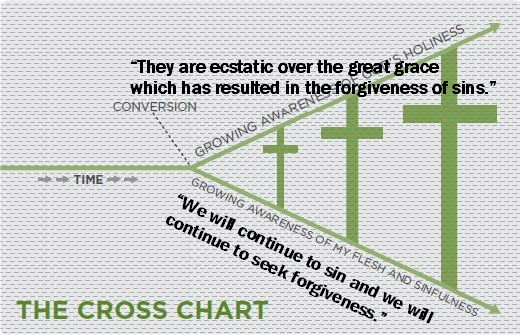
 “A devaluing of our own holiness for fear that it will eclipse the holiness of God, coupled with salvation being sought in the institutionalized…church, has led to the same indecencies seen in the mother of the Reformers; the Roman Catholic Church….Besides, the raped and spiritually abused should be thankful because what they deserve is hell anyway, right?”
Show me the Money.
Why has New Calvinism taken the American church by storm? Because the American church was already primed for it. Before authentic Calvinism was rediscovered by a Seventh-Day Adventist in 1969, America was, and always has been half-pregnant with the Puritan form of Calvin’s Geneva.
Calvinism makes everything about justification while excluding sanctification for a very simple reason: control. If justification is a finished work, and all that is at stake is eternal rewards in heaven, the church would not be nearly the institution that it is today. Why is there big money in religion? Why is there a church every two miles in America with a 500,000 dollar annual budget? Why did 3,000,000 people show up on a beach to see the new Pope? Why does the Catholic Church have so much power? Because salvation is big business my friend. If salvation is found in an institution, it will all but rule the world.
Plain and simple: the Reformers taught that the same forgiveness for sin that saved you needs to be continually sought out to maintain salvation (justification), and that forgiveness can only be found in the Protestant church. Sola Fide indeed, there is no money in sanctification; the big bucks are in justification. From a worldly perspective, Christ had a horrible business plan:
Go therefore and make disciples of all nations, baptizing them in the name of the Father and of the Son and of the Holy Spirit, teaching them to observe all that I have commanded you. And behold, I am with you always, to the end of the age.
There is no money or power in making disciples; the money is in making saved people and requiring them to be faithful to the institution in order to stay saved. In business, we call that RMR (reoccurring monthly revenue).
A finished justification and focus on discipleship empowers the individual, not the institution. Who the Master is—is a settled issue and the focus is preparing for His return by making maximum use of the individual talents given by grace. But when keeping our justification is the focus, individual responsibility to the Master is relegated to the closets. Come now, let’s be honest, how many Christians in the American church even know what their spiritual gifts are? How often do we see church “services” where we “encourage each other unto good works” as opposed to being there to “receive more Jesus.”
The Parable of the Talents is teaching about a servant who sought to only give back to the Master what he had originally received. And that is exactly what the Reformers promoted. Calvin et al believed that sanctification replaced the Old Testament Sabbath. We will make it to heaven if we “rest” in our salvation.
Enter a conversation I had with a brother not but two days ago:
Ya know Paul, this New Calvinism stuff is supposedly so great, but I have been a member of this church for ten years now, and what? Maybe five people have been saved in that time.
Exactly. Let’s face another fact, people aren’t being saved, if anything, they are just being shuffled around or convinced they were never saved to begin with. The reason for this is simple: Christ said to let our good works shine before men so that our Father in heaven would be glorified. That concept was anathema to Calvin. The fact that sanctification is a Sabbath rest should speak for itself.
The double myth of Arminianism.
Arminianism is another Protestant myth. It centers on the election debate, a doctrine that Calvinists don’t even believe to begin with. The Arminian/Calvinist debate is a double myth. Start thinking for crying out loud, what power and control would there be in election? There is no money in election either. Election portends a settled eternal destiny. If there is election, what do we need the institutional church for? “Election” only gets you into the race for “final justification,” but the race must be run in the church so that you can get your perpetual forgiveness that keeps you in the race. My friend, always follow the money. Always.
While arguing for free will versus total depravity, Arminians have always functioned like Calvinists. Since the Pilgrims Puritans landed on our Eastern shores, we have had Calvinism Lager and Calvinism Light. Arminianism is closet Calvinism. Both devalue sanctification. Calvinism completely rejects sanctification as “subjective justification.” Arminians give tacit recognition to sanctification while completely rejecting it by the way they function. The lager form proudly shows forth Calvin’s doctrine of ecclesiastical justification while Arminians live by John Calvin bumper stickers:
We are all just sinners saved by grace.
This is Calvin’s view of Christians remaining totally depraved while receiving justification in the present-continuance tense.
Just this week, I saw the following John Calvin bumper stickers posted by people who would vehemently deny that they are Calvinists:

This is based on Calvin’s Redemptive Historical hermeneutic and Luther’s Cross Story epistemology. The idea is that the Bible was not written for the purpose of grammatical exegesis, but rather to contemplate the redemptive narrative only leading to subjective, perpetual justification that is necessary to achieve “final justification.” Knowing the Bible factually is Luther’s Glory Story, knowing the Author is Luther’s Cross Story. In other words, every verse in the Bible is about justification and not wisdom for sanctification, the proverbial, “living by lists” and “do’s and don’ts.”
And….

Right, because sanctification is “subjective justification.” Any concern with our outward behavior is, as Calvinist hack Dr. Michael Horton states it, “trying to BE the gospel rather than preaching the gospel.” This fosters the very thing that makes Christianity contemptible to the world—preaching the gospel and not living it. It is the Sabbatical sanctification fostered by John Calvin himself and promoted by Arminians wholesale.
Calminianism is the real reality.
Sanctification?
So ok, the Bible has much to say about justification by faith alone, but where is this standalone subject of sanctification that is a different matter of Christian living altogether? One place among many would be 1Thessalonians 4:3ff:
3 For this is the will of God, your sanctification: that you abstain from sexual immorality; 4 that each one of you know how to control his own body in holiness and honor, 5 not in the passion of lust like the Gentiles who do not know God;
Obviously, sanctification is all about KNOWing HOW to control our bodies. And even more obvious is the fact that justification has nothing to do with that at all. And also obvious is the fact that the two aforementioned Calminian metaphysical bumber stickers totally reject this biblical definition. Let’s have another moment of honesty. How many Christians know more about controlling their body today than they did yesterday? And does that affect how the world sees us, and God?
Fusion and dichotomy.
Sanctification is a continued endeavor to learn more and more how to control our bodies from the Scriptures. Calvinism rejects that as the Glory Story. A focus on controlling our own bodies makes life about us and “eclipses the Son.” It fuses justification and sanctification together while dichotomizing anthropology. The opposite should be true in regard to both categories. Calminianism is an upside down Christian life.
Anthropological concepts; i.e., what makes people tick, are deemed pragmatic and unspiritual. Rather than seeing these subjects as wisdom where Christians ought to be outdoing the world, they are rejected as “living by lists” and “living by do’s and don’ts.” I like what one pastor had to say about those truisms:
They are telling us the following: “Don’t live by do’s and Don’ts.”
A prime example is something that everyone is born with: a conscience. The only Psychiatrist in history that really had a track record of helping people was O. Hobart Mowrer. The main thrust of his therapy was an emphasis on keeping a clear conscience. He believed that most mental illness was caused by a guilty conscience. He cured people by insisting that they deal with unresolved issues of guilt. Mowrer, once the President of the APA along with a long list of distinguished awards and appointments, wrote The Crisis in Psychiatry and Religion. The book rejected the medical model of Psychology and fustigated Christianity for relegating the care of the “mentally ill” to Freudian Psychology. Mowrer was not a Christian.
Nevertheless, he is the one who most inspired the father of the contemporary biblical counseling movement, Dr. Jay E. Adams, who applied Mowrer’s practical approach to biblical counseling. Adams did this because he observed Mowrer’s astounding results while doing an internship with him in the summer of 1965.
This only makes sense. The apostle Paul instructed Christians to “keep a clear conscience before God.” The Bible has much to say about the subject of conscience. Christians should use the Bible to be wiser in all areas of human practicality and should excel at it far beyond those who live in the world. Let’s have another honesty moment: how many sermons do we hear on the importance of practicality in the Christian life? Subjects such as, planning, accountability, etc. Unfortunately, these biblical subjects are dichotomized from the “spiritual” and deemed pragmatic.
At the same time, justification and sanctification are fused together in an effort to live out a Sabbatical sanctification; i.e., sanctification by faith alone. This is nothing new, James rejected the concept in his epistle to the 12 tribes of Israel that made up the apostolic church. It is also a Gnostic concept that sees the material as evil and only the spiritual as good. Therefore, since anthropology is part of the material realm, any practicality thereof cannot benefit the spiritual. Supposedly.
Another concept, along with conscience, is that of habituation. Through discipline, habit patterns can be formed that lead to change, ask anyone who has been in the military. People who inter the military come out as changed people. Because of our Protestant heritage and conditioning, these concepts seem grotesquely pragmatic. But according to the Bible, we are to make use of them.
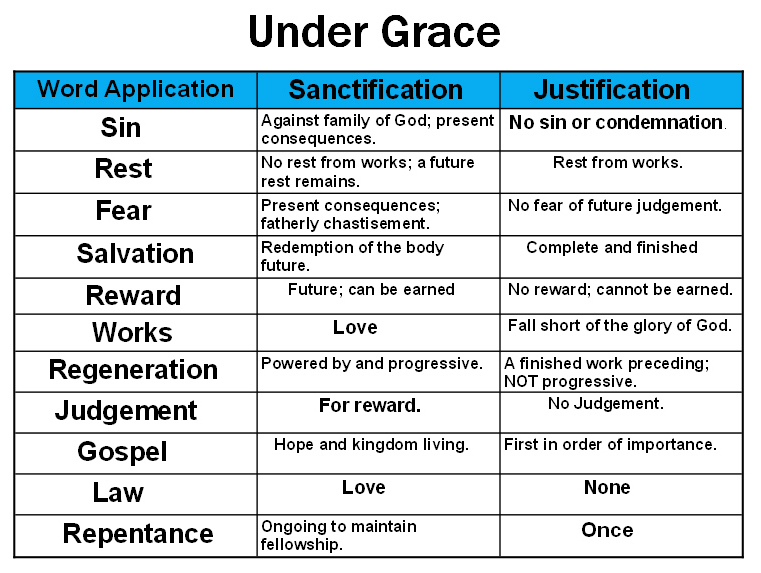
Sanctification is a many-faceted colaboring with the Holy Spirit, and the Spirit’s power is unleashed through wisdom and obedience (James 1:25). We must know assuredly that justification is a finished work, and absolutely nothing that we do in sanctification can affect it for better or worse. This is what purifies our motives in our love for Christ in sanctification. “If you love me, keep my commandments” has absolutely nothing to do with our justification. It’s for love only, not a working for justification. We are thankful for our justification, but that thankfulness doesn’t save us or keep us saved. Only Christ saves—the new creature now loves Christ because that’s who he/she is. Christ’s love made it possible for us to love Him in sanctification, but nothing in sanctification keeps us saved. Sanctification looks not for a “final justification,” but readies itself for the Master’s return and longs to hear the words, “Well done faithful servant!”
When I was a young boy, I often lived with my grandparents during the summer. My grandfather was a real-life John Wayne type. He worked as a construction foreman for a large company. And he was my hero. Before he left for work in the morning, I would sheepishly await for him to depart before beginning a flurry of tasks around their small farm. I would always have the tasks done well before his arrival home and waited at the end of the drive to hear his truck’s humming wheels come down State Route 125. I would then take him around the property and show him the finished tasks. His smile and compliments were my reward. These are tasks that I didn’t have to do; our love for each other was always something totally different from those tasks. I knew assuredly that he would love me whether I did those tasks or not because I was his grandson—his pride and joy. Some idea that the withholding of serving him in order to elevate the reality of his love for me would have been a ridiculous notion.
Justification and sanctification must be separate. Anthropology and the spiritual must be fused. Our bodies must be controlled and set apart for good works. This will lead to the showing forth of our good works and the glorification of the Father leading to salvation for others, not sheep redistribution.
Spiritual abuse and disdain for justice.
A devaluing of our own holiness for fear that it will eclipse the holiness of God, coupled with salvation being sought in the institutionalized Calminian church, has led to the same indecencies seen in the mother of the Reformers; the Roman Catholic Church. Rome has never repented of its abject thirst for blood, and the fruit does not fall far from the tree.
The family split for the time being, but the Reformers never departed from Rome’s ecclesiastical justification found through absolution by church leaders. When this is the case, any vehicle going to heaven will suffice for heaven’s sake alone. The institution will never be threatened for the sake of the few. To the leaders, their existence and power is threatened, to the parishioners, their salvation is threatened. The institution must be preserved.
This is no new thing, in the minds of the Jewish leaders; Jesus Christ was sacrificed to preserve the Jewish religious system. If even Christ Himself was expendable in this mentality, what will be of the molested and raped? Besides, we are all just sinners saved by grace anyway, right? Is justice therefore anywhere on the radar screen in this discussion? Hardly. Besides, the raped and spiritually abused should be thankful because what they deserve is hell anyway, right? Once this is understood, the landscape we see today in the American church should be no surprise whatsoever.
What is the answer?
The church is a sanctified body and not an institution for final justification. We are in the business of making disciples and not keeping people justified by faith alone in sanctification. The sanctified body doesn’t justify, it is God who justifies. Men must stop worshiping at the altar of ecclesiastical justification. Justification is free to us and finished, sanctification isn’t. Sanctification is where we show our love to the savior as servants, not leaches. Evil men like Paul David Tripp who posit the idea that the Christian’s whole duty is to “rest and feed” and wait for “new and surprising fruit” because Christians only “experience” fruit and don’t participate in it must be rejected with extreme prejudice. Their evil seed was spawned in 1970, but they have been in firm control of the American church for 25 years while proclaiming each year a “resurgence.” What do we have to show for it?
It is time for men and women to recognize their calling, their new birth, their indwelling counselor, their gifts, and the authority of Christ and His word alone. There is NO traceable lineage back to the apostolic church like the genealogy documents burned by Titus. Murdering mystic despots have no claim on any authority of the church.
Godly authority is continued wherever a spirit-filled Christian picks up a Bible and obeys its words. A church is a sanctified, obedient fellowship, not a justified institution drunk with its own visions of grandeur.
paul
Susan Dohse: Jonathan Edwards, Strange But True – 2015 TANC Conference: Session 2
The following is an excerpt of the transcript from Susan Dohse’s 2nd session at the 2015 TANC Conference on Gospel Discernment and Spiritual Tyranny.
I may be showing my age by asking this: who remembers Ripley’s Believe It or Not television show? It aired in 1985 and Jack Palance was its narrator. How about the museum at Niagra Falls? How about some of these believe it or not ideas Jonathan Edwards wrote about and believed?
Frank Viola’s blog helped me condense some of Jonathan Edward’s beliefs and kept me from jumping from one book or article to another collecting my specific thoughts. With his help, how about these shocking beliefs of Jonathan Edwards:
1) He was a strong advocate for Indian rights during his day. He was bitterly critical when New Englanders stole land from Native Americans, commanding them to pay for the land they took. The logical Reformed personality was a “social activist”? Peculiar isn’t it, since many contemporary Edwards followers turn their noses up at anything to do with social activism or social justice today.
2) “Edwards owned slaves and believed that being a slave-owner was NOT incompatible with being a follower of Jesus. While Edwards was an advocate of Indian rights and denounced the transatlantic slave trade, he himself was a slave owner.”
So, for “America’s greatest theologian” to own slaves and think it okay, is well, shocking, don’t you think?
3) Knowing how Calvinists hated Arminians and Arminians were mutual in their love for Calvinists, “Edwards did not believe that Arminians were disqualified from ministry or the Kingdom of God. He defended a pastor who had anti-Calvinistic views. The pastor (Benjamin Doolittle) was being denounced by his own church for owning a slave”. To defend an Arminian minister is “shocking to some hard-core Calvinists who believe that ‘unless you receive John Calvin into your heart, you cannot be saved’, or at least…”you are a heretic.”
4) “Edwards believed the Pope was the Antichrist; apologies to our Catholic friends.
This fact sobers popular notions that Edwards always interpreted Scripture correctly.
5) “Edwards believed that God hates sinners worse than you hate poison. Just read his sermon “Sinners in the Hands of an Angry God.”
6) “Edwards believed that the revival that was happening in 1740 was the prelude of the consummation of the ages where ‘the world would be renewed’ and that God’s great and last work on the earth began in America.
7) “Edwards believed that emotional outbursts that included bodily manifestations were normal during a revival…He explained that this was a human response in some people to the power of the Spirit.
8) “Edwards believed that mystical experiences were part of the Christian experience.” (Mystical meaning “…an experience that’s spiritual that goes beyond the faculties of the frontal lobe.”) “On one occasion, a vision caused him to weep aloud for almost an hour. He points out that he had experiences like this numerous times: ‘I have many times had a sense of the glory of the third person in the Trinity, in his office of Sanctifier, in his holy operation, communicating divine light and life to the soul.’”
Have you ever met a Calvinist who described a personal spiritual experience like this? Maybe, if you know a Charismatic Calvinist.
9) Edwards believed that God’s sovereignty requires that He create the entire universe out of nothing at every moment. (Frank Viola, “Shocking Beliefs of Jonathan Edwards”, November, 2014)
Watch all of Susan’s 2nd session below.
Ever heard of the 97 Theses? And is There Anything More Brainwashed than a Protestant?
 Funny how the Protestants of Western culture fancy themselves as being grounded in objective scholarship. Because of our supposed acute intellect that enables the Bible to kiss logic, light shines from darkness wherever the world is blessed with our storied missionaries proclaiming the “gaaaaassspul.”
Yes, we are supposedly soooo unlike those mystical misfits found in Eastern culture and third world countries. And this is such a lie; perhaps the biggest ever perpetrated on mankind in all of human history. Few Protestants have a clue what the Reformation was really about, and the churches have deliberately rewritten church history to keep parishioners in the dark. Arguably, Protestantism is the most pathetic super-cult ever conceived because its participants don’t even know what their faith really teaches; at least good Hindus have an accurate mental grasp on their religious tenets. The same can be said for those pesky Islamic extremists that we despise.
Point in case: most Protestants haven’t even heard of the documents that really formed the foundation of the Protestant Reformation. We have been deliberately conditioned to believe that Martin Luther’s 95 Theses and the 5 Solas form the doctrinal foundation of the Reformation. It’s deliberate deception.
It supposedly goes without saying that the Reformation was a logical and objective return to the authority of Scripture; ie., “Sola Scriptura,” etc. This is all a steroidal outrageous lie; the exact opposite is true. The Reformation was sparked as a pushback against the Catholic Church’s move towards logical theology. In other words, the Catholic Church was founded on Augustinian Platonic (Gnostic) principles, but in the 13th century, it began moving more towards theological tenets based on logic and objectivism. And Martin Luther would have none of it.
Let me sort of simplify this as much as I can. It is the difference between two schools; one states that man cannot know reality, and the other states that he can. The former one draws a strict dichotomy between the material realm and the invisible realm. In this one; that is, the former, the material realm is an illusion, or subjective. Human experience cannot yield knowledge, and empiricism is a lie or useless epistemology. This usually yields some form of theology that deems all things material as evil/knowable and all things invisible as good/unknowable. In other words, man can ONLY know the material/evil world. I contend that this religion was first introduced in the garden as the “knowledge of good and evil.” I contend that in the creation account God was emphatic that His creation is “good” for this very reason; He knew what was coming.
Part and parcel with this philosophy that has dominated human history is the caste system. Caste systems advocate a knowledge strata that demands rulership over the world for the sake of the collective good. Some force or god from the invisible realm preordains wisemen who aid mankind in making the best of existence in the evil material world. These are Plato’s philosopher kings, and the Catholic Church was structured accordingly. Monks were the ones that separated themselves from the world as much as possible to obtain wisdom from the invisible realm, and then passed their edicts on to the popes for implementation. Usually by force.
The Catholic Church started moving away from this philosophy and more towards the philosophy of Aristotle who believed that the material world is a valid reality.
THIS ALONE IS WHAT SPARKED THE REFORMATION. The rest is a lie dressed in biblical garb.
Far obscured from seminaries and the churches is true knowledge concerning the foundational Reformation documents written by Martin Luther in 1517 and 1518. The two primary documents that form the foundation of the Reformation are the Heidelberg Disputation, and the 97 Theses also known as “Disputations Against Scholastic Theology.” This was 97 disputations against…get this…the use of logic and reason in theology. In fact, the 97 Theses were written one month before the 95 Theses. Also, it is commonly thought that the Heidelberg Disputation, penned 6 months after the 95 Theses, only contains 28 theological theses. No, it contains 12 that are philosophical for a total of 40. In both cases concerning these foundational documents, the major theme is Plato versus Aristotle. This is irrefutable.
And the ignorance of Protestants is no accident—it’s deliberate. What we are seeing today in the New Calvinist movement is a return to Protestantism’s Platonic/Gnostic roots. In a shocking display of blatant deception, New Calvinist leaders claim that hordes of people are being drawn to the movement because they desire a more intellectual faith.
The fact is that it appears intellectual while denying all logic and reason in matters of faith. Perhaps the best example of how this functions is the New Calvinist claim that “Christians” are still “sinners” while the Bible uses that word exclusively for the unregenerate at least 70 times. Words, being objective and meaning things, don’t really mean anything. Truth comes from whatever the philosopher kings say they mean.
Regardless of these modern Reformers claiming a more logical faith, the opposite is true…and they know it.
paul

Calvinists: Going to Hell and Proud of It
Originally published January 5, 2015
“[T]he Bible is absolutely clear that ALL of those who will supposedly bark triumphantly at that judgment are among those already damned by virtue of the fact that they are standing at that judgment. That judgment is called the “second death” in Scripture; all who stand there are already damned. Yet, Calvinists constantly boast that they will stand in that judgment.”
 I hear it often, but I think this is the first time I have really parked on it and pondered; this whole thing with Calvinists being proud of the fact that they will “stand in the final judgment with no righteousness of their own.”
PPT logged a comment yesterday from “Frank” that once again proffers this idea with all of the delight of a newborn’s arrival into the world.
The Gospel very simple: God is holy and He is just, and I’m not. And at the end of my life, I’m going to stand before a just and holy God, and I’ll be judged. And I’ll be judged either on the basis of my own righteousness – or lack of it – or the righteousness of another. The good news of the Gospel is that Jesus lived a life of perfect righteousness, of perfect obedience to God, not for His own well being but for His people. He has done for me what I couldn’t possibly do for myself. But not only has He lived that life of perfect obedience, He offered Himself as a perfect sacrifice to satisfy the justice and the righteousness of God.
The great misconception in our day is this: that God isn’t concerned to protect His own integrity. He’s a kind of wishy-washy deity, who just waves a wand of forgiveness over everybody. No. For God to forgive you is a very costly matter. It cost the sacrifice of His own Son. So valuable was that sacrifice that God pronounced it valuable by raising Him from the dead – so that Christ died for us, He was raised for our justification. So the Gospel is something objective. It is the message of who Jesus is and what He did. And it also has a subjective dimension. How are the benefits of Jesus subjectively appropriated to us? How do I get it? The Bible makes it clear that we are justified not by our works, not by our efforts, not by our deeds, but by faith – and by faith alone. The only way you can receive the benefit of Christ’s life and death is by putting your trust in Him – and in Him alone. You do that, you’re declared just by God, you’re adopted into His family, you’re forgiven of all of your sins, and you have begun your pilgrimage for eternity.
That’s the simplicity of the gospel.
This is why we should in no wise be surprised that an Adventist theologian rediscovered the real Protestant gospel in 1970 which is predicated on this idea.
The SDA gospel focuses on being able to “stand in the final judgment.” So, the “Christian” life focuses on that; the endeavor of sanctification is to prepare for this one final judgment. For years, the mainline SDA take followed: beginning salvation takes care of past sin, and then the new “believer” labors with the Holy Spirit to become good enough to stand in the final judgment. Some substitution by Christ to achieve perfectionism was involved, but it required the best efforts possible by “believers” in order to warrant Christ topping off the difference with His own righteousness. The doctrine, known as the “investigative judgment” is extremely complex and downright confusing, but what I have stated here is the gist:
While the investigative judgment is going forward in heaven, while the sins of penitent believers are being removed from the sanctuary, there is to be a special work of purification, of putting away of sin, among God’s people upon earth.
Those who are living upon the earth when the intercession of Christ shall cease in the sanctuary above are to stand in the sight of a holy God without a mediator. Their robes must be spotless, their characters must be purified from sin by the blood of sprinkling. Through the grace of God and their own diligent effort they must be conquerors in the battle with evil.
Ellen White ~ The Great Controversy, chapter 24.
The understandable angst among the SDA faithful peaked in the 1950’s which spawned the Progressive Adventist movement. One of the major players in that movement was an Adventist theologian named Robert Brinsmead. Due to his intellectual prowess, he was able to plow through the writings of the Reformers and understand what their take was on the final judgment. Not only that, Brinsmead was, and I assume still is, a master communicator of ideas.
The message he brought to the SDA faithful follows: one is able to stand in the final judgment if they live their Christian life by the same gospel that saved them; i.e., by faith alone. If you do that, Christ will continue to cover you with His righteousness. If you disavow any righteousness of your own, and believe in being covered by the alien righteousness of Christ as depicted in the wearing of a white robe, you will be able to stand in the judgment.
So, let’s be clear: formally, the SDA as a whole advocated a do your best to keep the law and if you do that well enough Christ will completely cleanse you and declare you righteous. Then you will be able to stand in the judgment. What is the problem with that other than its fundamental falsehood? The SDA faithful had no way of knowing until the final judgment whether or not they did that well enough to warrant Christ’s complete cleansing.
Brinsmead traded that for what the Reformers advocated: rather than partaking in the heavy burden of law keeping, if one only lives by faith alone apart from the law, Christ will stand in the judgment for us. The one who lives their Christian life by faith alone will stand in the judgment covered by the righteousness of Christ apart from any righteousness of their own.
This spawned the Awakening movement which turned the SDA completely on its head. But not only that, it also spawned a return to the authentic Reformation gospel by evangelicals worldwide who had drifted away from it through a more literal interpretation of the Bible because literal interpretation is intuitive. In other words, that’s our natural bent.
The Reformers saw the Bible as a tool for continually returning to the same gospel that saved us by faith alone in order to keep oneself covered by the righteousness of Christ, and therefore making one able to stand in the final judgment.
A literal interpretation of the Bible suggests that God’s people are to work in sanctification, or the Christian life. That’s a problem because the Reformers saw the Christian life as the progression of salvation to a final salvation determined at a one, final judgment. Therefore, biblical imperatives must be interpreted in their “gospel context,” viz, God commands us to do things in order to show us we are not able to obey perfectly. Hence, many of the Reformed in our day suggest that a literal interpretation of the Bible is tantamount to works righteousness.
Again, let’s pause for some clarification: The SDA and the Reformers BOTH saw the Christian life as part of salvation culminating in a final determinative judgment. Both define justification, the state required to be saved, as an ability to keep the law perfectly. Both believe that a means of obtaining a perfect law-keeping as something accredited to our account for standing in the final judgment is paramount. The SDA believed that best effort law-keeping resulted in Christ topping off our account at the judgment. The Reformers believed that effortless living by faith alone resulted in being covered by the righteousness of Christ alone at the judgment. For example, John Calvin believed that the Christian life is the Old Testament Sabbath rest.
Luther described the believer’s “triumphant” declaration to God at the final judgment as, we have NO righteousness but Christ’s. This motif was once again echoed by Frank on PPT.
But there is only one problem; the Bible is absolutely clear that ALL of those who will supposedly bark triumphantly at that judgment are among those already damned by virtue of the fact that they are standing at that judgment. That judgment is called the “second death” in Scripture; all who stand there are already damned. Yet, Calvinists constantly boast that they will stand in that judgment.
Revelation 20:4 – Then I saw thrones, and seated on them were those to whom the authority to judge was committed. Also I saw the souls of those who had been beheaded for the testimony of Jesus and for the word of God, and those who had not worshiped the beast or its image and had not received its mark on their foreheads or their hands. They came to life and reigned with Christ for a thousand years. 5 The rest of the dead did not come to life until the thousand years were ended. This is the first resurrection. 6 Blessed and holy is the one who shares in the first resurrection! Over such the second death has no power, but they will be priests of God and of Christ, and they will reign with him for a thousand years.
7 And when the thousand years are ended, Satan will be released from his prison 8 and will come out to deceive the nations that are at the four corners of the earth, Gog and Magog, to gather them for battle; their number is like the sand of the sea. 9 And they marched up over the broad plain of the earth and surrounded the camp of the saints and the beloved city, but fire came down from heaven and consumed them, 10 and the devil who had deceived them was thrown into the lake of fire and sulfur where the beast and the false prophet were, and they will be tormented day and night forever and ever.
11 Then I saw a great white throne and him who was seated on it. From his presence earth and sky fled away, and no place was found for them. 12 And I saw the dead, great and small, standing before the throne, and books were opened. Then another book was opened, which is the book of life. And the dead were judged by what was written in the books, according to what they had done. 13 And the sea gave up the dead who were in it, Death and Hades gave up the dead who were in them, and they were judged, each one of them, according to what they had done. 14 Then Death and Hades were thrown into the lake of fire. This is the second death, the lake of fire. 15 And if anyone’s name was not found written in the book of life, he was thrown into the lake of fire.
In the Bible, there are multiple resurrections and judgments. Believers, who are already deemed righteous because they are in fact righteous, will be judged for rewards, not righteousness, because they are already righteous. They are resurrected to determine rewards, not righteousness. In the passage cited here, it is obvious that these are two different resurrections and two different judgments. One judgment has multiple thrones, while the other only has one throne and one judge. The latter judgment is the second death, and those who partake in the first resurrection are blessed. And, the latter judgment is identified as the one Calvinists say they will attend because it judges righteousness, and Calvinists, generally speaking, advocate a one judgment only position. Said another way, this is the only judgment they could possibly be talking about because there is only one according to them.
Why do they advocate a one judgment only when there is obviously more than one? Well, because that matches their gospel of beginning salvation, progressive salvation, and final salvation. It also matches the idea that perfect law-keeping is the required standard for being saved. If salvation is a settled issue that takes place for each individual in a moment of time, why would there be a need to finalize salvation at any other time? Also, there is only a future need to judge righteousness if perfect law-keeping remains the standard for Christians. If perfect law-keeping is not a determinative standard for Christians, the judge at the final judgment is without a law in which to judge righteousness. The judgment is without any law to judge.
In contrast, this is the case with the true gospel: the believer is made righteous through the new birth, and the law is ended for righteousness. The new birth is a gift, but like any gift, once you receive it, it belongs to you. This whole “righteousness of our own” business is a red herring. It’s like looking at someone living and besmirching them for believing they have a life of their own because they were born. We are righteous because we have the seed of God within our very being because of the new birth (1Jn 3:9). We still sin because the flesh is weak while our righteous soul is willing. It is sin against our Father, not our righteousness because Christ ended the law for that purpose.
This happened through the new birth. We were once under the law and its power to condemn us. Because we were unregenerate, sin within us used the law to provoke us to sin. When we died with Christ, it was like the death of a spouse—we are no longer obligated to that marriage covenant (law).
Or do you not know, brothers—for I am speaking to those who know the law—that the law is binding on a person only as long as he lives? 2 For a married woman is bound by law to her husband while he lives, but if her husband dies she is released from the law of marriage. 3 Accordingly, she will be called an adulteress if she lives with another man while her husband is alive. But if her husband dies, she is free from that law, and if she marries another man she is not an adulteress.
4 Likewise, my brothers, you also have died to the law through the body of Christ, so that you may belong to another, to him who has been raised from the dead, in order that we may bear fruit for God. 5 For while we were living in the flesh, our sinful passions, aroused by the law, were at work in our members to bear fruit for death. 6 But now we are released from the law, having died to that which held us captive, so that we serve in the new way of the Spirit and not in the old way of the written code (Romans 7).
So, we now “serve” in the “new way of the Spirit.” What’s that? That’s sanctification which is the use of Scripture to love God and others (Jn 17:17, Rom 8:4, Rom 8:7, Matt 4:4, Ps 1:1-6, Ps 119). Perfect law-keeping is not the standard for being justified—there is no law in justification, we are justified apart from the law (Rom 3:21). It would be futile for real Christians to stand in a judgment where Calvinists are present, the law they will be judged by doesn’t pertain to us:
Romans 3:19 – Now we know that whatever the law says it speaks to those who are under the law, so that every mouth may be stopped, and the whole world may be held accountable to God. 20 For by works of the law no human being will be justified in his sight, since through the law comes knowledge of sin.
Romans 4:15 – For the law brings wrath, but where there is no law there is no transgression.
Calvinists say it’s alright to still be under the law because Jesus keeps the law for us if we live by faith alone, and that is the definition of being under grace: we are under grace if we live by faith alone and the perfect obedience of Christ is imputed to our account. But that’s being under law and under grace at the same time; the Bible is clear that we are either under one or the other (Rom 6:14). Calvinism advocates the idea that the unregenerate are only under law, but are under both law and grace if they are saved. Hence, this is why they cannot advocate separate judgments, but only one. If under law and under grace are separate, any judgment regarding law for the believer is an anomaly regardless of who keeps it—the question of perfect law-keeping is the reason for the judgment in the first place.
This is why in fact there is a separate resurrection for the saved: because their judgment concerns rewards, not a just standing that has already been determined. This is why Jesus called it the “resurrection of the just” because they are already just, only their rewards need to be determined:
Luke 14:12 – He said also to the man who had invited him, “When you give a dinner or a banquet, do not invite your friends or your brothers[b] or your relatives or rich neighbors, lest they also invite you in return and you be repaid. 13 But when you give a feast, invite the poor, the crippled, the lame, the blind, 14 and you will be blessed, because they cannot repay you. For you will be repaid at the resurrection of the just.”
Salvation is earned by no one—it is a gift, but rewards are earned by those who are born again. In fact, God would be unjust not to reward them for what they have earned:
Hebrews 6:10 – For God is not unjust so as to overlook your work and the love that you have shown for his name in serving the saints, as you still do.
If Calvinists are under grace and not under law, why do they need Jesus to keep the law for them? The only possible reason that they could need Jesus to keep the law for them is if they are still under law. This is why they find themselves at a one final judgment that is the “second death.” That is where they will be judged by a law that has “nothing to say” to the born again.
One can only surmise that when they triumphantly claim that they have no righteousness of their own, God will respond with something like…
“You were never born of me, and those born of me are righteous even as I am righteous. My Son died to end the law for condemnation so that you could obey the law in order to love me and your neighbors. You see me as a hard god that reaps where I have not sown, and now present to me the same gospel that I originally gave. You are a lazy wicked servant and confess that you have no love towards me or others. Now your fear of being righteous is your condemnation.”
paul
The Protestant Twisting of 1John: A Clarification, Part 1
Originally published March 22, 2015
Listen to audio or download audio file.
Welcome to Blogtalk Radio False Reformation this is your host Paul M. Dohse Sr. Tonight, we are going to attack and unravel interpretive abuses of 1John, particularly 1John 1:9 and 2:1. There is only one other text twisted for ill use more than these two verses, and that would be Galatians 2:20 and 3:1-3. Later, In part 2, I will toss in an exegesis of those verses as a bonus.
There may be a lot of different religions and even more denominations, but for all practical purposes they all have one thing in common: this whole idea that salvation is a process with a beginning and an end. This makes salvation a process that includes our present life.
So, the argumentation between religions and denominations involves the correct way of getting from point A to point B. But there is no point A and point B. When you believe God unto salvation, you get the complete package and the salvation part of your life is finished. It is an instantaneous quickening of the Spirit that transports you from one kingdom to another, from one master to another, from being under law to being under grace, from the old person to the new person, and from darkness to light. You don’t become a servant of righteousness on the installment plan, and you don’t become a kingdom citizen on an installment plan.
How is 1 John used to argue for a progressive salvation, and what is John really saying in his epistle? Way back at the beginning of this ministry, I had this nailed down. If salvation is a process, and eternal life as opposed to eternal punishment is at stake, the Christian life is really a minefield. The focus isn’t being the best kingdom citizen; the focus is making sure you don’t mess up your salvation. The focus is salvation, not discipleship. The focus is fear of judgement, not love.
I realize many Christians hold to OSAS, “Once saved – always saved”, but the problem is how they are led by pastors trained in seminaries deeply grounded in Protestant tradition. That tradition looks to the institutional church as the primary way of getting God’s people from point A to point B in regard to their salvation. Whether OSAS or not, they are led to do the same things week in and week out. Be here at this time or that time; stand up; sing; sit down; listen to announcements; stand up; sing; sit down; listen to the special music presentation; put your tithe in the plate; listen to the sermon (always about the gospel just in case there are lost people present, wink, wink); stand up; sing “Just As I Am” until someone walks the isle so you can stop singing “Just As I Am”; pray; be dismissed; be cordial to people and tell them how much you love them; go home, and come back next week and do it again.
Why? Because all of that ritualism “imparts grace” and enables us to “grow in grace.” It enables us to “grow up in our salvation.” After all, discipleship is the “growing part of our salvation.” We have all said it, but salvation doesn’t grow. While believing in OSAS, most parishioners are led by pastors who believe in progressive salvation/justification which was clearly the foundational premise of Protestantism with the progression being overseen by the Protestant institutional church.
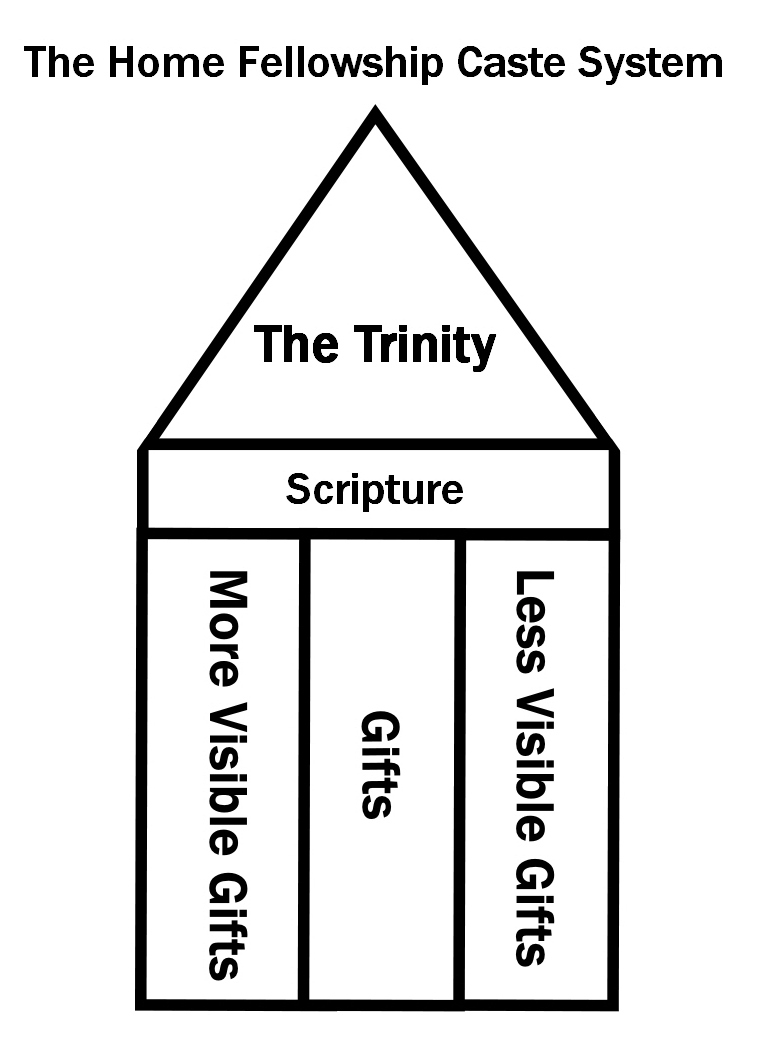
Moreover, let’s face it; while believing in OSAS, there is only one reason people put up with all of the nonsense and drama of the institutional church—OSAS means that if someone leaves the institutional church, they were never saved to begin with. Right? In other words, they function according to the idea that they are led by. It’s OSAS as long as you are “faithful” to the institution. Then each church has its own little “faithfulness” caste system. Those who show up for all of the services are the “core members” that run the church. Those “less faithful” that only come on Sunday mornings are a lower class of member in the caste system.
You have the pastors, staff and deacons, then the “faithful” that attend all of the services and tithe at least 10%, the “casual” attenders that tithe, and then the bottom of the caste strata, even lower than the serfs, the putrid “nonmembers.”
Whether Calvin or Luther, the two icons of Protestantism, these beliefs follow after the doctrine they established for the Protestant institutional church. Access to the institutional church was through water baptism, and the critical need according to the Reformers for formal church membership follows: as Christians, forgiveness for present and future sins can only be found in the institutional church, and those sins condemn us. Forgiveness for all sins does not occur at salvation, but only for past sins. Water baptism initiates us into church membership where forgiveness for present and future sins can be obtained through the sacraments; ie., “gospel preaching,” the Lord’s Table, and anything else deemed as acts of faithfulness to the institutional church not to exclude tithing by any means. Calvin states this explicitly in his institutes, 4.15.1.
All in all, you can say that in Protestantism, the status of sin does not change for the believer—it still condemns requiring perpetual resalvation for every sin committed.
Therefore, 1John 1:9 and 2:1 is interpreted in this light: “If we confess our sins, he is faithful and just to forgive us our sins and to cleanse us from all unrighteousness” (1:9). “My little children, I am writing these things to you so that you may not sin. But if anyone does sin, we have an advocate with the Father, Jesus Christ the righteous” (2:1).
These verses seem to bolster the authentic Protestant position on justification. Confession of sin in our Christian lives keeps us saved. And if we confess our sins, Jesus is up in heaven as our advocate with the Father continuing His work as a propitiation for our sins.
The problem is that this interpretation stands in stark contrast to what other Scriptures state about justification. Biblically, sin has a different classification after salvation—it can’t condemn; it can bring chastisement and present consequences, but it can’t condemn—its ability to condemn has been taken away. Hence, there is no need to have some institution that prevents future condemnation.
Nevertheless, it is easy to understand why the institutional church not only gets a pass on outrageous behavior, but the money keeps pouring in. What will people pay for their salvation and décor that glorifies the institution that saves them? Apparently, no price or compromise is too large. One can also appreciate the fear of so-called excommunication because the institutional church is the only place where one can receive continued forgiveness for present and future sins.
Before I move on, I will solidify my present point. Romans 8:1 states that there is presently NO condemnation for those who are in Christ. In Contrast, Calvin stated that “even saints cannot perform one work which, if judged on its own merits, is not deserving of condemnation” (CI 3.14.9, last sentence). Obviously, the focus is going to be avoiding condemnation, not our freedom to pursue aggressive love in discipleship.
So what are these verses in 1John really saying? Let’s begin to unpack that using the historical grammatical approach to interpretation as opposed to the traditional Protestant means of interpretation, the historical redemptive method. Since Protestantism sees salvation as a process, “redemptive” means that the Bible must be approached with a redemptive prism; ie., the Bible is about salvation. Clearly, this is eisegesis; going to the Bible with a presupposition.
In regard to the history part, this is the belief that history is an unfolding drama about salvation. Hence, all of reality is interpreted through salvation. All of history and the Bible continually reveals the one two-fold redemptive truth/reality: the sinfulness of man and the holiness of God. Salvation begins when we see or understand this reality, and the experience of that reality increases until final salvation.
In contrast, the historical grammatical method uses historical facts to bring more meaning to the text, and all truth is determined by what can be concluded by the grammar—this is known as exegesis. All meaning and truth comes out of the text without anything being read into the text except conclusions from other texts.
In fact, Protestant tradition holds to the idea that a historical grammatical approach to the Scriptures invariably leads to works salvation. Protestant tradition insists that the Scriptures must be interpreted through the prism of total depravity. In this year’s TANC conference, this is what I am going to be hitting on. Christians, save a few, have no idea that Protestant pastors that are leading them view reality in a totally different way than most parishioners. And this is why church looks like it does. And there is no salvaging it—it’s a completely broken system.
So, if you interpret said verses in 1 John redemptively, it fits right into their narrative, right? You have to continue to repent for new sins in your Christian life in order to not be condemned and to keep your salvation. A good old fashioned Baptist lady who I am sure would hold OSAS stated this to my wife Susan in the grocery store a couple weeks ago. When Susan asked her why Christians need to go forward during alter calls, she answered, “they have sin that needs to be forgiven.” Well, why can’t they get that forgiveness by praying at home? You ought to see the reaction Susan and I get when we suggest her mother was saved even though not a member of a church.
Protestantism and all of its offshoots including the Baptists is nothing more or less than functioning Calvinism. Election isn’t the point, progressive salvation is the point. Protestants think salvation grows—salvation doesn’t grow—you are either forgiven once and for all time or you aren’t. Look, if you are going to stay in the institutional church, it makes absolutely no difference where you go. Please, stop driving 15 miles to the Baptist church when there is a Catholic Church right across the street—it’s a shameful waste of gas. It’s all progressive justification.
In contrast, we have to see 1 John in its exegetical historical context. It must be interpreted according to what was going on during the time that prompted this letter. And what was that?
John was pushing back against the number-one nemesis of the assemblies during that time: Gnosticism. Now, there were many, many different veins of Gnosticism during that time, but like denominationalism, there are basics that are fundamentally the same. Denominationalism quibbles about how to get from point A to point B, but it is all progressive salvation.
When you understand the basics of Gnosticism, it is easy to see that John’s first epistle is a point by point rebuttal of Gnosticism, and NOT the proffering of progressive justification. Protestants can bicker with Catholics all they want to about how to get from point A to point B, but again, it’s all progressive justification. If it’s a religious institution, it’s selling final salvation, PERIOD.
If we follow John’s arguments in this epistle, it also apes the fundamental basics of Gnosticism, and that’s what we are going to do:
1 John 1:1 – That which was from the beginning, which we have heard, which we have seen with our eyes, which we have looked upon, and our hands have handled, of the Word of life; 2 (For the life was manifested, and we have seen it, and bear witness, and shew unto you that eternal life, which was with the Father, and was manifested unto us;) 3 That which we have seen and heard declare we unto you, that ye also may have fellowship with us: and truly our fellowship is with the Father, and with his Son Jesus Christ. 4 And these things write we unto you, that your joy may be full. [KJV].
The Gnostics taught that it really wasn’t the spiritual Christ that died on the cross. Gnosticism holds to the idea that material is evil and only the invisible spiritual world is good. Gnosticism rejected the idea that the spiritual realm, or godhood can be one with the material. You must understand: the biblical concept of God-man is a direct affront to the foundation of all false religions, or the knowledge of good and evil. It is the idea that true knowledge cannot be one with the material. Knowledge is good, material is evil and is only a shadow of true knowledge. Knowledge of the material is enslaved and dependent on the five senses.
Now, stop right there. Let me simplify this for you. All false religion flows from the religion of the knowledge of good and evil presented to Eve in the garden. This is also the first sentence of the Calvin Institutes and all of the Calvin Institutes flow from the foundation of 1.1.1., first sentence, viz, ALL wisdom is the knowledge of man and the knowledge of God; man is inherently evil and God is inherently good.
Also, the first sentence of the Calvin Institutes is the primary theses of Luther’s Heidelberg Disputation which is the Magnum Opus of the Reformation. All fundamentals found in contemporary evangelicalism can be found in the Heidelberg Disputation and flow from it. Calvin’s Institutes further articulated the former. In contemporary evangelicalism, we hear constantly that true biblical knowledge is “the knowledge of our own sinfulness as set against God’s holiness.” This is also the pronounced fundamental foundation of the contemporary biblical counseling movement as constantly stated publically in no uncertain terms.
Why am I interjecting this? Because even though much of our knowledge concerning first century Gnosticism comes from the writings of the early church fathers and while they railed against Gnosticism, they themselves were also Gnostics. However, in the process of railing against Gnosticism, they confirm unequivocally that John’s letter addressed the Gnosticism of their day; it just wasn’t the Gnosticism that they preferred.
And by the way, according to some church fathers, John was addressing a Gnostic named Cerinthus who was a contemporary of John and a personal nemesis.
Cerinthus was a gnostic and to some, an early Christian, who was prominent as a heresiarch in the view of the early Church Fathers. Contrary to proto-orthodox Christianity, Cerinthus’s school followed the Jewish law, used the Gospel according to the Hebrews, denied that the Supreme God had made the physical world, and denied the divinity of Jesus. In Cerinthus’ interpretation, the Christ came to Jesus at baptism, guided him in his ministry, but left him at the crucifixion.
He taught that Jesus would establish a thousand-year reign of sensuous pleasure after the Second Coming but before the General Resurrection, a view that was declared heretical by the Council of Nicaea. Cerinthus used a version of the gospel of Matthew as scripture.
Cerinthus taught at a time when Christianity’s relation to Judaism and to Greek philosophy had not yet been clearly defined. In his association with the Jewish law and his modest assessment of Jesus, he was similar to the Ebionites and to other Jewish Christians. In defining the world’s creator as the demiurge, he emulated Platonic philosophy and anticipated the Gnostics.
Early Christian tradition describes Cerinthus as a contemporary to and opponent of John the Evangelist, who may have written the First Epistle of John and the Second Epistle of John to warn the less mature in faith and doctrine about the changes he was making to the original gospel. All that is known about Cerinthus comes from the writing of his theological opponents (Wikipedia).
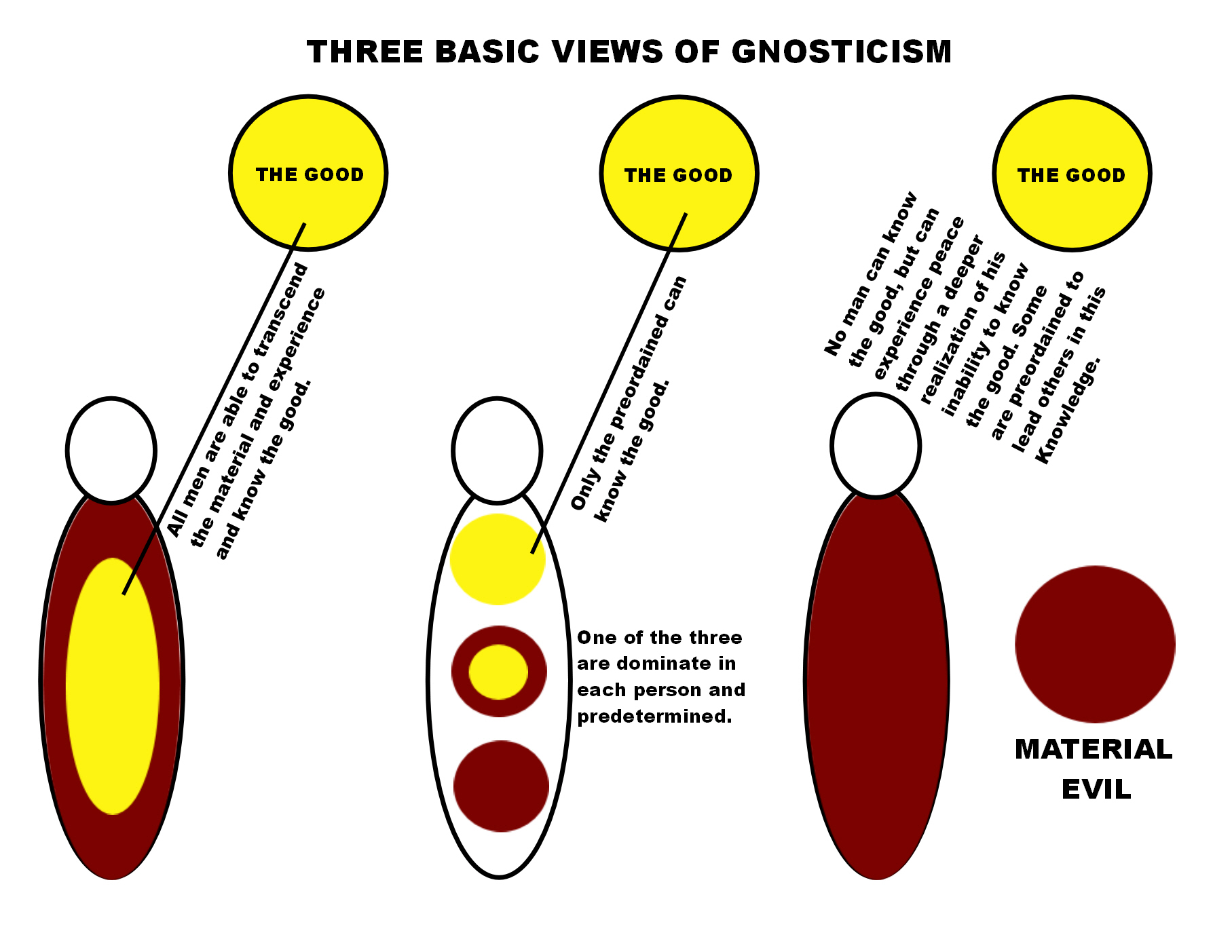
At any rate, the teachings of Cerinthus follow the basic fundamentals of 1st century Gnosticism of which there were two schools of thought unchanged from the cradle of society: intuitive knowledge within versus knowledge outside of man. While both schools held to the strict dichotomy of material being evil and the invisible good, and true knowledge being beyond the five senses, they disagreed on where that knowledge is found and whether or not it is intuitive among all men, or a select few preordained by nature or some supreme being.
Cerinthus followed the philosophical school of Idealism which holds to the belief that the one cosmic mind has an intuitive connection within every individual. Finding that knowledge is often a complex mind-numbing epistemology, but curiously, Luther and Calvin had their own angle that built on the Neo-Platonic teachings of St. Augustine.
This Gnostic bent actually allowed for Christ to be human, or at least some form of humanity. Apparently, God became exasperated with man’s penchant for trying to gain knowledge through the material world, and said in essence, “Ok, since you like to think you can know something and try to gain knowledge through the things that are seen, I am going to send my Son to die on the physical cross, and now all knowledge will only be gained through suffering—there mankind, take that!” This is the essence of the Heidelberg Disputation which is a philosophical treatise, not a theological one by any stretch of the imagination. Luther states plainly in the document that ALL knowledge is hidden in the suffering of the cross. Anyone who thinks they can understand Protestantism without a good grasp of world philosophy is sadly misguided. It is one of the historical necessities of historical grammatical hermeneutics.
Hence, in the Gnostic Protestant construct, Christ and His gospel is the only true objective knowledge and is outside of man. Man is not to seek any knowledge within himself, but all knowledge must be sought outside of him in contemplation of the gospel. All of reality is interpreted by the suffering of the cross. The cross is the epistemology from the material to the invisible, or from the evil to the good.
In contrast, other schools believe the epistemology is intuitive within all men because all men have a spiritual being separate from their material being, and the spiritual part of man is nonmaterial and therefore SINLESS. The material body of man is evil because it is material, but his invisible being is good and has a connection to the cosmic spiritual world that must be cultivated by transcending the material. This was key to the drug culture of the 60’s as LSD trips enabled the individual to transcend the five senses and see into the invisible spiritual world. Supposedly.
Other schools of thought believed that even though all men have a material and spiritual aspect, the spiritual anthropology has classifications in regard to who is able to see true knowledge and who isn’t as determined by the cosmos or cosmic mind; ie., determinism. And consequently, if utopia is to ever be achieved, those with the ability to see knowledge must rule over those who have the inability to transcend the material and are enslaved to it. How do you reason with people hopelessly enslaved to the material? They either understand that they can’t know reality and get with the program, or you kill them.
According to the Reformers, utopia is achieved by understanding that all reality is interpreted through the cross of redemption. This concept was established by Luther’s Heidelberg Disputation and is known as being a “theologian of the cross.” Theologians of the cross are able to know the “cross story,” or interpret reality through the cross, and all others are enslaved to the “glory story” or the story of man. This is the dichotomy of the knowledge of good and evil, or material versus spiritual.
Furthermore, the Reformers believed that the new birth entailed the gift of outward seeing only. All goodness remains outside of man. This is the pious distinction they claim over their fellow Gnostics. Unlike Cerinthus, who would be the modern equivalence of existentialism, no good can be in man, because that does not limit knowledge to suffering and the cross. Even though the early church fathers believed that material is evil and only the invisible is good like all ancient Gnostics, they labeled those heretics who believed that the invisible spirit within man was a connection to the good. That was heresy in their minds. And if you really understand what John Piper et al believe in our day, NOTHING HAS CHANGED.
The true Christians of that day had a different metaphysical take: the material realm is NOT evil, it’s weak. Something that is weak can still be good. The born again Christian struggles with sin because he/she is weak, not because the material realm is inherently evil. Christ really did come adorned in humanity in every since of the meaning because the material is not evil. This understanding of being fits together with the true gospel.
But what Cerinthus et al was teaching speaks directly to what John wrote in his first epistle, and we have addressed some of it in John’s introduction. John, in essence, said the following: Christ was 100% humanity and 100% God. We saw Him, we heard Him, we touched Him, we saw Him die on the cross, there isn’t two Christs, there is only one.
What Cerinthus et al taught explains everything John wrote in this epistle and why he wrote it. It not only explains why John wrote what he wrote in 1:9 and 2:1, it sheds light on why John wrote what he wrote in the rest of the book as well.
And that is what we will look at next. We will do a point by point fly over of 1 John while interpreting it according to this historical context of Gnosticism. John will address the definition of sin in contrast, the definition of knowledge and truth in contrast, the definition of the true gospel in context, the definition of love and hate in contrast, and the definition of the new birth in contrast.




 Paul's Passing Thoughts
leave a comment