Plan Moving Forward
As some of you know, I have been in the process of writing The Truth About New Calvinism Volume 2. There are also other book projects running in the background for the future. One of them is a home fellowship manifesto of sorts. The theses follows:
- The assemblies of Christ were intended to be home fellowships and nothing else.
- Any professing Christian indwelt by the Spirit has the authority to baptize or serve the Lord’s Table.
- Home fellowships should be organized according to New Testament principles.
- Home fellowships should be totally disconnected from the institutional church.
- Home fellowships are individual centered—not group centered; in other words, the focus is on individual gifts.
- The institutional church is historically rooted in the false gospel of progressive justification. The very gospel of “church” is progressive justification and salvation by institution.
- Home fellowships are predicated on fellowship for a common purpose, not authority.
- Home fellowships are predicated on encouragement and leadership, not horizontal lordship.
In light of recent episodes in the ongoing institutional church megadrama, such as the infamous John Piper tweet, “If Jesus is not empathetic to your mistreatment, you don’t need to be. If he is, no one else needs to be. He will settle,” it has been suggested that this project running in the background be moved up to first priority, and I agree. More and more, the true colors of the institutional church are becoming evident:
If you want to have any chance at all of getting to heaven, keep your damn mouth shut, give your tithe, and know that without us you have no hope because you are clueless.
Therefore, instead of resuming my writing schedule for TTANC 2 on Monday, I will be delving into this project: AC Preveiw
This is not going to be a lengthy writing project as we have been stockpiling articles and information for this project for some time (It should be in print by December 2014).
What is important is that the book will set forth a powerful argument that will embolden Christians to free themselves from this institutional church dark age and live out their calling to the fullest.
Please be in prayer, and by all means give us your input.
paul
What is the Reformed/Calvinist “Noble Lie”?
 This post wasn’t on my schedule this morning, but I am nevertheless compelled to start my day by commenting on a link that “Carmen” has sent me. Carmen comments on PPT publically, and I continually get emails along the line of, “Hey, did you see Carmen’s comment? She really gets it.” Not only that, Carmen sends me research that flavors what is written here, and frankly, I fear that a lot of it will be lost in PPT’s 1 TB plus archives.
Therefore, starting with this post, and because she comments publically as “Carmen,” we are going to attach her relevant input on the bottom of posts where applicable to the subject. This will prevent her efforts from being lost in PPT electronic files and my 58 year old mind. This might include one of her comments that often contain research, or research that she sends us.
Furthermore, the research she sends influences the writings here to the point where it is becoming a borderline plagiarism issue. We know that she probably isn’t concerned about this, but we are. Therefore, whenever Pearl or the other contributors want to pad a post with her research, it will be archived along with the post at the bottom starting with this post where you can refer to the link that she sent me.
Let’s now address the link sent: a post on the TGC blog by Colin Smith concerning “change.” Let’s also be clear: Reformed thought disavows the idea that people change. When they write books like “How People Change” by the habitual liar Paul David Tripp, they don’t really intend to teach that people change. This should be obvious, no? How many of these guys have publicly proclaimed on the one hand that, “I am done trying to fix people” while on the other hand speaking of “change.” So, what’s going on?
 “Cognitive dissonance!” That was easy. We have to go further than that; we have to discuss the most important element of CD, which is a mental form of ED. CD is functioning by two contradictory ideas or a series of contradictions, and in the case of CD, there is what psychologists call the “consonant” or “buffer.” It is the ideas that attempt to reconcile the contradictions and relieve the anxiety that causes it.
In the case of Reformed thought, the consonant is orthodoxy. What is orthodoxy? It is a dignified form of mythology which shouldn’t need dignifying. Mythology is not a collection of ancient superstitions as many people suppose. Mythology is the teaching construct of spiritual caste. This is the most common philosophy of world history. It presupposes an epistemological pecking order between deity, or a natural force, and humanity. The deity, or force, preselects those who can comprehend reality to lead those who cannot comprehend reality. Sometimes, those who cannot comprehend reality don’t know they can’t comprehend reality and hinder the preordained from bringing order and wellbeing to humanity; we call that “war.”
So, mythology is simply parables written by the preordained to help those who cannot understand reality to understand why they should follow the preordained. Predeterminism is central to this common philosophy and dominates mythology in general. Plato articulated this construct in The Republic this way: philosopher kings, warriors, producers. The producers do not necessarily take mythology literally, though some do (now you can invoke “superstition”); they understand that it is a narrative tool to help the producers understand why they should function a certain way in society. It is no different than the concept of children’s story books, except mythology is for adults. We try to instill principles in children based on what we know they can’t completely understand through stories and narratives—it’s the same construct. Of course there isn’t really a “Little Blue Engine That Can.” The personification of a train is not to be taken literally.
Orthodoxy is the same thing. It is the traditional teachings of preordained “Divines” who write creeds, confessions, and catechisms for the great unwashed masses. In mythology, orthodoxy’s kissing cousin, we have what’s called the “noble lie.” It is the misrepresentation of something cognitive that the producers understand in an elementary way. People don’t really change, but most producers are unable to grasp that, so the goal is to teach “change” in a way that produces the functionality desired by the philosopher kings.
Hence, the meaning of words in the minds of philosopher kings rarely mean the same thing to the producers. Philosopher kings allow the producers to assume they mean the same thing, but they don’t. And it’s not a lie because words that producers understand, and the way they understand them must be used in orthodoxy in order to lead the ignorant to green pastures of wellbeing; it is the noble lie.
And, the break point: the consonant is “paradox,” viz, contradictions only seem to be contradictions because the producers cannot comprehend what the philosopher kings can comprehend. And, this construct is appealing to the producer class for a number of reasons. If you want to see this construct in historical living color, study Nazi orthodoxy during the WWII era. The Bible makes it clear that there are some things God knows that we cannot understand, however, the bible also makes it clear that we are responsible for what we can know, and what we need to do in order to know it. In this construct, people are not responsible for knowing anything and many people like that idea for many misguided reasons not excluding good old fashioned laziness.
So, now we know the definitions of mythology, orthodoxy, superstition, and paradoxy in their true historical context.
The Colin Smith post is just another example of all of this. If you examine his sentence structure carefully, you begin to suspect that he really isn’t saying what he seems to be saying, and that’s the whole idea; he really isn’t saying what he seems to be saying. It’s a philosopher king thing, you wouldn’t understand. Notice that he subtly defines “birth” as an idea that can’t be dichotomized from the growth process. To think of a man as different from a baby is to deny babies because the growth that made the man is dichotomized from the separate concept of “baby.” Reformed elders constantly practice this cultish form of metaphysical two- stepping communication. It’s subtle, and very evil. It is often done by eliminating conjunctions/transitions and thereby making two different things the same. Their deceptive communication techniques are an identifiable system and complex.
Look, I am not going to dissect all of his nuance in the post; there is no need as others in his camp make it clear that people don’t change. Obviously, he is not saying what he seems to be saying, and you are supposed to accept it based on the Reformed CD consonant.
Don’t but it. It’s nothing more or less than Nazi Light.
paul

Victims and Discernment Bloggers: Let’s Ask the Right Questions
“So, they would say to the young ladies and boys who have been molested in the church, ‘So what?’ The same sin that indwells the pedophile is in the victim as well. Can we not survey the past and present abuse and see this worldview plainly?”
Even though we hate to think commonsense is important in understanding spiritual issues, the fact remains that such is the case. We struggle with this because of our notion that material is evil and spiritual is good. This notion is deep-seated in the Western psyche. Consequently, we are often willing to throw math out the window for something spiritual. Also, the spiritual get out of commonsense free card comes in handy when we have invested too much of our own self-esteem in a bad idea. If we humble ourselves and admit we were wrong, our intellect labeled as “humbleness” (lest it have no credibility) seems to lose its credibility.
Frankly, I find admission of wrong freeing. Yes, it may make you feel stupid for a while, but the problem with being wrong is that you can’t get anything done with bad information, and not getting anything done leads to hopelessness. Ultimately, even if you are stupid, people will judge you by what you get done, and even if they don’t, God will. Christ is documented throughout the New Testament as being annoyed by verbal assent to righteousness rather than actual doing, and bad information does not lead to right doing. This would seem evident.
But what if you can’t really know anything? And what if you can’t really do anything good? What would the results of that be? Well, look at the blogosphere spiritual discernment and victim “healing” ministries. In full force since 2009, matters continue to get worse, not better, and to date, justice for the victims is found nowhere. Why? Why doesn’t discernment ministry work? In the analysis of Herman Cain’s acronym, W-A-R, discernment bloggers are not working on the right problem, asking the right questions, nor removing the necessary obstacles.
What is the right question? It follows: “Why doesn’t discernment ministry accomplish anything?” Need proof? Anybody remember the outrageous ABWE scandal? Thought so. A secular media producer just cancelled “Here Comes Honey Boo Boo” because of the mere potential of a smidgen element of the ABWE scandal, yet, ABWE continues to thrive unabated. How can this be? is another right question.
No, that is THE right question. And what is the obvious answer? It follows: people keep supporting ABWE financially. In case it escapes anyone, ABWE cannot continue unless it receives money. That raises another question: “Why do people keep sending such an organization money despite their deplorable behavior?”
Um, I can only tell you why the people who keep sending ABWE money say they keep sending ABWE money. Would that suffice? The reasons follow:
- Because ABWE, and institutions like it are God’s anointed, preordained vessels to take the gospel to a dying world, they are the only ones qualified to do so. If ABWE fails, thousands and thousands of souls will go to hell for eternity. ABWE must survive.
- ABWE must operate with people, and where there are people, there is sin, this is unavoidable.
- ABWE should be forgiven as Christ forgave us.
These are the reasons that no justice can be found in the institutional church. These are the reasons that religious institutions continue to spiritually abuse unabated. That’s the problem that must be worked on. Those answers assume the following: spiritual hierarchy, moral equivalency, and individual value defined by contribution to the group; i.e., no justice for the individual is what’s best for the many.
Note: the institution in and of itself is not the problem, people in and of themselves within the institution are not the problem, and money in and of itself is not the problem: the logic is the problem. The threefold logic clearly gives license to the behavior. The threefold logic insists that nothing can be done, or that nothing should be done. In fact, the threefold logic insists that there really isn’t a problem to be worked on in the first place—this is clearly ascertained by the normative results of all of these scandals.
So, how do discernment blogs work on the problem? By exposing the problem, “properly” identifying the problem, and assuming that the institutions will respond and seek justice for the victims. How’s that working for us so far?
So let’s ask another right question: “Why isn’t that approach working?” One reason is the identification of a particular problem that discernment bloggers like to call “cognitive dissonance.” This is the study of how people believe contradictory propositions and their attempts to reconcile the contradictions. But this is where discernment bloggers totally miss it: spiritual hierarchy is more times than not predicated on the idea that the masses cannot properly interpret reality itself. How many times have we heard the following?
No matter what it looks like, you need to trust the leaders who have been working close to the situation and know all of the details.
Though we would not agree with a naked verbalization of the idea that only spiritual leaders can properly interpret reality, we by all means function that way. However, more and more in Reformed circles, this concept is being openly stated in the following way:
All of reality, or what is truly reality, is interpreted through redemption, and only the gifted are able to do so. Meanwhile, it is acceptable to obtain worldly knowledge, and some of it is good, but a good thing is not always the best thing.
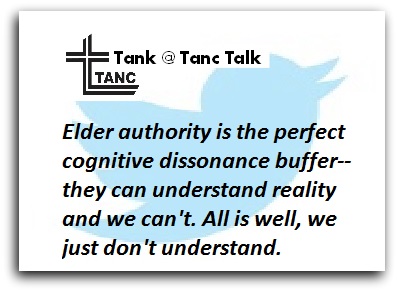 Therefore, when it comes to spiritual matters, trust God’s anointed regardless of the obvious. In cognitive dissonance, the thing used in an attempt to reconcile two contradictions as much as possible is called the “buffer.” In this case, the buffer is the belief that spiritual leaders must be obeyed because they are the ones who can see reality and we can’t. Sure, we can understand worldly things that have no eternal value, but when it comes to eternal matters the leaders must be trusted at all cost. The right problem to address is the buffer, not the symptom of being comfortable with contradictions. Discernment bloggers wrongly identify the real problem and work on the wrong one. They fail completely on Cain’s “W.”
And by the way, if you want to read a sermon by a conservative evangelical that exemplifies this dualist approach to reality, you can read it here, and listen to it here.
In addition, this author can give firsthand evidence of this mentality via correspondence from someone upset by what this ministry publishes.
Deep down you know that it is true. Turning logic on its head, twisting words, pseudo-scholarship, and outright attacking people for things that both you and I know they do not believe does no one any good.
Another misunderstanding is that I somehow knew and stood behind any improper things you may have experienced at Clear Creek.
These statements were made in light of the fact that citations/quotations make-up approximately 30% of what our ministry writes, and improper things “you may have” experienced is set against a website that thoroughly documents what exactly happened. The individual wrote these statements in the face of undeniable documentation. How can he do that? Because only those with authority can properly interpret reality despite the evidence presented to the contrary. That’s why. The individual also accused our ministry of “pseudo-scholarship.” Why is it such according to him? Because it doesn’t have the authority of Reformed institutional scholarship—they are the ones who really know the truth. Discernment bloggers seem to miss the point that institutional tyrants do not interpret reality in the normative sense.
Another point missed by discernment bloggers is: tyrants who interpret reality differently will not always act out in the same way. However, if the same ideology does not produce shameful behavior, it will at least produce tolerance for it. And the right question here is, “why is this so?” Answer: moral equivalence. If everyone is Adolf Hitler at heart, who is anyone to judge anybody for anything? We are ALL just sinners saved by grace after all. “Justice,” you say? What justice? We ALL deserve hell! Again, this is also seen in the aforementioned correspondence:
I truly grieve for the things that you have shared have happened with your family, but all either of us can do from here is look to faithful God and away from the sin that is in our heart and other men who will always ultimately disappoint because none of us are sinless.
Notice that he grieves for the things “that you have shared happened with your family,” i.e., how I interpret their actions, not what they actually did. And notice that the sin these men may have committed against me is also in my heart as well. So, they would say to the young ladies and boys who have been molested in the church, “So what?” The same sin that indwells the pedophile is in the victim as well. Can we not survey the past and present abuse and see this worldview plainly?
So, if there is no moral unequivalence necessitating a need for justice, all that is left is unity and peace for the sake of unity and peace which can only be obtained by blindly following those preordained to lead the great unwashed masses. We must also understand that this logic gave rise to institutions in general and the institutional church in particular.
Let’s work on the right problem: the worldview of the institutional church. Let’s ask the right question: “What should we do about it?” And finally, let’s remove obstacles to what works.
The obstacle that needs to be removed is fellowship with the institutional church. Again, the institution in and of itself is not the problem, but its caste worldview is the problem. Christians en masse must stop giving their money to the institutional church and must warn all people that they involve themselves with the institutional church at their own risk. It looks something like this:
Mark, likewise, I don’t care to debate with you because we see reality differently. I interpret reality grammatically, and you interpret reality redemptively like the Neo-Platonist “Christians” that you follow. Even John Street has bought into this latter-day antinomian nonsense. All I want to hear is that you stay clear of my family, and let’s be clear, it is not a wish—it is a demand, and I will protect my family at all cost—be sure of it.
Keep your family away from the institutional church. What else needs to happen in order to demonstrate that its fundamental worldview is horribly distorted? Husbands need to step up and take over their responsibility before Christ to lead their own families spiritually. You need to join a fellowship and be encouraged by men of God who can think for themselves and fear the Holy Spirit more than puffed-up control freaks. If you cannot find such a fellowship, do so in your own home.
paul
Related articles:

Like Atheists, Like Calvinists: What’s the Difference?
Very little, and arguably no applicable difference at all. Every now and then I read a post written by Dr. Jay Adams. He had a very interesting one today that examined the intent behind atheism:
The wicked arrogantly thinks “There is no accountability since God does not exist.” Psalm 10:4 (HCSB).
No doubt, no accountability is a strong motive and incentive for conveniently dismissing the existence of a just God, but are Calvinists any different? They are in regard to believing strongly in the existence of a just God, but what about accountability? In both cases, there is no accountability for sin.
The atheistic side is easy in regard to zero sum accountability, but on the Calvinist side it is a little more complicated. There is a just God who holds people accountable, and “people” would be other than Calvinist. Calvin believed law-keeping is futile because the standard is perfection; so, if you break one law, you might as well break all of it—same difference (he cited James 2:10 in order to make his case [Calvin Institutes 3.14.9,10,11]). Of course, James was talking about an attempt to keep the law for justification and not a general rule for life.
Calvin also believed new sins we commit cause us to fall from grace, so we supposedly need daily forgiveness, and that absolution can only be found in the institutional church, and baptism is efficacious for church membership. “No, no, we are not saved by baptism” Calvin would say while stating from the other side of his mouth that absolution can only be found in formal church membership…which can only be obtained by baptism (Calvin Institutes 4.15.1,3).
“To impart this blessing to us, the keys have been given to the Church (Mt. 16:19; 18:18). For when Christ gave the command to the apostles, and conferred the power of forgiving sins, he not merely intended that they should loose the sins of those who should be converted from impiety to the faith of Christ; but, moreover, that they should perpetually perform this office among believers” (The Calvin Institutes: 4.1.22).
“Secondly, This benefit is so peculiar to the Church, that we cannot enjoy it unless we continue in the communion of the Church. Thirdly, It is dispensed to us by the ministers and pastors of the Church, either in the preaching of the Gospel or the administration of the Sacraments, and herein is especially manifested the power of the keys, which the Lord has bestowed on the company of the faithful. Accordingly, let each of us consider it to be his duty to seek forgiveness of sins only where the Lord has placed it. Of the public reconciliation which relates to discipline, we shall speak at the proper place” (Ibid).
“…by new sins we continually separate ourselves, as far as we can, from the grace of God… Thus it is, that all the saints have need of the daily forgiveness of sins; for this alone keeps us in the family of God” (John Calvin: Commentaries on the Catholic Epistles; The Calvin Translation Society 1855. Editor: John Owen, p. 165 ¶4).
So, not unlike Catholicism as well, do whatever you want during the week and then obtain absolution on Sunday. Whether Protestant, Catholic, or atheist, there is no accountability.
paul

 Paul's Passing Thoughts
leave a comment