A Doctrinal Evaluation of the Anti-Lordship Salvation Movement: Part 1
Originally published August 13, 2014
Introduction and Historical Background Leading up to the Anti-Lordship Salvation Movement
Not long after I became a Christian in 1983, the Lordship Salvation (hereafter LS) controversy arose. This was a movement against “easy believism” (hereafter EB). The climate was ripe for the controversy because churches were full of professing Christians who demonstrated little if any life change. Members in good standing could be living together out of wedlock, wife abusing drunks, and shysters to name a few categories among many. Sin was not confronted in the church.
Of course, no cycle of Protestant civil war is complete without dueling book publications. Without naming all of them, the major theme was that of faith and works. John MacArthur Jr. threw gasoline on the fire with The Gospel According to Jesus published in 1988. This resulted in MacArthur being the primary target among the so-called EB crowd.
During that time as a new believer, I was heavily focused on the issue, but was like many others: I rejected outright sinful lifestyles among professing Christians while living a life of biblical generalities. In other words, like most, I was ignorant in regard to the finer points of Christian living. I resisted blatant sin, and in fact was freed from some serious temptations of the prior life, but had little wisdom in regard to successful application.
We must now pause to consider what was going in the 80’s. Christianity was characterized by two groups: the grace crowd that contended against any assessment of one’s standing with God based on behavior (EB), and the LS crowd. But, the LS group lived by biblical generalities. Hence, in general, both groups farmed out serious life problems to the secular experts. This also led to Christian Psychologist careerism.
This led to yet another controversy among American Christians during the same time period, the sufficiency of Scripture debate. Is the Bible sufficient for life’s deepest problems? Again, MacArthur was at the forefront of the controversy with his publication of Our Sufficiency in Christ published in 1991. Between 1990-1995, the anti-Christian Psychology movement raged (ACS). The primary lightening rod during that time was a book published by Dave Hunt: The Seduction of Christianity (1985).
In circa 1965, a young Presbyterian minister named Jay E. Adams was moved by the reality of a church living by biblical generalities. The idea that the church could not help people with serious problems like schizophrenia bothered him. He was greatly influenced by the renowned secular psychologist O. Hobart Mower who fustigated institutional psychiatry as bogus. An unbeliever, Mower was critical of Christianity for not taking more of a role in helping people with serious mental problems.
Mower believed that mental illness is primarily caused by the violation of conscience and unhealthy thinking. His premise has helped more people by far than any other psychological discipline and Adams witnessed this first hand. Mower’s influence provoked Adams to look into the Scriptures more deeply for God’s counsel regarding the deeper problems of life. This resulted in the publication of Competent to Counsel in 1970, and launched what is known today as the biblical counseling movement (BCM). Please note that this movement was picking up significant steam in the latter 80’s and early 90’s.
In 1970, the same year that the BCM was born, an extraordinary Reformed think tank was established by the name of The Australian Forum Project (AFP). Its theological journal, Present Truth, had a readership that exceeded all other theological journals in the English speaking world by the latter 70’s. Though the project died out in the early 80’s, it spawned a huge grassroots movement known as the “quiet revolution” of the “gospel resurgence.” The movement believed that it had recovered the true Reformation gospel that had been lost in Western culture over time, and frankly, they were absolutely correct about that.
The movement was covert, but spawned notable personalities such as John Piper over time. Piper exploded onto to the scene in 1986 with his book The Pleasures of God which promoted his Christian Hedonism theology. Unbeknown to most, this did not make Piper unique, the book is based on the same Martin Luther metaphysics that the AFP had rediscovered; he got it from them. At this point, the official contemporary name for the rediscovered Reformation gospel, the centrality of the objective gospel outside of us (Cogous), was taking a severe beating in Reformed circles. This is because contemporary Calvinists didn’t understand what Luther and Calvin really believed about the gospel.
John Piper looked to emerge from the movement as a legend because he had no direct ties to the AFP, but during the same time frame of his emergence, Cogous was also repackaged by a professor of theology at Westminster Theological Seminary. His name was John “Jack” Miller. Using the same doctrine, the authentic gospel of the Reformation, Miller developed the Sonship discipleship program. This also took a severe beating in Presbyterian circles. In fact, Jay Adams wrote a book against the movement in 1999. This was a debate between Calvinists in regard to what real Calvinism is. At any rate, Sonship changed its nomenclature to “Gospel Transformation” and went underground (2000). This started the gospel-everything movement. Sonship was saturated with the word “gospel” as an adjective for just about every word in the English language (“gospel centered this, gospel-driven that,” etc.). If anyone refuted what was being taught, they were speaking against the gospel; this was very effective.
If not for this change in strategy, John Piper would have been the only survivor of Cogous. Instead, with the help of two disciples of John Miller, David Powlison and Tim Keller, the Gospel Transformation movement gave birth to World Harvest Missions and the Acts 29 Network. It also injected life into the Emergent Church movement. Meanwhile, most thought the Sonship movement had been eliminated, but this was not the case at all. In 2006, a group of pastors that included this author tried to get a handle on a doctrine that was wreaking havoc on churches in the U.S. and spreading like wildfire. The doctrine had no name, so we dubbed it, “Gospel Sanctification.” In 2008, the same movement was dubbed, “New Calvinism” by society at large. In 2009, spiritual abuse blogs exploded in church culture as a direct cause of New Calvinism. We know now that the present-day New Calvinism movement was birthed by the AFP.
The Protestant Legacy of Weak Sanctification
The anti-Lordship Salvation movement came out of the controversy era of the 80’s. The following is the theses, parts 2 and 3 will articulate the theses. The theses could very well be dubbed, The Denomination Myth. All of the camps involved in these Protestant debates share the same gospel, but differ on the application. The idea that the debate involves different gospels is a misnomer.
The Protestant Reformation gospel was predicated on the idea that the Christian life is used by God to finish our salvation. The official Protestant gospel is known as justification by faith. This is one of the most misunderstood terms in human history. Justification refers to God imputing His righteousness to those whom He saves. Many call this a forensic declaration by God. At this time, I am more comfortable saying that it is the imputation of God’s righteousness to the saved person as the idea of it being forensic; it’s something I have not investigated on my own albeit it’s a popular way of stating it. This is salvation…a righteous standing before God.
Sanctification, a setting apart for God’s holy purposes, is the Christian life. The Reformers saw sanctification as the progression of justification to a final justification. In Reformed circles, this is known as the “golden chain of salvation.” So, the Christian is saved, is being saved, and will be finally saved. Christians often say, “Sanctification is the growing part of salvation.” But really it isn’t, salvation doesn’t grow, this is a Protestant idea. The Christian life grows in wisdom and stature, but our salvation doesn’t grow, the two are totally separate. One is a finished work, and the other is a progression of personal maturity.
The Reformers were steeped in the ancient philosophy of the day that propagated the idea that the common man cannot properly understand reality, and this clearly reflected on their theology. The idea that grace is infused into man and enables him to properly understand reality would have been anathema according to their spiritual caste system of Platonist origins. This resulted in their progressive justification gospel. Justification by faith is a justification process by faith alone.
Every splinter group that came out of the Reformation founded their gospel on this premise. John Calvin believed that salvation was entering into a rest from works. He believed that sanctification is the Old Testament Sabbath rest (The Calvin Institutes 2.8.29). Hence, the Christian life is a rest from works. The Christian life must be lived the same way we were saved: by faith alone. Part 2 will explain why we are called to work in sanctification, and why it is not working for justification.
Another fact of the Reformation gospel is “righteousness” is defined as a perfect keeping of the law. To remove the law’s perfect standard, and its demands for perfection from justification is the very definition of antinomianism according to the Reformers. A perfect law-keeping must be maintained for each believer if they are to remain justified. Thirdly, this requires what is known as double imputation. Christ not only died for our sins so that our sins could be imputed to Him, He lived a life of perfect obedience to the law so that His obedience could be imputed to our sanctification. So, if we live our Christian life according to faith alone, justification will be finished the same way it started; hence, justification by faith. For purposes of this series, these will be the three pillars of the Reformed gospel that we will consider:
1. An unfinished justification.
2. Sabbath rest sanctification.
3. Double imputation.
As a result of this construct, Protestant sanctification has always been passive…and confused. Why? Humans are created to work, but work in sanctification is deemed to be working for justification because sanctification is the “growing part” of justification. Reformed academics like to say, “Justification and sanctification are never separate, but distinct.” Right, they are the same with the distinction being that one is the growing of the other. A baby who has grown into an adult is not separate from what he/she once was, but distinct from being a baby. Reformed academics constantly warn Christians to not live in a way that “makes the fruit of sanctification the root of justification.” John Piper warns us that the fruits of sanctification are the fruits of justification—all works in sanctification must flow from justification. Justification is a tree; justification is the roots, and sanctification is the fruits of justification. We are warned that working in sanctification can make “the fruit the root.” In essence, we are replacing the fruits of justification with our own fruit. This is sometimes referred to as “fruit stapling.”
How was the Reformation gospel lost?
To go along with its progressive justification, the Reformers also developed an interpretation method. The sole purpose of the Bible was to show us our constant need to have the perfect works of Jesus imputed to our lives by faith alone. The purpose of Scripture reading was to gain a deeper and deeper knowledge of our original need of salvation, i.e. “You need the gospel today as much as you needed it the day you were saved.” Indeed, so that the perfect obedience of Christ will continue to be applied to the law. This also applies to new sins we commit in the Christian life as well. Since we “sin in time,” we must also continue to receive forgiveness of new sins that we commit as Christians. So, the double imputation must be perpetually applied to the Christian life by faith alone. John Piper often speaks of how Christians continue to be saved by the gospel. This is in fact the Reformation gospel.
But over time, humanity’s natural bent to interpret the Scriptures grammatically instead of redemptively resulted in looking at justification and sanctification as being more separate, and spiritual growth being more connected to obedience. This created a hybrid Protestantism even among Calvinists. Nevertheless, the best results were the aforementioned living by biblical generalities. Yes, we “should” obey, but it’s optional. A popular idea in past years was a bi-level discipleship which was also optional.
This brings us to the crux of the issue.
Since the vast majority of Protestants see justification as a golden chain of salvation, two primary camps emerged:
A. Christ obeys the law for us.
B. Salvation cannot be based on a commitment—obedience must be optional.
Model A asserts that since we cannot keep the law perfectly, we must invoke the double imputation of Christ by faith alone in order to be saved and stay saved. Model B asserts that since the same gospel that saved us also sanctifies us, any commitment included in the gospel presentation must then be executed in sanctification to keep the process of justification moving forward. Therefore, obedience in sanctification must be completely optional. A consideration of works is just fruit stapling. If the Holy Spirit decides to do a work through someone, that’s His business and none of ours, “who are we to judge?”
This is simply two different executions of the same gospel. Model A does demand obedience because it assumes that Christians have faith, and that will result in manifestations of Christ’s obedience being imputed to our lives. Because this is mixed with our sinfulness, it is “subjective.” The actual term is “justification experienced subjectively”; objective justification, subjective justification, final justification (redefined justification, sanctification, and glorification). However, model B then interprets that as commitment that must be executed in the progressive part of salvation.
This is where the EB versus LS debate comes into play. This is a debate regarding execution of the same gospel while making the applications differing gospels. Out of this misunderstanding which came to a head in the 80’s, comes the anti-Lordship Salvation movement (ALS). Conversations with proponents of ALS reveal all of the same tenets of Cogous. First, there is the same idea of a final judgment in which sins committed by Christians will be covered by Jesus’ righteousness; “When God looks at us, all he will see is Jesus.” Secondly, there is the same idea of one law. Thirdly, there is the idea that our sins are covered and not ended.
They do differ on the “two natures.” Model A holds to the idea that Christians have the same totally depraved nature that they had when they were saved. Model B thinks the new birth supplies an additional Christ-like nature that fights with the old nature. Model A, aka Calvinists, actually think this is Romanism/Arminianism. Indeed, authentic Protestantism rejects the idea that any work of the Spirit is done IN the believer. Model B has several different takes on this including the idea that Christians are still dead, but the life of Jesus inside of them enables them to obey.
In part 2, we will examine why this construct is a false gospel, and why both parties are guilty. In part 3, we will examine the new birth and the idea that Christians have two natures.
paul
Yes, In Fact, the Law does have the Power to Change Us: Romans 8:2
Originally published May 25, 2014

The confusion concerning sanctification in our day is totally over the top. Sanctification is the Christian life in which we are set apart for God’s purposes. The Bible has been around for a long time; yet, the debate rages. Those who would dare suggest that the Christian can change through obedience to God’s word are quickly muzzled by being accused of “suggesting the law has the power to change people” or “the law of God provides the power to produce what it commands.” These accusations send people running for cover for fear of being labeled a “legalist”, “Pharisee,” or worse.
In all of the discussion, it is assumed that the law has one dimension: that of exposing sin and death. Also, the discussion centers around an ambiguous understanding of what we mean exactly by the term, “law.” The word “law” for all practical purposes refers to the Bible, or the “Scriptures,” or the “law and the prophets,” or merely “law.”
In Matthew 5:17,18, Christ refers to all Scripture canonized at that time as “the law or the prophets.” But then in verse 18, he refers to everything as “the law.” In Luke 24, we have “the prophets” (v.25), “Moses and all the prophets” (v.27), “the Scriptures” (v.32), “the law of Moses, …the prophets…the psalms” (v.44), “the Scriptures” (v.45), “the writings” (v.46), all used interchangeably in this chapter.
In fact, verse 27 officially calls the whole cannon of that time, i.e., the Old Testament, “the Scriptures.” In the first part of verse 27, Christ refers to the Scriptures as “Moses and all of the prophets.” In the second part of the verse, He calls Moses and all of the prophets “the Scriptures.” It’s all the same . It’s all the “law.”
There is no way you can take the Decalogue (a theological term for the Ten Commandments), the prophets, the psalms, the writings of Moses, or any other segment-like portions of Scripture and relegate it to less significance for faith and order. I even take exception to a present uselessness for parts of the law. Though we would not stone rebellious children in our day, the fact that God at one time commanded his people to do so should teach us how much God loathes rebellion in any form.
Other laws that declared things unclean for that time, but not now; such as, for example, Gentiles, should be instructive as well. Certainly, we are not obligated to the Old Testament Law that commands us to let the poor glean what’s left of our harvested fields, but does it teach us what God expects concerning our attitude towards the poor? Absolutely. Scripture has specific application, general application, and different purposes for different times.
It’s all the same. It’s all “Scripture” with equal authority. According to Matthew, 22:23-33 Jesus argued with the Sadducee’s from the writings of Moses and called it “Scripture.” He even based his argument on the present tense verb “am” to argue for a resurrection. Obviously therefore, technical arguments in regard to truth can be made from the Old Testament alone. Scripture is also called the “law” in Psalms 1:2 and James 1:25. Christ called Scripture “all that I have commanded you” in Matthew 28:20. The apostle Paul proclaimed his writings to be “the commands of the Lord” in 1Corinthians 14:37.
Therefore, “All Scripture” is profitable for the things that make a person of God equipped for every good work (2Timothy 3:16). And Christ said that we don’t live by bread alone, but every word that comes forth from the mouth of God (Matthew 4:4). When we use the term ‘law” we are really talking about the Bible.
The Bible has two different purposes, or applications: one for the lost, and one for the saved. It has two dynamics in this regard, and that is completely absent from the present-day discussion on sanctification. Your relationship to the law determines your spiritual state before God. By the way, the fact that the law is only discussed from the perspective of a single dynamic should be alarming to us. Let’s begin our study by examining Romans 8:2,
There is therefore now no condemnation for those who are in Christ Jesus. 2 For the law of the Spirit of life has set you free in Christ Jesus from the law of sin and death.
If the law does not have the power to change us, we are not free from the law of sin and death. Both words for “law” in this verse are the same:
g3551. νόμος nomos; from a primary νέμω nemō (to parcel out, especially food or grazing to animals); law (through the idea of prescriptive usage), genitive case (regulation), specially, (of Moses (including the volume); also of the Gospel), or figuratively (a principle):— law.
It is this law in Christ that sets us free, that is why James calls it the “law of liberty.”
1:25 – But the one who looks into the perfect law, the law of liberty, and perseveres, being no hearer who forgets but a doer who acts, he will be blessed in his doing.
James also stated the practical use of this law as well:
1:22 But be doers of the word, and not hearers only, deceiving yourselves.
As did Christ:
Matthew 7:24 – “Everyone then who hears these words of mine and does them will be like a wise man who built his house on the rock. 25 And the rain fell, and the floods came, and the winds blew and beat on that house, but it did not fall, because it had been founded on the rock. 26 And everyone who hears these words of mine and does not do them will be like a foolish man who built his house on the sand. 27 And the rain fell, and the floods came, and the winds blew and beat against that house, and it fell, and great was the fall of it.”
Clearly, in any discussion these days about sanctification, only our relationship to “the law of sin and death” is discussed as if that is the only law; this is very telling. This defines Christians as yet being under that law and not free from it. Hence, lots of verbal wrangling about how Christians make some sort of a relationship with that law and sanctification. Ironically, being under that law is the very definition of a lost person:
Romans 6:12 – Let not sin therefore reign in your mortal body, to make you obey its passions. 13 Do not present your members to sin as instruments for unrighteousness, but present yourselves to God as those who have been brought from death to life, and your members to God as instruments for righteousness. 14 For sin will have no dominion over you, since you are not under law but under grace.
The problem with only recognizing one law is invariably, in one way or the other, “Christians” remain under law and not under grace. You have to be under one or the other. Clearly, the Reformers kept Christians under the law, and concocted a formula that fulfilled the demands of the law of sin and death through faith only in the idea that Christ fulfilled it. They say themselves that the law is God’s “standard of righteousness.” This is otherwise known as the “third use of the law.” Not so, the law of the Spirit of life is the standard of righteousness, which by the way is love, and also known as the law of Christ (Gal 6:2). To be under grace is to be under the law of Christ and fulfilling it.
This is the law that Christ came to fulfill, NOT the law of sin and death. He came to fulfill the law of love through us (compare Matt 5:17 and Rom 8:4). It’s peculiar; the Reformed ESV translation adds the word “requirement” to Romans 8:4. Why? Because they assert that there is only one law and that it “requires” perfection as a standard for righteousness. This is only true for those who are under it. For those under grace, that law is ended (Rom 10:4). Many assert that the law of sin and death is not ended and must be fulfilled by Christ for us through faith in the cross alone. As I have said before, this idea asserts that there is life in the law of sin and death if it is kept perfectly; viz, “fulfilled.” Galatians 3:21makes it clear that there is not a law that can give life regardless of who keeps it.
But as we shall see, “walking in the Spirit” does give life, and that is obedience to the law of the Spirit of life. We may aggressively pursue obedience to this law, which is the Spirit’s counseling book, because it has nothing to do with our justification. We are sanctified with the word of truth (John 17:17). What is that? That is the law of the Spirit (Ephesians 6:17). Yes, disobedience brings present consequences, but our sins are not increasing an eternal judgment because we are no longer under that law. Hence, this is why Paul states in our verse at hand, “There is therefore now no condemnation for those who are in Christ Jesus.”
Be sure of this: making the Bible ONE law is at the core of ALL the confusion over sanctification in our day, and yes, it has gospel consequences. UNDER LAW is under law no matter who keeps it. This is Galatians 5. In the early 70’s when the Australian Forum was reeducating the church in regard to what the Reformers really believed about the law, Jon Zens contacted Robert Brinsmead, the brainchild of the Forum, and warned him that the new resurgence was in jeopardy because of this flawed theological math. Together, they came up with what is known today as New Covenant Theology. Seeing the problem with Christians still being under law, and only under grace because Jesus keeps the law for us, known as the active obedience of Christ, or double imputation, NCT concurs that the law is ended, and replaced with the “single law of love” determined and ruled by one’s conscience.
This is an attempt to take the apostle Paul’s concept of the biblically trained conscience according to rules and make it a law unto itself. In the final analysis, the standard of love is what everyone sees as right in their own eyes. But actually, not any different than authentic Reformed doctrine, NCT makes pastors the final authority on what the right application of love is in any given situation. I have seen this in action in real life and in real time. In arguing for a right position on a certain topic, Reformed pastors who hold to NCT have said to me, my conscience and that of the elder board are clear on this matter. Remember that we learn from the apostle Paul that a clear conscience does not always mean we are right.
You might say that NCT is closer to the truth because it endorses an ending of the law of sin and death as opposed to a fulfillment of it, but the application is an ambiguous standard in regard to what walking in the Spirit is. Rather than a grammatical obedience to the law as acts of love towards God and others, it is a “guiding” of the Spirit according to how one feels.
Therefore, actual guidelines, or a grammatical interpretation does not transcend the ending of the one law to the other. In fact, both camps hold to a redemptive interpretation rather than a grammatical one resulting in even more confusion! In the one camp, we must live by faith alone in our Christian life so that Christ will continue to fulfill the law of sin and death for us in order to keep us justified. In the other camp, we must be “led by the Spirit” apart from a literal interpretation of the Scriptures. Either way, the means is the same: every verse in the Bible is about the cross, and the meditation thereof yields the results of the Spirits work completely apart from anything we do.
Please note that one of the most popular applications is the view that the two “laws” in Romans 8:2 are two laws of nature or two realms. The very definition of salvation is positional only in regard to one of these two realms. If you are unsaved, you are only pressured by the “law of sin” that is like the law of gravity. If you are saved, you feel the force of both realm and at any given time “yield” to one or the other. This is determined by the degree of grace given to us by the Spirit at any given time. In essence, he determines whether we obey or not, and thus, “the Christian life is as much of grace as our original salvation.” Please understand that this view is VERY popular in both camps.
While the propagators claim that those who disagree with them are guilty of being the Judaizers that Paul argues against in Galatians, the extreme opposite is true. The prevailing gospel of our day is the Galatian problem all over again with Galatians 5 being paramount and 5:7 being the crux:
You were running well. Who hindered you from obeying the truth?
If you look to what Paul said prior to this statement, it makes my point, but note that living by the law of the Spirit of life involves an obedience to a truth.
Nothing is changed in our day—the goal is to separate us from running well in obeying the law of the Spirit of life.
A related conversation:
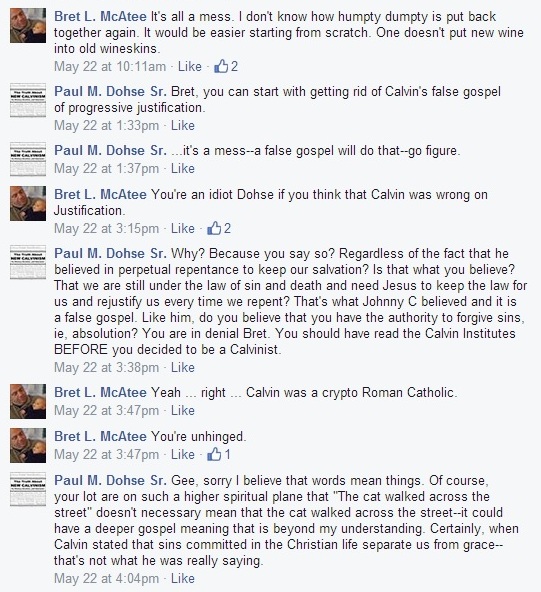


Addendum:


Piper, Tchividjian, Christian Counseling, and the Calvinist False Gospel: The Law of the Spirit has NO Power to Change
Originally posted May 22, 2014

DOING THE CROSS ONLY TO KEEP YOURSELF SAVED
The Bible is two different laws to the only two people groups in the world: the lost and the saved. To the lost, it is the law of sin and death. To the believer, it is the law of the Spirit of life:
Roman 8:1 – There is therefore now no condemnation for those who are in Christ Jesus. 2 For the law of the Spirit of life has set you free in Christ Jesus from the law of sin and death.
We are no longer UNDER LAW, but UNDER GRACE, and being under grace is the same as being under the law of the Spirit of life. As Christians, the Spirit does in fact use the law to change us:
John 17:14 – I have given them your word, and the world has hated them because they are not of the world, just as I am not of the world. 15 I do not ask that you take them out of the world, but that you keep them from the evil one. 16 They are not of the world, just as I am not of the world. 17 Sanctify them in the truth; your word is truth. 18 As you sent me into the world, so I have sent them into the world. 19 And for their sake I consecrate myself, that they also may be sanctified in truth.
20 “I do not ask for these only, but also for those who will believe in me through their word, 21 that they may all be one, just as you, Father, are in me, and I in you, that they also may be in us, so that the world may believe that you have sent me.
As I will keep proclaiming, the Achilles’ heel of Calvinism is law. Calvinism keeps the Christian under the law of sin and death. Hence, Jesus must fulfil the law of sin and death for us, and this is made up to be part of the atonement. But the law of sin and death has no part in justification—that’s why there is “no condemnation” for believers. But clearly, Calvin taught that Christians are still under the condemnation of the law and that Christ must perpetually save us from it by reapplications of the cross. In particular, note 3.14.9-11 in the Calvin Institutes. This construct turns the Bible and grace completely upside down. This is also why John Piper refers to the Bible as a book of “saving acts” (plural).
Note that John Piper, like Calvin, keeps Christians under the law of sin and death:
What Then Shall Those Who Are Justified Do with the Law of Moses?
Read it and meditate on it as those who are dead to it as the ground of your justification and the power of your sanctification. Read it and meditate on it as those for whom Christ is your righteousness and Christ is your sanctification.
Notice that Piper replaces the law of the Spirit of life with Christ alone as our sanctification. Notice also that we are to PRESENTLY read the law as those who are dead to it…[for] the power of your sanctification. Piper, like Calvin, only recognizes ONE law, the one we are dead to.
Tullian Tchividjian is more pointed about it:
So do you think the law no longer has—or should no longer have—a role in the Christian life?
No, I wouldn’t say that. While the law of God is good (Romans 7), it only has the power to reveal sin and to show the standard and image of righteous requirement—not remove sin. The law shows us what God commands (which of course is good) but the law does not possess the power to enable us to do what it says. You could put it this way: the law guides but it does not give. In other words, the law shows us what a sanctified life looks like, but it does not have sanctifying power—the law cannot change a human heart. It’s the gospel (what Jesus has done) that alone can give God-honoring animation to our obedience. The power to obey comes from being moved and motivated by the completed work of Jesus for us. The fuel to do good flows from what’s already been done. So, while the law directs us, only the gospel can drive us.
This, of course, asserts the idea, per Calvinism, that the power of our sanctification comes from justification. Per the usual, “gospel” and “Jesus” are words used to replace “justification” for cover on this issue. If our sanctification comes from justification, the law of sin and death is not ended and Jesus must continue to save us from it. The “finished” work isn’t so much finished, it needs to be perpetually applied to save us from the law of sin and death. Simply stated, Calvinism keeps us under the law of sin and death and ignores the law (“nomos”) of the Spirit of life. In other places, Tchividjian posits the idea that “the Bible never says that the law can give life.” That isn’t true,
Psalm 19:7 – The law of the Lord is perfect, reviving the soul;
Psalm 119:93 – I will never forget your precepts, for by them you have given me life.
I won’t belabor the point, but Christ also said that man lives by every word that comes from the mouth of God, and when Moses said to “choose life” he was talking about the law.
In the final analysis, it’s works salvation via antinomianism; we have to work hard at doing nothing but the cross to keep ourselves saved from the law of sin and death which Calvin, even from the grave, keeps poised over our heads, ready to damn us at any time unless we live by faith alone in sanctification. And of course, faithfulness to the institutional church which has the “power of the keys” is our best shot to be “ready for the judgment.” Frankly, a judgment that we will not be attending because the final judgment is according to the law of sin and death, not the law of the Spirit of life that the Spirit does in fact use to change us.
And also take note: 95% of the Christian counseling going on in the institutional church is based on Christians being yet under the law of sin and death with Christ fulfilling it in our stead as part of the atonement. Good luck with that—it’s a false gospel.
paul
The Real Meaning Behind “We Must Preach the Gospel to Ourselves Everyday”
 Originally published June 6, 2013
In his commentary on the Catholic Epistles, volume 45, Calvin states the following:
“Secondly, this passage shows that the gratuitous pardon of sins is given us not only once, but that it is a benefit perpetually residing in the Church, and daily offered to the faithful. For the Apostle here addresses the faithful; as doubtless no man has ever been, nor ever will be, who can otherwise please God, since all are guilty before him; for however strong a desire there may be in us of acting rightly, we always go haltingly to God. Yet what is half done obtains no approval with God. In the meantime, by new sins we continually separate ourselves, as far as we can, from the grace of God. Thus it is, that all the saints have need of the daily forgiveness of sins; for this alone keeps us in the family of God” (John Calvin: Commentaries on the Catholic Epistles. The Calvin Translation Society 1855. Editor: John Owen, p. 165 ¶4).
Calvin is clearly stating here that sin in sanctification separates us from grace:
by new sins we continually separate ourselves, as far as we can, from the grace of God.
Hence, there is no distinction between sonship and justification. Sin can only separate us from grace, and not intimacy with the Father. Sonship, which should be under the auspices of sanctification, is fused with justification. Then the shocker:
Thus it is, that all the saints have need of the daily forgiveness of sins; for this alone keeps us in the family of God.
Notice also that this “gratuitous pardon” is “offered” daily. So in the same way we are initially offered salvation for forgiveness of sins, we have to continually accept this daily offer of forgiveness. And moreover, that “keeps us” in the family of God. “We must preach the gospel to ourselves every day.” Sound familiar?
Now we know why.
paul

 Paul's Passing Thoughts
leave a comment