New Calvinism’s Contribution to the Church: It Reveals What Calvin Really Believed
 Originally published August 24, 2013
“A question we often hear is, ‘What is the difference between an Old Calvinist and a New Calvinist?’ The answer: maybe the music style and dress code, but that’s about it, Old Calvinists that don’t know what Calvin really believed about soteriology notwithstanding.…. This is the one area where New Calvinists can recommend themselves: they have a firm handle on Calvinology.”
Once upon a time, there was a family in Christianville that was highly respected among all of the town’s people. They owned the town’s water purification plant and purified the town’s water with a formula that had been in their family for centuries.
Then a distant relative of the family moved into town. He was obviously a fellow of the baser sort. “Well, every family has a black sheep” the town’s people reasoned. But then they found out this relative had also purified water in other towns with the same family formula resulting in the death of thousands. Apparently, for the first few years, the formula appears to improve the health of people, but ill effects follow in the long term.
The prestigious family objected and insisted that the family member had tampered with the original formula. What will Christianville do now?
No doubt, New Calvinism must be exposed and stopped, but its unwitting service to the church should not go unmentioned: it has exposed the original family formula, the same formula that evangelicals have fustigated the Catholic Church for over the years. For some reason, we are willing to buy into the idea that three Catholics founded an anti-Catholic movement and never stopped being Catholics. Truly, our Enlightenment forefathers would be ashamed of us for believing such.
Supposedly, the “Reformers” modified the original formula enough to bring life out of death. Now there is debate between the New Calvinists and the Old Calvinists in regard to the originality of that formula. Old Calvinists say the New Calvinists modified the formula. That’s not the case. A question we often hear is, “What is the difference between an Old Calvinist and a New Calvinist?” The answer: maybe the music style and dress code, but that’s about it, Old Calvinists that don’t know what Calvin really believed about soteriology notwithstanding. This is the one area where New Calvinists can recommend themselves: they have a firm handle on Calvinology.
Old Calvinists are obviously very threatened by what the New Calvinists have brought to light. Those who proudly label themselves with something that they misunderstood to begin with fall significantly short of being impressive. But their dilemma is understandable to a point. The Reformers interpreted all reality through Martin Luther’s Theology of the Cross. This seeks to use the Bible as a tool for gospel contemplationism only. The sole purpose of the Bible is to show us our sin (mortification), and God’s holiness, leading to a gospel visitation afresh (vivification). The Bible aids us in perpetual rebirth experiences. This is known as the Redemptive Historical use of the Bible.
But that is not the normative in regard to how people interpret literature or reality. Naturally, we interpret literature grammatically. Intuitively, we are exegetical beings. The way words are arranged in a sentence interprets our realty. Until Adam named the animals, they had no part in reality. You say, “Yes they did, even though they were unidentified, they were there—they had presence.” No, the word “unidentified” gives them their meaning in reality. Words interpret our reality. In the Redemptive Historical construct, all the words in the Bible must serve to show us our need to be saved perpetually—those words must continually show us our ruined state so that we can experience salvation (vivification) rather than being a participant in it via sanctification. That would be works salvation according to the Reformers.
To simplify this, it is fair to say that the Reformers brought an Eastern way of interpreting reality into the Western religious world. So, as Christians throughout the centuries read their Bibles, they are/were naturally drawn away from the original Reformed epistemology. The New Calvinists basically rediscovered the original epistemology of the Reformers. Their interpretive construct is critical for living by faith alone in sanctification as a way to maintain justification.
The proof in the pudding is interaction with Old Calvinists who scoff at the idea that New Calvinism is the same thing as their vaunted Reformed heritage. I cite here a debate I recently had with Calvinistic pastor Bret L. McAtee on a social network. The debate represents something that the laity must overcome in regard to seeking out truth and standing for it: academic antagonism. This is a Reformed mainstay. Much of the populous is eliminated from the debate because of a standard set up by the Reformers themselves. This was borrowed from the Eastern concept of social caste. The Reformers established a whole other standard of truth through councils, creeds, and catechisms attended by, “Divines.” Notably, those who drafted the Westminster Confession of Faith are known as the “Westminster Divines.” This is no more or no less than the Hindu Sage. True, Hinduism looks inward to interpret reality beyond the five senses while Reformed theology looks outward. But both interpret reality through an anti-grammatical construct. New Calvinists state implicitly that a literal, grammatical interpretation must bow to the redemptive interpretive process and its mortification /vivification experience.
Point being, throughout my debate with Pastor Bret L. MacAtee, he resorts to this, you’re a peasant and I am a sage communication technique. He also tried to use the Reformed debate technique of assumptive metaphysics. What’s that? That is the assumption that the reality established by the Reformers is truth because they state it so. And this has worked well. Most Christians associate truth with “orthodoxy.” Orthodoxy is a truth established by men. The Reformers play word games here by calling documents such as the Westminster Confession, “subordinate truth,” but that is disingenuous. In fact, those who reject orthodoxy are referred to as “heterodox,” and as we shall see, MacAtee makes that synonymous with rejecting the gospel itself. Part and parcel with debating a Calvinist is their attempt to set the metaphysical parameters of the debate. I did not allow this to happen.
Let’s review these important points: a debate with a Calvinist will always involve academic antagonism and metaphysical assumption.
Note: Posts on social internet threads don’t always appear in the intended order because of varied response times to particular points. Also, it was a lengthy thread, and only the posts that articulate my summation here are included, and in the order that best clarifies the points that are being made.
McAtee got the ball rolling by using academic antagonism right out of the gate:
BM: And that New Calvinism is authentic Calvinism is a howler of a statement.
PD: Bret, It’s a “howler” because you get your information from men. I get my information from 6 years of research on the Reformation and the Calvin institutes. You are clueless.
BM: LOL … Your indicting the wrong Chap Paul. Want to compare our reading over the years in Calvin and Calvin studies?
You’d lose.
And … I’ve read your books as well.
Those well versed in Reformed theology need not bow to this antagonism. We are in the truth business and are not bound by the musings of men. One must bring the debate to one or more subjects where Calvinism is vulnerable; in this case, progressive justification:
PD: Oh, so you believe in Progressive Justification?
BM: Nope … I believe in eternal justification, objective justification and then subjective justification … rightly explained and understood.
PD: “Nope”? Really? So tell me what book and chapter in the Calvin Institutes where Calvin talks about Progressive Justification.
PD: You there Brett?
BM: Yes yes Paul … I’ve read your open letter. An open letter that suggests you don’t know what you’re talking about and are a theological novice.
Two things here. First, his description of what he believes about justification is in fact New Calvinism to a “T.” New Calvinists, like Calvin, believed that grace remains completely outside of the believer and is only objective truth outside of us. Justification during our Christian life continues and is experienced subjectively. “Eternal justification” could refer to election or final justification which he seems to have left out. Nevertheless, note his description in relationship to the New Calvinist mantras, the centrality of the objective gospel outside of us and the subjective power of the objective gospel. The illustration below shows the kinship between New Calvinism and what McAtee stated:
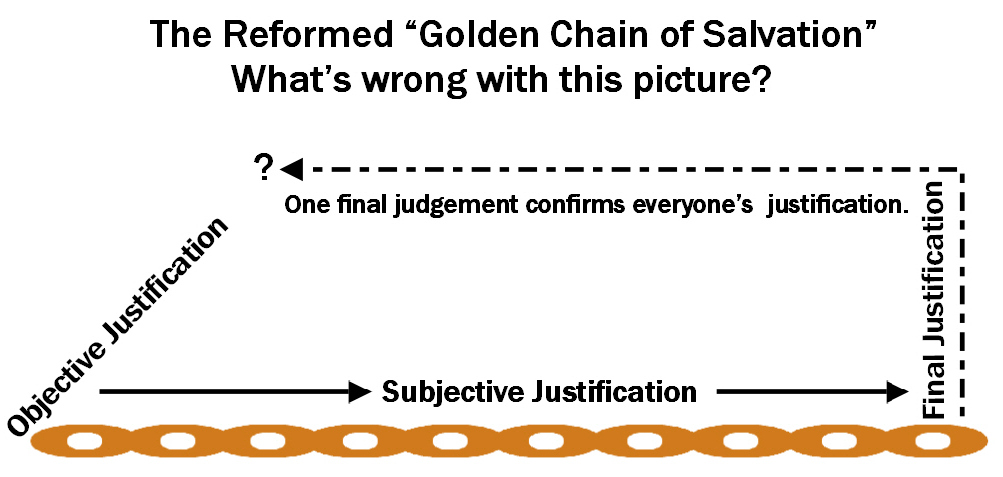
One Achilles’ heel for Calvinists is while denying that they believe in progressive justification, the title of book three and the fourteenth chapter of the Calvin Institutes is, “The Beginning of Justification. In What Sense Progressive.” This is what I was trying to get McAtee to explain. He once again resorted to academic antagonism by calling me a “theological novice” while this is one of several questions that he wouldn’t answer.
PD: So, when Calvin said that justification is progressive, he really didn’t mean that justification is progressive. Is that what you are saying?
BM: I’m saying you don’t know the difference between progressive and perpetual.
PD: Both move forward in time.
PD: No? Am I missing the definition in its “gospel context”?
PD: Both move forward in time—yes or no big guy.
This is the whole motif that Calvinists are on some higher plane of understanding to the point where what seems obvious to the peasantry really isn’t realty. Hence, “progressive” and “perpetual” are supposedly different concepts that the common man is unable to understand. Again, I ignored the academic antagonism and asked him if both words have the idea of moving forward in time. He wouldn’t answer the question; instead, he posed a question based on Reformed pseudo-church history:
BM: Only an idiot could believe that Cardinal Sadolet and Rome hated Calvin because he agreed with them on Justification.
This response combines academic antagonism and metaphysical assumption. The assumption is that, according to the Reformed motif, there was a great gulf in the view on justification between Rome and the Reformers, and the only reason Rome hated the Reformers is because of their diametrically opposed views on justification. This is not reality at all for a couple of reasons. First, Calvin got his theology from St. Augustine who is a celebrated spiritual hero in the Catholic Church till this day. Secondly, Augustine, Luther, nor Calvin ever renounced their own membership in the Catholic Church. Here is how I sated it further along in the debate:
PD: Bret, let me also say that a cursory observation of church history shows that Augustine, Calvin, and Luther never left the Catholic Church. Yet, you are incredulous that their take on justification would be basically the same. So is it, A. You just don’t know any better, or B. You know, but you are deliberately keeping your flock dumbed down? Augustine was a die-hard Catholic till the end while Calvin cites him more than 400 times in the Institutes. And the idea that they had the same basic approach to justification as Rome is an over the top idea?
McAtee continued to bear down with heavy doses of academic antagonism and metaphysical assumptions with this statement:
BM: Like all idiots you are reading Calvin through a keyhole and then reinterpreting him through the Keyhole instead of letting his whole corpus of thought inform you. You are an example of someone that got in way over his head into areas he was not yet ready to think about. You may yet return to Biblical Christianity Paul and leave your heterodox ways and thinking.
Please remember at this point that he refused to answer the simplest of questions: did Calvin mean progressive by “progressive,” and does both perpetual and progressive have the idea of moving forward in time? Instead, he suggests that all of Calvin’s massive literary droning would have to be read and studied to properly understand what Calvin meant by the very use of specific words. Of course, that is a ridiculous notion, but not a rare argument among the Reformed. The same argument is often used to defend John Piper who has also written a huge mass of literary droning. Note also that my “heterodox” (other than orthodoxy) is likened to a departure from “Biblical Christianity.” The mode of operation is to demean and argue from a reality that results in the desired outcome.
McAtee then introduces another Reformed technique of debate that we will call, drowning by orthodoxy. He then began to copy and paste a mass of Reformed orthodoxy that would take two days to read. The assumption is that I am not familiar with what he pasted into the stream. It assumes the response, “Oh my! I don’t understand any of this deep orthodoxy! And there is so much of it! Hark, I know nothing! What to do? His mind is so far above me!” Actually, I am very familiar with the information posted, especially his references to articles in the Trinity Review. Ironically, if that is a strong enough word, the founder of the Trinity Review bought into New Calvinism during the 90’s. I stated the following later in the thread:
PD: Furthermore Bret, you said you read my book, but yet you quote John W. Robbins’ Trinity Review above to make your point. As clearly documented in my book on pages 63-65, I show that Robbins bought into the Forum’s teachings via the SDA theologian Robert Brinsmead in 1995. As you know, New Calvinism came out of the Forum and Graeme Goldsworthy is popular in the movement till this day. Robbins reprinted Brinsmead’s magnum opus on justification in the Trinity Review, yet, you cite The Trinity Review as proof that Calvinists are not New Calvinists. Now if anything is funny, that is.
One of his several references to the Trinity Review follows:
The Trinity Foundation – Calvin on the “Pernicious Hypocrisy” of Justification by Faith and Works
http://www.trinityfoundation.org
That some serious slippage has occurred away from the classical Protestant doctrine of justification sola fide has been well documented in many religious publications. Certain teachers – Douglas Wilson.
Furthermore, his excerpts copied and pasted from the Calvin Institutes contained things like the following:
…a great part of mankind imagine that righteousness is composed of faith and works [but according to Philippians 3:8-9] a man who wishes to obtain Christ’s righteousness must abandon his own righteousness…. From this it follows that so long as any particle of works-righteousness remains some occasion for boasting remains with us [Institutes, 3.11.13].
This is yet another technique used by Calvinists to confuse those who are trying to nail their false doctrine by making distinctions between justification and sanctification—they continually refer back to justification and Sola Fide. Any attempt to make theological distinctions between the two is answered with more and more Reformed sanctification by justification orthodoxy. Even his Institute pasting was in context of what the Trinity Review said about it. This elicited the following responses from me:
PD: Brett, smothering me in all of this orthodox propaganda isn’t answering my question. Have you read CI 3.14 on what Calvin said about progressive justification or not? Why are you citing other people? I asked you as someone who says he reads the CI. You deny that your information comes from men, and then you cite a bunch of men. I want to know your specific evaluation of CI 3.14
[Note: all of his citations avoided the aforementioned title of CI 3.14 which resulted in the following reply: “I’m citing Calvin Paul. Read the quotes from the Institutes. You can’t make CI 3.14 disagree with the rest of what Calvin said on the subject. Good grief man … this is elementary hermeneutics” ( i.e., progressive doesn’t mean “progressive” because of other things Calvin wrote)].
PD: Right, he is applying justification truth to sanctification, so what’s your point?
PD: No Bret, I am not confused by your discussion of sanctification in a justification way.
I will shortly pause here and introduce yet another debate tactic of the Calvinist: the divine unction by a philosopher king declaring me to be unregenerate. Simply pronouncing a curse on your opponent has to be the quintessential easy button:
O Foolish Dohse … who has bewitched you?
Like all good Calvinists, McAtee believes in Calvin’s “power of the keys” that gives Reformed elders the power to loose or bind sin on earth. I have received several veiled threats by Reformed elders to bind my sin on earth. Some not so veiled.
McAtee’s comment about “elementary hermeneutics” was also addressed:
PD: “Elementary hermeneutics” ? Which hermeneutic? You act like there is only one.
BM: I’m talking about the place of Hermeneutics in interpreting literature. You’re hermeneutic on Calvin sucks.
PD: Redemptive or Grammatical Bret? Which one?
BM: Paul … I’m not talking about hermeneutics in terms of reading Scripture. I’m talking about hermeneutics in terms of reading Calvin which should be Historical Grammatical.
Here, McAtee seems to infer that there is a different hermeneutic for interpreting literature, and a different hermeneutic for interpreting the Bible. I will let that statement stand on its own and move on to the part of the debate where McAfee concedes that perpetual forgiveness, the same kind of forgiveness that saved us, needs continued application in the church:
PD: (Quoting BM) “Do you really want to advance the idea that Calvin and Rome agreed on Justification? Is that really your position Paul?” (Answer) Both held to a linear gospel which is progressive justification. They disagreed on how to get from justification to glorification.
But when it gets right down to it, BOTH by ecclesiastical absolution. Citations from CI available upon request.
BM: LOL!
PM: Bret, may I list the very fair questions you have not answered yet?
BM: Paul … purple.
BM: Paul … should I post again the very fair quotes from Calvin’s own pen indicating that he did not believe in progressive justification and so did not believe that one had to be sanctified before one could be justified?
PD: Of course not, he believed sanctification was progressive justification. But here is the better question: Why did he believe a justifying forgiveness of sins needed to be continually sought IN the church?
After all of his vehement denial that Calvin believed in a progressive justification, he begins to concede that a perpetual forgiveness for sin in the church for the purpose of keeping us justified is needed:
BM: “Not by righteousness which we have done, but according to his mercy he saved us”; that being justified by his grace, we might become the heirs of everlasting life, (2Ti 1: 9; Tit 3: 4, 5). By this confession we strip man of every particle of righteous, until by mere mercy he is regenerated unto the hope of eternal life, since it is not true to say we are justified by grace, if works contribute in any degree to our justification. The apostle undoubtedly had not forgotten himself in declaring that justification is gratuitous, seeing he argues in another place, that if works are of any avail, “grace is no more grace,”
(Rom 11: 6). And what else does our Lord mean, when he declares, “I am not come to call the righteous, but sinners to repentance?” (Mat 9: 13). If sinners alone are admitted, why do we seek admission by means of fictitious righteousness?
BM: Why do we expect corn plants to be irrigated outside a corn field?
PD: So, the point you are making here agrees with Calvin in context of sanctification. Justification must continually be sought in sanctification to retain a just standing before God.
BM: Section 11. In addition to the two former arguments, a third adduced against the Sophists, to show that whatever be the works of the regenerate, they are justified solely by faith and the free imputation of Christ’s righteousness….[Finally, BM quotes from the infamous 14th chapter of book three from the Institutes. Curiously, he only cites the section. Calvin’s point in sections 9-11 (BM’s long copy and paste is omitted here) is that Christians are not capable of doing any meritorious work before God. Therefore, they need “perpetual reconciliation” in the church. BM cites theses sections from the Calvin Institutes to make the very point that he denied throughout the whole debate].
PM: Bret, why did Calvin believe that a justifying forgiveness had to be continually sought in the church?
BM: The Church is the body of Christ where Christ is proclaimed. Where else would one go to be reminded that they are forgiven? [Do Christians need to be “reminded” that they have been forgiven? Peter said that we only forget that we are forgiven when we fail to ADD works to our faith (2PET 1:5-11)].
PD: Bret, he wasn’t talking about being “reminded” he was talking about perpetual “reconciliation.”
PD: What does “reconciliation” mean Bret?
PD: Do we need continual reconciliation?
BM: Paul … does Christ ever live to intercede for us?
Why?
PD: So, you are saying that is to keep us justified?
BM: Are you saying that we could be justified without His ongoing Intercession? Could we be justified by a Christ who was not at the right hand of the Father as our continual advocate? If Justification is merely in the death of Christ then there was no reason for Him to have been resurrected, ascended and set apart for the continual Priestly work of Intercession.
PD: Then why did Calvin teach that we have to continually seek that forgiveness in the church? If Christ is doing all of the work in heaven?
BM: Why do we expect corn plants to be irrigated outside a corn field?
[Note: We have to keep ourselves justified by staying in the cornfield of justification. He is conceding what he denied throughout the whole debate].
BM: The Church is the body of Christ. The minister the voice of Christ pronouncing the reminder of sins forgiven.
[Note: We have to be continually reminded that we are forgiven in order to stay justified].
PD: So, there is a continued need for forgiveness of sins to remain justified?
BM: Ask Jesus,
5 Then he poured water into a basin and began to wash the disciples’ feet and to wipe them with the towel that was wrapped around him. 6 He came to Simon Peter, who said to him, “Lord, do you wash my feet?” 7 Jesus answered him, “What I am doing you do not understand now, but afterward you will understand.” 8 Peter said to him, “You shall never wash my feet.” Jesus answered him, “If I do not wash you, you have no share with me.” 9 Simon Peter said to him, “Lord, not my feet only but also my hands and my head!” 10 Jesus said to him, “The one who has bathed does not need to wash, except for his feet, but is completely clean.
PD: You make my point for me. Calvin clearly said the whole washing of the body is continually needed.
PD: Jesus said it isn’t needed, Calvin said it is. That is, “the washing” which Calvin called “ablution.”
McAtee unwittingly cited John 13:5-10 in an effort to make his point. Jesus’ point in the passage is that once a person is washed (justified: 1COR 6:11) they are clean and have no further need of washing. There is a need to seek forgiveness for daily sin that disrupts our family relationship with God. That is probably what Christ is talking about in regard to the washing of feet. I would probably include 1John 1:9 here as well. This is further seen in what Christ told the woman at the well. When one drinks the water of salvation, they will never thirst again. In other words, there is no need for a perpetual returning to the well of salvation/justification.
paul
Calvin’s False Gospel: On the Wrong Side of the Law; Galatians 3:15-25
Originally published March 1, 2014
“If Christ had to keep the law perfectly, or if you will, fulfill it, the inheritance no longer depends on The Promise, but God in His grace gave it to Abraham through The Promise.”
“In a manner of speaking, Moses’ law was useless until Christ died. It was a will that promised an inheritance, but without the death of its testator, there is no inheritance; namely, eternal life. So why would Christ have to fulfill the law through obedience? His death alone resulted in the inheritance. Obedience to a will does not fulfil it, only death fulfills it. A will is a promise fulfilled by death only.”
The reason Calvinism is a false gospel is simple and glaring; Calvin was on the wrong side of the law. In fact, Calvin constructed the exact soteriology that the apostle Paul continually railed against. Simply stated, Paul sought to separate law from justification while Calvin sought to fuse law with justification.
Calvin condoned this by making Christ’s perfect obedience to the law part of the “atonement.” This is another caveat we will be discussing: Calvin also misused the word “atonement” and seems to have had a fundamental misunderstanding about what it is. As good Protestants we think of atonement as being central to the cross, and indeed it is VERY important, but not central. I will explain this further along—how Calvin’s understanding of atonement makes the L in TULIP an oxymoron.
Calvin made perfect law-keeping justification’s standard; Paul said, NO! law has nothing to do with being justified whatsoever! Calvin said Christ fulfilled the law for us, and His perfect obedience was imputed to us along with His personal righteousness. Hence, we are righteous positionally, and also righteous factually. Therefore, the “atonement” is a “covering”—no matter what the Christian does, when the father of wrath looks at us, He only sees Christ’s “doing and dying” and not anything we do. This is part and parcel with Martin Luther’s alien righteousness construct as well. It seems logical until you start reading the Bible. But this makes the concept of “covering” very important to the Reformation.
Also, this construct leads to various and sundry formulas for sanctification in which we conduct ourselves in a way that continually reapplies the “doing and dying” of Christ to our lives as opposed to “anything that we do”…and a lot of confusion following. And unfortunately, the elder’s soft whispering in our ear that says, “just trust us” as well. That’s not a good idea.
Let us now examine Galatians 3:15-25 to make these points:
15 Brothers and sisters, let me take an example from everyday life. Just as no one can set aside or add to a human covenant that has been duly established, so it is in this case (NIV).
Really, the crux of Christianity is the covenant God made with Abraham. EVERYTHING goes back to that. God’s complete plan for the ages is bound up in “The Promise.” That is another name, really the formal one, for the Abrahamic Covenant: “The Promise.” One must understand that Reformed theology and Calvinism in particular, is a complete deconstruction of biblical truth and the gospel. Reformed theology holds to the idea that The Promise was conditional. The idea, especially among renowned Southern Baptists, that common ground can be found with Calvinism is the epitome of biblical illiteracy, and this is just one point among many: Paul makes it clear in verse 15 that The Promise cannot be changed or annulled. Furthermore, it does not depend on anything that man does as demonstrated by the fact that God put Abraham in a deep sleep during the ceremony that consummated this covenant.
16 The promises were spoken to Abraham and to his seed. Scripture does not say “and to seeds,” meaning many people, but “and to your seed,” meaning one person, who is Christ (NIV).
Verse 16 is very helpful in understanding something basic about all biblical covenants, here referred to by Paul as “promises.” In the Bible, “promise” is an idiom for “covenant.” The two words are used interchangeably. All of the “promises,” plural, are built upon the one “promise,” singular. All of the covenants build one big historical picture, much of it future, but all based on the one Promise. It is interesting to note that Paul identifies the formally unregenerate Gentiles of his day as alienated from the Promises (plural) of Israel (Eph 2:12).
Verse 16 also makes a distinction in Abraham’s national descendants and spiritual descendants. Abraham is the father of Israel, but not all descendants of Israel are of the “seed of the woman” which is Abraham’s spiritual seed. But be sure of this: that does not negate the promises to national Israel (see Jer 31:31ff.) and those who are of “faith” within national Israel. The point of verse 16 is that belief in Christ denotes the only seed that can give life by “faith” alone apart from anything else. That’s why Paul continues in this way:
17 What I mean is this: The law, introduced 430 years later, does not set aside the covenant previously established by God and thus do away with the promise (Ibid).
The Promise is by faith alone and is the only seed that can give life. The law, which came 430 years later, does not CHANGE anything in regard to The Promise. ALL life is in faith alone, or the seed of faith. One must simply believe. Faith gives life completely separate from the law. Let us expedite the point with verse 21:
… For if a law had been given that could impart life, then righteousness would certainly have come by the law (Id).
You may argue that law can further define righteousness after the fact, but it cannot give life. The law is completely separate from justification/righteousness. The fulfillment of the law by anybody, including Christ, does not impart life—only faith imparts life. A keeping of the law for “atonement” changes the promise:
18 For if the inheritance depends on the law, then it no longer depends on the promise; but God in his grace gave it to Abraham through a promise (Id).
If Christ had to keep the law perfectly, or if you will, fulfill it, the inheritance no longer depends on The Promise, but God in His grace gave it to Abraham through The Promise. So, why the law? Paul will tell us:
19 Why, then, was the law given at all? It was added because of transgressions until the Seed to whom the promise referred had come. The law was given through angels and entrusted to a mediator. 20 A mediator, however, implies more than one party; but God is one (Id).
Moses was the mediator of the covenant of the law given at Mt. Sinai, and the angels enforced its inauguration. This was the unimaginable apocalyptic scene that guaranteed lack of interference from the forces of darkness. In the book of Revelation, we have a description of how angels will be used of God to once again enforce this covenant. Even though the law was added, this was not the addition of another seed of faith; ie., Moses, but there is only one seed that signifies The Promise and the only seed that can give life. Moses’ covenant cannot give life.
So why the law? Now we can talk about, “atonement,” well, sort of. The law was a covering of sorts by way of a will. Under the Old Covenant, if you believed God, you were in the will and guaranteed the inheritance. Remember what Paul said in verse 18?
For if the inheritance depends on the law…
The Old Testament law was a will that protected believers until Christ came and died for our sins. In that sense, they were “covered” until Christ came. Christ is the mediator of a “better” covenant because Moses’ covenant only protected believers from the consequences of sin until Christ came. Moses was the mediator of the will, but Christ is the testator:
22 But Scripture has locked up everything under the control of sin, so that what was promised, being given through faith in Jesus Christ, might be given to those who believe [Note what we have discussed in prior essays: “Scripture” and “law” are synonyms].
23 Before the coming of this faith, we were held in custody under the law, locked up until the faith that was to come would be revealed. 24 So the law was our guardian until Christ came that we might be justified by faith. 25 Now that this faith has come, we are no longer under a guardian.
Hebrews 9:15 – For this reason Christ is the mediator of a new covenant, that those who are called may receive the promised eternal inheritance—now that he has died as a ransom to set them free from the sins committed under the first covenant.
16 – In the case of a will, it is necessary to prove the death of the one who made it, 17 because a will is in force only when somebody has died; it never takes effect while the one who made it is living. 18 This is why even the first covenant was not put into effect without blood. 19 When Moses had proclaimed every command of the law to all the people, he took the blood of calves, together with water, scarlet wool and branches of hyssop, and sprinkled the scroll and all the people. 20 He said, “This is the blood of the covenant, which God has commanded you to keep.” 21 In the same way, he sprinkled with the blood both the tabernacle and everything used in its ceremonies. 22 In fact, the law requires that nearly everything be cleansed with blood, and without the shedding of blood there is no forgiveness (Id).
In a manner of speaking, Moses’ law was useless until Christ died. It was a will that promised an inheritance, but without the death of its testator, there is no inheritance; namely, eternal life. So why would Christ have to fulfill the law through obedience? His death alone resulted in the inheritance. Obedience to a will does not fulfil it, only death fulfills it. A will is a promise fulfilled by death only.
Moreover, in regard to justification, it would seem that the point of the Old Testament law was the temporary imputation of sin, and not the need for a righteous fulfillment. The law imputes NO righteousness, but in regard to justification was a “covenant of death” (2Cor 2:12, 3:6,7). More than likely, the idea is a will of death because it required a death, and can only bring death to those who attempt to be justified by it. Therefore, Christ was the “end of the law for righteousness.” If the definition of “sin” is lawlessness (and it is, see 1John), Christ didn’t merely cover sin—He ended it.
This brings us to “atonement” and the whole “covering” idea. First of all, it is likely that Christ was not crucified on the Day of Atonement because that day has exclusive Jewish cogitations for the future. It’s Jewish eschatology. It is the day when the sins of Israel are cleansed and they are restored as a nation:

(Online source: http://www.hebrew4christians.com/Holidays/Fall_Holidays/Yom_Kippur/YomKippur.pdf )
Secondly, atonement doesn’t allude primarily to “covering,” but rather an exchange:
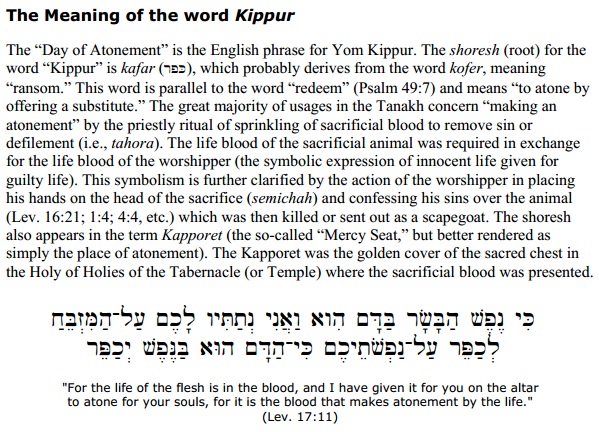
(Ibid).
Therefore, the idea of a “limited atonement” makes no sense at all. First of all, the limitation would only pertain to Israel. Secondly, in regard to Calvin’s overall soteriology, “covering” is only a plausible rendering of atonement; covering versus exchange must be weighed in the balance. In Calvinism, a covering over of our wickedness by the righteousness of Christ is feasible, but what about an exchange of death for life, and sin for righteousness? In the end, what is the passing from death to life? (1Jn 3:14). If we are only covered and not changed, that must be interpreted as mere realm transformation that is only experienced, or the allegory of choice that fits a preferred presupposition.
It’s ironic, even camps that reject the Calvinist label buy into the Calvinist idea of atonement. More buy into the idea that Christ had to keep the law for us. Even more buy into the idea that we are merely covered and not changed: “We are all just sinners saved by grace.” “When God looks at us, He only sees Christ.” We have all said these things.
This is a fundamental misinterpretation of the law’s relationship to grace. And that must change; we mustn’t be on the wrong side of the law.
paul
Calvinism and the Problem with Perfection
Originally published November 7, 2013
Augustine, Luther, and Calvin were first and foremost Platonists. They integrated the Bible with Platonism. Plato’s theory of forms posits the idea of two worlds; the mutable material world of illusion where reality can only be partially known, and another world where the immutable objective true forms exist. This material world is a shadow world; everything is shadows of the true forms. Therefore, man can only interpret and experience this world subjectively. The tendency is to interpret reality by observing the shadows. To the degree that mankind thinks the material world is reality according to the five senses, subjectivity and chaos will abound.
Therefore, Plato’s ethic was to improve the subjective experience of this life by accessing the true forms through ideas and mathematics—things that transcend the five senses (he believed math was an unchangeable rule and therefore not part of the shadow world). He believed that those who have the capability and willingness to bring more understanding of the objective into the subjective to be an elite minority. These were Plato’s philosopher kings whom he thought should rule society in order to decrease chaos as much as possible. Without philosopher kings, the world would be awash in a sea of subjectivity, everyone living by their own subjective presuppositions based on the shadows of this world. Hence, the arch enemy of the Platonic ideal is individualism.
Plato’s world of true objective forms was his trinity of the true, good, and beautiful. Experiencing the pure form of goodness in this world is impossible—only a shadow of good can be experienced subjectively. Plato’s social engineering has a doctrine, and to the degree that doctrine is applied, a higher quality of subjective existence occurs.
The Reformers put a slightly different twist on this construct. There is no doctrine to apply, only an orthodoxy that focuses on seeing and experiencing. Their version of Plato’s philosopher kings are pastors who possess the power of the keys. Orthodoxy is mediated truth determined by “Divines,” and passed down to the masses for the purpose of experiencing the objective power of the gospel subjectively. The Reformers made the true forms “the gospel,” and reality itself the gospel; ie., the work and personhood of Jesus Christ in particular.
Therefore, in the same way Plato envisioned a society that experiences the power of the true forms subjectively through ideas and immutable disciplines like mathematics; the Reformers sought a heightened subjective experience through a deeper and deeper knowledge of their own true, good, and beautiful—the gospel. And more specifically, instead of the gateway of understanding being reason, ideas, and immutable disciplines, they made the gospel itself the interpretive prism. So: life, history, the Bible; ie., everything, is a tool for experiencing true reality (the gospel) in a higher quality subjectivity. The Bible and all life events are a gospel hermeneutic. Salvation itself is the interpretive prism. All of reality is about redemption. Salvation itself is the universal hermeneutic.
But both constructs have this in common: pure goodness and perfection cannot exist objectively in the material world. This is where Calvinism and Platonism kiss. The Bible only agrees with this if it is a “gospel narrative.” But if it is God’s full orbed philosophical statement to all men to be interpreted grammatically and exegetically, contradictions abound. To wit, if man possesses goodness and the ability to interpret reality objectively, Platonism and its Reformed children are found wanting. If Reformation orthodoxy is not evaluated biblically with the very theses of its own orthodoxy as a hermeneutic, even more wantonness is found.
The Apostles rejected Platonism because they believed goodness and perfection could indeed be found in this material world. There is no question of the quality of goodness inside of man that enables mankind to interpret reality objectively, the quantity of goodness notwithstanding. In contrast, a dominate theme in the Calvin Institutes is the idea that no person lost or saved can perform a good work. Like Plato’s geometric hermeneutics, the Reformers believed the Law lends understanding to man’s inability to do good because eternal perfection is the standard. The best of man’s works are tainted with sin to some degree, and therefore imperfect. Even if man could perform one perfect work, one sin makes mankind a violator of the whole law. The Reformers were adamant that no person could do any good work whether saved or lost.
Why all the fuss over this point? Why was Calvin dogmatic about this idea to the point of annoyance? Because he was first and foremost a Platonist. The idea that a pure form of good could be found within mankind was metaphysical heresy. Because such contradicts every page of the Bible, the Reformers’ Platonist theology was made the hermeneutic as well. Instead of the interpretation method producing the theology, they made the theology the method of interpretation. If all of reality is redemptive, it must be interpreted the same way.
For the Platonist, the coming of Jesus Christ in the flesh poses a huge problem. He is the truth. He came to the material world in a material body. Platonism became Gnosticism and wreaked havoc on the 1st century church. Notice how the first sentences of 1John are a direct pushback against the Gnosticism of that day:
1John 1:1 – That which was from the beginning, which we have heard, which we have seen with our eyes, which we looked upon and have touched with our hands, concerning the word of life— 2 the life was made manifest, and we have seen it, and testify to it and proclaim to you the eternal life, which was with the Father and was made manifest to us— 3 that which we have seen and heard we proclaim also to you, so that you too may have fellowship with us; and indeed our fellowship is with the Father and with his Son Jesus Christ. 4 And we are writing these things so that our joy may be complete.
Christ is the true, good, and beautiful, and He was touched, felt, seen, heard, and understood. Game over. This is the paramount melding of Plato’s two worlds resulting in a plenary decimation of his philosophy. Nevertheless, Calvin et al got around that by keeping mankind in a subjective realm while making the material world a gospel hermeneutic. Reality still cannot be understood unless it is interpreted by the gospel—everything else is shadows.
Martin Luther took Plato’s two worlds and made them two stories; our own subjective story, a self “glory story” that leads to a labyrinth of subjectivism, or the “cross story” which is the objective gospel. Luther made Plato’s two worlds two stories, but still, they are two realms; one objective and one subjective. In the final analysis mankind is still incompetent, and void of any good whether saved or lost.
Whether the Reformed gospel or Platonism, the infusion of objective goodness is the heresy. Man cannot have any righteousness in and of himself, whether lost or saved. The pushback against this idea can be seen throughout the New Testament. A few examples follow:
1John 2:4 – Whoever says “I know him” but does not keep his commandments is a liar, and the truth is not in him, 5 but whoever keeps his word, in him truly the love of God is perfected.
1John 2:20 – But you have been anointed by the Holy One, and you all have knowledge.21 I write to you, not because you do not know the truth, but because you know it, and because no lie is of the truth.
1John 2:26 – I write these things to you about those who are trying to deceive you. 27 But the anointing that you received from him abides in you, and you have no need that anyone should teach you. But as his anointing teaches you about everything, and is true, and is no lie—just as it has taught you, abide in him.
1John 2:29 – If you know that he is righteous, you may be sure that everyone who practices righteousness has been born of him.
1John 3:2 – Beloved, we are God’s children now, and what we will be has not yet appeared; but we know that when he appears[a] we shall be like him, because we shall see him as he is. 3 And everyone who thus hopes in him purifies himself as he is pure. 4 Everyone who makes a practice of sinning also practices lawlessness; sin is lawlessness. 5 You know that he appeared in order to take away sins, and in him there is no sin. 6 No one who abides in him keeps on sinning; no one who keeps on sinning has either seen him or known him. 7 Little children, let no one deceive you. Whoever practices righteousness is righteous, as he is righteous.
Romans 15:14 – I myself am satisfied about you, my brothers, that you yourselves are full of goodness, filled with all knowledge and able to instruct one another.
Christians can know goodness, and perform righteousness objectively. This speaks to the quality of the righteousness when it is performed—it is perfect and acceptable to God. We are not limited to a mere subjective experience in regard to righteousness. When we are resurrected, the quantity thereafter will be 100%, but our present righteousness is acceptable to God when it is performed by us. If it is accepted by God, it is perfect.
Even the unregenerate know good, and can perform it. The works of the law are written on their hearts, and their consciences either accuse or excuse them (Romans 2:12-15). Though enslaved to unrighteousness, they are free to perform righteousness (Romans 6:20). The very goodness of God can be understood from observing creation as well (Romans 1:20).
The only way the Reformers can make all goodness outside of man is to make the Bible a salvation hermeneutic. It is the only way they could integrate the Bible with their Platonist philosophy.
A Doctrinal Evaluation of the Anti-Lordship Salvation Movement: Part 3
Originally published August 15, 2014
Do Christians Have Two Natures?
My belief strata is probably similar to most Christians: A. Dogma, firm on that fact; B. Not dogmatic, sounds logical, going with that for now; C. That’s a bunch of boloney. The idea that Christians have two natures has always been categorized under B for me.
Where do I think a stake needs to be driven most in the arena of Christianity right now? Who we are. We are righteous. We are able. We are good. We are not just righteous positionally, we are in fact righteous in and of ourselves. Righteousness is a gift from God, we cannot earn it, but once we have accepted the gift, we possess it. I fear that most gospels in our day propagate a rejection of the righteousness gift, and I strongly suspect that this is the point of the Parable of the Talents. Clearly, the paramount gospels of our day promote a meditation on the gift in order to keep our salvation. To put the gift into practice is to make His story our own story exclusively.
What is the gift? Is the gift just a gift, or is it also a calling? The “church” is a “called out assembly.” Is answering the call works salvation? And what are we called to? We are called to holiness. In part 2 we have looked at the primary problem with anti-Lordship Salvation. They make answering the call works salvation. How do they rationalize this? As we have discussed, it is the age-old Protestant golden chain gospel. Because justification and sanctification are not separate, a calling to holiness is a declaration that progresses in sanctification; if we commit to holiness in order to be saved, we now have to participate in that progression by obedience to the law.
ALS solves that problem by eliminating the commitment all together and making obedience in sanctification optional—a nice gesture unto the Lord, and it will kinda make your life better. If we doubt our salvation because of behavior, it shows a fundamental misunderstanding of grace; so, the solution is to return to the same gospel that saved us and re-preach it to ourselves. Both ALS and the Calvinists they despise proffer this same construct.
Calvinists deal with the progression of justification in sanctification a different way: by all means we are saved by making a commitment to obedience, but the commitment we are making is a commitment to living by faith alone in sanctification which results in the commitment being fulfilled by Christ. In fact, both camps speak of experiential sanctification; viz, we only experience the works of the Spirit being done through us and we kinda really aren’t doing the work. In Reformed circles, even our “good” works are sin, and our demeanor in obedience gives a clue that the work may be executed by the Lord in that instance, but we don’t know for certain. They call this the “subjective nature of sanctification.” It is manifested in Arminian camps via, “I didn’t do it—it was the Holy Spirit doing it through me.” Really, in all Protestant camps, accomplishment and meekness are mutually exclusive; you can’t have both.
And with ALS as well as Calvinism, righteousness is defined by perfect law-keeping. When their fusion of justification and sanctification is challenged, both camps retort, “Did you sin today?” In BOTH cases, they make no distinction between sin against the law of sin and death, and sin against the law of the Spirit of life in sanctification—violations that grieve the Spirit. That’s because they see justification and sanctification as the same (though both camps are outraged in regard to the accusation).
Because ALS, like Calvinism, makes perfect law-keeping the essence of righteousness, they cannot not deem the Christian perfect in regard to justification. They posit the idea that the Christian is only positionally righteous and not practically righteous. Unfortunately, that same view of our righteousness is then juxtaposed into sanctification because they fuse the two together. To not continually drive home the idea that we are just “sinners saved by grace” is to suggest that we can keep the law perfectly. But the question is… “What law?” There is no law in justification, and where there is no law there is no sin (Rom. 4:15).
Christ primarily died on the cross to end the law of sin and death. Now there is no law to judge us, and that can be coupled with the fact that we are born again of the Spirit and have the seed of God within us (1Jn. 3:9). The new birth is a reversal of slavery resulting in a change of direction. We were once enslaved to sin and free to do good, resulting in a direction away from God (under law Rom. 6:14), but now are enslaved to righteousness and free to sin (Rom. 6:20). As we will see in Romans 7, we were once enslaved to the law of sin and death (Rom. 8:2), but now we are enslaved to the law of the Spirit of life. In both cases, there is a reverse freedom as well. Unfortunately, the Christian is still harassed by the law of sin and death, which is a law standard by the way, and free to sin against it. We will discuss exactly how this happens.
But, because ALS, like the Reformed only see one nomos (law), and Christians obviously sin, the Christian must be both saint and sinner in sanctification. This is Martin Luther’s Simul iustus et peccator—at the same time righteous and a sinner. But, this means saint by declaration and position only while the Christian remains in the same state. The only change is the recognition of his vileness—this defines faith according to Reformed ideology.
Likewise, since the Christian cannot keep the law of sin and death perfectly, and that is justification’s standard, the ALS has its own version of the Simul iustus et peccator: the two natures. Sure, it’s soft Simul iustus et peccator, or Simul iustus et peccator Light, but it’s the same concept. I am not going to take time here to articulate all of the versions, but suffice to say all denominations are spawned by the question of how we do justification in sanctification. There are only two religions in the world: Progressive Sanctification and Progressive Justification. One is a call to holiness and you get justification in the bargain. The other is a call to be declared righteous while remaining a sinner. The former is a call to be made righteous. Answering the call saves you, following the call sanctifies you, but the two are separate with the demarcation being the new birth—following the call does not justify you. Accepting the gift justifies you—but the gift is a calling to holiness. Seeing the gift and the execution of the gift as being the same is the monster of confusion known as Protestantism.
The idea of two natures is contradictory to the new birth.
There is only one us. The other guy is dead. His nature is not hanging around with us. He is not sort of dead, and we are not sort of under the law. We are not under the law at all. The guy’s death did not merely weaken him, it utterly slaughtered him. You are not kinda the old you, there is no old you, that person is not you at all, he is dead.
So what’s going on? I am going to pull the theses out of the barn from the get-go. Think, “sin.” This all starts with a very simple word that has very deep metaphysical ramifications that will not be investigated here, but it all begins with sin as a master. Sin was originally found in God’s most magnificent angel, Lucifer, “son of the morning.” How did sin get there? Far be it from us to discuss that here, but there are theories.
Secondly, a law that should promise life, but sin uses the law to create sinful DESIRES within the individual.
Thirdly, this is daring, but it is best to think of the “flesh,” also, “members” as neutral. Our members can be used for both good and evil. The “flesh” IS NOT the old nature.
Fourthly, fruits unto death and fruits unto life.
The Theses Articulated
Much more study needs to be done in this area; this study is designed to get the ball rolling, but you could spend a lifetime articulating it.
When man is born into the world, sin is within him and sin is a master. When people are born into the world, they are sold into slavery:
Romans 7:14 – For we know that the law is spiritual, but I am of the flesh, sold under sin.
Paul is not saying that flesh =’s evil, he is saying that sin resides in our mortal members. He is saying our birth sold us under sin. Sin is a master. According to the New Testament, this is synonymous with being born “under law” as in… “the law of sin and death.” Christ was the only man ever born under that law who could keep it perfectly. All others are condemned by it.
Let’s look at sin as master:
Genesis 4:6 – The Lord said to Cain, “Why are you angry, and why has your face fallen? 7 If you do well, will you not be accepted? And if you do not do well, sin is crouching at the door. Its desire is for you, but you must rule over it.”
Sin is a master who desires to rule over the individual. Sin is the problem. This does not mean mankind is totally depraved and his will is in complete bondage to sin, he/she is still free to do good and obey the conscience, but the overall direction is away from God and to sin.
Sin resides in the mortal body, but the mortal body, as we shall see, is somewhat neutral. I am not going to get into anthropological dichotomies and theories, but the Bible seems to say that the mind within the body is what’s redeemed when we are saved. Our thesis here contends that the battle within is between our redeemed righteous minds and SIN, not the old us that is dead. However, we are using the same body that the old man (the former us) used and the body can be habituated to some degree. We are to put off those habits and build new ones into our lives:
Ephesians 4:17 – Now this I say and testify in the Lord, that you must no longer walk as the Gentiles do, in the futility of their minds. 18 They are darkened in their understanding, alienated from the life of God because of the ignorance that is in them, due to their hardness of heart. 19 They have become callous and have given themselves up to sensuality, greedy to practice every kind of impurity. 20 But that is not the way you learned Christ!— 21 assuming that you have heard about him and were taught in him, as the truth is in Jesus, 22 to put off your old self, which belongs to your former manner of life and is corrupt through deceitful desires, 23 and to be renewed in the spirit of your minds, 24 and to put on the new self, created after the likeness of God in true righteousness and holiness.
The putting off of the old self is the likeness of the old self, not the literal old self. The body is habituated by the old ways, and we can bring those same habits into the Christian life with the same ill results. Note that the mind is being renewed, and we are putting off the old ways and putting on new ways. We are not “sinners” just because we fall short of perfect putting off and putting on, we are righteous persons in the process of renovation. The flesh is not inherently evil because it can be used for righteousness:
Romans 12:1 – I appeal to you therefore, brothers, by the mercies of God, to present your bodies as a living sacrifice, holy and acceptable to God, which is your spiritual worship.
Romans 6:19 – I am speaking in human terms, because of your natural limitations. For just as you once presented your members as slaves to impurity and to lawlessness leading to more lawlessness, so now present your members as slaves to righteousness leading to sanctification.
The flesh is weak, sin resides there, and our bodies will be redeemed; in that sense, “nothing good dwells in me,” but our members are to be used as instruments for righteousness nevertheless. Let me caution in regard to this study. This is not a study that should be approached with sloppy research. For instance, consider Romans 7:24:
Wretched man that I am! Who will deliver me from this body of death?
We now hear, “See! See! Paul stated that we are still wretched sinners!” Problem is, the Greek word translated “wretched” in this verse means to persevere in affliction. Paul is longing to be saved from his mortal body where the conflict rages. He is not saying that Christians remain as wretched sinners. Likewise, was Paul really saying elsewhere that at the time of his writing that he was the premier sinner in the entire world at that time? The “chief” of sinners? I doubt it. One may ponder the idea that…it’s obviously not true. Paul was making some other point that will not be addressed here.
So, what is the dynamic that we are really fighting against? We are set free from the law of sin and death because Christ purchased us on the cross:
1 Corinthians 6:19 – Or do you not know that your body is a temple of the Holy Spirit within you, whom you have from God? You are not your own, 20 for you were bought with a price. So glorify God in your body.
When we are saved, ownership is transferred to another master. We are no longer enslaved to Master Sin. Let’s look at what that slavery looked like:
Romans 7:4 – Likewise, my brothers, you also have died to the law through the body of Christ, so that you may belong to another, to him who has been raised from the dead, in order that we may bear fruit for God. 5 For while we were living in the flesh, our sinful passions, aroused by the law, were at work in our members to bear fruit for death. 6 But now we are released from the law, having died to that which held us captive, so that we serve in the new way of the Spirit and not in the old way of the written code.
As Christians, we are no longer enslaved to sin which used our passions aroused by the law to provoke us to sin. Apparently, the cancelation of the law’s ability to condemn us comes into play here. If we cannot be condemned by the law, sin’s motivation is gone. Being condemned by the law is how sin enslaved us. If Christ died for sin, and the penalty is paid, and there is no condemnation in regard to the Christian, sin is robbed of its power. In addition, I assume it goes much deeper than this, but that is another study. We may assume that the intrinsic power of sin over us was broken as well.
Sin was able to produce sinful desires within us that provoked us to break God’s law; we were enslaved to a lawless master. Hence, and this is VERY important, phrases like, “For while we were living in the flesh” should not be interpreted as flesh=evil; it means that the unbeliever was living in a mortal body that was controlled by the Master Sin dynamic that used the law to condemn us and control us, and destroy us. No doubt, sin uses sinful desires to get even unbelievers to violate their consciences against the works of the law written on their hearts (Rom. 2:12-16).
This is why many unbelievers will obey their passions in things that are in the process of destroying them. They are enslaved by passions that Sin uses to get them to violate their consciences. In this sense, we were living according to the flesh—our flesh was controlled by the triad dynamic of sin, sinful desire, and the law of sin and death. Now we are controlled by a different triad dynamic: the Holy Spirit, His law, and godly desires. To insinuate in any way that a believer remains the same as before or is in some way marginally different borderlines on blasphemy against the Holy Spirit and troddens underfoot the blood of Christ.
We will look at another text to build on our point:
Galatians 5:16 – But I say, walk by the Spirit, and you will not gratify the desires of the flesh. 17 For the desires of the flesh are against the Spirit, and the desires of the Spirit are against the flesh, for these are opposed to each other, to keep you from doing the things you want to do. 18 But if you are led by the Spirit, you are not under the law. 19 Now the works of the flesh are evident: sexual immorality, impurity, sensuality, 20 idolatry, sorcery, enmity, strife, jealousy, fits of anger, rivalries, dissensions, divisions, 21 envy,[d] drunkenness, orgies, and things like these. I warn you, as I warned you before, that those who do such things will not inherit the kingdom of God. 22 But the fruit of the Spirit is love, joy, peace, patience, kindness, goodness, faithfulness, 23 gentleness, self-control; against such things there is no law. 24 And those who belong to Christ Jesus have crucified the flesh with its passions and desires.
A problem arises when we interpret “flesh” without the full corpus of the subject. When we “walk” we are using the flesh. When we walk according to the Spirit, we are using our flesh (members/body) for holy purposes. The full dynamic of sin’s mastery is then interpreted by one word used in various and sundry ways to make any number of points. And, any idea that the Christian is still under the law of sin and death is particularly egregious. Worse yet, if one believes that the law still condemns them as most teach today, this empowers the Sin Master. The word of God can now be used to provoke even Christians with sinful desires.
Furthermore, since sin still remains in the body, it still attempts to use the law to provoke us with evil desires. I imagine that ignorance of the Scriptures supplies a field day for sin in the life of believers accordingly:
James 1:13 – Let no one say when he is tempted, “I am being tempted by God,” for God cannot be tempted with evil, and he himself tempts no one. 14 But each person is tempted when he is lured and enticed by his own desire. 15 Then desire when it has conceived gives birth to sin, and sin when it is fully grown brings forth death.
The desire James is talking about are sinful desires provoked by sin. When we are tempted by a sinful desire, we should know exactly where that is coming from; sin is still trying to master us by using the former scheme. A Christian can produce fruits of death in this life by succumbing to those desires. These are temporary death fruits, not eternal. The former you could generate fruits of death in both this life and the life to come, but the believer can only generate temporary fruits of death. Peter referred to it this way: suffering as an unbeliever.
With all of this in mind, let’s look at some verses from Romans 7:
Romans 7:14 – For we know that the law is spiritual, but I am of the flesh, sold under sin. 15 For I do not understand my own actions. For I do not do what I want, but I do the very thing I hate. 16 Now if I do what I do not want, I agree with the law, that it is good. 17 So now it is no longer I who do it, but sin that dwells within me.
Precisely. But note, when Paul writes, “I am of the flesh, sold under sin,” he is not saying that we are still enslaved to the same master or dynamic, he is saying the dynamic is still at work in us, but we are obviously no longer enslaved to it. Hence…
16 Now if I do what I do not want, I agree with the law, that it is good. 17 So now it is no longer I who do it, but sin that dwells within me.
So, “Did you sin today?” Well, what sayeth Paul? Unless you take all that we observed in these three parts, this statement by Paul would seem outrageous, but we know what he is saying, and no, we are NOT “sinners.” Note as well, the law is not sinful, our flesh is “weak,” but it is sin itself that causes us to sin. Before we were saved, we desired sin and were ruled by it, but now, we have the desires of the Spirit and love His law…
For I do not do what I want, but I do the very thing I hate.
And:
Romans 7:21 – So I find it to be a law that when I want to do right, evil lies close at hand. 22 For I delight in the law of God, in my inner being, 23 but I see in my members another law waging war against the law of my mind and making me captive to the law of sin that dwells in my members. 24 Wretched man that I am! Who will deliver me from this body of death? 25 Thanks be to God through Jesus Christ our Lord! So then, I myself serve the law of God with my mind, but with my flesh I serve the law of sin.
There remains a rest for God’s people, but it is not now. This is war, but we must know who the enemy is and how he works. Let me also add that simplicity is not the duty of the “learner,” aka disciple. Christians are to study in order to show themselves an approved “worker.” Lazy thinkers make for poor disciples and are the fodder for the wicked. The final analysis is this:
So then, I myself serve the law of God with my mind, but with my flesh I serve the law of sin.
We are enslaved to the law of the Spirit of life, and fight against the law of sin and death that sin uses to provoke us with evil desires.
Romans 8:1 – There is therefore now no condemnation for those who are in Christ Jesus. 2 For the law of the Spirit of life has set you free in Christ Jesus from the law of sin and death. 3 For God has done what the law, weakened by the flesh, could not do. By sending his own Son in the likeness of sinful flesh and for sin, he condemned sin in the flesh, 4 in order that the righteous requirement of the law might be fulfilled in us, who walk not according to the flesh but according to the Spirit. 5 For those who live according to the flesh set their minds on the things of the flesh, but those who live according to the Spirit set their minds on the things of the Spirit. 6 For to set the mind on the flesh is death, but to set the mind on the Spirit is life and peace. 7 For the mind that is set on the flesh is hostile to God, for it does not submit to God’s law; indeed, it cannot. 8 Those who are in the flesh cannot please God. 9 You, however, are not in the flesh but in the Spirit, if in fact the Spirit of God dwells in you. Anyone who does not have the Spirit of Christ does not belong to him. 10 But if Christ is in you, although the body is dead because of sin, the Spirit is life because of righteousness. 11 If the Spirit of him who raised Jesus from the dead dwells in you, he who raised Christ Jesus from the dead will also give life to your mortal bodies through his Spirit who dwells in you.
We are not fighting against the old us. We are fighting the sin within that is no longer our master. In addition, our battle is not against “flesh and blood” but rather principalities.
We only have ONE nature, the new one.

 Paul's Passing Thoughts
leave a comment