When the Truth UnCalvinizes a Calvinist
 Originally published July 18, 2014
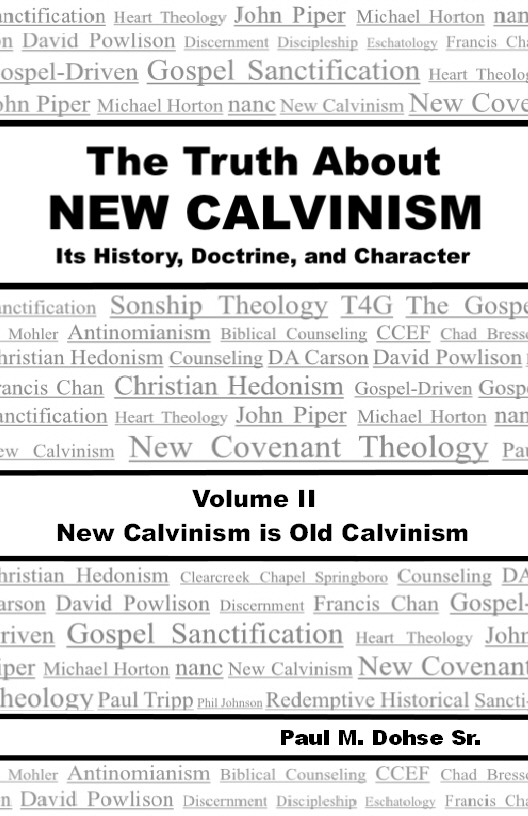
A TTANC 2 Freewriting post and book review of Dr. Robert Congdon’s latest booklet in his New Calvinist series.
Dr. Robert Congdon, according to his own bio, is an “international Bible teacher, conference speaker, author, and radio commentator on subjects relating to current trends in Christianity. He holds a B.S. in mechanical engineering from the University of Illinois, a M.Div. in theology from Grace Theological Seminary, and TH.D in theology from Trinity Theological Seminary.”
Dr. Congdon, according to him, was compelled to write a series of booklets on the New Calvinist movement because he has observed its ill effects on the church*; specifically, the dividing of churches and families, fear in regard to assurance of salvation, and a fatalistic mentality leading to a mindset of irresponsibility.[1]
Correctly, Dr. Congdon also charges that New Calvinism is “traditional Reformed/Covenant theology that has been repackaged in post-modern ‘wrappings.’” This is true in that both New Calvinism and Postmodernism interpret reality from a narrative standpoint. This is meta-narrative in regard to metaphysical narrative. New Calvinists believe that all of reality is a prewritten gospel narrative. Postmoderns believe the same thing, but there is a distinction in how we “enter into the plot,” or “make the Bible story our story—the story of every believer.” New Calvinists believe you participate by living the Christian life the same way you were saved, by faith alone. You then merely watch what unfolds in God’s pre-written narrative with a focus on how He is glorified by what happens. Life events merely make us better see’ers in regard to what “Jesus has done, not anything we do.”
Faith is an eye that can only see outward. Inner light depends on how we see the world, and the payoff is joy regardless of circumstances because circumstances are part of the narrative that increases our faith as we see what God is doing in the world. Also, inner light is a partial experience of the light we will actually experience in heaven. This philosophical** side of Calvinism will be addressed in volume III of The Truth About New Calvinism series.
The Postmoderns believe that you “enter into the plot” by doing what Jesus would do. Both camps see “entering into the plot” as an act of faith, but this brings a charge of works salvation by the New Calvinists against the Postmoderns because salvation is seen as a PROCESS and not a finished work, so what people do or believe in the middle between beginning justification and final justification determines justification by faith alone or works justification. The Postmoderns would cry foul by insisting that they are merely participating in works prepared ahead of time in the metaphysical narrative of reality. By participating, they are merely experiencing the works pre-wrought by Christ—the works are being done to us not by us.
____1______________________________________________________
* Throughout this book, “church” is used in regard to the institutional church, not the called out assembly.
** The metaphysic is a plenary progression of all things from the material to the spiritual in time.
New Calvinists believe the same thing. Seemingly, the difference is that Postmoderns believe participation is a choice which robs God of His sovereignty.*
As a short aside, Congdon’s mention of the divisive nature of New Calvinism needs to be addressed. The so-called “factious” man of Titus 3:10 (ASV) is interpreted in all English Bibles as pertaining to individuals [who question elder authority]. Actually, the Bible has little to say about individuals who cause strife. The overarching concern is groups who divide with a particular false doctrine. The actual word for this so-called divisive individual in Titus 3:10 is…
g0141. αἱρετικός hairetikos; from the same as 140; a schismatic:— heretic (the Greek word itself). AV (1)- that is a heretic 1; fitted or able to take or choose a thing schismatic, factious, a follower of a false doctrine, heretic.
Therefore, New Calvinism takes its place among one of the mountain peak concerns of the Scriptures: sectarian groups that divide with false doctrine (See Addendum A).
Congdon qualifies as the quintessential hybrid Calvinist. Often, he refers to himself as grammatical, premillennial, and dispensational. In the latest booklet of his New Calvinist series[2], he reiterates this and describes himself as a former four-point Calvinist. A grammarian interpretation of reality is mutually exclusive from Calvinism which he apparently now realizes because the theses of his newest addition to the series follows:
- New Calvinism is Old Calvinism.
- Both are false gospels.
- He misunderstood what the five points of Calvinism really represented.
- He is now a Biblicist, not a Calvinist.
His journey into researching New Calvinism has led him to this conclusion: (more…)
How Calvinism is in League with the Accuser of the Brethren
 The born again Christian is no longer under law but under grace. In regard to justification, the Christian is sinless because Christ died on the cross to end the law, and where there is no law there is no sin.
So, the believer dies with Christ as one born under the slavery of sin, law, and death. The sting of death is sin, and the power of sin is the law. That is why it is the “law of sin and death” to the unbeliever. The one who is also resurrected with Christ is no longer under any condemnation whatsoever. The law now guides the believer in love, but in no way condemns.
Those whom Satan cannot keep out of the kingdom he seeks to neutralize by keeping them under condemnation. The power of sin is the law’s ability to condemn. Therefore, by a variety of means, he seeks to keep Christians under law and away from love. Not being under law enables the Christian to aggressively obey without fear of condemnation. Fear has to do with judgment and condemnation; those who fear are not mature in love.
Calvinism keeps the “Christian” under law via a particular view of double imputation. Instead of the biblical imputation being OUR sins imputed to Christ and God’s righteousness imputed to us APART from the law, Calvinism teaches that Christ lived a perfect life to fulfill the law so that His obedience to the law, in addition to Him dying for our sins, is imputed to our Christian life in order to keep us saved. This not only keeps Christians under the law, and is not justification apart from the law, but requires the “Christian” to live by faith alone in the Christian life in order for the obedience of Christ to perpetually fulfill the law for justification in order to keep us saved.
It is a satisfaction/fulfillment of the law of sin and death rather than the law of the Spirit of life.
Hence, supposedly, the Christian life must be lived by faith alone so that the law may be continually satisfied by Christ’s obedience and not ours until the final judgment. At the final judgment, if we lived by faith alone well enough, our sins are covered by Christ’s righteousness. This removes the Christian from actual acts of obedience for purposes of loving God and others, and replaces them with faith only in Christ’s loving acts that replace anything we would do lest it be works salvation. So, when Christ says, “well done faithful servant,” He is not going to be talking about anything that we really did, but what we didn’t do by faith alone.
All in all, this keeps Christians under law and condemnation. They must live in constant fear that they are not “trusting” in the works of Christ well enough for the law to be satisfied; or, in Calvin’s words, resting enough. In this construct, sin is empowered because the law’s ability to condemn is still operational. To the contrary, Christ died to end the law (Rom 10:5) for justification, and we are quickened by the Holy Spirit so that the law might be fulfilled by us in our loving acts towards God and others:
Romans 8:1 – There is therefore now no condemnation for those who are in Christ Jesus. 2 For the law of the Spirit of life has set you free in Christ Jesus from the law of sin and death. 3 For God has done what the law, weakened by the flesh, could not do. By sending his own Son in the likeness of sinful flesh and for sin, he condemned sin in the flesh, 4 in order that the righteous requirement of the law might be fulfilled in us, who walk not according to the flesh but according to the Spirit. 5 For those who live according to the flesh set their minds on the things of the flesh, but those who live according to the Spirit set their minds on the things of the Spirit. 6 For to set the mind on the flesh is death, but to set the mind on the Spirit is life and peace. 7 For the mind that is set on the flesh is hostile to God, for it does not submit to God’s law; indeed, it cannot. 8 Those who are in the flesh cannot please God.
Calvinism keeps Christians under the law of sin and death via its double imputation view of law. By faith alone in the obedience of Christ while in the flesh, the law is actually doing something that Scripture clearly says it can’t do: give life in justification. It doesn’t matter who keeps it; there is not a law that can give life for justification (Gal 3:21).
Listen: Christ came to set us free from the law of sin and death, not to fulfill it for us so that His obedience can replace our loving acts in sanctification. He came to end the law of sin and death, not fulfill it. Our sin is not covered, it is ended. Because it is ended, we are free to serve the law of the Spirit of life without fear of condemnation. We fulfill the law of liberty and are blessed in the doing of it (James 1:25), and are not under the condemnation of the law of sin and death. The fulfillment of that law cannot bring forth life—only condemnation.
In the Calvinist double imputation approach, we continually seek to see our own condemnation in order to achieve a deeper and deeper gratitude for our original salvation. If we do so, the law of sin and death continues to be satisfied by Christ’s obedience to it and we remain justified by the blood. Instead of there being no condemnation in the Christian life, we are exhorted by the Calvinists to seek a deeper and deeper understanding of our condemnation to make the cross bigger (deeper gratitude for our original salvation).
This is a satanic objective dressed up in Christian garb. We are helping the accuser of the brethren by continually seeking to accuse ourselves. Instead of seeking to love through obedience, we are told to partake in “deep repentance,” “repentance from good works,” and “revealing the sin under the sin.” They tell us that the Christian life is a sin onion, and that the gospel is made bigger by continually peeling back the layers of sin.
There is NO sin onion. The law is ended, and there is no onion to peel. Sinning as God’s children and the grieving of the Holy Spirit is another issue that has nothing to do with justification. Well, sort of.
Obviously, Calvinism also seeks to grieve the Holy Spirit through us by empowering sin in our lives because sin is empowered by condemnation. And it also denies the primary reason Christ went to the cross…
…to end the law of sin and death, and to set us free to love Him through obedience to the law of the Spirit of life.
paul
How Election Promotes the Institutional Church
 Election is scary stuff. Bottom line: before the foundation of the earth, God decided who will be saved and who will not be saved. This is even a gospel in and of itself known as the “gospel of sovereignty” or the “gospel of sovereign grace.”
Did God save me or not? In the final analysis, the Reformed admit that we can’t know for certain. You cannot put any stock in your choice to believe the gospel, because you have no choice—it’s God’s choice alone. In fact, telling people they can choose violates the gospel of sovereign grace and is deemed a false presentation of the gospel for that reason. We are to merely “show forth” the gospel and wait to see what God does or doesn’t do. We are to never tell anyone that they can do anything to be saved—that includes believing itself. Pastor John MacArthur even advocates telling people that they can only do one thing and one thing only; “ask.” Yep, ASK and hope for the best.
Some cynically ask if this is really “good news.” It could also be asked if this is a “promise” because no one really knows who the promise is to for certain.
Ah, but a Protestant institutional church near you offers a get out of election free card. They have a program initiated by John Calvin known as the “power of the keys.” Whatever an ordained Reformed elder or elders bind on earth will be bound in heaven, and whatever they loose on earth will be loosed in heaven as well. So, if the elders like you, and you are a “member in good standing,” you’re in! Or, at the very least it’s your best shot.
So, “be faithful” to your local institutional church and obey your elders—it probably means that you are in fact one of God’s elect. Calvin categorized three classes of elect: nonelected, called, and those who persevere. The “called” are those who are temporarily illumined and do not remain faithful to the institutional church. Those who persevere remain in good standing till the end.
So sign up and remain faithful my dear friend—membership has its privileges.
paul
Additional Reading: Calvinism’s Get Out of Election Free Card
Loving The Truth is Often Bittersweet
Originally published February 7, 2013
“Part and parcel with being made a new creature in Jesus Christ is love for the truth.”
This is something that I don’t write about enough. Loving the truth and upholding the truth can be a rough life. I don’t think about them much, but when I do in a thoughtful way I find myself in tears; those who have lost almost everything over truth. I feel their pain when I read their emails and published articles. We are social creatures and losing all of your friends is not a pleasant experience. It causes us to long for the day when we will gaze upon the personification of truth among enumerable truth lovers.
Today this hits close to home. Someone very dear to me is once again faced with a choice: the comfort of compromise, or standing by the truth at all cost. The Bible has much to say about this. Let me repeat that another way: God has strong opinions about this issue.
2 Corinthians 10:5 – We destroy arguments and every lofty opinion raised against the knowledge of God, and take every thought captive to obey Christ, 6 being ready to punish every disobedience, when your obedience is complete.
Truth is God’s opinion about what makes the world He created tick, and apparently, those who know more about life than He does are very annoying to Him. Equally annoying to Him is the idea that His truth is ambiguous and not near to all. Listen to what Moses had to say about that:
Deuteronomy 30:11 – “For this commandment that I command you today is not too hard for you, neither is it far off. 12 It is not in heaven, that you should say, ‘Who will ascend to heaven for us and bring it to us, that we may hear it and do it? ‘ 13 Neither is it beyond the sea, that you should say, ‘Who will go over the sea for us and bring it to us, that we may hear it and do it? ‘ 14 But the word is very near you. It is in your mouth and in your heart, so that you can do it.
15 “See, I have set before you today life and good, death and evil. 16 If you obey the commandments of the Lord your God that I command you today, by loving the Lord your God, by walking in his ways, and by keeping his commandments and his statutes and his rules, then you shall live and multiply, and the Lord your God will bless you in the land that you are entering to take possession of it. 17 But if your heart turns away, and you will not hear, but are drawn away to worship other gods and serve them, 18 I declare to you today, that you shall surely perish.
God doesn’t appreciate the implication that His truth is not near to us—that it is ambiguous and difficult to ascertain—that we need orthodoxy from a host of mystic academics. No, and by the way, we can’t blame those who we chose to listen to in the end; the truth is near to all of us—we are responsible for the sum and substance of our own lives.
Part and parcel with being made a new creature in Jesus Christ is love for the truth. The apostle Paul, in his apocalyptic letter to the Thessalonians, warned that those who perish have not “received the love of the truth.” Receiving this love also comes part and parcel with an attitude: read about Daniel’s three friends and the bunch in Hebrews 11.
This attitude might also be influenced by something believers know about God. When God made a covenant with Israel as stipulated in the Book of the Covenant, and they broke it with defiant flare while Moses was on Mt. Sinai receiving the “tablets of the testimony,” we observe the following scene when Moses returned:
Exodus 32:25 – And when Moses saw that the people had broken loose (for Aaron had let them break loose, to the derision of their enemies), 26 then Moses stood in the gate of the camp and said, “Who is on the Lord’s side? Come to me.” And all the sons of Levi gathered around him. 27 And he said to them, “Thus says the Lord God of Israel, ‘Put your sword on your side each of you, and go to and fro from gate to gate throughout the camp, and each of you kill his brother and his companion and his neighbor.’” 28 And the sons of Levi did according to the word of Moses. And that day about three thousand men of the people fell. 29 And Moses said, “Today you have been ordained for the service of the Lord, each one at the cost of his son and of his brother, so that he might bestow a blessing upon you this day.”
Christ said God’s word is truth, and ONLY truth sanctifies (John 17:17). Sanctification is separation from the world, and hence, when separation occurs—it is often difficult to distinguish naive Christians from worldly false confessors. A stand for the truth is seen as fanaticism. Perhaps rock legend Alice Cooper said it best:
Drinking beer is easy. Trashing your hotel room is easy. But being a Christian, that’s a tough call. That’s real rebellion!
paul
Free-Writing Notes: “The Church’s War Against the Holy Spirit”
 “Church” is a word that should be associated with institution and NOT body. Much will be said in this book about the need for a body to be organized, but much will also be said about authority and attempts to invoke life from a so-called body via a spiritual caste system. Though many will find the title of this chapter shocking and absurd, the institutional church’s war against the Holy Spirit is well-defined. If Christ’s called out assembly is a body of Spirit indwelled members, and it is, that could pose significant problems for a top-down institutional authority, and it does.
We will begin where chapter three ended with the rise of the Catholic institutional church that waged all-out war on home fellowships through academic intimidation. Finally, after a nearly 300 year effort, the church at Rome married with the state in order to enforce its orthodoxy upon the masses. Constantine The Great (AD 272-AD 337), the first Roman emperor converted to “Christianity,” consummated the marriage and his rule began the epoch of force and faith in Western culture.
Constantine was the consummate double-minded man, and like the bishops of Rome, integrated paganism with Christianity. What Victor could only verbalize at the first church counsel in AD 193, Constantine made law in the first ecumenical church council (First Council of Nicaea AD 325); that is, the recognition of Passover versus Easter. The reason this is key follows:
“This marked a definite break of Christianity from the Judaic tradition. From then on the Roman Julian Calendar, a solar calendar, was given precedence over the lunar Hebrew Calendar among the Christian churches of the Roman Empire” (Wikipedia: Constantine The Great…citing, Life of Constantine Vol. III Ch. XVIII by Eusebius).
The adoption of “church” nomenclature, as we shall see, was also very deliberate in marking that departure, but for purposes of this book, we would be errant to focus primarily on anti-Semitism; a major problem was the Jewish focus on body versus institution. Like all nations – and of course the Jews were and are a nation – institutions are relevant and needed, but religiously, the Jews always functioned as a body with heavy focus on the individual. A person is normally concerned with their own body parts in equal measure. If Christians are members (as in body parts) of one body, and they are, there should be equal concern and care for each member. This is much different than institutional membership. What the world needs are more functioning body members versus church member-ship. The teachings of Jesus, as well as Jewish traditions, are saturated with a focus on the individual life. When we think of Jewish worship, our minds, unfortunately, gravitate towards the formality of temple worship, but the temple was only a focal point of a broader interpersonal sharing of the faith.
The best example of this is the tabernacle during the exodus. Obviously, the small dwelling was not a central meeting place for millions of Jews who were part of the exodus. Even then, there were elders who led small groups among the people in the learning of the word, prayer, and fellowship. Seventy of these elders were summoned to meet with God on Mt. Sinai with Moses (Exodus 24:1,9). As we know, the temple was not always available for the Jews, and was never the central place of fellowship around the learning of the word, or discipleship, but rather a place of ritual sacrifice. Historically, that was always the norm. Even when the temple existed, the Passover meal was experienced in private homes (Matthew 26:14,15). This is also indicative of the 1st century home fellowships that met together for discipleship and mutual edification. There was fellowship around a meal, a teaching and sharing from the word of God, and singing of hymns.
There are many reasons for anti-Semitism, but one of Judaism’s foremost threats is against spiritual caste systems that have always dominated world history. Judaism emphasizes the authority of God’s word, and the ability of the individual to understand it:
Deuteronomy 29:29 – “The secret things belong to the Lord our God, but the things that are revealed belong to us and to our children forever, that we may do all the words of this law.
Deuteronomy 30:11 – “For this commandment that I command you today is not too hard for you, neither is it far off. 12 It is not in heaven, that you should say, ‘Who will ascend to heaven for us and bring it to us, that we may hear it and do it?’ 13 Neither is it beyond the sea, that you should say, ‘Who will go over the sea for us and bring it to us, that we may hear it and do it?’ 14 But the word is very near you. It is in your mouth and in your heart, so that you can do it.
Herein is a major distinction between individualism and collectivism.[9] In collectivism, there is in fact an hierarchy that must “ascend to heaven for us and bring it to us, that we may hear it and do it… go over the sea for us and bring it to us, that we may hear it and do it.” The word, or truth, is not near to the individual, it must be brought to bear by others who are “specially gifted” to understand. Historians believe there were about 400 synagogues in Jerusalem alone during the ministry of Christ.[10] These were mostly small groups meeting in private homes. These groups were focused primarily on the reading and study of God’s word.
This is where we begin to examine four ways in which the institutional church of Rome began to wage war on the Holy Spirit. Primarily, the newly appointed religion of the Roman Empire under Constantine sought to remove the private interpretation of the Bible from the common people. Let us remember, the word is the “sword of the Spirit” (Eph 6:17) and what the Spirit uses to sanctify (John 17:17).
At that time, New Testament Scriptures were a far less problem than Old Testament Scriptures which were painstakingly preserved and canonized by the Jews. The Old Testament Hebrew had also been translated into Greek (the Septuagint) circa 250 BC. Greek and Latin were the most common languages during the Roman era, but Latin was the language of bureaucracy, law, and the military.
This is when two primary theologians of the Roman church emerge and seek to demonize the people of God making a strong distinction between the Jews and Christianity. Remember, one of the primary objectives of the Holy Spirit was to make Jew and Gentile ONE body in Jesus Christ (Eph 2:11-22). This is/was one of the primary objectives of the Holy Spirt. The church’s two foundational theologians in its 4th century infancy were St. Augustine of Hippo, and St. Jerome. Both were Saints and Doctors of the Roman Catholic Church. And…
“Church Fathers like St John Chrysostom, St Ambrose, St Jerome and St Augustine (second only to St Paul as a Christian authority for the Western world) had by the end of the fourth century AD crysallised a demonic image of the Jew who combined superhuman malevolence with total spiritual blindness…The monkish, ascetic St Jerome, embittered by the spectacle of successful missionizing in Antioch by the large Jewish population, denounced the synagogue in theses terms: ‘If you call it a brothel, a den of vice, the Devil’s refuge, Satan’s fortress, a place to deprave the soul…you are still saying less than it deserves’” (Robert S. Wistrich: Anti-Semitism|The Longest Hatred; Pantheon Books 1992, p. 17 ).
“This theology is for the first time institutionalized in the fourth century AD, when Christianity becomes the official religion of the Roman Empire” (Ibid p. 19).
To divide Jews from the body is an audacious throwing down of the gauntlet against the Holy Spirit. But Jerome and company were far from going to war with the Holy Spirit on that front alone. Jerome set out to translate the Bible in the bureaucratic language of the empire and make it inaccessible to the laity and common people via the Latin Vulgate. Eventually, Rome made it against the law to translate the Bible or even teach from it unless accredited by the Church upon pain of death. This was Rome’s mandate for about 1000 years:
Decree of the Council of Toulouse (1229 C.E.): “We prohibit also that the laity should be permitted to have the books of the Old or New Testament; but we most strictly forbid their having any translation of these books.”
Ruling of the Council of Tarragona of 1234 C.E.: “No one may possess the books of the Old and New Testaments in the Romance language, and if anyone possesses them he must turn them over to the local bishop within eight days after promulgation of this decree, so that they may be burned…”
Proclamations at the Ecumenical Council of Constance in 1415 C.E.: Oxford professor, and theologian John Wycliffe, was the first (1380 C.E.) to translate the New Testament into English to “…helpeth Christian men to study the Gospel in that tongue in which they know best Christ’s sentence.” For this “heresy” Wycliffe was posthumously condemned by Arundel, the archbishop of Canterbury. By the Council’s decree “Wycliffe’s bones were exhumed and publicly burned and the ashes were thrown into the Swift River.”
Fate of William Tyndale in 1536 C.E.: William Tyndale was burned at the stake for translating the Bible into English. According to Tyndale, the Church forbid owning or reading the Bible to control and restrict the teachings and to enhance their own power and importance.
~ Source: Huffington Post .com: Why Christians Were Denied Access to Their Bible for 1,000 Years; Bernard Starr, Ph.D. 5/20/2013.
The Church also took it upon themselves to establish the formal canon of the New Testament which was only in the form of letters written by the apostles and others. There were many copies of these letters circulated among the laity and commonly accepted as Scripture:
2 Peter 3:15 – And count the patience of our Lord as salvation, just as our beloved brother Paul also wrote to you according to the wisdom given him, 16 as he does in all his letters when he speaks in them of these matters. There are some things in them that are hard to understand, which the ignorant and unstable twist to their own destruction, as they do the other Scriptures.
Colossians 4:15 – Give my greetings to the brothers at Laodicea, and to Nympha and the church in her house. 16 And when this letter has been read among you, have it also read in the church of the Laodiceans; and see that you also read the letter from Laodicea. 17 And say to Archippus, “See that you fulfill the ministry that you have received in the Lord.”
1Corinthians 14:37 – If anyone thinks that he is a prophet, or spiritual, he should acknowledge that the things I am writing to you are a command of the Lord. 38 If anyone does not recognize this, he is not recognized.
Therefore, the idea that there was no agreed upon collective Scripture for New Testament era believers is unfounded, and the body of Christ hardly needed Gnostic academics to tell them what was inspired and not inspired. Nevertheless…
The Council of Nicaea called by the Emperor Constantine met in 325 C.E. to establish a unified Catholic Church. At that point no universally sanctioned Scriptures or Christian Bible existed. Various churches and officials adopted different texts and gospels. That’s why the Council of Hippo sanctioned 27 books for the New Testament in 393 C.E. Four years later the Council of Cartage confirmed the same 27 books as the authoritative Scriptures of the Church.
~ Source: Huffington Post .com: Why Christians Were Denied Access to Their Bible for 1,000 Years; Bernard Starr, Ph.D. 5/20/2013.
And…
In 382, Pope Damascus therefore commissioned Jerome (c. 347-420) to translate the Bible into Latin, a task which took him twenty years to complete. This Bible came to be known as the versio vulgata (common translation) and became standard for the Western Church.
~ Source: gbgm-umc.org: Three Early Biblical Translations.
Attempting to obstruct the Spirit’s work in baptizing the Jews and Gentiles into one body, and confiscating the sword of the Spirit from the laity was manifested in a third way. In translating the Bible into English from the Septuagint (LXX), and for the most part not the original Hebrew, the English translators substituted the word “assembly” for “church.” The Greek word for assembly is “ekklesia” as translated from the Hebrew word for assembly, kahal, or edah.
This is a very significant fact in the transition period that produced another version of the institutional Catholic Church, Protestantism. These are merely two sides of the same institutional church that waged the exact same war against the Holy Spirit and continues to do so in our day. As aforementioned, it was against the law to translate the Scriptures without the permission of the Catholic Church, but this happened anyway because of the “Lollard movement, a pre-Reformation movement that rejected many of the distinctive teachings of the Roman Catholic Church” (closed quotation from Wikipedia).
In the early Middle Ages, most Western Christian people encountered the Bible only in the form of oral versions of scriptures, verses and homilies in Latin (other sources were mystery plays, usually conducted in the vernacular, and popular iconography). Though relatively few people could read at this time, Wycliffe’s idea was to translate the Bible into the vernacular, saying “it helpeth Christian men to study the Gospel in that tongue in which they know best Christ’s sentence”.
~ Source: En Wikipedia .org: Wycliffe’s Bible.
Although unauthorized, the work was popular. Wycliffite Bible texts are the most common manuscript literature in Middle English. More than 250 manuscripts of the Wycliffite Bible survive.
The association between Wycliffe’s Bible and Lollardy caused the kingdom of England and the established Catholic Church in England to undertake a drastic campaign to suppress it.
~ Source: Ibid.
However, by no means did the Protestant Reformation abandon the core fundamentals of the institutional Church’s war against the Holy Spirit which was a devotion to the separation of Judaism from the body of Christ, and academic authority in regard to private interpretation of the Scriptures. Though the Protestants presented themselves as commendable for the distribution of Bible translations to the common people, they never believed the laity could interpret it for themselves, nor did they ever state such. To the contrary,
“The Protestant Reformers in leaving Rome did not leave all Romanism behind them. In particular, they brought with them the prosecuting principles of Rome, and worked them freely and vigorously in support of the Reformed faith. They changed the Pope but not the popedom… Persecution is the deadly sin of the Reformed churches, that which cools every honest man’s zeal for their cause, in proportion as his reading becomes more extensive—Hallam… Rightfully and nobly did the Protestant Reformers claim religious liberty for themselves; but they resolutely refused to concede it to others” (William Marshall’s The Principles of the Westminster Standards Persecuting (William Marshall, D.D., Coupar – Angus. Edinburgh: William Oliphant & Co. 1873).
The English translators did something in the English translation of the Bible that Rome did not even do in the Latin Vulgate. They translated “assembly” as “church” which had no validity whatsoever. The Greek word for assembly and the Greek word for church are two entirely different Greek words with completely different meanings. The Hebrew words for assembly and the Greek word for assembly allowed for a connection between the Judaism of the Old Testament and the Christianity of the New. The word “church” puts forth the idea of a completely different program and plan of some sort. In the like institutional core fundamentals, the Catholics kept the Bible from the laity, while the Protestants skinned the cat a different way by taking liberty with translation. Tyndale was much more virtuous on this wise, translating assembly as “congregation,” but unfortunately was executed by the Catholics for the effort.
We will make this point here, but will revisit this issue in a later chapter because the rendering of “assembly,” “synagogue,” and “church” in Protestant translations of the Bible present an egregious distorted dichotomy in regard to the Jewishness of God’s overall plan for the ages. It is best to delve into this while discussing the fact that the 1st century home fellowships were merely a continuation of the Jewish synagogue, and that word seems to suggest some sort of institution, or temple-like mini-institution.
To the contrary, some sort of substructure or mini temple version would have been a blasphemous notion to the Jews. Furthermore, for the most part historically, the Jews have had little choice to do anything other than worship in the privacy of their own homes. Moreover, synagogues were of the laity and far removed from any priestly authority whatsoever. The intended model for Christian fellowship and assembly has never changed since the exodus and before. It is a body and ground-level family unhindered by the musings of bureaucratic control. It is not a machine controlled by men, it is a body that lives and grows.
The Protestants never sought to separate from the Catholic Church and indeed they did not. It was a protest, not a revolution by any stretch of the imagination. Institutional accreditation was vital to the Protestants, and critical to their credibility. This means they NEVER left the Catholic Church. Protestants retained solidarity with the Doctors of the Catholic Church for this reason, particularly St. Augustine. The most prominent fathers of the Reformation, Luther and Calvin, were avowed Augustinians till the day they died. No citations will be noted here due to the immense common knowledge of it. Contemporary Reformers constantly strive to outdo each other in quoting Augustine at every opportunity, but God’s people are completely unmiffed by the exaltation of this serial anti-Semite Platonist. Why? Because what happens under the roof of an institutional church is mostly inconsequential; it is the depot that punches your ticket to heaven.
There are four primary ways that the institutional church wages war against the Holy Spirit, and this is a joint effort that includes Catholic and Protestant alike. We have examined three of them, but the fourth is what separates the Catholic from the Protestant. This war is not as absurd as it sounds, for the permanent indwelling of the Spirit suggests ability on the part of the individual. Both sides endorse the incompetence of the individual and need for enlightened mediators between the great unwashed masses and God; in other words, an efficacious caste system.
This fourth war strategy involves the indwelling of the Holy Spirit and the new birth. The Catholic Church acknowledges the indwelling of the Spirit and the new birth, but insists that this only enables the salvation candidate to cooperate in the finishing of the salvation process; primarily by faithfulness to the Mother Church. As we discussed in the first two chapters, Rome is not shy or ambiguous about this idea. Yes, Catholicism and Protestantism alike hold to an unfinished progressive justification. Again, this was addressed in some detail in chapters one and two.
Protestants deny the indwelling of the Holy Spirit and the new birth all together. Let’s think about this: if the Holy Spirit permanently indwells the believer, salvation MUST be FINISHED, there is simply no way around that. A permanent indwelling of the Spirit makes a progressive salvation dependent on the church completely unnecessary.
So, what are the specific differences in this fourth aberration of the Spirit’s work, and what are the specific differences in their progressive justification constructs? In addition, how does authentic Protestantism explain away the new birth, and how is the new birth redefined by them?
In the next chapter, these questions are answered in detail.
Endnotes:
9. Collectivism defines the worth of an individual by their ability to contribute to the common good. That adds up to the “collective good” which determines the overall wellbeing of a society.
10. Talmud: Bavli Ketubot 100a; there were 394 synagogues in Jerusalem. Yerushalmi (Ketubot 8:1); there were 460 synagogues in Jerusalem. Yerushalmi (Megillah 3:1); in Jerusalem, there were 480 synagogues.

 Paul's Passing Thoughts
leave a comment