We Forgive the Way Our Father Forgives Who Doesn’t Want to Condemn Anyone
 “God doesn’t choose His enemies, he seeks to be reconciled to them.”
We have a severe identity crisis among professing Christians. Who are we and what is our specific relationship to the Father? However, there is one thing we do know that explains why we know little: the Protestant waters we swim in culturally have always been about keeping ourselves saved—not living out our true heritage.
This is why Christians live by illogical truisms. If you pay close attention, discussion and sermons will often be little more than adages strung together to make sentences. The problem with that follows: this will not bring about the righteousness that God desires. The purpose of Christ’s assembly is to create a mature body that impacts the world.
The topic of forgiveness is by no means excluded from the institutional church’s incessant pooling of ignorance leading to decadence of every sort. While stating that we should forgive others “the way we have been forgiven,” something totally different is prescribed. Per the usual with other orthodoxy as well, selected Scripture verses make the case with contradictory verses being the elephants in the room. Moreover, contradictions are trumped by the assumed authority of Protestant academics. How dare thee bring up contradictions and thereby touch God’s anointed? Thou should know that your lack of understanding only makes these deep truths appear to be contradictions!
Here is the normally accepted orthodoxy: he who is without sin throw the first stone; so, if one doesn’t forgive others unconditionally, even without repentance, we are judging ourselves sinless and qualified to judge others. Forgiveness in the church must be the norm and without any conditions. When pressed with biblical contradictions, some will make a defense for “vertical and horizontal forgiveness.” The first being a “forgiveness in the heart,” and the second being “practical forgiveness” IF one repents. The latter is nice when it happens, sort of the icing on the cake, but the former is required lest God not forgive us of our own sin. Again, you can add this to a long list of things that Protestants do to keep themselves saved, ie., forgive under all circumstances or God will not forgive you of “present sin.” This is therefore added to the Protestant Means of Grace which is salvation on the installment plan. This is why this ministry receives vitriolic pushback on this subject, we are spearing one of the sacred Means of Grace.
Presumably, this idea of heart forgiveness comes from Matthew 18:35, “So also my heavenly Father will do to every one of you, if you do not forgive your brother from your heart.” The problem with this view is the context of Matthew 18 which makes this particular heart forgiveness contingent on repentance. If the offender repents, “you have gained a brother,” ONLY then are we obligated to extend forgiveness and forgive “your brother”… “from your heart.”
Additionally, according to orthodoxy, we forgive others unconditionally because if we don’t, our anger towards the person will turn to bitterness and result in self-destruction. Hence, another popular Protestant adage is, “We don’t forgive others for them, we forgive others for ourselves.” But what is the real framework for forgiveness according to the Bible? If we don’t forgive the other person because they refuse to repent, where do we go from there?
Answer A: We forgive the way God forgives, and it’s contingent upon repentance.
Answer B: If they don’t repent, we do what God does; we seek their repentance for their sake…and ours. We seek to “gain a brother.”
This is exactly what God does. Much could be discussed here about one’s view of God, but let it be said that blank check forgiveness comes from a certain view of God, namely, that it is not God’s will or desire that all people be saved. God does good to His enemies because He wants them to know that it is NOT His desire that they perish. His constant show of goodness towards mankind as set against judgment leads them to repentance. When a professing believer sins against another Christian and refuses to repent, they show themselves as unbelievers. They are now your enemy, and God’s enemy as well. Now listen, this is all based on objective facts, not orthodox opinion.
Herein, we are like God: we now seek the repentance of our enemies. We seek their reconciliation: “be reconciled to God.” This is what God does, and we are to be like Him in the world. God doesn’t choose His enemies, he seeks to be reconciled to them.
Let me pause here and make the case. Romans chapter one clarifies God’s pending wrath against all who defy righteousness. However, let’s also clarify the context of Romans chapters one and two. The mystery of the gospel, as defined by the New Testament, is the joining together of Jews and Gentiles into one body. Jewish attitudes and traditions were mucking that up. The Jews, as God’s chosen people, refused to forgive Gentiles, considered them to be their enemies and the enemies of God as well, and therefore promoted revenge against the Gentiles whenever possible. Jewish tradition promoted “You shall love your neighbor and hate your enemy.” The Jewish sages interpreted “neighbor” as someone in good standing with the Jewish community (Luke 10: 25-37). This made the Jews little better than violent sects often found in Islam. But, “God shows no partiality” (Romans 2:11).
As we will see, much of this hinges on God’s desire to see ALL people saved, and we should have this desire as well (see the historical account of Jonah). True biblical forgiveness hinges on the idea that God doesn’t predestine people for condemnation. This also answers the question of unresolved anger. Our battle is not against flesh and blood, but the subjects of the kingdom of darkness that hell was prepared for. While we may be angry at those who have sinned against us, do we really want to see them suffer in hell for eternity because of what they did to us? In most cases NO, but in fact, they will if they don’t repent. This is not to say that they would go to hell simply for offenses against us, but a lifestyle of unrepentant sin is in view here. Therefore, it is our goal to “gain a brother.” The energy produced by righteous indignation is to be used in “gaining a brother.” This means we “overcome evil with good.” This is what God does, and this is what leads people to repentance (Romans 2:4). God makes it rain and shine upon the just as well as the unjust, and we are to do the same in a manner of speaking. We hold them accountable because unrepentance puts their soul in peril, but we also treat them as we would want to be treated in that situation; we would want to be reminded that we are under judgment by God who does not wish to condemn us. Because God is love, we should be love.
In the final analysis, be angry and don’t sin. Revenge belongs to God, but He desires reconciliation over judgment. All in all, we should only have two kinds of people in our lives: brothers and those we are trying to gain as brothers. Some are our enemies, most aren’t. BUT, we gain them through repentance which comes through showing God’s desire for mercy. Therefore, we do good to them, we pray for them, we bless them, but true fellowship with the Father and the Son that we enjoy only comes through reconciliation and fruits that show repentance accordingly. Those who have truly repented will want to compensate IF possible, and those who have committed crimes against us will be willing to suffer the consequences. I vaguely remember the last words of a condemned criminal before the victim’s family who reportedly became a Christian while on death row. He said he hoped his execution and the fulfilled justice thereof would give the family some relief and closure to what he had done to them. In my book, that is indicative of true repentance.
Putting feet on forgiveness towards those who have repented is fairly simple, and again, the way God forgives. It is a promise to not bring the sin up to former offenders for purposes of condemnation. Likewise, this includes others, and ourselves. Like God, we “will remember their sin no more.” By practicing this, the initial decision to forgive based on repentance/reconciliation is solidified deeply in the heart. This is the true forgiveness in the heart.
Christians have a difficult time understanding true biblical forgiveness because the debate still rages about who God is and what He wants. If man is totally depraved and unable to respond to God’s call to sinners, moral equivalency demands blank check forgiveness. Who are we not to forgive? The only apparent reason that we are forgiven is because God chose us, and also chose His enemies. Who are we not to forgive others whether they repent or not? Whether they repent or not is God’s choice, not ours. After all, it’s God’s choice to have enemies.
But that’s not God. He desires mercy and not sacrifice. Therefore, worship by those who have circumvented reconciliation is a stench before God. In this case, those who chain the temple doors are commended by him.
And this may apply to those who demand forgiveness without reconciliation as well. Remember, by no means can the idea of reconciliation be divorced from repentance, and we dare not offer at the alter without it.
paul
The Higher Law of God?
 In this post, I am not sure I adequately conveyed my thoughts so this post adds some clarification. If present-day calamities are God’s judgment against America prompting a call to “return to God,” how would America do so? So, when pastors call for America to “return to God,” how is the following assumption in anywise avoidable? “Do what the church says because we represent God’s authority on earth.” And consequently, if America refuses, calamities will occur. Is this not laying claim to a shadow theocracy? And if that theocracy becomes a reality, why wouldn’t evildoers be done away with to prevent natural calamities? Isn’t it better for one gay guy to die than thousands dying in an earthquake? And what would be considered ill behavior evoking the wrath of God? Here is the real point of the former post: the idea that God punishes countries with natural calamities because the people don’t listen to the church is merely one step from ISIS ideology.
And scarier yet is the idea that “God’s law” is a “higher law” than the American Constitution. And I will give you three wild guesses as to who they think the experts are in regard to God’s “higher law.” That would be the church (give me a break, the church doesn’t even have a proper understanding of justification). So, if the church oversees the higher law of God, and “man’s laws” should not have precedent, you do the math; everything would be good in the world if the church ruled on God’s behalf.
Christians consume everything labeled “Christian” that sounds good and pouring forth from the mouths of all who claim to be God’s anointed because they have been certified by puritanical seminaries. But if they would just read the Bible for themselves and have an original thought, they would see that all moral laws come from God. There is NO “higher law” of God, only more specific revelation, and in both cases, to be interpreted by every man, woman, and child according to their own consciences. Governments are God’s ministers to make sure they have the freedom to do so. As I stated in the other post, God’s kingdom is not presently on earth, and it is not the church’s role to rule here on God’s behalf.
The fact is, the works of God’s law are written on the hearts of every human being born into the world:
“For when Gentiles, who do not have the law, by nature do what the law requires, they are a law to themselves, even though they do not have the law. They show that the work of the law is written on their hearts, while their conscience also bears witness, and their conflicting thoughts accuse or even excuse them on that day when, according to my gospel, God judges the secrets of men by Christ Jesus.”
There is no “man’s law” as opposed to some higher law of God. We are not here to invoke God’s law on mankind via authority, we are here to appeal to the God-given consciences of men. Christians need to facilitate good governing as much as we are able. Good governments reward good and punish evil according to God’s purposes which does not include forced subservience because this is God’s kingdom—God’s kingdom is not here yet.
We are not here to promote a theocracy through the institutional church; we are “ambassadors” from a foreign country presently located in heaven. Our appeal is not an authority enforced by God through natural calamities. That notion is egregiously misguided.
paul
The Present Day Evangelical Theocracy
Did you know that evangelicals presently operate a theocracy in America? That’s right. In fact, according to them, the manifestation of it can be seen more and more in current events; namely, any and all natural and man-made calamities. Yep, whether tornadoes, earthquakes, floods, or terrorist attacks, God is judging America for not obeying His authority on earth, the church. And unless America “repents,” the Chief Shepherd will utterly destroy those who dare snub their noses at God’s anointed. Of course, it is framed in context of a direct insult to God, but who is the judge of that? Think about this: is not the assumption that any given calamity is an act of God’s vengeance utterly presumptuous?
Sure, it’s a theocracy only in their own minds constantly verbalized every time God smites America on their behalf because they are suffering under what many of them call the “satanic system of democracy,” but it is also a stark reminder of how these guys would govern if they were able to get in bed with the government. Let’s face it, 99.999% of all evangelicals think it would be absolutely wonderful if America was run by Christians as in the good ole’ days of colonial Puritanism. This displays a stunning ignorance of American history and biblical metaphysics.
And the beat goes on: they invoke the Bible, but in fact, the Bible states that “judgment begins in the house of God.” Sooooo, at what point in history did God judge the church? These guys never fail to make me think about jumping off of a bridge; if some guy goes into a church and shoots the place up, or if a church gets burned down, that’s “persecution,” or the devil’s work. But if the same happens to the world at large, it’s God’s judgment. Calgon take me away! We have a large evangelical church here in Xenia, Ohio that was recently flattened by a tornado and unfortunately rebuilt (as if we need yet another functioning Western style Hindu temple littering the landscape). What do you want to bet that not one soul in that place would disagree that terrorism is God’s judgment on America?
I will close this post with a thought. This thinking comes from the Reformation idea that God’s kingdom is on earth. If Christians would just thoughtfully read their own Bibles for themselves, they would undoubtedly be shocked to find out that God’s kingdom is not presently on earth. And this bad idea, actually false idea, is why evangelical leadership wants us to invest so much in the institutionalization of Christianity.
But it is all totally wrong-headed.
paul
Albert Mohler: “Christians” Retain Their Salvation by Sitting Under Pastoral Preaching
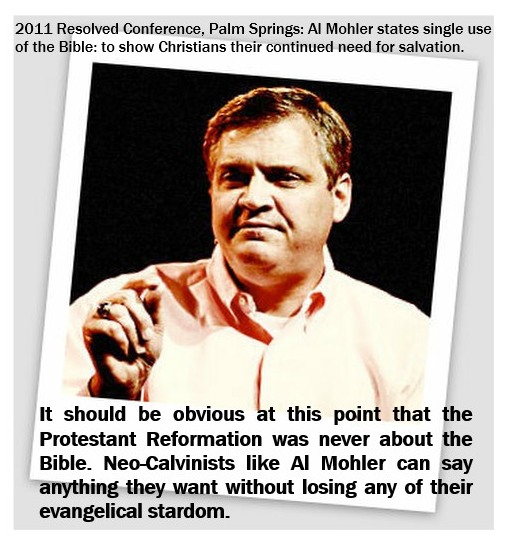 This ministry has documented extensively through the words of Protestant evangelical pundits what the true soteriology of authentic Protestantism is: it is the false gospel of progressive justification. One is saved through the institutional church and its hierarchical priesthood, and then must remain faithful to the institution and its “means of grace” in order to retain salvation. Though evangelicals vehemently deny salvation by church membership, the facts are irrefutable.
Let’s review the major tenets of this false gospel propagated by Protestants and their many offshoots such as Baptists etc. Though they claim salvation by new birth, the biblical definition is denied. In contrast to the biblical definition, justification is a mere “forensic declaration.” Instead of the saint being literally made righteous, they are only declared righteous. This attempts to reconcile their error concerning law and gospel.
In the soteriology of Protestantism, the law only has one purpose instead of two: it only serves to show one’s sin.1 Therefore, the law is justification’s standard. Hence, the simple biblical concept of justification being apart from the law is totally missed.2 Now more error must be added to cover for the fundamental error: their definition of justification as a legal declaration. Now, the law is unwittingly added as something that can give life.3 And since it is seated on a throne beside God and the Son, “its righteous demands must be continually fulfilled.” This necessarily requires even more error: the idea that Christ not only died for our sins, but that He also lived a perfect life in obedience to the law so that His obedience can be continually imputed to the law in the believer’s stead. This is known as “double imputation.”
Enter even more error. Since justification is only a legal declaration and didn’t put the old us to death through Spirit baptism, and we are therefore still under the law’s condemnation instead of Christ’s death ending that aspect of the law, our sins are only COVERED and not ENDED which means continued imputation of Christ’s death and righteousness is needed. However, we don’t need Christ’s obedience to the law imputed to us in order to keep us saved because we were made righteousness in being resurrected with Him4—also in Spirit baptism. This frees us from all condemnation under the law and frees us to serve according to the positive aspects of the law…love.5
And consequently due to this error, “saints” only remain covered by double imputation through faithfulness to the institutional church and its “means of grace” or what really boils down to means of continued salvation.6 These “means of grace” can only be found in the institutional church, and there are many, but one is the hearing of pastoral preaching. Faith comes by hearing the word of God, we know that, but in context of Protestantism, that’s an ongoing need that is only found in the institutional church. If we don’t continually hear the word from those “under the authority of the church” we lose our faith and subsequently our salvation.
In the following video link, Albert Mohler expresses these ideas starting at mark 1:14:00. Yes, he throws in some red herrings in regard to individual study of the word, but take note towards the end regarding his statement that salvation is for the lost as well as the saved. In other words, the “saved” need continued means of salvation that can only be found in the church. This ministry has documented many statements by evangelical leaders plainly stating that Christians continue to need salvation. Where the confusion often comes in is with the citation of verses referring to the saving of the mortal body, viz, redemption which is NOT salvation in the justification sense. Both only happen once.
paul
1Romans 8:2
2Romans 3:21
3Galatians 3
4Romans 5 and 6
5Romans 7 and Galatians 5:6

 Paul's Passing Thoughts
leave a comment