The Elephant in the Room: The Historical-Redemptive Gospel
 Originally published September 3, 2013
How Should We Read Our Bibles?
There isn’t a bigger elephant in the Sunday school room or the sanctuary than the issue of Bible interpretation. The reason for this follows: the method of interpretation that comes natural to us is assumed.
What is that method? This gets into an area of study called hermeneutics (the theory of interpretation), and the two primary theories thereof are exegesis and eisegesis. These are big theological words that the average Protestant is not supposed to know. This is because the Protestant interpretation of the Scriptures is based on authority.
We will get to exegesis and eisegesis, but the crux of the issue is authority. The Reformers came from Romanism and clearly, their interpretive construct was based on authority; i.e., the average parishioner was not free to interpret the Bible and follow it according to one’s own conscience:
Rightfully and nobly did the Protestant Reformers claim religious liberty for themselves; but they resolutely refused to concede it to others. [1]
The very foundation of Protestant interpretation is based on authority; that is, the leaders dictate meaning. Therefore, traditionally, the need for Protestants in general to understand interpretive principles would be unnecessary, and as a result, Protestantism functions that way till this very day. In the early days of the Reformation, private interpretation was outlawed [2]; in our day, education regarding the tools needed to interpret the Bible are merely excluded.
This fact brings us to an interesting word, “orthodoxy.” Traditionally, this word is associated with “truth” as a synonym. This is not the case at all. Orthodoxy is the authority of truth based on counsels of any given sect. [3] The opinions of these counsels regarding the meaning of “truth” are known as “creeds” and “confessions.” These are “truths” (actually, opinions concerning the meaning of any given subject) repackaged for those who have limited understanding, and usually recited and learned through catechisms [4].
Authority Versus Individual Interpretation
Hence, Protestant interpretation is based on authority and not individual interpretation. The structure of this interpretive process is orthodoxy formed through counsels, distributed by creeds/confessions, and practiced through catechisms. In Europe and early Colonial America, it was a matter of civil law, in our day the process is tempered by the freedom to choose your own orthodoxy, but it is still orthodoxy. Once a typical American parishioner chooses who they want to believe, they will follow that leader as an authority. A like tendency caused the Apostle Paul to confront the believers at Corinth (1COR 3:1-9).
Of course, the authoritative method of interpretation is at the root of every cult. Traditionally, when people seek to find God, they begin by finding an authority that they are comfortable with. This is why many people prefer authoritative interpretation in a free society: it allows them to choose their own general truth while leaving the hard task of thinking to others. The Apostle Paul said this would be particularly problematic in the last days (2TIM 4:3-5).
The visible authority structure within the church is known as “church polity” or church government. [5] Again, the whole construct is based on authority. If authority is the interpretive prism, roles in the church are going to be seen as positions of authority rather than gifts. When Christ ministered here on earth, disciples were free to follow Him or not follow Him under their own free volition (JN 6:66-69). Christ made it clear to the disciples that their roles in the kingdom were not that of authority (Matthew 20:20-28).
The word “office” inserted in the English translations when associated with “bishop” or “deacon” were added in to the translations and do not appear in the Greek manuscripts while in other places these roles are spoken of as gifts (EPH 4:11-16). We have been given authority to proclaim the gospel of the kingdom on earth, but that is a vertical authority and not horizontal. Those who protest the gift idea versus the authority idea often cite the following text:
Hebrews 13:17 – Obey your leaders and submit to them, for they are keeping watch over your souls, as those who will have to give an account. Let them do this with joy and not with groaning, for that would be of no advantage to you.
The word for “obey” in this verse is πείθω (peithō) which means to persuade by argument. The word “submit” is ὑπείκω (hypeikō) which means “to surrender.” Here is the best rendering according to a heavy paraphrase:
Be persuaded by your leaders’ arguments from Scripture and don’t be stubborn in regard to the truth for this is no advantage to your own spiritual wellbeing. Besides, they have to give an account for how they led you, and let that account be a joyful recital to the Lord rather than a sorrowful report.
Why is this important? Because every person is personally culpable before God for following the truth, not men. Paul was an apostle, yet the Bereans verified what he taught according to their own understanding of Scripture (Acts 17:11). Paul told the Corinthians that he should only be followed as he followed Christ (1COR 11:1). Every individual will stand before God to give an account of the sum and substance of their own lives, not who they followed among mortals.
The Exegesis and Eisegesis of Hermeneutics
The theological word for the science of biblical interpretation is hermeneutics. The first consideration of hermeneutics must be exegesis and eisegesis. Exegesis draws conclusions from written text depending on the grammatical meaning and arrangement of words. Eisegesis approaches the text with an interpretive prism. One who uses the exegetical approach will even approach the text to learn how the text itself should be interpreted. Eisegesis assumes one must approach the text with a proper presupposition in order to properly understand it.
Therefore, this takes us right back to the basic question of authority versus the freedom of individual interpretation. Eisegesis will approach the text with a prescribed method of interpretation while exegesis will look for the best way to interpret the text from the text itself. The interpretive prism for eisegesis comes from an authority. The common contention from those of the authority camp is that everybody approaches the Bible with presuppositions, and this is unavoidable; so, it is important to use the right interpretive prism. Since we are supposedly incapable of approaching the Bible objectively, we should bow to their authority in regard to the proper interpretive prism.
Historical-Grammatical Versus Historical Redemptive: The Elephant in the Room
Eisegesis and exegesis really boils down to authority versus individualism, and so does the two major methods of interpretation in the church: historical-grammatical method and the historical-redemptive method. This is where we get into discussion about the elephant in the room. These two devices of interpretation yield completely different results. When we sit under any given teacher, he/she will be using one of these hermeneutics. The two different approaches will sound the same because each uses all of the familiar terms, “gospel,” “justification,” etc., but the terms mean different things in each construct. This is the elephant in the sanctuary and the Sunday school room that no one is talking about.
As suggested by the terms themselves, one interprets the Bible grammatically, and the other interprets the Bible through a Redemptive prism. The latter seems perfectly reasonable: “Isn’t the Bible primarily about Redemption?” The former would judge that assertion by a grammatical evaluation of the text. In other words, conclusions are drawn by the arrangement of words, their meaning, and what those words meant to people in that historical context. This is exegesis.
The redemptive method presupposes that the Bible is a gospel narrative about the works and personhood of Christ. It presupposes that this is the dominate theme of the Bible and everything else in the Bible is secondary and points back to Christ. For example, biblical commands aren’t really meant for us to obey, but rather illustrate the works that Christ has accomplished for us and illustrative of what we are unable to do. This bypasses the normal grammatical interpretation of an imperative expectation, and interprets it as a finished work that God in fact does not want us to do. This is assumed because of the redemptive presupposition. As Neo-Calvinist Paul David Tripp has said, biblical commands must be seen in their “gospel context.” [6]
The Gospel Transformation Study Bible and the Redemptive-Historical Gospel
Dr. Kathleen Nielson, in a promotional video for the Gospel Transformation study Bible, stated that the historical-redemptive theme is not imposed on the text, “it’s actually in there!” This, we by no means deny, but are the works of Christ and His personhood something that every verse in the Bible points to? Nielson, like many from the redemptive-historical camp, use the grammatical approach to determine that something is in the text, and then make that an authoritative interpretive prism.
I have talked face to face with pastors who use this hermeneutic. As one stated to me, “You might have to cover multiple chapters in one sermon in order to see the Christocentric theme God is showing you at the time.” Others are even more direct:
At this time, resist the temptation to utilize subsequent passages to validate the meaning or to move out from the immediate context. Remembering that all exegesis must finally be a Christocentric exegesis.
Look for Christ even if He isn’t there directly. It is better to see Christ in a text even if He isn’t, than to miss Him where He is. [7]
Again, we see that a “Christocentric exegesis,” something that is in the text grammatically, becomes the authoritative eisegesis. And this elephant is a big one, because interpreting the Bible this way is intrinsically tied to the gospel that comes part and parcel with the redemptive method. The historical-redemptive method is a tool for enabling the believer to live by faith alone in their Christian walk. The historical-redemptive method is actually a gospel in and of itself. To interpret the Bible grammatically is to conclude that God actually wants us to exert our own will in response to commands in the Bible. To proponents of the redemptive-historical method, this is works salvation because Christ is not obeying for us in our Christian life. This is what the Reformation motto, “Christ for us” means. The Neo-Calvinist John Piper has stated it this way, “[Christ] 100% for us.” [8] Piper has also said that “necessary sanctification” comes from faith alone in the Christian life (Ibid).
Therefore, according to proponents of the redemptive model, a historical-grammatical interpretation of Scripture necessarily leads to works salvation and making what we do in the Christian life “the ground of our justification” (Ibid). For all practical purposes, Paul David Tripp has stated such:
….and the Bible does call us to change the way we think about things. But this approach again omits the person and work of Christ as Savior. Instead, it reduces our relationship to Christ to “think his thoughts” and “act the way Jesus would act.” [9]
Here, Tripp concedes that the Bible can be interpreted grammatically, “and the Bible does call us to change the way we think about things.” Grammatically, one assumes the commandments are to us and that we are called to do them. Again, Tripp clearly recognizes this fact. But what does he say the results are?
But this approach again omits the person and work of Christ as Savior.
What happens if we “omit” Christ as “Savior”? Clearly, Tripp is stating that if we interpret the Bible literally and obey it, we are circumventing Christ’s salvific work. Much more than mere semantics are at stake here. The elephant in the room is absolutely huge! This is about the gospel.
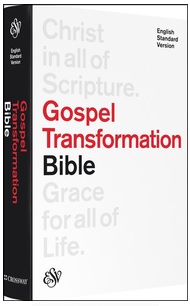
The historical-redemptive method of interpretation is all the rage in contemporary Christianity. Projects and programs that promote this method of interpretation and target all age groups abound. Almost all Christian publishers are on board with the historical-redemptive hermeneutic. The latest project that has been unveiled towards this endeavor is Crossway Publishers’ The Gospel Transformation Bible. It will be available 10/19/13.
The subtitle is, “Christ in all of Scripture, Grace for all of Life.” This is typical of those who promote this method of interpretation and its gospel. Christians will assume that the title only pertains to justification by faith alone, but it doesn’t. “Transformation” or change has to do with the Christian life, and in the subtitle, “Grace” replaces “gospel” to veil the real crux of this doctrine. Basically, it teaches that Christians are transformed by continually revisiting the same gospel that saved them. Not only that, we keep ourselves saved by doing such. This is what is behind the Neo-Calvinist mantra, “We must preach the gospel to ourselves every day.” John Piper has said that the question is not only how one gets saved, but how one must use the same gospel that saved him/her to keep themselves saved. [10] Piper has also said that we must “see” the same gospel that saved us over and over again as a requirement to enter heaven. [11]
Note: This is what’s so critical about the Reformed historical-redemptive interpretative model according to many Calvinists, it enables us to fulfill what is “required of us” to enter heaven (Ibid). In essence, once saved, how we read our Bible determines whether we keep our salvation or not. So therefore, those who promote The Gospel Transformation Bible actually see it as a resource for maintaining one’s salvation.
The “Gospel-Driven” Life
The question that is invariably raised is, “How do proponents of the historical-redemptive model explain obedience and the Christian life?” Primarily, they say Christians must “experience” obedience, but must not be the ones who perform it in the Christian life. By revisiting the gospel afresh, the works of Christ are “manifested” in our lives. When this happens, the obedience is experienced by a willing, joyful spirit. As we use the historical-redemptive model to see how sinful we are (a deeper realization of our sin, the realization that originally saved us), and thereby gaining a greater appreciation for what Jesus did for us, we experience “vivification.” This is some sort of joyful rebirth. Proponents of this hermeneutic, primarily those of Reformed theology, refer to this as “mortification and vivification.” A “daily dying and rising,” a “living out of our baptism.” [12] [13]
The Origin of the Historical-Redemptive Hermeneutic
Where did this hermeneutic originate? Even though Martin Luther’s 95 Theses launched the Reformation, the framework of the Reformation’s doctrine and gospel was articulated by Martin Luther six months later. Essentially, Luther’s Heidelberg Disputation to the Augustinian Order in 1518 is the heart and soul of the Reformation. Calvin’s Institutes of the Christian Religion is a greatly expanded treatise of Luther’s framework. However, every fundamental element of Reformation doctrine can be found in Luther’s Disputation, and this by no means excludes the historical-redemptive hermeneutic. [14]
The primary theme of Luther’s Disputation is known as The Theology of the Cross. It was comprised of the glory story and the cross story. Luther believed that salvation must be maintained by an incessant emptying of self. One’s focus must be OUTWARD only. Any semblance of an inward look was the “glory story.” The outward focus on Christ and His works, and nothing about us whatsoever is the “cross story.” A beginning focus on the cross saves us, and a continued focus on the cross story keeps us saved the same way we were originally saved: by faith alone. Sola Fide also pertains to the Christian walk/life. The historical-redemptive model came from Luther’s Theology of the Cross.
Luther believed the outward focus and utter eradication of self leads to a subjective power displayed by the Holy Spirit that we experience. However, we are not to be concerned with it because there is no way for us to distinguish between our own efforts and those of the Spirit. [15] Mortification and vivification can be ascertained in Theses’ 16 and 17 of the Disputation.
Never have Christians been so oblivious to such a critical issue. What we believe about the gospel and how we convey it to the world is at stake. Every Sunday in America, historical-grammatical parents deliver their children to historical-redemptive teachers while clueless in regard to the ramifications. This reality actually creates mixed families and marriages via two different gospels. One spouse buys into sanctification by faith alone while the other one doesn’t. Eventually, you have a mixed marriage.
The issue with these two hermeneutics is not a matter of semantics and preference—these are two different gospels. This issue is the elephant in the sanctuary and the Sunday school room.
ENDNOTES
1. Nabu Public Domain Reprints: The Principles of the Westminster Standards Persecuting; William Marshall, D.D., Coupar – Angus. Edinburgh, William Oliphant & Co. 1873, p. 13.
2. Ibid., pp. 19-22, 28.
3. Bruce Overton: MacMillan’s Modern Dictionary; The Macmillan Co. New York 1943.
4. Ibid.
5. Ibid. designated as synonymous with “politic” : the science of government.
6. Paul David Tripp: How People Change; Punch press 2006, p. 26.
7. The Biblical Theological Study Center: A Christo-Presuppositional Approach to the Entire Scriptures; Max Strange. Online source: http://goo.gl/5sGjP).
8. John Piper: Desiring God .org blog: Video, If you had 2 minutes with the Pope, what would you say?
9. Paul David Tripp: How People Change; Punch press 2006, p. 27.
10. John Piper: Desiring God .org blog; How Does The Gospel Save Believers? Part 2. August 23, 1998 Bethlehem Baptist Church.
11. Ibid, Part 3.
12. Michael Horton: The Christian Faith: A Systematic Theology for Pilgrims On the Way; Zondervan 2011, p. 661.
13. Paul Washer: The Gospel Call and True Conversion; Part 1, Chapter 1, heading – The Essential Characteristics Of Genuine Repentance, subheading – Continuing and Deepening Work of Repentance.
14. In its fundamental elements. It was not referred to as the historical-redemptive hermeneutic for many years afterward.
15. Heidelberg Disputation: Theses 24.
How Calvinism Turns Brave Hearts into Cold Hearts
 Originally posted April 29, 2013
I will post a video at the end of this article that elicited the following response from those who posted it on the social network where I watched it:
“Not sure what one could add to or take away from what we have just seen. I am reminded of Matt. 24 when Jesus says that because of lawlessness the hearts of many will grow cold. “Just do it” and laughter throughout the time is just beyond me. Heather was in tears. I wanted to throw up. Beyond disgusting.”
The key to understanding the cold-bloodedness that they observed is in their mention of Matthew 24:12, and the two key words are BECAUSE and LAWLESSNESS. Christ said that “because” of “lawlessness,” love would “grow cold.” The source of this lawlessness is described by Jesus in the previous verse: “many false prophets.”
Now we would do well to examine what Christ meant by the word often translated “lawlessness” and “wickedness” in our English Bibles. These words posit the idea of bad behavior, but that’s not what the actual word that is used by Christ means at all. The word is “anomia.” The “a” is a negative article prefix that means “anti” and “nomia” or nomos, refers to God’s law specifically. The idea of sinful behavior is an entirely different word altogether. Among many used is “hamartia,” or “sin” and these two words are specifically contrasted in 1John 3:4. Sin is defined by any aberration of God’s standard.
In Matthew 24:12, as well as many other passages, an anti-Bible agenda is in view propagated by false prophets.
The world in general becomes cold-hearted by rejecting the law of God written on their hearts and administered by the conscience—either excusing or accusing their actions (ROM 2:15,16). The conscience can eventually be seared if continually violated and ignored (1TIM 4:2). Christians are to keep a clear conscience before God (Acts 24,16 1Peter 3:16, 1TIM 1:5, 3:9, 2TIM 1:3). Keeping a clear conscience before God is obviously behavior focused as judged by the Bible.
One of the monumental misnomers of all time is the idea of “legalism.” This term was formulated by false prophets who really want to steer us away from nomos. Misguided obedience has never been the church’s primary nemesis; it has always been anti-word of God. When the apostle Paul warned those who wanted to be justified by the law, “law,” is in a manner of speaking; Paul was referring to what false teachers purport to be the law, not an actual sincere love for truth and a desire to live by it. This is why James stated that anyone who wanted to be justified by the law had to keep all of it, not a standard of their own choosing (James 2:10). Supposed law-keeping is also often connected to salvation by mere ritual as well. This point cannot be better made than to cite what Paul wrote to the Galatians:
5:2 Look: I, Paul, say to you that if you accept circumcision, Christ will be of no advantage to you. 3 I testify again to every man who accepts circumcision that he is obligated to keep the whole law. 4 You are severed from Christ, you who would be justified by the law; you have fallen away from grace. 5 For through the Spirit, by faith, we ourselves eagerly wait for the hope of righteousness. 6 For in Christ Jesus neither circumcision nor uncircumcision counts for anything, but only faith working through love. 7 You were running well. Who hindered you from obeying the truth? 8 This persuasion is not from him who calls you.
We see here, clearly, that Paul was confronting a belief that being circumcised according to law excused them from a truthful obedience to the law. In other words, justification by law-keeping is ALWAYS a dumbed-down version of the law to make adherence for salvation feasible. Paul contrasts this with true obedience to the law in sanctification:
You were running well. Who hindered you from obeying the truth?
Justification by law-keeping is NEVER an endeavor to obey the truth; it is ALWAYS the replacement of God’s law with the traditions of men—making the law of God “void.” The Pharisees, the supposed poster children for “legalism,” or “living by the law,” were not guilty of trying to obtain salvation by a sincere obedience to the truth, but rather replaced the law of God with their traditions and made that the standard for salvation (which has no law standard to begin with):
Matthew15:1 – Then Pharisees and scribes came to Jesus from Jerusalem and said, 2 “Why do your disciples break the tradition of the elders? For they do not wash their hands when they eat.” 3 He answered them, “And why do you break the commandment of God for the sake of your tradition? 4 For God commanded, ‘Honor your father and your mother,’ and, ‘Whoever reviles father or mother must surely die.’ 5 But you say, ‘If anyone tells his father or his mother, “What you would have gained from me is given to God,” 6 he need not honor his father.’ So for the sake of your tradition you have made void the word of God.
Matthew 23:16 – “Woe to you, blind guides, who say, ‘If anyone swears by the temple, it is nothing, but if anyone swears by the gold of the temple, he is bound by his oath.’ 17 You blind fools! For which is greater, the gold or the temple that has made the gold sacred? 18 And you say, ‘If anyone swears by the altar, it is nothing, but if anyone swears by the gift that is on the altar, he is bound by his oath.’ 19 You blind men! For which is greater, the gift or the altar that makes the gift sacred? 20 So whoever swears by the altar swears by it and by everything on it. 21 And whoever swears by the temple swears by it and by him who dwells in it. 22 And whoever swears by heaven swears by the throne of God and by him who sits upon it. 23 “Woe to you, scribes and Pharisees, hypocrites! For you tithe mint and dill and cumin, and have neglected the weightier matters of the law: justice and mercy and faithfulness. These you ought to have done, without neglecting the others. 24 You blind guides, straining out a gnat and swallowing a camel!
25 “Woe to you, scribes and Pharisees, hypocrites! For you clean the outside of the cup and the plate, but inside they are full of greed and self-indulgence. 26 You blind Pharisee! First clean the inside of the cup and the plate, that the outside also may be clean. 27 “Woe to you, scribes and Pharisees, hypocrites! For you are like whitewashed tombs, which outwardly appear beautiful, but within are full of dead people’s bones and all uncleanness. 28 So you also outwardly appear righteous to others, but within you are full of hypocrisy and lawlessness.
And what were the Pharisees full of “within”? “[L]awlessness” which is the word “anomia.” The English translation is “anti-law” or “antinomianism.” That’s what the Pharisees were full of within—not “legalism” which is a concept not found in the Bible anywhere by idea or word. There is obedience to truth or anti-truth—no in-between.
“Legalism” fosters the idea that Christians can unwittingly try to please God by obeying the truth as a way to earn their justification. The idea was hatched by the Reformers and is a Neo-Calvinist doctrinal mainstay in our day. The favorite illustration is the Pharisees who supposedly were really, really good at keeping the law and obeying the Bible in an attempt to earn their justification. This is a ploy to create confusion in regard to the law’s relationship to justification and sanctification. The Reformers created immense fear among Christians by making the law’s relationship to justification the same as sanctification. In justification, law has no jurisdiction in regard to the Christian. The Christian is transformed from a status where the law is the standard to be justified (and impossible) to a status where the law informs our sanctification totally separate from justification. So, the law is a standard for sanctification, but in regard to the Christian, the law no longer has jurisdiction over his/her salvation. In Calvinism, the law remains a standard for justification IN salvation that must be maintained until the final judgment.
Because man is created to do works, this makes sanctification very tricky with our eternal destiny hanging in the balance. Calvinists therefore assure Christians that if they live their Christian lives by faith alone—they are playing it safe. As one New Calvinist told me: “If I let Jesus do all the work, He can’t fault me for anything when I stand before Him.” Of course, living in a way that imputes the works of Christ to our Christian walk is very complicated, but be assured: New Calvinists will teach us how to “practice obedient faith” so we can arrive at the final judgment covered by “what Jesus has done, not anything we do”….in our Christian walk. This confounding of the law’s relationship to justification and sanctification makes the Christian walk a minefield with constant danger of “making sanctification the ground of our justification.” We must therefore seek out the Reformed for their secret formula for living the Christian life by faith alone. “Sola Fide” is for justification and sanctification both—that’s the dirty little secret. The Reformed couch the language in terms like “obedient faith.” The Reformers saw faith as a neutral conduit that God uses to impute the perpetual works of Christ to the believer. In other words, Christ’s atoning work is not yet finished for salvation: though accomplished in one period of time, it must be continually appropriated to maintain our just standing. The maintenance of our salvation is in view. Hence, we must “preach the gospel to ourselves every day.”
But this brings us from fearful hearts to cold hearts. Reformed theology will heap its share of cold-hearted mentality on humanity “because of anomia.” It’s just more anomia dressed in religious garb. This brings my point back to the video that was posted. It is cold-heartedness on steroids regarding the abortion issue. Therefore, the following should make perfect sense to us:
According to the National Right to Life, the total number of abortions in the US is down-33% from its peak in 1980/81- and the greatest decrease is among adolescent girls and young women. Good News!
But if we look further into these statistics, we find disconcerting news for the Church: The abortion rates among professing Christians are commensurate with the rest of the population!
Approx. 560,000 for Protestants (43%)
Approx. 350,000 per year for Catholics (27%)
13% of abortions (approx. 170,000 per year) are performed on self-described “Born Again” or Evangelical Christians (Alan Guttmacher Institute and Physicians for Reproductive Choice, “An Overview of Abortion in the United States,” 2003 and 2008)
Even more disturbing is the fact that these percentages have NOT dropped, even though the number of abortions have in recent years!
These statistics reveal that actually MORE women who profess Christianity are having abortions.
This is what Reformed theology has always done to society. Despite the traditions of men that claim otherwise, the Reformation did not bring light to darkness, it brought more darkness. Post Reformation brought little more than chaos and turmoil to Europe—more than it had ever seen before. It brought tyranny to America in the form of the Salem witch trials, and its contemporary resurgence has resulted in an unprecedented level of abuses in the American church.
It is the epitome of a primary concern of Christ during His ministry: the replacement of the law by the traditions of men resulting in anomia. While waxing eloquent about the Pharisees, Neo-Calvinism is in fact a return to what plagued the apostolic church. To say that Calvinists vaunt the opinions of a litany of past Reformers as authority is an understatement of the most dramatic sort. Even Charles Spurgeon, “the prince of preachers” did little more than regurgitate Reformed tradition. Recently, one Reformed conference was based on the writings of twenty-five Reformed icons. The popular Resolved conferences hosted by John MacArthur highlighted the traditional teachings and legacies of Reformed men of years gone by.
With all of the harping about the Pharisees by Calvinists—they are the Pharisees, and they propagate the same kind of cold-heartedness with it.
Their heart is unfeeling like fat, but I delight in your law.
~Psalm 119:70
paul
Spurgeon’s False Gospel
 Meme Post #4
Where to start in all the ways that this meme contradicts Scripture and denies the new birth and true gospel? Let’s start with a few blatant contradictions.
Our faith does NOT rest. Our faith WORKS through love (Gal 5:6). Faith is a GIFT, but that doesn’t mean we don’t put the gift to work. In fact, the belief that our faith doesn’t work suggests that we must continue to keep ourselves saved through “rest.” Spurgeon, like most lying Calvinist heretics, held to the Reformation’s Sabbath Rest Salvation. It holds to the idea that the Old Testament Sabbath rest is New Testament sanctification and we must continue to live by faith alone in our Christian lives to keep ourselves saved. This, according to Calvin, happens through receiving continued forgiveness for “present sin” through church membership.
And remember, Spurgeon once said that Calvinism isn’t “just a nickname,” but “is the gospel” itself.
True faith doesn’t rest–it works. There is no true love in a faith that rests.
Secondly, the Bible makes it clear that we grow spiritually through obtaining knowledge; what’s up with the idea that knowledge doesn’t define who we are as believers? Frankly, I don’t care how many people think this guy is a spiritual icon–you know, kinda like the Bereans who held Paul accountable to Scripture.
Thirdly, the idea that who we are doesn’t point to the legitimacy of our faith and is therefore not a resting faith contradicts a vast number of Scriptures and Hebrews 11 in particular.
Fourthly, how we feel is most certainly important because the Bible says that faith not working in love will cause the believer to be full of fear.
Why is it ok for Spurgeon to blatantly contradict Scripture? Because Baptists have a longstanding tradition of being man-followers, that’s why.
Furthermore, note that we supposedly rest in the idea that who we are is NOT who Christ is! HUH!!!! Say what???? If Jesus is your big brother because you are literally born into the same family, you had better be like Him or you aren’t born again (see 1John).
And finally, note that we rest in what Christ has both DONE and is DOING. This is the Reformed doctrine of Double Imputation. It teaches that Christ came to secure our salvation by both dying for sin and keeping the law in our stead. It teaches that justification is based on perfect law-keeping rather than the new birth. Jesus could die for us because He lived up to the standard of the law, and presently keeps the law for us if we are “resting” in what He has “done and is doing.” This is a blatant contradiction to Galatians chapter 3. This is the very idea that Paul is refuting in that chapter.
This makes the law a co-life-giver with God and promotes an additional seed (offspring), but their is only ONE SEED (see Gal 3). In essence, Paul was arguing that this very idea makes the law a fourth member of the Trinity. And in fact, Calvinists state this openly when they say that “the empty hand of faith presents the doing and dying of Christ to the law and the law is satisfied.”
So, instead of God electing the means of salvation, Christ dying to end the law, and the Spirit fulfilling “The Promise” of resurrection and baptism to Abraham and Christ, we now have that added fourth element of the law being the standard for justification instead of new birth obtained by faith alone in The Promise. The contrary view of this meme keeps the so-called believer under law rather than under grace, and that’s supposedly ok because Jesus keeps the law for us.
But this also keeps the believer from performing the purpose of the law for sanctification, faith working through love. Instead, we must rest because Jesus is the only one that can keep the law perfectly as the law supposedly gives salvific life when fulfilled. In contrast, the Old Covenant kept sin captive until Christ came and ended it. The law was ended by Christ’s death in regard to its ability to condemn, and we are now free to serve the law in regard to love (Rom 7 and Heb 6:10). The Old Covenant still holds all sin captive that is committed against it (“all sin is against the law”) until a person believes in Christ resulting in the law being ended for condemnation and the person being set free to “use the law lawfully” (1Tim 1:8ff.) for purposes of loving God and others. Those who do not believe on Christ will be condemned by the law, but there is “NOW NO condemnation for those in Christ.” Rather, true believers are free to fulfill the law in aggressive love for God and others (Rom 8).
For the outcome of Spurgeon’s “rest” see the Parable of the Talents. Resting in love that Christ supposedly fulfills for us evokes this response from Him: “You lazy, wicked servant.”
Albert Mohler: “Christians” Retain Their Salvation by Sitting Under Pastoral Preaching
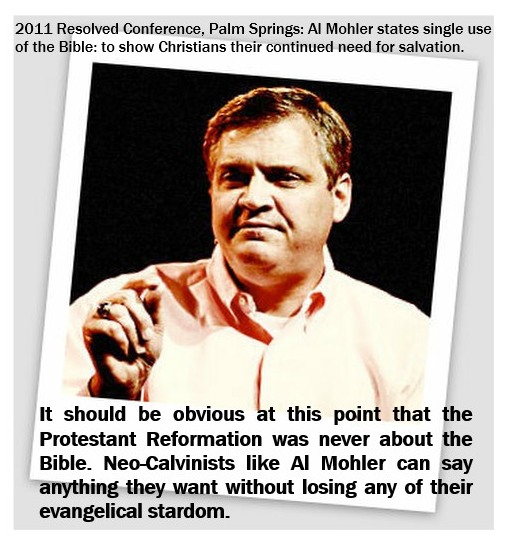 This ministry has documented extensively through the words of Protestant evangelical pundits what the true soteriology of authentic Protestantism is: it is the false gospel of progressive justification. One is saved through the institutional church and its hierarchical priesthood, and then must remain faithful to the institution and its “means of grace” in order to retain salvation. Though evangelicals vehemently deny salvation by church membership, the facts are irrefutable.
Let’s review the major tenets of this false gospel propagated by Protestants and their many offshoots such as Baptists etc. Though they claim salvation by new birth, the biblical definition is denied. In contrast to the biblical definition, justification is a mere “forensic declaration.” Instead of the saint being literally made righteous, they are only declared righteous. This attempts to reconcile their error concerning law and gospel.
In the soteriology of Protestantism, the law only has one purpose instead of two: it only serves to show one’s sin.1 Therefore, the law is justification’s standard. Hence, the simple biblical concept of justification being apart from the law is totally missed.2 Now more error must be added to cover for the fundamental error: their definition of justification as a legal declaration. Now, the law is unwittingly added as something that can give life.3 And since it is seated on a throne beside God and the Son, “its righteous demands must be continually fulfilled.” This necessarily requires even more error: the idea that Christ not only died for our sins, but that He also lived a perfect life in obedience to the law so that His obedience can be continually imputed to the law in the believer’s stead. This is known as “double imputation.”
Enter even more error. Since justification is only a legal declaration and didn’t put the old us to death through Spirit baptism, and we are therefore still under the law’s condemnation instead of Christ’s death ending that aspect of the law, our sins are only COVERED and not ENDED which means continued imputation of Christ’s death and righteousness is needed. However, we don’t need Christ’s obedience to the law imputed to us in order to keep us saved because we were made righteousness in being resurrected with Him4—also in Spirit baptism. This frees us from all condemnation under the law and frees us to serve according to the positive aspects of the law…love.5
And consequently due to this error, “saints” only remain covered by double imputation through faithfulness to the institutional church and its “means of grace” or what really boils down to means of continued salvation.6 These “means of grace” can only be found in the institutional church, and there are many, but one is the hearing of pastoral preaching. Faith comes by hearing the word of God, we know that, but in context of Protestantism, that’s an ongoing need that is only found in the institutional church. If we don’t continually hear the word from those “under the authority of the church” we lose our faith and subsequently our salvation.
In the following video link, Albert Mohler expresses these ideas starting at mark 1:14:00. Yes, he throws in some red herrings in regard to individual study of the word, but take note towards the end regarding his statement that salvation is for the lost as well as the saved. In other words, the “saved” need continued means of salvation that can only be found in the church. This ministry has documented many statements by evangelical leaders plainly stating that Christians continue to need salvation. Where the confusion often comes in is with the citation of verses referring to the saving of the mortal body, viz, redemption which is NOT salvation in the justification sense. Both only happen once.
paul
1Romans 8:2
2Romans 3:21
3Galatians 3
4Romans 5 and 6
5Romans 7 and Galatians 5:6

 Paul's Passing Thoughts
leave a comment