Why Calvinists Need to be Saved
You can click on screen shots to enlarge, and then use back arrow to return to post.
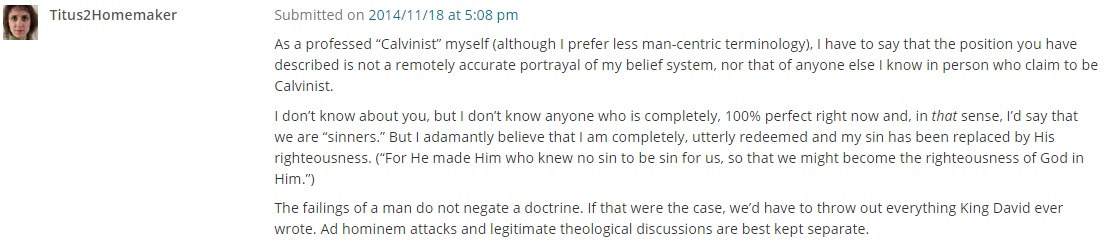
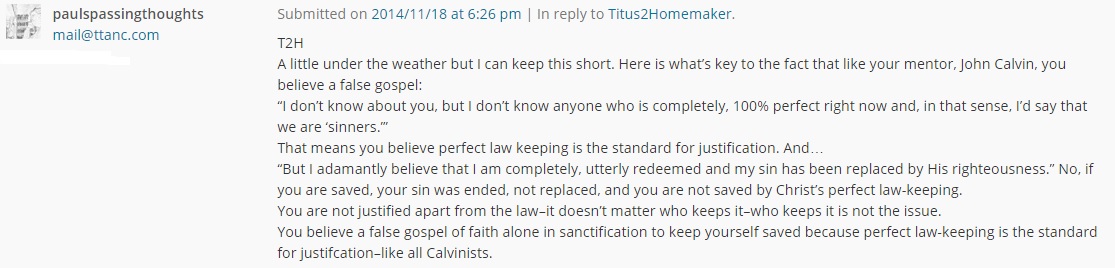
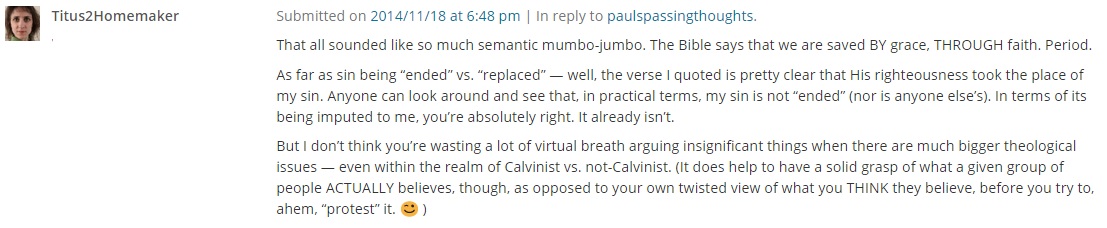







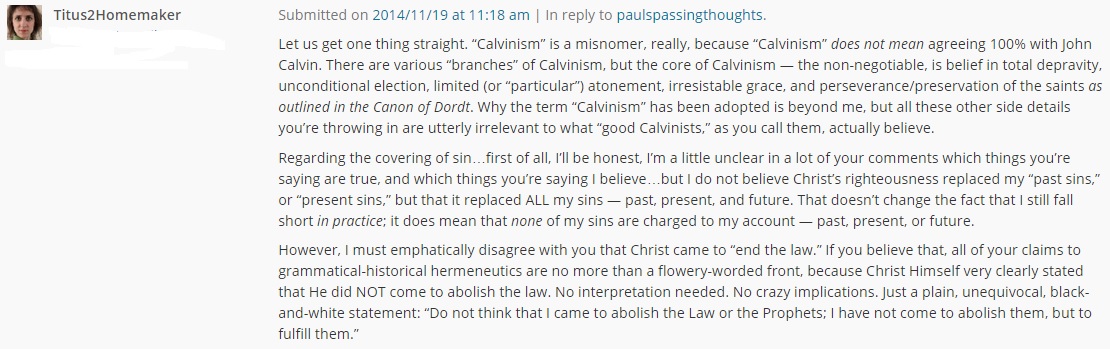

How Calvinism Turns Brave Hearts into Cold Hearts
 Originally posted April 29, 2013
I will post a video at the end of this article that elicited the following response from those who posted it on the social network where I watched it:
“Not sure what one could add to or take away from what we have just seen. I am reminded of Matt. 24 when Jesus says that because of lawlessness the hearts of many will grow cold. “Just do it” and laughter throughout the time is just beyond me. Heather was in tears. I wanted to throw up. Beyond disgusting.”
The key to understanding the cold-bloodedness that they observed is in their mention of Matthew 24:12, and the two key words are BECAUSE and LAWLESSNESS. Christ said that “because” of “lawlessness,” love would “grow cold.” The source of this lawlessness is described by Jesus in the previous verse: “many false prophets.”
Now we would do well to examine what Christ meant by the word often translated “lawlessness” and “wickedness” in our English Bibles. These words posit the idea of bad behavior, but that’s not what the actual word that is used by Christ means at all. The word is “anomia.” The “a” is a negative article prefix that means “anti” and “nomia” or nomos, refers to God’s law specifically. The idea of sinful behavior is an entirely different word altogether. Among many used is “hamartia,” or “sin” and these two words are specifically contrasted in 1John 3:4. Sin is defined by any aberration of God’s standard.
In Matthew 24:12, as well as many other passages, an anti-Bible agenda is in view propagated by false prophets.
The world in general becomes cold-hearted by rejecting the law of God written on their hearts and administered by the conscience—either excusing or accusing their actions (ROM 2:15,16). The conscience can eventually be seared if continually violated and ignored (1TIM 4:2). Christians are to keep a clear conscience before God (Acts 24,16 1Peter 3:16, 1TIM 1:5, 3:9, 2TIM 1:3). Keeping a clear conscience before God is obviously behavior focused as judged by the Bible.
One of the monumental misnomers of all time is the idea of “legalism.” This term was formulated by false prophets who really want to steer us away from nomos. Misguided obedience has never been the church’s primary nemesis; it has always been anti-word of God. When the apostle Paul warned those who wanted to be justified by the law, “law,” is in a manner of speaking; Paul was referring to what false teachers purport to be the law, not an actual sincere love for truth and a desire to live by it. This is why James stated that anyone who wanted to be justified by the law had to keep all of it, not a standard of their own choosing (James 2:10). Supposed law-keeping is also often connected to salvation by mere ritual as well. This point cannot be better made than to cite what Paul wrote to the Galatians:
5:2 Look: I, Paul, say to you that if you accept circumcision, Christ will be of no advantage to you. 3 I testify again to every man who accepts circumcision that he is obligated to keep the whole law. 4 You are severed from Christ, you who would be justified by the law; you have fallen away from grace. 5 For through the Spirit, by faith, we ourselves eagerly wait for the hope of righteousness. 6 For in Christ Jesus neither circumcision nor uncircumcision counts for anything, but only faith working through love. 7 You were running well. Who hindered you from obeying the truth? 8 This persuasion is not from him who calls you.
We see here, clearly, that Paul was confronting a belief that being circumcised according to law excused them from a truthful obedience to the law. In other words, justification by law-keeping is ALWAYS a dumbed-down version of the law to make adherence for salvation feasible. Paul contrasts this with true obedience to the law in sanctification:
You were running well. Who hindered you from obeying the truth?
Justification by law-keeping is NEVER an endeavor to obey the truth; it is ALWAYS the replacement of God’s law with the traditions of men—making the law of God “void.” The Pharisees, the supposed poster children for “legalism,” or “living by the law,” were not guilty of trying to obtain salvation by a sincere obedience to the truth, but rather replaced the law of God with their traditions and made that the standard for salvation (which has no law standard to begin with):
Matthew15:1 – Then Pharisees and scribes came to Jesus from Jerusalem and said, 2 “Why do your disciples break the tradition of the elders? For they do not wash their hands when they eat.” 3 He answered them, “And why do you break the commandment of God for the sake of your tradition? 4 For God commanded, ‘Honor your father and your mother,’ and, ‘Whoever reviles father or mother must surely die.’ 5 But you say, ‘If anyone tells his father or his mother, “What you would have gained from me is given to God,” 6 he need not honor his father.’ So for the sake of your tradition you have made void the word of God.
Matthew 23:16 – “Woe to you, blind guides, who say, ‘If anyone swears by the temple, it is nothing, but if anyone swears by the gold of the temple, he is bound by his oath.’ 17 You blind fools! For which is greater, the gold or the temple that has made the gold sacred? 18 And you say, ‘If anyone swears by the altar, it is nothing, but if anyone swears by the gift that is on the altar, he is bound by his oath.’ 19 You blind men! For which is greater, the gift or the altar that makes the gift sacred? 20 So whoever swears by the altar swears by it and by everything on it. 21 And whoever swears by the temple swears by it and by him who dwells in it. 22 And whoever swears by heaven swears by the throne of God and by him who sits upon it. 23 “Woe to you, scribes and Pharisees, hypocrites! For you tithe mint and dill and cumin, and have neglected the weightier matters of the law: justice and mercy and faithfulness. These you ought to have done, without neglecting the others. 24 You blind guides, straining out a gnat and swallowing a camel!
25 “Woe to you, scribes and Pharisees, hypocrites! For you clean the outside of the cup and the plate, but inside they are full of greed and self-indulgence. 26 You blind Pharisee! First clean the inside of the cup and the plate, that the outside also may be clean. 27 “Woe to you, scribes and Pharisees, hypocrites! For you are like whitewashed tombs, which outwardly appear beautiful, but within are full of dead people’s bones and all uncleanness. 28 So you also outwardly appear righteous to others, but within you are full of hypocrisy and lawlessness.
And what were the Pharisees full of “within”? “[L]awlessness” which is the word “anomia.” The English translation is “anti-law” or “antinomianism.” That’s what the Pharisees were full of within—not “legalism” which is a concept not found in the Bible anywhere by idea or word. There is obedience to truth or anti-truth—no in-between.
“Legalism” fosters the idea that Christians can unwittingly try to please God by obeying the truth as a way to earn their justification. The idea was hatched by the Reformers and is a Neo-Calvinist doctrinal mainstay in our day. The favorite illustration is the Pharisees who supposedly were really, really good at keeping the law and obeying the Bible in an attempt to earn their justification. This is a ploy to create confusion in regard to the law’s relationship to justification and sanctification. The Reformers created immense fear among Christians by making the law’s relationship to justification the same as sanctification. In justification, law has no jurisdiction in regard to the Christian. The Christian is transformed from a status where the law is the standard to be justified (and impossible) to a status where the law informs our sanctification totally separate from justification. So, the law is a standard for sanctification, but in regard to the Christian, the law no longer has jurisdiction over his/her salvation. In Calvinism, the law remains a standard for justification IN salvation that must be maintained until the final judgment.
Because man is created to do works, this makes sanctification very tricky with our eternal destiny hanging in the balance. Calvinists therefore assure Christians that if they live their Christian lives by faith alone—they are playing it safe. As one New Calvinist told me: “If I let Jesus do all the work, He can’t fault me for anything when I stand before Him.” Of course, living in a way that imputes the works of Christ to our Christian walk is very complicated, but be assured: New Calvinists will teach us how to “practice obedient faith” so we can arrive at the final judgment covered by “what Jesus has done, not anything we do”….in our Christian walk. This confounding of the law’s relationship to justification and sanctification makes the Christian walk a minefield with constant danger of “making sanctification the ground of our justification.” We must therefore seek out the Reformed for their secret formula for living the Christian life by faith alone. “Sola Fide” is for justification and sanctification both—that’s the dirty little secret. The Reformed couch the language in terms like “obedient faith.” The Reformers saw faith as a neutral conduit that God uses to impute the perpetual works of Christ to the believer. In other words, Christ’s atoning work is not yet finished for salvation: though accomplished in one period of time, it must be continually appropriated to maintain our just standing. The maintenance of our salvation is in view. Hence, we must “preach the gospel to ourselves every day.”
But this brings us from fearful hearts to cold hearts. Reformed theology will heap its share of cold-hearted mentality on humanity “because of anomia.” It’s just more anomia dressed in religious garb. This brings my point back to the video that was posted. It is cold-heartedness on steroids regarding the abortion issue. Therefore, the following should make perfect sense to us:
According to the National Right to Life, the total number of abortions in the US is down-33% from its peak in 1980/81- and the greatest decrease is among adolescent girls and young women. Good News!
But if we look further into these statistics, we find disconcerting news for the Church: The abortion rates among professing Christians are commensurate with the rest of the population!
Approx. 560,000 for Protestants (43%)
Approx. 350,000 per year for Catholics (27%)
13% of abortions (approx. 170,000 per year) are performed on self-described “Born Again” or Evangelical Christians (Alan Guttmacher Institute and Physicians for Reproductive Choice, “An Overview of Abortion in the United States,” 2003 and 2008)
Even more disturbing is the fact that these percentages have NOT dropped, even though the number of abortions have in recent years!
These statistics reveal that actually MORE women who profess Christianity are having abortions.
This is what Reformed theology has always done to society. Despite the traditions of men that claim otherwise, the Reformation did not bring light to darkness, it brought more darkness. Post Reformation brought little more than chaos and turmoil to Europe—more than it had ever seen before. It brought tyranny to America in the form of the Salem witch trials, and its contemporary resurgence has resulted in an unprecedented level of abuses in the American church.
It is the epitome of a primary concern of Christ during His ministry: the replacement of the law by the traditions of men resulting in anomia. While waxing eloquent about the Pharisees, Neo-Calvinism is in fact a return to what plagued the apostolic church. To say that Calvinists vaunt the opinions of a litany of past Reformers as authority is an understatement of the most dramatic sort. Even Charles Spurgeon, “the prince of preachers” did little more than regurgitate Reformed tradition. Recently, one Reformed conference was based on the writings of twenty-five Reformed icons. The popular Resolved conferences hosted by John MacArthur highlighted the traditional teachings and legacies of Reformed men of years gone by.
With all of the harping about the Pharisees by Calvinists—they are the Pharisees, and they propagate the same kind of cold-heartedness with it.
Their heart is unfeeling like fat, but I delight in your law.
~Psalm 119:70
paul
Calvinism and the Problem with Perfection
Originally published November 7, 2013
Augustine, Luther, and Calvin were first and foremost Platonists. They integrated the Bible with Platonism. Plato’s theory of forms posits the idea of two worlds; the mutable material world of illusion where reality can only be partially known, and another world where the immutable objective true forms exist. This material world is a shadow world; everything is shadows of the true forms. Therefore, man can only interpret and experience this world subjectively. The tendency is to interpret reality by observing the shadows. To the degree that mankind thinks the material world is reality according to the five senses, subjectivity and chaos will abound.
Therefore, Plato’s ethic was to improve the subjective experience of this life by accessing the true forms through ideas and mathematics—things that transcend the five senses (he believed math was an unchangeable rule and therefore not part of the shadow world). He believed that those who have the capability and willingness to bring more understanding of the objective into the subjective to be an elite minority. These were Plato’s philosopher kings whom he thought should rule society in order to decrease chaos as much as possible. Without philosopher kings, the world would be awash in a sea of subjectivity, everyone living by their own subjective presuppositions based on the shadows of this world. Hence, the arch enemy of the Platonic ideal is individualism.
Plato’s world of true objective forms was his trinity of the true, good, and beautiful. Experiencing the pure form of goodness in this world is impossible—only a shadow of good can be experienced subjectively. Plato’s social engineering has a doctrine, and to the degree that doctrine is applied, a higher quality of subjective existence occurs.
The Reformers put a slightly different twist on this construct. There is no doctrine to apply, only an orthodoxy that focuses on seeing and experiencing. Their version of Plato’s philosopher kings are pastors who possess the power of the keys. Orthodoxy is mediated truth determined by “Divines,” and passed down to the masses for the purpose of experiencing the objective power of the gospel subjectively. The Reformers made the true forms “the gospel,” and reality itself the gospel; ie., the work and personhood of Jesus Christ in particular.
Therefore, in the same way Plato envisioned a society that experiences the power of the true forms subjectively through ideas and immutable disciplines like mathematics; the Reformers sought a heightened subjective experience through a deeper and deeper knowledge of their own true, good, and beautiful—the gospel. And more specifically, instead of the gateway of understanding being reason, ideas, and immutable disciplines, they made the gospel itself the interpretive prism. So: life, history, the Bible; ie., everything, is a tool for experiencing true reality (the gospel) in a higher quality subjectivity. The Bible and all life events are a gospel hermeneutic. Salvation itself is the interpretive prism. All of reality is about redemption. Salvation itself is the universal hermeneutic.
But both constructs have this in common: pure goodness and perfection cannot exist objectively in the material world. This is where Calvinism and Platonism kiss. The Bible only agrees with this if it is a “gospel narrative.” But if it is God’s full orbed philosophical statement to all men to be interpreted grammatically and exegetically, contradictions abound. To wit, if man possesses goodness and the ability to interpret reality objectively, Platonism and its Reformed children are found wanting. If Reformation orthodoxy is not evaluated biblically with the very theses of its own orthodoxy as a hermeneutic, even more wantonness is found.
The Apostles rejected Platonism because they believed goodness and perfection could indeed be found in this material world. There is no question of the quality of goodness inside of man that enables mankind to interpret reality objectively, the quantity of goodness notwithstanding. In contrast, a dominate theme in the Calvin Institutes is the idea that no person lost or saved can perform a good work. Like Plato’s geometric hermeneutics, the Reformers believed the Law lends understanding to man’s inability to do good because eternal perfection is the standard. The best of man’s works are tainted with sin to some degree, and therefore imperfect. Even if man could perform one perfect work, one sin makes mankind a violator of the whole law. The Reformers were adamant that no person could do any good work whether saved or lost.
Why all the fuss over this point? Why was Calvin dogmatic about this idea to the point of annoyance? Because he was first and foremost a Platonist. The idea that a pure form of good could be found within mankind was metaphysical heresy. Because such contradicts every page of the Bible, the Reformers’ Platonist theology was made the hermeneutic as well. Instead of the interpretation method producing the theology, they made the theology the method of interpretation. If all of reality is redemptive, it must be interpreted the same way.
For the Platonist, the coming of Jesus Christ in the flesh poses a huge problem. He is the truth. He came to the material world in a material body. Platonism became Gnosticism and wreaked havoc on the 1st century church. Notice how the first sentences of 1John are a direct pushback against the Gnosticism of that day:
1John 1:1 – That which was from the beginning, which we have heard, which we have seen with our eyes, which we looked upon and have touched with our hands, concerning the word of life— 2 the life was made manifest, and we have seen it, and testify to it and proclaim to you the eternal life, which was with the Father and was made manifest to us— 3 that which we have seen and heard we proclaim also to you, so that you too may have fellowship with us; and indeed our fellowship is with the Father and with his Son Jesus Christ. 4 And we are writing these things so that our joy may be complete.
Christ is the true, good, and beautiful, and He was touched, felt, seen, heard, and understood. Game over. This is the paramount melding of Plato’s two worlds resulting in a plenary decimation of his philosophy. Nevertheless, Calvin et al got around that by keeping mankind in a subjective realm while making the material world a gospel hermeneutic. Reality still cannot be understood unless it is interpreted by the gospel—everything else is shadows.
Martin Luther took Plato’s two worlds and made them two stories; our own subjective story, a self “glory story” that leads to a labyrinth of subjectivism, or the “cross story” which is the objective gospel. Luther made Plato’s two worlds two stories, but still, they are two realms; one objective and one subjective. In the final analysis mankind is still incompetent, and void of any good whether saved or lost.
Whether the Reformed gospel or Platonism, the infusion of objective goodness is the heresy. Man cannot have any righteousness in and of himself, whether lost or saved. The pushback against this idea can be seen throughout the New Testament. A few examples follow:
1John 2:4 – Whoever says “I know him” but does not keep his commandments is a liar, and the truth is not in him, 5 but whoever keeps his word, in him truly the love of God is perfected.
1John 2:20 – But you have been anointed by the Holy One, and you all have knowledge.21 I write to you, not because you do not know the truth, but because you know it, and because no lie is of the truth.
1John 2:26 – I write these things to you about those who are trying to deceive you. 27 But the anointing that you received from him abides in you, and you have no need that anyone should teach you. But as his anointing teaches you about everything, and is true, and is no lie—just as it has taught you, abide in him.
1John 2:29 – If you know that he is righteous, you may be sure that everyone who practices righteousness has been born of him.
1John 3:2 – Beloved, we are God’s children now, and what we will be has not yet appeared; but we know that when he appears[a] we shall be like him, because we shall see him as he is. 3 And everyone who thus hopes in him purifies himself as he is pure. 4 Everyone who makes a practice of sinning also practices lawlessness; sin is lawlessness. 5 You know that he appeared in order to take away sins, and in him there is no sin. 6 No one who abides in him keeps on sinning; no one who keeps on sinning has either seen him or known him. 7 Little children, let no one deceive you. Whoever practices righteousness is righteous, as he is righteous.
Romans 15:14 – I myself am satisfied about you, my brothers, that you yourselves are full of goodness, filled with all knowledge and able to instruct one another.
Christians can know goodness, and perform righteousness objectively. This speaks to the quality of the righteousness when it is performed—it is perfect and acceptable to God. We are not limited to a mere subjective experience in regard to righteousness. When we are resurrected, the quantity thereafter will be 100%, but our present righteousness is acceptable to God when it is performed by us. If it is accepted by God, it is perfect.
Even the unregenerate know good, and can perform it. The works of the law are written on their hearts, and their consciences either accuse or excuse them (Romans 2:12-15). Though enslaved to unrighteousness, they are free to perform righteousness (Romans 6:20). The very goodness of God can be understood from observing creation as well (Romans 1:20).
The only way the Reformers can make all goodness outside of man is to make the Bible a salvation hermeneutic. It is the only way they could integrate the Bible with their Platonist philosophy.
Death to Mommy Perfection?
Originally published May 10, 2012
Yet another book from the enlightened Christian class for us totally depraved zombie sheep. What’s the difference between a pope interpreting the Bible for us verses a steady diet of books from the enlightened class? None: the way of the noble Berean is fading fast. The newest is Amy Spiegel’s Letting Go of Perfection. Snippets from the Christianity Today review will give you the gist:
Why author Amy Spiegel wants us to let go of perfection, whatever that is, in favor of Providence.
As Christian women, have we set the bar too high for ourselves? Are we striving to achieve our own version of the American dream, some sort of Focus on the Family all-star clan where the kids all love each other, while also reading above grade level and excelling in at least two extracurricular activities?
This is an easy post. Would you hire a contractor to build your house who wrote a book entitled Letting Go of Perfection? Imagine finding out a few minutes before being wheeled into surgery that your surgeon wrote a book entitled Letting Go of Perfection. Yikes! As a former contractor who framed houses, we knew the framing was not going to be absolutely perfect, but was that our goal? Of course it was, and much to the delight of the client.
It can all be summed up by the beloved apostle regarding the enlightened spiritual class of our day: “Claiming to be wise, they became fools.” Ya, do that: teach the ones that are raising the future leaders, surgeons, and builders of our day that perfection shouldn’t be our goal. Brilliant. Ya, hurry and buy that book as quickly as you can.
These same brainiacs interpret things that Jesus said in the Sermon on the Mount this way:
Jesus told us to be perfect like God so that we would go and try to be perfect, and then discover that it’s not possible—leading to us crying out, “I can’t do it! I can’t do it! Someone must do it for me!” [ie., Jesus].
No, Jesus warned us to not “relax” the standard of the law; in fact, the least of any commandment contained therein. And whoever does so will be least in the kingdom of heaven. We are not justified by keeping the law, but the new birth does not produce a relaxed attitude towards its standards of love, equity, and justice. That is why Jesus said that our righteousness must surpass that of the Pharisees. They actually revised the law of God with their own traditions in an attempt to make it easier to keep. That’s what you have to do when you think sanctification maintains justification (like John Piper et al). The Pharisees revised it with tradition, the New Calvinists do away with it altogether by teaching that Jesus keeps it for us.
Popes and books from the enlightened ones (like antinomian Elyse Fitzpatrick), Pharisees and New Calvinists—all the same difference.
paul

 Paul's Passing Thoughts
4 comments