What God Does in Protestant Progressive Justification
Originally published May 31, 2015
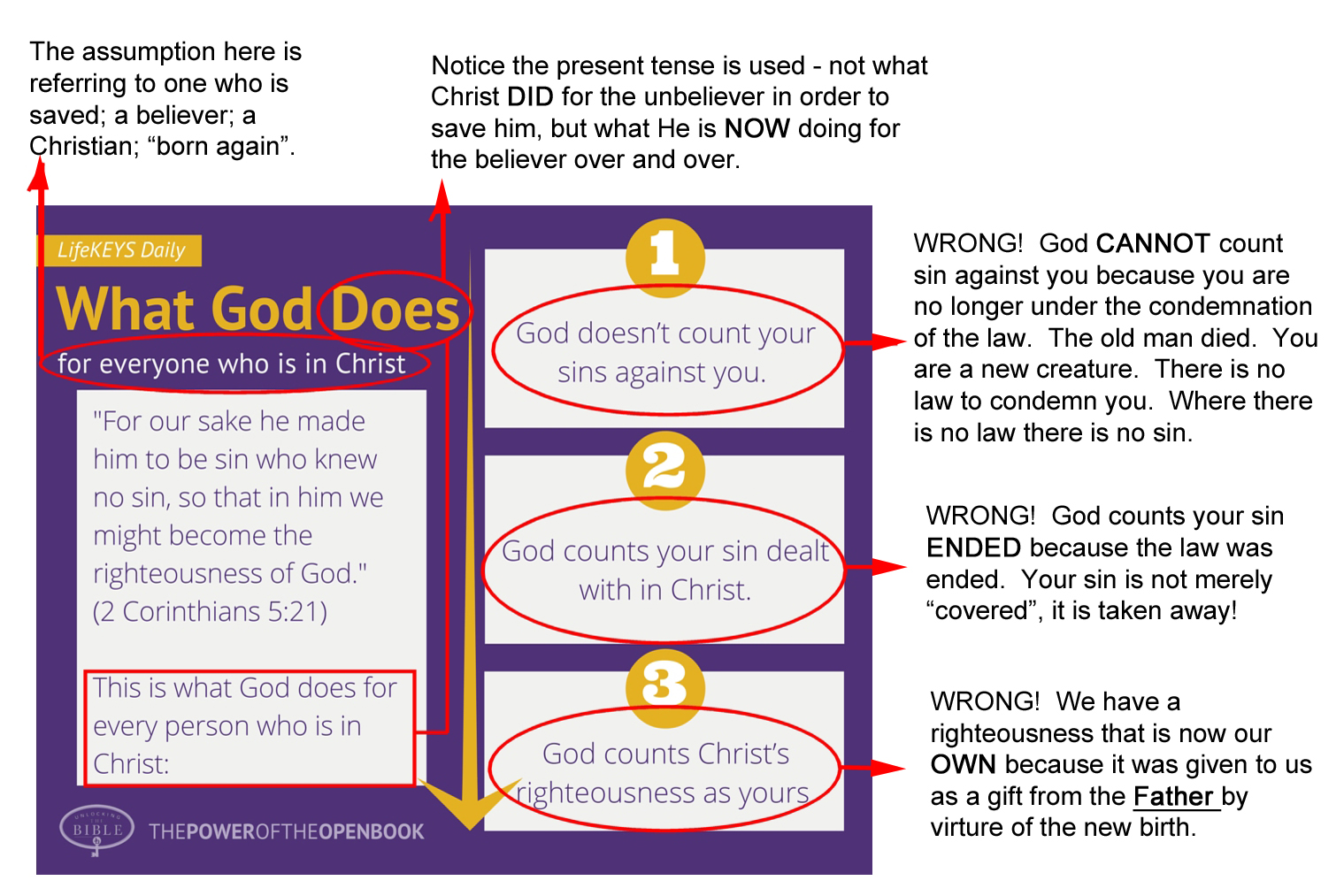
There was a meme in my Facebook news feed that caught my eye this morning. I felt compelled to make some corrections to it. If you still don’t believe that Protestantism teaches progressive justification, think again.
Andy
Reformed Caste System: The Puritans Saw Violation of Caste as Equal to Violation of the 5th Commandment
This article is updated and revised from an article originally published on October 4, 2012

“But with this considered, the Puritans believed that the idol of upward social mobility was a specific violation of the 5th commandment. Yes, wanting to improve the lot you were born into was dishonoring one’s parents.”
There is a reason for everything. I like reasons; the “why.” I understand that “Stupid is—is stupid does,” but I want to know why people are stupid. “They’re just stupid”; that’s easy, discovering why they are stupid can enable us to save them from their stupidness and thus give them hope. See, I really am a loving, hopeful kind of guy.
Why do Protestants constantly quote and point to the Westminster Confession to make their points? And why does that irritate us so much? The second why is easy; they act like the Confession has the same authority as Scripture. An added third why changes our irritation to fear: the Westminster Confession was a standard of civil law compiled by Calvinistic Puritans at the beckoning of the Church of England. Hence, when Protestants cite the confession, they are exposing their kinship, knowingly or ignorantly, to a theocratic document (“Theocracy is a form of government in which official policy is governed by immediate divine guidance or by officials who are regarded as divinely guided, or is pursuant to the doctrine of a particular religion or religious group”[and I will give you three wild guesses as to who Protestants believe are the “divinely guided” ones]).
Later, the Church of England and the Puritans had a lovers quarrel over control of European mutton, and the Puritans were labeled, “nonconformists.” Other groups of Baptist origin were labeled the same regardless of their devotion to the same totalitarian principles as the Church of England; ie., the 1689 Baptist Confession of Faith which was drawn from the Westminster Confession and written by Puritans as well. After this totalitarian plague landed in America, another document was drafted from the Westminster model, this time by the “Pilgrims” (alien European Puritans): The Savoy Declaration.
These documents encompass a conviction for state and church to rule together at the supposed pleasure of God, and with all of His authority by proxy. Ooopsies and boo-boos are covered by diplomatic immunity. Be not deceived: the spirit of the Westminster Confession is the lust of every authentic Protestant. That’s the why behind their obsessive citation of it.
 However, the central idea of the Westminster Confession, that totally depraved mankind must be ruled with a divine iron fist, is going to manifest itself in a number of different applicable elements. Authentic Protestants use this for cover; the “fact” that they don’t “agree with everything” in the Confession supplies cover for the fact that they are totally sold out for the central idea that is the foundation of the document. That would be the control of the totally depraved by the “Westminster divines” of whom they are kin.
The heart of the document and its sentiment is revealed in the applicable elements—one being a caste system modeled after the extreme European social caste system of that day. Misrepresenting your social class to marry into a family that was in a higher social stratum was a capital offense. Different social classes dressed differently, and entitlements were also determined by class as well.
The Puritans were really, really big on the whole idea of being content with were God had sovereignly placed you in life. In all caste systems, your social stratum is determined by what stratum you were born into; ie, determined by the social stratum of your parents. The system disallowed mobility between the social strata, or for all practical purposes: improvement. Of course, there were rare exceptions born of the milieu of life combined with intentionality for those who dared.
Notwithstanding, the Puritans saw a desire to climb the social strata as a “heart” problem: pride, discontent, thinking that your totally-depraved-self deserves more than your sovereignly appointed lot in life—which is a magnificent gift compared to what you deserve: hell. Today’s authentic Protestant Puritan wannabes would say that you have “idols of the heart.”
But with this considered, the Puritans believed that the idol of upward social mobility was a specific violation of the 5th commandment. Yes, wanting to improve the lot you were born into was dishonoring one’s parents:
The essence of the Puritan idea of status is found in the Larger Catechism of the Westminster Confession of Faith, that comprehensive body of theology hammered out by the Puritan scholars of Cromwell’s England in the mid-1640′s. The question of status was basic to the Puritans’ interpretation of the Fifth Commandment, “honor thy father and thy mother.”
By father and mother, in the fifth commandment, are meant not only natural parents, but all superiors in age and gifts; and especially such as, by God’s ordinance, are over us in place of authority, whether in family, church, or commonwealth…. The general scope of the fifth commandment is, the performance of those duties which we mutually owe in our several relations, as inferiors, superiors, or equals (Gary North: The Freeman; June 1974 • Volume: 24 • Issue: 6).
The logical conclusion is borne out by what the Americanized Puritans (Pilgrims) instituted as civil law in their own New England old England way. Undoubtedly, due to European influence that connected dress to status, the Pilgrims included what is known as Sumptuary Laws (laws regarding what one may or may not wear) in their theocratic laws:
Colonial Laws of Massachusetts, 1651
Sumptuary Laws (Laws Regarding What One May or May Not Wear)
ALTHOUGH SEVERAL DECLARATIONS and orders have been made by this Court against excess in apparell, both of men and women, which have not taken that effect as were to be desired, but on the contrary, we cannot but to our grief take notice that intolerable excess and bravery have crept in upon us, and especially among people of mean condition, to the dishonor of God, the scandal of our profession, the consumption of estates, and altogether unsuitable to our poverty. And, although we acknowledge it to be a matter of much difficulty, in regard of the blindness of men’s minds and the stubbornness of their wills, to set down exact rules to confine all sorts of persons, yet we cannot but account it our duty to commend unto all sorts of persons the sober and moderate use of those blessings which, beyond expectation, the Lord has been pleased to afford unto us in this wilderness. And also to declare our utter detestation and dislike that men and women of mean condition should take upon them the garb gentlemen by wearing gold or silver lace, or buttons, or points at their knees, or to walk in great boots; or women of the same ran to wear silk or tiffany hoods, or scarves which, though allowable to persons of greater estates or more liberal education, we cannot but judge it intolerable. . . .
It is therefore ordered by this Court, and authority thereof, that no person within the jurisdiction, nor any of their relations depending upon them, whose visible estates, real and personal, shall not exceed the true and indifferent value of £200, shall wear any gold or silver lace, or gold and silver buttons, or any bone lace above 2s. per yard, or silk hoods, or scarves, upon the penalty of 10s. for every such offense and every such delinquent to be presented to the grand jury. And forasmuch as distinct and particular rules in this case suitable to the estate or quality of each perrson cannot easily be given: It is furtber ordered by the authority aforesaid, that the selectmen of every town, or the major part of them, are hereby enabled and required, from time to time to have regard and take notice of the apparel of the inhabitants of their several towns respectively; and whosoever they shall judge to exceed their ranks and abilities in the costliness or fashion of their apparel in any respect, especially in the wearing of ribbons or great boots (leather being so scarce a commodity in this country) lace, points, etc., silk hoods, or scarves, the select men aforesaid shall have power to assess such persons, so offending in any of the particulars above mentioned, in the country rates, at £200 estates, according to that proportion that such men use to pay to whom such apparel is suitable and allowed; provided this law shall not extend to the restraint of any magistrate or public officer of this jurisdiction, their wives and children, who are left to their discretion in wearing of apparel, or any settled militia officer or soldier in the time of military service, or any other whose education and employment have been above the ordinary degree, or whose estate have been considerable, though now decayed.
And:
By 1674, Cotton Mather’s father, Increase Mather, was convinced that the continual violation of the Fifth Commandment — the status commandment — was the chief sin of his generation. (That someone named Increase could take this position only serves to emphasize the irony.) Inferiors were rising up against superiors in the commonwealth — in families, schools, churches. It was not an uprising that he feared, but this incessant rising up. “If there be any prevailing iniquity in New England, this is it…. And mark what I say, if ever New England be destroyed, this very sin of disobedience to the fifth commandment will be the ruin of the land.” Samuel Willard agreed with Mather.
The problem, as the Puritan divines saw it, was that men were not satisfied with their lot in life. Daniel Dension’s last sermon, appended by another famous preacher of his day, William Hubbard, to Hubbard’s funeral sermon for Denison, cities ambition as the curse of the land, along with envy:”… Ambition is restless, must raise commotions, that thereby it might have an opportunity of advancement, and employ envy to depress others, that they fancy may stand in their way….” Such ambitious men are unwilling “to abide in the calling, wherein they are set; they cannot stay for the blessing, nor believe when God hath need of their service, he will find them an employment, whatever stands in the way of their design, must give place…”(Ibid).
Of course, Protestants would reject this outwardly, but what they can’t deny is that they are merely rejecting a nuance of the central idea that they embrace with all passion.
Caste is king.
paul
Authentic Protestantism (aka “New Calvinism”) is Totally Debunked by 2Peter 1:1-15
This is a revised version of an article originally published on January 16, 2012
 2 Peter 1:1-14 contradicts almost all of the major tenets of authentic Protestantism: Christocentric salvation; Christocentric interpretation; double imputation; Christocentric sanctification; the total depravity of the saints; sanctification by faith alone; the imperative command is grounded in the indicative event; assurance based on gospel contemplationism; sanctification is not “in our OWN efforts”; the apostolic gospel.
Christocentric Salvation
“Simeon Peter, a servant and apostle of Jesus Christ, to those who have obtained a faith of equal standing with ours by the righteousness of our God and Savior Jesus Christ” (v1).
Salvation is not Christocentric. Peter states that we obtained our faith by God the Father AND Jesus Christ.
Christocentric Interpretation
“May grace and peace be multiplied to you in the knowledge of God and of Jesus our Lord” (v2).
The benefits of salvation are multiplied by the knowledge of both the Father and the Son. Of course, this knowledge can only come from the Scriptures. Obviously, knowledge of both is required for the multiplication of grace and peace. One may also note that when Peter restates this truth in verse 3, he only mentions the one “who called us” which of course is God the Father.
Double Imputation
“The imputed righteousness of Christ” is an often heard slogan among reformed. But it is the righteousness of God that was imputed to us by the New Birth when we believed in Christ (see v1). The believer is righteous because he is God’s literal offspring. Christ lived a perfect life as a man because of who He is (the Son of God), not for the purpose of imputing obedience to us as part of the atonement in sanctification.
Christocentric Sanctification
“His divine power has granted to us all things that pertain to life and godliness, through the knowledge of him who called us to his own glory and excellence” (v3).
Again, God the Father is the member of the Trinity who called us. Knowledge pertaining to the Father is efficacious in sanctification.
The Total Depravity of the Saints
“His divine power has granted to us all things that pertain to life and godliness, through the knowledge of him who called us to his own glory and excellence, 4 by which he has granted to us his precious and very great promises, so that through them you may become partakers of the divine nature, having escaped from the corruption that is in the world because of sinful desire” (v3,4).
“Partakers” is: koinōnos from koinos; a sharer, that is, associate: – companion, fellowship, partaker, partner. Koinos means: common, that is, (literally) shared by all or several and is derived from a primary preposition denoting union; with or together, that is, by association, companionship, process, resemblance, possession, instrumentality, addition, etc.: – beside, with. In compounds it has similar applications, including completeness.
Sanctification by Faith Alone
“For this very reason, make every effort to add to your faith goodness; and to goodness, knowledge; 6 and to knowledge, self-control; and to self-control, perseverance; and to perseverance, godliness; 7 and to godliness, brotherly kindness; and to brotherly kindness, love” (v 5,6,7).
Obviously, if sanctification is by faith alone, Peter wouldn’t tell us to ADD anything to it.
The Imperative Command is Grounded in the Indicative Event
“For if you possess these qualities in increasing measure, they will keep you from being ineffective and unproductive in your knowledge of our Lord Jesus Christ. 9 But if anyone does not have them, he is nearsighted and blind, and has forgotten that he has been cleansed from his past sins. 10 Therefore, my brothers, be all the more eager to make your calling and election sure. For if you do these things, you will never fall, 11 and you will receive a rich welcome into the eternal kingdom of our Lord and Savior Jesus Christ” (v8,9,10,11).
Glorification (and one could argue assurance as well) is an indicative act, but in these verses, it is contingent and preceded by imperatives. Peter uses the conjunction “if” three times to conjoin imperatives preceding the indicative.
Assurance Based on Gospel Contemplationism
One of the more hideous teachings of the Reformation is that guilt is indicative of not understanding grace. Therefore, saints will not be told to take biblically prescribed action to relieve guilt, but will be told to further contemplate the gospel. There is barely anything more powerful in the Christian life than full assurance of salvation, and Peter tells us in no uncertain terms how to obtain it: aggressively adding certain things to our faith.
Sanctification is not “in our OWN efforts.”
Authentic Protestantism, by default, disavows our effort in sanctification by continually utilizing the either/or hermeneutic: it’s either all our effort, or all of Christ. Though we can do nothing without Christ, Peter makes it clear that peace and assurance will not take place if we do not “make every effort” (ESV).
The Apostolic Gospel
“So I will always remind you of these things, even though you know them and are firmly established in the truth you now have. 13 I think it is right to refresh your memory as long as I live in the tent of this body, 14 because I know that I will soon put it aside, as our Lord Jesus Christ has made clear to me. 15 And I will make every effort to see that after my departure you will always be able to remember these things” (v12,13,14,15).
Think about it. It had been revealed to Peter that his departure was near, so his ministry was focused on what he thought was the most important thing that they needed to be continually reminded of. Where is, “The same gospel that saves us sanctifies us”? Where is, “We must preach the gospel to ourselves every day”? Where is, “Beholding the face of Christ as a way of becoming”?
paul
Why Are You “Dissing” the Church?
Originally published April 16, 2015
 Leaving the institutional church has been one of the best decisions our family has made. Granted, there are the social aspects that we miss (my wife especially, she’s a people person), but it doesn’t take much searching to admit that real friendships have to be based on more than just a weekly formal gathering. Want to know who your real friends are? Just try leaving your church for whatever reason. See how many of them still keep in contact with you. In fact, it was a comment very similar to that which I posted on Facebook a few weeks ago, which prompted quite a debate.
There is a young man with whom I am friends, let’s call him “Trevor”. I have personally known Trevor for many years. Trevor has come to me with many questions about some of the things I post on Facebook, and we have had some very edifying discussions. We’ve talked at length about the differences between Justification and Sanctification. He is genuinely seeking answers, and I am grateful for the opportunities to help disciple him.
But a few weeks ago, Trevor sent me the following private message on Facebook:
“Hey Andy I keep seeing you dissing on churches and even though you are probably right why not use your intelligence and abilities on helping teach people about God. There are a lot of people who need God that I’m sure are reading that and when people see hostility amongst Christians towards other Christians it turns them off to it completely and isn’t that contradictory to what we want for people”
I understand the motivation behind his response, and I don’t hold it against him. It is typical from anyone who sits under the orthodoxy of the institutional church. Trevor has probably even spoken with his pastor about some of these issues I’ve brought up, and maybe this response comes after the result of one of those conversations. Either way, his tone of concern is well noted and appreciated. So below you will find my response to Trevor. I apologize that it is rather lengthy, but I hope that it will be edifying.
Dear Trevor,
I’m sure you will agree that it is hard to give a full-orbed treatise within the confines of a simple Facebook status message. It doesn’t lend itself well for going into details. So the goal is to try and make your point in the most direct and concise manner possible. For that reason, a simple matter-of-fact statement may come across as curt and abrasive. That is unavoidable. Nevertheless, statements such as these should prompt people to think. But often times, rather than think, people respond defensively because they automatically assume I am attacking them. I am not attacking people, I am challenging ideas. But most people are too lazy to differentiate the two because they have too much ego invested in their ideas, and therefore take any attack on an idea as a personal attack. This is true of both Christians and non-Christians alike. And actually I have found that those who call themselves “Christian” have an even greater tendency toward ego investment, and there is a very good explanation for that, which leads me to the next point.
When you challenge what a “Christian” has traditionally been taught, you are indeed challenging their very salvation. And this is a frightening prospect for them. But it is for this very reason that these notions need to be challenged, because what it boils down to is that their faith is in a “belief system” rather than belief in the name of the Lord Jesus Christ. That which passes for “the church” is the very embodiment of this belief system. Is it any wonder then that people have such a knee jerk reaction? For someone to even raise the question that what they have been taught might be wrong scares the crap out of them!
This is why I criticize the institutional church, because it embodies this system that has kept people in the spiritual dark ages for centuries! The institutional church is based on “authority”, and the system is needed to maintain the authority. But this is so contrary to scripture. There is to be no authority among the brethren of Christ. Christ is the authority! And he is the only mediator between God and man. Now that is not to say that there is not leadership, but leadership is not the same as authority. Authority implies “power”, while leadership implies “example”. But the emphasis within the traditional “church” model is predicated on power and authority, and everything that happens within the confines of these institutions is designed to maintain that power structure. It has been that way since the very early beginnings of the Roman Catholic church in the 4th century. And Protestantism is no different.
I see many good genuine Christian people languishing away within the walls of the institutional church, and it grieves me deeply, for there are eternal consequences at stake. Not as far as salvation goes, but with regard to eternal rewards. You have spiritually illiterate Christians looking to some authority to tell them what to believe, who have never been equipped to carry out the task that was given to them from the first day they were born again- to go out and make disciples. They are not exercising their gifts. Instead they hide their talent in the ground, waiting for the Master to return and say, “here Lord, here’s what you gave me.” And there will be no eternal reward for them. And the church is purposefully keeping them in this state of immaturity. How I long for believers to realize their full potential as Children of God! But that will never happen in the “church”. The church serves itself.
So, even having said all of that, I still haven’t fully been able to explain the depth of this all. But your concern is how this arguing among believers will turn off others. I contend that what turns of the unsaved is not the fact that they see Christians argue, but rather that Christians don’t even know what they believe. Furthermore, what they do claim to believe is not even rational. Christianity for the past 1500 years has simply failed to produce a fully rational explanation for why someone should believe in Jesus. There must be more to it that just, “well you just have to have faith.” Faith must be grounded in reality. So we don’t simply lay aside arguments regarding contending for truth just for the sake of presenting the illusion of a unified front to the world.
In addition, the traditional excuse for evangelism is simply nothing more than who has the better sales pitch for getting someone to attend their church versus another. This ties in directly with the notion of salvation being in the church. Christians are more interested in getting people into their church than they are with teaching people about the gospel of the Kingdom. By definition, the church cannot be comprised of unbelievers. The body of Christ, the “assembly”, is only made up of believers. The purpose of believers assembling is for edification, and that happens by four functions: instruction in the word, fellowship, sharing meals (including the Lord’s table), and praying together. (Acts 2:42). How can an unbeliever possibly be any part of that? He shares nothing in common. He is not a part of the Body. 2 Corinthians 6:14-15 says, “Be ye not unequally yoked together with unbelievers: for what fellowship hath righteousness with unrighteousness? and what communion hath light with darkness? And what concord hath Christ with Belial? or what part hath he that believeth with an infidel?” Unbelievers have no part in the fellowship of God’s people.
Now the excuse has been that we need to bring unsaved to church so that they can get saved. But that is simply a lazy excuse for evangelism. It is not what Christ’s instructions were. Believers gather in fellowship to be edified. Having then been properly equipped, WE can go OUT into the world to take the gospel TO the lost so that they can HEAR it from US. Faith cometh by hearing, and hearing by the word of God. How then shall they believe in whom they have not heard? And how shall they hear without a preacher? And how shall they preach unless they be SENT? (Romans 10:14-15, 17) Every believer is a preacher- and ambassador from God’s heavenly Kingdom – sent forth with the message of reconciliation to the world. It is our mandate as individuals, NOT the function of an institution!
And so seeing how the “church” has utterly failed in every way in all of these areas, I hope you can better understand now why I have such disdain for it and am so critical of it. But the answer is not reform. It doesn’t need to be reformed, it needs to be defeated because it is not what God intended for His people. The answer is, to come out from among them and be separate. And that is what I have done, and that is what I want to encourage all believers to do. Come out from this institution and join in genuine fellowship with other like-minded believers and start exercising your gifts. There is no horizontal authority between men among believers. All authority is in Christ.
Andy
Anti-Catholic or Pro Gospel: A Review of Tim Challies’ Article – Part 6
This is the sixth and final part of a six part series.
Click here for Part One.
Click here for Part Two.
Click here for Part Three.
Click here for Part Four.
Click here for Part Five.
We are coming to the end of our review of the Tim Challies article, “Anti-Catholic or Pro Gospel”. There is one more point to examine, but before we get to that I want to disclose something I discovered in my research for this series. The very same canons from the Sixth Council of Trent that Challies uses for his evaluation in his article are the same ones found evaluated in this article. Since I could not find any publication date on it, I cannot determine who wrote their article first. I’ll let you compare them for yourself and come to your own conclusion on that, but it certainly does make one scratch their head. At any rate, it does serve to reinforce the notion that Reformed talking points run far and wide.
The Protestant Reformation is probably the biggest farce that has ever been perpetrated on Christianity. That farce lives on with help from the likes of Tim Challies and writings such as the one under evaluation here. Whether or not his misrepresentation is purposeful or he is simply just confused himself, it doesn’t excuse him from being complicit in the deception of the thousands of laity who look to him daily for their interpretation of reality. Elders are to be above reproach, and there is certainly much in his own writing that can be cause for reproach.
So then let’s get on with our examination of point number six. Once again, I have included the quote from the canons of the Sixth Council of Trent so that we may consider them alongside Challies’ own rejection of Catholic doctrine.
“If anyone says that the Catholic doctrine of justification as set forth by the holy council in the present decree, derogates in some respect from the glory of God or the merits of our Lord Jesus Christ, and does not rather illustrate the truth of our faith and no less the glory of God and of Christ Jesus, let him be anathema. (Canon 33)”
“This is the heart of the issue, isn’t it? The Roman Catholic doctrine of justification, as laid out by the Council of Trent, and as systematized in the canons, does that very thing—it diminishes the glory of God and the merits of Jesus Christ. It adds to Christ’s work. To add anything to Christ’s work is to destroy it altogether.”
This is Martin Luther’s “Theology of the Cross” plain and simple. It is the “cross story” vs. the “glory story”. Challies might have just as well quoted from Luther directly.
Thesis 22: That wisdom which sees the invisible things of God in works as perceived by man is completely puffed up, blinded, and hardened.
…This has already been said. Because men do not know the cross and hate it, they necessarily love the opposite, namely, wisdom, glory, power, and so on. Therefore they become increasingly blinded and hardened by such love, for desire cannot be satisfied by the acquisition of those things which it desires. Just as the love of money grows in proportion to the increase of the money itself, so the dropsy of the soul becomes thirstier the more it drinks, as the poet says: »The more water they drink, the more they thirst for it.« The same thought is expressed in Eccles. 1:8: »The eye is not satisfied with seeing, nor the ear filled with hearing.« This holds true of all desires.
Thesis 24: He, however, who has emptied himself (cf. Phil. 2:7) through suffering no longer does works but knows that God works and does all things in him. For this reason, whether God does works or not, it is all the same to him. He neither boasts if he does good works, nor is he disturbed if God does not do good works through him. He knows that it is sufficient if he suffers and is brought low by the cross in order to be annihilated all the more. It is this that Christ says in John 3:7, »You must be born anew.« To be born anew, one must consequently first die and then be raised up with the Son of Man. To die, I say, means to feel death at hand.
In the above-cited Heidelberg Disputation, Luther contended that man’s desire to do works only feeds “the glory story,” or the story of man. In Luther’s construct, ALL reality is interpreted through two stories: the glory story (the story of man), and the cross story (the story of redemption). Giving any credence to the works or the belief that man can perform good works only contributes to the story of man and his glory. This includes believers! When Challies claims that the Catholic doctrine of justification diminishes the glory of God and the merits of Jesus Christ and adds to Christ’s work, that’s Luther’s “glory story” and not the “cross story”.
And he is exactly right; that is the heart of the issue. It was what the reformation was all about. It was a battle over “infused grace” vs. the obedience of Christ in our place. But the dirty little secret is that it was an argument over those things with regard to progressive justification, which the reformers never denied and actually upheld. The dispute was simply over the means. Authentic Protestantism saw no difference between justification and sanctification. It saw sanctification as the means by which justification was preserved, not the means in which we bring glory to our Father through good works.
This is what is meant when reformed teachers uses phrases like, “sanctification is the growing part of salvation,” or, “the same gospel that saves you sanctifies you.” It reveals their belief that justification is a process. But unlike Catholicism, that process is maintained by “faith alone”. It is why they view works in such a derogatory manner, because works diminish the “cross story”. They diminish the “work” that Christ does in maintaining the believer’s declared righteousness. “Christ’s work” is not simply His “work” on the cross. “Work” in their construct is a collective term that encompasses all of the tasks that Christ performs, including an active obedience to the law continually imputed to the believer, so that when God looks at you, all He sees is Christ. But if at any time you believe that any work you did originated with you, you rob Christ of His glory and make it your own, “destroying it altogether.”
What this all boils down to is that the whole argument over works vs. “faith alone” is a distraction from the real issue. We are lead to believe that it is an argument over justification. We are left to assume that Protestant’s believe that justification is a one-time event. But the real debate of the Reformation was an argument over the means of maintaining justification.
No wonder so many Christians are confused. I myself could not understand why obedience in the Christian life was looked upon so negatively by my reformed pastor and elders, when all of scripture clearly stated that believers are to obey. I had no problem understanding and making the distinction that it had nothing to do with me trying to stay justified. I wanted to obey because I loved my Father. But now that I understand the way authentic Protestantism regards works as well as their take on progressive justification, it all makes so much more sense now. And what I find is that with practice, the duplicity and doublespeak become so much easier to spot.
Andy
“Study to shew thyself approved unto God, a workman that needeth not to be ashamed, rightly dividing the word of truth. But shun profane and vain babblings: for they will increase unto more ungodliness.” ~ 2 Timothy 2:15-16

 Paul's Passing Thoughts
1 comment