Galatians: Protestantism is No New Thing Under the Sun; Law-Based Justification is Functioning Antinomianism
Projected Publication: 2017
The law was NEVER the standard for righteousness, but it is the standard for love and the work of faith.
Protestantism is the Galatian problem all over again. In Paul’s letter to the Galatians he attacks law-based justification, but functioning antinomianism has a slick way of dissing the law while applauding it. On the one hand the law is applauded as the standard for righteousness; ie., justification, but on the other hand some sort of substitute for the law fulfills it. This is anti-law while presaging to applaud it. And by the way, antinomianism is really anti-love.
Hence, while Protestants proudly proclaim themselves people of the book, evil and tyranny reins in the church. Those who show themselves reasonably equitable are really just good Germans. Why is this? Answer: law-based justification. Protestants are perhaps the wiliest in this falsehood because the banner over them is “justification by faith.” While proclaiming justification by faith alone apart from the law, it is really justification by the law. The key here is that like all law-based religions before it, Protestantism makes the law justification’s standard.
As a result, that standard must be met by some sort of substitutional ritual that fulfills the law FOR the “believer.” This actually leads to a “relaxing” of the law because we can’t fulfill its…watch for it….”righteous demands.” Why strive to obey the law when it demands perfection? In fact, Martin Luther and John Calvin both stated that any little falling short makes one guilty of violating every point of the law. Will this lead to a “relaxing” of the law which was the very thing that Christ accused the Pharisees of? Of course it will. As the institutional Protestant church rediscovers its true roots more and more will antinomianism increase? Of course it will. Is that the very thing we are witnessing in our day? Absolutely.
With the Judaizes, the substitute for functioning righteousness was a litany of manmade traditions including the recognition of days and circumcision:
Galatians 4:9,10,11 – But now that you have come to know God, or rather to be known by God, how can you turn back again to the weak and worthless elementary principles of the world, whose slaves you want to be once more? You observe days and months and seasons and years! I am afraid I may have labored over you in vain.
Again, Protestants are really slick at this game. One of their rituals is “living by faith alone.” Instead of salvation being a onetime act that makes us righteous, our salvation is maintained by ritual faith alone works. This is the sort of thing James addressed in his epistle and why Martin Luther had open contempt for that particular New Testament letter.
In Protestantism, like all law-based false gospels, the law is the standard. Righteousness is defined by perfect law-keeping coupled with a substitute for fulfilling the law. Let me repeat that:
In Protestantism, like all law-based false gospels, the law is the standard. Righteousness is defined by perfect law-keeping coupled with a substitute for fulfilling the law.
With the Judaizes it was circumcision et al, with Protestantism it is the manmade tradition of “double imputation.” What’s that? It is the idea that Jesus kept/keeps/fulfills the law for us. If we keep the law we will fall short of its “perfect demands” and will be guilty of violating the whole standard for righteousness. The very verse they use to prove this makes the opposite point (James 2:10) as we shall see further along. But, this very error can be addressed using Paul’s letter to the Galatians:
Galatians 5:2 – Look: I, Paul, say to you that if you accept circumcision, Christ will be of no advantage to you. 3 I testify again to every man who accepts circumcision that he is obligated to keep the whole law. 4 You are severed from Christ, you who would be justified by the law; you have fallen away from grace.
Note that in order to be justified by the law, the receiver of the justification must be the one who keeps it. Unless they alone keep the whole law, they are severed from Christ. “Every man” that wants to be justified by the law must keep it himself. This is why double imputation doesn’t cut it. And in regard to the whole idea of a substituted righteousness, what is the result in every case? A relaxing of the law, and a righteousness that does not exceed that of the Pharisees who substituted the law with their manmade traditions.
This is where double imputation keeps the so-called believer under the condemnation of the law and calls the “believer” to live by faith alone works (ritual) invented by men. Jesus is a substitute for perfect law-keeping which completely misunderstands the purpose of the Old Covenant. The OC uses the law to hold all sin captive. All sin is against the law. The OC imputes all sin to the law, and then Jesus came to end the law (Romans 10:4).
Galatians 3:19 – Why then the law? It was added because of transgressions, until the offspring should come to whom the promise had been made, and it was put in place through angels by an intermediary. 20 Now an intermediary implies more than one, but God is one. 21 Is the law then contrary to the promises of God? Certainly not! For if a law had been given that could give life, then righteousness would indeed be by the law. 22 But the Scripture imprisoned everything under sin, so that the promise by faith in Jesus Christ might be given to those who believe. 23 Now before faith came, we were held captive under the law, imprisoned until the coming faith would be revealed. 24 So then, the law was our guardian until Christ came, in order that we might be justified by faith. 25 But now that faith has come, we are no longer under a guardian, 26 for in Christ Jesus you are all sons of God, through faith.
When one believes on Christ, he/she is baptized in the Spirit and is no longer under the OC to which all sin is imputed. The believer is saved by “the promise” of new birth, NOT the law. In fact, if the law has anything to do with being made righteous, even if it is fulfilled by a substitute, that would make the law an additional “seed” BUT there is only ONE seed:
Galatians 3:15 – To give a human example, brothers: even with a man-made covenant, no one annuls it or adds to it once it has been ratified. 16 Now the promises were made to Abraham and to his offspring. It does not say, “And to offsprings,” referring to many, but referring to one, “And to your offspring,” who is Christ. 17 This is what I mean: the law, which came 430 years afterward, does not annul a covenant previously ratified by God, so as to make the promise void. 18 For if the inheritance comes by the law, it no longer comes by promise; but God gave it to Abraham by a promise.
Protestantism, like all law-based salvation plans, makes the law an additional life source other than the new birth made possible by “the promise” of the Spirit who raised Christ from the grave. This changes the true believer’s relationship to the law. Instead the law condemning, it is the standard for loving God and others.
The law was NEVER the standard for righteousness, but it is the standard for love and the work of faith:
Galatians 5:6 – For in Christ Jesus neither circumcision nor uncircumcision counts for anything, but only faith working through love.
This is the whole point of James 2:10 as set against many verses noting that love fulfills the whole law. The contrast is the point. The new birth is the standard for righteousness—not the law. This makes the whole Protestant “sinners save by grace” a lie from the pit of hell. Those who sin against the law are still under law. Grace in not a covering for sin, it is an ending of the law and its condemnation. Grace has a law: the law fulfilled by the believer’s work of love; read Romans 8 and…
1John 3:3 – And every man that hath this hope in him purifieth himself, even as he is pure. 4 Whosoever committeth sin transgresseth also the law: for sin is the transgression of the law. 5 And ye know that he was manifested to take away our sins; and in him is no sin. 6 Whosoever abideth in him sinneth not: whosoever sinneth hath not seen him, neither known him. 7 Little children, let no man deceive you: he that doeth righteousness is righteous, even as he is righteous. 8 He that committeth sin is of the devil; for the devil sinneth from the beginning. For this purpose the Son of God was manifested, that he might destroy the works of the devil. 9 Whosoever is born of God doth not commit sin; for his seed remaineth in him: and he cannot sin, because he is born of God. 10 In this the children of God are manifest, and the children of the devil: whosoever doeth not righteousness is not of God, neither he that loveth not his brother (KJV).
Christ didn’t come to cover sin via obedience to Protestant orthodoxy which holds to a law-based standard for justification like all other false religions. He came to end enslavement to sin and the law’s condemnation in order to free us to live by love. The law is good for that purpose. In this sense, the law and its truth sanctifies us (John 17:17). In this sense, “If you love me keep my commandments.”
paul
Sin, Sin, Sin, Sin, Sin, Sin, Sin, Sin
Originally published on July 28, 2015
 Got sin? You do if you are a Protestant, and you have a lot of it. The “T” in TULIP doesn’t stand for total depravity for no good reason, no pun intended. The only good thing is focusing on the bad thing: your nasty, wicked self.
Sin is a really big deal in Protestantism because we get ourselves into heaven by dwelling on the fact that we are “sinners.” If we can do any good work, if ALL of our works are NOT filthy rags—that’s not living by “faith alone” for our justification. Supposedly, if we think we can do anything good, that’s not living by faith alone in what Jesus has accomplished for us, but rather living in the “confidence of the flesh.”
The foundation of Protestant soteriology is the idea that “Christians” live under the possibility of condemnation and should fear accordingly. Christians remain under the condemnation of the law and remain covered by professing that they can do no good work. By continually returning to the same gospel that saved us for forgiveness of works, both good and bad, the righteousness of Jesus continues to be imputed to us. Hence, “We have no righteousness of our own in salvation or the Christian life.”
In contrast, the emphasis of our Christian lives should be LOVE. We still sin, but it is not sin unto condemnation, but rather sin against our Father as a family matter. We may receive chastisement, but we are in no danger of condemnation. Not so with the Protestant gospel: the “Christian” remains under eternal condemnation and is only covered through faith alone by returning to the same gospel that saved us. This is why Protestantism has always been weak in the area of discipleship. This is why there is an obsession with making saved people rather than disciples. And by the way, the only place we can find continued forgiveness for “sin that removes us from grace” (Calvin/Luther) is under the “authority” of the local church. Go figure.
Even in Baptist churches, pastors bemoan the fact that “10% of the congregants do 90% of the work.” Well, duh, I am surprised that even 10% are doing anything as the focus is keeping oneself saved by focusing on how inept we are.
More and more in counseling, I am telling people to stop focusing so much on sin. Clearly, especially in the Protestant contemporary biblical counseling movement, the specific instruction is to “find the sin beneath the sin” as a means of growing your salvation as if salvation grows to begin with. If our focus is sin- searching as a means of spiritual wellbeing, and good works tempt us to think we did something good (again, Luther/Calvin), what in the world will be the results? Well, look around for yourself—it’s called “the church.”
 A focus on sin will not prevent sin or promote love. If there is something to be gained by finding sin, it will be far from us to fight against it. Why would we cut off our supply of blessings by making the cross smaller? It becomes a supply and demand issue.
The Bible endorses a focus on love, not sin-searching. We are to look for ways to love God and others, not ways to find the “sin beneath the sin” or some endeavor to “peel back the layers of sin.” No doubt, there is a CONTROL conspiracy involved with this supposed method of sanctification as well. Stripping people of an accurate evaluation of self is a very efficient way of controlling them. Being worthy enough to hold others accountable for their own good will not get you into heaven—only returning daily to the same gospel that saved you for a fresh set of downs to get into the salvation end zone.
And what will eventually happen to any marriage if the constant focus is your spouse’s sin? No wonder then that the present-day biblical counseling movement (mostly sponsored by Reformed churches) is overflowing with marriage counseling cases. Week in, and week out, teaching will knock down any notions that either spouse can do any work that is not “filthy rags.” And, the only real sin is not knowing that everything you do is sin; if you don’t know that, you may find yourself in so-called church discipline. We do know this: those who will not accept this premise are deemed “unteachable.”
We have not been given a spirit of fear under the law of sin and death and its condemnation. We, instead, have been given the Holy Spirit and boldness to love God and others without any fear of condemnation.
We are to be enslaved to love—not to a fear of condemnation.
paul

Protestants: Willing Participants in a Truman Show Reality.
 Truman Burbank lived a seemingly normal life. He was just your regular, ordinary kind of guy. Everybody liked Truman. He had a pretty wife, a nice house, a good job. He had everything anybody could ask for. His life was perfect. Or so it seemed.
Of course, Truman Burbank isn’t a real person. He is the titular fictional character in the 1998 film The Truman Show. Those of you who are familiar with the film well know that while Truman’s story is fictional, the reality of his world in that fiction was fiction as well; a fiction engineered specifically for him. The problem was, Truman did not realize that his reality was fake. Unfortunately, just like Truman Burbank, 99% of Protestants don’t realize that their reality as they know it is just as fake, yet they willingly accept it. Truman Burbank offers a perfect philosophical metaphor, so I am using him to illustrate my point.
At the time we meet him in the movie, Truman is approximately 30 years old. From the time he was born, his entire existence has been in the world of Seahaven, FL. It is the only reality he has ever known. And up until now he has never questioned the truth of his reality. What he does not know is that this world is a carefully crafted façade, and every other person in his reality is nothing more than an actor playing a role. Their sole purpose is to make Truman believe that everything he sees around him and everything that happens to him is real. And as he goes about his daily life, hundreds of tiny hidden cameras capture his every move and broadcast his life to the world 24 hours a day. You could say that Truman was the first reality TV star.
How is it that a person can live his entire existence and not realize that his reality is fake? Because Truman’s reality consists of a very deceptive hermaneutic. Everything that happens in his life is carefully interpreted for him so that his understanding of reality remains consistent with what he observes. On this scale you can be sure that this is a very complicated feat to pull off for thirty years.
Such a task can only be maintained for so long, and eventually, unexpected “glitches” begin to occur. For example, one day a strange object falls from the sky and smashes on the ground just feet from where Truman is standing. It happens to be a stage light that is labeled, “SIRIUS (9 Canis Major)”. On another day, while listening to the radio in his car, his radio suddenly begins broadcasting the director’s instructions to the cast, and Truman realizes that the voice on the radio is describing every turn he makes in his car. Yet another time, Truman enters an elevator only to realize when the door opens that no elevator is there but instead he sees a group of stage hands on break around a snack table.
Obviously, such events would be out of the ordinary in Truman’s reality. Here is a conflict between what Truman thinks to be true about his world and what he observes, and he has no idea how to reconcile these contradictions. At this point a mediator is needed to reinterpret what Truman has observed to reconcile the contradiction and convince him that nothing is wrong, everything is as it should be. No, that wasn’t a stage light that fell from the sky, it was a part that fell off an airplane flying overhead. No, you didn’t really hear a guy on the radio announcing your every move. Our station accidentally picked up police frequencies, ha ha, sorry it sometimes happens. Oh did you hear? There was a freak elevator accident in the building next to yours, and a woman was critically injured- no you didn’t really see a stage crew taking their break where an elevator should have been.
The producers went to great lengths to discourage Truman from leaving Seahaven, because as a boy, Truman had a longing for exploring. They posted subtle messages around town with outrageous warnings about the dangers of travel. Sometimes, drastic intervention was required. They even created a scenario one day where Truman was out on a boat with his father, and a sudden storm swept his father overboard, never to be found again. Of course, it was all an act, but to Truman it was very real, and it made quite an impression on him as a small boy. So much so that Truman developed an acute fear of the water and never thought twice about leaving Seahaven by boat, or even crossing a body of water. But as things progress, Truman’s suspicion grows. He begins to ask serious questions of those around him, who continue to simply play along with their roles in a vain attempt to deflect his suspicions.
But despite all these obstacles, Truman was determined to find answers to his questions. He discovered that he could make unusual things happen anytime he was unpredictable. Those involved with the show could not react fast enough to his spontaneity, and this would give them away, only furthering his resolve. Truman knew something was not right about his world, but he did not know why. He could not explain it, but he was no longer willing to accept the explanations given to him by those around him.
We could summarize the salient points about Truman’s reality this way:
- Truman’s understanding of the world was based on a false assumption.
- From time to time Truman would encounter contradictions in his reality that he could not reconcile.
- Truman needed mediators in his life to interpret reality for him.
In much the same way, the way that Protestants understand reality is based on a false assumption. Doctrines such as total depravity (total inability), determinism and God’s sovereignty, election, and many others present man with a view of reality where man is evil and therefore cannot know truth. Believers go to church week after week so that they can be told not just what to think but also HOW to think about not just what the Bible says but also how the world itself works.
Invariably there will come a time when a believer will encounter a contradiction. It may be that he comes across passages of scripture in his Bible that seem to contradict each other. It may be that he encounters something in life that runs counter to what he was taught from the pulpit. Something that he cannot explain, like how can man have a free will if God is sovereign? “Well, you know God’s ways are higher than man’s ways, so we just have to accept that there are some things we just can’t understand and accept as true because God says so.”
Most often, contradictions are handled from a matter of interpretation. This is where the mediator steps in and reinterprets scripture for the believer in its proper “gospel context”. You see, because man is unable to know truth, he needs the authority of a mediator to explain it to him. This is the role of pastors, elders, deacons, bishops, et al.
For Truman Burbank, his mediators were not just a select few in positions of authority. It was the entire cast of characters from the crew behind the scenes, to the actress who played his wife, to the guy who sold him his daily paper at the newsstand. Every person in Truman’s life was a willing participant, regardless of how much they were aware of their overall impact in shaping his life. Extras in the cast, for example, would dutifully play their part all while being totally ignorant of the ultimate level of control the producers sought to wield over Truman’s life.
Truman himself was a willing participant in this ruse. One could argue that he was simply an innocent victim in the whole matter, but consider how much he was willing to overlook in his life for such a long time just so that he could go on living the only life he ever knew. That fact was a major point in the film, when a disgruntled viewer called the show and told the show’s creator just how wrong she thought it was the way they were using Truman for their own ends. The creator’s response was profound and powerful. He said that if Truman REALLY wanted to discover the truth, he would find a way, and that when that happens, there would be nothing they could do to stop him. The point being of course was that the mere fact that Truman lived this life for so long was a statement to the reality that he really didn’t want to know the truth.
How much can the same be said of Protestants? To what extent are Protestants willing participants in their own “Truman Show” existence? How much are we willing to overlook just so that we can be comfortable in our lives? How much abuse and evil are we going to tolerate just so that we can have some sense of security in where we think our salvation lies? Do we blame the cast of mediators who create this charade for us? Their role is obvious, and they play their parts well, wittingly or unwittingly. But the laity are playing a role as well. They shoulder just as much of the blame as those under whose self-appointed authority they have placed themselves. And they will dutifully pay their tithes and offerings each week, and they will warm their spot on the pew every time the church doors are open, and they will sing when told to sing, and they will stand when told to stand, and they will pray when told to pray, and they will outsource their minds to someone standing before them who will tell them what to think about life. And they will never ask a hard question, even when a stage light falls from the sky.
But there is hope! Because if Protestants really want to know the truth, they will find it. If they really want to find a way out of the nightmare that is the institutional church, they will discover it. And when they are determined to do so, there isn’t a thing the church can do about it!
Andy
Be Careful About What Protestantism Allows You to Assume.
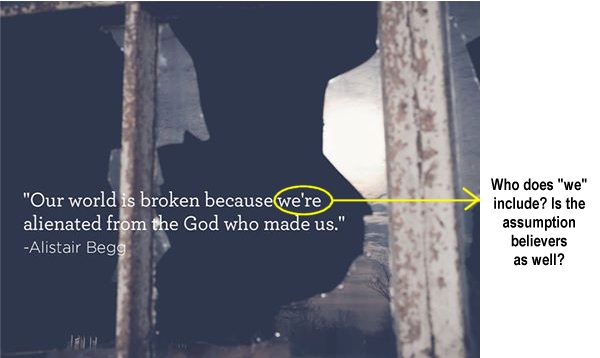
“Wherefore remember, that ye being in time past Gentiles in the flesh, who are called Uncircumcision by that which is called the Circumcision in the flesh made by hands; That at that time ye WERE without Christ, being aliens from the commonwealth of Israel, and strangers from the covenants of promise, having no hope, and without God in the world: BUT NOW in Christ Jesus ye who sometimes were far off are made nigh by the blood of Christ. For he is our peace, who hath made both one, and hath broken down the middle wall of partition between us; Having abolished in his flesh the enmity, even the law of commandments contained in ordinances; for to make in himself of twain one new man, so making peace; And that he might reconcile both unto God in one body by the cross, having slain the enmity thereby: And came and preached peace to you which were afar off, and to them that were nigh. For through him we both have access by one Spirit unto the Father. Now therefore ye are no more strangers and foreigners, but fellowcitizens with the saints, and of the household of God;“
~ Ephesians 2:11-19
Praise God!
Andy

 Paul's Passing Thoughts
leave a comment