Galatians 2:20 and the Gospel According to Phil Johnson, Parts 1 & 2
Listen to podcast or download audio file.
PAUL DOHSE: Welcome, truth lovers, to BlogTalkRadio.com/False Reformation. This is your host Paul Dohse. Tonight, part eight of the Magnum Opus of the Reformation, Martin Luther’s Heidelberg Disputation. Greetings from the Potter’s House and TANC ministries where we are always eager to serve all of your heterodox needs. Our teaching catalog can be found at tancpublishing.com. If you would like to add to our lesson or ask a question, call 855-8317. I failed to put the area code in there. That’s (347) 855-8317. Remember to turn your PC volume down to prevent feedback. If you choose to use Skype to listen to the show, my advice is to just dial direct from your Skype account without using any of the Blogtalk links. And again that number, just dial direct from your Skype account is (347) 855-8317. Per the usual, we will check in with Susan towards the end of the show and listen to her perspective. Remember, you may remain anonymous. When I say, “This is your host. You are on the air. What’s your comment or question,” just start talking. If you would like to comment on our subject tonight, you can also e-mail me at paul@ttanc.com. That’s paul@Tom-Tony-Alice-Nancy-Cat.com. I have my e-mail monitor right here and can add your thoughts to the lesson without need for you to call in. You can post a question as well.
Tonight, we’re going to have another interlude, and I know these interludes drive people crazy. But it is very important to establish and have a sentence by sentence evaluation of Martin Luther’s Heidelberg Disputation because that is the first and founding document of the Protestant Reformation. It was written about six months after Martin Luther’s Ninety-Five Theses which is thought to have launched the Protestant Reformation, and I guess that’s fair enough. But the Heidelberg Disputation is the first and foundational document of the Protestant Reformation. And it is, absolutely, amazing how to this day, literally everything that we see in contemporary, or at least the return to the contemporary authentic Protestantism, flows from that document. But in doing this series, to have a sentence by sentence evaluation of the Heidelberg Disputation, though very important, it is getting the cart a little bit before the horse. Because in our day, Christians, by and large, really don’t understand the gospel. They really don’t understand the gospel. And this is by design. This is the essence of Protestantism, a dumbed-downed congregant. And we’re learning why that is in our study of the Heidelberg Disputation. But foundational to the doctrinal illiteracy of present-day Christians is this whole idea that we’re sanctified by the gospel. So throughout Protestant history, the emphasis has always been the gospel, the gospel, the gospel, the gospel, or the gospel or first importance or going back, discontinually going back to the cross. And this gets a pass, by and large, because people are saying, “Oh, this is just a theory on how to be better sanctified or how to better grow in our faith by returning to the original gospel that saved us time and time again.” But as we are learning, and the contention of this ministry is that our contention is – our contention is that no, this just isn’t one of many techniques to better grow in the Lord according to the Bible supposedly. No. This is a gospel or a soteriology that calls for us to continually return back to the same gospel that saved us, so that we can live by faith alone as a way to keep ourselves saved. This is the dirty little secret of Protestantism.
So in essence, you have a work salvation by faith alone or in essence, a work salvation by doing nothing, kind of like Bachman-Turner Overdrive theology. I work hard at doing nothing all day as a way to keep myself saved. Or the way they put it, living by faith alone. And if you think about those words carefully, one might logically ask, “How do you live by faith alone?” Kind of like saying, “How do you live by thinking alone without doing anything?” So this is why we’re taking these interludes. It’s very important for us to establish what exactly the foundational document of Protestantism is all about. But, again, for contemporary or present practical purposes, we need to get it out there what the true gospel is, the true biblicist gospel in comparison to–I hate to say it, I hate to just put it out there–Protestantism.
Now as we’ve discussed before, the official coined term by this ministry, anyway, concerning the official doctrine of the authentic Protestant Reformation, not the watered down version and the truisms connected with it that most Protestants, Baptists, Methodists, Charismatics, et cetera, are used to, we’re talking about this return to the authentic Protestant Gospel in the body of the new Calvinist movement, which is all but completely taken over the institutional church.
In regard to gospel sanctification, the go-to verse is Galatians 2:20. This is the primary go-to verse. Now a lot of people claim that the Higher Life movement and all these other movements, the Keswick movement and all these movements, they are really big on Galatians 2:20 as well. And what’s in vogue is to think that the Higher Life movement and the Keswick movement, so on and so forth, are somehow different from authentic Reformed Protestantism and their gospel. And such is not the case. The applications are different, but the basic soteriology is the same. And what is that? Here it is. It’s a soteriology based on gospel contemplationism, and keeping yourself saved by going back to the cross. Or in essence, keeping yourself saved through contemplationism of some sort because to actually do something would be works salvation because this is key running the basic premise, running through all these doctrines is that justification is progressive.
And as we’re going to hear, and how we’re going to approach this topic in the show today, what we’re going to hear, Phil Johnson of John MacArthur’s Grace Community Church out in California, he is actually going to call salvation a process. And this is the fundamental basic premise of all of these doctrines, all of these passive doctrines, all of these doctrines that would say, synergistic sanctification is work salvation. Why? Because it’s, and we’ve all said this, “The growing part of salvation.” Well, folks, salvation doesn’t grow. Salvation doesn’t grow, okay? And, again, we’re going to really hunker down on Galatians 2:20 because I stumbled upon a video that’s a sermon by Phil Johnson of Grace Community Church in California where he really articulates Galatians 2:20 in the Reformed view to a T. And, again, in this incredible video, he is also speaking for the Higher Life movement and all these other movements, even though he speaks out against them in this. Again, the basic soteriology is the same, this whole idea that salvation is a process that starts at point A and gets to point B and that we have to keep the process going by doing nothing. So we’re going to look at this, and this ministry is just going to flat out make a lot of hay of this video, and we’re going to slice it, dice it, rework it, keep adding to it, taking away from it. And we begin that process in today’s program. And basically, we’re going to continue that process on Sunday morning as well. And as well, we’re going to post videos on Paul’s Passing Thoughts, the blog, for TANC ministries. And we’re going to, really, work this thing. We better get going because the sermon itself was 50 some minutes. I cut some parts out, and I’ll tell you why when we get into the video. (more…)

There is NO Such Thing as “Legalism”
 Originally posted March 21, 2013
We live in a unique era marked in its beginning by Christ paying the penalty for our sin (HEB 1:2). We are in the last days. We know that because it’s post cross. We live in this specific era which is also biblically described as a time of unprecedented deception (MATT 24:3,4; 2THESS 2:10-12).
Therefore, we must be careful to use specific biblical words in our communication of the truth. Those who define the language win the argument. Redefining the meaning of words to deceive is literally the oldest trick in the book; e.g., Satan redefined what God meant by death. “Surely, you will not die.” Depending on your definition of death, that was true—Eve didn’t die on the spot.
“Legalism” is a word that is not in the Bible anywhere. The concept/term was made popular by Martin Luther’s interpretation of law and grace. The term, “legalism” lends strong foundation to authentic Reformed doctrine. If you use the term, you are being a good Calvinist whether you know it or not. The Reformers were anti-sanctification because it suggests enablement and some room for self-esteem. The Bible does not call us to eradicate all concept of self for the sole purpose of the group, it calls us to evaluate ourselves truthfully (ROM 12:3). That’s why there is a severe lack of sanctification in the church today—we are all just good Protestants.
So, legalism is in, but the word for the primary nemeses of righteousness throughout the ages is out: “anomia.” The English word is, “antinomianism.” It means, anti (a) – law (nomia). And I assure you that man made law is not in view. Ignorantly, Christians deem the word as just another 50-cent theological term even though it appears throughout the New Testament and defines the core of human woes. While anomia is ignored, a word that doesn’t even exist in the Bible is thrown around more often than we change clothes.
Because the ramifications of anomia pushback against Luther’s law/gospel theology, the word is translated in English Bibles as “wickedness” and “lawlessness” giving the idea of general bad behavior. The real idea is anti-truth, anti-God’s full counsel, anti-God’s wisdom, anti-sanctification, anti-kingdom living, anti-clear conscience, anti-life, anti-goodness, etc., etc. Christ points to it as the primary cause of lovelessness and cold-heartedness (MATT 24:12; PS 119:70). John indicts it as the very definition of sin (1JN 3:4).
Perhaps the greatest deception in all of this is the Reformed motif that the Pharisees are the poster children for “legalism.” Supposedly, they strived to keep God’s law as a way of earning His favor for both justification and sanctification of which are the same to the Reformers. The opposite is true; the Pharisees were full of anomia and voided the law with their anti-truth (MATT 15:1-9; 23:23-28). The Pharisees were not “legalists,” that’s a lie, they were antinomians.
Nothing cripples sanctification more than the Reformed idea that Christians can sincerely seek to obey God by following their born again new desire for the law and thereby unwittingly partaking in works righteousness. There is no more detestable evil under the sun because it causes a conflict between the new desire God has put in our hearts (ROM 7:25; PS 119:1ff.) and instruction that propagates a relaxed view of the law (MATT 5:19). This is why Calvinism has crippled the American church. They propagate a doctrine that sets us against the very desire that God has put in our new hearts.
Satan did not come to Eve in the garden as a “legalist.” He came to her as an antinomian. In regard to the time of the end, the apostle Paul refers to the antichrist as the man of anomia at least four times in his letter to the Thessalonians. From the beginning, and through the middle embodied in the likes of Baalam’s error and Korah’s rebellion, and culminating in the end, the doctrine of anomia is the primary beast that devours the souls of men. But yet, New Calvinist queen Elyse Fitzpatrick likens anomia to the Loch Ness Monster, and is celebrated accordingly for her supposed biblical insight.
It’s time to eradicate “legalism” from our Christian vocabulary and replace it with a description of the New Calvinist breed of beasts among us: Antinomians.
paul.
The Problem With Protestant Election
 Listen to the program or download audio file.
Welcome truth lovers to Blog Talk radio .com/False Reformation, this is your host Paul Dohse. Tonight, another Paul Dohse parenthesis in our Heidelberg Disputation series, “The Problem With Protestant Election.”
Greetings from the Potters House and TANC ministries where we are always eager to serve all of your heterodox needs. Our teaching catalog can be found at tancpublishing.com.
If you would like to add to our lesson or ask a question, call (347) 855-8317. Remember to turn your PC volume down to prevent feedback over your cellphone. If you choose to use Skype to listen to the show, my advice is to just dial direct from your Skype account without using any of the Blogtalk links. It’s the same number, 347-855-8317.
Per the usual, we will check in with Susan towards the end of the show and listen to her perspective.
Remember, you may remain anonymous. When I say, “This is your host; you are on the air, what’s your comment or question”—just start talking.
If you would like to comment on our subject tonight, you can also email me at paul@ttanc.com. That’s Paul @ Tom, Tony, Alice, Nancy, cat .com. I have my email monitor right here and can add your thoughts to the lesson without need for you to call in. You can post a question as well.
Before we get started tonight, I must implement our new policy here at False Reformation. I think as recovering Protestants, we must embrace our fears and failures. One example is the sin minefield. Whenever disciples endeavor to embark on some new project, deep introspection ensues. Could the project cause us to sin? Pray tell, what are our true motives? And overall, we deem it our duty to recognize the major weaknesses of the other disciples, and for me, that is, “going off on rabbit trails all the time.”
Therefore, as a recovering Protestant, I have decided to embrace this failure as one no longer under condemnation. Yes, whenever I go down a rabbit trail, I want to make it a memorial of remembrance that I am not condemned for going down that rabbit trail. Hence, from now on, just prior to going down a rabbit trail in this show, the rabbit trail will be introduced with the following song:
So basically, when you hear an excerpt of that song on the program, you know that it is a rabbit trail coming. The upbeat introduction is also a remembrance that I need not seek forgiveness for the rabbit trail least I be condemned. Ahmen.
What is the major problem with the Protestant view of election? It is tenfold. First, as thoroughly documented by TANC ministries, the Protestant Reformation is dead wrong on salvation. The second point exacerbates the problem: all positions on election come from Protestantism, and all positions are framed by Protestant scholars. In other words, Protestant academia controls the context in which the issue is debated. Think about the insanity of this: all arguments about election start with a Protestant context; the so-called 5 points of Calvinism. In the same way that a “Band-Aid” viz, a brand defines what something is, Protestants of the authentic Reformed tradition have completely co-opted the context and framework of the argument which virtually guarantees the outcome that they want; either capitulation, or confusion which only bolsters their worldview that mankind cannot comprehend reality.
Thirdly, while there are many verses in the Bible that seem to indicate an individual preselection for salvation and damnation, there are also many that indicate that mankind is able to choose or reject salvation. There is obviously a contradiction which is written off as paradox, BUT, with one side of the paradox being the engine of existence. What am I saying here? They claim paradox, but only one side of the paradox is applicable—the sovereign side.
Fourthly, Protestantism deliberately uses a process of assimilation based on allowing the saints to assume things about orthodoxy at its progressive points. As the saints are gradually assimilated into full blown Platonism dressed in biblical garb, they are allowed to assume that “faith alone” does not include sanctification, and that “total depravity” does not include the saints, and that God does not preselect people for eternal damnation. This is a 500 year-old system of assimilation that is evil genius. And they know exactly what they are doing. How do they condone it? Well, we must not teach things that the great unwashed masses are not yet “ready for.” Nevertheless, in the same way that pot leads to harder drugs, hardcore Protestant Platonists invariably move from a grudging soft determinism to soft determinism, ie., so-called 3 or 4 point Calvinism, but eventually become advocates of hard determinism.
Fifthly, we are allowing a religion that continually produces bad fruit to dictate the confines of the debate and define the interpretive terms and words. Protestant orthodoxy has effectively defined all of the biblical terms in which our reality is interpreted, and be sure of it, those who effectively define the definition of words control reality. We have allowed a religion that continually produces rotten fruit to co-opt the grammar. That’s a really, really bad idea.
Sixth, a casual reading of Scripture is tortured because of the overall biblical dialogue found by independent reading. If God preselects some for salvation and others for damnation for his glory and self-love, why do we have Christ weeping over Jerusalem, why do we have God saying, “come let us reason together saith the Lord,” why do we have the apostle Paul expending all kinds of energy to “persuade” people in regard to the gospel? If individual determinism is true, the Bible makes NO sense whatsoever. Let’s look at a specific example of this:
Luke 16:19 – “There was a rich man who was clothed in purple and fine linen and who feasted sumptuously every day. 20 And at his gate was laid a poor man named Lazarus, covered with sores, 21 who desired to be fed with what fell from the rich man’s table. Moreover, even the dogs came and licked his sores. 22 The poor man died and was carried by the angels to Abraham’s side. The rich man also died and was buried,23 and in Hades, being in torment, he lifted up his eyes and saw Abraham far off and Lazarus at his side. 24 And he called out, ‘Father Abraham, have mercy on me, and send Lazarus to dip the end of his finger in water and cool my tongue, for I am in anguish in this flame.’ 25 But Abraham said, ‘Child, remember that you in your lifetime received your good things, and Lazarus in like manner bad things; but now he is comforted here, and you are in anguish. 26 And besides all this, between us and you a great chasm has been fixed, in order that those who would pass from here to you may not be able, and none may cross from there to us.’ 27 And he said, ‘Then I beg you, father, to send him to my father’s house— 28 for I have five brothers—so that he may warn them, lest they also come into this place of torment.’ 29 But Abraham said, ‘They have Moses and the Prophets; let them hear them.’ 30 And he said, ‘No,father Abraham, but if someone goes to them from the dead, they will repent.’ 31 He said to him, ‘If they do not hear Moses and the Prophets, neither will they be convinced if someone should rise from the dead.’”
Ok, so, the guy asks Abraham to send Lazarus over to give him relief from his suffering, and Abraham’s answer includes nothing about preselection; why not? If the guy is over there suffering for God’s glory, what’s all of this other discussion about? And why do they discuss the best means of persuasion? If the point is preselection, how people might be best persuaded is certainly a mute point, no? What is problematic is the Bible’s constant passing on making the preselection angle the main point when such opportunities appear over and over again throughout the Bible. Let’s look at another example. Matthew 26:24.
The Son of Man goes as it is written of him, but woe to that man by whom the Son of Man is betrayed! It would have been better for that man if he had not been born.”
Well, doesn’t God always want what’s best? Consider this verse in context of what love is via 1Corinthians chapter 13. Love ALWAYS seeks what’s best for others. Bottom line: if preselection is true, the Bible is nothing more than a convoluted quagmire of confusion. But God is NOT a God of confusion.
Here is another thought. The Reformed love to talk about the potter and the clay deal in Romans 9. The potter has a right to make some vessels for wrath and others for salvation and He is glorified by both. But then there is this also…
2Timothy 2:20 – Now in a great house there are not only vessels of gold and silver but also of wood and clay, some for honorable use, some for dishonorable. 21 Therefore, if anyone cleanses himself from what is dishonorable, he will be a vessel for honorable use, set apart as holy, useful to the master of the house, ready for every good work. 22 So flee youthful passions and pursue righteousness, faith, love, and peace, along with those who call on the Lord from a pure heart. 23 Have nothing to do with foolish, ignorant controversies; you know that they breed quarrels.
Here, what kind of vessel you are is determined by “cleansing” yourself. We will not be discussing Romans 9 tonight, but it will be covered in a series of articles I am presently writing.
Seventh, Biblicism rejects plenary paradox as an interpretive method because of interpretive presuppositions demanded by Scripture itself: God is NOT a God of confusion. Though paradox is a biblical reality, it is rare, and always suspect. It is guilty until proven innocent.
Eighth, individual HOPE is an acid test for truth. If something lacks individual assurance or hope, it is extremely suspect. And regardless of Protestant squealing of denial in epic volume, the engine of its progressive salvation is predicated on the so-called Christian being under a greater awareness of condemnation and fear—not a soteriology that escapes the terrible-two.
Ninth, because of the way the Bible is written, Protestant paradox demands an inconsistent method of interpretation. In some verses paradox is employed while in others grammar is employed without any determinate principle whatsoever except orthodox presuppositions. In other words, interpretive methodology demanded by the context is ignored and exchanged for orthodoxy. I suppose the classic example of this is Romans 8:2 where the same word for “law” used twice in that verse is interpreted both as a written standard and a realm. Once you break an interpretive rule of that sort, anything goes; you can interpret the Bible any way you want to.
Lastly, the injection of chapters and verses into the Bible by the Protestant Reformers has made it possible to proof-text orthodoxy without considering the corpus of Scripture. Furthermore, it suits preaching and not the necessity of reading the corpus without elements being emphasized through a numbering system. It is incredible to consider that chapters and verses were deemed unnecessary until the 16th century. It should not only seem suspect, it should be deemed such. Chapters and verses make it possible to sell a doctrine with a collection of biblical one-liners.
Therefore, an alternative to the traditional view of election must be sought, and the traditional definition of the words used to discuss this issue must be traded for their biblical assessment.
Indeed, there are many verses in the Bible that seem to indicate that people are preselected for salvation; after all, the word “elect” is in the Bible, but there are just as many or more verses that seem to indicate people are able to believe or reject the gospel. You can understand why we are still at a stalemate 500 years later. But again, is this because we are constrained by Protestant rules of engagement? Unfortunately, for the most part, logic enters in based on subjective criteria rather than conclusions drawn from the objective definition of words. And again, if one buys into the paradox argument, they are merely on their way to being full-blown predeterminists.
Before we get into the meat of our study, let’s serve up a few appetizers. First, the word “elect” or often translated “chosen” does not always apply to people who need salvation or people at all for that matter. The word “election” sometimes applies to deity, ie., Christ, or the holy angels, or a thing such as the nation of Israel. The nation Israel spoken of as being elect is a major Old Testament theme.* Not only that, in Romans 11:2, Israel is spoken of in the exact same way that elected individuals are spoken of in Romans 8:29. This should alert us that something is up with all of this.
Secondly, the definition of “called” creates critical problems for the 5 points of Calvinism (TULIP) with the other points attempting to cover for the one fundamental flaw. Again, this has to do with the definition of “called.” God calls all people because Christ died for everybody. In the minds of the Reformers, if God preselected some for salvation and others for damnation, He could not have possibly died for the sins of the damned. If He died for their sins, they are forgiven, and only need to accept the pardon. If Christ died for all sin, this suggests a choosing by men rather than God. Hence, the Reformed called for a limited atonement (the “L” in TULIP) effected by an “effectual calling” (Irresistible grace [the “I” in TULIP]).
Herein is the problem: Christ died to end the law, and how many people are under the law? Right, everyone. So, Romans 10:4 alone completely blows up the leading authority on predeterminism; the 5 points of Calvinism. Or…
Colossians 2:11 – In him also you were circumcised with a circumcision made without hands, by putting off the body of the flesh, by the circumcision of Christ, 12 having been buried with him in baptism, in which you were also raised with him through faith in the powerful working of God,who raised him from the dead. 13 And you, who were dead in your trespasses and the uncircumcision of your flesh, God made alive together with him, having forgiven us all our trespasses, 14 by canceling the record of debt that stood against us with its legal demands. This he set aside, nailing it to the cross. 15 He disarmed the rulers and authorities and put them to open shame, by triumphing over them in him.
Instead of Christ dying for everyone, which throws a large monkey wrench into the 5 points of Calvinism, the Reformed merely keep the so-called “saints” under the law and its “legal demands.” This takes care of the problem of the law being ended because everyone remains under it while those who are preselected receive a perpetual forgiveness from Christ for their ongoing sin. This makes limited atonement possible. According to the Synod of Dort and the Canons of Dort in 1618 and 1619 which codified the 5 points of Calvinism:
For it was the entirely free plan and very gracious will and intention of God the Father that the enlivening and saving effectiveness of his Son’s costly death should work itself out in all his chosen ones, in order that he might grant justifying faith to them only and thereby lead them without fail to salvation. In other words, it was God’s will that Christ through the blood of the cross (by which he confirmed the new covenant) should effectively redeem from every people, tribe, nation, and language all those and only those who were chosen from eternity to salvation and given to him by the Father; that he should grant them faith (which, like the Holy Spirit’s other saving gifts, he acquired for them by his death); that he should cleanse them by his blood from all their sins, both original and actual, whether committed before or after their coming to faith; that he should faithfully preserve them to the very end; and that he should finally present them to himself, a glorious people, without spot or wrinkle. (Christ’s Death and Human Redemption Through It, Article 8)
Here is the point: the leading authority on Protestant election is the 5 points of Calvinism which is plainly wrong and defines the saints as unbelievers according to the biblical definition of under law versus under grace.
Verses that assume choice more or less speak for themselves—let’s examine verses that seem to indicate preselection, and we will start with the book of Ephesians:
1:3 – Blessed be the God and Father of our Lord Jesus Christ, who has blessed us in Christ with every spiritual blessing in the heavenly places, 4 even as he chose us in him before the foundation of the world, that we should be holy and blameless before him. In love 5 he predestined us for adoption as sons through Jesus Christ, according to the purpose of his will, 6 to the praise of his glorious grace, with which he has blessed us in the Beloved. 7 In him we have redemption through his blood, the forgiveness of our trespasses, according to the riches of his grace, 8 which he lavished upon us, in all wisdom and insight 9 making known to us the mystery of his will, according to his purpose, which he set forth in Christ 10 as a plan for the fullness of time, to unite all things in him, things in heaven and things on earth.
11 In him we have obtained an inheritance, having been predestined according to the purpose of him who works all things according to the counsel of his will, 12 so that we who were the first to hope in Christ might be to the praise of his glory. 13 In him you also, when you heard the word of truth, the gospel of your salvation, and believed in him, were sealed with the promised Holy Spirit, 14 who is the guarantee of our inheritance until we acquire possession of it, to the praise of his glory.
Let’s begin by defining who the “we” and the “us” are. In context, it is the Jews. When Paul wrote that “he predestined us for adoption as sons through Jesus Christ, according to the purpose of his will,” he is talking about the predestination of the Jews as a group, not individuals. Hence…
In him we have obtained an inheritance, having been predestined according to the purpose of him who works all things according to the counsel of his will, 12 so that we who were the first to hope in Christ might be to the praise of his glory. 13 In him you also, when you heard the word of truth, the gospel of your salvation, and believed in him, were sealed with the promised Holy Spirit, 14 who is the guarantee of our inheritance until we acquire possession of it, to the praise of his glory.
The first to hope in Christ and obtain an inheritance are the Jews. The “you also” are the Gentiles to whom Paul is writing. Keeping in mind that Christ is elect, note the following:
In love 5 he predestined us for adoption as sons through Jesus Christ, according to the purpose of his will, 6 to the praise of his glorious grace, with which he has blessed us in the Beloved. 7 In him we have redemption through his blood, the forgiveness of our trespasses, according to the riches of his grace, 8 which he lavished upon us, in all wisdom and insight 9 making known to us the mystery of his will, according to his purpose, which he set forth in Christ 10 as a plan for the fullness of time, to unite all things in him, things in heaven and things on earth.
It’s Christ and the plan of salvation that is in Christ, or the “mystery of the gospel”** that is preordained—not individuals. But, how do individuals obtain this “inheritance”?
13 In him you also, when you heard the word of truth, the gospel of your salvation, and believed in him, were sealed with the promised Holy Spirit, 14 who is the guarantee of our inheritance until we acquire possession of it, to the praise of his glory.
“You also” is the Gentiles in general, “when you heard the word of truth, and believed in him” is how the inheritance is obtained: by individual faith. At the time one believes they receive a “guarantee.” This is why Christ is elect, and why Israel is also elect: national Israel is also part of the salvation plan and the mystery of the gospel.
Ephesians 2:11 – Therefore remember that at one time you Gentiles in the flesh, called “the uncircumcision” by what is called the circumcision, which is made in the flesh by hands— 12 remember that you were at that time separated from Christ, alienated from the commonwealth of Israel and strangers to the covenants of promise, having no hope and without God in the world. 13 But now in Christ Jesus you who once were far off have been brought near by the blood of Christ. 14 For he himself is our peace, who has made us both one and has broken down in his flesh the dividing wall of hostility15 by abolishing the law of commandments expressed in ordinances, that he might create in himself one new man in place of the two, so making peace, 16 and might reconcile us both to God in one body through the cross, thereby killing the hostility.17 And he came and preached peace to you who were far off and peace to those who were near. 18 For through him we both have access in one Spirit to the Father. 19 So then you are no longer strangers and aliens, but you are fellow citizens with the saints and members of the household of God, 20 built on the foundation of the apostles and prophets, Christ Jesus himself being the cornerstone, 21 in whom the whole structure, being joined together, grows into a holy temple in the Lord. 22 In him you also are being built together into a dwelling place for God by the Spirit.
Other than the fact that this passage makes being part of the commonwealth of Israel synonymous with salvation, we see that “we both have access in one Spirit to the Father.” This speaks of two groups, not individuals who have access to the father through the Spirit. God’s clear purpose in election was to unite both Jew and Gentile into one body, not the preselection of some individuals over others.
There are many, many other verses we could discuss, but we will close with a couple of tough ones in this whole discussion. First, the dreaded Acts 13:48.
And when the Gentiles heard this, they began rejoicing and glorifying the word of the Lord, and as many as were appointed to eternal life believed.
First of all, as Andy Young aptly pointed out in his Acts series, the context of Acts 13 is a historical account of Romans 11 in full action. Second, many who contend against preselection of individuals quibble about the actual meaning of the word “appointed” or “ordained” in said verse. For example, here is what the late Dave Hunt said about it:
Some claim that the Dead Sea Scrolls, as well as comments from early church writers, indicate
that the first 15 chapters of Acts were probably written first in Hebrew. The Greek would be a
translation… going back to a “redacted Hebrew” version, based upon word-for-word Greek-Hebrew equivalents, would render Acts 13:48 more like “as many as submitted to, needed, or wanted salvation, were saved (Dave Hunt, What Love is This? 3rd Edition, 2006, page 264).
Perhaps, but I think there is a better explanation. Go with me to Romans 13:1ff.
Let every person be subject to the governing authorities. For there is no authority except from God, and those that exist have been instituted by God. 2 Therefore whoever resists the authorities resists what God has appointed, and those who resist will incur judgment. 3 For rulers are not a terror to good conduct, but to bad. Would you have no fear of the one who is in authority? Then do what is good, and you will receive his approval, 4 for he is God’s servant for your good.
See the word, “appointed” in this verse? It is the same word for “appointed” in Acts 13:48. In fact, I believe, if I am not mistaken, these are the only two places in the NT where the word is used in the exact same form (tense, voice, etc., etc.). It is the governmental authorities that are ordained for a specific purpose plainly stated in the context. Now, let me ask you a question: does that mean everyone who works in government didn’t have a choice to do so? Does this mean that everyone who works in government was preselected to do so and had no choice? Or, did their own decision to work in government make them the appointed authority? You see that God appoints the means to an end and not necessarily those who choose to be part of the means. Likewise, as many Gentiles who believed became God’s appointed heirs to the commonwealth of Israel in Christ. That doesn’t mean they had no choice in the matter.
Let’s look at this from yet another angle. If an appointed means necessarily means that all of the individuals that are a part of the means were also preselected, does that mean all government officials were chosen to be such by God? Did God choose Adolf Hitler for your good? That’s the stated purpose for governmental authorities, no?
But thirdly, why are the Reformed so keen on using this verse anyway? By their very doctrine, those who presently believe do not necessarily possess ETERNAL life. If you presently have eternal life, it’s eternal, right? Because of the doctrine of the perseverance of the saints (the “P” in TULIP), the jury is out on whether you get eternal life or not at “the tribunal” as Calvin called it.
In closing, what am I saying here? Am I saying that this proposition is the definitive answer to Protestant determinism? No, so what am I saying? I am saying that the purveyors of a false gospel have dictated the definitions and confines of the debate for 500 years, and the time for an honest discussion is now, and that discussion must be divorced from Protestant orthodoxy found egregiously wanting. I do believe that this proposition, ie., God preselects the means and not individuals, is a good starting point.
With that, let’s go to the phones.
________________________________________________________________
* Deuteronomy 7:6
“For you are a holy people to the LORD your God; the LORD your God has chosen you to be a people for His own possession out of all the peoples who are on the face of the earth.
Exodus 19:4-6
‘You yourselves have seen what I did to the Egyptians, and how I bore you on eagles’ wings, and brought you to Myself. ‘Now then, if you will indeed obey My voice and keep My covenant, then you shall be My own possession among all the peoples, for all the earth is Mine; and you shall be to Me a kingdom of priests and a holy nation.’ These are the words that you shall speak to the sons of Israel.”
Psalms 135:4
For the LORD has chosen Jacob for Himself, Israel for His own possession.
Isaiah 41:8-9
“But you, Israel, My servant, Jacob whom I have chosen, Descendant of Abraham My friend, You whom I have taken from the ends of the earth, And called from its remotest parts And said to you, ‘You are My servant, I have chosen you and not rejected you.
Isaiah 43:10
“You are My witnesses,” declares the LORD, “And My servant whom I have chosen, So that you may know and believe Me And understand that I am He Before Me there was no God formed, And there will be none after Me.
Isaiah 44:1-2
“But now listen, O Jacob, My servant, And Israel, whom I have chosen: Thus says the LORD who made you And formed you from the womb, who will help you, ‘Do not fear, O Jacob My servant; And you Jeshurun whom I have chosen.
Isaiah 45:4
“For the sake of Jacob My servant, And Israel My chosen one, I have also called you by your name; I have given you a title of honor Though you have not known Me.
Amos 3:2
“You only have I chosen among all the families of the earth; Therefore I will punish you for all your iniquities.”
** Ephesians 3:1 – For this reason I, Paul, a prisoner for Christ Jesus on behalf of you Gentiles—2 assuming that you have heard of the stewardship of God’s grace that was given to me for you, 3 how the mystery was made known to me by revelation, as I have written briefly. 4 When you read this, you can perceive my insight into the mystery of Christ, 5 which was not made known to the sons of men in other generations as it has now been revealed to his holy apostles and prophets by the Spirit. 6 This mystery is that the Gentiles are fellow heirs, members of the same body, and partakers of the promise in Christ Jesus through the gospel.
The Protestant Twisting of 1John: A Clarification, Part 1
 Originally published March 22, 2015
Listen to audio or download audio file.
Welcome to Blogtalk Radio False Reformation this is your host Paul M. Dohse Sr. Tonight, we are going to attack and unravel interpretive abuses of 1John, particularly 1John 1:9 and 2:1. There is only one other text twisted for ill use more than these two verses, and that would be Galatians 2:20 and 3:1-3. Later, In part 2, I will toss in an exegesis of those verses as a bonus.
There may be a lot of different religions and even more denominations, but for all practical purposes they all have one thing in common: this whole idea that salvation is a process with a beginning and an end. This makes salvation a process that includes our present life.
So, the argumentation between religions and denominations involves the correct way of getting from point A to point B. But there is no point A and point B. When you believe God unto salvation, you get the complete package and the salvation part of your life is finished. It is an instantaneous quickening of the Spirit that transports you from one kingdom to another, from one master to another, from being under law to being under grace, from the old person to the new person, and from darkness to light. You don’t become a servant of righteousness on the installment plan, and you don’t become a kingdom citizen on an installment plan.
How is 1John used to argue for a progressive salvation, and what is John really saying in his epistle? That’s what we are discussing tonight. If you would like to add to our lesson or ask a question, call (347) 855-8317. We will check in with Susan towards the end of the show and listen to her perspective. If you would like to comment on our subject tonight, you can also email me at paul@ttanc.com. That’s Tom, Tony, Alice, Nancy, cat, paul@ttanc.com. I have my email monitor right here and can add your thoughts to the show.
Way back at the beginning of this ministry, I had this nailed down. If salvation is a process, and eternal life as opposed to eternal punishment is at stake, the Christian life is really a minefield. The focus isn’t being the best kingdom citizen; the focus is making sure you don’t mess up your salvation. The focus is salvation, not discipleship. The focus is fear of judgement, not love.
I realize many Christians hold to OSAS, once saved always saved, but the problem is how they are led by pastors trained in seminaries deeply grounded in Protestant tradition. That tradition looks to the institutional church as the primary way of getting God’s people from point A to point B in regard to their salvation. Whether OSAS or not, they are led to do the same things week in and week out. Be here at this time or that time; stand up; sing; sit down; listen to announcements; stand up; sing; sit down; listen to the special music presentation; put your tithe in the plate; listen to the sermon (always about the gospel just in case there are lost people present, wink, wink); stand up; sing “Just As I Am” until someone walks the isle so you can stop singing “Just As I Am”; pray; be dismissed; be cordial to people and tell them how much you love them; go home, and come back next week and do it again.
Why? Because all of that ritualism “imparts grace” and enables us to “grow in grace.” It enables us to “grow up in our salvation.” After all, discipleship is the “growing part of our salvation.” We have all said it, but salvation doesn’t grow. While believing in OSAS, most parishioners are led by pastors who believe in progressive salvation/justification which was clearly the foundational premise of Protestantism with the progression being overseen by the Protestant institutional church.
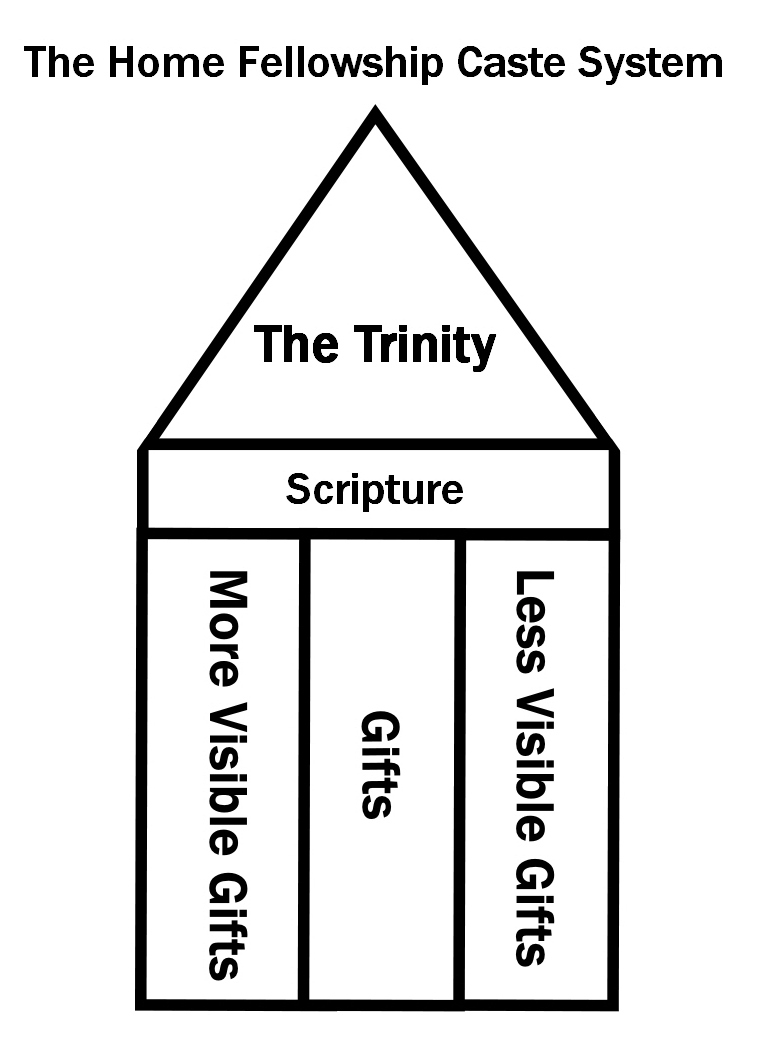
Moreover, let’s face it; while believing in OSAS, there is only one reason people put up with all of the nonsense and drama of the institutional church—OSAS means that if someone leaves the institutional church, they were never saved to begin with. Right? In other words, they function according to the idea that they are led by. It’s OSAS as long as you are “faithful” to the institution. Then each church has its own little “faithfulness” caste system. Those who show up for all of the services are the “core members” that run the church. Those “less faithful” that only come on Sunday mornings are a lower class of member in the caste system.
You have the pastors, staff and deacons, then the “faithful” that attend all of the services and tithe at least 10%, the “casual” attenders that tithe, and then the bottom of the caste strata, even lower than the serfs, the putrid “nonmembers.”
Whether Calvin or Luther, the two icons of Protestantism, these beliefs follow after the doctrine they established for the Protestant institutional church. Access to the institutional church was through water baptism, and the critical need according to the Reformers for formal church membership follows: as Christians, forgiveness for present and future sins can only be found in the institutional church, and those sins condemn us. Forgiveness for all sins does not occur at salvation, but only for past sins. Water baptism initiates us into church membership where forgiveness for present and future sins can be obtained through the sacraments; ie., “gospel preaching,” the Lord’s Table, and anything else deemed as acts of faithfulness to the institutional church not to exclude tithing by any means. Calvin states this explicitly in his institutes, 4.15.1.
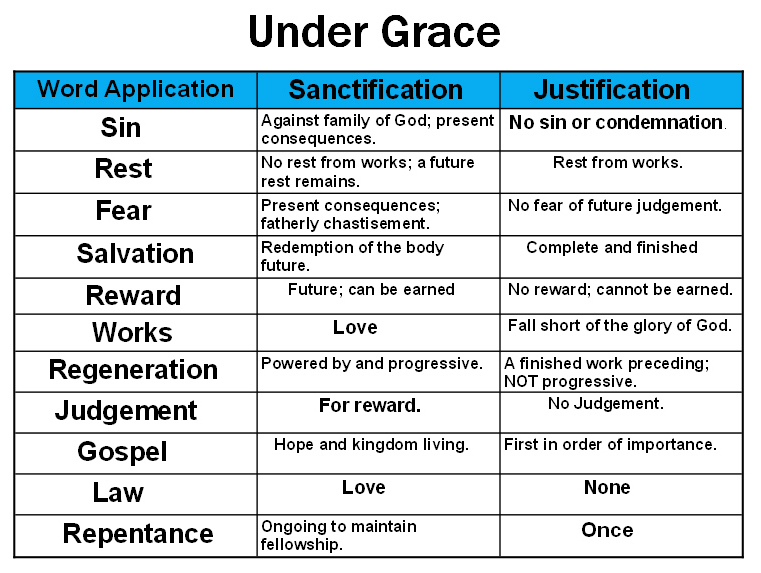
All in all, you can say that in Protestantism, the status of sin does not change for the believer—it still condemns requiring perpetual resalvation for every sin committed.
Therefore, 1John 1:9 and 2:1 is interpreted in this light: “If we confess our sins, he is faithful and just to forgive us our sins and to cleanse us from all unrighteousness” (1:9). “My little children, I am writing these things to you so that you may not sin. But if anyone does sin, we have an advocate with the Father, Jesus Christ the righteous” (2:1).
These verses seem to bolster the authentic Protestant position on justification. Confession of sin in our Christian lives keeps us saved. And if we confess our sins, Jesus is up in heaven as our advocate with the Father continuing His work as a propitiation for our sins.
The problem is that this interpretation stands in stark contrast to what other Scriptures state about justification. Biblically, sin has a different classification after salvation—it can’t condemn; it can bring chastisement and present consequences, but it can’t condemn—its ability to condemn has been taken away. Hence, there is no need to have some institution that prevents future condemnation.
Nevertheless, it is easy to understand why the institutional church not only gets a pass on outrageous behavior, but the money keeps pouring in. What will people pay for their salvation and décor that glorifies the institution that saves them? Apparently, no price or compromise is too large. One can also appreciate the fear of so-called excommunication because the institutional church is the only place where one can receive continued forgiveness for present and future sins.
Before I move on, I will solidify my present point. Romans 8:1 states that there is presently NO condemnation for those who are in Christ. In Contrast, Calvin stated that “even saints cannot perform one work which, if judged on its own merits, is not deserving of condemnation” (CI 3.14.9, last sentence). Obviously, the focus is going to be avoiding condemnation, not our freedom to pursue aggressive love in discipleship.
So what are these verses in 1John really saying? Let’s begin to unpack that using the historical grammatical approach to interpretation as opposed to the traditional Protestant means of interpretation, the historical redemptive method. Since Protestantism sees salvation as a process, “redemptive” means that the Bible must be approached with a redemptive prism; ie., the Bible is about salvation. Clearly, this is eisegesis; going to the Bible with a presupposition.
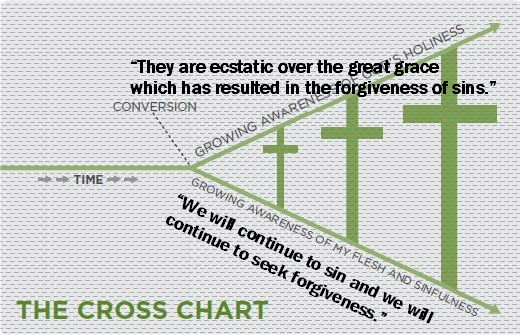
In regard to the history part, this is the belief that history is an unfolding drama about salvation. Hence, all of reality is interpreted through salvation. All of history and the Bible continually reveals the one two-fold redemptive truth/reality: the sinfulness of man and the holiness of God. Salvation begins when we see or understand this reality, and the experience of that reality increases until final salvation.
In contrast, the historical grammatical method uses historical facts to bring more meaning to the text, and all truth is determined by what can be concluded by the grammar—this is known as exegesis. All meaning and truth comes out of the text without anything being read into the text except conclusions from other texts.
In fact, Protestant tradition holds to the idea that a historical grammatical approach to the Scriptures invariably leads to works salvation. Protestant tradition insists that the Scriptures must be interpreted through the prism of total depravity. In this year’s TANC conference, this is what I am going to be hitting on. Christians, save a few, have no idea that Protestant pastors that are leading them view reality in a totally different way than most parishioners. And this is why church looks like it does. And there is no salvaging it—it’s a completely broken system.
So, if you interpret said verses in 1John redemptively, it fits right into their narrative, right? You have to continue to repent for new sins in your Christian life in order to not be condemned and to keep your salvation. A good old fashioned Baptist lady who I am sure would hold OSAS stated this to my wife Susan in the grocery store a couple weeks ago. When Susan asked her why Christians need to go forward during alter calls, she answered, “they have sin that needs to be forgiven.” Well, why can’t they get that forgiveness by praying at home? You ought to see the reaction Susan and I get when we suggest her mother was saved even though not a member of a church.
Protestantism and all of its offshoots including the Baptists is nothing more or less than functioning Calvinism. Election isn’t the point, progressive salvation is the point. Protestants think salvation grows—salvation doesn’t grow—you are either forgiven once and for all time or you aren’t. Look, if you are going to stay in the institutional church, it makes absolutely no difference where you go. Please, stop driving 15 miles to the Baptist church when there is a Catholic Church right across the street—it’s a shameful waste of gas. It’s all progressive justification.
In contrast, we have to see 1John in its exegetical historical context. It must be interpreted according to what was going on during the time that prompted this letter. And what was that?
John was pushing back against the number-one nemesis of the assemblies during that time: Gnosticism. Now, there were many, many different veins of Gnosticism during that time, but like denominationalism, there are basics that are fundamentally the same. Denominationalism quibbles about how to get from point A to point B, but it is all progressive salvation.
When you understand the basics of Gnosticism, it is easy to see that John’s first epistle is a point by point rebuttal of Gnosticism, and NOT the proffering of progressive justification. Protestants can bicker with Catholics all they want to about how to get from point A to point B, but again, it’s all progressive justification. If it’s a religious institution, it’s selling final salvation, PERIOD.
If we follow John’s arguments in this epistle, it also apes the fundamental basics of Gnosticism, and that’s what we are going to do:
1John 1:1 – That which was from the beginning, which we have heard, which we have seen with our eyes, which we have looked upon, and our hands have handled, of the Word of life; 2 (For the life was manifested, and we have seen it, and bear witness, and shew unto you that eternal life, which was with the Father, and was manifested unto us;) 3 That which we have seen and heard declare we unto you, that ye also may have fellowship with us: and truly our fellowship is with the Father, and with his Son Jesus Christ. 4 And these things write we unto you, that your joy may be full. [KJV].
The Gnostics taught that it really wasn’t the spiritual Christ that died on the cross. Gnosticism holds to the idea that material is evil and only the invisible spiritual world is good. Gnosticism rejected the idea that the spiritual realm, or godhood can be one with the material. You must understand: the biblical concept of Godman is a direct affront to the foundation of all false religions, or the knowledge of good and evil. It is the idea that true knowledge cannot be one with the material. Knowledge is good, material is evil and is only a shadow of true knowledge. Knowledge of the material is enslaved and dependent on the five senses.
Now, stop right there. Let me simplify this for you. All false religion flows from the religion of the knowledge of good and evil presented to Eve in the garden. This is also the first sentence of the Calvin Institutes and all of the Calvin Institutes flow from the foundation of 1.1.1., first sentence, viz, ALL wisdom is the knowledge of man and the knowledge of God; man is inherently evil and God is inherently good.
Also, the first sentence of the Calvin Institutes is the primary theses of Luther’s Heidelberg Disputation which is the Magnum Opus of the Reformation. All fundamentals found in contemporary evangelicalism can be found in the Heidelberg Disputation and flow from it. Calvin’s Institutes further articulated the former. In contemporary evangelicalism, we hear constantly that true biblical knowledge is “the knowledge of our own sinfulness as set against God’s holiness.” This is also the pronounced fundamental foundation of the contemporary biblical counseling movement as constantly stated publically in no uncertain terms.
Why am I interjecting this? Because even though much of our knowledge concerning first century Gnosticism comes from the writings of the early church fathers and while they railed against Gnosticism, they themselves were also Gnostics. However, in the process of railing against Gnosticism, they confirm unequivocally that John’s letter addressed the Gnosticism of their day; it just wasn’t the Gnosticism that they preferred.
And by the way, according to some church fathers, John was addressing a Gnostic named Cerinthus who was a contemporary of John and a personal nemesis.
Cerinthus was a gnostic and to some, an early Christian, who was prominent as a heresiarch in the view of the early Church Fathers. Contrary to proto-orthodox Christianity, Cerinthus’s school followed the Jewish law, used the Gospel according to the Hebrews, denied that the Supreme God had made the physical world, and denied the divinity of Jesus. In Cerinthus’ interpretation, the Christ came to Jesus at baptism, guided him in his ministry, but left him at the crucifixion.
He taught that Jesus would establish a thousand-year reign of sensuous pleasure after the Second Coming but before the General Resurrection, a view that was declared heretical by the Council of Nicaea. Cerinthus used a version of the gospel of Matthew as scripture.
Cerinthus taught at a time when Christianity’s relation to Judaism and to Greek philosophy had not yet been clearly defined. In his association with the Jewish law and his modest assessment of Jesus, he was similar to the Ebionites and to other Jewish Christians. In defining the world’s creator as the demiurge, he emulated Platonic philosophy and anticipated the Gnostics.
Early Christian tradition describes Cerinthus as a contemporary to and opponent of John the Evangelist, who may have written the First Epistle of John and the Second Epistle of John to warn the less mature in faith and doctrine about the changes he was making to the original gospel. All that is known about Cerinthus comes from the writing of his theological opponents (Wikipedia).
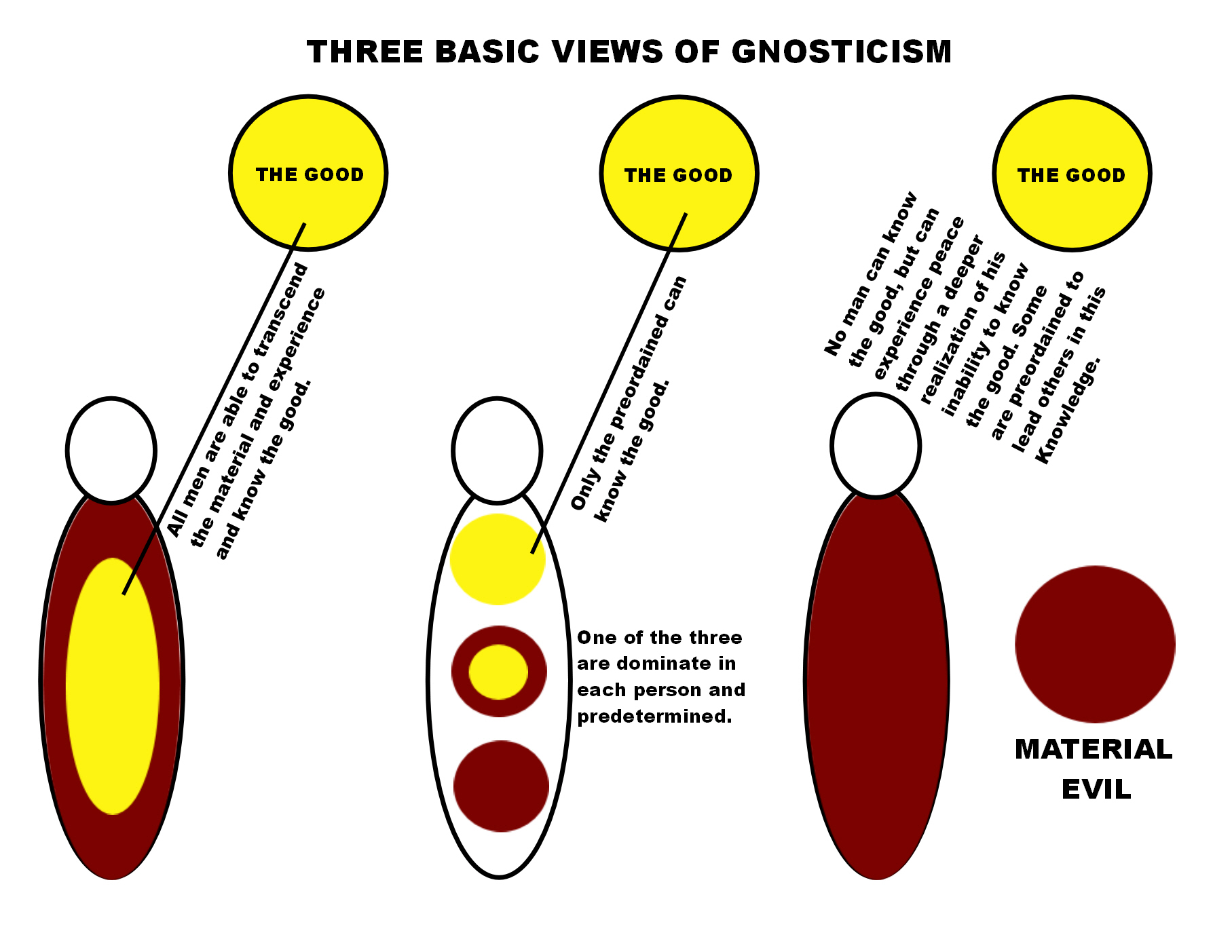
At any rate, the teachings of Cerinthus follow the basic fundamentals of 1st century Gnosticism of which there were two schools of thought unchanged from the cradle of society: intuitive knowledge within versus knowledge outside of man. While both schools held to the strict dichotomy of material being evil and the invisible good, and true knowledge being beyond the five senses, they disagreed on where that knowledge is found and whether or not it is intuitive among all men, or a select few preordained by nature or some supreme being.
Cerinthus followed the philosophical school of Idealism which holds to the belief that the one cosmic mind has an intuitive connection within every individual. Finding that knowledge is often a complex mind-numbing epistemology, but curiously, Luther and Calvin had their own angle that built on the Neo-Platonic teachings of St. Augustine.
This Gnostic bent actually allowed for Christ to be human, or at least some form of humanity. Apparently, God became exasperated with man’s penchant for trying to gain knowledge through the material world, and said in essence, “Ok, since you like to think you can know something and try to gain knowledge through the things that are seen, I am going to send my Son to die on the physical cross, and now all knowledge will only be gained through suffering—there mankind, take that!” This is the essence of the Heidelberg Disputation which is a philosophical treatise, not a theological one by any stretch of the imagination. Luther states plainly in the document that ALL knowledge is hidden in the suffering of the cross. Anyone who thinks they can understand Protestantism without a good grasp of world philosophy is sadly misguided. It is one of the historical necessities of historical grammatical hermeneutics.
Hence, in the Gnostic Protestant construct, Christ and His gospel is the only true objective knowledge and is outside of man. Man is not to seek any knowledge within himself, but all knowledge must be sought outside of him in contemplation of the gospel. All of reality is interpreted by the suffering of the cross. The cross is the epistemology from the material to the invisible, or from the evil to the good.
In contrast, other schools believe the epistemology is intuitive within all men because all men have a spiritual being separate from their material being, and the spiritual part of man is nonmaterial and therefore SINLESS. The material body of man is evil because it is material, but his invisible being is good and has a connection to the cosmic spiritual world that must be cultivated by transcending the material. This was key to the drug culture of the 60’s as LSD trips enabled the individual to transcend the five senses and see into the invisible spiritual world. Supposedly.
Other schools of thought believed that even though all men have a material and spiritual aspect, the spiritual anthropology has classifications in regard to who is able to see true knowledge and who isn’t as determined by the cosmos or cosmic mind; ie., determinism. And consequently, if utopia is to ever be achieved, those with the ability to see knowledge must rule over those who have the inability to transcend the material and are enslaved to it. How do you reason with people hopelessly enslaved to the material? They either understand that they can’t know reality and get with the program, or you kill them.
According to the Reformers, utopia is achieved by understanding that all reality is interpreted through the cross of redemption. This concept was established by Luther’s Heidelberg Disputation and is known as being a “theologian of the cross.” Theologians of the cross are able to know the “cross story,” or interpret reality through the cross, and all others are enslaved to the “glory story” or the story of man. This is the dichotomy of the knowledge of good and evil, or material versus spiritual.
Furthermore, the Reformers believed that the new birth entailed the gift of outward seeing only. All goodness remains outside of man. This is the pious distinction they claim over their fellow Gnostics. Unlike Cerinthus, who would be the modern equivalence of existentialism, no good can be in man, because that does not limit knowledge to suffering and the cross. Even though the early church fathers believed that material is evil and only the invisible is good like all ancient Gnostics, they labeled those heretics who believed that the invisible spirit within man was a connection to the good. That was heresy in their minds. And if you really understand what John Piper et al believe in our day, NOTHING HAS CHANGED.
The true Christians of that day had a different metaphysical take: the material realm is NOT evil, it’s weak. Something that is weak can still be good. The born again Christian struggles with sin because he/she is weak, not because the material realm is inherently evil. Christ really did come adorned in humanity in every since of the meaning because the material is not evil. This understanding of being fits together with the true gospel.
But what Cerinthus et al was teaching speaks directly to what John wrote in his first epistle, and we have addressed some of it in John’s introduction. John, in essence, said the following: Christ was 100% humanity and 100% God. We saw Him, we heard Him, we touched Him, we saw Him die on the cross, there isn’t two Christs, there is only one.
What Cerinthus et al taught explains everything John wrote in this epistle and why he wrote it. It not only explains why John wrote what he wrote in 1:9 and 2:1, it sheds light on why John wrote what he wrote in the rest of the book as well.
And that is what we will look at next week. We will do a point by point fly over of 1John while interpreting it according to this historical context of Gnosticism. John will address the definition of sin in contrast, the definition of knowledge and truth in contrast, the definition of the true gospel in context, the definition of love and hate in contrast, and the definition of the new birth in contrast.
See you next week.




 Paul's Passing Thoughts
1 comment