How Calvinism Turns Brave Hearts into Cold Hearts
 Originally posted April 29, 2013
I will post a video at the end of this article that elicited the following response from those who posted it on the social network where I watched it:
“Not sure what one could add to or take away from what we have just seen. I am reminded of Matt. 24 when Jesus says that because of lawlessness the hearts of many will grow cold. “Just do it” and laughter throughout the time is just beyond me. Heather was in tears. I wanted to throw up. Beyond disgusting.”
The key to understanding the cold-bloodedness that they observed is in their mention of Matthew 24:12, and the two key words are BECAUSE and LAWLESSNESS. Christ said that “because” of “lawlessness,” love would “grow cold.” The source of this lawlessness is described by Jesus in the previous verse: “many false prophets.”
Now we would do well to examine what Christ meant by the word often translated “lawlessness” and “wickedness” in our English Bibles. These words posit the idea of bad behavior, but that’s not what the actual word that is used by Christ means at all. The word is “anomia.” The “a” is a negative article prefix that means “anti” and “nomia” or nomos, refers to God’s law specifically. The idea of sinful behavior is an entirely different word altogether. Among many used is “hamartia,” or “sin” and these two words are specifically contrasted in 1John 3:4. Sin is defined by any aberration of God’s standard.
In Matthew 24:12, as well as many other passages, an anti-Bible agenda is in view propagated by false prophets.
The world in general becomes cold-hearted by rejecting the law of God written on their hearts and administered by the conscience—either excusing or accusing their actions (ROM 2:15,16). The conscience can eventually be seared if continually violated and ignored (1TIM 4:2). Christians are to keep a clear conscience before God (Acts 24,16 1Peter 3:16, 1TIM 1:5, 3:9, 2TIM 1:3). Keeping a clear conscience before God is obviously behavior focused as judged by the Bible.
One of the monumental misnomers of all time is the idea of “legalism.” This term was formulated by false prophets who really want to steer us away from nomos. Misguided obedience has never been the church’s primary nemesis; it has always been anti-word of God. When the apostle Paul warned those who wanted to be justified by the law, “law,” is in a manner of speaking; Paul was referring to what false teachers purport to be the law, not an actual sincere love for truth and a desire to live by it. This is why James stated that anyone who wanted to be justified by the law had to keep all of it, not a standard of their own choosing (James 2:10). Supposed law-keeping is also often connected to salvation by mere ritual as well. This point cannot be better made than to cite what Paul wrote to the Galatians:
5:2 Look: I, Paul, say to you that if you accept circumcision, Christ will be of no advantage to you. 3 I testify again to every man who accepts circumcision that he is obligated to keep the whole law. 4 You are severed from Christ, you who would be justified by the law; you have fallen away from grace. 5 For through the Spirit, by faith, we ourselves eagerly wait for the hope of righteousness. 6 For in Christ Jesus neither circumcision nor uncircumcision counts for anything, but only faith working through love. 7 You were running well. Who hindered you from obeying the truth? 8 This persuasion is not from him who calls you.
We see here, clearly, that Paul was confronting a belief that being circumcised according to law excused them from a truthful obedience to the law. In other words, justification by law-keeping is ALWAYS a dumbed-down version of the law to make adherence for salvation feasible. Paul contrasts this with true obedience to the law in sanctification:
You were running well. Who hindered you from obeying the truth?
Justification by law-keeping is NEVER an endeavor to obey the truth; it is ALWAYS the replacement of God’s law with the traditions of men—making the law of God “void.” The Pharisees, the supposed poster children for “legalism,” or “living by the law,” were not guilty of trying to obtain salvation by a sincere obedience to the truth, but rather replaced the law of God with their traditions and made that the standard for salvation (which has no law standard to begin with):
Matthew15:1 – Then Pharisees and scribes came to Jesus from Jerusalem and said, 2 “Why do your disciples break the tradition of the elders? For they do not wash their hands when they eat.” 3 He answered them, “And why do you break the commandment of God for the sake of your tradition? 4 For God commanded, ‘Honor your father and your mother,’ and, ‘Whoever reviles father or mother must surely die.’ 5 But you say, ‘If anyone tells his father or his mother, “What you would have gained from me is given to God,” 6 he need not honor his father.’ So for the sake of your tradition you have made void the word of God.
Matthew 23:16 – “Woe to you, blind guides, who say, ‘If anyone swears by the temple, it is nothing, but if anyone swears by the gold of the temple, he is bound by his oath.’ 17 You blind fools! For which is greater, the gold or the temple that has made the gold sacred? 18 And you say, ‘If anyone swears by the altar, it is nothing, but if anyone swears by the gift that is on the altar, he is bound by his oath.’ 19 You blind men! For which is greater, the gift or the altar that makes the gift sacred? 20 So whoever swears by the altar swears by it and by everything on it. 21 And whoever swears by the temple swears by it and by him who dwells in it. 22 And whoever swears by heaven swears by the throne of God and by him who sits upon it. 23 “Woe to you, scribes and Pharisees, hypocrites! For you tithe mint and dill and cumin, and have neglected the weightier matters of the law: justice and mercy and faithfulness. These you ought to have done, without neglecting the others. 24 You blind guides, straining out a gnat and swallowing a camel!
25 “Woe to you, scribes and Pharisees, hypocrites! For you clean the outside of the cup and the plate, but inside they are full of greed and self-indulgence. 26 You blind Pharisee! First clean the inside of the cup and the plate, that the outside also may be clean. 27 “Woe to you, scribes and Pharisees, hypocrites! For you are like whitewashed tombs, which outwardly appear beautiful, but within are full of dead people’s bones and all uncleanness. 28 So you also outwardly appear righteous to others, but within you are full of hypocrisy and lawlessness.
And what were the Pharisees full of “within”? “[L]awlessness” which is the word “anomia.” The English translation is “anti-law” or “antinomianism.” That’s what the Pharisees were full of within—not “legalism” which is a concept not found in the Bible anywhere by idea or word. There is obedience to truth or anti-truth—no in-between.
“Legalism” fosters the idea that Christians can unwittingly try to please God by obeying the truth as a way to earn their justification. The idea was hatched by the Reformers and is a Neo-Calvinist doctrinal mainstay in our day. The favorite illustration is the Pharisees who supposedly were really, really good at keeping the law and obeying the Bible in an attempt to earn their justification. This is a ploy to create confusion in regard to the law’s relationship to justification and sanctification. The Reformers created immense fear among Christians by making the law’s relationship to justification the same as sanctification. In justification, law has no jurisdiction in regard to the Christian. The Christian is transformed from a status where the law is the standard to be justified (and impossible) to a status where the law informs our sanctification totally separate from justification. So, the law is a standard for sanctification, but in regard to the Christian, the law no longer has jurisdiction over his/her salvation. In Calvinism, the law remains a standard for justification IN salvation that must be maintained until the final judgment.
Because man is created to do works, this makes sanctification very tricky with our eternal destiny hanging in the balance. Calvinists therefore assure Christians that if they live their Christian lives by faith alone—they are playing it safe. As one New Calvinist told me: “If I let Jesus do all the work, He can’t fault me for anything when I stand before Him.” Of course, living in a way that imputes the works of Christ to our Christian walk is very complicated, but be assured: New Calvinists will teach us how to “practice obedient faith” so we can arrive at the final judgment covered by “what Jesus has done, not anything we do”….in our Christian walk. This confounding of the law’s relationship to justification and sanctification makes the Christian walk a minefield with constant danger of “making sanctification the ground of our justification.” We must therefore seek out the Reformed for their secret formula for living the Christian life by faith alone. “Sola Fide” is for justification and sanctification both—that’s the dirty little secret. The Reformed couch the language in terms like “obedient faith.” The Reformers saw faith as a neutral conduit that God uses to impute the perpetual works of Christ to the believer. In other words, Christ’s atoning work is not yet finished for salvation: though accomplished in one period of time, it must be continually appropriated to maintain our just standing. The maintenance of our salvation is in view. Hence, we must “preach the gospel to ourselves every day.”
But this brings us from fearful hearts to cold hearts. Reformed theology will heap its share of cold-hearted mentality on humanity “because of anomia.” It’s just more anomia dressed in religious garb. This brings my point back to the video that was posted. It is cold-heartedness on steroids regarding the abortion issue. Therefore, the following should make perfect sense to us:
According to the National Right to Life, the total number of abortions in the US is down-33% from its peak in 1980/81- and the greatest decrease is among adolescent girls and young women. Good News!
But if we look further into these statistics, we find disconcerting news for the Church: The abortion rates among professing Christians are commensurate with the rest of the population!
Approx. 560,000 for Protestants (43%)
Approx. 350,000 per year for Catholics (27%)
13% of abortions (approx. 170,000 per year) are performed on self-described “Born Again” or Evangelical Christians (Alan Guttmacher Institute and Physicians for Reproductive Choice, “An Overview of Abortion in the United States,” 2003 and 2008)
Even more disturbing is the fact that these percentages have NOT dropped, even though the number of abortions have in recent years!
These statistics reveal that actually MORE women who profess Christianity are having abortions.
This is what Reformed theology has always done to society. Despite the traditions of men that claim otherwise, the Reformation did not bring light to darkness, it brought more darkness. Post Reformation brought little more than chaos and turmoil to Europe—more than it had ever seen before. It brought tyranny to America in the form of the Salem witch trials, and its contemporary resurgence has resulted in an unprecedented level of abuses in the American church.
It is the epitome of a primary concern of Christ during His ministry: the replacement of the law by the traditions of men resulting in anomia. While waxing eloquent about the Pharisees, Neo-Calvinism is in fact a return to what plagued the apostolic church. To say that Calvinists vaunt the opinions of a litany of past Reformers as authority is an understatement of the most dramatic sort. Even Charles Spurgeon, “the prince of preachers” did little more than regurgitate Reformed tradition. Recently, one Reformed conference was based on the writings of twenty-five Reformed icons. The popular Resolved conferences hosted by John MacArthur highlighted the traditional teachings and legacies of Reformed men of years gone by.
With all of the harping about the Pharisees by Calvinists—they are the Pharisees, and they propagate the same kind of cold-heartedness with it.
Their heart is unfeeling like fat, but I delight in your law.
~Psalm 119:70
paul
Spurgeon’s False Gospel
 Meme Post #4
Where to start in all the ways that this meme contradicts Scripture and denies the new birth and true gospel? Let’s start with a few blatant contradictions.
Our faith does NOT rest. Our faith WORKS through love (Gal 5:6). Faith is a GIFT, but that doesn’t mean we don’t put the gift to work. In fact, the belief that our faith doesn’t work suggests that we must continue to keep ourselves saved through “rest.” Spurgeon, like most lying Calvinist heretics, held to the Reformation’s Sabbath Rest Salvation. It holds to the idea that the Old Testament Sabbath rest is New Testament sanctification and we must continue to live by faith alone in our Christian lives to keep ourselves saved. This, according to Calvin, happens through receiving continued forgiveness for “present sin” through church membership.
And remember, Spurgeon once said that Calvinism isn’t “just a nickname,” but “is the gospel” itself.
True faith doesn’t rest–it works. There is no true love in a faith that rests.
Secondly, the Bible makes it clear that we grow spiritually through obtaining knowledge; what’s up with the idea that knowledge doesn’t define who we are as believers? Frankly, I don’t care how many people think this guy is a spiritual icon–you know, kinda like the Bereans who held Paul accountable to Scripture.
Thirdly, the idea that who we are doesn’t point to the legitimacy of our faith and is therefore not a resting faith contradicts a vast number of Scriptures and Hebrews 11 in particular.
Fourthly, how we feel is most certainly important because the Bible says that faith not working in love will cause the believer to be full of fear.
Why is it ok for Spurgeon to blatantly contradict Scripture? Because Baptists have a longstanding tradition of being man-followers, that’s why.
Furthermore, note that we supposedly rest in the idea that who we are is NOT who Christ is! HUH!!!! Say what???? If Jesus is your big brother because you are literally born into the same family, you had better be like Him or you aren’t born again (see 1John).
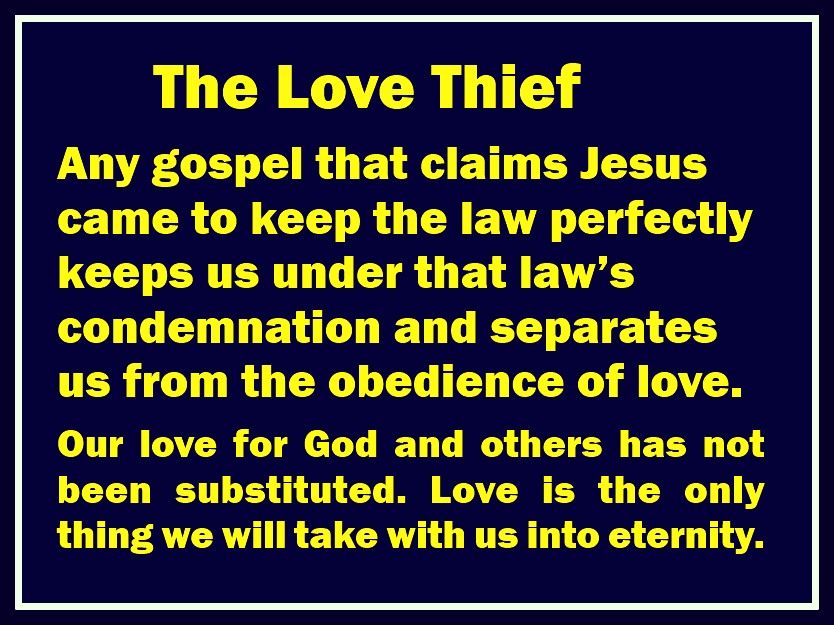
And finally, note that we rest in what Christ has both DONE and is DOING. This is the Reformed doctrine of Double Imputation. It teaches that Christ came to secure our salvation by both dying for sin and keeping the law in our stead. It teaches that justification is based on perfect law-keeping rather than the new birth. Jesus could die for us because He lived up to the standard of the law, and presently keeps the law for us if we are “resting” in what He has “done and is doing.” This is a blatant contradiction to Galatians chapter 3. This is the very idea that Paul is refuting in that chapter.
This makes the law a co-life-giver with God and promotes an additional seed (offspring), but their is only ONE SEED (see Gal 3). In essence, Paul was arguing that this very idea makes the law a fourth member of the Trinity. And in fact, Calvinists state this openly when they say that “the empty hand of faith presents the doing and dying of Christ to the law and the law is satisfied.”
So, instead of God electing the means of salvation, Christ dying to end the law, and the Spirit fulfilling “The Promise” of resurrection and baptism to Abraham and Christ, we now have that added fourth element of the law being the standard for justification instead of new birth obtained by faith alone in The Promise. The contrary view of this meme keeps the so-called believer under law rather than under grace, and that’s supposedly ok because Jesus keeps the law for us.
But this also keeps the believer from performing the purpose of the law for sanctification, faith working through love. Instead, we must rest because Jesus is the only one that can keep the law perfectly as the law supposedly gives salvific life when fulfilled. In contrast, the Old Covenant kept sin captive until Christ came and ended it. The law was ended by Christ’s death in regard to its ability to condemn, and we are now free to serve the law in regard to love (Rom 7 and Heb 6:10). The Old Covenant still holds all sin captive that is committed against it (“all sin is against the law”) until a person believes in Christ resulting in the law being ended for condemnation and the person being set free to “use the law lawfully” (1Tim 1:8ff.) for purposes of loving God and others. Those who do not believe on Christ will be condemned by the law, but there is “NOW NO condemnation for those in Christ.” Rather, true believers are free to fulfill the law in aggressive love for God and others (Rom 8).
For the outcome of Spurgeon’s “rest” see the Parable of the Talents. Resting in love that Christ supposedly fulfills for us evokes this response from Him: “You lazy, wicked servant.”
Galatians 2:20 and the Gospel According to Phil Johnson, Parts 1 & 2
Listen to podcast or download audio file.
PAUL DOHSE: Welcome, truth lovers, to BlogTalkRadio.com/False Reformation. This is your host Paul Dohse. Tonight, part eight of the Magnum Opus of the Reformation, Martin Luther’s Heidelberg Disputation. Greetings from the Potter’s House and TANC ministries where we are always eager to serve all of your heterodox needs. Our teaching catalog can be found at tancpublishing.com. If you would like to add to our lesson or ask a question, call 855-8317. I failed to put the area code in there. That’s (347) 855-8317. Remember to turn your PC volume down to prevent feedback. If you choose to use Skype to listen to the show, my advice is to just dial direct from your Skype account without using any of the Blogtalk links. And again that number, just dial direct from your Skype account is (347) 855-8317. Per the usual, we will check in with Susan towards the end of the show and listen to her perspective. Remember, you may remain anonymous. When I say, “This is your host. You are on the air. What’s your comment or question,” just start talking. If you would like to comment on our subject tonight, you can also e-mail me at paul@ttanc.com. That’s paul@Tom-Tony-Alice-Nancy-Cat.com. I have my e-mail monitor right here and can add your thoughts to the lesson without need for you to call in. You can post a question as well.
Tonight, we’re going to have another interlude, and I know these interludes drive people crazy. But it is very important to establish and have a sentence by sentence evaluation of Martin Luther’s Heidelberg Disputation because that is the first and founding document of the Protestant Reformation. It was written about six months after Martin Luther’s Ninety-Five Theses which is thought to have launched the Protestant Reformation, and I guess that’s fair enough. But the Heidelberg Disputation is the first and foundational document of the Protestant Reformation. And it is, absolutely, amazing how to this day, literally everything that we see in contemporary, or at least the return to the contemporary authentic Protestantism, flows from that document. But in doing this series, to have a sentence by sentence evaluation of the Heidelberg Disputation, though very important, it is getting the cart a little bit before the horse. Because in our day, Christians, by and large, really don’t understand the gospel. They really don’t understand the gospel. And this is by design. This is the essence of Protestantism, a dumbed-downed congregant. And we’re learning why that is in our study of the Heidelberg Disputation. But foundational to the doctrinal illiteracy of present-day Christians is this whole idea that we’re sanctified by the gospel. So throughout Protestant history, the emphasis has always been the gospel, the gospel, the gospel, the gospel, or the gospel or first importance or going back, discontinually going back to the cross. And this gets a pass, by and large, because people are saying, “Oh, this is just a theory on how to be better sanctified or how to better grow in our faith by returning to the original gospel that saved us time and time again.” But as we are learning, and the contention of this ministry is that our contention is – our contention is that no, this just isn’t one of many techniques to better grow in the Lord according to the Bible supposedly. No. This is a gospel or a soteriology that calls for us to continually return back to the same gospel that saved us, so that we can live by faith alone as a way to keep ourselves saved. This is the dirty little secret of Protestantism.
So in essence, you have a work salvation by faith alone or in essence, a work salvation by doing nothing, kind of like Bachman-Turner Overdrive theology. I work hard at doing nothing all day as a way to keep myself saved. Or the way they put it, living by faith alone. And if you think about those words carefully, one might logically ask, “How do you live by faith alone?” Kind of like saying, “How do you live by thinking alone without doing anything?” So this is why we’re taking these interludes. It’s very important for us to establish what exactly the foundational document of Protestantism is all about. But, again, for contemporary or present practical purposes, we need to get it out there what the true gospel is, the true biblicist gospel in comparison to–I hate to say it, I hate to just put it out there–Protestantism.
Now as we’ve discussed before, the official coined term by this ministry, anyway, concerning the official doctrine of the authentic Protestant Reformation, not the watered down version and the truisms connected with it that most Protestants, Baptists, Methodists, Charismatics, et cetera, are used to, we’re talking about this return to the authentic Protestant Gospel in the body of the new Calvinist movement, which is all but completely taken over the institutional church.
In regard to gospel sanctification, the go-to verse is Galatians 2:20. This is the primary go-to verse. Now a lot of people claim that the Higher Life movement and all these other movements, the Keswick movement and all these movements, they are really big on Galatians 2:20 as well. And what’s in vogue is to think that the Higher Life movement and the Keswick movement, so on and so forth, are somehow different from authentic Reformed Protestantism and their gospel. And such is not the case. The applications are different, but the basic soteriology is the same. And what is that? Here it is. It’s a soteriology based on gospel contemplationism, and keeping yourself saved by going back to the cross. Or in essence, keeping yourself saved through contemplationism of some sort because to actually do something would be works salvation because this is key running the basic premise, running through all these doctrines is that justification is progressive.
And as we’re going to hear, and how we’re going to approach this topic in the show today, what we’re going to hear, Phil Johnson of John MacArthur’s Grace Community Church out in California, he is actually going to call salvation a process. And this is the fundamental basic premise of all of these doctrines, all of these passive doctrines, all of these doctrines that would say, synergistic sanctification is work salvation. Why? Because it’s, and we’ve all said this, “The growing part of salvation.” Well, folks, salvation doesn’t grow. Salvation doesn’t grow, okay? And, again, we’re going to really hunker down on Galatians 2:20 because I stumbled upon a video that’s a sermon by Phil Johnson of Grace Community Church in California where he really articulates Galatians 2:20 in the Reformed view to a T. And, again, in this incredible video, he is also speaking for the Higher Life movement and all these other movements, even though he speaks out against them in this. Again, the basic soteriology is the same, this whole idea that salvation is a process that starts at point A and gets to point B and that we have to keep the process going by doing nothing. So we’re going to look at this, and this ministry is just going to flat out make a lot of hay of this video, and we’re going to slice it, dice it, rework it, keep adding to it, taking away from it. And we begin that process in today’s program. And basically, we’re going to continue that process on Sunday morning as well. And as well, we’re going to post videos on Paul’s Passing Thoughts, the blog, for TANC ministries. And we’re going to, really, work this thing. We better get going because the sermon itself was 50 some minutes. I cut some parts out, and I’ll tell you why when we get into the video. (more…)
There is NO Such Thing as “Legalism”
Originally posted March 21, 2013
We live in a unique era marked in its beginning by Christ paying the penalty for our sin (HEB 1:2). We are in the last days. We know that because it’s post cross. We live in this specific era which is also biblically described as a time of unprecedented deception (MATT 24:3,4; 2THESS 2:10-12).
Therefore, we must be careful to use specific biblical words in our communication of the truth. Those who define the language win the argument. Redefining the meaning of words to deceive is literally the oldest trick in the book; e.g., Satan redefined what God meant by death. “Surely, you will not die.” Depending on your definition of death, that was true—Eve didn’t die on the spot.
“Legalism” is a word that is not in the Bible anywhere. The concept/term was made popular by Martin Luther’s interpretation of law and grace. The term, “legalism” lends strong foundation to authentic Reformed doctrine. If you use the term, you are being a good Calvinist whether you know it or not. The Reformers were anti-sanctification because it suggests enablement and some room for self-esteem. The Bible does not call us to eradicate all concept of self for the sole purpose of the group, it calls us to evaluate ourselves truthfully (ROM 12:3). That’s why there is a severe lack of sanctification in the church today—we are all just good Protestants.
So, legalism is in, but the word for the primary nemeses of righteousness throughout the ages is out: “anomia.” The English word is, “antinomianism.” It means, anti (a) – law (nomia). And I assure you that man made law is not in view. Ignorantly, Christians deem the word as just another 50-cent theological term even though it appears throughout the New Testament and defines the core of human woes. While anomia is ignored, a word that doesn’t even exist in the Bible is thrown around more often than we change clothes.
Because the ramifications of anomia pushback against Luther’s law/gospel theology, the word is translated in English Bibles as “wickedness” and “lawlessness” giving the idea of general bad behavior. The real idea is anti-truth, anti-God’s full counsel, anti-God’s wisdom, anti-sanctification, anti-kingdom living, anti-clear conscience, anti-life, anti-goodness, etc., etc. Christ points to it as the primary cause of lovelessness and cold-heartedness (MATT 24:12; PS 119:70). John indicts it as the very definition of sin (1JN 3:4).
Perhaps the greatest deception in all of this is the Reformed motif that the Pharisees are the poster children for “legalism.” Supposedly, they strived to keep God’s law as a way of earning His favor for both justification and sanctification of which are the same to the Reformers. The opposite is true; the Pharisees were full of anomia and voided the law with their anti-truth (MATT 15:1-9; 23:23-28). The Pharisees were not “legalists,” that’s a lie, they were antinomians.
Nothing cripples sanctification more than the Reformed idea that Christians can sincerely seek to obey God by following their born again new desire for the law and thereby unwittingly partaking in works righteousness. There is no more detestable evil under the sun because it causes a conflict between the new desire God has put in our hearts (ROM 7:25; PS 119:1ff.) and instruction that propagates a relaxed view of the law (MATT 5:19). This is why Calvinism has crippled the American church. They propagate a doctrine that sets us against the very desire that God has put in our new hearts.
Satan did not come to Eve in the garden as a “legalist.” He came to her as an antinomian. In regard to the time of the end, the apostle Paul refers to the antichrist as the man of anomia at least four times in his letter to the Thessalonians. From the beginning, and through the middle embodied in the likes of Baalam’s error and Korah’s rebellion, and culminating in the end, the doctrine of anomia is the primary beast that devours the souls of men. But yet, New Calvinist queen Elyse Fitzpatrick likens anomia to the Loch Ness Monster, and is celebrated accordingly for her supposed biblical insight.
It’s time to eradicate “legalism” from our Christian vocabulary and replace it with a description of the New Calvinist breed of beasts among us: Antinomians.
paul.

 Paul's Passing Thoughts
2 comments