The True Gospel Verses Calvinism: Part 2
“The whole idea that Christians are unable to obey the law in a way that is acceptable to God is an absurd contradiction of a massive body of Scripture. But yet, this is widely accepted in Reformed circles and key to understanding their doctrine.”
“And moreover, according to Reformed theology, the law is still a standard that must be maintained to get justification home to glorification by driving on a road named Sanctification.”
“However, If you will stay your mind on the reality of the above illustration, and dogmatically assert that all Reformed theology in some way relates to this illustration, you will be given insight into the soul of Reformed theology. Do not let the Reformed academics move you away from this reality with rhetoric.”
“So, in Reformed theology, because the law remains a standard for progressive justification, perfect obedience to the law in sanctification must also be imputed to us.”
Let’s begin by revisiting the original question that prompted this two part post:
Paul, please explain in layman’s terms how Calvinism views justification and sanctification. I am trying to understand this. Does this have anything to do with the saint’s persevering?
What most people don’t understand is the fact that Reformed theology is all but a complete demolition of the truth. The election/free will debate is hardly the issue; this theology barely falls short of contradicting every basic theological point of Scripture.
This starts with the fusion of justification and sanctification….
….this fusion is the leaven that leavens the whole lump. Reformed theology thinks that sanctification links justification to glorification. It believes that sanctification is the growing part of salvation. But, salvation doesn’t grow, it’s a finished work. The chart below from a Calvinist organization should make my point (click to enlarge if necessary).
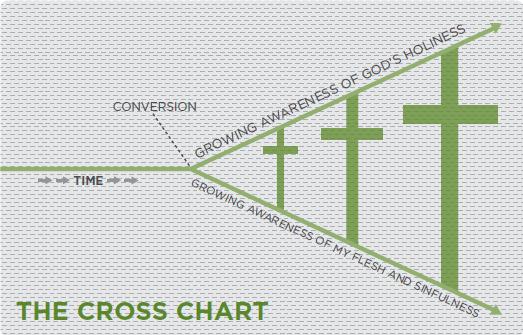
Also note: the believer doesn’t grow, the cross does. In fact, the believer gets worse! Or at least endeavors to increasingly realize how rotten he/she is. But what about the new birth? Reformed theology denies it regardless of the fact that Christ said, “You must be born again.” I can already hear the cat cries, but I will make my case. There isn’t a theology on earth that is more wrong than Reformed theology for many reasons including the denial of the new birth.
First of all, while denying that they fuse justification and sanctification together, the core element of Reformed theology is based on such. If justification and sanctification are fused together, we abide in the milieu that is between the two. That can make sanctification very tricky, unlike my biblical thesis in part one—we don’t abide in that realm that is a finished work. If we reside in a place where justification progresses to glorification, can we mess it up? According to Calvinists, “yes.” More on that later. But again, they clearly recognize this problem and base their core doctrine on it.
So, what doctrine is that? Well, there is only one way to prevent us from short circuiting justification on the way to glorification: cut us out of sanctification all together and make it a 100% work of God. And I agree, if our sanctification is the link between justification and glorification, we would need to be cut out of the equation all together. This is greatly magnified in Reformed theology by the idea that justification must be maintained by the keeping of the law. So, justification begins, but needs to be maintained until it arrives to glorification via the road of sanctification. This can be seen in a personal conversation I had with the well-known Calvinist Voddie Baucham:
paul: “Do you believe in this Gospel Sanctification stuff?”
Baucham: “I’m not sure what you mean.”
paul: “The same gospel that saved us also sanctifies us.”
Baucham: “Yes, absolutely!”
paul: “But Dr. Baucham, justification is a finished work, how can it sanctify us?”
Baucham: Nodding toward the window where we were standing; “That road out there is a finished work, but we still use it.”
Is that true? Are we sanctified by justification? Do we still “use” justification to get to glorification? At least in the Reformed view, the answer to all three of those questions is “yes,” and the perfect maintaining of the law to get justification home to glorification is the key. Justification must be maintained by the perfect keeping of the law, or else the legal declaration that we are justified is, “legal fiction” according to Reformed academics. This is the exact term they use to explain why sanctification must maintain justification by a perfect maintaining of a true legal declaration by perfect law-keeping. And moreover, according to Reformed theology, the law is still a standard that must be maintained to get justification home to glorification by driving on a road named Sanctification. As we discussed in part one, the law has been voided in regard to justification. Paving a road from justification to glorification, and naming it Sanctification, and using the law for the asphalt is a gargantuan theological misstep.
Well, that certainly excludes us! No? But don’t worry, Calvinists have a solution to this problem—it’s the doctrine of The Objective Gospel Outside of Us. The gospel gets justification home to glorification on the road named Sanctification, and we don’t have anything to do with it because the road is maintained by the perfect keeping of the law. How in the world does all of this work? I will explain, stay tuned. But first, let me establish that Calvinists believe that the law must be obeyed perfectly to maintain justification. This can be seen clearly in the writings of John Calvin himself. In context of sanctification, Calvin wrote that any attempt by a Christian to keep the law in sanctification was akin to an effort to keep the law….for justification. So, in Reformed theology, whatever is….for sanctification, IS ALSO….for justification because the two are the same. Calvinists use James 2:10, which is a statement….for justification, and apply it….for sanctification as one example, but they also routinely speak as if justification, and sanctification are the same thing with the same standard for keeping the law. Here is what Calvin said on this wise in his Institutes (Book 3; ch. 14, sec. 9,10):
Let the holy servant of God, I say, select from the whole course of his life the action which he deems most excellent, and let him ponder it in all its parts; he will doubtless find In it something that savors of the rottenness of the flesh, since our alacrity in well-doing is never what it ought to be, but our course is always retarded by much weakness. Although we see that the stains by which the works of the righteous are blemished, are by no means unapparent, still, granting that they are the minutest possible, will they give no offense to the eye of God, before which even the stars are not clean? We thus see, that even saints cannot perform one work which, if judged on its own merits, is not deserving of condemnation.
Even were it possible for us to perform works absolutely pure, yet one sin is sufficient to efface and extinguish all remembrance of former righteousness, as the prophet says (Ezek, 18:24). With this James agrees, “Whosoever shall keep the whole law, and yet offend in one point, is guilty of all” (Jam 2:10).
Notice that there is nothing a Christian does that is considered good or righteous by God. The same is echoed by Calvinists in our day like Tullian Tchividjian (click to enlarge if necessary):

And also notice what the standard for that is: the law….for justification in sanctification. The whole idea that Christians are unable to obey the law in a way that is acceptable to God is an absurd contradiction of a massive body of Scripture. But yet, this is widely accepted in Reformed circles and key to understanding their doctrine. Obviously, the law is still the standard, which is a problem in and of itself if you read part 1. The road named Sanctification that links justification and glorification together is paved with the law, and the asphalt is kept in perfect condition by a perfect keeping of the law. As discussed in part one, the law is not available to progress justification forward. For purposes of progressing justification—the law is void—we are no longer UNDER it….for justification. Therefore, justification can’t progress. It doesn’t get bigger, and it doesn’t grow. But obviously, if we are still on that road, things get tricky.
Therefore, Reformed theology holds to the idea that salvation grows to perfection until glorification, but we must remain OUTSIDE of this process lest the growing process is messed up by our mortal imperfection. This is where the Centrality of the Objective Gospel Outside of Us comes into play. Reformed academics get a covert pass on this because listeners assume they are talking about justification only—BUT THEY ARE NOT—THEY ARE TALKING ABOUT BOTH JUSTIIFICATION AND SANCTIIFCATION. So, we must be cut out of the growing process of salvation because of our imperfection while being able to lay claim to it. But how? Here is how: THE GOSPEL GROWS, BUT WE DON’T. Remember the cross illustration above?
Ok, so, in Reformed theology, justification and sanctification are the same thing. Sanctification is the growing of justification until it reaches glorification, and in the process, justification must not be “legal fiction.” Therefore, sanctification maintains justification by the perfect keeping of the law until the day of glorification . We can lay claim to it, but because of our mortal imperfection, we can’t be part of justification progressing to glorification. So how does this work in Reformed theology? We will get to that, but first, let me further substantiate my claims thus far. Let me begin by quoting Calvin on the idea that justification is progressive. Really, our first clue should be the title of chapter 14 from the Calvin Institutes: “The Beginning of Justification. In What Sense Progressive.” Calvin states the following in that chapter:
Therefore, we must have this blessedness not once only, but must hold it fast during our whole lives. Moreover, the message of free reconciliation with God is not promulgated for one or two days, but is declared to be perpetual in the church (2 Cor 5:18, 19). Hence believers have not even to the end of life any other righteousness that that which is there described. Christ ever remains a Mediator to reconcile the Father to us, and there is a perpetual efficacy in his death, i.e., ablution, satisfaction, expiation; in short, perfect obedience, by which all our iniquities are covered. In the Epistle to the Ephesians, Paul says not that the beginning of salvation is of grace, but “by grace are ye saved,” “not of works, lest any man should boast” (Eph 2:8, 9).
Furthermore, a Reformed think tank that was highly regarded in the early seventies, the Australian Forum, published the following illustration that captures the general idea of the doctrine (click to enlarge):
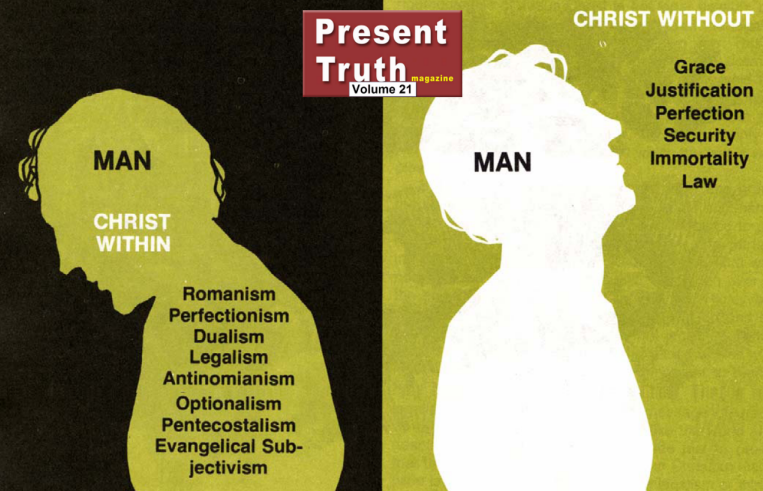
Let me add an additional note:

Obviously, this illustration provokes multiple questions in regard to practical application which will be discussed later (how this supposedly works in sanctification). But the key reality must not leave your mind: Christians cannot really participate in sanctification according to Reformed theology with the exception of one concept, and unfortunately, as we shall see, that one concept can only be works salvation. Not only is our role limited and narrow, the specific role is efficacious to maintaining our own salvation. However, If you will stay your mind on the reality of the above illustration, and dogmatically assert that all Reformed theology in some way relates to this illustration, you will be given insight into the soul of Reformed theology. Do not let the Reformed academics move you away from this reality with rhetoric.
Let’s also illustrate that proponents of Reformed theology fuse justification and sanctification together and speak of the two as being the same thing. In their sermons and teachings, they do this by virtue of the missing transition of subject matter—that being the difference between sanctification and justification. In their messages, they transition between the two without noting any difference as if the two are the same thing—because that is what they believe. Furthermore, this is an excellent communication method for assimilating this idea into the minds of their parishioners victims without them realizing what is happening. Examples of this are strewn about everywhere, but I will cite the following example from The Truth About new Calvinism, page 18:
Regarding the same message in context of who the audience was, in the sermon notes, the top of the page had statements like, “Things Jesus wants us (“us” would presumably be Christians) to know about the law.” The top parts of the notes were also replete with “we” in regard to the law, but the bottom part had statements like: “We live in the Age of Grace; salvation is not of works,” but yet, the whole message clearly regarded the role of the law in the lives of Christians. Therefore, whether unawares or otherwise, the pastor extended the relationship of the law in regard to justification (salvation) into the realm of sanctification (our life as already saved Christians), by virtue of a missing transition in subject matter. Hence, the subject of the law’s relationship to the lost was spoken of as being the same thing as its relationship to those who are saved. Theologians call this a collapsing of sanctification into justification or the synthesizing of the law’s relationship to justification and sanctification. This is most definitely a hallmark of New Calvinist doctrine to keep in mind for later discussion. The communication technique of the missing transition is also a technique used often by New Calvinists.
Next, let’s establish the fact that in Reformed theology, the law must still be the standard for sanctification because sanctification is the growing process of justification; in other words, progressive justification. Again, if law is not the standard for sanctification which is supposedly the progression of justification, then justification (according to Reformed theology) is mere “legal fiction.” Well, justification does not grow, it is based on God’s declaration—not law (as discussed in part one), and there is a reason why sanctification need not be perfect as a kingdom life totally separate from the finished work of justification which will be addressed later. But without further ado, the aforementioned Reformed view can be seen in Calvin’s diatribe in which he thinks it of abundant importance for Christians to know that they cannot obey the law in order to please God:
For since perfection is altogether unattainable by us, so long as we are clothed with flesh, and the Law denounces death and judgment against all who have not yielded a perfect righteousness, there will always be ground to accuse and convict us unless the mercy of God interpose, and ever and anon absolve us the constant remission of sins. Wherefore the statement which we set out is always true. If we are estimated by our own worthiness, in everything that we think or devise, with all our studies and endeavors we deserve death and destruction.
We must strongly insist on these two things: that no believer ever performed one work which, if tested by the strict judgment of God, could escape condemnation (Calvin Institutes: book 3; ch.14, sec. 10,11).
So, though the apostle Paul states that the paramount goal of Christians is to please God (2Cor. 5:10); obviously, Reformed theologians state unequivocally that the law is not the standard for that. Again, it can’t be, because sanctification is growing justification which demands a perfect adherence to the law in order not to be “legal fiction.” Therefore, if not the law, what? This interpretive question is the juggernaut of the subject at hand. The answer: more salvation. According to Reformation theology, our only possible participation in progressive justification is the same thing that justified us to begin with: faith alone. But wait a minute, in Reformed theology, we are not justified per se. Remember the illustration that is the soul of Reformed theology that we cannot be removed from, and the reality thereof. All righteousness , Christ, grace, ect., must remain outside of us. Nothing of grace can be within. So, we have no righteousness that is our own….for sanctification. Like….for justification, it must remain outside of us. In fact, Reformed theologians believe that if grace, Christ, or any kind of valid righteousness is inside of us, that is infusing grace into us while in sanctification. And if we do that, we are making sanctification the ground of our justification. Get it? If sanctification is a road that takes justification to glorification, and it must be paved with perfection, and we are on that road, and grace is infused into us, then we are made part of the progressive justification process. Game over.
We must (according to Reformed theology) walk side by side with justification on the road named Sanctification that takes us to glorification without being a part of the process. Otherwise, our participation is legal fiction because we obviously still sin. An “aberration” that believes that we have righteousness inside of us is called “infused grace” by Reformed academics and is the primary offence to the soul of Reformed theology: The Objective Gospel Outside of Us. Again, reobserve the two-man Christ within/Christ without Reformed illustration that is the soul of this doctrine. All Righteousness must remain outside of us and we must walk the road named Sanctification the same way we were initially permitted to be on the road, by faith only. If we work, or obey the law, we are believing that there is a righteousness inside of us that can participate with progressive justification in arriving at glorification at the end of the road. This is infusing grace into us and making our ability to travel with justification the ground of our justification. At least partially, which is a horseshoe and hand grenade issue in regard to justification anyway. Now, let’s observe the “elder statesman” of New Calvinism reiterating what I have just written. Take note that John Piper’s comments following were in regard to a lecture by Graeme Goldsworthy at Southern Seminary. Goldsworthy was one of the key members of the aforementioned Reformed think tank, the Australian Forum. The following excerpts were taken from The Truth About new Calvinism, pages 41-43:
In the aforementioned article concerning Goldsworthy’s lecture at Southern, Piper agrees that the original Reformation sought to correct the reversal of sanctification and justification:
“This meant the reversal of the relationship of sanctification to justification. Infused grace, beginning with baptismal regeneration, internalized the Gospel and made sanctification the basis of justification. This is an upside down Gospel.”
In case one would think that Piper excludes evangelicals from this concern because of his mention of baptismal regeneration, consider what he said in the same article: “I would add that this ‘upside down’ gospel has not gone away— neither from Catholicism nor from Protestants….”
….Piper concurs with Goldsworthy that “infused grace” is the problem. The like complaint is that the completely outside of us gospel empowers us inwardly, subjects us to subjective distractions from the power of the historic Christ event, and makes the natural result of the gospel our power source (the fruit), instead of the outward power of the gospel, the real root. To infuse grace is to suggest that we are enabled to participate in being justified by our own efforts in bringing about the natural results of the gospel.
Nothing shows this kinship between the Forum and New Calvinism more than a Piper quote from this same article and a visual aid used by Robert Brinsmead to demonstrate how “infused grace” supposedly puts our souls in peril. First Piper’s quote:
“When the ground of justification moves from Christ outside of us to the work of Christ inside of us, the gospel (and the human soul) is imperiled. It is an upside down gospel [emphasis Piper’s—not this author].”
Now observe Brinsmead’s illustration on the next page: [the two-man Christ within/Christ without chart which was published by the Australian Forum].
This necessarily leads to the Reformed denial of the new birth. Obviously, the idea that Christ lives within us and works within us is part and parcel to the new birth—and a big problem for The Objective Gospel Outside of Us. Reformed theologians know that they cannot blatantly deny the new birth and retain credibility, so they have many cute ways of relegating it to insignificance in order to bolster their staple doctrine. I have addressed how they do this in many other articles including chapter 11 of The Truth About New Calvinism, and will not continue to do so here, but will at least note some interesting quotes that speak to my assertion:
It robs Christ of His glory by putting the Spirit’s work in the believer above and therefore against what Christ has done for the believer in His doing and dying.
~ Geoffrey Paxton (Australian Forum)
But to whom are we introducing people to, Christ or to ourselves? Is the “Good News” no longer Christ’s doing and dying, but our own “Spirit-filled” life?
~ Michael Horton
And the new-birth-oriented “Jesus-in-my-heart” gospel of evangelicals has destroyed the Old Testament just as effectively as has nineteenth-century liberalism. (footnoted to Paxton’s article with above quote).
~ Graeme Goldsworthy (Australian Forum)
One would therefore think that this theology would lead to a view that believers are no different from the unregenerate save belief in the gospel only. Practically, Christians remain totally depraved like the unregenerate. And you would be correct about that. Reformed theology holds to the idea that justification initially recons us righteous in Christ, and without Christ in us, and then continues to recon us clothed with Christ’s righteousness (and none of our own in sanctification) as long as we “live by faith” ALONE….for sanctification. Moreover, only the POSITION of a person is changed in salvation, not the character, personhood, or creaturehood. There is no better illustration of this than the following citation from Michael Horton’s Christless Christianity, p.62:
Where we land on these issues is perhaps the most significant factor in how we approach our own faith and practice and communicate it to the world. If not only the unregenerate but the regenerate are always dependent at every moment on the free grace of God disclosed in the gospel, then nothing can raise those who are spiritually dead or continually give life to Christ’s flock but the Spirit working through the gospel. When this happens (not just once, but every time we encounter the gospel afresh), the Spirit progressively transforms us into Christ’s image. Start with Christ (that is, the gospel) and you get sanctification in the bargain; begin with Christ and move on to something else, and you lose both.
The tail end of Horton’s quote brings me to the next point. Notice that Horton states that “we” can “lose,” as in l-o-s-e “both.” Both what? Obviously, justification and sanctification. Which equals = no salvation. “Paul, is he really saying that we can lose our salvation?” Sure he is—IF—we “move on to something else.” Which equals = moving on to something else but faith alone…for sanctification which is the same thing as moving on to something else….for justification. Progressive justification is not the only theological anomaly that Reformed theologians are content with, they must also add sanctification by faith alone. But all of this is necessary in order to stay consistent with their core doctrine: The Centrality of the Objective Gospel Outside of Us. Yes, let them squeal all night long; nevertheless, they teach that you can lose you salvation.
I will illustrate this further by revisiting the idea that Reformed theology fuses justification and sanctification together. Reformed theologians are big on the “Golden Chain of Salvation” concept based on Romans 8:30. We discussed Romans 8:30 in part one along with its ramifications for salvation. The Reformed take on this verse is the idea that sanctification is excluded because it is one and the same with justification. The opposite position was presented in part one to some extent. Note the following quotation by John Piper:
This is probably why in the golden chain of Romans 8:30 the term sanctification is missing: “And those whom he predestined he also called, and those whom he called He also justified, and those whom he justified he also glorified.” When Paul jumps directly from justification to glorification he is not passing over sanctification, because in his mind that process is synonymous with the first phase of glorification and begins at conversion. (God is the Gospel, footnote, p. 93).
Ok, notice that Piper calls justification (“conversion”) “the first phase of glorification.” So, again, we see that justification grows in glory and culminates at complete glorification and sanctification is part of that “process.” Not so. In regard to the fusion of justification and sanctification, what is a “chain”? Reformed theologians clearly refer to the justification “process” as a chain with justification on one end and glorification on the other end, and sanctification in the middle. Moreover, John Piper preached a sermon in which he warns that if we do not participate in the salvation “links” in the proper way, that we put ourselves in great danger—presumably in regard of losing our salvation. The following illustration with a golden chain and Piper’s quotes from the sermon should clearly make my point here (click to enlarge):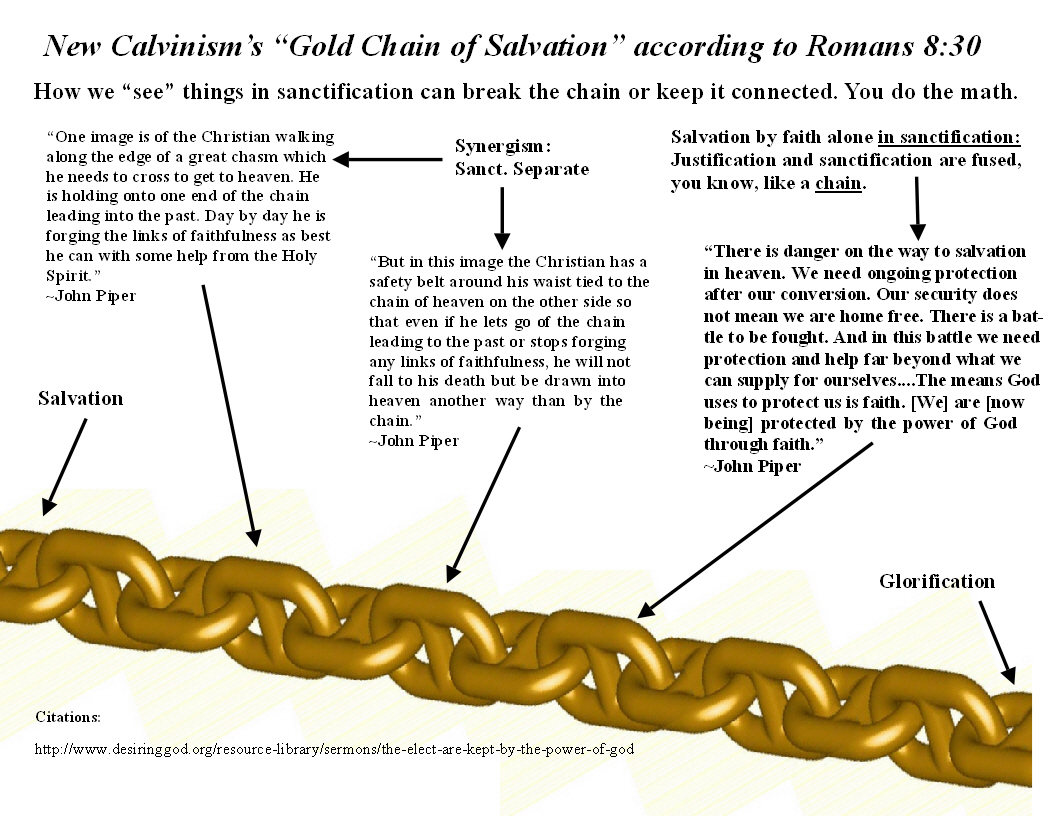
Which brings me to yet another point. If we can lose our salvation, what do we have to do to keep it? Whatever that is, it’s a work to maintain justification. And that is works salvation. In the case of Reformed theology, we have to keep our salvation by sanctification by faith alone. Hence: salvation by Christ + faith alone in sanctification. Think about that. To the Reformed, moving on to anything else but sanctification by faith alone will cause us to lose our salvation. Historically, the relaxing of the law in sanctification has always been deemed antinomianism. Is Reformed theology salvation by antinomianism? Yes, I think it is—the fusion of justification and sanctification can hardly end up anywhere else.
This entails the belief that Christ not only came to die for our sins, but He also came to live a perfect life of obedience to the law so that His perfect obedience in the life he lived on earth could be imputed to us in sanctification. So, in Reformed theology, because the law remains a standard for progressive justification, perfect obedience to the law in sanctification must also be imputed to us. In other words, Jesus obeys for us. How our justification must be maintained in our sanctification (according to Reformed theology) is well articulated by the Australian Forum Reformed think tank (The Truth About new Calvinism: p. 101, 102):
After a man hears the conditions of acceptance with God and eternal life, and is made sensible of his inability to meet those conditions, the Word of God comes to him in the gospel. He hears that Christ stood in his place and kept the law of God for him. By dying on the cross, Christ satisfied all the law’s demands. The Holy Spirit gives the sinner faith to accept the righteousness of Jesus. Standing now before the law which says, “I demand a life of perfect conformity to the commandments,” the believing sinner cries in triumph, “Mine are Christ’s living, doing, and speaking, His suffering and dying; mine as much as if I had lived, done, spoken, and suffered, and died as He did . . . ” (Luther). The law is well pleased with Jesus’ doing and dying, which the sinner brings in the hand of faith. Justice is fully satisfied, and God can truly say: “This man has fulfilled the law. He is justified.”
We say again, only those are justified who bring to God a life of perfect obedience to the law of God. This is what faith does—it brings to God the obedience of Jesus Christ. By faith the law is fulfilled and the sinner is justified.
On the other hand, the law is dishonored by the man who presumes to bring to it his own life of obedience. The fact that he thinks the law will be satisfied with his “rotten stubble and straw” (Luther) shows what a low estimate he has of the holiness of God and what a high estimate he has of his own righteousness. Only in Jesus Christ is there an obedience with which the law is well pleased. Because faith brings only what Jesus has done, it is the highest honor that can be paid to the law (Rom. 3:31).
A more contemporary example from the Journal of Biblical Counseling (David Powlison’s CCEF) can be observed in the following citation:
It is by virtue of Christ’s perfect life, death on the cross and resurrection-plus nothing-that we are justified (made and declared right with God) and sanctified (set apart, kept, and viewed as right with God) and sanctified (set apart, kept, and viewed as right in the Lord’s eyes by virtue of His obedience). Christ is our holiness. Christ is our sanctification.
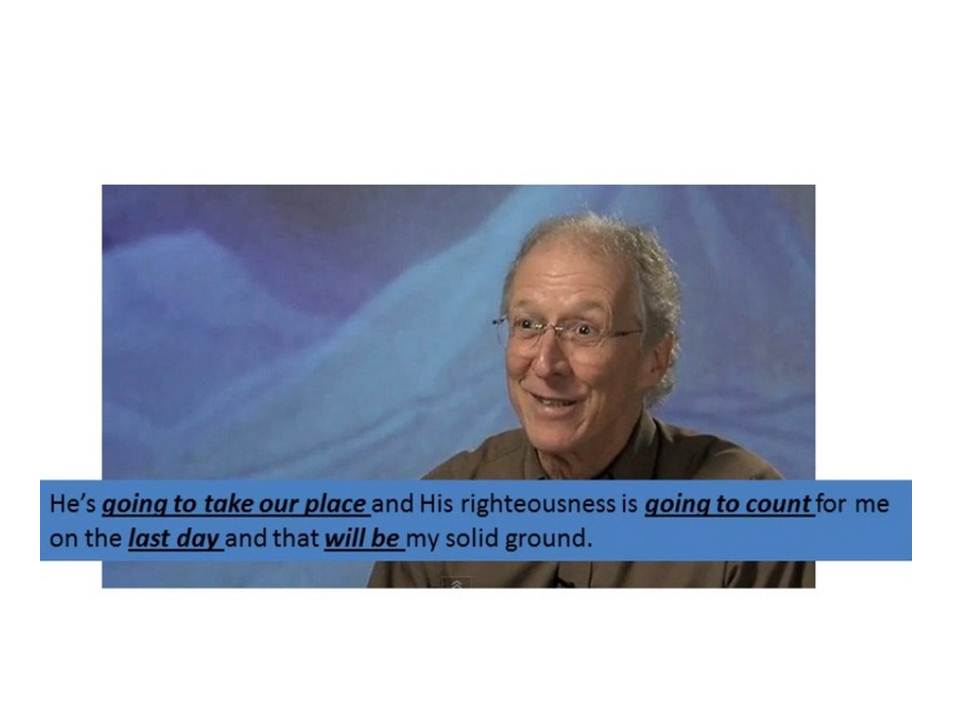
Therefore, our walk with Christ must be a continual reoffering of the works of Christ to maintain our just standing. When we come to the last resurrection, we will be judged accordingly. If we lived sanctification in this way, the righteousness of Christ will be the ground of our justification and we will be glorified. See the following illustration from a John Piper video clip (click to enlarge):
 Christians will stand in no such judgment. And via the new birth, we are new creatures that in fact are righteous. Our lack of imperfection, though displeasing to the Lord, has no bearing….for justification. We are new creatures that deplore the weakness of our mortality, but are indwelt and enabled to obey God through our new life in the Holy Spirit. We are declared righteous, and in fact are righteous. We are not colaboring with our flesh like the world, but we rather colabor with God (1Cor. 3:9, 1Thess. 3:2, 2Cor. 6:1). Therefore, Paul could say, “Now if I do what I do not want, it is no longer I who do it, but sin that dwells within me (Romans 7:20). We will look at the supposed practical application of Reformed theology in part three, and compare it to the truth in light of assurance, spiritual growth, perseverance of the saints, and other sanctification issues.
paul
An Open Letter to the President of the National Association of Nouthetic Counselors
“This is the apostle Paul’s disparaged 3-verse system to fix a lack of peace. It is the wonderful hope that obedience to God’s word seizes upon His promises. And that’s why many NANC counselors strip their victims of hope.”
“The cited letter reflects the same things often taught by many board members of NANC and BCC. Because this doctrine combines justification and sanctification, it makes sanctification like a minefield because what we do in sanctification can affect the justification that supposedly powers it. This does not lay a healthy foundation for counseling”
Dr. Street,
The National Association of Nouthetic Counselors website states the following about your organization:
NANC exists to help pastors and those who would be ministers of the Word of God by providing help and encouragement. NANC is first and foremost a certifying organization. The certifying process is rigorous but attainable by even the busiest pastor. The process consists of the completion of an approved training course, the completion of a theological and a practical counseling test, several references, and a minimum of 50 hours of supervised counseling experience.
Furthermore, your organization refers hundreds of “counselors” certified by your organization. The purpose of this letter is to publically confront you in regard to the fact that NANC has board members, Fellows, and hoards of certified counselors who openly promote a blatant false gospel. I will first establish this fact, in case you are not aware of it, and then beseech you to tell me why this acceptable.
Much data could be provided as I have been sent several articles written by NANC Fellows that contain outrageous teachings; and apparently, NANC thinks nothing of sending troubled people to antinomian mystics. But I only need to quote one of your present board members, David Powlison. Powlison performed a lecture at John Piper’s church while Piper was on a sabbatical to eradicate “several species of heart idols” that he saw in his heart. Apparently, they were of the 8-month type because he was able to return to ministry at the pre-appointed time. Powlison stated the following at Piper’s church:
This might be quite a controversy, but I think it’s worth putting in. Adams had a tendency to make the cross be for conversion. And the Holy Spirit was for sanctification. And actually even came out and attacked my mentor, Jack Miller, my pastor that I’ve been speaking of through the day, for saying that Christians should preach the gospel to themselves. I think Jay was wrong on that.
Jack Miller was the father of Sonship Theology, a false gospel that is presently wreaking havoc on Presbyterian churches. It has also been known as Gospel Sanctification and is the primary catalyst for the present-day New Calvinist movement which has turned orthodoxy completely upside down. The doctrine is best explained by a theological journal that was its source:
Unless sanctification is rooted in justification and constantly returns to justification, it cannot escape the poisonous miasma of subjectivism, moralism or Pharisaism…. Since the life of holiness is fueled and fired by justification by faith, sanctification must constantly return to justification. Otherwise, the Christian cannot possibly escape arriving at a new self-righteousness. We cannot reach a point in sanctification where our fellowship with God does not rest completely on forgiveness of sins…. Christian existence is gospel existence. Sanctification is justification in action.
Miller adopted the theology and coined the phrase, “We must preach the gospel to ourselves every day.” “The same gospel that saved us also sanctifies us” is the New Calvinist mantra of our day. I receive many links to articles written by NANC Fellows who clearly hold to this doctrine. In fact, How People Change, written by Timothy Lane and Paul David Tripp (and based on Powlison’s Dynamics of Biblical Change) is a Sonship/Gospel Sanctification treatise. Tripp and Lane are also on the board of the upstart Biblical Counseling Coalition. That board is the who’s who of Sonship/GS/ NC, including hyper-antinomian Elyse Fitzpatrick.
On a church level, here is the fruit of this doctrine:
To the Ruling Elders of Southwood:
On September 4, 2011, our daughter and her family from Atlanta were here and we attended the Sunday worship at Southwood. After the service, our 13 year old granddaughter, who is well grounded in scripture, stated that she was very confused by the message. She had come away hearing that every good thing she does is wrong. Why would she believe that? We have gone back and listened again to that message, entitled “Duh,” and here is what we found:
The message is from Galatians 3:1-6. Paul is chastening the church for falling prey to the persuasion of the Judaizers, exhorting them again that God’s love for them was not by any of their own works but through the miraculous work of Christ and the Holy Spirit. Jean seems to take the written word beyond its intent. He subtly changes ‘God’s love’ to ‘God’s favor.’ He changes legalism to performance. He takes Jewish law and extends it to almost any action one does. Here are some paraphrased quotes from the sermon. “To keep God’s favor, the Galatians were believing they needed Christ and a dash of obedience which looks like those things called Christian disciplines. Christian walk Christianity is from the Devil. Faithfulness is feeling condemned for work you haven’t finished (as contrasted with faith: resting completely in Christ). Faith is a litmus test for teachers and leaders; the difference between faith in Christ alone and faithfulness is like the difference between truth and falsehood, between Heaven and Hell. Faith alone is all we will teach.” (Here Jean says this is what Paul is teaching but he gives no supporting scriptures to support his interpretation.) “Discern as false any book, sermon, or Bible study where you hear a dash of self justifying obedience. Self justifying obedience is from Satan.
Jean’s statements, combined with the tone and inflections in his delivery, imply that he is scornful of Christian disciplines, preachers, Christian writers, the Christian walk, obedience, faithfulness, good works, and an individual’s efforts. This message can lead to the conclusion that everything we do is evil and, by extension, that God and the Holy Spirit can do nothing through us. The message lacks balance and leaves sanctification out of the equation. A new believer under this teaching would be moribund after accepting Christ, hidebound in fear that he can do nothing right. While it is true none of us have all pure motives, it is also true that God commands us to go forward and that the Holy Spirit will be with us. God says we are His instruments for spreading the Truth. We cannot do this if we are strapped by guilt; we can do this if we seek partnership with the Holy Spirit.
From here Jean goes back to Paul saying “…since you were 100% depraved when you were brought into the Kingdom by the Holy spirit and by no works of your own, why are you trying to be perfected by your own human efforts? You are being deceived by the Devil.” I believe Jean is paralleling Paul in this. Jean then goes on to “We are like alcoholics ; we use Bible study, prayers, small groups, etc. as a crutch and the church rewards our ‘addiction’ with its approval. How would you know if you were addicted? Stop everything. If you feel anxiety, then you are afraid of leaving your ‘fix.’” So we ask: what does God have us do? Jean’s answer is “rest totally in Jesus.” So in turn we ask, what does Scripture say about resting totally in Jesus? But we hear no clear answer from the pulpit.
The cited letter reflects the same things often taught by many board members of NANC and BCC. Because this doctrine combines justification and sanctification, it makes sanctification like a minefield because what we do in sanctification can affect the justification that supposedly powers it. This does not lay a healthy foundation for counseling, and as Timothy F. Kauffman recently stated in the Trinity Review, when justification and sanctification are combined, anything we do in sanctification is works salvation—even doing nothing. It’s eerily reminiscent of Christ’s parable concerning the slothful servant. When such a parable is considered and compared to statements by Elyse Fitzpatrick and her spiritual big brother Tullian Tchividjian, it should make the hair stand up on a deceased person.
Moreover, the unfortunate results of counseling that comes from this doctrine can be seen in the following statement by a pastor who oversees a NANC counseling center:
We read this quote from Paul Tripp in last week’s Biblical Theology Study Center. Amazingly, part of the quote was used again the following evening during testimony time from someone not in our class…someone who resonated with the quote in the midst of personal crisis. For those who are involved in biblical counseling, it can be really easy (and tempting) for the Bible to become little more than a 12-verse system designed to fix a life. Tripp reminds us that the Bible isn’t a how-to manual, but a place where we find hope in a Person.
Compare that statement with what the apostle Paul said:
Do not be anxious about anything, but in every situation, by prayer and petition, with thanksgiving, present your requests to God. And the peace of God, which transcends all understanding, will guard your hearts and your minds in Christ Jesus.
Finally, brothers and sisters, whatever is true, whatever is noble, whatever is right, whatever is pure, whatever is lovely, whatever is admirable—if anything is excellent or praiseworthy—think about such things. Whatever you have learned or received or heard from me, or seen in me—put it into practice. And the God of peace will be with you.
This is the apostle Paul’s disparaged 3-verse system to fix a lack of peace. It is the wonderful hope that obedience to God’s word seizes upon His promises. And that’s why many NANC counselors strip their victims of hope. That, and confusing children who love the Lord.
So tell me Dr. Street, why is this acceptable? Why not come out from among them? Besides, the evidence that this doctrine was concocted by a Seventh-Day Adventist who is now an atheist is overwhelming. The truth will come out, and will eventually be accepted as truth. Why stick around and look stupid? Or, you could fix the problem. I beseech you Dr. Street, stop sending troubled people to false teachers. This is something that none of us want on our resume.
Paul Dohse
Tchividjian/Coral Ridge Hosting Brazen Antinomian Super Bowl
 On February 23-25, 2012, Coral Ridge will host the inaugural Liberate Conference. A reader sent me the following promo link. I went ahead and posted the video portion below. No commentary needed on this. This bunch is openly antinomian and Tchividjian states the following in the promo: 1. Spiritual growth comes one way—going deeper and deeper into the same gospel that saved us 2. Their movement is rediscovering the lost gospel 3. They’re just getting warmed up.
And the Presbytery is simply not going to stand up to him and do anything about it. Christians, especially layman, have a choice: start a counter movement, or stand by and watch this happen.
The New Calvinist Takeover of Southwood Presbyterian Church, Part 21: Let’s Pretend; JL3 Believes in Obedience
Sure he does. “Scandalous obedience” that is. Put your hand on your spiritual wallet. JL3 is not about to settle for the customary obedience of the forefathers, the New Calvinists have something better: high octane obedience because Jesus obeys for us. Throughout the message I suffered through this morning preached on January 1 at Southwood, JL3 frames obedience as something that we watch ourselves do as spectators, and “dancing with Jesus.” Why is obedience “scandalous”? Isn’t that an oxymoron in the way of John Piper’s “Christian Hedonism”? I can answer that, and don’t miss the crux of the matter: it’s “scandalous” because it is obedience apart from the law. That’s the rub. Hence, JL3 reminds us throughout the message that scandalous obedience is “BECAUSE of scandalous grace, not the BALANCE of the two.” Straw man alert. Christians don’t attempt to balance obedience with grace—that’s impossible, grace (used in context of justification) is a finished work and separate from obedience in sanctification.
The message is the same old New Calvinist manifesto throughout. Instead of following the text, JL3 set up an interpretive prism from which he exegetes the text (Romans 6:1-14). Through the use of compelling stories and spiritual sounding platitudes, the prism is either prison or Jesus, sin or Jesus, and either scandalous obedience that comes from scandalous grace or non-scandalous obedience that DOES NOT come from scandalous grace. If one listens very carefully, the prism JL3 sets up makes prison, sin, and liberty synonymous with law, and in contrast to Jesus/grace. In other words, though subtle, he sets up a distinct dichotomy between Christ and the law.
In fact, he completes the sermon with a story about a girl who turned her back on the faith because she wasn’t willing to accept radical, scandalous obedience that flows from scandalous grace which might have called her to do things she wasn’t willing to do. Instead, she wanted an obedience that she could control, ie., a list of rules that is a balance to scandalous grace. JL3’s point to this story is clear: living by “checking off the boxes” of a to-do list rather than letting scandalous obedience flow from scandalous grace in sanctification will cost you your very soul. Supposedly, when this girl realized this, for the first time in her life she understood the gospel well enough to reject it. This part of the message was definitely fear factor 101 and indicative of what I am constantly complaining about—the cultish techniques employed by New Calvinists to control people. Bottom line: you either become a New Calvinist, or you are going to hell.
In his introduction, he touts this new series on scandalous obedience as being for the purpose of seeing “what it looks like to respond to the grace of God.” His opening prayer asked that we would see more of Jesus’ holiness in the Bible (while insinuating that we have none), and more of Jesus’ holiness in ourselves and others, resulting in us being “shaped” by Jesus. In both of his introductory stories about two men who sought to be put back in prison, JL3 states that Christians are just like these two men, we “share a human nature that loves sin.” This is nothing more than the New Calvinist doctrine of the objective gospel completely outside of us. God’s grace is not internalized in the believer via the new birth (therefore, we are barley any different from the unregenerate), and all of God’s holiness remains outside of us. When we contemplate the objective gospel outside of us, it results in manifestations of sanctification that have already been secured for us in the atonement, especially obedience to the law. Moreover, JL3 used the stories in his sermon to inform the congregation of what they are asking, fearing, loving, and what they should say amen to. It’s downright creepy.
Another tenet of New Calvinism that was in this message, though very subtle, was the New Covenant Theology concept of the higher law of love which supposedly replaced the written law of God since Christ (supposedly) came to abolish it. Supposedly, since we are free from the law, we are free to love. According to my notes, at one point, JL3 asked the congregation, “Southwood, are you free to love?” Again, according to my notes, JL3 states, “A true Christian is not in bondage to his liberty, but is free to love his brother.” Liberty from what? The law. JL3 plainly states that at the end of the message and uses Romans 6:14 for a proof text. Basically, this advocates a subjective standard of love based on results of contemplating the works of Christ/gospel, which includes the fulfillment of the law for us in sanctification. Specific imperatives in the Bible are indicative of what Christ fulfilled for us as part of the atonement and should invoke thanksgiving, not a list of rules to obey. As Francis Chan said in Crazy Love, “When you are loving, it is impossible to sin.”
JL3 asked repeatedly during the message: “Is the resurrection showing up in your life?” The obvious implication was that there is only one way that resurrection power will start “showing up” in our lives, “Gospel preaching.” Throughout the message JL3 insulted the intelligence of the congregation by implying that all of what he taught in this message was proof that he is a big obedience guy. But who’s obedience? Certainly not ours. And by what standard? Certainly not the law. Like all New Calvinists, JL3 interprets Romans 6:14 in context of sanctification to make this point, but that verse is clearly referring to those who are under the dominion of sin and will be judged by the law. The New Calvinist lie that we are sanctified by justification will not stand.
Paul
Critical Review of TTANC is Confirming
 “RS does state in his review that I fail to ‘connect the dots’ between historical events that he doesn’t refute, but then states in another part of the review that the magnum opus of the Australian Forum is the true gospel!”
“But get this: while denying any connection between New Covenant Theology and New Calvinism, he is a New Covenant Theologian that believes in unadulterated New Calvinist theology; specifically, we are not saved by justification alone (‘justification is only one part of God’s salvation’) and Gospel Sanctification.”
The honeymoon is over after the 5 Point Salt review. But all is well from where I am looking. As I shared with an advisor before “The Truth About New Calvinism” was completed, it was not written to persuade anybody; it was written as prevention. The book was written to show the danger behind the red flags flying around in people’s minds, and to show them that everybody isn’t doing New Calvinism. No, it’s not you. No, you do get it. No, you haven’t lost your mind, they have. Yes, all of these hip people who appear so intelligent fell for the musings of a Seventh-Day Adventist who is now an atheist. Brilliant.
Randy Seiver (Th.M from Westminster Theological Seminary) is a New Covenant Theologian and missionary in Costa Rica. His review will be printed in full following my response. His review confirms, thus far, that the Primary goals of TTANC were achieved:
1. The book is easy to understand.
2. The position is stated clearly.
Therefore, the fact that RS strongly disagrees with me, and also thinks the book is laughable, is really irrelevant. The goal of the book was to unravel a complex theological issue of our day and let Christians decide for themselves, and from everything I can see so far, especially from this review, mission accomplished. Look, the biggest problem with this movement is the unavailability of information from which people can make an overall assessment. The book seeks to change that.
1. History Documented in TTANC Not Refuted.
Unfortunately, the best comments I can make are that the book is well written, easy to read, and provides interesting information about the history of Jon Zen’s association with Brinsmead, Westminster Seminary etc….I studied Church History under the Fundamentalist, Dr. George W. Dollar and his sidekick Dr. Robert Delney.
RS is a graduate of Westminster and is acquainted with many of the early movers and shakers of the movement, especially Ernest Reisinger (“I knew Ernest Reisinger”). He is also a student of church history. In all of his contentions against my writings as the most formidable member of PPT’s peanut gallery, he has never refuted my historical account concerning New Calvinism and the Australian Forum. So it boils down to the following: does God reveal long-lost doctrinal truth via the unregenerate or not?
1 Corinthians 2:14
The natural person does not accept the things of the Spirit of God, for they are folly to him, and he is not able to understand them because they are spiritually discerned.
Based on 1Corintians 2:14, I’m thinking, “No.” And let me get this straight from the proponents: “Yes, Brinsmead was an atheist not yet revealed, but he got his ideas from Luther.” So, all of the hordes of New Calvinist brainiacs who have been studying Owens, Calvin, and Luther all of these years had to be pointed to the real crux of the Reformation by a Seventh-Day Adventist who is now an atheist? Really? RS does state in his review that I fail to “connect the dots” between historical events that he doesn’t refute, but then states in another part of the review that the magnum opus of the Australian Forum is the true gospel!
2. The New Covenant Theology Connection
When I first began to post on Paul’s blog, he learned that I believed in New Covenant Theology. From that point on, Paul began to tell me what I believed. It did not matter that I didn’t believe what he thought I believed. I had to believe what he thought I believed because it was the only thing that would fit his preconceived model.
Paul views everything from his narrow understanding of Theology and his preconceived notions about New Covenant Theology and its supposed relationship with New Calvinism. The reality is that though the two may have some doctrines in common, they are neither dependent on one another nor synonymous with one another. In Paul’s world, if they use any of the same vocabulary, they must be the same.
It’s high time somebody said: “This movement, after forty years, still refuses to be honest about who they are. So yes, the right to be heard is now lost, and rightfully so.” Secondly, my evaluation of the connections between New Covenant Theology and New Calvinism are clearly understood by RS. Mission accomplished. Disagreement; irrelevant, let the readers decide for themselves.
3. Anomia
Thus, the charge of antinomianism is an unfounded charge unless it is made against a person who argues that we are absolutely without obligation to obey God’s revealed will.
RS doesn’t fully reveal my argument in the book. The argument is substantiated in two different chapters. He only addresses one of them. The crux of the matter is the following: can we be considered those who believe in an obligation to obey the law while believing that Jesus obeys it for us, and we are completely unable to do so? New Calvinists believe they have an obligation to the law via “offering the obedience of Christ by faith.” Let the reader decide after reading both chapters.
4. I believe New Calvinist doctrine, but I’m not a New Calvinist.
Let me be clear. I do not consider myself a New Calvinist. In fact, were it not for what I believe the Scriptures teach I would not consider myself a Calvinist at all. There are probably as many areas of the Reformed Faith with which I find disagreement as there areas in which I agreement. I am not even an advocate for New Calvinism. Frankly, all I know about New Calvinism is what I have read in magazine articles.
But then he states in the same paragraph:
He regularly confuses justification and sanctification. Somehow, he has the idea that justification is salvation. It is something that happens to us, and then we get beyond it. Anyone who has the most casual acquaintance with theology understands that justification is only one part of God’s salvation.
Justification alone is not salvation; sanctification and glorification are also salvation. And we don’t “get beyond” justification, and justification is “only one part of God’s salvation.” Again, mission accomplished. He understands one of the major points of the book. Look, I have said it before, again and again: New Calvinists believe that sanctification maintains justification, and glorification completes it. Therefore, we are obviously out of the loop because any law-keeping on our part in sanctification would be efforts on our part to maintain justification. Just this morning pastor David Conrad could not have said it better: “Romans 13:11 isn’t talking about getting our salvation when we get to heaven, we are already saved. It’s talking about the full experience of a past event [paraphrase].” Spot on. What RS states here can be reiterated via the New Calvinist mantras, “The same gospel that saved you also sanctifies you,” and “We must preach the gospel to ourselves every day.”
RS, in the past, has also stated that he is a proponent of “Gospel Sanctification” which speaks for itself. Gospel Sanctification is now widely recognized as a New Calvinist doctrine. But get this: while denying any connection between New Covenant Theology and New Calvinism, he is a New Covenant Theologian that believes in unadulterated New Calvinist theology; specifically, we are not saved by justification alone (“justification is only one part of God’s salvation”) and Gospel Sanctification.
5. The Magnum Opus of New Calvinism
For some strange reason, Paul has a problem with the rectitude by which we are declared righteous in God’s sight being an alien righteousness, a righteousness that is totally outside of us–an objective righteousness. The truth is, this is simply the gospel. If we believe we are justified by our improvement on an infused righteousness that flows to us as a result of Jesus’ death, we don’t understand the gospel at all. Additionally, Paul has a problem with the idea that our sanctification is accomplished by the redemptive work of Christ as much as our justification was accomplished by his redemptive work. He talks about people fusing justification and sanctification because he doesn’t seem to understand the biblical teaching about either justification or sanctification.
Again, mission accomplished. What RS has stated above harkens back to my interview with Robert Brinsmead:
Author: What do you think the unique theological findings of the Forum were in light of history? Robert Brinsmead: “Definitely the centrality and all sufficiency of the objective gospel understood as an historical rather than an experiential event, something wholly objective rather than subjective – an outside of me event and the efficacy of an outside-of-me righteousness.”
6. Just because Jesus obeys for us doesn’t mean we are not expected to obey.
He regularly confuses the idea that we are motivated by God’s love in justifying us with the idea that there is now no need for us to obey God since Jesus obeys for us. We are justified because Jesus obeyed for us. That does not mean we are not expected to obey him.
This speaks for itself.
7. Ernest Reisinger didn’t believe in the fusion of justification and sanctification, he
believed the two are always joined.
There are at least three ridiculous statements in the book. One has to do with Ernest Reisinger’s supposed fusion of justification and sanctification. p. 157 “The Lordship teaching puts the order of salvation as follows: 1) Regeneration, 2) Faith (which includes repentance), 3) Justification, 4). Sanctification (distinct from but always joined to justification), and 5) Glorification.”
How does that “fuse” justification and sanctification (It states that sanctification is distinct from justification)? There can be no question at all that both justification and sanctification result from Christ’s redemptive. A person who is not being sanctified has never been justified.
Classic New Calvinist double speak: fusion doesn’t mean joining. The “distinction” that Reisinger was talking about is the supposed idea that sanctification is justification in action, or progressive justification. A boy standing, and a boy running are distinct, but the same boy. In the last sentence quoted, RS makes no distinction between justification making sanctification possible, and spiritual growth in sanctification. If it moves, it must be justification.
I knew Ernest Reisinger and he was neither a New Calvinist nor a New Covenant Theologian.
But for some reason, Reisinger’s understudy and heir apparent to Founders Ministries, Thomas Ascol, is a consummate New Calvinist. Ascol himself claims that Founders was established on the Reformed theology of his “mentor,” Ernest Reisinger, and Founders Ministries is the epitome of New Calvinism.
8. Redemptive church discipline doesn’t have anything to do with regeneration.
The second concerns a resolution that was offered by Tom Ascol to the Southern Baptist Convention in 2008. It urges the churches of the Southern Baptist Convention to repent of the failure among us to live up to our professed commitment to regenerate church membership. . . . p. 160. Granted, the statement would have been clearer if Ascol had inserted an “a” before regenerate church membership, i. e. a regenerate church membership. Baptist have always believed not in a sacral society but in a regenerate membership. Paul, wrongly interprets this statement to mean that church discipline regenerates. In other words he understands the word “regenerate” as a verb rather than as an adjective. Ascol was talking about the kind of church membership to which Baptist have always been committed, not to what regenerates the church membership. A man with any understanding of Baptist churches and of theology would have known this. Instead, Paul wrote, “Notice the implication that church discipline regenerates.” It is just ignorance on fire. I pointed this out to him before he went to press, but he published it anyway.
Ignorance on fire? I have firsthand knowledge concerning why New Calvinists call church discipline, “redemptive church discipline.” Accepting verbal repentance in a Matthew 18 situation “doesn’t get to the heart of the matter.” In this synergistic Dark Age, stuff happens because people believe in a subjective gospel inside of us rather than the objective gospel outside of us. “Redemptive” church discipline focuses on redeeming professing Christians by saving them from a belief that Christ does a work in them as opposed to Christ being formed in them by trusting in a righteousness completely outside of us. To believe that we possess righteousness within us is to, in John Piper’s words, “reverse justification and sanctification” which “imperils our soul.”
Therefore, concerning Ascol’s resolution on church discipline, I strongly suspect his wording was careful, but deliberate:
RESOLVED, That we urge the churches of the Southern Baptist Convention to repent of the failure among us to live up to our professed commitment to regenerate church membership and any failure to obey Jesus Christ in the practice of lovingly correcting wayward church members (Matthew 18:15-18).
The resolution concerns church discipline. So if what I say is true, the “a” is probably missing for a reason.
More could be discussed, but again, the review confirms that the book’s goals have been met. The rest is just rhetoric as far as I am concerned. It is important that the book can be understood by those who want to decide for themselves.
RS concludes with a hallmark of New Calvinism: having the audacity to tell the saints what to read, and not to read. That’s not a good idea.
paul
I just finished reading The Truth About New Calvinism by Paul M. Dohse Sr. The author was kind enough to send it to me for review. Given his kindness, I would be delighted to be able to say very nice things about what he has written. Unfortunately, the best comments I can make are that the book is well written, easy to read, and provides interesting information about the history of Jon Zen’s association with Brinsmead, Westminster Seminary etc.
In the interest of full disclosure, I was reared in a Fundamentalist Baptist home. I studied Church History under the Fundamentalist, Dr. George W. Dollar and his sidekick Dr. Robert Delney. Dr. Dollar used to claim he and Dr. Charles Woodbridge were the only two real Fundamentalist left. He was clearly struck with the same club that Elijah had encountered. I never was sure where that left his friend and colleague Dr. Delney. At the time, the enemy of God and truth was a new movement called, “neo-evangelicalism.” We were taught certain catch phrases to look for. Anyone who used these phrases was to be castigated and avoided as an enemy of the truth. We were able to pigeon hole most anyone we met just by listening to the phrases they used. It didn’t actually matter if they really didn’t believe what we had detected. We knew they must be guilty if for no other reason than that they associated with people who, had some sort of nebulous relationship with someone who had eaten breakfast with someone who was associated with anti-fundamentalism. I cannot shake the feeling that the spirit of George Dollar’s Fundamentalism has risen from the grave and inhabited the body of Paul Dohse.
When I first began to post on Paul’s blog, he learned that I believed in New Covenant Theology. From that point on, Paul began to tell me what I believed. It did not matter that I didn’t believe what he though I believed. I had to believe what he thought I believed because it was the only thing that would fit his preconceived model.
Paul views everything from his narrow understanding of Theology and his preconceived notions about New Covenant Theology and its supposed relationship with New Calvinism. The reality is that though the two may have some doctrines in common, they are neither dependant on one another nor synonymous with one another. In Paul’s world, if they use any of the same vocabulary, they must be the same.
He is convinced that the Greek word “anomia” refers to antinominism. He brands anyone who understands that God’s eternal and universal law has been given different expressions under different divine covenants as an antinomian. Somehow he has convinced himself that when the New Testament writers spoke about lawlessness, they were speaking about antinomianism. There is a difference between a nomia and anti nomia [n]. One is a doctrine that may or may not manifest itself in lawless behavior , the other is a lawless attitude that manifests itself in rebellious acts against God. In order for one to be truly an antinomian in the theological sense, he would have to declare that a believer has no duty to obey God’s eternal and universal righteous standard. The apostle Paul makes it clear that the Mosaic expression of that Law was neither universal nor eternal. Otherwise, he could not have spoken of the Gentiles who “do not have the Law,” and who “have sinned without the Law” and “will be judged without the Law.” It seems to me, that leaves us with two exegetical choices: 1. The Gentiles were without God’s law altogether, or 2. The Gentiles were without the Mosaic codified expression of that Law. Since the apostle also tells the Law entered at a specific point (“the Law came in alongside so that the offense might overflow” Rom 5 “It [the Mosaic Law] was added for the sake of transgressions” Gal. 3) and was given “til the Seed [Christ] came to whom the promises were made.” Gal 3), it could not have been eternal.
If a person argues that that covenantal expression of God’s eternal and universal righteous standard has been replaced by a new expression of the same standard, that does not mean he is against God’s Law or will encourage people to break God’s Law. Thus, the charge of antinomianism is an unfounded charge unless it is made against a person who argues that we are absolutely without obligation to obey God’s revealed will.
Let me be clear. I do not consider myself a New Calvinist. In fact, were it not for what I believe the Scriptures teach I would not consider myself a Calvinist at all. There are probably as many areas of the Reformed Faith with which I find disagreement as there areas in which I agreement. I am not even an advocate for New Calvinism. Frankly, all I know about New Calvinism is what I have read in magazine articles. What I do know is that the evidence Paul Dohse has compiled is not convincing. His book is woefully deficient in the area of documentation. He offers many endnotes, but his references usually do not say what he claims they say. He regularly confuses justification and sanctification. Somehow, he has the idea that justification is salvation. It is something that happens to us, and then we get beyond it. Anyone who has the most casual acquaintance with theology understands that justification is only one part of God’s salvation.
For him, sanctification is simply a matter of obedience. In his view, we are given the equipment in regeneration and the rest is up to us. Once we are underway, God will help us, but the idea that any desire for obedience or ability to obey comes from God seems foreign to his concept of sanctification. He regularly confuses the idea that we are motivated by God’s love in justifying us with the idea that there is now no need for us to obey God since Jesus obeys for us. We are justified because Jesus obeyed for us. That does not mean we are not expected to obey him.
For some strange reason, Paul has a problem with the rectitude by which we are declared righteous in God’s sight being an alien righteousness, a righteousness that is totally outside of us–an objective righteousness. The truth is, this is simply the gospel. If we believe we are justified by our improvement on an infused righteousness that flows to us as a result of Jesus’ death, we don’t understand the gospel at all. Additionally, Paul has a problem with the idea that our sanctification is accomplished by the redemptive work of Christ as much as our justification was accomplished by his redemptive work. He talks about people fusing justification and sanctification because he doesn’t seem to understand the biblical teaching about either justification or sanctification.
Paul is muddled in this thinking. He spins statements to make them say what he wants them to say. He totally misrepresents New Covenant Theology and insists that anyone who subscribes to it must be a New Calvinist. He gives a great deal of interesting history, but fails to accurately connect the dots. There are at least three ridiculous statements in the book. One has to do with Ernest Reisinger’s supposed fusion of justification and sanctification. p. 157 “The Lordship teaching puts the order of salvation as follows: 1) Regeneration, 2) Faith (which includes repentance), 3) Justification, 4). Sanctification (distinct from but always joined to justification), and 5) Glorification.”
How does that “fuse” justification and sanctification. (It states that sanctification is distinct from justification). There can be no question at all that both justification and sanctification result from Christ’s redemptive. A person who is not being sanctified has never been justified. This is neither a New Calvinist position nor a New Covenant Theology position. It is a biblical position. I doubt there was a single old Calvinist who didn’t believe this truth. Additionally, I knew Ernest Reisinger and he was neither a New Calvinist nor a New Covenant Theologian.
The second concerns a resolution that was offered by Tom Ascol to the Southern Baptist Convention in 2008. It urges the churches of the Southern Baptist Convention to repent of the failure among us to live up to our professed commitment to regenerate church membership. . . . p. 160. Granted, the statement would have been clearer if Ascol had inserted an “a” before regenerate church membership, i. e. a regenerate church membership. Baptist have always believed not in a sacral society but in a regenerate membership. Paul, wrongly interprets this statement to mean that church discipline regenerates. In other words he understands the word “regenerate” as a verb rather than as an adjective. Ascol was talking about the kind of church membership to which Baptist have always been committed, not to what regenerates the church membership. A man with any understanding of Baptist churches and of theology would have known this. Instead, Paul wrote, “Notice the implication that church discipline regenerates.” It is just ignorance on fire. I pointed this out to him before he went to press, but he published it anyway.
The third is the claim that Piper encourages meditation on pictures of Jesus. p. 99. From the statement, one would conclude that Piper might be advocating some sort of veneration of or at least contemplation of icons. What a horrible thing, right? Such would be a clear violation of God’s commandments. “My little children, keep yourself from icons.” What Piper was actually talking about was literary portraits of Jesus given us by the four biblical evangelists. I confronted Paul about this prior to publication but he insisted on publishing this nonsense anyway.
Paul continues to interpret the following statements improperly: (see p. 97).
1. “This meant the reversal of the relationship of sanctification to justification. Infused grace, beginning with baptismal regeneration, internalized the Gospel and made sanctification the basis of justification. This is an upside down Gospel. Jn. Piper
2. When the ground of justification moves from Christ outside of us to the work of Christ inside of us, the gospel (and the human soul) is imperiled. It is an upside down gospel.”
Anyone who understands theology, even marginally, would understand that Piper is talking about the basis of our justification. Paul claims Piper is, by these statements, denying the necessity and reality of regeneration.
These statements have nothing whatsoever to do with regeneration. This is the kind of misrepresentation that characterizes the entire book.
There may be many problems with New Calvinism, but Paul has lost all credibility by his prodigious misrepresentations. I know this personally since he has misrepresented my views on many occasions. For all I know, New Calvinism may be fraught with problems. If so, someone needs to write a book that exposes them. Actual quotations in context would be very helpful. If someone is telling us we do not have to be obedient to Christ, we must reject them. If someone is telling us we may do what we like because he is obeying for us, we may safely reject their message. If someone is teaching that believers continue to be totally depraved, they need to be corrected. If someone is abusing their authority in church discipline, they need to stop abusing the sheep and return to a bibilical pattern. Still, we must not “throw the baby out with the bath water.” We need to accept the truth the New Calvinists are teaching and reject whatever we cannot find substantiated in the Bible. “Prove all things; hold fast that which is good.” Unless you need a good laugh, don’t waste you money on this book.

 Paul's Passing Thoughts
19 comments