Are Calvinists Saved?
 The begging of the question has a sound Scriptural argument.
This ministry has made much of the critical importance of separating justification (salvation) and sanctification (growth in holiness, or kingdom living). The Reformed (Calvin/Luther Reformation doctrine/gospel) “never separate, but distinct” doublespeak doesn’t cut it in the arena of truth, and we will see why. “Never separate” =’s false gospel. If you get a little lost in the first part of my argument which gives the lay of the land, don’t worry, when I get into the specific Scriptural argument, it will clear things up and make it all come together for you.
It must delight the ghosts of the Reformation that the argument has always been in the arena of freewill verses predestination. It’s the primary thrust of this ministry to change that argument. This isn’t a quibbling about semantics in the mainstream—this is about the truth of the gospel. As New Calvinist Russ Kennedy once thundered from the pulpit in his mousy voice: “Any separation of justification and sanctification is an abomination!”
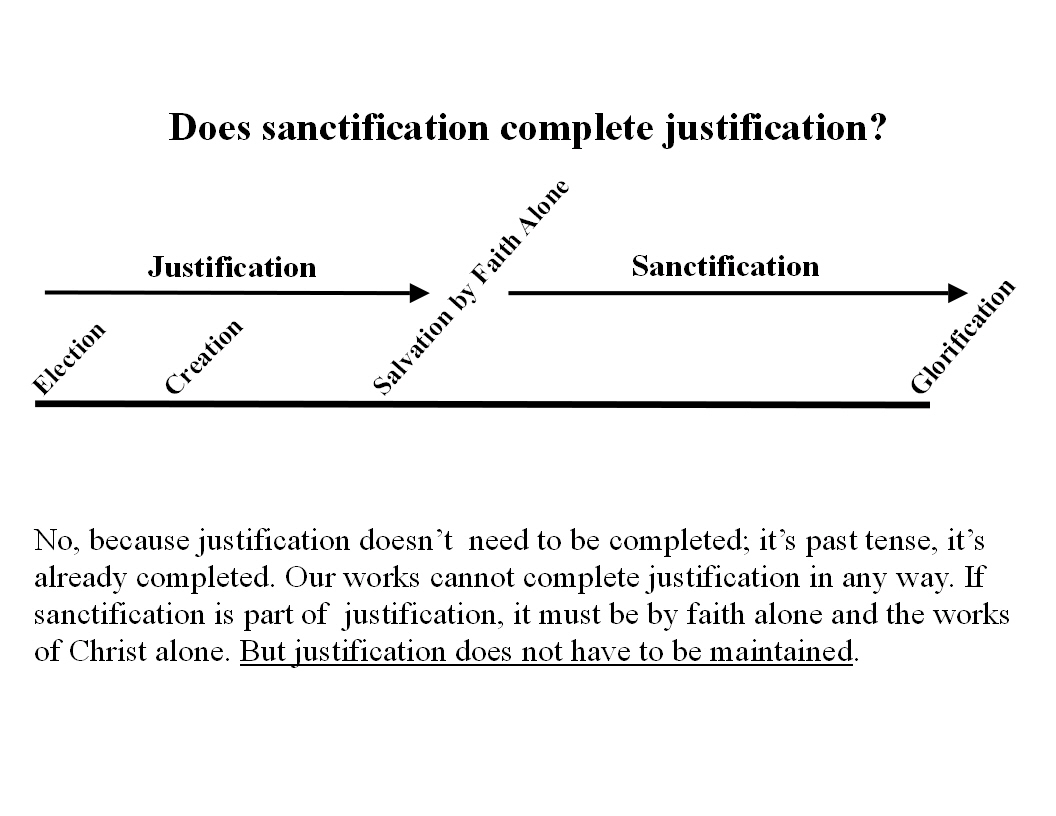
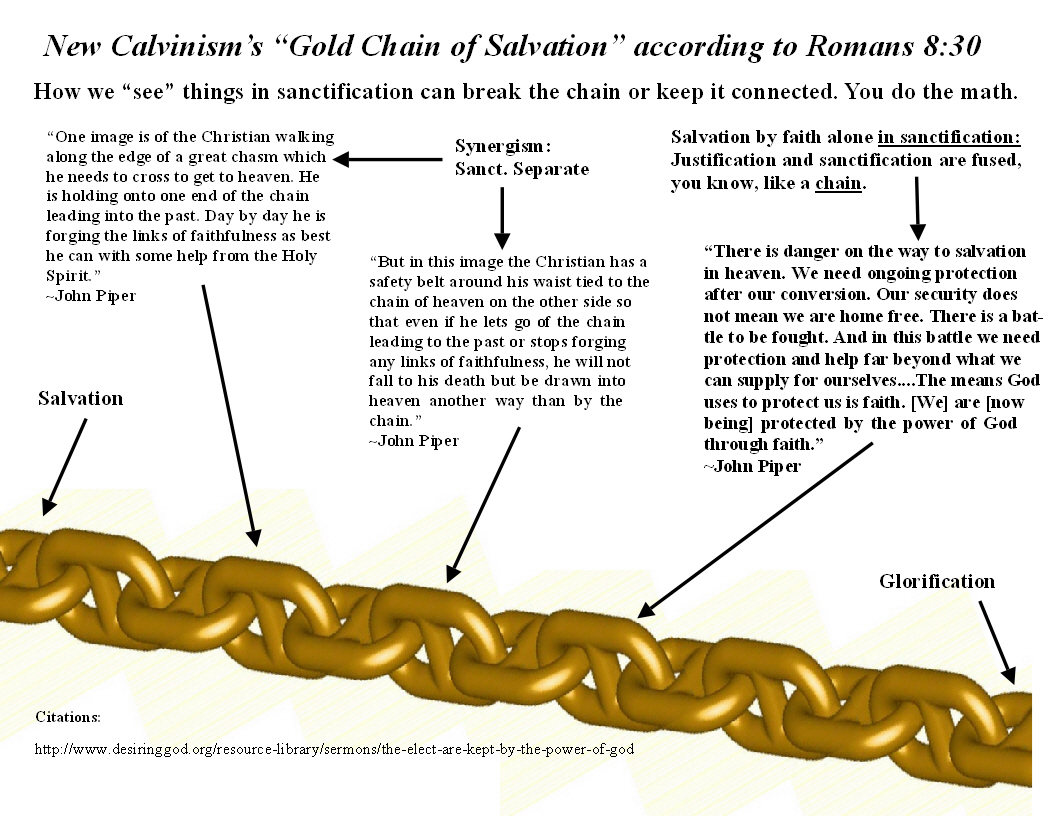
I have often argued from the standpoint of this issue. If sanctification is the middle of the Reformed “golden chain of salvation” then sanctification is part of finishing justification. This means that what happens in sanctification determines whether or not justification is properly finished. What’s a chain? John Piper even preached a message about the eternal importance of our contribution to the “links” in just the right way. In essence, sanctification becomes a spiritual minefield.
This is exactly the same thing that the Reformed crowd has always accused Rome of: the fusing together of justification and sanctification. However, as we shall see, they are both guilty of the exact same heresy/false gospel. As we shall see, both teach that sanctification finishes justification.
This is a linear gospel (one unified chain from salvation to resurrection (glorification) versus a parallel gospel with salvation on one plane as a finished work before the foundation of the world, and kingdom living that runs parallel with the finished work and reflects the reality of our salvation until glorification. Typical in the linear gospel is the idea that Christ died for all of our past sins, but we must now finish the work (with the Holy Spirit’s help [sanctified works salvation]) until glorification when we are completely transformed into complete holiness. This is the often-heard bemoaning of “Christ PLUS something.”
An excellent example is some strains of Freewill Baptists who teach that Christ died for all of our past sins, but with the help of the Holy Spirit, we must confess and repent of every sin we commit until the resurrection; e.g., Christ plus salvation by repentant prayer for sins committed after we are “saved.” My grandparents were saved out of this tradition. When my grandfather asked my grandmother if she thought that God could ever forgive him of all the sins he committed, she answered: “Yes, but you are going to have to pray awful hard!” Praise God that through the ministry of several individuals my grandparents eventually abandoned that gospel for the true one of salvation by faith alone as a finished work.
Likewise, Rome teaches that you must let the Catholic Church finish your justification through ritual; e.g., Christ plus Catholic ritual. The Reformation gospel is also Christ plus something else, but the something else is ever-so-subtle. In both cases, sin must be dealt with in sanctification in order for the saint to remain justified until the final judgment. In other words, the righteous standard of justification must be maintained on our behalf. Like all other proponents of a linear gospel, the Reformed crowd contends that anything less than the perfection demanded of the law (“all sin is transgression of the law”) is “legal fiction.” So both Rome and the Reformers agree: justification must be maintained by sanctification, and in the case of the Reformers specifically, they believe that the perfect standard of the law must be maintained until glorification; otherwise, our justification is “legal fiction.”
Here is where Reformed subtlety is uncanny: Christ keeps the law for us in sanctification. He maintains the perfect standard. All the fruit of sanctification (obedience/good works) flows from the life He lived on Earth and His death on the cross. Christ plus the works of Christ to finish salvation. “But Paul, what in the world is wrong with that!” Here is what is wrong with it: works are still required to maintain justification. That is a huge problem, even if it is Christ doing the work. What did the Hebrew writer say about Christ’s work for justification not being complete?
And even more subtle is the following Reformed idea: believing that the law is no longer a standard for maintaining justification is antinomianism. Antinomianism =’s legal fiction. Their definition of antinomianism is the removal of the law from justification as the standard for maintaining it. Traditionally, among Biblicist, antinomianism is the removal of the law from sanctification, and herein lays even further steroidal subtlety: the Reformed theologians would refute a removal of the law from sanctification as well, not only because they think justification and sanctification are the same thing, but because its perfect keeping is required to maintain a true declaration of the just that is not “legal fiction.”

However, the Biblicist believes that the law is a standard for kingdom living and is no longer a standard for justification. Therefore, if we attempt to obey it with the Holy Spirit’s help, and to please/serve the Lord, it can have no bearing on our just state. While the Biblicists think they are therefore joint contenders with the Reformers against antinomianism, such is far from the truth. The Reformed mind believes the Biblicist is either a legalist or an antinomian, or both. The Biblicist is supposedly an antinomian because he/she has removed the law from justification as a just standard, or is a legalist because they think they should strive to keep the law in sanctification. Since sanctification finishes justification’s perfect standard of law keeping, our “own” attempts to keep the law in sanctification is an attempt to finish justification. Hence, what the Biblicist fails to understand is the Reformers belief that Christ must maintain the law for us in sanctification because justification and sanctification are not separate. Anything more or less is supposedly works salvation.
On the other hand, because it is vital that Christ obeys the law for us in sanctification, the likes of John Piper and Tullian Tchividjian contend that those who are really preaching the Reformed gospel will indeed be accused of antinomianism. All in all, their position is easy to see if you pay attention. John Piper and many other Calvinists often state that, “Good works are the fruit of justification.” And, “Justification is the root, and sanctification is the fruit.”
Well, the average Biblicist then thinks, “Yes, but of course, our salvation makes good works in sanctification possible.” But that’s not what they are saying. If you pay closer attention, they are saying that justification is a tree that produces its own fruit. Justification is the root, and whatever happens in true sanctification is the fruit of the root of the justification tree. Problem is, justification doesn’t grow. Justification is a finished work. What Calvinists refer to as “progressive sanctification” is really the fruit of the root: progressive justification. Another name for this that they throw around is “definitive sanctification.” The word “definitive” refers back to the definite completion of justification.

Revision: this ministry now rejects the idea that orthodoxy is truth; orthodoxy is the traditions of men. Never in Scripture do we find premise for a body of teaching that explains the teaching. The above illustration is valuable for demonstrating that the fruit of justification is glorification, NOT sanctification.
This brings us to the Scriptural argument which begins with a question I asked myself just this morning: “Paul, you are always harping about the crucial importance of the separation of justification and sanctification—a parallel gospel versus a linear one. But where does the Bible say specifically that this is critical?”
First, the very definition of a lost person in the Bible is one who is “under the law”:
Romans 3:19
Now we know that whatever the law says it speaks to those who are under the law, so that every mouth may be stopped, and the whole world may be held accountable to God.
Romans 6:14
For sin will have no dominion over you, since you are not under law but under grace.
Romans 6:15
What then? Are we to sin because we are not under law but under grace? By no means!
1 Corinthians 9:20
To the Jews I became as a Jew, in order to win Jews. To those under the law I became as one under the law (though not being myself under the law) that I might win those under the law.
Romans 7:1
Or do you not know, brothers —for I am speaking to those who know the law—that the law is binding on a person only as long as he lives?
Romans 7:2
For a married woman is bound by law to her husband while he lives, but if her husband dies she is released from the law of marriage.
Romans 7:3
Accordingly, she will be called an adulteress if she lives with another man while her husband is alive. But if her husband dies, she is free from that law, and if she marries another man she is not an adulteress.
The unsaved are “under the law” and will be judged by it in the end. This is the very definition of the unsaved. Calvinists define Christians the same way—we are supposedly still under the law and will be judged by it in the end. That’s why Christ must keep the law for us—because we are still under it.
If not this position, why do many in the Reformed tradition hold to the idea that Christ’s perfect obedience is imputed to our sanctification? His death justifies us, and His perfect life sanctifies us. Hence, His death pays the penalty for past sins, and then His perfect life imputed to our sanctification keeps us justified. Why would an imputation to our sanctification be necessary if we are no longer under the law? This is known as the Reformed view of “double imputation” and has been called out as heresy by many respected theologians for this very reason: it implies that Christians are still under the law.
In regard to sustaining the law in our stead, why? It has been totally abolished in regard to our just standing:
Romans 3:20
For by works of the law no human being will be justified in his sight, since through the law comes knowledge of sin.
Romans 3:21
But now the righteousness of God has been manifested apart from the law, although the Law and the Prophets bear witness to it—
Romans 4:15
For the law brings wrath, but where there is no law there is no transgression.
The keeping of the law by anybody DOES NOT do anything to justify mankind:
Romans 3:28
For we hold that one is justified by faith apart from works of the law.
Here is where the separation of justification and sanctification is vital on this first point: we ARE NOT under the law for justification, but rather UPHOLD THE LAW in sanctification. The two must be separate because of the differing relationships to the law:
Romans 3:31
Do we then overthrow the law by this faith? By no means! On the contrary, we uphold the law.
Romans 6:15
What then? Are we to sin because we are not under law but under grace? By no means!
Furthermore, if we are still under the law (whether or not Christ obeys it for us to keep us in a just standing), this means we are still under the power of sin. Being under the law and also under its spell to provoke sin in the unregenerate is spoken of as being synonymous in the Bible. Those who are “under the law” are also under the power of sin and enslaved to it:
Romans 7:4
Likewise, my brothers, you also have died to the law through the body of Christ, so that you may belong to another, to him who has been raised from the dead, in order that we may bear fruit for God.
Romans 7:5
For while we were living in the flesh, our sinful passions, aroused by the law, were at work in our members to bear fruit for death.
Romans 7:6
But now we are released from the law, having died to that which held us captive, so that we serve in the new way of the Spirit and not in the old way of the written code.
Romans 7:8
But sin, seizing an opportunity through the commandment, produced in me all kinds of covetousness. For apart from the law, sin lies dead.
If we are still under the law, and will be judged by it, whether or not Christ stands in the judgment for us with His own works, we are still enslaved to sin by virtue of being under the law…. for justification. And Calvinists know this to be true, that’s why they say we are still…. what? Right, even as Christians, “totally depraved.” And, “enemies of God.” Of course, throughout the Bible, Christians are spoken of as being friends of God and no longer His enemies. Our status as enemies of God is stated in the past tense. But the Reformed crew continually state that Christians are vile enemies of God and are enslaved to sin. They realize that this goes hand in hand with being under the law.
To the contrary, dying to the law in the death of Christ….for justification—sets us free to be enslaved to the righteousness that is defined by the law. We are dead to the law for justification and alive to obey truth….for sanctification:
Romans 8:2
For the law of the Spirit of life has set you free in Christ Jesus from the law of sin and death.
Romans 8:3,4 [emphasis by author]
For God has done what the law, weakened by the flesh, could not do. By sending his own Son in the likeness of sinful flesh and for sin, he condemned sin in the flesh,….in order that the righteous requirement of the law might be fulfilled in us, who walk not according to the flesh but according to the Spirit.
Romans 8:7
For the mind that is set on the flesh is hostile to God, for it does not submit to God’s law; indeed, it cannot.
Romans 9:31
but that Israel who pursued a law that would lead to righteousness did not succeed in reaching that law.
John 17:17
Sanctify them in the truth; your word is truth.
James 1:25
But the one who looks into the perfect law, the law of liberty, and perseveres, being no hearer who forgets but a doer who acts, he will be blessed in his doing.
So, that is the separation that must be for the true Christian: Justification has no law for which we are judged, and we live by the law of blessings in sanctification.
This brings us to another important separation in the two: the judgments. Those under the law and sin will stand in a final judgment which will be according to the law. Again, because Calvinists believe that we are still under the law, albeit that Christ obeyed/obeys it for us, Christians will supposedly stand in the same judgment as the damned who are under the law and enslaved to it. At that time, the children of God, according to Calvinists, will be “made manifest.”
But because Christians are not under the law and cannot be judged by it, they will stand in a judgment for rewards and not a judgment that determines a perfect keeping of the law by Christ in our stead. Hence, there will be two different resurrections: one for those under the law and another for those under grace, and two different judgments for the same two groups. One for rewards, and one to determine if those under the law kept it perfectly. That judgment doesn’t go well for any standing in it.
Luke 14:12-14
He said also to the man who had invited him, “When you give a dinner or a banquet, do not invite your friends or your brothers or your relatives or rich neighbors, lest they also invite you in return and you be repaid. 13 But when you give a feast, invite the poor, the crippled, the lame, the blind, 14 and you will be blessed, because they cannot repay you. For you will be repaid at the resurrection of the just.” [Notice that this is a resurrection for the “just.” They are already determined to be just before they are resurrected].
2Corinthians 5:9,10
So whether we are at home or away, we make it our aim to please him. 10 For we must all appear before the judgment seat of Christ, so that each one may receive what is due for what he has done in the body, whether good or evil.
1Corintians 3:11-15
For no one can lay a foundation other than that which is laid, which is Jesus Christ. 12 Now if anyone builds on the foundation with gold, silver, precious stones, wood, hay, straw— 13 each one’s work will become manifest, for the Day will disclose it, because it will be revealed by fire, and the fire will test what sort of work each one has done. 14 If the work that anyone has built on the foundation survives, he will receive a reward. 15 If anyone’s work is burned up, he will suffer loss, though he himself will be saved, but only as through fire.
Hebrews 6:10
For God is not unjust so as to overlook your work and the love that you have shown for his name in serving the saints, as you still do.
Revelation 20:6
Blessed and holy is the one who shares in the first resurrection! Over such the second death has no power, but they will be priests of God and of Christ, and they will reign with him for a thousand years.
Revelation 20:11-15
Then I saw a great white throne and him who was seated on it. From his presence earth and sky fled away, and no place was found for them. 12 And I saw the dead, great and small, standing before the throne, and books were opened. Then another book was opened, which is the book of life. And the dead were judged by what was written in the books, according to what they had done. 13 And the sea gave up the dead who were in it, Death and Hades gave up the dead who were in them, and they were judged, each one of them, according to what they had done. 14 Then Death and Hades were thrown into the lake of fire. This is the second death, the lake of fire. 15 And if anyone’s name was not found written in the book of life, he was thrown into the lake of fire.
Don’t let anyone tell you that eschatology is a “secondary” or “nonessential” consideration. Your eschatology is your gospel. It will state your position regarding whether or not you fuse justification and sanctification together; ie, likening Christians to those under the law.
Yet another vital difference in sanctification and justification is repentance. Repentance for salvation (when you are justified) is different from our repentance in sanctification. Among many in the Reformed tradition where the “same gospel that saved you also sanctifies you,” the repentance is the same. Repentance unto salvation is not a onetime “washing,” but rather a means to continue “in the gospel” through what they call, “deep repentance.” Biblicism holds to repentance in sanctification that restores his/her fellowship and communion with God as His children. They would see repentance unto salvation as differing, and only necessary for salvation—a onetime decision to take one’s life in a new direction by following Christ, and believing in his death, burial, and resurrection.
Reformed repentance, according to the likes of Paul David Tripp and others is a “daily rescue.” Our original repentance was for rescue, and we need rescue today as much as we needed rescue when we were saved. Again, this indicates their belief that we are still under the curse of the law and need to be continually rescued from it while remaining under the bondage of sin.
However, Christ made it clear to Peter (John 13:6-11) that those who have been washed (1Corinthians 6:11, Romans 8:30) do not need another washing. Those who drink of the living water do not thirst again (John 4:13,14).
Lastly, though many other separations could be discussed, why saints can be considered just while they still sin at times is of paramount importance. There is no sin in our justification because there is no law, and where there is no law, there is no sin. Though unfortunate, there can be sin in our sanctification because it is totally separate from justification and can’t affect our just standing with God.
Basically, all of the aforementioned makes it of necessity to deny the new birth. If we have God’s seed in us, and we do (1John 3:9), that dispels total depravity, and without total depravity, justification and sanctification cannot be fused together. The new birth is a huge problem for Reformed theology. If the old man that was under the law is dead (Romans 7:1ff), and the seed of God is in the saved person, and the sin due our weakness in the flesh cannot be laid to our account for justification, then our justification is not “legal fiction” because we do not exhibit perfect obedience to the law. This is another grave consideration because Christ said, “You must be born again.” Obviously, despite their denials that they deny the new birth—you can’t be both totally depraved and born again.
Reformation doctrine is clearly a false gospel. Its version of justification does not void the law, and denies the new birth while distorting everything in-between. Freewill verses predestination is hardly the issue, the very gospel itself is the issue.
paul
John MacArthur’s Showing Without Telling: The Reformed Way of Preaching Progressive Justification
“Moreover, this paradigm, according to many Calvinists in our day including John MacArthur, asserts that Christians often obey and experience biblical truth that they are unaware of intellectually.”
“MacArthur had a choice: the authority of Scripture or Reformed orthodoxy; he chose the latter.”
“And, what exactly are the ‘implications’ that John MacArthur ‘explains’ from the text? If you assume a many-faceted full counsel of God, your assumptions would be dead wrong.”
Progressive justification is the gospel of John Calvin and present-day neo-Calvinists of all stripes. Forget the freewill/election debate; forget all of the haranguing over the residual issues; progressive justification is simply a false gospel.
It teaches that the power for our Christian living comes from our salvation or justification. At first, you may object to my objection on the bases that salivation makes Christian living possible, and I agree, but making Christian living possible and being directly powered by it are two opposing ideas with a crucial difference.
If Christian living is powered by our salvation (justification), and if our salvation does more than change our standing, position, or status, Christian living (sanctification) remains connected to our justification. This makes sanctification a spiritual minefield with endless and sobering implications.
Of which the least is not: preaching. When justification and sanctification are fused together, we are interacting with our justification throughout life; this would seem evident and terrifying to those who understand the implications because we can supposedly do things in our sanctification that can affect our standing before God.
Hence, in this fusion of the Reformed “golden chain of salvation” (what’s a chain?) we must be careful in how we (according to John Piper) participate in the links because we are not home free and there is a danger in sanctification. No kidding. There would be when justification and sanctification are fused together.
Furthermore, because this makes sanctification very tricky, the children of God (according to Doug Wilson) will be manifested at the last judgment. I sometimes receive complaints here at PPT that John Piper et al seem to state that we cannot know for certain whether we are saved or not until the last judgment. I am not surprised by these questions; they would be consistent with the logical conclusions one must draw from the theology.
This now brings us to our discussion about preaching. Obviously, Reformed pastors are going to be very careful not to preach in a way that will lead us in making our sanctification the ground of our justification. Or, leaping from the imperative to obedience. If we do not pre-bathe all obedience in our salvation, it is “making our sanctification the ground of our justification.” In Reformed circles, they call this, “The biblical command is grounded in the indicative event.” The indicative “event” is the crucifixion of Christ—all obedience flows from that event directly as the empowerment thereof—not a possibility that we participate in.
Therefore, all true obedience in the life of a believer is a mere natural flow experienced by joy and a willing spirit IF it is powered by our salvation. This is obtained through using our Bible to meditate on our salvation, and the works of Christ, and then just letting the Spirit take things from there. If the Spirit then instigates the obedience, it’s the Spirit applying justification to our sanctification and not us. Hence, we are safe from “making our own sanctification the ground of our justification.” Again, this is supposedly manifested and verified by joy (which Piper makes absolutely synonymous with saving faith and the struggle thereof dependent on our salvation [When I Don’t Desire God p.35]). Likewise, John MacArthur mimics the same nonsense as documented in the following PPT post:
Hence, creepy similarities to Piper’s theology appear in “Slave,” especially Pipers belief that true Christian obedience is always experienced as an unhesitating, natural response accompanied by joy. Throughout the book, MacArthur describes Christian obedience as “pure delight” and “joy-filled.” On page 208, he describes our experience as slaves to Christ as “not partially sweet and partially sour, but totally sweet.” This, despite what the apostle John clearly experienced as recorded in Revelation. But regardless of the fact that there is nothing sweeter than being a slave of Christ, to suggest that our experience is never mixed with bitterness (taste, not attitude) is just plain nonsense. A believer who has lost an unbelieving relative or close friend would be an example. Also, even though I realize the importance of joy in the Christian life, I make this observation in “Another Gospel” (page 78):
“Only problem is, among many, is the eleventh chapter of Hebrews contradicts everything in Piper’s statement above. Hebrews 11 is one of the more extensive statements on saving faith in Holy writ. The Hebrew writer defines the faith of at least twenty believers in regard to the decisions they made and obedience. Joy or pleasure, even pleasure in God, is not named once as being an attribute of their faith. The only semblance of feelings or emotions mentioned is that of strife and fear of God more than man. The truth of Hebrews 11, as well as many other Scriptures, makes a mockery of Piper’s theory of Christian hedonism.”
According to John Piper, if we find ourselves in a situation where we find no joy in the obedience—go ahead and obey, but be sure to ask God for forgiveness because of your sinful obedience (John Piper: Treating Delight as Duty is Controversial; pdf booklet available on Desiring God .org). Moreover, this paradigm, according to many Calvinists in our day including John MacArthur, asserts that Christians often obey and experience biblical truth that they are unaware of intellectually. A prime example of this would be the following excerpt from an article written by New Calvinist Bill Baldwin:
Give me a man who preaches the law with its terror and Christ with his sweetness and forgets to preach the law as a pattern of the fruit of sanctification and what will result? In two months his parishioners will be breaking down his door begging to be told what behavior their renewed, bursting with joy, hearts may best produce. And when he tells them, they will be surprised (and he will not) to discover that by and large they have produced exactly that. And where they haven’t, take them back to Christ again that they may contemplate him in all his glorious perfection so that they may better understand what sort of God and man he was and is (Bill Baldwin: Sanctification, Counseling, and the Gospel 08/02/1996).
My best information is that MacArthur bought into this nonsense circa 1994. He was persuaded by, among others, John Piper and Michael Horton that the Reformers in fact held to a progressive justification. MacArthur had a choice: the authority of Scripture or Reformed orthodoxy; he chose the latter. Therefore, MacArthur’s preaching will ape that of most Reformed teachers: heavy on the glory of God and very light on practical application or specific instruction. As Baldwin states it: “….the law as a pattern of the fruit of sanctification.”
And even though MacArthur is far more subtle in his anti-instruction/application than most Calvinists (probably due to the habits of his prior preaching which was heavy on sanctification elements), Christians have nevertheless noticed his lack of application (most likely due to the contrast) and questioned him on it. His defense reveals his dastardly selling out of the truth.
In, “Why doesn’t John MacArthur add much application to his sermons?” (Online source: http://goo.gl/P0eR9), MacArthur defends his Reformed Application Light sermons. But for you skeptics, let me get your attention. In regard to my accusation that this paradigm doesn’t require intellectual knowledge for experience or application, MacArthur concludes his defense by stating the following:
So now you know. You’ve been experiencing this. You had no idea what you were experiencing, right? (Applause) Okay.
The “applause” part of the transcript is the barf factor when one ponders the mindless following of philosopher kings such as “Pastor” John MacArthur Jr. Nevertheless, MacArthur continues:
Now let me tell you what happens when you preach effectively. You do explanation. In other words, you explain the meaning of Scripture, okay? The explanation carries with it implication. In other words, there are implications built into this truth that impact us. You add to that exhortation. And I’ve said things tonight to exhort you to follow what is implied by the text. Now when you deal with the text and the armor of God, like tonight, all I can do is explain it. That’s all it does. There aren’t any applications in that text. It doesn’t say, “And here’s how to do this if you’re 32 years old, and you live in North Hollywood.” “Here’s how to do this the next time you go to a Mall.” “Here’s how to do this when you go in your car and you’re driving in a traffic jam.” It doesn’t tell you that. And if I made my message mostly a whole lot of those little illustrations, I would be missing 90 percent of you who don’t live in that experience.
Unfortunately, MacArthur has gone the way of New Calvinist ungodly communication. He makes application of Scriptures the same thing as applying it to petty life concerns; such as, going to the mall. It’s the classic New Calvinist demeaning of biblical application and obedience. What is really behind it is an antinomian spirit. Let me point out MacArthur’s error in regard to the above quote concerning the idea that there is no application in Ephesians 6:16-20, only “explanation.” That text is full of imperatives and applications in regard to the full armor of God: “Put on…., stand against…, take up…, that you may be able…., having done all…., having put on…., Stand therefore…., having fastened…., and having put on…., in all circumstances [what circumstances? It would be wrong to draw examples from our life?]…., with which you can…., to that end…., [etc., etc., etc].” To imply that Ephesians 6:16-20 doesn’t contain instruction for practical application is ludicrous.
Also, adding to the absurdity of MacArthur’s statement is the fact that “putting on” is a major theme of that passage. This refers back to Ephesians 4:20-24, and the Apostle Paul’s discussion of putting off the old nature and putting on the new. So, MacArthur is not only denying application from our life experience, but specific life application specified in Scripture. Dr. Jay E. Adams notes 45 life applications to the putting off/putting on concept that he didn’t deduct from life observation, but are specifically mentioned in Scripture regarding life application (INS Training in Biblical Counseling by Extension: Introduction Principles and Practices; pp.22-24).
Surely, other than what good preachers should be able to draw from life for biblical application, specific biblical applications regarding life are too numerous to list. For example, Paul states in I Corinthians 7:41 that Christians should only marry “in the Lord.” The life application is what Nehemiah stated about Solomon when he didn’t follow that mandate; ie., even a man of his spiritual wherewithal fell into grievous sin by violating said spiritual principle.
Nehemiah 13:26
Was it not because of marriages like these that Solomon king of Israel sinned? Among the many nations there was no king like him. He was loved by his God, and God made him king over all Israel, but even he was led into sin by foreign women.
No life application in that? Really?
MacArthur continues:
It’s not for me to do that. Application belongs to the Spirit of God. All I’m interested in is explanation and its implications [What about 2Timothy 3:16,17 and the issue of “instruction” ?]. And the power comes in the implication and the Spirit of God takes the implications of what I’ve said tonight, all these things I’ve said, I don’t need to say all kinds of little scenarios to you and paint all kinds of little individual circumstances. All I need you to know is this is what the Word of God says and the implications are powerfully brought to bear with authority on your life and I exhort you to respond to those implications, it is the Spirit’s work to drive those implications into direct and personal application. That’s why you’re not going to, like so many preachers, you’re not going to hear me create all kinds of practical scenarios about how this all fleshes out in everybody’s world because you may hit somebody, you may hit a person here or there, that’s kind of a rifle-shot approach, the shot-gun approach that sprays everybody is the implicational essence of Scripture. That’s the power. And that’s when everybody walks out and says, “Wow, that hit me!” because you already have a commitment to the authority and the power of Scripture.
So, Reformed preaching merely explains Scripture, and the Holy Spirit applies it. So what do we need “instruction” for? (2Timothy 3:16,17). As we have clearly seen, this is an iffy proposition. If this is the case, why does the Bible command specific life application? Does the Spirit need to inform Christians as to what He may or may not do in their lives? I contend that this is MacArthur’s nuanced way of propagating the whole Reformed idea that the Holy Spirit obeys for us, so that our sanctification will not be the “ground of our justification.”
MacArthur further explains:
You already have a commitment to the truthfulness of Scripture. All I want you to understand is what it means. And in the meaning expanded beyond the given text to other texts so that you build all the theological implications, I leave you with the implications and an exhortation to be obedient and I leave the application to the Spirit.
Obedient to what? Obviously, there can be no specific instruction from the pulpit, only “explaining.” Instruction would imply specific application of the text. So, not only does the Holy Spirit apply the text, does he also teach the Christian how to apply it specifically? Or does that just come as a mere natural flow? Well, since, “So now you know. You’ve been experiencing this. You had no idea what you were experiencing, right?” Answer: like Baldwin, and for that matter, all New Calvinists, the “obedience” is “experienced” (not personally applied) without necessary intellectual understanding or knowledge. Let me reiterate MacArthur’s exact words:
So now [present tense] you know. You’ve been [past tense] experiencing this [experiencing what? Answer: obedience]. You had no idea [this should speak for itself….] what you were experiencing, right?
Right John. Whatever you say.
And, what exactly are the “implications” that John MacArthur “explains” from the text? If you assume a many faceted full counsel of God, your assumptions would be dead wrong. MacArthur makes it clear what should be primarily mined from the Scriptures in his Forward to Rick Holland’s Gnostic masterpiece, Uneclipsing The Son:
As believers gaze at the glory of their Lord—looking clearly, enduringly, and deeply into the majesty of His person and work—true sanctification takes place as the Holy Spirit takes that believer whose heart is fixed on Christ and elevates him from one level of glory to the next. This is the ever-increasing reality of progressive sanctification; it happens not because believers wish it or want it or work for it in their own energy, but because the glory of Christ captures their hearts and minds. We are transformed by that glory and we begin to reflect it more and more brightly the more clearly we see it. That’s why the true heart and soul of every pastor’s duty is pointing the flock to Christ, the Great Shepherd….The pastor who makes anything or anyone other than Christ the focus of his message is actually hindering the sanctification of the flock.
What MacArthur endeavors to “explain” in every verse of Scripture is Jesus and His works (as stated by many New Calvinists), “not anything we would do.” As can be seen in the above MacArthur quote, he also follows the Reformed tradition of making God the Father and the Holy Spirit of lesser significance than Christ. Sadly, throughout church history, those of Reformed tradition has burned many at the stake for misrepresenting the Trinity while they are in fact guilty of the same thing.
There is certainly no reason to believe that MacArthur has not completely embraced this doctrine which also suggests that the saints can only get an adequate explanation of the Scriptures from Reformed elders. Saints dare not even fill up half of their plate with anything but Reformed elder preaching:
You think, perhaps, that [you] can fill up the other half of the plate with personal study, devotions, or quiet times, or a radio program. Beloved, you cannot. Scripture is relatively quiet on such practices. But on preaching, the case is clear and strong. Neglect preaching and neglect your soul (Elder Dr. Devon Berry: How to Listen to a Sermon; Clearcreek Chapel .org).
MacArthur’s defense of his preaching being discussed here implies the same idea:
But I want you to understand, if you don’t already understand, what I think should happen in effective biblical preaching. You heard a testimony tonight in the waters of Baptism from Juan about how he kept coming to Grace Church. And in spite of the fact that he wanted to be a hypocrite, the power of the Scripture began to overwhelm him.
Notice that the “power of the Scripture,” which should be understood in context of what we are discussing here, is not the primary crux of the point, but rather, “….he kept coming to Grace Church.” The “power of the Scripture” coming from the pulpit at Grace Church seems to be the point, and would also fit with the Reformed view of anointed elder preaching. MacArthur’s Bible Commentary is now published in the official New Calvinist translation of the Bible, The English Standard Version. It is published by Crossway, which is totally in the tank for New Calvinism. In the following promotional video clip, MacArthur hails the translation as the best ever: http://youtu.be/L1VxhQqsGXU. Again, MacArthur is now a dyed in the wool New Calvinist in the same order of the ones he supposedly despises like Mark Driscoll. While whining about their view of alcohol use among Christians and other residual issues, he is a believer in the same gospel (progressive justification).
The fact that John MacArthur is one of the most popular preachers in church history should be a chilling realization for those Christians who still love the truth.
He is also an excellent acid test for those who really want to know if they are followers of men or followers of the truth.
paul
The PPT Francis Chan Archives
There have been a lot of requests for information on Francis Chan of late. Not sure why, but nevertheless, hope this helps. Click on title links below:
Can Anybody Say Nothing Better Than Francis Chan?
Francis Chan Not Sure That Hell Is Eternal Suffering
Chan, Carson, Piper, Tchividjian Verses the Holy Spirit On “Rules”
Ok, Let’s Go Over This Again: Crazy Truth
Francis Chan’s “Crazy Love” is Really Antinomian Puppy-Love
The Doctrine of Centralism and the “Cult” Misnomer
 “Hence, there are only two types of churches in our day: those that promote bondage to pastor kings, and those that promote the priesthood of believers—with the latter being an anomaly in our day. ”
“This Reformation myth—the epic battle for truth between Rome and a lowly monk, is the greatest hoax ever perpetrated on mankind.”
Like “legalism,” “gospel,” “grace,” and “Christian,” “cult” is a loosely used term thrown around in our day. Like “legalism” in particular, I don’t think there is any such thing as a “cult.”
The word is very unhelpful, inaccurate, and enables spiritual abuse and tyranny of the worst sort. And, bibliology, or doctrine, has absolutely nothing to do with whether or not an organization is something that doesn’t exist; namely, a cult.
Have you noticed? People still attend and vigorously support what some call the big C. Why is that? Why do they also cover up big C behavior? Why the blind faith? Why do upright law abiding citizens support certain organizations in the face of damning evidence? Why are the victims blamed for the actions of their abusers? What’s going on?
Same Behavior
Observation begins to supply clues. Some years ago, I had a ministry to Jehovah Witnesses. JW’s are commonly accepted as being a cult. But in case you haven’t noticed, they aren’t going away anytime soon. Why is that? I will answer that question later, but for now, let me state a procedure that JW’s use to neutralize those who contend against them: they set out to end your marriage. I was called into a situation where an individual was meeting with a group of JW elders from a kingdom hall that his wife was a member of. They had been recently married. He wanted to follow God, and considered the Bible to be the authority, and wanted me to attend the meeting to present another perspective on Scripture for him to consider.
But I did something surprising. I wouldn’t discuss doctrine with them. Instead, I brought copies of old Watch Tower theological journals (some dating back to the 1920’s) that clearly showed how JW’s have changed their positions on major theological issues over the years. Until the 70’s (if I remember correctly), JW’s disallowed blood transfusions (based on obscure Old Testament law) which led to the untimely deaths of many of their followers—especially children. Some of the younger elders present were unaware of this fact and didn’t buy the idea suggested at the meeting that I had photo-shopped the copies.
The next morning, three ladies from the same kingdom hall came to visit my wife after I left for work. They offered to come to our home during the day and have Bible studies with her. Despite my outrage, they were so persistent that I had to consider the obtaining of a restraining order from the local police.
Now enter Calvinist churches that are in contention with individuals. They do the EXACT same thing. The first thing that is going to happen when, and if you are in a contention with Calvinist elders in a local church—they are going to set the wheels in motion to drive a wedge between you and your spouse. I don’t condone it, but in cases that have been brought to our attention, the stalking of wives was only halted when Reformed elders were threatened with physical violence, or confrontation in the middle of Sunday morning services. The latter we do indorse, and many Reformed churches have security teams in place to thwart such confrontation which by the way is biblical. In other articles, I have outlined fourteen cult elements that are aped by Reformed churches. According to “cult” experts, the primary motivating factor is CONTROL. The process aimed at getting control and keeping it is known as centralism.
Now, try to solve the Reformed bully problem by labeling them a cult. Ya, good luck with that one. So, herein is now the problem: by labeling some “cults” and others not cults, the others get a free ticket to act like a cult without being one when the fact of the matter is that they are all CONTROLISTS.
Controlism
Labeling them all “control freaks” (centralism, or controlism) is much better, and more accurate than “cult,” but still way short of being solution oriented. Why would so many people be concerned with controlling others? People do what they do for a reason. They do what they do because of what they believe or want. “Oh, you mean ‘doctrine,” right?” Wrong. Doctrine is the tool that makes control possible. Something comes before the doctrine. We are going to discuss the primary crux of this issue and lay all of the residual issues aside. This is the big picture.
Philosophy
Philosophy is the theory of being or existence, how we know what we know, ramifications of knowledge, and how we communicate it to others. Western culture is predicated on the idea that philosophers are an elite class that should rule the world. And depending on the philosophy’s doctrine, they are mediators between the masses and the cosmos, nature, various invisible forces, gods, or thee God.
Prior to the sixth century, Western culture primarily functioned on mythology. The fifth century saw a movement towards science, but the study of human existence and how truth related to life (philosophy) did not emerge till circa 400 BC. The epicenter was the Academy in Athens Greece. This is where the philosophical wheel of Western culture was invented. The primary premise mentioned above, Plato’s philosopher kings, moved out from Athens into history by two roads: secular, and religious. In the religious realm, doctrines and church polity were geared for the ultimate goal necessary to implement the core philosophy: CONTROL. Though religious wars have raged throughout Europe till this day under the auspices of doctrinal disagreements (going to war over doctrine is not doctrinally sound to begin with), what the issue has always been is that of control.
Even in regard to the doctrinal contentions between the Reformers and Rome, both doctrines were designed to control the saintly masses. That is why the results have always been the same whether Reformed or Catholic: heavy-handed leadership, abuse, and cover-ups. Why are there so many different denominations, doctrines, and beliefs? Really there isn’t; these are just different theological systems that approach control in different ways. The doctrine assimilated into the minds of both groups lead to the behavior. Why do pastors feel entitled to abuse? Philosophical indoctrination via biblical proof texting. Why do pastors cover for each other and refuse to confront other pastors? Same reason. Why are victims told that it is their fault? Same reason. Why do parishioners look the other way and pretend it didn’t happen? Same reason. Want to see this in action? Watch the following video:
And this article: http://martybraemer.wordpress.com/2012/08/07/jack-schaap-my-friend/
The primary crux of Centralism in both Reformed doctrine and Catholicism is the emphasis on saintly ineptness. The Reformers relegated the saints to total depravity and a total inability to please God in any way. If you can convince people that they are worthless, it goes without saying that they become docile followers who are hesitant to question anything. Likewise, on the Catholic side, if you can’t interpret the Scriptures on your own and absolution can only be found through the Catholic Church—few are willing to rock the boat. Today’s Baptists of all strips are either one or the other, or a combination of both. While supposedly rejecting both, determinism and weekly absolution can be found at the altar weekly. After all, we are “all just sinners living by the same grace that saved us.” Sermons are about “forgiving the way we have been forgiven,” and how “complaining is always sin.”
As obedience to the local pastor king is slowly assimilated into the minds of parishioners through various doctrines, followers will ultimately drink the Kool-Aid if they are told to. The infamous Jack Hyles (Independent Fundamental Baptist) demonstrated this to a fellow pastor by saying to one of his deacons: “stand up”; and he did. “Sit down”; and he did, and much to the astonishment of the other pastor. Hyles’ daughter once stated that she was certain that her father’s 50,000 followers would drink the Kool-Aid if he told them to and prefaced the statement with, “I’m not kidding!” Therefore, in her estimation, when it got right down to it, the (at one time) largest Baptist church in the world was no different from Jonestown, and I concur. Hyles and Jim Jones simply had different flavors of doctrine that were geared to obtain the same results.
When Christ came upon the scene proclaiming His good news of the kingdom of God, His message was a head-on collision with Greco-Roman philosophy that had been integrated into Judaism. Christ proclaimed the Scriptures, for all practical purposes, to be the comprehensive metaphysical, epistemological, ethical, political, philosophical statement directly from God, and placed it in the hands of the saints to interpret it for themselves, and supplied everything necessary to do so. The priesthood of believers is the extreme antithesis to philosopher kings. And Christ looked to none of the theologians of that day for credibility—He didn’t cite any of them. He picked twelve uneducated blue-collar workers to build the greatest kingdom of the ages, and made every citizen a priest unto God. He purchased us with His own blood, and we are owned by no other man.
Hence, there are only two types of churches in our day: those that promote bondage to pastor kings, and those that promote the priesthood of believers—with the latter being an anomaly in our day. Susan and I are visiting churches right now, and we know this: any given church will be geared to control the members through doctrine, polity, and ministry, or will be geared to equip priestly saints full of goodness and competence in spiritual matters—able to minister to each other and the world with all knowledge. There is no in-between; every church will fit into one of these two criteria.
Where Truth Still Matters
Christians are under the illusion that truth matters, and doctrinal disagreements in our day are driven by such. Hardly. Truth is irrelevant; the real crux of the matter is what doctrine best suits to effectively control the masses. Truth is not the epicenter of God’s comprehensive philosophical statement on life and godliness in our day. The prior question (which doctrine best controls) has always led to the marriage of church and state throughout history. The state has always sought to unite with a “unifying belief system,” ie., religion; the state has a vested interest in a docile populous, while religion has an interest in using the state to control the totally depraved zombie sheep from destroying themselves. Rome and the Reformers were in agreement on the marriage of church and state; their disagreement concerned the gospel of centralism under the guise that gospel truth really matters. This Reformation myth, the epic battle for truth between Rome and a lowly monk, is the greatest hoax ever perpetrated on mankind. And, read the book of Revelation and the book of Daniel for yourselves, the marriage of the anti-Christ statesman with the one world religion of the latter days is hardly a mere preface in the scheme of things. The anti-Christ is Plato’s magnum opus of philosopher kings.
1. Exhort with sound doctrine and truth.
But there are still plenty of saints around that care about real truth, and they must be convinced with sound doctrine and sound doctrinal apologetics. This is the first piece of the puzzle that answers the ministry riddle of our day.
2. Save the honestly deceived.
There are saints who love the truth, and have no agenda, but have unwittingly resigned their priesthood to pastor kings, and are owned by them instead of Jesus Christ. They must be convinced with the truth they love, and thereby rescued from throwing away their high calling and casting their pearls before swine.
3. Do not invest in “saints” with itching ears.
Don’t waste time with those who value what they receive from pastor kings more than truth. Pastor kings offer easy believeism, and ease is a universal temptation. Whether, this is easy because to do anything in sanctification is works, and not grace; or, obedience is optional—at least we are saved; or, we are totally depraved pieces of crap that couldn’t please God even if we tried, so what could be easier?; or, any effort in sanctification is works salvation because the two are the same; or, the same gospel that saved us also sanctifies us—no need to move on to anything else that might be harder than that; or, no need to delve deep into the Scriptures and study hard because the Bible is a gospel narrative only; or, whatever else is the reason—something that people want that they are receiving from the pastor kings is more important than truth. Truth is often hard.
This is why they are willing to compromise and lay almost everything at the altar of the pastor kings. It’s easy. And, victims are a big-time inconvenience. Hence, ignorance is bliss and cover-ups are the first order of the day. Doctrine will condone this in various and sundry ways. Occasionally, these saints with itching ears will contend against truth bearers that threaten their comfort. Be careful to not invest time in them—invest in the honest doubters.
4. Prevention
Saints must be educated and warned not to squander their priesthood under the auspices of the pastor kings, whether of the Reformed stripe, the Arminian stripe, or the misnomer of cultism.
paul
Why Christians Can’t See the Total Absurdity of Total Depravity
“One can clearly see here where Powlison wants to take the plain sense of Scripture and apply the Socratic dialectic; ie, start asking questions about the obvious because truth couldn’t be that easy, and if it is, any Spirit indwelled Christian can do truth at home which is a huge problem for the philosopher kings. Empirical Objectivism puts the power of understanding in the hands of the common people. It is enemy number one for the Platonic New Calvinists.”
1. Background: No New Arrogance Under the Sun
This whole philosopher king idea is really getting traction in my mind and begs for a discussion on Calvin’s total depravity. As I read more and more Socrates and Plato, I keep looking at the cover of the book to make sure it wasn’t really written by some New Calvinist: “Er, did I pick up the wrong book from the stack?” Socrates didn’t like to be questioned with challenging questions. Most of his dialogue was through questions because he believed that was how truth was rediscovered in the mind—through interpretive questions. Socrates didn’t mind inquisitive questions, they were efficacious to the process, but challenging questions in regard to his positions offended him. He had a specific response when he was challenged accordingly: he would sarcastically reverse the roles of teacher and student, and ask questions as the student while making the student the teacher. Sometimes he was very subtle about it to the point that the student was not aware it was going on; apparently, to amuse the gods.
2. Background: No New Interpretation Methods Under The Sun
Before we get to our subject of total depravity, I might mention that this exact same interpretive dialogue schema to determine truth is used by such New Calvinists like Paul David Tripp to discover what our heart idols are. He got the idea from mystic heretic David Powlison who dubs the method, “x-ray questions.” Much of “How People Change” is devoted to this Socratic method. It is also an important part of Neuro Linguistic Programming (used by motivational speaker Tony Robbins) which is a practical modeling application of Neuropsychology (Ed Welch of Powlison’s CCEF holds a Ph.D. in Neuropsychology). Socratism is also the bases of many schools of thought in psychotherapy—especially that of Carl Rogers. As an unbeliever, I was counseled by a Rogerian psychologist and the dialogue was very much like what it would have been with Socrates and one of his students 2500 years ago. This is known as the Socratic dialectic.
3. Background: No New Need For CONTROL Under The Sun
Socrates, and his understudy Plato, taught the governing/aristocratic philosophical class of Athens Greece which was only 10% of the population. Some historians estimate the slave class in that culture as being around 90% of the population. So, the last thing you want is 90% of the population thinking for themselves and coming up with their own ideas. Ideas have a lot of power, and people are inclined to act on them if they think their ideas are really good, or true. Unfortunately, this is the effect that the rulers of Athens were afraid Socrates would have on their society, so they executed him when he refused to go into exile. In case you are curious, executions during that time were boring—they merely brought a cup of Kool-Aid to your jail cell and you drank it.
Later, when Plato founded the first institution of learning in western culture, the Academy in Athens, he made it clear that the philosopher kings were the only ones who had knowledge, and that they should rule over the masses. This was much more acceptable than what Socrates claimed—that the ruling class didn’t know anything because they thought they did. Leveling the playing field to those who simply admit that truth is not definitive, while dissing the ruling class for not knowing anything, was just really a bad idea. There was no middle class to buffer the tipping of the scales.
3A: The Doctrine of Incompetence Necessary for Control
And like the true God, truth was a trinity: beautiful; good; true. However, to claim to know everything about truth would be the same as knowing everything about God. Both Plato and Socrates taught that truth was subjective at best and unknowable in the worst case:
I know not how I may seem to others, but to myself I am but a small child wandering upon the vast shores of knowledge, every now and then finding a small bright pebble to content myself with.
I’m trying to think, don’t confuse me with facts [thinking leads to truth apart from observable criteria].
How can you prove whether at this moment we are sleeping, and all our thoughts are a dream; or whether we are awake, and talking to one another in the waking state?
What truth that the philosopher kings can muster up is societies best shot. Overall, Plato believed that man was inept and should be ruled by philosopher kings who are a little better off because they at least know that truth can’t be known, and if we can ascertain truth at all—it’s not through what can be experienced through the five senses. That leaves the subjective intuition of the mind that is helped in the process (as much as it is one) through the Socratic dialectic. Later, Augustine took these concepts and integrated them with theology. One result of this integration was the idea that man is totally depraved. And that includes saved men as well. Now, by contrast, Plato and Socrates believed man, given a crystal ball, would always choose what’s best, and that his downfall was IGNORANCE (Plato: “Ignorance, the root and stem of every evil.”). Whether a man was good or evil was irrelevant to their school of thought. BUT, the crux of the issue was transferred: the inability/incompetence of man.
3B: Intuitive Subjectivism Verses Empirical Objectivism
Why do the saints of our day buy into such doctrines as total depravity when Scripture plainly teaches otherwise? Because a literal interpretation of Scripture is the same as trying to obtain truth through what can be observed—that’s why. To the Platonist, the idea that objective truth can be obtained at all, much less by evaluating the verbs, nouns, subjects, direct objects, etc. in a sentence, is absurd, and will incite sneers every time. And, this same idea can be found throughout New Calvinist teachings in this present day. In the book, How People Change, Paul David Tripp decries a literal interpretation of biblical imperatives that should rather be seen in their “gospel context.” Even in regard to following the biblical imperative to change our thinking (in the same book), Tripp objects by complaining that Jesus comes to us as a person, not a “cognitive concept” that we apply to our lives as a “formula.” Today’s Reformed philosopher kings have access to the higher knowledge of seeing the gospel and the personhood of Jesus in every verse.
Obviously, this can’t be done empirically if the subject of the verse is not the gospel; unless of course, you are gifted with the correct Reformed metaphysics. Coming to conclusions by Interpreting verbs, nouns etc. are merely Platonist shadows of the real form and not the true reality. New Calvinist Paul Washer has complained that evangelicals propagate a reductionist gospel when the truth is supposedly that the gospel is eternal and unknowable. It’s all the same basic philosophy dressed up in biblical terminology.
Incredibly, this very same contention can be seen in David Powlison’s complaints about Jay Adams in our very day. While lecturing at the church of Reformed heretic John Piper, Powlison stated the following:
I think there’s been a huge growth in the movement in the understanding of the human heart, which is really a way of saying of the vertical dimension. And I had an interesting conversation with Jay Adams, probably 20 years ago when I said, why don’t you deal with the inner man? Where’s the conscience? Where’s the desires? Where’s the fears? Where’s the hopes? Why don’t you talk about those organizing, motivating patterns?
And his answer was actually quite interesting. He said, “when I started biblical counseling, I read every book I could from psychologists, liberals, liberal mainline pastoral theologians. There weren’t any conservatives to speak of who talked about counseling. And they all seemed so speculative about the area of motivation. I didn’t want to speculate, and so I didn’t want to say what I wasn’t sure was so.
One thing I knew, obviously there’s things going on inside people. What’s going on inside and what comes out are clearly connected cause it’s a whole person, so I focused on what I could see.”
In other words, Adams was asserting that since behavior is connected to the heart and motivations anyway, why not focus on what can be objectively observed and apply empirical biblical solutions? The invisible interworking’s of the heart is subjective at best, and risky in regard to being used to help people. Adams wanted to be sure of what he was telling people in regard to solutions for their life problems. But if you believe that objective truth is unknowable anyway, and man’s best hope is the new experimental drug that may or may not help because truth is so far above our knowing (but Plato’s “bright pebble[s]” can be found now and then) then you must find truth beyond observing how the nouns and verbs of Scripture work together empirically to an objective conclusion with solutions following.
So, Powlison answers the Adams’ approach by asserting that the verbs of Scripture have a deeper meaning than what appears objectively. Pretty clever: don’t discount verbs, but add the idea that verbs are also intuitive for the purposes of deeper knowledge:
And that notion that the active verbs with respect to God can do multiple duty for us, they not only call us to faith and love and refuge and hope, but they can turn on their heads and they become questions, what am I hoping in, where am I taking refuge, what am I loving that is not God, that that’s actually a hugely significant component, both of self-knowledge and then of repentance as well.
Emphasis on the positive side of the heart is the whole relationship with God. And I do think that’s a way where, in the first generation, it looks pretty behavioral, and the whole vividness of relationship with God.
One can clearly see here where Powlison wants to take the plain sense of Scripture and apply the Socratic dialectic; ie, start asking questions about the obvious because truth couldn’t be that easy, and if it is, any Spirit indwelled Christian can do truth at home which is a huge problem for the philosopher kings. Empirical Objectivism puts the power of understanding in the hands of the common people. It is enemy number one for the Platonic New Calvinists.
The proof is in the pudding. I have written extensively on the long, long, long list of New Calvinist ideas that blatantly contradict the plain sense of Scripture. How can they get away with this? And why do they do it? Well, first, because what can be plainly observed are shadows of real truth which must be obtained by loftier methods beyond empirical observation. Secondly, the philosopher kings are the supposed experts on that. It harkens back to the famous Jack Hyles quote: “Now shut your Bibles and listen to me.” Rather than to immediately drag this man from the pulpit and toss him into the street, why did the 10,000 plus in attendance that morning obey him without a whimper or batting of the eye?
Because he was a philosopher king—that’s why.
Interpreting “Total Depravity” at Home
But if one does interpret the Bible literally, and if God does speak to us individually through his word, the folly of total depravity is plainly seen. In fact, if Christians do have the freedom to interpret the Bible for themselves, a child can even see the foolishness of this concept. First, we only need to observe 2 Peter 2:7,8;
and if he rescued Lot, a righteous man, who was distressed by the filthy lives of lawless men (for that righteous man, living among them day after day, was tormented in his righteous soul by the lawless deeds he saw and heard)—if this is so, then the Lord knows how to rescue godly men from trials and to hold the unrighteous for the day of judgment, while continuing their punishment.
Peter calls Lot (not exactly the brightest bulb in the Christian bunch ) “righteous.” Not, “totally depraved.” If God wants to put forth the idea that Christians are totally depraved, many passages like this would only cause confusion. “But Paul, that’s talking about positional righteousness, not the actual righteousness of the person.” Oh really? The passage states that it was Lot’s righteous “soul” that was “vexed.” And how do you vex something that is already totally vexed? Nevertheless, we can also add the Apostle Paul’s commentary on the Christian’s righteousness and ability:
I myself am convinced, my brothers, that you yourselves are full of goodness, complete in knowledge and competent to instruct one another (Romans 15:14).
In case there is any question that Paul is not talking about us specifically and not just an attribute that we have in Christ alone, he doubles the personal pronoun for emphasis: “you yourselves.” In a further attempt to show that Christians are totally depraved and no different than unbelievers, Calvinists make the law the standard for justification. A New Calvinist recently challenged my contention that Christians do not sin as a lifestyle, and therefore shouldn’t be referred to as “sinners.” He challenged my contention with their classic rhetorical question that supposedly ends the argument: “Did you sin today?” Hence, if we sinned once, we are guilty of breaking the whole law (James 2:20 [a justification verse not applicable to sanctification]) which supposedly =’s total depravity.
But the law is no longer a standard by which Christians are judged; so therefore, the repentance is even different—it is a washing of the feet rather than a washing of the whole body (see John, chapter 13). Because we have the seed of God within us and this treasure in earthen vessels, we do sin, but not habitually because we are born again and the power of habitual sin is broken. The law is a standard for our kingdom living, but not our just standing—the whole book of 1John is about this and Romans references the same tenets throughout. Because Reformed theology starts with Platonist assumptions about truth and man’s relationship to it—they must rewrite Scripture in totality to make it work which necessarily dismisses a literal interpretation of the grammatical sort.
And I contend that the unregenerate are not even totally depraved. Romans, chapter 2 makes it clear that all people born into the world have the law of God written on their hearts and a conscience that mediates between their actions/thinking and the natural law of God. This, in my mind, thoroughly explains why unsaved people do good things, and pass judgment on what is “natural/good” and “unnatural/evil.” In most cases, extreme behavior (especially unnatural) is attributed to the mind being “ill.” “But Paul, Isaiah said that all of the righteous works of man are as filthy rags to him.” Right, when they are for the purpose of earning favor with God for salvation, or in other cases, hypocritical. I once knew a serial adulterer who volunteered at the community soup kitchen that fed the poor. Does God see that good work as filthy? Of course. But does He look upon the work of a person, who without thinking (because of the law written upon his/her heart), throws themself in front of a car that is about to run over a mother and her baby in the same way? I doubt it. Will that act earn heaven? No. But is the act filthy in God’s eyes? Hardly.
Furthermore, throughout the Scriptures, we learn that there are different degrees of punishment in hell. For the Reformed mind, that’s gotta hurt. That means that the unregenerate, in the negative sense, are given some merit for not being as depraved as they could be. Therefore, the life of an unbeliever does contain merit—not for salvation, but for responding positively to God’s natural law. In fact, at times, the unsaved put Christians to shame in regard to this because as a man thinks in his heart—so is he, and many Christians have been taught that they are totally depraved. This is one of the very reasons that the world is often not endeared to Christianity: it’s a contradiction to the natural law within unbelievers.
Moreover, we see further contradictions in Christ’s account of Lazarus and the rich man in Luke, chapter 16. What did the condemned man have to gain by exhorting Abraham to warn his living brethren about his eternal demise lest they end up the same way? I’m sorry, but how can this not be seen as a selfless exhortation for the benefit of others? Total depravity? How?
But there is a warning in this for the Reformed as well. Abraham told the rich man that if they would not listen to the Scriptures, neither would they listen to one who had been raised from the dead. So, does that mean to merely “listen” to a gospel story? Or, other biblical truth as well? Does the Bible use a myriad of other truths about God to lead others to the gospel, or just the gospel story itself? And who are the approved narrators? Is the true gospel a gospel story about a call to believe and contemplate the gospel only? Is that a true gospel? The Reformed philosopher kings of our day assure us that they know the answers to these questions, and to just trust them as God’s anointed.
No thanks, Christ told me to “consider carefully what you hear.” And sorry, I think “you” means, “me” as in, Paul Dohse. Plato said, “Those who tell the stories rule society.” And in our day, those who make the whole Bible a gospel story are ruling the church. Well, not in my house.
As for me and my house, we will heed our Lord’s advice and consider carefully what we hear. No matter who is telling the story, and we will pay closer attention in alarm to those looking for deeper meaning in simple verbs.
paul

 Paul's Passing Thoughts
10 comments