TANC 2015 – Andy Young, Session 1: Challenging Presuppositions of the Believer’s Identity
So I had originally chosen a few other topics on which to speak. And then several weeks ago Paul and I were chatting on Facebook, and I think it was following something he had just posted on the blog – I don’t remember the exact circumstances now – but I had been sitting there thinking about this, and the thought came to me, “Believers don’t really know who they are!” And I was overcome by the realization of this, how profound this was. Here we are, some 2000 years after, if you want to call it the “birth of Christianity”, some 500 years after the reformation.
What do we have?
- Grand churches with their grand buildings and their programs
- Christian schools
- Christian universities
- Seminaries turning out all these pastors
- all these resources
And with all of this, people are sitting in churches Sunday after Sunday, and they still don’t even know who or what they are. They are not aware of the reality of their existence. And that is what it really boils down to is this philosophy of existence. Who are we? What are we? And I don’t want to delve into a fundamental discussion about what is man. That’s a really esoteric subject, and not that it’s not worthy of discussion or that it’s not relevant, but I’ve only got so much time here, and I want to focus on something more specific.
Specifically, what is a Christian? You remember that it was in Antioch of the province of Syria that the term “Christian” was first coined, but not in a good way. It was a pejorative. It was meant as an insult. In the Greek, the word literally translates, “Christ ones”. We can make it sound even more derogatory by saying “christers”. You’re one of those “christers”. One who goes around talking about Christ. It was meant to be an insult. In fact, every time you see the word “Christian” used in the NT, which isn’t often, it is generally used in a negative context.
Of course, the fact that is was meant as an insult is what caused the term to be adopted as badge of honor in later decades and centuries, in a sort of ironic fashion. And to this day the word “Christian” is very common and normal and doesn’t carry the stigma with it. People in churches gladly call themselves Christians. Now granted, in recent years there has been a growing intolerance of what passes for Christianity, but for many years that wasn’t the case. It was almost popular to be a “Christian”.
But we’ve seen, I’d say in the last 10 years or more, a growing animosity towards Christians once again, and that isn’t necessarily for the reasons that we think of immediately. You know the first thing that comes to mind is this conflict between government and religion and the whole separation of church and state issue. But more and more I see that being a secondary issue. What we really have is a growing hatred for those who call themselves “Christians” because of what they represent. And that is, on an institutional level, on a theological level, on a philosophical level, it has to do with this seeming indifference to abuse and suffering both inside and outside the institution. Christians are viewed as uncaring and insensitive. You have Hollywood actors referring to God as a sadistic monster. And I can’t necessarily blame them for that kind of assessment. You look at the way “Christians” behave, especially toward each other.
And if you don’t believe me, watch what happens when you try to ask a question in Sunday school that questions the orthodox position. Or you leave a church over doctrinal matters and see how many of those people who you thought were friends continue to have contact with you. Or you watch how downright vicious they get with you when you try to present a rational argument in a Facebook discussion. One has to ask themselves, if they treat a fellow brother like that, how do they treat a lost person? How do they treat someone they are trying to evangelize?
And you don’t think the world sees this? You don’t think the world looks at the behavior of Christians, and then we wonder why they don’t want to have anything to do with us. What did Jesus say?
John 13:35 By this shall all men know that ye are my disciples, if ye have love one to another.
Does the world see us loving each other? How can they believe anything we have to say? Dear lost person, I want to share with you the gospel because I love you. Oh, like you love that other guy who calls himself a Christian? I see the way you treated him.
The blame for this rests squarely on Augustinian/Reformed/Protestant orthodoxy. Traditional orthodoxy has created a god in its own image that IS without a doubt a sadistic monster. And so as a result, you have followers of this god going around treating people the exact same way that they believe their god treats them. Why should we expect any different. And this is the reason then that the term “Christian” has become a pejorative once again. And it is for this reason why I no longer refer to myself as a “Christian”. I call myself a believer. Or follower of Christ. A disciple of Christ. I prefer believer.
So along those same lines then, this becomes the foundational premise for why those who call themselves “christians” don’t even know who they are. What is the primary defining term that traditional orthodoxy uses today and has used for centuries to determine our identity as believer? When you sit in that pew, or that stadium chair, or whatever kind of seats your church uses, and the pastor/elder/bishop/apostle or whatever he wants to call himself, stands in front of the plexiglass podium, and he’s standing up there, and he’s looking so hip with his goatee or soul patch, in his blue jeans and turtleneck and sports coat and brown suede shoes, and he starts to deliver his sermon, what is the one theme that is driven home to you over and over and over again? What does he want you to know about yourself? What are you?
SINNER!
This is the theme. This is what defines you. It’s in the songs we sing. Only a sinner saved by grace. Amazing grace…that saved a wretch like me. I need thee every hour! And I could go on. We see it in the pithy little memes on Facebook. Here’s one I saw recently….I’m not a christian because I am strong and have it all together…Of course the question we should immediately ask ourselves is, why do Christians need a savior? But we never ask those questions, do we? Here’s another one. I’m not that perfect Christian, I’m the one who knows I need Jesus. Of course there’s a subtle snarkiness to this one. It’s almost a kind of holier-than-thou attitude. It almost seems to contradict the very humility it’s supposed to be trying to convey. I’m so humble that I know I’m not perfect, but at the same time, I know something you don’t know. I know I need Jesus and you don’t. And of course at first glance, no one is going to argue with that. How can you say you don’t need Jesus? But what they don’t realize is that, wait a second, believers already have Jesus. We’re already saved. Why do I need a savior over and over? But you will see this theme over and over all over the place. Don’t forget, Christian, you’re a sinner!
Now of course what do they mean by that? Well they say, well I still sin. Right. They like to ask that question. Did you sin today? Then you’re a sinner. And of course they think they trick you when they ask you that question. They think they’re being clever if you come to them with some notion of righteousness. And of course their mistake there is equating righteousness with obeying the law.
But the fundamental flaw in this assumption about being a sinner is this. If you make this your assumption that because you sin you are therefore a sinner, what you are doing is allowing your identity to be defined by a practice or a behavior. (let me say that again.) You are allowing your identity to be defined by a practice or a behavior.
Now on a certain level this is not necessarily incorrect. This is something we do all the time in our everyday life. We tend to categorize ourselves and others by what we do. We do this in our jobs. I have my own business. I earn my living by cooking food. So since that is a behavior in which I engage, I can legitimately say, I am a cook. Or Paul writes for a blog, therefore Paul is a blogger. Or Cam Newton plays football for the Carolina Panthers, therefore Cam Newton is a football player. (I threw that one in there for Zach). Ok, all of these are examples of behaviors or activities that we use to categorize each other and to compare ourselves with others to help organize our world, and so all of these things are true. But do those things define us as individuals? In other words, aren’t we more than just cook, or blogger, or football player?
There is a tendency to divide people up in to groups and call them “communities”. And these so-called “communities” are defined by the behaviors and actions of those who would identify with them. And so what ultimately ends up happening is you have those who say they are part of this “community” as if everything they are, who they are, is defined solely by the behaviors that are common to those in this community. The LGBT crowd is a great example of this. How do they refer to themselves? They say the LGBT “community”. Well what does that mean? Their whole identity is wrapped up in a specific behavior. Now I’m not going to get into, is this a choice or are they born this way, that’s irrelevant to this point. Even if you assume you are born this way, it is still a behavior, and you are choosing a behavior to be the basis of your identity.
Why don’t we do this with other behaviors? Why don’t we have a pedophile community? Why don’t we talk about the serial killer community? Or the alchoholic community? And I’ll stop there because I don’t want to go too far and have the analogy fall apart, but I think you should begin to see the point I’m trying to make here. We don’t define ourselves by our behavior. And this has tremendous ramifications.
So how do we define ourselves? I think a great place to start is asking how does God define himself? Is God defined by His attributes? We say God is love, God is just, God is holy, God is immutable. But again, is this how God is defined, or are these all abstract concepts that man has assigned to God to help organize the world around him, and so we create these aspects of God so that we can try to understand Him? How did God define Himself? How does God identify Himself?
Moses asked this very question at the burning bush. You remember that he was to be the leader of Israel, and he was concerned that they would not follow him, and he asked God, who should I tell them sent me? How will they know You sent me? And so in Exodus 3:14 God answers Moses, and He says:
Exodus 3:14 “And God said unto Moses, I AM THAT I AM: and he said, Thus shalt thou say unto the children of Israel, I AM hath sent me unto you.”
God said, I exist! Do you realize what a profound declaration that is? God was not just being coy with Moses. In this simple three-word declaration in Hebrew, God was establishing the fundamental definition of self. I EXIST. Who am I? I am me. I am who I am. I exist! That is such a profound declaration. To declare your own existence is to acknowledge your right to self. But there is even more to this, as I was discussing this very point with Zach last week, as he pointed out, and I agree, that there is a corollary to this truth. That when God declared I EXIST, at the same time He declared, YOU EXIST. To recognize self also means to recognize the existence of other “selfs”. This is especially profound when we consider that God made man in His image. That God is “self” also means that man is self. So that man can also legitimately declare, I exist! I am! And because he can declare this, he must also recognize other “selfs”.
So if we truly understand this, we can see that man cannot be legitimately defined by actions or behaviors. He can only be defined as “self”. He is who he is. Who am I? I am me. You are you. That is who I am. That is the definition of my existence. You can categorize me anyway you want, but that is not who I am. And I’ll let you ponder all the ramifications of that.
But this is where we must start before we can even begin to discuss who we are as believers. What is means to be born again. Because first and foremost we are creatures made in God’s image whether we are born again or not. Everything I just said must be true of all mankind. We have to begin with the right assumption about man in general. Only then can we have a valid discussion and understanding about who we are as believers.
So that was a big long introduction. And now we’re finally ready to get into the meat of this whole topic. But that was some necessary ground work. So, as believers, who are we, really? If we are not defined as “sinners”, if we are not defined by behavior, who are we then?
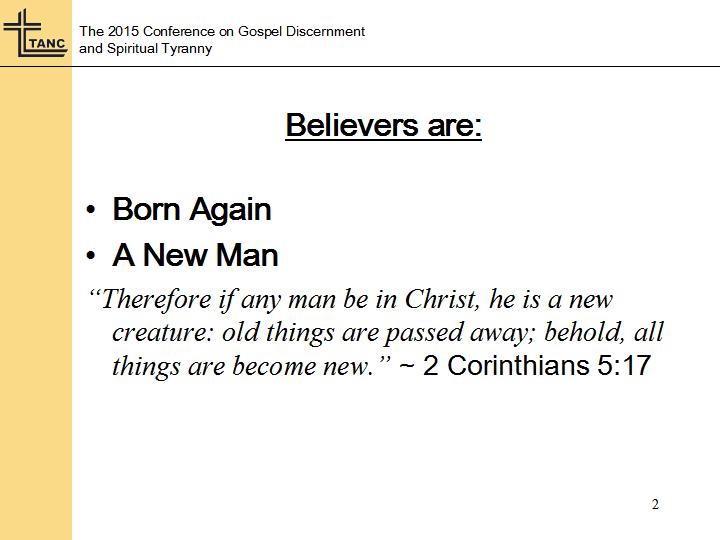
Born again
I want to start off with this right here. This single statement by the apostle Paul is the single-most emphatic statement regarding the reality of the new birth.
“Therefore if any man be in Christ, he is a new creature: old things are passed away; behold, all things are become new.” ~ 2 Corinthians 5:17
In fact the structure of this verse in the Greek is rather interesting. I’m not going to get into a deep study of the grammatical structure of this verse, but there are a couple things I want to point out for starters. Most obvious in this verse is this contrast Paul uses between old and new. And I’m going to speak in depth on this contrast in the next session. But what I want you to see here are the words that Paul uses to express this contrast.
First of all, the “old things”. Now Paul uses a word here that is rarely used for “old”. In the NT there is another Greek word for “old”.
“Old” – παλαιος (pal-ay-OS) – antique, not recent, worn out. Paleontology.
This is the word used most frequently. In other words, when you are reading through the NT and you see the word “old”, most of the time it’s going to be this word “palaeos”. What is worth noting here about this word is that there is an age aspect involved. So this is old with respect to age. I might say, my grandfather is “old”. Or my car is “old”. I’m talking about it being old in years or months or whatever. And like I said I’ll talk more about this in the next session.
But Paul uses a different word here. And this is the word:
αρχαια (ar-KAY-ah) – original, that which was from the beginning, the former.
This is old not with respect to age but with respect to comparison. Someone might talk about his old school or his old job, or his old girlfriend. Now the old girlfriend might not like being referred to as “old”, but in this context we mean former or previous. This is the idea behind the word “archaiah”. So when Paul talks about the old things, he’s talking about the former things or the previous things. Now this is going to be important to understand later on when we talk about this again in the next session, because there is a time aspect involved in that we are referring to something that was in the past, but we are not specifically referencing the age of something. OK? So keep this in mind, we are differentiating between previous things and the age of something.
So Paul contrasts these old things, or these former things, or these previous things, with new things. He says all things are become new.
“New” – καινος (kay-NOS) – new with respect to freshness as opposed to age. Different. A replacement.
“He got a new job”. “My son just transferred to a new school.” “He has a new girlfriend”. You see the meaning here? We’re not talking about the age of something. When I say he got a new job I don’t mean a job that didn’t exist before. Although that could be the case, but fundamentally I’m referring to it being different. Different from the one he had before. This word presents the perfect inverse comparison with “archaiah”. It’s a comparison not of age but to indicate a difference or a distinction between the two. He left his old job; he started his new job. He left his old school; he’s going to a new school (Not one that was just built). He broke up with his old girlfriend; he’s dating a new girlfriend (not one that was just…what? can we say born? Let’s hope not. But you get the idea.)
It’s a profound distinctiveness. There is nothing that remains of the former. You don’t keep any of it around for sentimental reasons. It’s not like you took that which is former and restored it. Or rehabilitated it. No, you completely eliminated the former, the previous, in exchange for a different one. You have something now that is different from what you used to have. And this is a description of the new birth.
Jesus taught this very thing. In the middle of the night, a Pharisee named Nicodemus came to Jesus to ask him questions about His teaching. And he came at night because he didn’t want to be seen talking with Jesus. It would not have been good for him to be seen with Jesus. Because Nicodemus was genuinely interested in what Jesus had to say. And almost immediately Jesus responds to Nicodemus by teaching him about the new birth. He says In John 3:
John 3:3-7 “Jesus answered and said unto him, ‘Verily, verily, I say unto thee, Except a man be born again, he cannot see the kingdom of God.’ 4 Nicodemus saith unto him, ‘How can a man be born when he is old? Can he enter the second time into his mother’s womb, and be born?’ 5 Jesus answered, Verily, verily, I say unto thee, Except a man be born of water and of the Spirit, he cannot enter into the kingdom of God. 6 That which is born of the flesh is flesh; and that which is born of the Spirit is spirit. 7 Marvel not that I said unto thee, Ye must be born again.’ ”
This expression that Jesus uses is two words in the Greek.
γενναω ανοθεν (gen-AH-oh AN-oh-then) – to be born on high, from above
Now Peter takes this expression that Jesus uses, born from above, and he takes that idea with the proper understanding uses a different word altogether. He takes the word “genAHoh”, and combines that with the prefix “ana”, which if it’s used alone it means “up”. But when you combine it as the prefix of another word it adds a meaning of repetition or intensity. So in 1 Peter 1:23, Peter uses the word
αναγενναω (an-a-gen-AH-oh) – to be born again, to be reborn.
1 Peter 1:23 “Being born again, (αναγενναω) not of corruptible seed, but of incorruptible, by the word of God, which liveth and abideth for ever.”
These are the only two passages in the NT where you will see the expression “born again”. It is important for believers to realize they are born again. Why? How is this significant regarding a believer’s identity? Well here it is. Being born again is the basis for righteousness. Let’s run through this again. Why did Jesus die? Did Jesus die to shed his blood to be a covering for our sin? No, Jesus died to end the law. Specifically the law of sin and death. Jesus didn’t cover our sin, He took it away, as far as the east is from the west. What did John the Baptizer say when he saw Jesus coming? “Behold, the Lamb of God which taketh away the sins of the world!” This is the imagery of the scapegoat from Leviticus 16. You remember this? (See video below, mark 37:00, for summary of the scapegoat).
This is what Christ did for us. When he died he ended the law and took away all our sins. They aren’t covered, they are gone! Because what happens when we believe? When we believe on the Lord Jesus Christ, the old man dies. That old man that was under law is dead. The law can’t touch him any more. He was crucified with Christ. And a new man is resurrected in his place. A new man is reborn. The old law of sin and death can’t touch him. And where there is no law there is no sin. Where there is no sin there is no condemnation. Therefore, there is now no condemnation for those who are in Christ. There is no condemnation for the new man. There is no condemnation for the one who is born again because there is no sin because there is no law to condemn him. I know it sounds like I’m repeating myself, but I want this to be clear. I want you to get this.
Now if that wasn’t exciting enough, consider this. You tell this to any of your protestant/reformed friends, you tell them that you are righteous – not just positionally righteous, or forensically righteous, or declared righteous, but that you ARE righteous. That’s your identity. Righteous. Righteous because you are born again. What’s the first they will say to you? “Well did you sin today?” And they are so smug when they say that. They say it like they just gotcha. Ah ha! See! And if you say, no I didn’t sin, then they will immediately pull out 1 John 1:8
1 John 1:8 “If we say that we have no sin, we deceive ourselves, and the truth is not in us.”
Of course this is a proof text taken out of context, but they won’t hear you on that because it doesn’t fit in with their reality. Remember what is their reality? What is man? For that matter what are believers? SINNERS. To them, that is our identity. But let me show you something else John said in that same letter. And I tell you, I’ve read this passage in 1 John many times, and I’ve struggled with it, but then I was preparing this lesson, and I had one of those lightbulb moments, and my jaw hit the floor! And the reality of what I read just thrilled me! And I’m like, of course! That’s it! Let me show you this. Look at 1 John 3:8. Let’s start with that first.
1 John 3:8 “He that committeth sin is of the devil; for the devil sinneth from the beginning. For this purpose the Son of God was manifested, that he might destroy the works of the devil.”
Now the protestant/reformed crowd has a hard time with that verse because that would suggest that if believers still sin then we are still of the devil and not really saved. So they reinterpret it to better fit the orthodoxy. In fact the ESV translates that verse by saying “Everyone who makes a practice of sinning”. So the idea is that a believer sins, but he doesn’t make a practice of sinning. Which,if you think about it, is still an outright contradiction because according to them if it is our nature to sin then we can’t help it anyway, so calling it a practice means that somehow you can choose not to. So this is just one more example of the blatant hypocrisy in reformed doctrine. They play these word games with the text and try to get you to think they don’t really mean what they say.
But then we come to verse 9, and this is where the lightbulb went on. Remember we’re working with the conclusion where there is no law there is no sin. Did you sin today? You can state most emphatically, NO! Why?
1 John 3:9 “Whosoever is born of God doth not commit sin; for his seed remaineth in him: and he cannot sin, because he is born of God.”
Do you realize what this says? The reality of this is incredible! John says plainly, the born again believer does not sin. Not only that, he CANNOT sin! Is this talking about ability? One would think so, but think about what this has to do with the law? Where there is no law there is no sin. The believer CANNOT sin because there IS no sin! This is yet another contrast between the old and the new. Verse 8 and 9. Verse 8 is the old. Before you were born again you committed sin because you were under law. The law condemned you. Therefore you were of the devil. But that was then. The old passed away (the previous, the former). It was replaced with the new (something different). You were reborn and the law was ended and sin was taken away. Therefore you CAN no longer sin because there IS no sin. But it doesn’t end there. John goes on later in the letter and says the same thing again.
1 John 5:1 “Whosoever believeth that Jesus is the Christ is born of God: and every one that loveth him that begat loveth him also that is begotten of him.”
Again, talking about the new birth. Who is the one that begat? That would be God, the Father. We are born of God. Not only do we love the one who begat us, ok, not only do we love the Father, but we also love others, we love everyone else who is also born again. We’ll talk about this some more later on in another session as well. So we have the reality of the new birth once again. But then he continues. Look at verse 18 same chapter.
1 John 5:18 “We know that whosoever is born of God sinneth not; but he that is begotten of God keepeth himself, and that wicked one toucheth him not.”
Do you see how all of this so wonderfully fits together with the rest of what scripture teaches! How wonderfully consistent this is when we understand it in context. There is no conflict here. We don’t have to twist the words around to make it fit. It is logically consistent. This is the reason why believers are righteous. This is why we can say without a doubt, nope, I didn’t sin today. I am not condemned today. See and that’s really what they are talking about when it comes right down to it. Sin has to do with condemnation and judgment. Their reality says that when you sin, you need another covering to keep you from being condemned. But you see, this is what they don’t get about it.
So, what is our identity as believers? Are we sinners? No, we are born again. We are righteous. We cannot sin because there is no sin. The law was ended and our sins were taken away. We are truly righteous by virtue of our new birth. Do you see how important this is to understand? This reality alone is so liberating. Once believers come to the realization of who they are because of the new birth and what that actually means. This has got to be such an encouragement. To get out from underneath this burden of being constantly reminded that you’re a sinner, you’re a sinner, you’re a sinner, and to suddenly realize that no, I cannot sin. Not just I do not sin, but I cannot sin. How tremendously freeing that has to be for someone who’s been told otherwise all his life. So that is where I’m going to stop for this session. We’ll look at some more examples of the believer’s identity in the next session.
TANC 2015, Andy Young – Session 3: The Believer’s Identity
This is session 3. We’ve been challenging presuppositions regarding a believer’s identity, especially this notion that believers are sinners. That’s what we hear most often in just about every Christian circle, in just about every church you go to around the world. The emphasis that we are sinners. That because we are sinners we still need a savior. And of course this particular emphasis flows right out of the reformation. This was taught by Calvin and Luther, this idea that believers don’t change, that they are still under law, that they are still in need of daily salvation. We have a term for that, it’s called progressive justification. And whether people want to admit it or not, anyone who echoes these kinds of sentiments – and this is just one indication of the kind of theological ignorance that exists among believers, they are actually espousing a progressive justification viewpoint with these kinds of statements.
So we’re trying to reverse the damage that has been done to the spiritual psyche of the believer as a result of years and years of having this mantra constantly pounded into our heads. You are a sinner, you are a sinner, you are not perfect, you are totally depraved, your righteousness is filthy rags. We need to stop telling ourselves these things, and we need to change the narrative and look at what the Bible actually has to say in this regard.
Session 1 was devoted to our identity with respect to the new birth. What that actually means to be born again, and why that is important. And then in session 2 we explored the contrast between the old and the new, and we saw how that the “New Man” is actually a reference to the one spiritual body that was made up of people from every nation and status in the world. How we are no longer identified as either Jew or Greek, etc…and we become part of this New Man, the Body of Christ.
So now in this last session on the believer’s identity, I want to take a look at a few more ways that the scriptures refer to believers. And these won’t spend as long as we did on the first two, so we should be able to run through these rather quickly, but that doesn’t make them any less important. Each one of these is a critical part of our identity as believers.
So the Bible says the believer is born again, he is a new creature, he is part of the New Man, the Body of Christ. What else is he?
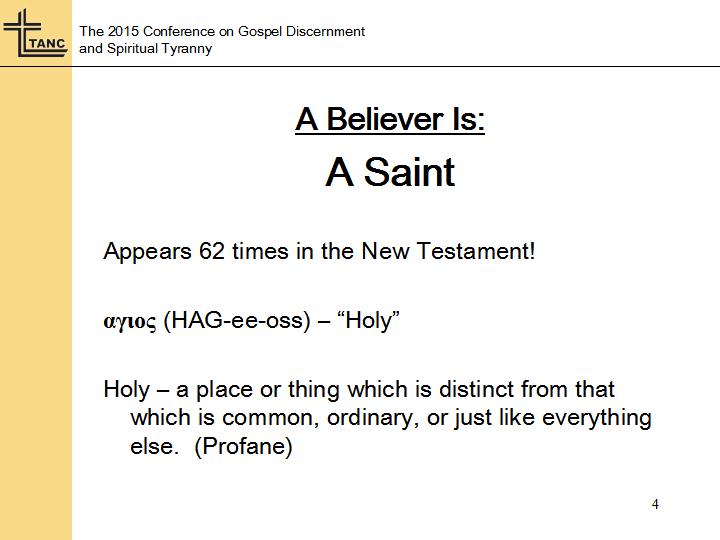
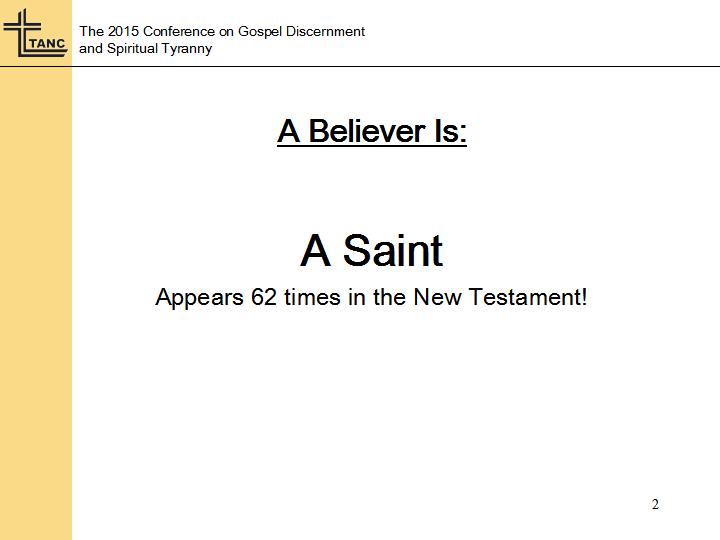
A saint
How is that for a title? Did you know you’re a saint? Now here is a word that couldn’t be any farther opposite from sinner! Do you know how many times believers are referred to as sinners? I could probably point to no more than maybe 5 at most. And even in those instances it is always in the past tense. Do you realize the frequency that believers are referred to as saints? 62 times in the NT, believers are referred to as saints. 62 times! I’m not going to show you all of them, but here are a few select. You’ll see that in just about every epistle the believers are addressed as saints in the salutation.
Romans 1:7 “To all that be in Rome, beloved of God, called to be saints: Grace to you and peace from God our Father, and the Lord Jesus Christ.”
1Corinthians 1:2 “Unto the assembly of God which is at Corinth, to them that are sanctified in Christ Jesus, called saints, with all that in every place call upon the name of Jesus Christ our Lord, both theirs and ours:”
Ephesians 1:1 “Paul, an apostle of Jesus Christ by the will of God, to the saints which are at Ephesus, and to the faithful in Christ Jesus:”
Romans 15:25-26 “But now I go unto Jerusalem to minister unto the saints. 26 For it hath pleased them of Macedonia and Achaia to make a certain contribution for the poor saints which are at Jerusalem.”
Ephesians 4:12 “For the perfecting of the saints, for the work of the ministry, for the edifying of the body of Christ:”
And we could go on and on and on. Believers are saints. Now, as if that wasn’t exciting enough, take a look at this word in the Greek. Do you know what the word saint is in the Greek?
αγιος (hag-ee-oss) – “Holy”
Look at that. Holy. In each of the 62 instances it is this word for holy. That means you could go through each instance, 62 times in the NT, and replace the word saint with holy, or holy ones. The Bible calls believers “holy ones”. You are holy. Did you know that? You are not a sinner, you are holy! You are a holy one.
Now if any of you watching online now or maybe later on when this is archived, if you tuned in last year for the conference you will remember I talked about Sanctification. And in my first session last year I walked us through scripture and we were able to derive a truly biblical, meaningful definition of this word holy? Does anyone remember what we came up with? If you don’t remember or if you didn’t tune in for that session, here is the definition we came up with for holy.
Holy – a place or thing which is distinct from that which is common, ordinary, or just like everything else. (profane)
And as we worked through our understanding of this word we discovered that the opposite of holiness was not sinfulness, but profane. And profane in the Biblical sense has to do with this idea of being common, or ordinary, or just like everything else. So, while it is true that believers are not sinners – we’ve already established that through the new birth – we have a special status. We are holy. We are distinct from that which is profane. We are not common, we are not just like everybody else. Some people like to use the term “set apart” as a means of understanding our sanctification, and that’s a good way to look at it because it encompasses this notion of being distinct. Setting something apart makes it distinct.
So this takes us back to the sanctification issue that I talked about last year. And I think it begs the question, if we are saints, if we are holy, if we are distinct, ought we to not act like it? And I don’t mean we go around casting judgment on others and act like we are better than everyone else. But if we are in fact holy, don’t you think our behavior should reflect that holiness? See, we don’t let our behavior define who we are, but rather I think it’s the other way around, who we are should manifest itself in our behavior. And you can think back to our last session on the New Man, were we had this contrast between behaviors that characterized the old man, like lying and arguing and licentiousness, and behaviors that characterize the New Man, loving each other, caring for each other, and so on. And you see the motivation for this is love. This has to do with love for the law and keeping the law. Not for justification, but because we love our Father and we love others, so we use the law in this way, we keep the law out of a motivation of love. And this is the reality of what it means to be a saint; to be a holy one.
So believer’s are saints. What else are we? How does the Bible refer to believers?
Oh I love this one.
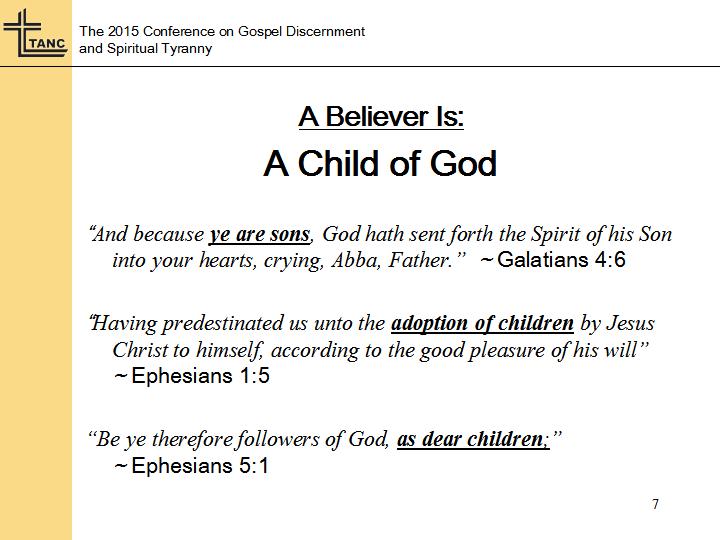
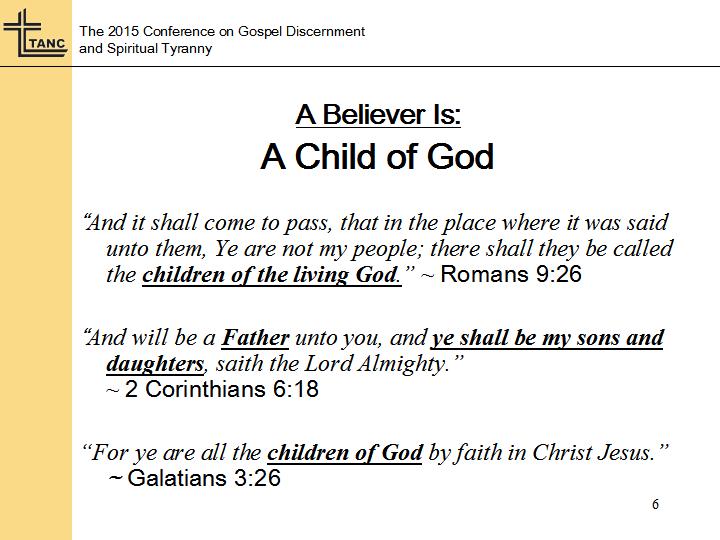
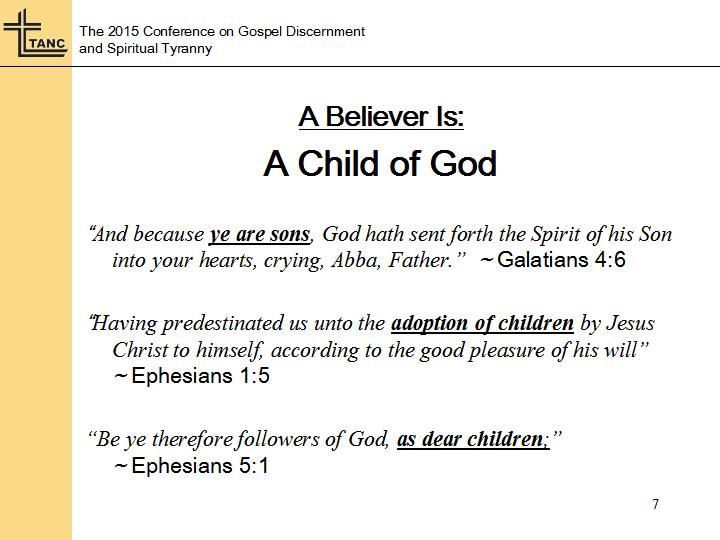
A child of God
I know I have a lot of references here, but can we just take the time to read through these. It’s such a good reminder, and it’s such a blessing!
Romans 8:14 “For as many as are led by the Spirit of God, they are the sons of God.”
Romans 8:16-17 “The Spirit itself beareth witness with our spirit, that we are the children of God: 17 And if children, then heirs; heirs of God, and joint-heirs with Christ; if so be that we suffer with him, that we may be also glorified together.”
Romans 9:26 “And it shall come to pass, that in the place where it was said unto them, Ye are not my people; there shall they be called the children of the living God.”
2 Corinthians 6:18 “And will be a Father unto you, and ye shall be my sons and daughters, saith the Lord Almighty.”
Galatians 3:26 “For ye are all the children of God by faith in Christ Jesus.”
Galatians 4:6 “And because ye are sons, God hath sent forth the Spirit of his Son into your hearts, crying, Abba, Father.” (daddy reference)
Ephesians 1:5 “Having predestinated us unto the adoption of children by Jesus Christ to himself, according to the good pleasure of his will”
Ephesians 5:1 “Be ye therefore followers of God, as dear children;”
1 Thessalonians 5:5 “Ye are all the children of light, and the children of the day: we are not of the night, nor of darkness.”
1 John 3:1-2 “Behold, what manner of love the Father hath bestowed upon us, that we should be called the sons of God… 2 Beloved, now are we the sons of God…”
And of course this goes right back to all the things we talked about in session 1. How is it that we are children of God? We are children by virtue of the new birth. Do you see how significant the new birth is?
Being born again, being born of the spirit is being born of God. Where God is your Father, and you are His child. If you deny the new birth, you deny your identity as a child of God and you forfeit all the rights that go with that as being sons.
Now there’s a lot more that can be said about the significance of being a child of God. You saw the reference about being an adopted child. Now an adopted child is what, one who was not born to the parents who have legal custody of him, right? So I don’t want us to misunderstand when Paul uses this terms referring to adopted children. The new birth is a reality. We are born of God in every sense of that word. The new birth is an actual birth. It is not something that we have already that God then accepts as His own and reforms it.
What Paul is referring to here to the Ephesians has to do with the relationship to Israel. There was always this distinction between promises made to Israel that will be fulfilled with Israel, and how Israel would always have a claim to the promises and covenants that God made to her children. And since the Gentiles were not part of Israel, what happens when a Gentile believes is that he is then made part of Israel, adopted in that sense, and so he then has access to those same promises by rights as an adopted child. He said this also in Galatians that those who come to faith in Christ are considered the children of Abraham, adopted into the promises made to Israel. And he elaborates on this even further in Romans. So I want you to understand that this notion of adoption is a reference to being included with Israel in the promises and does not contradict the reality of the new birth.
There is another significance to being a child of God. Let me ask you something. Those of you who have children, when your children disobey you, do they stop being your children? When your child fails somehow, does he stop being your child? Or when your child grows up and starts his own family, even though he is no longer under your roof, does he stop being your child? Does your child ever stop being your child? No, and so from this we begin to understand this doctrine of eternal security. You want to know why you can never lose your salvation? Because you are a child of God. God never disowns you. You can’t be unborn into His family.
Now of course we know of instances where our children may not want to be a part of our family. They may run off and not act like our child. But they are still our child. There is some aspect of this to be found in the parable of the prodigal son. Now I understand that the main purpose of that parable was to draw a contrast between the Pharisees and the other religious leaders and the remainder of Israel, and that Israel was like a lost son who had run away from his Father. Jesus said he came to save the lost children of Israel. And so there is this picture of God calling out to his lost children to come home to him. But if you notice something else in that story, the prodigal son never stopped being a son. The Father looked for him every day to come home. He was ready to bestow upon him the riches that were there for him. And so in that sense there are sometimes believers who wander away and don’t act like sons, but they never stop being sons.
And I kind of touched on another point there; this thing about being a child has other significance too that I will get to in a moment. But before we get to that, along with being a child of God is this next point.
A brother of Christ
This one might be a little controversial because it’s not something that you here brought up much if at all. But I think it is a reality that is taught in scripture. Scripture doesn’t say much about Christ being our brother, but there are a few passages that reference it. Let’s start with this.
Matthew 12:46-50
“While he yet talked to the people, behold, his mother and his brethren stood without, desiring to speak with him. 47 Then one said unto him, Behold, thy mother and thy brethren stand without, desiring to speak with thee. 48 But he answered and said unto him that told him, Who is my mother? and who are my brethren? 49 And he stretched forth his hand toward his disciples, and said, Behold my mother and my brethren! 50 For whosoever shall do the will of my Father which is in heaven, the same is my brother, and sister, and mother.”
Alright, so what exactly is Jesus saying here? Let’s first understand that when we read the word “disciples” in any of the synoptic gospels that it’s not just a reference to the 12 disciples. It is clear if you read the gospels that Jesus had a lot more disciples or learners that just Peter, Andrew, James, John, and the rest. Whenever the writer wants to make this distinction he usually refers to them as “the twelve”. But whenever we see the generic reference “disciples” that’s a reference to all of them. And this was a number that reached into the hundreds at times.
So among these disciples following Jesus, are any of them his mother? No. So it’s easy to assume that when Jesus makes this statement in verse 49 that it is not a literal reference to his physical earthly family. Not only that, but Jesus Himself states very plainly what he means by his statement. He explains it. Whosoever shall do the will of my Father which is in heaven, the same is my brother, and sister, and mother. We all have people in our lives that we regard as family who are not literally a part of our family. I have a very good relationship with my wife’s parents, and I regard them as my mother and father ever though they did not give birth to me. I even call them Mom and Dad. That’s the kind of relationship we have. That is how close we are. You may have a best friend who you think of more as a brother or sister than simply a friend. And of course this has to do with the nature of your relationship with them.
So the point Jesus is making in this statement has to do with how He views His relationship with those who do the will of the Father. He views them as family. Now by extension, we can take this one step further. When we consider the reality of the new birth, that those who do the will of the Father are those who are born again, then in reality, we are then literally part of God’s family, including the Son, Jesus. So as far as God’s family is concerned, we are all brothers and sisters, and that would include Jesus. We can be considered as brothers and sisters of Christ. And I believe in this passage here in Matthew, that is exactly what Jesus is talking about. But what else does scripture have to say about this family relationship we have with Jesus?
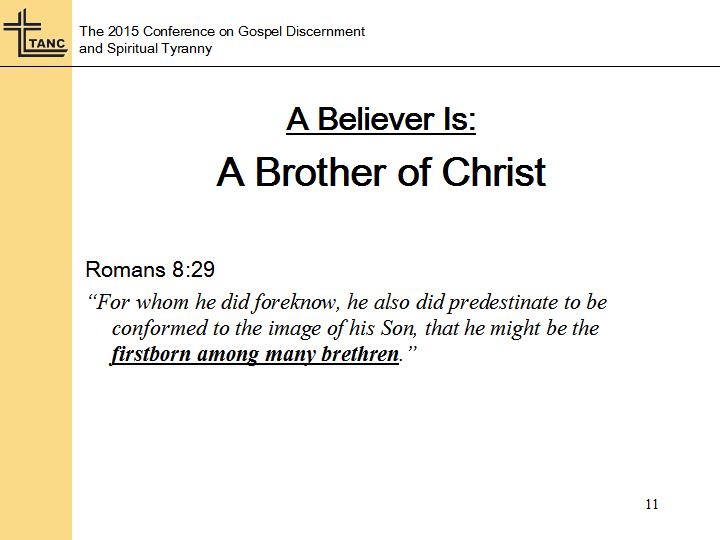
Romans 8:29
“For whom he did foreknow, he also did predestinate to be conformed to the image of his Son, that he might be the firstborn among many brethren.”
I’ve underlined the key phrase in that verse. If you study the grammatical structure of that verse, “firstborn among many brethren” is speaking of the Son. And the preposition “among” is inclusive. It indicates inclusiveness. If you are among something you are part of it. If you are among the crowd you are included in the crowd. What Paul says here is that there are many brethren, and Jesus is one of them, more than that, he’s the oldest. He is the firstborn. And if we think back to our study of the Body of Christ, the New Man, His right as firstborn makes Him the Head. How is it that Jesus is firstborn? He was the first resurrected following the ending of the law. And as such, each believer, by virtue of the new birth is resurrected just like Christ, we are born anew, as new creature that is not under law. A new creature that is also a child of God. And if we are a child of God, and Jesus is the Son of God, that makes Jesus our brother. Our oldest brother, our firstborn brother. We see this same idea expressed here as well.
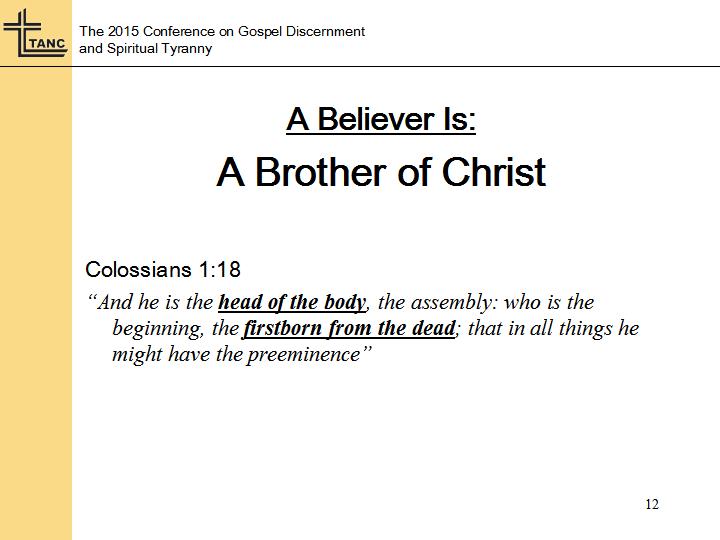
Colossians 1:18
“And he is the head of the body, the assembly: who is the beginning, the firstborn from the dead; that in all things he might have the preeminence”
Here again is that reference to Jesus being the firstborn, and His right as firstborn to be the Head of the Body. If any of you out there are an only child and have always wanted a brother or a sister, think about what a wonderful reality it is to know that you are now part of a family full of brothers and sisters, and the God of Heaven is your Father. And because of that, Jesus, the King of Kings, is your brother!
Now we’re talking about brothers and sisters and families, and I want to jump back to another point I alluded to earlier when we were talking about being a child of God. I mentioned how that being a child of God has another significance to it. As the Son of God, Jesus was entitled to certain privileges. As the firstborn, He is made Head of the Body. We have certain privileges as well, since we are also children of God because of the new birth.
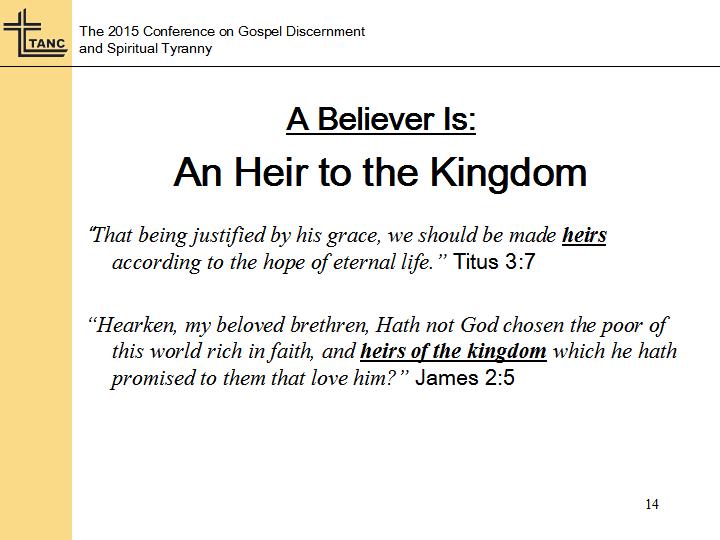
Because of the new birth, the believer is an heir to the Kingdom of God.
An heir to the Kingdom
And this is the last point I have about a believer’s identity. An heir to the Kingdom! Take a look at some of these passages
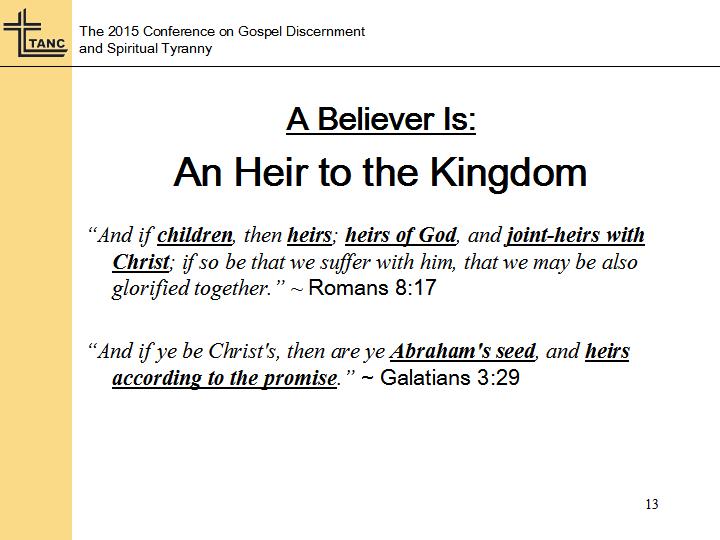
Romans 8:17
“And if children, then heirs; heirs of God, and joint-heirs with Christ; if so be that we suffer with him, that we may be also glorified together.” Here’s another reference that alludes to Jesus being our brother. We are joint heirs with Christ.
Galatians 3:29
“And if ye be Christ’s, then are ye Abraham’s seed, and heirs according to the promise.”
Being born again makes us part of Abraham’s children and eligible to participate in the promises and covenants made to Israel.
Titus 3:7
“That being justified by his grace, we should be made heirs according to the hope of eternal life.”
James 2:5
“Hearken, my beloved brethren, Hath not God chosen the poor of this world rich in faith, and heirs of the kingdom which he hath promised to them that love him?”
Of course when you talk about being an heir to something that means that there is an inheritance waiting for you.
Inheritance
Ephesians 1:14
“Which is the earnest of our inheritance until the redemption of the purchased possession, unto the praise of his glory.”
This is talking about the Holy Spirit. The Holy Spirit is an earnest payment. Like a down payment. A good faith payment that there will be a full payment coming at a later time. The Holy Spirit is a part of our inheritance given to us now as an indication of a promise of more that is to come later.
Ephesians 1:18
“The eyes of your understanding being enlightened; that ye may know what is the hope of his calling, and what the riches of the glory of his inheritance in the saints,”
Colossians 1:12
“Giving thanks unto the Father, which hath made us meet to be partakers of the inheritance of the saints in light:”
Colossians 3:24
“Knowing that of the Lord ye shall receive the reward of the inheritance: for ye serve the Lord Christ.”
1 Peter 1:3-4
“Blessed be the God and Father of our Lord Jesus Christ, which according to his abundant mercy hath begotten us again unto a lively hope by the resurrection of Jesus Christ from the dead, to an inheritance incorruptible, and undefiled, and that fadeth not away, reserved in heaven for you,”
And there are several things that are in view here with regard to inheritance, eternal life not the least of them. An incorruptible body, eternal fellowship with the Father. We don’t really know what we will be doing for eternity, but we know for certain that there is a Kingdom that awaits us. This is what Jesus came to earth to offer. You may have heard pastors say, what did Jesus preach? What was His message? And they’ll say He preached the gospel. We need to preach the gospel. Well what gospel? The word for gospel simply means a good message. Any good message is the gospel. The word for evangelist is literally “good messager” To evangelize means to “good message” someone. To deliver a good message. To deliver the gospel. But what gospel?
When you go back and read through the NT, if you study carefully, what you will notice consistently is that when a reference is made to the gospel, it is consistently referred to as the gospel of the Kingdom. When Jesus is introduced in the gospels, when His ministry first starts, it says he was preaching the gospel of the Kingdom. The apostles preached the gospel of the Kingdom. This is what we have to offer people when we tell them about Christ. He came to offer a Kingdom. And your ticket into the Kingdom is the new birth through faith in Christ. The new birth makes you a child of God. As His child you have an inheritance waiting for you. You have the right to everything that the Father owns. He bestows it upon you.
One day, this old heaven and earth are going to melt away with a fervent heat. And in their place will be a new heaven and a new earth. And the City of God, the New Jerusalem will descend from heaven and come down upon this new earth. And God will make His tabernacle with man. God will dwell with man forever and ever. This is the city that Abraham looked for. A city not made with hands, whose builder and maker is God. And we will dwell there with the Father. This is what we have to look forward to! This is our inheritance as believers.
I hope that at the end of this study you have a better understanding of just who we are. We are not sinners. We are not totally depraved, unrighteous, wretched people. We are new creatures. We are born again. We are part of the New Man with Christ as the Head. We are God’s children. Son’s and Daughters of the heavenly Father. We a part of God’s family with Jesus as our brother, joint heirs with Him in a heavenly inheritance that awaits us. This is the blessed hope that Paul spoke of. Not hope as in a wishful thinking. This is a hope that is a joyful anticipation of something that is assured. As believers, this is the way we need to be thinking. We need to be aware of just who we are. This is knowledge that empowers us and affects everything we do in life. We go into the world armed with this knowledge, think of how much more effective our witness and our testimony is to those we’re trying to reach with the gospel. Think of how much better our own lives will be. We focus on the good instead of evil. We don’t rejoice in iniquity.
And I could go on and on here, but I hope you get the point. And I think that might be a good way to wrap up this session, by opening things up to you out there, and let me ask you, how do you apply this to your life? What does this mean for you personally? How does this affect you? What ways does this make you think differently? I leave you with these questions, so please feel free to answer and share with us any thoughts you might have.
Podcast link: listen or download audio file.

















TANC 2015 Live, Andy Young, Session 2



2015 TANC Conference Speaker:
 Andy Young
Challenging Presuppositions of the Believer’s Identity
Session 1: Friday, August 28, 2:15 PM
Session 2: Saturday, August 29, 8:00 AM
Session 3: Sunday, August 30, 2:15 PM

 Paul's Passing Thoughts
5 comments