LAW and Calvin’s False Gospel
 Here I am, some thirty years after being saved, and looking back; and I can tell you that theological training from the pulpit to the saint is abysmal. Hence, today’s Christian landscape. If Christians are ignorant in regard to their relationship to the law, they are open to just about any proposition that would come down the pike—Reformed theology far from being excluded.
As previously discussed here at PPT, the primary problem with Reformed theology is that it fuses justification and sanctification together, but another glaring contradiction to truth is its view of the law. One stands amazed that the election/freewill debate is even the issue.
Let’s begin by looking at the truth concerning the relationship of the law to Christians. First, “law” is really a biblical term that is speaking of the word of God as a whole. The word is used interchangeably throughout the Bible with “Scripture, “word,” law and the prophets,” etc. Only thinking of law as the Ten Commandments or biblical imperatives is not helpful. Matthew 4:4, as well as many other texts, refer to the Bible as being God’s complete philosophical statement to man in regard to life and godliness.
Second, there is an anthropological law of God written on the hearts of every person born into the world:
They show that the requirements of the law are written on their hearts, their consciences also bearing witness, and their thoughts sometimes accusing them and at other times even defending them (Romans 2:15).
Therefore, sadly, antinomian Christians will display worse behavior than the unregenerate that follow the law written on their hearts. All people are also accused or defended according to this inherent natural law by their consciences. Even after salvation, Christians are to utilize this aspect of our design in sanctification (1Timothy 1:5, 1:19, 3:9, 4:2, 2Timothy 1:3).
But the law also poses a continual confrontation and dilemma for the unbeliever. Without Christ, it is their only ticket to heaven—good luck with that one, and the violation of one law is all it takes to condemn in the first place (James 2:20), plus the law provokes sin. Somehow, knowing of a law tempts the unbeliever to actually break it—leading to death. So, God sent the law to increase sin as a way to show the unbeliever their need for Christ (Romans 5:20, 7:5 Galatians 3:24,25).
Now, this is the part that is hard to get our minds around, but when we are saved, the law is abolished…for justification purposes. All men are born “under the law.” It is a covenant that they are born under, but it also enslaves them to sin. When we are saved; ie. when we die in Christ, the covenant of the law is cancelled in the same way that a marriage covenant is cancelled when one of the spouses dies, and we are also freed from the enslavement of the law as well (Romans 7:1-4). We are then raised to new life in Christ that totally changes our relationship to the law—we are now free to obey it and experience the blessings of the “perfect law of liberty” (James 1;25). It is utterly awesome to study all of the different ways other than these in which the word of God frames the law’s different relationship to the believer verses the unbeliever. Rather than the law being nothing more than a covenant of condemnation constantly pointing us to Christ, it is now what we need to be equipped for every good work (2Timothy 3:16,17). So, our relationship to the law must always be framed according to the following: ….for justification, or ….for sanctification.
But here is the HUUUUUUGE problem with Reformed theology, and Calvinism in particular: the relationship between the law and the believer does not change after salvation. They even say in broad daylight that it still shows us our need for the cross, or still leads us to Christ. Supposedly, we are therefore continually sanctified by the death of Christ. This is blatant heresy of the worst order. What more do I really need to make my case other than the highly acclaimed cross graphic below?

Like the law’s relationship to the believer before salvation, the law points to a continual need for the cross (or gospel). The relationship doesn’t change. This fact is articulated well by Michael Horton on page 62 of Christless Chritianity:
Where we land on these issues is perhaps the most significant factor in how we approach our own faith and practice and communicate it to the world. If not only the unregenerate but the regenerate are always dependent at every moment on the free grace of God disclosed in the gospel, then nothing can raise those who are spiritually dead or continually give life to Christ’s flock but the Spirit working through the gospel. When this happens (not just once, but every time we encounter the gospel afresh), the Spirit progressively transforms us into Christ’s image. Start with Christ (that is, the gospel) and you get sanctification in the bargain; begin with Christ and move on to something else, and you lose both.
So, in other words, if we move on to “something else” other than the gospel, we lose “both.” Both what? Sanctification and justification—if we move on to a different perspective on the law that isn’t gospel focused; ie, a continual need for the same gospel that saved us. All law must be seen as grace “disclosed in the gospel.” This unchanging relationship to the law in regard to salvation is plainly aped by John Calvin in book 3, chapter, 14, and sections 9-11 in the Calvin Institutes:
Although we see theft the stains by which the works of the righteous are blemished, are by no means unapparent, still, granting that they are the minutest possible, will they give no offense to the eye of God, before which even the stars are not clean? We thus see, that even saints cannot perform one work which, if judged on its own merits, is not deserving of condemnation.
God does not (as many foolishly imagine) impute that forgiveness of sins once for all, as righteousness; so that having obtained the pardon of our past life we may afterwards seek righteousness in the Law. This were only to mock and delude us by the entertainment of false hopes. For since perfection is altogether unattainable by us, so long as we are clothed with flesh, and the Law denounces death and judgment against all who have not yielded a perfect righteousness, there will always be ground to accuse and convict us unless the mercy of God interpose, and ever and anon absolve us by the constant remission of sins.
Please note, since our relationship to the law is not changed, “….there will always be ground to accuse and convict us unless the mercy of God interpose, and ever and anon absolve us by the constant remission of sins.” And, “God does not (as many foolishly imagine) impute that forgiveness of sins once for all, as righteousness; so that having obtained the pardon of our past life we may afterwards seek righteousness in the Law.”
Notice that Calvin frames sanctification in a linear law that demands perfection to remain justified. We rather contend that law in regard to justification has been abolished and replaced with a different relationship to the law.
I strongly suspect that the Reformed gospel is grounded in the Platonist view of truth which holds to the idea that truth is immutable. Hence, to say that the law has a different relationship to the believer verses the unbeliever would be to believe that the standard of the law changes. This breaks a fundamental rule of Platonist metaphysics. It also explains the Reformed rejection of anything that smacks of dispensationalism. Furthermore, to abolish the law….for justification, and uphold it ….for sanctification, would be an enablement for man (or the general population of the saints) to participate in interpreting truth, which is a clear violation of Platonist epistemology. More research is needed, but this is where my strong suspensions are leading me.
Nevertheless, Calvinism is still plainly guilty of fusing justification and sanctification together with an unchanging relationship to the law following. In the Reformed mind, the law remains the standard for maintaining justification, and believers remain under it….for justification. Which is a huge problem.
paul
Guest Author Susan Dohse: “I Need My People”
 Editors Note:
It is a wonderful privilege for me in regard to Susan’s willingness to post here at PPT. Susan is a free thinker, loves thinking, and is known among her many former students as the teacher who always challenged them to think. Susan’s relationship with God is very personal, and at times this is very challenging for me because of my Reformed background. Though the Reformed speak of an intimate relationship with God—that is simply not true, and I still have a long way to go in shedding my distorted, impersonal view of God. So, when Susan first brought me this post, I was somewhat taken aback in regard to the suggestion that God wants things. To the Reformed mind, that is an absurd notion. Somehow, a God that has desires doesn’t want anything, and for certain, doesn’t need us for anything as well. This post challenged me to ask many interpretive questions about my view of God. And that is what PPT is all about: challenging each other with thoughts and ideas that hopefully aid us in a deeper understanding of our great God.
Paul M. Dohse
I Need My People
By Susan Deborah Dohse
Note: The letter H is used to replace the child’s name in order to preserve privacy.
Bright-eyed, and with a smile that could melt the coldest heart, he came into my classroom holding tightly to his father’s hand. “I’m H,” he said to me in a friendly, confident voice, but his body language spoke volumes. He held on tighter to his father’s hand, and leaned into his dad’s side. H was anxious about his first day in my class. I showed him where he could sit. He turned to look at his dad. When Dad nodded, H sat down in our Circle Area. “Have a good day, H. I love you.” Dad kissed the top of his son’s head and exited the room. I assured H that his daddy would be back later to get him.
His first day in my class was truly great, and the rest of the week went amazingly well. H’s adjustment to his new school environment was phenomenal. You see, H had already been asked to leave one preschool and his parents were hoping that this school setting would be different. The weeks following revealed some aspects of his developmental delay that we all hoped would not manifest itself; those issues being physically aggressive and impulsive behaviors toward peers and adults. If H did not like someone, he would pinch, scratch, or hurt them. On the other hand, if he really liked someone, he would get very close to them and put his face in their face. This was very intimidating to a preschooler who had just witnessed a friend being pinched by H. Outside play was the most difficult to monitor. H was a follower and an imitator. The outside play area was large and the boys loved to run and chase each other. If the boys were running, H was running after them, even if he did not understand the game.
A tool we made to help H in the learning of appropriate play skills was a social story book. Over time progress was made and his negative behaviors diminished. However, there was a situation when lining up to go outside when H pushed a classmate in line, not a nudge, but a big hefty push. So H had to wait for his friends to leave and stay with me in the room for a few minutes. It was a teaching moment to again review with H the rules of friendship. H burst into tears! I was totally taken aback. I had yet to see him cry or show remorse for any of his negative behaviors.
“I need my people!” he wailed. He repeated that need several times with tears flowing down his face, “I need my people!”
It took some time, but H became calm. I took the opportunity to speak to his need as well as his friends’ needs. He needed his people, but his people needed him to have nice touches. He needed his people, but his people needed him to keep his hands to self. He needed his people, but his people needed him to wait in line. H was allowed to go outside to play, happy to be with his people at last.
Over the course of the remainder of the school year, H had ups and downs in his learning of socially acceptable skills, and his parents noticed the improvements and how they carried over into other play situations at home and in the community. “I need my people” was used many times by H to express his need to be with his friends. I now find myself using his phrase at home when I need Philip or Paul to help me. And when I do, it reminds me of H.
Does Almighty God have needs? Not requirements as in He needs us to do something, to change something, or to go somewhere, but does God have personal needs? In Webster’s Dictionary, the word need is defined as necessity, or lack, urgent want. In both the Old and New Testaments there are references to God having an urgent want, a need. In Exodus 6:7 God needs his peopleto be relieved of their burden. In Deuteronomy 4:20 He needs His people to be redeemed. II Samuel 7:23,24: a need for His people to be a people of inheritance. Jeremiah 13:11: a need for His people to Cling to Him. In the New Testament book of Luke 1:17, a need for His people to be prepared. In Titus 2:1, a people zealous of good works.
If God has personal needs, then as His child, am I not obligated to find ways to meet those needs? What a concept and deep spiritual calling. Meet the needs, the urgent wants of God.
If God has a need for me to be relieved of my burdens, how do I meet that need? By casting all of my cares upon Him, for He cares for me.
If God has a need, an urgent want for me to be redeemed, how do I meet that need? Believe on the Lord Jesus Christ. If God has a need, an urgent want for me to be a child of inheritance, how do I meet that need? Through kingdom living. If God has a need, an urgent want for me to be prepared, how do I meet that need? Work for the night is coming. If God has a need, an urgent want for his child to be zealous of good works, how do I meet that need? Godly thinking and godly doing.
I will continue to search the Scriptures for other personal needs of God, and then I will search the Scriptures for the ways and means as His child to meet those needs.
How I miss H. He has moved onto Kindergarten and will find new people to need. But that four year old taught me lessons with eternal benefits, and has given me a glimpse into some of God’s needs.
susan
John Calvin: Gnostic Extraordinaire
“If you believe that going to a Reformed ‘biblical’ counselor is about change, I have some oceanfront property in Xenia, Ohio that I would like to sell you.”
“In the first sentence of the Institutes, Calvin completely circumvents one of the primary purposes of God’s word for the believer.”
Note: You can click on charts to make them bigger.
It’s really not rocket science. The much touted idiom for Reformed thought is, the objective gospel outside of us. What does this mean? It means that all truth, wisdom, knowledge, and reality is contained in the knowledge of God which =’s “the gospel” which =’s the “personhood and works of Christ.” The dirty little Reformed secret is that the effects of the knowledge of God continues to remain outside of us even after salvation. Recently, New Calvinists have had to come clean on this to some extent by admitting that total depravity also applies to believers, and much to the consternation of Sanctified Calvinists who don’t know that they have been sanctified from Reformed soteriology. TANC is in the process of producing a 12 step program for recovering Sanctified Calvinists. The first step is to admit that Calvin was a Gnostic: “Hi, my name is Bob, I unwittingly promoted a Gnostic for ______years.” Hi Bob. The second step is vital for rebuilding self-esteem: “Hi my name is Bob, I have never been a Gnostic, and I am not totally depraved.” Hi Bob.
Obviously, if you are totally depraved, you can’t know anything that actually becomes a part of you and changes your behavior. Sanctified Calvinists must come to grips with the logical conclusions that follow the idea that GRACE remains completely outside of the believer. Reformed thought eventually referred to the antithesis of the “true gospel” as “infused grace.” In other words, the new birth does not change the individual by making grace a part of him, and thus making change possible via the new creaturehood. If words mean things, and they do, total depravity does not = change. Hence, grace does not enable individuals to perform works.
This line of thought educes statements from the likes of Tullian Tchividjian who boasts that he has never done one work that pleased God and looks to this as the assurance of his salvation. These fanatical concepts are running amuck and unfettered in today’s church because they came from Calvin, and nobody wants to take on Calvin. This is because too many have not paid attention for too long and now don’t want to look stupid. Basically, instead of thinking for themselves, and studying for themselves, they followed others.
John Piper teaches that the crux of the Reformation was the idea that grace remains outside of us after salvation. In other words, grace changes our position, but not us. And he is exactly correct in his assessment. He, like the Reformers, attributes infused grace to the very root of all evil as demonstrated by the following chart published by a Reformed think tank (I discuss Piper’s Reformed view of this in detail: chapter 4 of The Truth About New Calvinism):

I have a lot of work to do in order to nail all of this down specifically, but the basics are pretty simple: if you note the chart above carefully, and think about it, the only place to go from there is Gnosticism—Gnosticism makes it work—Gnosticism is the practical application—nothing else works. By the way, a primary contributor to the above chart was Graeme Goldsworthy. Think about that one for a while. Graeme Goldsworthy was also a contributor to an article entitled, “The False Gospel of the New Birth.” In the article, the new birth is explained away by the Gnostic concept of “emphasis.”
Plato, the father of Gnosticism, believed that matter was a form or shadow of the true, good, and beautiful. The forms were certainly TRUE in regard to being a reality, but man’s basic problem was that he/she EMPHASIZES the shadows over the true form. Likewise, the new birth is true, but is merely a form of the true gospel. Focusing on the new birth (ie., our responsibility to exercise our redeemed will to obey God), “eclipses” the true Sun (a play on words). The life-giving ray of the Sun that manipulates dead matter and gives it form is a constant theme throughout the Calvin institutes and literature like Pilgrims Progress. We are frozen blocks of ice until the Sun shines its light on us and changes the form of the block gradually, but obviously, the block of ice has no participation in the process.
Calvin presents this Gnostic epistemology in the very first sentence of his Institutes. He states:
Our wisdom insofar as it ought to be deemed true and solid wisdom, consists almost entirely of two parts; the knowledge of God and of ourselves. But as these are connected together by many ties, it is not easy to determine which of the two proceeds and gives birth to the other. For in the first place, no man can survey himself without forthwith turning his thoughts toward the God in whom he lives and moves; because it is perfectly obvious, that the endowments which we possess cannot possibly be from ourselves; no, that are very being is nothing else than subsistence in God alone.
So, ALL wisdom concerns knowledge of ourselves and God, but the knowledge of ourselves must come first through God. And, since God is the good, and we are the evil, God is the knowledge of the good and we are the knowledge of the evil. All of the Calvin Institutes are framed within this prism—the knowledge of good and evil. I have made a chart below to illustrate this:

As we delve deeper and deeper into the knowledge of both, the glory of God is manifested. As illustrated by the following chart that is a viral illustration in Reformed circles. The knowledge of the good coupled with the knowledge of the evil makes the cross bigger; or in other words, the glory of God:
Of course, this is eerily similar to the lie in the garden. I wouldn’t drive a theological stake on this, but it seems that God called His creation good (including Adam and Eve), and the serpent came along and told Eve that there was also a knowledge of the evil that God was keeping from them. They rest is history. So, God redeems us, and once again His creation is good (as in the new birth made possible by Jesus Christ), and here comes the Reformed crowd with the knowledge of God’s goodness and the news that we are still evil, and the knowledge thereof. Creepy, if you think about it. And I suggest that you do. Go ahead, it’s safe for you to do so—Calvin and Luther are both dead.
Even though we do not really change according to Reformed thought, what does change? Before I address that, let me first answer the cat-cries that I presently hear. Notice in the very popular Reformed illustration above that we don’t change, the cross does. It gets bigger. We get worse in our own minds which also makes the cross bigger. We are the knowledge of the evil and are totally depraved accordingly. If you believe that going to a Reformed “biblical” counselor is about change, I have some oceanfront property in Xenia, Ohio that I would like to sell you. Come now, let us reason together, how do the totally depraved change?
According to Reformed thought, we don’t change; we manifest God’s glory; ie, “spiritual formation” or “transformation” or “reorientation of the heart.” Regardless of how change-like their terms sound; once again, ask yourself how the totally depraved change, and remember—we don’t change, only the manifestation of God’s glory does. This transformation takes place by “knowing.” We are transformed into the image of what we know. This is also a Gnostic concept. In fact, Calvin quotes Plato accordingly in book 1, chapter 3, section 3:
This did not escape the observation even of philosophers. For it is the very thing which Plato meant (in Phoed. et Theact.) when he taught, as he often does, that the chief good of the soul consists in resemblance to God, i.e., when by means of knowing him she is wholly transformed into him.
As an aside that I am not going to address deeply here, Reformed thought holds to the idea that anything more than obtaining the knowledge of the good while letting any result thereof happen naturally—is works salvation. As some in that camp state it: “You can’t just leap from the command to obedience.” Right. You have to know that the command is a command that we can’t keep, and see it as a work that Christ has already accomplished for us—anything more than that is works salvation. What we know about the command will create a manifestation of God’s glory. “Ya, like, we will then obey, right?” No, no, and no. Again, how do the totally depraved obey? Again, how do we obey if only the cross grows, but not us? By the way, the cross illustration above also illustrates Luther’s Gnostic concept of law/gospel. The law is meant to drive us to despair of self-righteousness (knowledge of the evil via the good) which drives us back to the foot of the cross. See illustration below:

This is only true of unbelievers, but for the born again believer, the Bible is God’s full philosophical statement for life and godliness (Matthew 4:4, 2Tim. 3:16). In the first sentence of the Institutes, Calvin completely circumvents one of the primary purposes of God’s word for the believer.
Much more research is needed, but one gets a hint of how this all supposedly works in real life as Calvin refers to the ideas of Socrates and Aristotle as well in book 1, chapter 5, section 3:
Hence, certain of the philosophers have not improperly called man a microcosm (miniature world) as being a rare specimen of divine power, wisdom, and goodness in containing within himself wonders sufficient to occupy our minds [emphasis mine] if we are willing to employ them.
This seems to indicate that God is satisfied with man contemplating Him in their minds only, while what happens in the outside world is totally in God’s control. The fact that Reformed thought holds to the idea that all occurrences in human history point to God’s glory in one way or the other—is no big secret. Therefore, since God is not the creator of evil, but preordains it for his glory, all human occurrences should be seen as either a manifestation of the good or a manifestation of the evil, or the knowledge of good and evil as well, but with both purposed for glorifying God accordingly. So, a bad event is knowledge of evil which glorifies the good by contrast, while good things that happen are obviously knowledge of the good as well. What is true of the “believer” in his mind, is also true in the metaphysical world. When we contemplate the goodness of God in our mind, the cross is bigger. When we see our own depravity—the cross is bigger; likewise, good and bad events in the world make the cross bigger as well. This explains the Reformed infatuation with tragedy. Do I think this philosophy is at the core of why there is so much indifference in the church to spiritual tyranny and abuse? YES.
Moreover, it explains why there is no concern over the fact that Reformed theology’s European legacy is aflame with the Witch Wars (in some villages, the female population was completely eradicated), the Inquisition, the Peasant Wars, the Thirty-Year War, the First English Civil War, the Second English Civil War, the Third English Civil War, and the Levellers’ rebellion against Puritan tyranny. These were all religious wars involving theocracies—mostly of the Reformed stripe.
Because the Church of England wasn’t lopping of enough heads to satisfy the Puritans, they tried to bring their show to America, but the founding fathers shut them down. There is a reason why America has never had a religious war. Nevertheless, their very first theocracy resulted in the very same European behavior: the Salem witch trials. As a memorial to the glorifying knowledge of the evil, New Calvinists signed the Danvers Statement on Puritan Manhood and Womanhood at the same location.
The restrained tyranny is now manifesting itself in New Calvinist “churches.” Abuse and tyranny will always follow the philosophy.
And of course, for the glory of God.
paul
Revised: The Road From Geneva to Jonestown Starts With Believing the First Lie; A Lie That Our Home Fellowships Reject
Originally Posted September 2, 2012
“Many of the Temple members left notes and letters behind. Some Temple members wrote of their desire to leave all their assets to the Soviet Union. One unsigned letter read, ‘We did not want it this way. When we heard (that Congressman Ryan was killed) we had no choice. We would be taken. We have to go as one, we want to live as Peoples Temple or end it. We have chosen. It is finished.'”
I will be starting a series of studies with my family today. The series will begin with discussing a photo of 900 bodies rotting in the hot sun in what was once the Jim Jones theocracy of Jonestown. I will begin with asking my family if they think they are smarter than every one of the people who are lying dead in that photo. I will then ask them if they think they are more educated than every person in that photo. If the assumed answers to these rhetorical questions are “no,” then how did these people get there?
Did they willingly, even joyfully, drink from the vat of poison as a result of following the truth? No. But in the initial days of this sect, could there have been a mass suicide day one? Not likely. Why not? Because there was not yet a consensus of belief that led to the action. You get from point A to point H by believing a series of lies that build on each other…
…but it all starts with the first lie. Satan did not introduce himself to Eve with a proposal to eat the fruit God told her not to eat. She ate at the end of a series of propositions.
I read a lie, actually written by a good-guy the other day that is a classic New Calvinist (read “Protestant”) lie that ensnares many into their body of thought. This is not a person who would ordinarily buy into New Calvinism—knowingly. But we don’t buy into anything that we think will turn out bad. The lie is that the gospel is about, “community,” and “relationship,” and the idea that original sin was a sin against “relationship.”
Sounds good. Sounds profound. Makes logical sense. And it is an element of truth for certain. But the crux here is that the New Calvinists (Protestant, and every other cult in the world) then make that truth bigger than what it is in order to lead you elsewhere. The “group” as the pinnacle of purpose is the foundational premise of Communism (as in Marx, Stalin, etc.), as the name implies. “Community” is a good and true concept if it is not used to pave the road to bad places. By the way, Jones’ theology was based on Marxist doctrine (“Apostolic Socialism”).
It all goes something like this:
A. Community is what it is all about, “it’s not about you” (wow! Who would disagree with that?).
B. And of course, this makes UNITY very, very, important (duh! You look stupid if you disagree with that. No?).
C. But this also brings up a problem (Oh my!): The community is made of individuals (duh), and they are not always going to agree on things (double duh). What to do? (Pray tell).
D. We don’t always agree on things because we are sinners, but God has divinely appointed men to help us because God has gifted them with the gift of teaching. They can see the truth better than we can. And the truth is very, very, very important, so the church utilizes a group of these men to work together—just to make sure the church is being led by the truth (read, “truth as unity for the sake of unity”). We call these men “elders,” can you say, “e-l-d-e-r”?
E. Therefore, we should listen to obey these men. But, some people don’t like to listen, so the group/community should support the elders in disciplining these people in love for the sake of unity.
F. And in regard to yourself, if the elders are saying something that doesn’t seem right to you, and you disagree with them, you are saying that you are smarter than ALL of the elders. You don’t want to do that, do you?
G. And you don’t want to cause disunity, do you?
H: A+B+C+D+E+F = We do whatever the elders tell us to do for the sake of the group. Besides, they are accountable to God as his “under shepherds” and not us.
This is the same line of reasoning that ruled Calvin’s Geneva that the New Calvinists dream of in our day. And on a hot sunny day in Jonestown, “H” was a final sermon by Jim Jones ending with an alter call to the vat. Meanwhile, other followers who were not even present, and located in other parts of the world complied to the alter call and slew their children with knives before taking their own lives.
And it all started with believing the “community” lie.
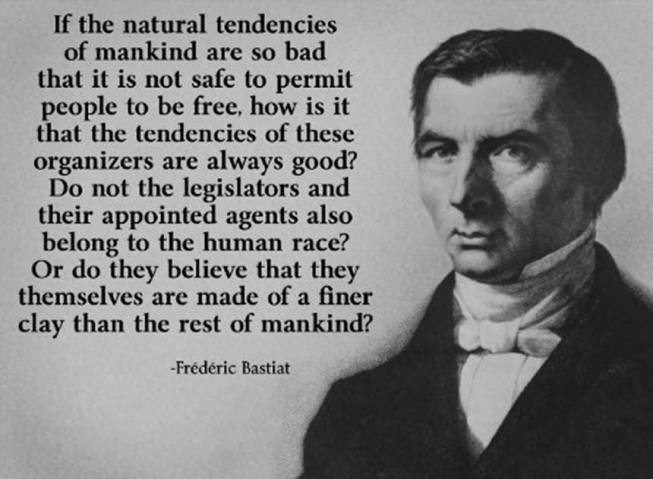
At this point, I direct you to the introductory meme at the top of this post. The answer to the question posed by Bastiat, according to Protestant orthodoxy, is, in fact, “yes.” Protestant orthodoxy holds to the idea that God does, in fact, preordain certain men to “save God’s people from ignorance” (Al Mohler). Know this: Protestantism’s infatuation with predeterminism points directly to the authority/control issue.
It’s not an oxymoron; truth wrongly applied is far more dangerous than outright lies. And in Protestant circles—no suicides, that is far too undignified, just burnings and beheadings in Calvin’s Geneva, and more recently in our day: broken marriages, countless broken friendships, countless church splits, relentless slandering, bogus church discipline, false incrimination, molestation cover-ups, unfettered arrogance, and outrageous propositions such as the “scream of the damned”….to name a few.
Lastly, a word on the return to real family-of-God fellowship/edification apart from manmade institutional authority. While it’s true that this sets God’s people free to maximize the individual gifts given to them, the so-called home church movement is way too loosey-goosey and seemingly a return to the Corinthian problem. This is one of many reasons that a distinction should be made between home church and home fellowship.
Freedom, a gospel truth, can certainly be misapplied in egregious ways, and is. Go figure that one of the unity problems in this movement is, “conflicting [direct individual] revelations.” Well, someone is either lying or misguided. In home fellowship, new birth resulting in a love for THE truth instead of A truth is assumed, and people are given space to be “convinced in their own minds” and their own consciences. Unity is based on agreement on the one mind of Christ, the head of His body…it’s a “body” analogy. The Bible states that all born again believers have that one mind that is developed by studying the word of God. How this works can be seen in the book of Acts regarding the care of the Greek widows, and how that problem was solved to everyone’s satisfaction.
Does not REASON have a standard? Yes it does, and the Bible also states that our service is according to reason and logic. Even non-Christians know things that are “self-evident” according to God’s creation. Group-think is the rejection of reason and logic as a metaphysical reality which always ends up in unthinkable sorrows. Group-think is determined by those supposedly made of a finer clay according to God’s predeterminism and the script of His metaphysical narrative.
Home fellowships will not use the truth of our freedom to create a hot mess, but will do all things decently and in order. The Spirit uses truth to sanctify and NOTHING else, and trust me, with Him coming alongside in the cooperation of truth, there will be plenty of fireworks to get excited over, but that’s His job, not ours; our job is to study in order to find ourselves approved of God and not ashamed as we apply that truth to life.
paul
What is the Single Most Important Thing for a Christian to Know Before Joining a New Calvinist “Church”?
Every New Calvinist church, by virtue of its body of thought developed over hundreds of years via the Reformed tradition, is a theocracy. Many churches in our day that claim to be part of the Reformation tradition are Calvinism Ultra-light. Know this: if you join a New Calvinist church, you are in a theocracy (or at least heading that way with intentionality). New Calvinism is the authentic Reformed article and theocracy goes hand in hand with it.
What is a theocracy? Wikipedia offers the following definition:
Theocracy is a form of government in which official policy is governed by immediate divine guidance or by officials who are regarded as (or claim to be) divinely guided, or is pursuant to the doctrine of a particular religion or religious group.
From the perspective of the theocratic government, “God himself is recognized as the head” of the state, hence the term theocracy, from the Greek θεοκρατία “rule of God.”
“But Paul, God isn’t down here on a throne.” Right. Instead, “divines” are appointed to rule for God by proxy. “Oh, ok, and the Bible determines how they rule, right?” Uh, no. If the Bible was the law (authority), what to do when Joe Church Member disagrees with the interpretation? No, no, we can’t have that, so the “divines” must predetermine what the correct interpretation is. Ever heard of the Westminster Confession? Ever heard if the Westminster Divines?
“Oh ya, New Calvinists quote that all the time. In fact, is that why they quote it more than the Bible?” You’re catching on. “But Paul, certainly they do not all agree on every element of the Westminster Confession.” Right, that’s why local New Calvinist elders have been “given the keys to the kingdom” and “whatever they bind on earth will be bound in heaven.” They have the final word on what all of the Reformed “doctors” and “divines” have determined as documented in the recognized “confessions.” This is known as orthodoxy. Their right to govern is known as church polity.
“Oh ya, God has given them the right to govern in the church.” Uh, it doesn’t stop there. In the authentic Reformed tradition, they believe they have a Divine mandate to rule all people as church and state. In fact, their eschatology is geared towards this as well. However, the American Revolution was the beginning of the end for the divine rights of kings. Nevertheless, this does not mean that they are going to slack on implementing their “full authority” in the local church regarding as it is in heaven, and if they had their way, on earth as well.
“Oh, so, that’s why they bring people up on church discipline for not tithing; in essence, they see it as a tax.” You are a very quick study. But of course, they wouldn’t state it that way. They would say that they are only holding you accountable as an act of love.
“So, what do congregants need their Bibles for?” It’s for the purpose of gospel contemplationism—not a book of authority to be interpreted individually. “Hmmm, sounds like this is an issue of authority. Are individual Christians mandated by God to interpret the Bible for themselves as His ultimate authority in their lives, or does that authority rest with the elders? It seems the latter is the Reformed position.”
Like I said, you are a quick study.
paul



14 comments