Joseph Prince and John Piper Sitting in a Tree, K-i-s-s-i-n-g and Why John MacArthur is a Hypocrite

Kinder, Gentler Calvinist
“Not only that, Prince et al are kinder, gentler Calvinists who wouldn’t dream of endorsing a serial sheep abuser like CJ Mahaney.”
I have seen something for some time that I just haven’t had time to write on: Joseph Prince, the charismatic prince of Singapore, knows the Reformation gospel to a “T” and does a phenomenal job of articulating it from the pulpit. Really, the big boys, Piper et al, can’t touch this guy when he talks about the Reformation gospel of progressive justification from the pulpit. Check out the video series from when Prince preached at Joel Osteen’s church. It is the Reformed Justification by Faith Alone [for sanctification also] par excellent bar none.
Yes, yes, Prince has a different application of that gospel in some areas of life. He uses progressive justification to promote prosperity. It is not true that Prince promotes a “prosperity gospel”—that’s a red herring to throw folks off the scent—his gospel is the Reformed gospel of Justification by Faith Alone [for sanctification also] to a “T.” In fact, Prince’s application of the gospel is actually less harmful than the New Calvinist spiritual despots. And there are no charges of spiritual abuse or control issues coming from Prince’s camp as yet. Indeed, the prosperity Gospel Sanctification camp seems to be a kinder, gentler Reformed theology (by golly, that’s a tweet).
I was given the opportunity to squeeze this post into my schedule via a Facebook conversation I stumbled into yesterday. Jo Bowyer of The Reformed Traveler blog stated the following on her FB page:
The Resurgence [I am assuming the New Calvinist Resurgence blog] now quoting Joseph Prince? Seriously?????!!!! The quote they used is this:
“The law justified no one and condemned the best of us, but grace saves even the worst of us.” – Joseph Prince
I wasn’t the least bit surprised. It’s the same gospel. The New Calvinist crowd then picks and chooses who they will associate with according to the application thereof and other criteria. Certain biblical anomalies are acceptable because such and such “has the gospel right and the other issue is secondary” while some have “secondary” 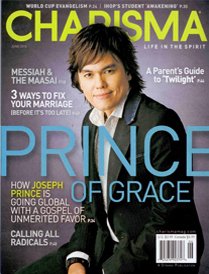 applications that they deem unacceptable. This not only explains the strong ecumenical flavor of New Calvinism, but exposes it for its pervasive hypocrisy.
What better example than John MacArthur who continually rags on Joel Osteen and the likes of Prince while he believes the same gospel. Gag, his hypocrisy makes me sick! Not only that, Prince et al are kinder, gentler Calvinists who wouldn’t dream of endorsing a serial sheep abuser like CJ Mahaney. Like MacArthur does.
Yes, the internet is a wonderful gift from God. While the European oppression of the Scriptures was cured by Gutenberg’s press, the deep deception of Reformed theology is exposed by Google. As Joseph Prince would say, “Thank you Jesus.” I said to self: “Self, I am very busy, what’s the best infogoog for this?” So I typed in, “Joseph Prince John Piper” and came up with a jewel.
It was a post by some Reformed guy objecting to the fact that many people think Justification by Faith Alone “for the baptized as well as the unsaved” is all of Joseph Prince’s idea. He makes the case that the Reformers had the idea first, and posted two videos by John Piper and RC Sproul to prove it. Too rich.
Now look, I am really busy and must move on, but you bloggers out there, with the help Gootenberg, can have a lot of fun with this. Trust me, the infogoog on this is vast.
paul
The Gospel of Spiritual Abuse Can Minister to the Spiritually Abused?
 The serial spiritual abusers of our day all function by the same gospel. That gospel is Gospel Sanctification; or progressive justification. It teaches that justification is a finished work for justification (effected by Christ’s passive obedience to the cross), and also a progressive work for our sanctification (effected by Christ’s perfect obedience to the law and imputed to us for our sanctification). So, “double imputation” is the imputation of Christ’s righteousness for justification, and the imputation of His obedience for our sanctification. Instead of God’s righteousness being imputed to us and our sin being imputed to Christ, “double imputation” is redefined as Christ’s righteousness being imputed to us while His perfect obedience to the law is substituted for our obedience in sanctification. In other words, Christ’s obedience to the law while he was on earth was part of the atonement just as much as His dying on the cross.
Moreover, we stay in our sinful state because our sins have not been imputed to Christ, but rather His obedience has been imputed to our sanctification, or the progressive part of the legal declaration. Any belief on our part that we can do any kind of work that pleases God is paramount to works salvation. The new birth which enables us to colabor with the Spirit in sanctification is denied, and relegated to the manifestations of a realm.
How does this gospel lead to abuse? It is predicated on the idea that even the regenerate remain in their sinful state and are incapable of doing good or pleasing God. This idea is coupled with the belief that God has appointed men to rule over the spiritually ignorant masses, and should rightfully be able to compel by force if necessary. This fundamental principle is the root of all cults and spiritual despotism of every kind.
If this is not the logical conclusion, how then are the totally depraved to be led? You certainly can’t counsel the totally depraved, so when something is going on under the nomenclature of counseling, what is really going on?
In the present-day blogosphere spiritual abuse wars, many so-called advocates of anti-spiritual abuse hold to this same doctrine embraced by Mark Driscoll, and CJ Mahaney et al. Some even throw in the vigorous defense of women’s rights, but how far can that really go when the doctrine holds to the total inability to do anything pleasing to God? What dignity is retained for women in such a worldview?
This post is a primer. In later articles I will be more specific and name names, but many in our day that are being touted as the answer to the likes of spiritual despots like Mahaney and Driscoll in fact hold to the exact same gospel. Again, as stated in this other post, I think cumulative facts that lead to a proposition are confused with truth, and only a true gospel can ultimately set us free.
paul
What Happens When Salvation is Enough: An Ode to Wayne St. Denis
I have always wanted to write a poem or the kissing cousin to a poem—the ode. This essay in ode form will have to suffice for the rough draft; perhaps I will find time later to put it in poem or lyric form, or someone else will be inspired by the essay and save me from the effort. For the sake of a life that speaks from the grave, it would indeed be a worthy effort.
The Strophe
Really, I was just minding my own business when I married this man’s wife who survived him, a man struck down by the world’s devices—Wayne St. Denis. He had a large library of theological books which I inherited. In many of the books he wrote his thoughts where printed words did not occupy, and I have read them. Not all of them mind you, but enough to see the sentiment of the heart.
What I knew of Wayne’s life from others and the heart I saw in his books has laid siege to my thoughts for several months now. An eerie contradiction not in the forefront, but yet following my heart like a stray dog that refuses to go away until it is fed.
In all, mutual ground between me and one in the grave; we both hate hopelessness. Wayne lost his battle with the beast, but his life story only adds to my resolve to fight this monster. The monster’s intimidation and strong message only feeds my resolve and hatred of it. Because of God, where there is life—there is hope—I stake my life on this belief.
The Antistrophe
There is no need to go into all of the gory details of Wayne’s behavior, but yet, this is the testimony that has followed him to the grave; it is his legacy. A like story was sent to me by a reader this week that was written by an agnostic. The author wrote of another professing Christian’s life and asked the following question which is now a companion to the first dog: “Why is God so bad at making people good?”
From 1950 to 1970, the first gospel wave would answer that question as follows: “God doesn’t make us good until we go home to be with him. Until then, we are ‘sinners’ saved by grace.” From 1970 to present (the second gospel wave), the mantras are, “It’s not about our doing, it’s about HIS doing and dying.” “It’s not about us, it’s about making us small and the cross big.” “It’s about making much of Jesus.” “If we get better, that eclipses the Son.”
Does that answer the agnostic’s question? “God is not trying to make us good. If He wanted us to be good, He could make us good.” And perhaps Michael Horton would answer the question this way: “We preach the gospel; we don’t try to be the gospel.”
I have read Wayne’s notes. He would have strongly objected to such a notion. So what’s with the life? The first gospel wave would say, “Well, at least he was saved.” The second gospel wave would say: “His problem was that he tried. He made an effort to keep the law. Therefore, he was ‘making his sanctification the ground of his justification.’ He was a legalist which is why his life was powerless. That’s why he never experienced, ‘real and lasting change.’ He would try, and fail—try, and fail—try, and fail over and over again. He partook in ‘Christless activism’ which is why his life didn’t show forth the fruits of Christ’s active obedience. He wasn’t saved, he was a Pharisee. He lived a hopeless life, and died without hope.”
The first and second gospel wave would debate Wayne’s probable eternal state, the latter accusing the former of easy believeism, and the former accusing the latter of legalism (not realizing that they believe Jesus obeys for us). In both cases however, Salvation is enough. The gospel is the final word.
Wayne would have never bought that, he was searching in a world that (to a large degree) didn’t believe what he believed—that God had the answers and solutions for life’s deepest problems—here and now. He was a man who sought to give answers to others in various ways, but he was seemingly searching by himself, perhaps passing others who were searching like two ships in the night.
The Epode
Funny, not many give hope that Wayne was saved though his life looked a lot like another man who lost hope when he couldn’t seem to find the answers: King Solomon. And like the description of the man written of by the agnostic, Wayne had a storied gospel life of being miraculously transformed from a life of decadence, and henceforth paraded around before others as a celebration of the gospel that is enough. And when they fell, as usual, the propagators of everything gospel didn’t have the answers…. because the gospel is enough.
Yes, Wayne should of learned to live by the gospel that saved him. Who knew? Supposedly, Wayne should have lived by the gospel honeymoon that apparently requires no investment in relationship following. That would eclipse our Spouse.
I contend that Wayne tried to do the right thing the wrong way. And as he failed, he lost hope, and perhaps the demons kicked out of the house during the honeymoon were tamer than the ones who returned. Nevertheless, those who mocked his efforts by predicting his short-term repentance were of no more help than the demons. At any rate, King David is testimony to how we can go from men after God’s own heart to falling into unspeakable sin. Though the enslaving power of sin is broken in the believer, it is still present and powerful. That powerful? Yes, I think so.
The gospel is a settled issue for the dead, but the lives of the dead still speak from the grave on other issues with the help of God’s counsel contained in the Bible. In Wayne’s efforts to find life more abundant after gospel life, he colored his life with more than his legacy. That is sanctification truth that Philippians 4:8 points us to. That verse isn’t about the gospel, it is about truthful, sanctified thinking about others. Wayne’s legacy isn’t the truth, what his life really was as whole is the truth. Armed with the truthful remembrance of Wayne’s entire life, and biblical wisdom concerning how men who love God can fall deep and hard, forgiveness is found for Wayne by some that he harmed long after his departure.
That is the power of sanctification wisdom beyond the gospel. There is no healing apart from truth. That is the power of the word that equips us for every good work. That is the power of the word that we live by. I am therefore inspired to dedicate my life to the idea that salvation is not enough, we need resurrection also, and in showing forth the power that resurrected Christ from the grave, men want what we have. We have been given that power as a gift, but with any gift, ownership, learning, and responsibility is implicit. Wayne failed in his search to best appropriate God’s wisdom for his life, but that doesn’t mean we should fail also. His life is a testimony to why we shouldn’t. His life still speaks from the grave….
The gospel is not enough.
paul
Is All Truth God’s Truth? And How Does the Question Relate to Spiritual Abuse?
There is a thinking crisis in our culture that is greatly compounded in the church because faith is often a license for subjectivity; an inability to think coupled with an attitude that pragmatism is the antithesis of spirituality. Especially in Reformed circles, knowing things and being solution oriented =’s “arrogance.”
Propositions are judged by how good they sound, or how logical they sound, or if the hearing thereof incites a stimulating chemical reaction in the brain that we seem to like.
All truth is God’s truth; is that true? No. However, the following is true: that truism has led many to destruction. Why? Because it assumes truth is the same as facts, and it doesn’t understand that all teaching is a process of propositions that lead to a conclusion. And, logic always yields the same results.
“Dr. John Doe has said many valid things here; I would only disagree with this point or that point.”
Facts and truth are two different things. Facts are usually passive and an elementary part of a larger schema. 2+2=4 is a fact, and a tree is a fact, but unlike truth, they are morally neutral and can rarely take you anyplace by themselves. Truth has a moral aspect, and usually has a purpose in mind. Jesus Christ is not merely a fact, though His existence is certainly factual—He is “The Truth.” He is the epitome of all that is good and gives life.
When the serpent deceived Eve in the garden, he used facts to take her to a rejection of the truth. The fact that Eve was not going to die on the spot after eating the apple was a fact. Satan presented many facts to Jesus when he tempted Him in the wilderness, but the goal wasn’t truth. Does that make the facts God’s truth? Hardly.
True facts that lead to untruth are not God’s truth, because God’s truth always equals life and has that end in mind. Sub truth, or facts, are only as true as what they yield whether life or death. When ill motives are attached to a fact, it is still fact, but it isn’t truth because the fact was used for ill intent. Truth has a moral qualification.
It is not a good idea to sit under the tutelage of Satan because he espouses facts that are undeniable—his facts never lead to truth, he is “the father of lies.”
“Satan has said many valid things here. I agree that Psalms 9:11,12 states that the angels will bear Jesus up. However, I disagree with his suggestion that Jesus should have jumped off the temple pinnacle.”
Really? That’s nice.
Secondly, each proposition that builds up to the conclusion needs to be evaluated. Sub points need to be true and they need to fit together logically to affirm the conclusion. When we have some disagreement on a point in a message or teaching, the possible application of it for another conclusion should be irrelevant. It needs to be judged according to its proposition and contribution to the conclusion at hand. Not all incorrect propositions on the way to a conclusion do irreparable damage to the conclusion, but it’s rare.
Thirdly, Philosophy forms logic which always leads to the same results. All “truth” teachers have a philosophy. All teaching seeks to lead you to a conclusion. Conclusions form logic and lead to action. Hence, “….the student will be like his teacher.”
Philosophy is metaphysics (what we believe about reality and being), epistemology (the theory of how we come to know what we know, or how we obtain knowledge), ethics (the moral application of what we know), and politics (how we use what we know to relate to others, or how we communicate it). The first two elements of philosophy always determine ethics and politics. Often, behavior reveals the philosophy: “….by their fruits you will know them.”
This is exactly why we categorize teachers and reject all that they say out of hand because once their philosophy is revealed, we know where the logic will always take us. Even if some of what they say is factual, the conclusions they want to take you to are based on the philosophy. Therefore, their factual stepping stones are only relevant to the truth or error that is the goal, and for all practical purposes, the same value is placed on the propositions leading to the conclusion. Hence, the biblical prescription for those who have errant philosophy: “AVOID THEM,” and, “Do not allow them into your home or bid them God’s speed.”
Therefore, facts that are part of a conclusion that is a lie have no moral value and are not truth, but part of a deception.
This is the folly of sitting under the teachings of people with errant philosophy, or even greeting them: even the facts that they present are intended to lead to untruthful conclusions. So no, all truth is not God’s truth. God’s truth always has a good ending. Scripture states plainly to completely avoid anyone with errant philosophy.
How you would then glean what is “good” from their teachings while “leaving what’s bad on the shelf,” or “eat the chicken and throw away the bones” is a mystery to me. God forbids that the chicken is even in our house and disallows the use of our shelves.
What does this all have to do with the war against spiritual abuse in the blogosphere? Well, there is a reason it is beginning to look like the Jerry Springer show more and more every day. Even though the Christian culture of our day is primarily framed with two gospels that are radically different, nobody is required to state their philosophy. Spiritual abuse blogs are fraught with Christian mystics, Gnostics, and proponents of progressive justification.
As I have confronted some of these bloggers in regard to their abhorrent psychobabble solutions for spiritual abuse, at least one informed me that the Bible (what the Apostle Paul called “the mind of Christ”) is “not enough” to fully address the problem. And let there be no doubt: what you read out there is a gargantuan volley of propositions from a myriad of philosophical camps followed by massive chatter that evaluates the propositions.
If the Apostle John said that greeting a person with errant philosophy was to also partake in their sin—then it is no less for propositions—factual or otherwise.
Do I think there is an endgame to all of this “all truth is God’s truth” business? Yes. I think it is a ploy to keep us at the feet of those with errant philosophy because there are some “facts” in their teachings that can be added to the “wider field of knowledge.” But those facts can’t help us who strive for truth because the usage of those facts are in a context leading to bad conclusions.
And I think that’s the crux. It creates conduits between ill philosophies and good philosophies. There isn’t the wide separation God calls for.
Whatever is used to endorse error is not God’s truth, even if it is factual. The moral goal is not the same. It may be a fact, but it’s not God’s truth.
Propositions are only as good as the conclusions and results that they always produce. And that qualifies the propositions as either endorsing truth or not endorsing truth. And only TRUTH sets us free from spiritual abuse.
paul



12 comments