Caste Systems: Are They the Key to Understanding Rape, Tyranny, Impotence, and Reformed Theology in the Church?
 “So, it begs the question: how much of Calvinism and Reformed doctrine in general is part of a caste system philosophy? Are the elect, non-elect , ruling elders, and totally depraved more spiritual social strata than doctrinal truth?”
Regarding my upcoming book projects, volume two of The Truth About New Calvinism will merely trace New Calvinism back to its Reformation roots. Volume one traced it from present-day, back to the resurgence movement of 1970. However, The Reformation Myth (TRM) will delve deep into Reformation philosophy, history, its false gospel of progressive justification, and its bogus motif. The so-called Reformation is the biggest hoax ever perpetrated on mankind—that’s the thesis of TRM.
During my research for TRM, I stumbled onto the whole issue of Caste Systems. Woe, what an eye opener. What is also very intriguing in regard to the discussion thereof is the topics ability to organize and lend understanding to complex philosophical issues. That makes the concept dangerous to those who prefer their parishioners dumbed down.
Let’s begin by stealing some definitions:
A caste system is a type of social structure which divides people on the basis of inherited social status. Although many societies could be described in this way, within a caste system, people are rigidly expected to marry and interact with people of the same social class. India has a well known example of a caste system, although various forms of caste systems can be found in many other cultures as well (Online source: http://goo.gl/tcCzX).
Yes, India is caste on steroids, but that only serves to lend understanding to caste systems in general. We must also thank Indian culture for demonstrating how caste systems interact and integrate with religion. Often, caste systems come from religion, and determine the social strata, especially in theocracies. The following chart is helpful accordingly:

And….
The roots of the Indian caste system can be found in the Hindu scriptures, although the caste system was adopted by other religions in India as well. According to scripture, Indian society could be broken down into a number of different groups, known as Varnas. Brahmins, the highest caste, were scholars and priests, while Kshatriya were warriors, rulers, and landlords. Vaisya were merchants, while Sudra were manual laborers. Beyond there four basis Varnas are the Untouchables or Dalit, and the system also has a space for outsiders and foreigners who do not conform with the system (Ibid).
Massive research has been done by sociologists on this subject—it is a treasure trove of understanding. I am 56 years old, done my share of schooling, and have never been exposed to this vast topic and its implications. And as we will see, the absence of consideration regarding caste systems, and its very, very likely influence on Calvinism is downright scandalous. Add it to the list of why Calvinism is a “scandalous gospel.” Moreover, the understanding gained via this topic in the realm of spiritual abuse and tyranny is absolutely priceless.
Caste systems can take on many forms, but for now, let’s stick with the more naked forms. These are caste systems that have actually been enforced by civil and criminal law throughout history. As the former and latter excerpts note, caste systems, social and religious, are not exclusive to Indian culture. In fact, European culture has been inundated with caste systems throughout history:
According to Haviland, social systems identical to caste system elsewhere in the world, are not new in Europe. Stratified societies were historically organized in Europe as closed social systems, each endogamous, into for example nobility, clergy, bourgeoisie and peasants. These had distinctive privileges and unequal rights, that were neither a product of informal advantages because of wealth nor rights enjoyed as another citizen of the state. These unequal and distinct privileges were sanctioned by law or social mores, confined to only that specific social subset of the society, and were inherited automatically by the offspring.
In some European countries, these closed social classes were given titles, followed mores and codes of behavior according to their closed social class, even wore distinctive dress. Royalty rarely married a commoner; and if it did, they lost certain privileges. This endogamy limitation wasn’t limited to royalty; in Finland, for example, it was a crime – until modern times – to seduce and defraud into marriage by declaring a false social class. In parts of Europe, these closed social caste-like groups were estates.
Along with the three or four estates in various European countries, another outcast layer existed below the bottom layer of the hierarchical society, a layer that had no rights and was there to serve the upper layers. It was prominent for centuries, and continued through middle 19th century. This layer was called serfs. In some countries such as Russia, the 1857 census found that over 35 percent of the population was serf (крепостной крестьянин).
While the serfs were of the same race and religion, serfs were not free to marry whomever their heart desired. Serf mobility was heavily restricted, and in matters of who they can marry and how they lived, they had to follow rules put into place by the State and the Church, by landowners, and finally families and communities established certain social mores that was theirs to follow because the serfs were born into it.
In modern times, regions of Europe had untouchables in addition to the upper castes and serfs. These were people of the same race, same religion and same culture as their neighbors yet were considered morally impure by birth, repulsive and shunned, just like the Burakumin caste of Japan and Osu caste of Nigeria.
A sense of hereditary exclusion, unequal social value, and mutual repulsion was part of the relationship between the different social strata in Europe. In late 19th century through the early 20th century, millions of the outcasts, downtrodden and socially ostracized people from Europe migrated on their own, or transferred as indentured laborers to the New World (Online source: http://goo.gl/Fx4VU).
Caste systems form naturally from our tendencies to be prejudice against, in varying degrees, what makes us uncomfortable. And different usually =’s uncomfortable. Therefore, the formation of caste attitudes come naturally to us, and unless restrained, become caste systems. And, unless the brakes are applied to caste systems, the mentality can deprecate to the point of the upper social strata viewing the lower strata as less than human, and a threat to the purity of the upper strata. Can we say, “genocide” ?
This gives new brevity to the basic idea of “love” which strives to value others as much as we value ourselves. The antithesis leads to all kinds of formal, informal, spoken, and unspoken caste systems according to what people look like, talk like, have, have not, etc., etc., etc. Does Hollywood have a caste system? Do high schools have a caste system? Do churches have a caste systems? Yes, yes, and yes.
Interestingly, in regard to the founding fathers of this country, they resisted caste systems. You were pretty much judged by the game you brought to the table regardless of how you got the game. That is why there were African American congressman, mayors, and notable educators early in American history. However, the same cannot be said of the Southern states who implemented a racial caste system that was civil and criminal law:
The term caste entered American debates long before the American Civil War, in the antebellum era and has continued through modern times. Frederick Douglass, William Garrison, Horace Greeley, Harriet Stowe, William Seward, Gerrit Smith, Charles Sumner, Theodore Parker, and Cassius Clay used the term caste, rather than race or class, in their writings and speeches to discuss and inspire America to abolish slavery.
And by the way, Calvinism was the predominate religion in the South during the Civil War (at least in regard to backing the South’s apologetic). Just sayin’.
Like falling off a log, the documenting of Plato’s influence on the father of the Reformation, St. Augustine, is equal in task. The same goes for Augustine’s connection to Martin Luther and John Calvin. And to say that Martin Luther had a caste mentality would be the understatement of the century. And caste systems were part and parcel with medieval history. Even more evident is the hyper-caste mentality that influenced the views of Plato. According to Dr. TS Girishkumar:
Plato had a theory of soul which has three parts, reason, courage and appetite. The development of them shall be different in different people. When reason is dominant, and other part dormant, it is the philosopher. Courage is dominant, the warriors. Appetite is dominant, the traders and cultivators. When all three are dormant, the slaves.
This is just the copy of the Varnashrama system in Indian Philosophy. Four Varnas according to the quality of individuals, and unlike Plato’s theory, the quality is acquired and not by birth. The Brhamanas, Kshatriyas, Vaisyas and the Sudras (Online source: http://goo.gl/JuuGU).
So, it begs the question: how much of Calvinism and Reformed doctrine in general are part of a caste system philosophy? Are the elect, non-elect , ruling elders, and totally depraved more spiritual social strata than doctrinal truth? I intend to research that question thoroughly.
How much of the abuse/tyranny problem in the church today can be related to a caste mentality? What about the indifference regarding church abuse/tyranny that we see in our day? In a caste system, the system answers to nobody about anything. Is this the dynamic that we are experiencing?
What about impotence? In society, lack of social mobility is proven to cripple society because the possible contributions of the lower strata are ignored and shunned. In the church, do caste systems limit spiritual mobility? Certainly, a plenary pushback regarding such attitudes by Christ and the apostles can be seen throughout the New Testament by word and lifestyle.
And we should not expect that the natural degenerative activity of a caste system will behave any differently in the church. Indifference towards justice, abuse, and tyranny will be the same result.
paul

Heresy in Heels: The Queens of Progressive Justification
 “As one respected Reformed pastor noted: it is the same Catholic salvation that those of Reformed thought claim to refute.”
He is supposedly the Master who does all the work for us lest He be robbed of any glory. Somehow, if we actually do any of the work as born again slaves, that doesn’t honor the Master, but yet, he insists on being known as a master. It seems like God would want to be known by something else other than, “Lord.”
Using language that referred to the slave culture of that day, the apostle Paul said we were “bought with a price.” We were purchased as slaves with the blood of Christ, but the gospel that is all the rage of our day denies this very purchase and the lordship of Christ; it’s replaced with a supposed purchase of parasites.
As the heretic Paul David Tripp states it: we “rest and feed” on Christ. Got that? We are the slaves, He is the Lord, but we “rest and feed.” Really? And how valid is any profession of faith that doesn’t understand this relationship? How valid is a profession that accepts Christ as Savior only and denies the purchase?
Contemporary Reformed leaders of our day are now cashing in on this false gospel two-fold. The judgement they are heaping upon themselves for present-day cash is not enough—they are getting their wives in on the action. The organization True Woman .com is only one of many massive organizations saturating Christian culture with New Calvinism’s fusion of justification and sanctification.
The organization is led by several wives of the who’s who of neo-Calvinism—following their husbands in heresy. And I am not the only one saying so. Even those of the “Reformed tradition” label the neo-Calvinist active obedience of Christ (Christ obeys for us) as, “heresy,” “works salvation” by not working in sanctification, “easy believism,” and antinomianism.
When justification and sanctification are fused together, justification is not a finished work. The doctrine makes two justifications: one finished and one progressive. They deceptively refer to this as “progressive sanctification.” Hence, “progressive sanctification” is really finishing justification. That’s a huge problem because we are in the sanctification process and what we do can therefore effect our “just standing with God.” It requires a maintaining of antinomianism to keep our just standing before God; ie., sanctification by faith alone. But living by faith alone in sanctification becomes a way to maintain our just standing before God—for all practical purposes, works salvation by antinomianism.
It’s not an oxymoron; when justification and sanctification are fused together, everything we do in sanctification points back to, or effects our justification because at least one aspect of it is not finished. As one respected Reformed pastor noted: it is the same Catholic salvation that those of Reformed thought claim to refute.
Furthermore, the primary catalyst for the doctrine’s present success was its Sonship theology package hatched at Westminster Seminary by Dr. John “Jack” Miller. A self-proclaimed understudy of Miller’s, David Powlison, then made the doctrine the foundation of Westminster’s biblical counseling curriculum via CCEF. In a book written by Dr. Jay E. Adams, he clearly states that the doctrine promotes a view that sanctification is powered by justification. Clearly, even in the Reformed community, there is a dispute in regard to the very reason we are supposed to be here: the gospel.
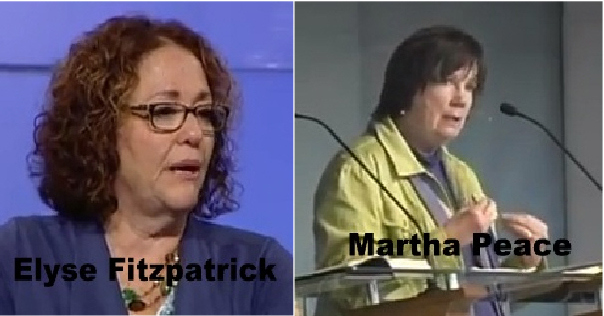
But does the Reformed tradition trump gospel truth? The answer is a resounding, “yes,” especially in the biblical counseling community. The two primary queens of that movement are Elyse Fitzpatrick and Martha Peace. Fitzpatrick has openly denied that there is any such thing as an antinomian because man is helplessly legalistic. Like all good neo-Calvinists, the poo-pooing of specific biblical truth is done without a blinking of the eye. In this case, the biblical word “anomia” is completely dismissed. And apparently, Satan came to Eve in the garden as a legalist.
Peace is a hardcore New Calvinist proponent of the active obedience of Christ and sanctification by faith alone. But yet, these two women are the toast of the biblical counseling community—even by those who refute the neo-Calvinist take on double imputation (the active and passive obedience of Christ imputed to our sanctification).
Why? Because it’s really not about the gospel. That’s why. And as far as counseling, people can’t be helped with a false gospel. No way.
paul
PsychoHeresy Unawareness: Dr. John Street Shot the Sheriff, but He Didn’t Shoot the Deputy
No doubt, PAM reveals many problems with the biblical counseling movement that one may expect when it is based on a false gospel. But John Street’s real sin is his participation in a mass propagation of a false gospel.
Dr. John Street, founder of Clearcreek Chapel in Springboro, Ohio has finally made it big in the biblical counseling movement. This is evident from the fact that he has become a target of PAM (PsychoHeresy Awarness Ministries). PAM is directed by Martin and Deidre Bobgan who without a doubt are the most formidable critics of the “biblical” counseling movement.
John Street is an elder at John MacArthur’s Grace Community Church in California, and the Chair of the graduate program for biblical counseling at the seminary associated with MacArthur’s church. Also, last time I checked, Street is the president of the National Association of Nouthetic Counselors (NANC).
In the most recent PAM newsletters (http://www.psychoheresy-aware.org/street_tmc&s.html and http://www.psychoheresy-aware.org/street_tmc&s_2.html) Street is barbecued for practicing counseling methods that the Bobgans deem unbiblical. PAM primarily decries the biblical counseling movement’s “problem-centered counseling” verses “Christ-centered Ministry” (http://www.psychoheresy-aware.org/e-books/CCMpcc-ebk.pdf ).
I am not sure what PAM means by “Christ-centered ministry,” but it seems to be a passive approach regarding the disciple’s role in sanctification:
This is why we say that those who minister to one another need to get in the way and out of the way. They need to be available, but they need to let God work rather than push their own agenda.
The idea of pushing our own agenda could mean “let go and let God” instead of pushing an agenda that just so happens to be God’s agenda. The wording is unsettling. Elsewhere the Bobgans write the following:
Christ-centered ministry encourages spiritual growth and depends on the Lord to do the work in each individual through His Word and Spirit. Therefore, one can confidently assure believers that this ministry is more effective, long-lasting, and spiritually rewarding than problem-centered counseling for those who are willing to go this way.
Depend on the Lord to do the work? At the very least, the Bobgans need to clarify their position more thoroughly because by and large, gospel contemplationism is the primary thrust of NANC counseling. One wonders if PAM is accusing NANC of what they are guilty of: an overly passive approach to sanctification.
And, NANC, when they were (past tense) helping many people, encouraged an aggressive role in sanctification by the counselee. Christians are called to “study to show thyself approved,” and then aggressively apply that truth to their lives in order to have a life built on a rock (Matthew 7:24).
This was NANC’s approach in the past, and it did result in massive professions of faith, and real lasting change. I know; I was there; I am a firsthand witness. This was before David Powlison via CCEF and company infiltrated NANC with the gangrene of progressive justification. Unbelievably, in broad daylight, Powlison admitted (during a lecture at John Piper’s church while Piper was on sabbatical searching for different “species of idols” in his heart) that NANC’s “first generation” counseling was in contention with “second generation counseling” over the very definition of the gospel!
And this is my point: PAM is focused on the supposed evil of “problem-centered” counseling (is the gospel itself not problem-centered? The gospel did not come to solve a problem?) while the real issue is that NANC and CCEF both propagate a blatant false gospel. The counseling is based on the fusion of justification and sanctification with gospel contemplationism as its practical application.
CCEF’s counseling is based on Sonship theology. Dr. Jay E. Adams nailed that doctrine specifically as the fusion of justification and sanctification in his book, “Biblical Sonship” published in 1999. Adams, in the book, decried Sonship’s position that regeneration is powered by the finished work of justification. CCEF then effectively infiltrated NANC and took it over with the same doctrine. I use over 200 pages to document all of this in “The Truth About New Calvinism” (thetruthaboutnewcalvinism.com).
Hence, we must assume that NANC counseling yields many ill results, and I will say this: PAM points them out though they are missing the much larger issue. Case in point:
The truth is that counselors and especially counselors with an agenda (their particular approach) too often take credit for successes and attribute failures to the counselees. The trumping truth is that success is primarily in the hands of the counselees….
And worse yet, The counselee’s “failure” ends up in church discipline!
Also:
Problem-centered counseling is typically a one-to-one relationship. Sometimes couples and families are involved, but the relationship is generally artificial and restrictive. The counseling relationship itself usually does not extend outside the counseling room. The relationship lasts as long as counseling is being provided and normally does not extend to other involvement, even in most biblical counseling centers. Problem-centered counselors commonly do not involve themselves with counselees outside the counseling room. That is why both psychological and biblical counselors sometimes use intake forms requesting a great deal of personal information. Because this relationship is generally isolated, the counselor and counselee can be selective as to what they want to reveal about themselves. In fact, as we mentioned earlier, research shows that counselees often lie to their counselors and protect themselves by concealing important information.
The great advantage of Christ-centered ministry is that it is not limited to an artificial one-to-one relationship where one has the problem and the other supposedly has the solution. In the Body of Christ all are growing together. there are many opportunities to know one another and to interact in genuine relationships. When a believer is experiencing problems, more than one person may be involved in ministering to that individual. One may be teaching. One may be reminding. Another may simply be extending support and fellowship. Another may be helping in practical ways. Another may be exhorting. Another may be admonishing. And, in a few cases, some may be exercising the responsibility of disciplining a fellow believer for the sake of restoration. But, all can be praying and encouraging the individual in the direction of the Lord. And, through all this, all are growing together and the relationships may deepen with one another as well as with the Lord.
No doubt, PAM reveals many problems with the biblical counseling movement that one may expect when it is based on a false gospel. But John Street’s real sin is his participation in a mass propagation of a false gospel. It reminds me of Eric Clapton’s ode to one who objects to being accused of shooting a deputy when he really shot the sheriff.
paul
The Potter’s House: Sunday, September 29, 2012
 Introduction to the Book of Romans: “What’s in the Word, ‘Gospel?’” Romans 1:1
Please turn with me to the book of Romans, and the first chapter. This is probably not going to be your typical introduction to a series on a biblical book. Our days and the challenges thereof demand a close look and deep thought on what the apostle Paul’s intent was behind this letter to the Romans. Our particular focus to start this series will be Chapter 1, verse 1.
But first, what are we to expect in the forthcoming messages? Primarily, what is the book of Romans about and why did Paul write it? And what do we expect to learn from it? The answer comes by contrasting Romans 1: 8-15, and verse 16 following. We conclude from verse 8 that this was a strong group of believers whose testimony was known worldwide. Because of this, Paul was eager to visit them, but had been hindered.
Unlike the letter to the Corinthians, Paul wasn’t writing to the Romans to correct error. Unlike the Corinthian letters, we would not expect the content to reflect problems among believers in Rome. In fact, we see in verses 11 and 12 that Paul longed to see them so that they could mutually encourage each other. These Christians were strong Christians who even had the ability impart spiritual fruit to the apostle Paul.
But after Paul introduces himself in Chapter 1:1-7, and commends the believers at Rome in verses 8-15, something happens. Seemingly out of nowhere, and without purpose, he starts talking about other people. In verse 18 he writes, “The wrath of God is being revealed from heaven against all the godlessness and wickedness of people, who suppress the truth by their wickedness….” What could that have to do with the church at Rome? Remembering that the Roman church was primarily Gentile, we find that Paul starts writing about hypocritical Jews in verse 12 of Chapter 2. What in the world is going on?
The key is in 1:14,15. “I am obligated both to Greeks and non-Greeks, both to the wise and the foolish. That is why I am so eager to preach the gospel also to you who are in Rome.” What do we think primarily when we think about the word, “gospel”? Well, in one regard, we would rightfully think about the good news (that’s what the word “gospel” means: “good news”) that Christ died for our sins and made a way for us to be reconciled to God.
But wait a minute. The Romans were saved, and their faith was even spoken of throughout the whole world. Paul even thought he could benefit from their faith. Why would the apostle Paul want to go there and preach the gospel to them again? Well, from 1950 to 1970, American Christianity would answer that question this way: “Church is where people get saved. We have to get people to church so that we can get them under the gospel. Yes, discipleship is important, but the more time we spend in holy huddles the less we get people under the gospel.”
From 1970 to present, the answer is:
“We agree, but the key is that the same gospel that saved you also grows you. We grow in salvation by hearing the gospel afresh. We agree that investing a bunch of time in the discipleship of do’s and don’ts not only lessons the preaching of the gospel, but will not contribute to our spiritual growth as well.”
So, that is what these two groups would suggest in answering the question of Romans 1:15: why would Paul want to preach the gospel to believers at Rome? And my friends, these two groups probably represent at least 85% of American Christianity in our day. But the key to understanding what Paul meant in Romans 1:15 stems from a question that is being asked more and more in our day by Bible teachers and pastors. Is the “gospel” more than the five-word gospel, “Christ died for our sins” that is all the rage in our day? John Piper expands on it a little more; he suggests that the gospel can be stated in one sentence. And no doubt, that is probably true of the good news that Christ died for our sins. But is the “gospel” more than that?
Yes it is. You see, Paul didn’t long to go to Rome to reiterate the good news of the death, burial, and resurrection of Christ to already-saved Christians, he longed to go to them to preach the entire spectrum of the gospel. And since he didn’t know for certain that he would still get to come to them, he states the full spectrum of the gospel in this letter to them, starting in 1:16 and concluding in 15:21.
That’s what we have before us. That is the intent of this letter. That is what we should expect from this study: God’s full good news truth statement concerning what the world’s philosophers and psychologists have clamored about to know or disprove since ancient times. This is the good news of understanding what makes man tick, and how God truly relates to him. The deepest “why,” “how,” and “what” questions regarding life and godliness are answered in this letter; for example, why do Christians still sin?
Moreover, we see this truth concerning the word gospel in the ministry of Jesus. We read the following in Matthew 4:23, “Jesus went throughout Galilee, teaching in their synagogues, proclaiming the good news of the kingdom, and healing every disease and sickness among the people.” We find out exactly what Jesus was preaching in regard to the “good news of the kingdom” three verses latter in the Sermon on the Mount, and the sermon states nothing in regard to death, burial, and resurrection of Christ. The sermon is instruction for having a life built upon a rock by learning the commands of Christ and putting them into practice (Matthew 7: 24). That’s good news also. The full orbed gospel is the full counsel of God that answers the important questions of life and gives us the information we need for life and godliness. My own experience is the norm. By and large, making sure Christians have an in-depth understanding of the book of Romans is low on the priority list.
That’s the introduction. We now begin our study of the book of Romans in verse one. Verse one is all we will cover in this first message. “Paul, a servant of Christ Jesus, called to be an apostle and set apart for the gospel of God.” This first verse is ripe with critical salvation truth. Paul introduces himself as a saved person. The saved person that describes the apostle Paul can be no less for anybody naming the name of Jesus Christ.
First, he describes himself as a servant of Jesus Christ. In our present day, the information age, there are many study helps that enable us to define how Bible words are translated in the different versions. You don’t have to know Greek or Hebrew, and we are not in bondage to those who do. For instance, “E-Sword” is an online source that has a complete electronic Bible. By hovering over any given word with our mouse, we can see the Greek definition. We can also do searches of synonyms to see how the same word might be used in other places in the Bible. In this case, “servant,” according to E-Sword’s online dictionary, can also mean “slave” or “bond slave.” In fact, the New American Standard Bible translates it, “bond servant.” But if you go to Bible Gateway, which is a free online concordance, and do a New Testament search for “slave,” and then refer back to E-Sword for the Greek word that is used—you find that Paul refers to himself by the same word that is translated “slave” in many other places in the New Testament. Paul called himself a slave of Jesus Christ.
And if you are a Christian, that’s what you signed up for. If you didn’t sign up for slavery to Jesus Christ—you’re not a Christian—you agreed to a gospel presentation that was errant. You agreed to Christianity that is not a true Christianity. Period. In this case, you only signed up for salvation, not discipleship. Being saved is both.
In Christ’s mandate to the church, he calls us to “make disciples,” not saved people. Here is exactly what he said as documented in Matthew 28:18-20: “Then Jesus came to them and said, ‘All authority in heaven and on earth has been given to me. Therefore go and make disciples of all nations, baptizing them in the name of the Father and of the Son and of the Holy Spirit, and teaching them to obey everything I have commanded you. And surely I am with you always, to the very end of the age.’”
Your baptism was a public profession that you have come to believe in the death, burial, and resurrection of Christ for the forgiveness of sin. You are justified by God when you believe this. But that is only half of the gospel. You must also recognize that you are a disciple that observes everything Christ has commanded. This is the great heresy of our day. We have a culmination of two movements coming together that either teach that discipleship is optional, or that discipleship is the same thing as being declared righteous. This is the culmination of two movements that plainly state that sharing the gospel in a context that is more than the five words of, “Christ died for our sins” is a works salvation. It is the false gospel that James decried that is a calling to a discipleship that functions on belief in the five words only, and not the full gospel that also includes the full counsel of God. We are not saved by participating in discipleship, but our belief in the five words also comes with recognition that we are committing our life to Christ and His lordship. Christ is either Lord, or He isn’t!
In 1Corinthians 6:20 Paul states that we are “bought with a price.” What was that price? Is it not the blood of Christ? Therefore, to deny that we have been purchased (this is first century slave terminology) as slaves is to deny the very purchase. If we are not slaves to Christ’s lordship, then neither were we purchased.
So, how does this happen without making our role in discipleship a part of God’s saving work and our justification? And why do Christians who have committed to Christ’s lordship still sin? And how does the law function in all of this? The answering of these questions is of extreme importance, and that’s why Paul longed to come to Rome to preach it to the Christians there. Nevertheless, he begins to proclaim the depths of the gospel to them in 1:16. Paul wanted to teach it to them publically and from house to house as he had done in other regions, but until then, this letter would have to suffice. That is why this letter is profoundly critical for Christians to understand.
Secondly, Paul said he was called and set apart for the “gospel of God.” And if you are saved, it is no different for you. You are not called to be an apostle, but if you are saved, you are a servant; you are also called, and set apart. Turn to with me to 1 Corinthians 6:9-11. It reads as follows, “Or do you not know that wrongdoers will not inherit the kingdom of God? Do not be deceived: Neither the sexually immoral nor idolaters nor adulterers nor men who have sex with men nor thieves nor the greedy nor drunkards nor slanderers nor swindlers will inherit the kingdom of God. And that is what some of you were. But you were washed, you were sanctified, you were justified in the name of the Lord Jesus Christ and by the Spirit of our God.”
In the thirteenth chapter of John, Christ told Peter that he no longer needed a washing—that was done when Peter was saved. We are justified, and declared holy. If you use E-Sword, and hover over the word, “sanctified” in 1Corinthians 6:11, you find out that it means “holy.” To be sanctified is to be made holy. You say, “Well, I am not looking very holy right now, how can this be?” Questions like this is why the book of Romans is so vital—these are the very questions that this book answers lest Christians are confused, neutralized, and hesitant in the aggressive discipleship God has called us to.
Watch what Paul states in 1Thessalonians 4:3-8, “It is God’s will that you should be sanctified: that you should avoid sexual immorality; that each of you should learn to control your own body in a way that is holy and honorable, not in passionate lust like the pagans, who do not know God; and that in this matter no one should wrong or take advantage of a brother or sister. The Lord will punish all those who commit such sins, as we told you and warned you before. For God did not call us to be impure, but to live a holy life. Therefore, anyone who rejects this instruction does not reject a human being but God, the very God who gives you his Holy Spirit.”
This is why Paul longed to preach the whole gospel to the Christians at Rome. The gospel is not only about the gospel, it is about how to do the gospel. It is about how to control “YOUR OWN BODY” in a way that is holy and honorable. It is the whole counsel of God, the good news of Jesus Christ, and the good news of the kingdom. It is the good news of God’s entire truth, not just part of it. The fact that Christ died for our sins is good news; the fact that God set us apart is good news; the Holy Spirits role as our helper in sanctification is good news; the fact that we can have life, and have it more abundantly is good news.
But be sure of this: he who rejects the full counsel of God in learning how to control our own bodies is…. as Paul clearly states, not rejecting a man, but rejecting God. And that is what a great deal of Romans is about.
And as we move forward in this book, I hope you share my same anticipation in what we will learn together about God’s great gospel. We have a little more business to take care of in the next messages, but our endeavor into Paul’s gospel treatise begins in Romans 1:16.




9 comments