@ Ligon Duncan
Duncan is a disgrace to the ministry. Where is the outcry for the victims of SGM? Instead, notable leaders run to the side of their abusers? I will not be silent. Reformed tyrants can dream their filthy dreams on earth all they want to; God will not “bind” their behavior in heaven.

Mutable Justification: Not Shocking—Just Reformed
 Denver Sound Church is a church of the “Reformed tradition.” I have posted some of their material regarding a rejection of double imputation taught by “some in the Reformed tradition.” They reject the uniquely Reformed idea that Christ lived in perfect obedience to the law as part of the atonement, so that His perfect obedience could be imputed to our sanctification. They rightfully and forcefully make the case that such teachings are “heresy.”
Therefore, you would think that an article published by them propagating a mutable justification would be shocking to me, but not really. The idea that justification has to be maintained by us in sanctification is a Reformed family tradition. Even those who propagate the aforementioned Reformed view of double imputation believe that our justification has to be maintained by faith alone. I know that sounds no-brainer, but there is a big difference between being justified by faith alone and maintaining justification by faith alone. The latter requires faith alone in sanctification, or sanctification by faith alone in order to maintain our justification. The former is free to work in sanctification because justification is finished and immutable. But if justification is mutable as a result of our missteps, we must maintain it the same way we got it—by faith alone. So, we must maintain our justification by faith alone in sanctification. That’s where Reformed double imputation comes into play; we offer the perfect obedience of Christ to the Father in sanctification to maintain our justification.
Denver Sound Church calls that heresy, but agrees that we must maintain justification (obtained by faith alone) via obedience. Here is how they begin the post:
Despite being well-supported in Scripture, the doctrine of the loss of justification is not widely held in the contemporary Evangelical-Reformed community. Instead, most believe and teach that justification is a one-time, legal declaration by God. Contemporary theologians explain that once the decree of “justified” has been declared it cannot be revoked regardless of a person’s future actions.
The idea that justification can be lost is a minority view among Reformed Evangelicals, but that does not necessarily make it wrong. All theologians understand that the majority of Christendom is not always right. In fact, it might be more accurate to say that when it comes to theology, the majority is more often in the wrong. Examples of this from history abound: only eight people made it onto Noah’s ark, the majority of the Old Testament Jews were apostate, Roman Catholics certainly outnumbered Protestants at the beginning of the Reformation, etc.
The point is that every doctrine, even if widely accepted and even doctrines which are at the core of the Reformed faith must be put to biblical test. Our goal throughout this series is to demonstrate that Scripture does not teach justification as a one-time, merely forensic declaration, but that it is a righteous and forgiven state before God which can be lost due to unrepentant sin. Justification is gained by grace through faith alone, but must be maintained through faithfulness. This doctrine is solidly supported through biblical theology and its support from systematic theology is just as sound.
Recently, we published an article highlighting twenty three Scripture passages which teach, imply or warn that a person can lose his justification. That article was followed up with a post about why it is consistent with both Scripture and Calvinistic soteriology to say that one can lose his justification, but that salvation cannot be lost. The doctrine of the loss of justification provides a framework that adds great depth and consistency to the theological unity of Scripture. On the other hand, the more commonly held position that justification is an immutable (unable to be changed) result of a one-time expression of faith causes theological problems throughout the Bible, in fact, the belief in an immutable state of justification undermines many orthodox doctrines. Here are a few:
And the key to the problem here is the words, “orthodox doctrines.” We owe a great debt of gratitude to church historian John Immel for pointing out that “orthodoxy” is a body of interpretation by Reformed “divines” and “doctors” of the Church. We need to be reminded that we have the same illuminating Holy Spirit that they had; or, those “divines” who actually had Him. The Sound Church guys then go on to make their case in the post with nine arguments, some of which are of the Reformed tradition to begin with.
We will address each, but first let me put the argument to bed. I would also like to preface my rebuttal with the following: I believe a careful study of the apostle Paul’s writings indicate that the offer of salvation to all men is a legitimate offer, and Paul believed that his efforts of persuasion made a difference. How do I reconcile that with God’s knowledge of the future and how He makes that a part of His preordained plan? The best I can do is to state that God wants to involve us in the process while preserving all glory unto Himself. How He weaves His sovereignty together with our will is a mystery, and a debate that I do not enter into.
With that said, I believe justification is immutable because of Romans 8:30:
And those whom he predestined he also called, and those whom he called he also justified, and those whom he justified he also glorified.
And when did that happen?
Ephesians 1:4 – even as he chose us in him before the foundation of the world, that we should be holy and blameless before him. In love 5 he predestined us for adoption as sons through Jesus Christ, according to the purpose of his will, 6 to the praise of his glorious grace, with which he has blessed us in the Beloved. 7 In him we have redemption through his blood, the forgiveness of our trespasses, according to the riches of his grace, 8 which he lavished upon us, in all wisdom and insight 9 making known to us the mystery of his will, according to his purpose, which he set forth in Christ 10 as a plan for the fullness of time, to unite all things in him, things in heaven and things on earth.
Are we already glorified? No, but I believe Romans 8:30 states our glorification in the past tense in regard to its certainty which is connected to our justification. Glorification comes part and parcel with our justification.
Christ furthers this point:
John 10: 27 – My sheep hear my voice, and I know them, and they follow me. 28 I give them eternal life, and they will never perish, and no one will snatch them out of my hand. 29 My Father, who has given them to me, is greater than all, and no one is able to snatch them out of the Father’s hand. 30 I and the Father are one.
How peculiar that Calvinism is associated with predestination, yet many of the Reformed tradition believe that we can lose our salvation. Note what Michael Horton writes on page 62 of Christless Christianity:
Where we land on these issues is perhaps the most significant factor in how we approach our own faith and practice and communicate it to the world. If not only the unregenerate but the regenerate are always dependent at every moment on the free grace of God disclosed in the gospel, then nothing can raise those who are spiritually dead or continually give life to Christ’s flock but the Spirit working through the gospel. When this happens (not just once, but every time we encounter the gospel afresh), the Spirit progressively transforms us into Christ’s image. Start with Christ (that is, the gospel) and you get sanctification in the bargain; begin with Christ and move on to something else, and you lose both.
Both what? Answer: justification and sanctification. How peculiar that a doctrine associated with predestination also teaches that we can lose our justification. But they offer assurance that this won’t happen in something that might surprise you, and is offered as one of the nine arguments in said post. Yes, you are predestined for justification, but you can lose it, and the status thereof can change (mutable) under certain conditions. We will get to that, but let me state beforehand that assurance of salvation comes through obedience in sanctification (2Peter 1:5-11 is one of many examples). Our justification cannot change, but assurance of our standing can. Lack of assurance is a time for reevaluation and examination in our Christian lives. And hopefully, we will be associated with those who can help us with the word of God as well.
This brings us to the first argument given:
1. If justification is immutable, then the doctrine of sola fide is destroyed.
So what? Sola fide is one of the five solas of Reformed orthodoxy. It’s NOT Scripture—it’s orthodoxy. And not only that, to many in the Reformed tradition, it isn’t faith alone for justification, but faith alone for sanctification as well. In sanctification, we are called on to mix our faith with works/obedience for the purpose of showing forth our faith—leading to “blessings.” This is what the whole book of James is about. Though Denver Sound Church is not in this camp (sola fide in sanctification), using Reformed orthodoxy as an argument is dead on arrival. And though they offer twenty-three Scriptural arguments in another post, it is obvious from John 10:27, Romans 8:30, and Ephesians 1:4 that those citations cannot be used to make a case for mutable justification. Furthermore, I have reviewed those arguments and do not find them compelling, but you can read them for yourself here; http://www.soundchurch.org/23-bible-passages-which-teach-the-loss-of-something/ . And by the way, let me further my point on Reformed orthodoxy, and the five solas in particular by saying that Solus Christus is blatantly unbiblical. Salvation is not by Christ alone. The Father elected, the Spirit set us apart, and Christ died for our sins. Salvation is Trinitarian; it is not through Christ alone.
2. If justification is immutable, then church discipline is an empty threat with no realistic consequences.
This is the money argument that takes the place of true biblical assurance, and according to church historian John Immel, is the real crux of Reformed orthodoxy. Justification is maintained and assured by submitting to the authority of the Church and being a member in good standing. This is tied to elder rule which supposedly has the authority to declare people unjustified:
An immutable justification means that the removal from the covenant community (the final step of the process of church discipline) has no teeth. In fact, if one who has been excommunicated retains his justification, church discipline might actually seem like a better situation for the person who has been removed from the church. If justification remains intact, life without membership in the covenant community might actually be attractive to some folks. To eventually go to heaven without enjoying potlucks in the basement or having to deal with the interpersonal relationship stresses that come with church participation seems like a pretty good deal!
However, despite what some may say, Scripture makes it clear that there is no justification available to a person who is outside of the local biblical church. Thus, the only conclusion that we can make is that one who is removed from the covenant community has lost his justification. The belief in an immutable justification is logically inconsistent because it creates a class of believers who are on the “outs” with God’s people, but yet somehow still “in” with God. This is biblically impossible. All believers will be in a biblical, visible, local church – the Body of Christ (Acts 2:38-41; 1 Corinthians 10:16-17; Ephesians 1:23). The person who is not in the visible, local church cannot be a believer and is therefore, not reconciled to God – i.e. not justified.
By a local “biblical” church, they mean Reformed. So, regardless of the fact that Reformed orthodoxy is fraught with biblical error (like the Synod of Dort total depravity that is also the total depravity of the saints), and we are only truly sanctified by truth (John 17:17), we hold up our part of the marriage covenant (justification) by submitting to a local church whether they are bearing the truth or not. This in and of itself is another element of a long list of error. Justification is a covenant that God upholds Himself; it is a covenant that God in no wise trusts us to uphold in any way, shape, or form. We have a picture of this in Genesis chapter 15. God put Abraham in a deep sleep and consummated the covenant Himself. When God makes any covenant with mankind, he is the one that guarantees it, and we have no part of that guarantee. We cannot participate in the maintaining of any covenant with God any more than Noah participated in making rainbows.
3. If justification is immutable, then obedience becomes optional.
Obedience is optional, but with consequences following: lack of assurance, discipline, loss of rewards, sin unto death, etc., etc., etc. You can read this post for yourself here: http://www.soundchurch.org/if-justification-is-immutable/ ,but I am not going to address #3 at length.
4. If justification is immutable, then apostasy is a myth.
I believe I stared apostasy in the face shortly before I gave my life over to Christ. God had reach out to me through other people for almost two years. It came to a point where I knew that if I didn’t respond to what God had used other people to do in my life to that point—I never would. What else was God going to do to convince me? I had a very strong sense that it was then, or never. I believe Scripture validates that experience. Again, I have supplied the link to their argument which you can read for yourselves.
5. If justification is immutable, then there is no reason for the Church to exist.
This relates to #2. Basically the same argument.
6. If justification is immutable, then a large number of the parables of Jesus are pointless.
Again, you can read this argument for yourself—I do not find it compelling in light of reconciling Romans 8:30 and the other cited passages.
7. If justification is immutable, then pastors and churches are liars.
See #2.
8. If justification is immutable, then the marriage covenant is irrelevant to salvation.
See #2.
9. If justification is immutable, then the final judgment according to deeds is a kangaroo court.
Again, this argument depends heavily, heavily on Reformed orthodoxy which holds to one resurrection and one judgment. A biblical argument for two resurrections and 2-3 judgments is very strong if the Scriptures are taken literally.
What was the “Reformation”? What did it reform? It Reformed the Catholic Church. But Scripture doesn’t say to reform heresy; it commands us to “come out from among them.” Yet, the father of the Reformation, Saint Augustine, never repented of being a Catholic nor disavowed the Catholic Church. And the Reformed community is looking more like the Catholic Church everyday despite claims to the contrary. We see the same basic philosophy concerning church authority that seeks to control people and tell them how to think. It is the same philosophy that has always led to the same tyranny whether in Rome or Geneva.
And neither have ever repented of it.
paul
Excuse Me, But the Reformers Were Mystic Before Mysticism Was Cool
My daughter sent me some pretty decent articles yesterday. Apparently, everyone is catching on to the fact that John Piper and many other vaunted teachers of our day propagate contemplative spirituality. No kidding? What was our first clue? Maybe the conference with headliners like John MacArthur where Piper preached on the Gospels as being “pictures of Jesus”?
But what drives me absolutely nuts is the fact that even those who are blowing the whistle still don’t get it. Piper, Warren, Tchividjian, Keller et al know their cuts of Reformed theology. Where do folks think they get all of this stuff? In one of the articles my daughter sent me, Ken Silva of Apprising .org states the following (emphasis by underline added):
Unfortunately we live in a time where, in my opinion, a tsunami of apostasy—likely driven by 1 Peter 4:17 judgments—is rapidly heading toward the mainstream of, largely pretending to be Protestant, evangelicalism.
Sadly, we’re watching the Reformation being undone as more and more people embrace corrupt Contemplative Spirituality/Mysticism (CSM); particularly within the sinfully ecumenical neo-liberal cult of the Emergent Church aka the Emerging Church. As a result, one of the trends developing as the above happens is a neo-Reformed new Calvinism, which I touched upon e.g. in Mark Driscoll And Neo-Reformed New Calvinist Contemplative Spirituality.
As I said in previous AM posts such as Acts 29 Network And Reformed Counter Reformation Spirituality? and Acts 29 Pastor Matt Chandler On Being A Reformed Charismatic, in my estimation, there’s very good reason for concern as these people are rapidly growing in popularity, and in influence within the younger sector of the Reformed Camp; blessed as they are by Dr. John Piper, who’s seen by some as a “pioneer” of this New Calvinism.
Everything I underlined in his statement is basically/fundamentally all the same. Piper et al are not changing anything; they are taking Protestantism back to its original roots of gospel contemplationism. I have never been perplexed about who Piper associates with; ie, Beth Moore etc. Silva’s so-called “Protestant evangelicalism” is a life form that strayed away from the original article through ideas contrived by treating the Bible as propositional truth as opposed to a tool for gospel contemplationism. But now, the real “unadjusted,” “underestimated,” “scandalous” gospel has been rediscovered.
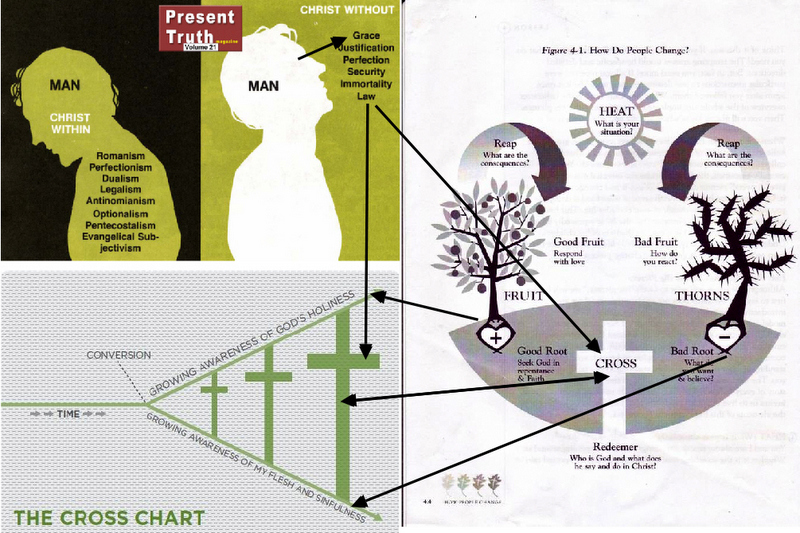
Of late, this occurred in 1970 through the Progressive Adventism movement. A Reformed think tank called the Australian Forum took what those Seventh-Day Adventists started (the Awakening Movement) and launched it into the present-day New Calvinist movement. I document this thoroughly in “The Truth About New Calvinism” (TANC publishing 2011). This movement was the latest resurgence of authentic Reformed doctrine that dies a social death from time to time because of the tyranny that always accompanies it. It enjoys its present success because the AF systematized it. My apologies that a hillbilly such as myself found out about it, but it is what it is. Please excuse me.
Let me give credit where credit is due: Piper et al know their Reformed theology very well. The Reformers were mystic before mysticism was cool. Reminds me of the following song:
I Was Mystic Before Mysticism Was Cool, by John Calvin
I remember burning stakes
Even when they weren’t in style
I remember singin’ at executions
When Geneva was really wild
And I was listenin’ to Augustine
When all of my friends were diggin’ Baptists
And dissing popes
I was Mystic, when Mysticism wasn’t cool
I remember circlin’ the stake, pilin’ up green wood
And turnin’ down Michael Servetus for a way out of town
I remember when no one was lookin’
I was puttin’ peanuts in my beer
I took a lot of kiddin’
‘Cause I never did fit in
now look at everybody tryin’ to be what I was then
I was Mystic, when Mysticism wasn’t cool
(Chorus:)
I was Mystic, when Mysticism wasn’t cool
I was Gnostic, from my hat down to my boots
I still act, and look the same
What you see ain’t nothin’ new
I was Mystic, when Mysticism wasn’t cool
They call us New Calvinists
For stickin’ to our roots
I’m just sad we’re in a country
Where Arminians are free to choose
I was Mystic, when Mysticism wasn’t cool
(Repeat chorus)
Yeah, I was Mystic when Mysticism wasn’t cool



9 comments