Stuart Scott’s Joyful Fellowship With Spiritual Despots is a Microcosm of New Calvinist Reasoning
 “Hence, and don’t miss this, justice is not the point. The concept of justice and fairness digresses from Reformed Calvinistic dualism.”
“….six months after Luther’s 95 Theses launched the Reformation, the true magnum opus of the Reformation was written by Martin Luther; his Heidelberg Disputation to the Augustinian Order. The document reflects Luther’s utter Platonist disdain for humanity.”
“Now, let’s take this information and evaluate why Scott et al are completely indifferent to suffering and injustice.”
Once again, Stuart Scott will break bread with the elders at Clearcreek Chapel (Springboro, Ohio) as he is the featured speaker at this year’s “Family Enrichment” Conference. Clearcreek Chapel having a family enrichment conference is like the Nazis sponsoring an endowment for Judaism. It’s a mockery; the Chapel has ravaged innumerable families and Christian lives since its orchestrated takeover by Russ Kennedy and aided by former Clearcreek elder Greg Cook. Cook brought in a group from another Baptist church which included present Clearcreek elders Chad Bresson and Dr. Dale Evans.
Their attempted takeover of the church they left failed, but their endeavor at the Chapel succeeded—the spiritual carnage notwithstanding. Cook, as the former (?) director of Clearcreek’s counseling program, was giving wives the green light to divorce husbands who had “ruined the family finances” while he himself was just under $200,000.00 in due and owing debt. It is unclear as to whether this revelation led to his stepping down as an elder, or not. Probably not since hypocrisy is a requirement for eldership in our day.
Other present Clearcreek elders have been forced to step down in the past, but have been reinstated; specifically, Mark Schindler who was re-baptized after his prior eldership. Apparently, not being sanctified by justification was the prior cause of his disgrace. Whatever it was specifically, his wife gave testimony that she never considered divorce and was determined to make the marriage work. It’s a pity that such wifely resolve that saved Schindler’s marriage is not encouraged among wives in the counseling rooms of the Chapel in this day. But one must remember that such resolve is only honorable in regard to saving the marriages of New Calvinist philosopher kings.
It all seems insane, until you realize that people act from their logic. Why would Scott give credence to such a camp? Why would he ignore the pleadings of the oppressed? Why is he, like all New Calvinists, utterly indifferent to justice? We get a clue from his book, The Exemplary Husband on page 72. He states the following:
God uses everything in our lives for His perfecting (growing) purposes (Romans 8:28-29; James 1:2-4). As we learned earlier, our growth as Christians toward Christ-likeness is a life-long process, often referred to as sanctification. Because God is so intent on sanctifying us, we know that He will certainly use our most important human relationships to do this.
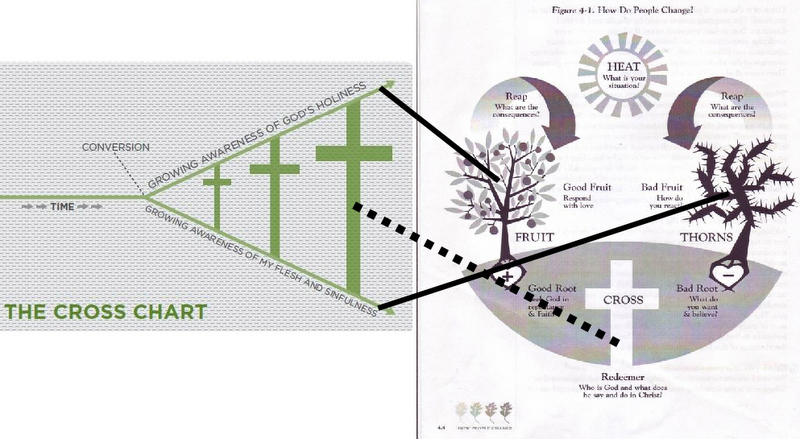
Right. As I have worn out multiple keyboards emphasizing here on PPT, New Calvinism is a dualist philosophy. Let’s go over this again. Below is THEIR illustration, NOT mine:

Note first that regardless of their verbiage, they don’t believe we really grow, it’s the cross (what it represents) that grows. That’s obviously job one. The endeavor thereof requires a primary focus on two goals and two goals only: a deeper and deeper UNDERSTANDING of our sinfulness, and absolutely nothing else, as set against God’s holiness. Part and parcel with this is also the idea of worthlessness on our part.
The cross represents bigger and bigger salvation which must be manifested more and more until the day when our “final justification” is “revealed.” This occurs as we are sanctified the same way we are saved, by partaking in the realizing of our sinful worthlessness before God and His holiness. The more we understand the difference between the two, the more our salvation is manifested. We don’t change, only the greatness of our salvation changes in order to glorify God. Of course, this obviously redefines the new birth and denies it.
As prorogated in the satanic treatise, “How People Change” by Paul David Tripp, ALL tragic and sinful events in life serve the bottom of the cross chart, and ALL good that occurs in our lives serves the top of the chart. As we contemplate the gospel narrative, the goodness of God is manifested which contributes to more understanding at the top of the chart. Goodness is not our fruit, its God’s fruit only for the purpose of aiding us in understanding His goodness—not ours. Hence, and don’t miss this, justice is not the point. The concept of justice and fairness digresses from Reformed Calvinistic dualism.
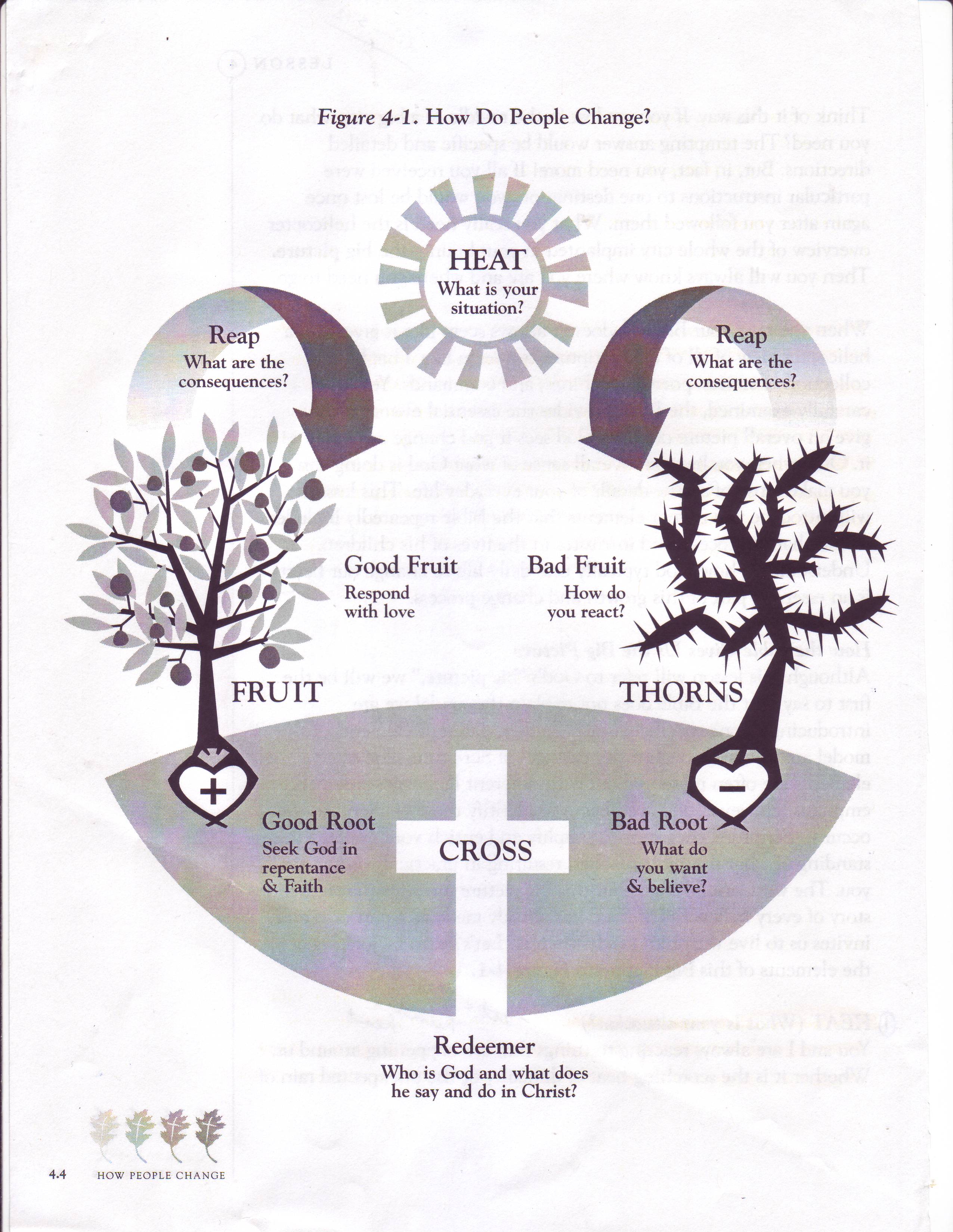
The next point is that in the neo-Calvinist gospel schema, the Scriptures serve as a Cross narrative to help us see this dualism in a clearer way. In the mind of the neo-Calvinist, the Scriptures do not define what is right and fair; the Scriptures define Luther’s “cross story.” Here is what the vast majority of Christians do not understand: six months after Luther’s 95 Theses launched the Reformation, the true magnum opus of the Reformation was written by Martin Luther; his Heidelberg Disputation to the Augustinian Order. The document reflects Luther’s utter Platonist disdain for humanity.
In Luther’s Disputation, all reality must be seen through the cross story; i.e., the cross illustration at hand here, and ALL else is the “glory story” or anything at all to do with us—our glory, not the cross story that makes God bigger and mankind smaller. To any degree that we are in the equation, the cross story is diminished.
Now, let’s take this information and evaluate why Scott et al are completely indifferent to suffering and injustice. What did the Clearcreek elders do that is wrong? Nothing because the purpose of the Bible is not to judge the authority of Reformed elders, it is to show forth the cross story, not our story, and injustice is an Us Story kind of thing. Have former parishioners at Clearcreek suffered unjustly at the hands of the elders? Well, that’s a good thing! That suffering shows us the bottom of the chart. And besides, “justice”? If we got what we all deserved, there wouldn’t be any grace! Is this like Paul’s protest in Romans against propagating more evil that grace may abound? Yes, I think so. To the contrary in the minds of neo-Calvinists, we should bow down and thank God for bringing such abuse into our lives.
This is the gospel construct that rules the majority of biblical counseling in our day and is taking over the church in this country. It is a Platonist world view that set Europe on fire for hundreds of years with unspeakable horrors. And it is a story that is playing at a local church near you.
And this weekend, Stuart Scott brings his version of the show to Springboro, Ohio. A celebration of suffering in the name of Christ. But I have news for Scott: the sins of the Clearcreek elders does not cause grace to abound. And his appearance there has nothing to do with grace or love.
If there are any parishioners at Clearcreek (who may be reading this) who are presently there against their will for fear of public humiliation or things revealed in counseling —in your desperation, don’t slip Scott a note—he’s one of them.
paul
Justin Taylor: We Cannot Know With Certainty Who is Saved Until the Final Judgment
Justin Taylor answered some questions about Calvinism on a blog recently. Here is how he was introduced:
Justin Taylor is a popular blogger and leader in the modern Reformed movement. The vice president of book publishing and an associate publisher at Crossway, he has edited and contributed to several books and served as the managing editor for The ESV Study Bible. He blogs at Between Two Worlds.
As I have said before, Calvinism is a gospel where you are elected to run a race of faith alone. If you aren’t elected, you don’t even get on the racetrack. If you are elected to run the race, the race must be run by faith alone and we must persevere against a supposed constant temptation to implement our own efforts in the running by faith alone race. The race must be run the same way we were saved, by faith and repentance alone via “obedience of faith,” “deep repentance,” and “new obedience” being the result. Sure, we are elected and our salvation is past (already), but the “not yet” will determine if we finished the race by faith alone. This is often referred to as the already/not yet in Reformed circles.
It also necessitates a single, final judgment of all people that includes those not in the race (non-elect), those who were in the race but were disqualified for adding works to their faith (apostates), and those who finished the race by faith alone and receive the crown of life.
Hence, when the following question was asked,
What would you tell someone who has not been chosen by God to be saved?
Taylor answered this way:
Who is ultimately among the elect will only be known with certainty at the Day of Judgment. Now—in the already/not-yet, “between the times”—we must obey God’s revealed will, which is to preach the gospel indiscriminately. (For the distinction between God’s secret and revealed wills, see Deut. 29:29.)
So I would tell anyone to “believe in the risen Lord Jesus, and you will be saved” (Acts 16:31; Rom. 10:9). I would encourage them to “repent and believe in the gospel” (Mark 1:15). I would tell them that Jesus is calling them: “Come to me, all who labor and are heavy laden, and I will give you rest” (Matt. 11:28)—even though in the previous verse Jesus had said that no one knows the Father expect those to whom the Son reveals him (v. 27).
This Reformed gospel construct runs afoul of much literal interpretation, but primary in regard to the clear statements in Scripture that posit more than one resurrection and judgment, and the clear teaching by the apostle John that we can know for certain that we are saved (1John 5:13).
paul
Stuart Scott of Southern Seminary is Just Another Wolf in the Pack
Integrity in pastoral ministry is caring about the one as much as the ninety-nine. It’s like the Jewish proverb: “He who saves one life saves the world.” James chastised Jewish leaders for treating a certain class of believers like they were expendable. Most leaders of our day don’t get that.
Once again, Stuart Scott, Director of “Biblical Counseling” at Southern Seminary will speak at Clearcreek Chapel’s (Springboro, Ohio) annual “Family Enrichment” Conference. Scott has been exhorted by me in the past to not lend the Chapel credibility in this way because they have never repented of a litany of unresolved conflict with many former members, some who fled the state of Ohio to get their families as far away from the Chapel as possible. The elders there are also on record in regard to preaching outrageous, cultish concepts.
Indifference to justice and spiritual abuse in the church is part and parcel with being a visible leader in our church culture today. The abused are expendable and underfoot. And unlike Hollywood where a few stars admit that they are Republicans, the spiritual rock stars of our day share no such intestinal fortitude, not even for what is right. Scott’s indifference is just another example among many. Whether Grace Community Church and their seminary in California, or his present tenure at Southern, Scott runs with the best of the wolf packs.
His former boss, John MacArthur, and his present boss, Al Mohler, both endorse /fellowship with CJ Mahaney. Regardless of being entangled in a lawsuit concerning various abuses by Mahaney’s ministry (SGM) including sexual abuse cover-ups, Mahaney will be a featured speaker at the next Together For The Gospel conference (T4G). Mohler, Mark Dever, Ligon Duncan, and CJ Mahaney are the “core four “ of these bi-annual conferences. Mohler, Dever, and Duncan continue to be staunch defenders of Mahaney. At the very least, Mahaney has never confessed his blackmailing of SGM’s co-founder in an effort to prevent him from leaving SGM for doctrinal reasons. Said co-founder tape recorded the attempted blackmail which involved counseling issues being made public. The transcript of the attempted blackmail has been made public.
Mahaney will also be a featured speaker at this year’s TGC conference (the bi-annual compliment of T4G) in April along with Al Mohler and the who’s who of the New Calvinist wolf pack. This conference includes many Emergent church speakers as well as the rankest of mystic heretics such as Tim Keller who propagates New Age spiritual contemplationism in broad daylight.
These people have zero pastoral integrity and absolutely no love for the truth. Scott, who undoubtedly lusts constantly to be a part of the bigger show, must settle for the smaller stages among the spiritual despots of our day; i.e., Clearcreek Chapel.
And that he will do. That is who he is. He is just another wolf in the pack.
paul

Romans 6
Not that any part of Romans is more important than the rest, but I can’t help but say that we now enter into a most significant chapter in our day. Why do Christians sin? How can we be declared righteous and holy when our sin haunts us daily? If we are born again, if we are new creatures, why do we still sin? We start finding the answers in Romans chapter six.
Paul has been emphasizing the point over and over again that we are justified apart from the law. We are under grace, not under law. There is no law in justification though the law informs our Christian living. So now, Paul begins a rebuttal of what would seem to be the logical conclusion of what he has taught thus far:
Romans 6:1 – What shall we say then? Are we to continue in sin that grace…
View original post 3,409 more words
The Potter’s House: Sunday, January 22, 2013; Romans 6
Romans 6
Not that any part of Romans is more important than the rest, but I can’t help but say that we now enter into a most significant chapter in our day. Why do Christians sin? How can we be declared righteous and holy when our sin haunts us daily? If we are born again, if we are new creatures, why do we still sin? We start finding the answers in Romans chapter six.
Paul has been emphasizing the point over and over again that we are justified apart from the law. We are under grace, not under law. There is no law in justification though the law informs our Christian living. So now, Paul begins a rebuttal of what would seem to be the logical conclusion of what he has taught thus far:
Romans 6:1 – What shall we say then? Are we to continue in sin that grace may abound?
The rhetorical question should serve to illustrate how hard Paul has emphasized that Christians are not under the law for justification. He then answers the question as follows:
2 By no means! How can we who died to sin still live in it?
How have we died to sin? Answer:
3 Do you not know that all of us who have been baptized into Christ Jesus were baptized into his death? 4 We were buried therefore with him by baptism into death, in order that, just as Christ was raised from the dead by the glory of the Father, we too might walk in newness of life.
Here we have it in a nutshell. We died with Christ when we were saved, and are raised like Christ to “newness” of life. If we are new in life, the old died. A new life obviously replaced the old one. It happened “in order that” “we too” might walk in newness of life. “We” (first person plural) is us, as in, Christians. “Too” means that we might walk in newness of life like Jesus walked. “Too” implies that we are the ones walking—Jesus doesn’t walk for us. We are new creatures and able to walk in newness of life—the fact that we are empowered by the Holy Spirit is true, but does not negate the fact that we also walk. Let me remind you that even the unregenerate walk by the power of Christ who sustains all things (Colossians 1:9). That doesn’t mean that the unregenerate aren’t really the ones walking just because they are sustained by Christ. The same must be said for us regardless of the fact that we are empowered and recreated. Water baptism pictures this spiritual reality.
Romans 6:5 – For if we have been united with him in a death like his, we shall certainly be united with him in a resurrection like his. 6 We know that our old self was crucified with him in order that the body of sin might be brought to nothing, so that we would no longer be enslaved to sin. 7 For one who has died has been set free from sin. 8 Now if we have died with Christ, we believe that we will also live with him. 9 We know that Christ, being raised from the dead, will never die again; death no longer has dominion over him. 10 For the death he died he died to sin, once for all, but the life he lives he lives to God. 11 So you also must consider yourselves dead to sin and alive to God in Christ Jesus.
Dead to sin, and alive to God. Note verse 6 specifically: the “old self” was crucified with Christ which resulted in us not being any longer “enslaved to sin.” The reason that we can be considered righteous in our present life is because slavery is the issue. The old man is dead, so the life that enslaved him is powerless, but there is a remnant that is left behind or we would not still be walking around in mortal bodies. Nevertheless, his power to enslave to sin has been broken and we are free from the bondage of sin.
This is the case when we died with Christ, and what is also true is that we are now alive WITH Christ. We do not remain dead and the only life in us is Christ, we are also alive. Our resurrection life would be impossible without Christ, but that doesn’t mean we are still dead because we got our life from Him. Like any gift, once it is given, we have possession of it. This would seem evident. The apostle John made it clear that we have the seed of God in us (1John 3:9), so that making us righteous in our present day should not be an issue. The ability to do works that please God should not be an issue either.
According to what we have learned thus far in Romans, this old man that is now dead is also part of a position that we are no longer are a part of; namely, “under the law.” The eternal state is decided by whether one is under law or under grace. Those who are under the law will be judged by the law (Romans 2:12) and the standard is perfection. It will not go well for them. Not only are we considered righteous in our present state, but there is simply no law to judge the sin that presently takes place in the Christian life under the confines of justification. In regard to our justification, the law has no jurisdiction. Even if we were to appear in a court to determine our just state the judge would have no law to judge us by:
Romans 5:13 – for sin indeed was in the world before the law was given, but sin is not counted where there is no law.
The relationship of the law to Christians differs from that of the unbeliever: in regard to our justification the law has no jurisdiction. The jurisdiction of the law now applies to our sanctification. The law no longer informs our justification—we are no longer “under it.” But it does inform our sanctification:
Galatians 4:21 – Tell me, you who desire to be under the law, do you not listen to the law?
There is no need for Christ to keep the law for us in our sanctification as many teach in our day—we are not under it to begin with. The law itself informs us that we are no longer under it for our justification. Moreover, it is the full counsel of God for our sanctified life—it defines the reality thereof. This position is antithetical to being under the law; i.e., “under grace.”
So, we must consider the old man to be dead, and the new man alive. Even though the old man is dead and is no longer able to enslave us to sin, he is able to make an appeal to sin through the emotions:
Romans 5:12 – Let not sin therefore reign in your mortal body, to make you obey its passions. 13 Do not present your members to sin as instruments for unrighteousness, but present yourselves to God as those who have been brought from death to life, and your members to God as instruments for righteousness. 14 For sin will have no dominion over you, since you are not under law but under grace.
We are not primarily informed of this transformation from death to life experientially. Again, the law informs us that this is the case and we are to act accordingly. Apparently, our mortal bodies, which still includes the mind, can make one whale of a plea to sin through the passions. We don’t have to sin, but it is inevitable because though transformed, we are still imprisoned in our present mortality. Christ stated it this way:
Watch and pray that you may not enter into temptation. The spirit indeed is willing, but the flesh is weak (Matthew 26:41).
The law now informs us on how to present “your members to God as instruments for righteousness.” Elsewhere, Paul states it this way:
1Thessalonians 4:1 – Finally, then, brothers, we ask and urge you in the Lord Jesus, that as you received from us how you ought to walk and to please God, just as you are doing, that you do so more and more. 2 For you know what instructions we gave you through the Lord Jesus. 3 For this is the will of God, your sanctification: that you abstain from sexual immorality; 4 that each one of you know how to control his own body in holiness and honor, 5 not in the passion of lust like the Gentiles who do not know God;
For the believer, a lot of the law is about, “how you ought to walk.” And we are to do it, “more and more.” And we can do it because we are no longer under the dominion of sin which is synonymous with being “under the law.”
So, as far as obedience in sanctification, why all the fuss? The law can’t touch our eternal destiny, and where there is sin, grace abounds that much more (Romans 5:20). So, why not be relaxed in regard to the law? Paul explains:
Romans 6:15 – What then? Are we to sin because we are not under law but under grace? By no means! 16 Do you not know that if you present yourselves to anyone as obedient slaves, you are slaves of the one whom you obey, either of sin, which leads to death, or of obedience, which leads to righteousness? 17 But thanks be to God, that you who were once slaves of sin have become obedient from the heart to the standard of teaching to which you were committed, 18 and, having been set free from sin, have become slaves of righteousness. 19 I am speaking in human terms, because of your natural limitations. For just as you once presented your members as slaves to impurity and to lawlessness leading to more lawlessness, so now present your members as slaves to righteousness leading to sanctification.
20 For when you were slaves of sin, you were free in regard to righteousness. 21 But what fruit were you getting at that time from the things of which you are now ashamed? For the end of those things is death. 22 But now that you have been set free from sin and have become slaves of God, the fruit you get leads to sanctification and its end, eternal life. 23 For the wages of sin is death, but the free gift of God is eternal life in Christ Jesus our Lord.
Paul’s first point is that we show ourselves saved or unsaved by what we are enslaved to:
16 Do you not know that if you present yourselves to anyone as obedient slaves, you are slaves of the one whom you obey, either of sin, which leads to death, or of obedience, which leads to righteousness?
This is linked intrinsically to our assurance of salvation. We show ourselves a slave to righteousness or unrighteousness. Everybody born into the world is a slave. Yes, there is a choice; what type of slave do we want to be? A slave to righteousness or unrighteousness? Once again, we learn another powerful concept that can be integrated into our gospel presentations as we go in the way. I am convinced that more would be led to Christ in our day if we were better educated in the law. This is indeed a concept that can even be shared with children at a very young age.
Secondly, Paul makes the point that we become better and better slaves to whatever we are enslaved to—righteousness or unrighteousness. Slaves to unrighteousness sow and reap more and more death upon their lives, and slaves to righteousness sow and reap more and more righteousness upon their lives. Can you see that the difference between saved and unsaved is being defined here? Oh my! What a horrible travesty in our day that such a distinction is blurred! Again, the applications here on this one point are endless. One who doubts their salvation should give attention to their slavery. One who is a slave to sin with indifference should not be given any comfort that they are not under the law.
Third, Paul adds yet another point to why the law should not be lax in sanctification. Even though we are no longer under it for our justification, we were COMMITED to it for our sanctification:
17 But thanks be to God, that you who were once slaves of sin have become obedient from the heart to the standard of teaching to which you were committed, 18 and, having been set free from sin, have become slaves of righteousness.
A commitment (obedience) to the “standard of teaching” (the law) is part and parcel with the transformed heart. We are not saved by the law, but we are sanctified by it (John 17:17). When we profess Christ by faith alone, we are not only signing up for salvation, but for discipleship (Matthew 28:19, 20). Enslavement to sin, becoming a better and better slave to sin, and being under the law which in itself provokes the slave to sin more and more, and moreover will judge him/her in the end, is indicative of the unregenerate. Slavery to righteousness leading to more and more righteousness, and a love for truth (2 Thessalonians 2:10,11) is indicative of the righteous. Hence,
19 I am speaking in human terms, because of your natural limitations. For just as you once presented your members as slaves to impurity and to lawlessness leading to more lawlessness, so now present your members as slaves to righteousness leading to sanctification.
It might be added here that a commitment to no longer be a slave to sin is not in concert with so-called Lordship salvation. Anybody who is presented with the gift of the gospel should certainly be informed that they are not only seeking to escape hell by faith alone, but are also seeking to escape slavery to sin. They should also understand that they are escaping judgment from the law by the same token. Certainly, to understand that they are now a slave to Christ and not unrighteousness is efficacious to a proper understanding of the gospel. Lordship does not have one thing to do with our justification because there is no standard (law) in justification. The “standard” is now in sanctification (the “standard of teaching”) and is merely indicative of who we are. As Christians, we merely experience the reality that the law informs us of—by appropriating it through obedience, or working out what has been worked in. This is essential to our assurance. In order to prevent confusion, you can’t just say, “Lordship salvation.” It must be framed as Lordship justification or Lordship sanctification. Lordship justification is still under the law and enslaved to sin, Lordship sanctification is under grace.
Romans 6:20 – For when you were slaves of sin, you were free in regard to righteousness. 21 But what fruit were you getting at that time from the things of which you are now ashamed? For the end of those things is death. 22 But now that you have been set free from sin and have become slaves of God, the fruit you get leads to sanctification and its end, eternal life. 23 For the wages of sin is death, but the free gift of God is eternal life in Christ Jesus our Lord.
Paul frames this concept with slavery and freedom. The cute little Reformed comeback to the argument for freewill, “Mankind has a freewill alright; free to sin,” is actually backwards. Man is born in slavery to sin, and freedom in regard to righteousness. There is in fact, freewill. Slavery to a direction towards either righteousness or unrighteousness is the crux of the matter, with freedom to do good or evil with either. Note the illustration below:

Ultimately, though the unbeliever is enslaved toward evil, he/she has the freedom to do good, and I contend that at times do so accordingly. Even with honorable motives. The good works of the unrighteous have merit—not for justification, but in other matters. One, for what it is worth, is degree of eternal punishment. We also see some measure of freedom in regard to righteousness when Jesus said the following:
Matthew 11:20 – Then he began to denounce the cities where most of his mighty works had been done, because they did not repent. 21 “Woe to you, Chorazin! Woe to you, Bethsaida! For if the mighty works done in you had been done in Tyre and Sidon, they would have repented long ago in sackcloth and ashes. 22 But I tell you, it will be more bearable on the day of judgment for Tyre and Sidon than for you. 23 And you, Capernaum, will you be exalted to heaven? You will be brought down to Hades. For if the mighty works done in you had been done in Sodom, it would have remained until this day. 24 But I tell you that it will be more tolerable on the day of judgment for the land of Sodom than for you.”
Let’s now look at the circle on the right: are believers free to do evil? They most certainly are. But this is what Paul states in that regard:
21 But what fruit were you getting at that time from the things of which you are now ashamed? For the end of those things is death. 22 But now that you have been set free from sin and have become slaves of God, the fruit you get leads to sanctification and its end, eternal life.
Many English translations tend to give the idea that we persevere in doing good and this perseverance ends with eternal life, but that’s not what Paul is saying. If our perseverance ends with eternal life, then we are trying to obtain an end by works. This is Paul’s same point in Galatians 3:1-3;
O foolish Galatians! Who has bewitched you? It was before your eyes that Jesus Christ was publicly portrayed as crucified. 2 Let me ask you only this: Did you receive the Spirit by works of the law or by hearing with faith? 3 Are you so foolish? Having begun by the Spirit, are you now being perfected by the flesh?
Now note how Young’s Literal Translation renders this:
O thoughtless Galatians, who did bewitch you, not to obey the truth — before whose eyes Jesus Christ was described before among you crucified?
2 this only do I wish to learn from you — by works of law the Spirit did ye receive, or by the hearing of faith? 3 so thoughtless are ye! having begun in the Spirit, now in the flesh do ye end?
Paul, in essence is asking, “How do you work towards an end that has already been ended? This of course is in regard to justification. We have already come to an end of our justification before the Earth was even created. Also note that when we believed, we received the Spirit who seals us until the day of redemption (Ephesians 4:30). Paul is making two points here: it’s foolish to work towards an end that has already been finished. It’s foolish to work to keep something that is already sealed by the Holy Spirit’s power.
Rather, Paul is speaking of two directions: one that experiences progressive life and ending in eternal life, and one that experiences progressive death with eternal death as its end. As the arrows in the picture illustrate, we are either moving from less righteousness to more unrighteousness, or from less unrighteousness to more righteousness. It is no wonder that the gospel is often framed in context of repentance—repentance is a change of direction. I believe that the Scripture states that we can be so sure of this paradigm that we can know our present spiritual condition by examining our lives. I believe this is the whole point of 1John. See 1John 2:5 and 5:13 specifically. Peter also wrote of adding to the foundation of our faith in order to obtain a “rich” entry into heaven (2Peter 1:5-11). Can a saved person have poor entry into heaven shrouded with doubt? Yes, I think so.
Christians can experience death in this life through sin, and those experiences don’t lend themselves to a hopeful end. James spoke of singular sinful events that lead to death (James 1:14,15). John spoke of sin that leads to death among Christians (1John 5:16,17) and Paul wrote elsewhere that God puts some to death so that they will not be judged with the world (1Corintians 5:4,5; 11:30,31).
A life of death gives assurance that eternal death will be the end. A life of life gives assurance of eternal life. Being unregenerate is like job wages, the wages of sin is death, but our already finished end is a gift—let us be sure of it by how we walk,
23 For the wages of sin is death, but the free gift of God is eternal life in Christ Jesus our Lord.




1 comment