Why David Powlison is a Liar
 Cultists are all the same. First, they believe they understand a higher knowledge that most Christians are not “ready for.” Example: in an interview with John Piper conducted by someone who asked him what he would say to the Pope if he had two minutes with him, Piper stated in no uncertain terms that most Christians are not ready for the true Reformation gospel of justification by faith alone [in sanctification]. Secondly, this mentality allows them to condone the hijacking of familiar Christian terms/phrases and use them to deceive. Example: when they use the term progressive sanctification they really mean progressive justification and they know it grade-A well. It’s deliberate deception.
“Cult” is a loosely used term and it should be. Cults are defined as any group that seeks to control others through deception. They are also defined by being sectarian; in other words, their false doctrine divides relationships of various kinds. New Calvinism has its roots in ancient spiritual caste systems that are defined by those characteristics. Much of today’s religion finds its origins in those ancient philosophies. So “cult” is going to be a term often used, and rightfully so.
This post was instigated by an email I received from a reader regarding a recent article by David Powlison in the revamped The Journal of Biblical Counseling. I believe Powlison to be, for many documented reasons, an unrepentant, habitual liar. The article that was referred to me, as you can tell, has ruffled my feathers. I’m just fed up with all of the deception. The link was a review written by John Piper puppet Justin Taylor. What is the gist of the article? Powlison is going to explain why being sanctified by justification is only one small part of the full counsel of God that he pretends to proffer. In one promotion for the article we read,
David Powlison challenges the popular views on sanctification that take one strand in Scripture and present it as the be all and end all of Christian growth. He specifically engages the strengths and weaknesses of the view that asserts, “You are sanctified by remembering that you are justified.”
Um, excuse me, but first of all, the idea that Christian growth comes from preaching the gospel to ourselves every day or revisiting the gospel isn’t even “one strand” of Scripture to begin with. That strand isn’t there period. It’s a lie directly from the pit of hell itself. According to Taylor, Powlison will address the following in part 2 of the article:
In an article planned for the next issue of the journal, Powlison plans to look at several related questions:
Is sanctification essentially the activity of remembering and rebelieving that Jesus died for your sins? Is self-justification by your own performance the chief problem that sanctification must deal with? When the Bible says to “make every effort,” is the hard work chiefly the struggle to remember and believe again that we are saved by the achievement of our Savior? “In each case,” he writes, “I will say No, and will seek to widen both our personal approach to sanctification and the scope of ministry to others.”
Powlison chooses his words carefully. He is going to “teach” us how to “widen” our “approach to sanctification.” But the “approach” is still singular, and as this blog has exhaustively documented, his approach is exclusively Christocentric. Powlison’s language is also continually saturated with nuance such as, “I will say no.” Why not just say NO and be done with it? Because the answer is not really “no,” that’s why. That’s the usual Powlison speak for, “It’s kinda ‘no’ but then again it’s kinda ‘yes’”
Let me make my point with this excerpt from Taylor’s blog:
Is self-justification by your own performance the chief problem that sanctification must deal with?
Um, excuse me, but if you are a Christian, self-justification in sanctification is a complete impossibility. But notice that it is conceded that such is a possibility by referring to it as a question of being the “chief problem.” Also note that the concern isn’t those who attempt to be saved by their works which then cannot be called sanctification to begin with, but that self-justification in and of itself is possible in sanctification. The very question verifies what Powlison really believes. Works justification CANNOT take place in sanctification. Where works justification is present, sanctification cannot exist. The very framing of the question shows that Powlison doesn’t believe that the two are mutually exclusive. Moreover, we need them to guide us through the very tricky business of figuring out what is our “own performance” in sanctification resulting in “self-justification” verses what isn’t our own efforts in sanctification. Again, their very premise is a biblical impossibility, but reveals what they really believe.
Powlison is a cultist extraordinaire. That’s what he is. Like all New Calvinists.
paul
Easter Sunday in America: A Celebration of Christian Depravity
 “The lie that is sucking the life out of the American church started early and was repeated often throughout the service; Jesus Christ is alive and we are dead.”
“This is why the American church is chocked full of spiritual despots and pedophiles; we only preach Calvin and Luther’s half-gospel of one resurrection and deny the primary purpose of the second, that resurrected saints would fulfill the law of God and destroy the works of the devil for the glory of God in this life.”
My wife Susan likes music and people. I love Christ, but don’t much care for contemporary Christian music that makes Him a Brahman and not the Lord and King of the forthcoming new heavens and new earth. We Americans love our mystical Jesus. We make much of Him so we can know little of Him. He is so high above us that to claim to know anything save Him crucified is arrogance. It’s Tal Bachman theology; he knew a girl that was so high above him, “Like Cleopatra, Joan of Arc, or Aphrodite,” that, “She comes to speak to me I freeze immediately,” and, “What could a guy like me ever really offer?”
The more subjective a god is, the more we can make it a god of our own making. Many will stand before Christ’s eyes of fire in the judgment and claim Him so wonderful that they couldn’t have known anything about Him that is objective. After all, only the gospel is objective and anything we think we know is subjective at best. Dishwalla, in their song, “Tell me all Your Thoughts on God,” present us as children who can’t really know God, but the song surmises that God is a woman. But that’s ok, after all, we are merely children who, “count only blue cars and skip the cracks in the street. And ask many questions like children often do.” The world has this gig down better than Christians; we are nothing compared to whatever the higher power is, so who is the higher power to find fault? Don’t worry, she won’t, all will end well.
Oh, but like Susan, I like people too, it was one of the conditions of our marriage contract. We compromised on the music. Since the Potter’s House is a very humble upstart, and the wonderment of the Easter holiday was upon us, off we went to a morning cantata service to experience American Easternism. And because I am a mere worm like all others that attended, I won’t name the Southern Baptist church located in Xenia, Ohio that we attended. Besides, the point here is that this service was undoubtedly representative of the vast majority of Easter Sunday services taking place in the evangelical church.
The lie that is sucking the life out of the American church started early and was repeated often throughout the service; Jesus Christ is alive and we are dead. One who was leading music pontificated that Jesus was resurrected to confirm that God was pleased with the sacrifice. What he couldn’t say would get someone thrown out of the church in our day: Christ was resurrected to give us life in the here and now; the same power that raised Him from the dead (EPH 1:18-20). This is why the American church is chocked full of spiritual despots and pedophiles, we only preach Calvin and Luther’s half-gospel of one resurrection and deny the primary purpose of the second, that resurrected saints would fulfill the law of God and destroy the works of the devil for the glory of God in this life (ROM 8:3,4, 1JN 3:8, JN 14:12). As a man thinks in his heart so is he, if he thinks he is a worm, he will act like one.
After an hour of everything life of Jesus and our depravity music, the pastor delivered a mini-treatise that was the usual Heidelberg Confession construct: all wisdom and true theology is a deeper and deeper knowledge of our evil as set against the holiness of Christ. He said we are “broken people in a broken world” and unable to do anything with pure motives. This is not how the Bible describes Christians at all. We are described as being resurrected WITH Christ and in high places with Him. We are described as “more than conquerors.” And the Bible does not even describe the unregenerate as incapable of impure motives because they were born with the works of the law written on their heart. They will not be justified by that, but it doesn’t render them incapable of doing good works. Yes, works they do in order to be justified are filthy rags, but that is not a sweeping metaphysical indictment of mankind in general.
Then he added the caveat that there is no real purpose in this life. And believe me, that’s how the American church lives. What purpose could there be if only Christ was resurrected and we are dead? And the practical application? As stated, “We overcome with the joy of our salvation.” Really? This aped the song that we also sang earlier: “We overcome by the blood and our testimony.” Stated another way by the Neo-Calvinists of our day running the church: “We shouldn’t be the gospel, we should only preach the gospel.” While New Calvinists bemoan the idea that the world is mostly unevangelized, I assure them that the gospel of preaching only is well known throughout the world and God is blasphemed accordingly.
Susan and I are beginning to note a trend in these churches as we visit some that we were previously acquainted with in the past: They are dead. The worship is half-hearted. It’s like, “Are we having fun worship yet?” But what do we expect? We are dead, right? I know that the theses is that by making much of Christ and little of us that worshipful manifestations will take place, but joyful skeletons singing aloud in praise is a pipe dream that Calvinists will never realize. They are sucking what life was left of the church after Billy Graham’s first gospel wave. Dr. Kevorkian is presiding over the terminal ill patient that is the American church: a reputation for being alive, but really dead, and proud of it.
Unfortunately, Susan and I had watched the epic Star Wars movie late into the night before. By the end of all of this, a part of the movie seized my mind: Darth Vader; “I find your lack of faith disturbing.” As I focused on the pastor finishing his skeletal rendition of the resurrection, I observed my hand raised up in a grasping configuration. I looked to Susan for help, but found little on her frowning face as she commented, “I have a problem with the suggestion that God [the Father] was resurrected.” But when you reduce Christianity to a narrow objective door, you enter into a reality of subjective monstrosity. Anything goes from there. Dishwalla followers see no need to change venue; counting blue cars and going to church is all the same.
Christ never commanded us to celebrate His resurrection via a special day on the calendar. It’s optional. But if we are going to do it, don’t make it a lie and a half-gospel—celebrate not only what Christ did, but His purposes as well. He came to give us purpose in the here and now as well as eternally. Easter is not only about the resurrected Christ Himself, but what he sought to do in us being resurrected WITH him as new creatures.
The half-gospel of total depravity is a lie and a false gospel. And let those who preach it be accursed.
paul
What John Piper Really Believes
“How are we changed by God if nothing happens inside of us?”
“Reformation epistemology must exclude any improvement or grace inside of us; otherwise, by their own definition, reality cannot be known.”
“This brings us to the fact that Reformers, both old and new, seek to create a completely different reality of thought and metaphysics in order to control their followers. They also rewrite church history to match this created reality of their own making.
What John Piper really believes represents the basic principles of the Reformation gospel. The Reformation has always been endowed with those who can sell snow to the Eskimos. The official name of their doctrine sounds so theologically cutting edge: the centrality of the objective gospel outside of us. One thinks: “Right, the gospel should be central, no? And, we were not saved by any kind of knowledge that was within us; of course we were informed by the all-knowing God! Salvation wasn’t something that originated within us!” This is something that the Reformers, past and present, are absolute masters of: drawing people in by using terminology that plays on their assumptions. Hence, “total depravity” is assumed to only apply to the unregenerate. Hence, “justification by faith alone” is assumed to apply to, well, justification alone, when it really applies to both justification and sanctification. Luther and Calvin didn’t see this as disingenuous because they believed the two are the same anyway. Hence, “Scripture alone” assumes applicable knowledge rather than Christocentric contemplationism. But that’s the first one: assumptive terminology; terminology that plays on the assumptions of others.
John Piper has been very careful to stay aloof from the progressive Adventist movement that rediscovered Luther’s “justification by faith alone” gospel and spawned the present-day New Calvinist tsunami. The leader of that movement started a Reformed think tank to systemize the doctrine for contemporary consumption. He was joined by Graeme Goldsworthy who wrote several articles for the think tank’s theological journal in the seventies. But when Goldsworthy was invited to Southern Seminary to lecture, Piper couldn’t help himself; someone who really understood the heart of Reformation theology lecturing at Southern approached orgasmic reality.
TANC Publishing, our own anti-Reformation think tank has known since 2010 what this gospel is, in its least common denominator, but were perplexed concerning the big picture. We understood elements and cause/effect, but in essence, our thoughts were: “How in the world does this work in real life?” We came to believe that said think tank, The Australian Forum, had created an image that captured the big picture of the Reformation gospel, but what in the world could the picture really mean? (Click to enlarge if necessary):

As you can see, anything going on within the believer yields bad results. We called this illustration the “fetus” because we knew it captured the essence of the Reformation gospel, but again, what does it mean in real life? How are we changed by God if nothing happens inside of us? This brings us to the day in 2009 when John Piper couldn’t help himself. He wrote an article on his Desiring God blog that concurred with Goldsworthy on why the Reformation was needed. Supposedly, the Reformation was needed because Rome infused the works of Christ inside of the believer. Because Rome and the Reformers both saw justification as a continuous “chain” from eternity past to “final justification,” any “work” by the believer , whether done by Christ within us, or otherwise, makes us participants in justification. Rome is/was ok with this, the Reformers were not. This author uses almost the whole fourth chapter of The Truth About New Calvinism to document Piper’s commentary on this.
So, regardless of the entire “inside of us” lingo used by Piper et al, they don’t believe there is any grace inside us. Christ doesn’t do work inside of us; if He did, that would “make sanctification the ground of our justification.” Again, because sanctification is the middle links in the chain from eternal justification to so-called final justification. If we are involved in the links at all, we are a part of our own justification and are making “sanctification the ground of our justification.” It all must be a work of God by faith alone. I delve into this matter in detail in Sessions two and three of the 2012 TANC Conference, and in False Reformation published this year.
However, we contend that if salvation is a “chain,” EVERYTHING we do in sanctification is a work. Whether thinking, praying, or meditation, we are still involved in the links. Calvinism makes distinctions between what is a work in sanctification and what isn’t a work in sanctification and thereby classifies passive activities as faith and not works. WORKS ARE WORKS, AND ARE NOT DEFINED BY DEGREE OF PASSIVITY. This is why justification and sanctification must be separate.
Once Calvinism categorizes what is of faith in the Christian life and what is of works, these same conduits are used to live by faith alone which equals all of grace staying COMPLETLEY outside of us. Look back at the illustration—it is what it is. However, their thesis is crippled by the idea that thinking is not a work. Nevertheless, we will begin with Luther and Calvin’s dualist approach to understanding wisdom and use it to reveal how contemporary Calvinists use deliberate deception in propagating this false gospel.
Luther and Calvin believed that all reality was understood by a deeper and deeper understanding of God’s holiness as set against a deeper and deeper understanding of our sinfulness. And this is how people are saved as well: by faith (in whom God is) and repentance (from how evil we are). Neither of these change, the key is a deeper understanding on our part in regard to both. When this continues to happen, the works of Christ are continually imputed to us throughout our Christian life in the same way we were saved; i.e., justification by faith because “sanctification” is really the progression of justification. The works of Christ are imputed to us as we “see” them in the Bible. This is indisputable as illustrated by THEIR OWN chart published by a New Calvinist organization (Click to enlarge if necessary).
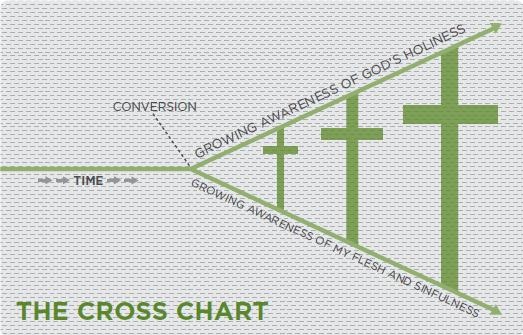
Therefore, New Calvinists communicate within the context of this dualism: the cross story, or your story. It’s either all you, or all God in sanctification. It is either the Cross Chart illustration or a chart that notes some goodness/grace within you. We call this the Either/Or hermeneutic. New Calvinist preaching /teaching well rarely present a metaphysical balance/middle ground/alternative perspective accordingly. The messages will always, in some way, merely contrast total depravity and God’s holiness.
In regard to believing that justification and sanctification are one and the same, we call this the Missing Transition communication technique. In teaching and preaching, New Calvinists continually transition between elements of justification and sanctification without a transition in subject as if they believe the two are one and the same. And that’s exactly what they believe. This has the effect of Christians functioning as if there is no sanctification due to the proverbial out of sight—out of mind consequence. While rejecting the idea of no sanctification when verbalized, that’s how they function because their mental data lacks sanctification wisdom. And be sure of it: this is by design.
New Calvinists also employ terminology that leads followers into assuming that their doctrine is normal. An example is, “heart change.” The heart speaks of that which is inside of us, right? The following New Calvinist illustration, again, THEIR OWN, illustrates that this is deception (Click to enlarge if necessary):

If we can do no work other than seeing our own depravity more and more, how does the heart on the other side of the chart pertain to us? If we change, would that not prevent us from understanding reality because there is less and less of our own depravity to see? Reformation epistemology must exclude any improvement or grace inside of us; otherwise, by their own definition, reality cannot be known. Obviously, “heart” does not pertain to our “heart” per se. It’s assumptive terminology. It plays on the known assumptions of others.
This brings us to the fact that Reformers, both old and new, seek to create a completely different reality of thought and metaphysics in order to control their followers. They also rewrite church history to match this created reality of their own making. Since reality is Christocentric, and all life must be found in the knowledge of the “Sun,” to the degree that we emphasize anything else other than the life-giving rays of the “Sun” (Son), we diminish true life.
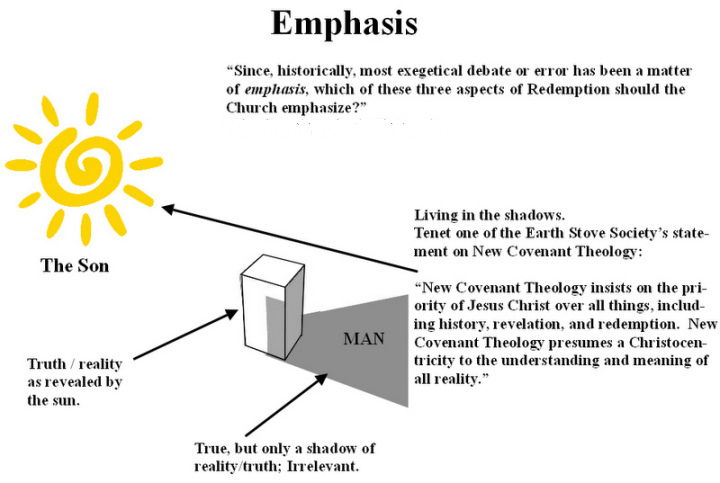
This enables New Calvinists to posit all things true, such as the new birth, “in us” terminology, and the other members of the Trinity while pointing to the whole issue of “emphasis.” Sure, all of those other things apart from Christ are certainly TRUE, but they are forms or shadows of reality (Christ) and to the degree that we focus on them apart from Christ we diminish the life-giving rays. Those things are “good things, but not the best thing.” They are “the fruit, not the root.” “Oh yes, the Holy Spirit’s sanctification is a wonderful truth! But it is a good thing, not the best thing. It is the fruit, not the root.” So, the more you deemphasize the “good thing” for the “best thing,” the better. And obviously, those things are eventually eliminated.
Obviously, the only place left to go from here for New Calvinists is Eastern mysticism. John Piper and other New Calvinists like Tim Keller are not even subtle about their beliefs in such. Neither was the primary forefather of the Reformation, St. Augustine. TANC is presently hard at work unpacking the specific connections between the two and how they function with Reformed theology, especially in regard to realms, manifestations, and spatial birthing. Susan will be bringing an astounding report to the Conference this June. In one of her sessions, she discusses how Augustine thought the Bible was the completion of Platonism.
Let’s conclude with a list of the six communication techniques used by New Calvinists:
1. Assumptive terminology: plays on the known assumptions of others.
2. Either/Or hermeneutic: interprets all wisdom through good and evil.
3. Missing Transition: excludes subject transitions as a way to subtly deny difference.
4. Metaphysical Redefinition of works and non-works.
5. Emphasis: reduces horizontal reality to one life source.
6. Dualism.
paul



6 comments