“God Hates the Sin But Loves the Sinner” And We know This How Exactly?
 “One of the things we learn from the pure milk that is not mixed with orthodoxy is that lying about the truth is not love.”
There has been a lot going on in the societal realm lately and I haven’t had time to write about it, but the topic of this post pretty well covers it. Idol worship is always formal. Even when parents of ancient paganism sacrificed their children to the Gods, it was according to orthodoxy. The average Joe never devises his own gods and the prescribed worship—he’s not qualified, it is always devised by the religious experts ruling the day. Hence, parents didn’t just sacrifice their children by some flippant self-devised method; it was done according to proper worship.
Historically, there are only two religions; Cult and Word. Cult is the idea that enlightened human mediators rule the unenlightened masses on behalf of God. The truth that they supposedly get directly from God in order to guide the masses is called “orthodoxy.” Orthodoxy has its own metaphysics, epistemology, ethics, and politics. The unenlightened masses sometimes have a choice as to what cult they may choose. Do I believe my infant should be boiled alive in oil to appease the gods, or stabbed through the heart by the High Priest? In contrast, a government will sometimes dictate the cult through the combination of force and faith.
In ancient times, God walked past all of the cults and spoke to his chosen subjects face to face. There were two authorities; one of your own choosing (if you had a choice), and God. Those who chose God are documented in the Bible, and the same also describes the personal interaction that God had with them. In ancient times, cults got a little out of control. Orthodoxy resulted in God being sorry that He created man, so He paid Noah a visit and told Him to build a boat. Not long after the flood waters went away, man once again gravitated to orthodoxy at the Tower of Babble.
Over time, and for His own reasons, God has changed His methods for communicating with His servants. But He has always promised that those seeking His truth would find it. This doesn’t include those seeking orthodoxy of their own desire. Neither does it include those who seek freedom from faith and force so they can choose orthodoxy suited to their own lusts. Those who flee worship with boiling oil for worship with the knife are not heroes. Not in God’s eyes anyway—God is in the truth business.
Orthodoxy and truth. Those are our choices. God’s eyes go to and fro throughout the earth constantly seeking those who worship Him according to spirit and what? TRUTH (JN 4:24). The one who Christ called “the rock” implores us to grow spiritually by feeding on the PURE milk of the what? WORD (1Peter 2:2). Pure milk is available, and God has made it available to all. He uses leaders, but their authority is bound up in His word as judged by the congregation of the saints. The saints follow leaders as they follow Christ.
One of the things we learn from the pure milk that is not mixed with orthodoxy is that lying about the truth is not love. Truisms and spiritual sound bites are the orthodoxy of the American church. They are cult orthodoxy. American pastors invent them to bring God’s truth down to a level where unenlightened congregants can understand it. The inability of the congregant is assumed and feared if not assumed. Even congregants that know something are believed to be equipped with enough knowledge to be dangerous like a loaded gun in the hands of a child. Therefore, orthodoxy proffers the virtue of “childlike faith” as opposed to hard thinking with the brains that God apparently gave the masses accidently.
“We are all just sinners saved by grace.” “God hates the sin, but loves the sinner.” And also popular contemporary “Christian” music: “Jesus, Friend of Sinners.” Is Jesus a friend of sinners? Jesus stated that His FRIENDS pattern their lives according to righteousness, not sin. A “sinner” patterns their life after the orthodoxy of choice, and that can be hedonism as well as any other religion. Who is Mark Hall to redefine who Christ says His friends are?
Only the truth sets us free. If you are a pastor who doesn’t challenge American orthodoxy in the form of spiritual sound bites, you are not a pastor; you are just another everyday cultist bent on having a manageable dumbed-down congregation. You comfort with instruction from the manual published by the Hemlock Society and your “love” is woefully misguided.
paul
Fundamentals of American Christianity, Calvinism, Covenants, and Election: The Potter’s House: 4/7/2013
Chart illustration for discussion at 00:45:31
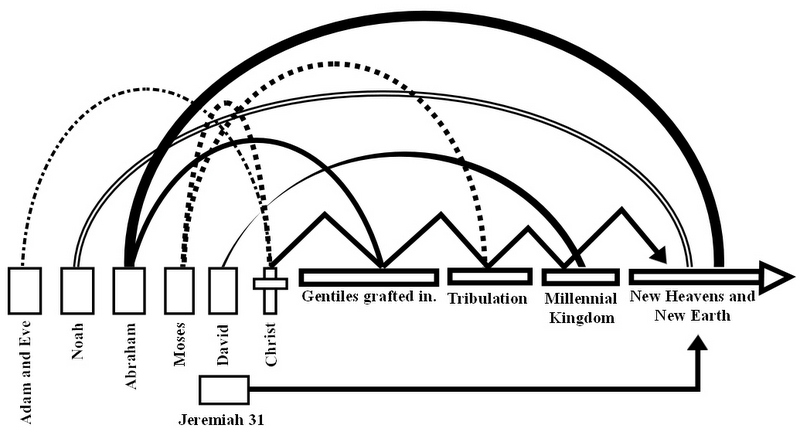
If you are much like me as an average American Christian, you are pretty foggy on God’s overall plan for mankind involving Old Testament and New Testament tenets. Perhaps due to laziness, we accept broad generalizations concerning the differences between the testaments. For example, “Old Testament saints were saved by keeping the law—we are saved by grace,” “God gave the law to show us we can’t keep it—to drive us to resting in Christ alone,” etc.
There is no doubt that it takes diligent study to understand redemptive covenants, election, and sanctification paradigms. The complexities of these issues have not been taught in the American church. Why? Our American Christian heritage comes from the Puritans who arrived on our Eastern shores from Europe. They were Calvinistic, and part and parcel with European Calvinism comes theocracy and orthodoxy. Like ducks searching for bodies of water, European Calvinism will eventually head in this direction. There are no exceptions, and it is only a matter of time. If Calvinism is ultimately deprived of theocracy and orthodoxy, particularity the Puritan breed, it will die. Lesser forms of pure Calvinism can survive well on orthodoxy alone, but the more pure forms like Puritanism will die without theocracy. Hence, Puritanism today is merely folklore propagandized with spiritual sound bites.
What is orthodoxy? It’s the antithesis of Acts 17:11. It assumes a spiritual caste system where some are preordained to understand things that the average saint cannot understand. The average Christian searching the Scriptures to determine if a pastor is teaching truth was, and still is an unacceptable construct in European Calvinism. It is thought to prideful, unsubmissive, and a rejection of God-appointed authority. Orthodoxy is what the spiritually enlightened prepare for the unenlightened in creeds, confessions, and counsels. One advertisement I saw for a seminary announced that it was “confessional.” What does that mean? It means that it teaches and holds to historic confessions of faith. These confessions have authority, and were written by the, for example, “Westminster Divines.” Problem is, this passes a traditional interpretation from generation to generation on an assumptive basis; i.e., to rethink orthodoxy would be arrogantly reinventing the spiritual wheel. This is our heritage, and why we don’t know much. Creeds, confessions, and counsels do not deliver in-depth analysis on the aforementioned issues; primarily, they tell us how to think.
Therefore, the Potter’s House is a journey, and there is no looking back. We have learned astounding things from the book of Romans that Susan and I have never been taught in our combined eighty years of being Christians. But most importantly, what we have learned are building blocks that are keys to understanding more of God’s counsel. I think it is time in our study to look at some of these fundamental building blocks. Some speak directly to the chapter we are in. But first, let’s review some former ones:
1. The “gospel” is the good news of God’s full counsel for life and godliness. The death, burial, and resurrection of Christ is the gospel of “first importance” or “first order of importance.” “Word,” Scripture,” Gospel,” “holy writ,” etc., are all used interchangeably throughout the Bible.
2. Paul categorizes all people into two categories: under law, and under grace. Those under the law are enslaved to sin, provoked to sin by the law, and will be judged by the law. Those under grace are enslaved to righteousness, provoked to do good by the law, and will not be judged by the law.
3. The importance of angels in administering God’s covenants.
4. Salvation is Trinitarian, not Christocentric.
5. A major key to understanding the book of Revelation is Exodus 19-24.
6. The Bible interprets itself and identifies its own methods of interpretation.
7. The law is completely separate from justification, but informs our sanctification.
8. The difference between justification, definitive sanctification, progressive sanctification, and final sanctification.
9. The difference between salvation and justification.
10. Why Christians are truly righteous in the here and now.
11. Why Christians still struggle with sin.
12. The difference between our redeemed hearts and our mortality.
13. Motivation to share the gospel and better ways to do it.
14. Divine Anthropology: what makes mankind tick?
Other things are becoming clearer in our study concerning election and covenants which brings us closer to the issues at hand in chapter nine. I will save election for last because once that is discussed it will be all anybody is thinking about. I would like to use Ephesians 2:11-16 for our first point:
11 Therefore remember that at one time you Gentiles in the flesh, called “the uncircumcision” by what is called the circumcision, which is made in the flesh by hands— 12 remember that you were at that time separated from Christ, alienated from the commonwealth of Israel and strangers to the covenants of promise, having no hope and without God in the world. 13 But now in Christ Jesus you who once were far off have been brought near by the blood of Christ. 14 For he himself is our peace, who has made us both one and has broken down in his flesh the dividing wall of hostility 15 by abolishing the law of commandments expressed in ordinances, that he might create in himself one new man in place of the two, so making peace, 16 and might reconcile us both to God in one body through the cross, thereby killing the hostility.
This passage makes separation from the covenants of promise synonymous with being alienated from God. There is also more than one covenant of promise.
“Covenants” is in the plural. So, we don’t want to think of Old Testament Covenants as being replaced by the New, but rather we want to think of all of these covenants as building on each other. Also, the covenants will have future elements, abolished elements, and elements that are being phased out with time. Paul states what part of the Mount Sinai Book of the Covenant was “abolished,” the ordinances regarding sin offerings since Christ fulfilled the propitiation for sin (vv. 14, 15).
To be separated from Christ is also likened to being separated from the “commonwealth” of Israel (v. 12). This speaks to Israel as a nation. As we discussed last week, this doesn’t mean that all of national Israel will be saved. They were an elect nation with elect people, but not all in the nation are elected individually. Allegorically, some are descendants of Hagar and others are from Sarah. This symbolizes slavery to sin versus heirs of the promise. Paul wanted to make sure the Gentiles at Rome understood that rebellion within Israel didn’t mean that God had revoked His promises to Israel as a nation.
As yet, none of the covenants have been abolished. Again, some elements are yet future, some are fading away, and some elements have been abolished. Even the New Covenant has such elements. Jeremiah 31 states that the law of God will be written on everyone’s heart and there will be no need to teach anybody about the Lord. Obviously, that is future. We read the following in 1Corintians 13:8-10;
8 Love never ends. As for prophecies, they will pass away; as for tongues, they will cease; as for knowledge, it will pass away. 9 For we know in part and we prophesy in part, 10 but when the perfect comes, the partial will pass away.
Prophesies, tongues, and knowledge are all under the New Covenant (past, present), and when the perfect comes knowledge will pass away. Nobody will have need to be taught as Jeremiah predicted. That’s future. The “perfect” is what Peter said we are ultimately looking for: the new heavens and new earth:
1Peter 3:13 – But according to his promise we are waiting for new heavens and a new earth in which righteousness dwells.
The “promise” is another name for the Abrahamic covenant which, as we looked at last week, included the Gentiles from the beginning.
Another truth about the Old Covenant is that it was a will. It was like the inheritance that your parents leave you in their will. The inheritance is eternal life, and Christ, the testator, had to die for the will to be executed:
Hebrews 9:15 – Therefore he is the mediator of a new covenant, so that those who are called may receive the promised eternal inheritance, since a death has occurred that redeems them from the transgressions committed under the first covenant. 16 For where a will is involved, the death of the one who made it must be established. 17 For a will takes effect only at death, since it is not in force as long as the one who made it is alive. 18 Therefore not even the first covenant was inaugurated without blood.
And like any will, the inheritance is promised. In this sense, sin was bound up or imputed to the covenant until Christ came:
Galatians 3:15 – To give a human example, brothers: even with a man-made covenant, no one annuls it or adds to it once it has been ratified.
Galatians 3:21 – Is the law then contrary to the promises of God? Certainly not! For if a law had been given that could give life, then righteousness would indeed be by the law. 22 But the Scripture imprisoned everything under sin, so that the promise by faith in Jesus Christ might be given to those who believe. 23 Now before faith came, we were held captive under the law, imprisoned until the coming faith would be revealed. 24 So then, the law was our guardian until Christ came, in order that we might be justified by faith. 25 But now that faith has come, we are no longer under a guardian, 26 for in Christ Jesus you are all sons of God, through faith.
These are building blocks; neither do I have a full understanding about how all of this works together, but apparently sins were imputed to the covenat/will until Christ died. To be saved in the Old Testament was to acknowledge that you were an heir of salvation through Christ. So, Old Testament saints would have definitely been looking for the coming of Christ. Soon after Christ died, the Gentiles received the good news that they were part of the inheritance as well.
Furthermore, outside of the covenant there is a principle of reaping and sowing as well as a principle of reaping and sowing in the covenant as well. This is abundantly clear as Paul cites the Old Covenant in regard to blessings in this life:
Ephesians 6:1 – Children, obey your parents in the Lord, for this is right. 2 “Honor your father and mother” (this is the first commandment with a promise), 3 “that it may go well with you and that you may live long in the land.” 4 Fathers, do not provoke your children to anger, but bring them up in the discipline and instruction of the Lord.
Hence, promises of spiritual wellbeing through obedience are an undeniable part of the Old Covenant and most definitely still in effect presently. There is a lot going on in these covenants and confusion in our day is not lacking. Nevertheless, the Scripture explains all of this in further detail, but it takes diligent study to show ourselves approved. The following chart may be helpful in encouraging you to study these things for yourself.
Lastly, the relationship between covenants and election. I get my share of grief over my present understanding of election. I take a paradoxical position. Election is 100% true and is crucial for keeping justification and sanctification separate as well as eternal security. Paul, as we saw last week, states the purpose of election is no uncertain terms: to exclude works from justification. On the other hand, I believe free will is also 100% true. I believe this because it is what I see in the Scriptures. It comes with special privilege as well: I get accused of being both a Calvinist and Arminian. But Calvinists don’t believe in election, that’s a myth. For example, though Israel was clearly elected by God (DEUT 7:6-8), most of them hold to Supersessionism. That’s the belief that God replaced Israel with the church because they violated their covenant with God. This is a denial of election. The promise is not contingent on anything we do. It’s not conditional. Blessings and cursing/reaping and sowing is conditional, but not election. This same Reformed take on Israel applies to the individual as well: we are elected to participate in the race, but must be faithful to the church in order to not be disqualified from the race of faith. Calvinists don’t believe in election. As if their doctrine wasn’t goofy enough already—you can add that: the supposed sultans of election don’t even hold to it.
Besides, this paradox can be seen in real life. We implore people with all passion to be reconciled to God, especially Arminians. Yet, Arminians always credit God with saving the person. Few Arminians will ever be heard crediting themselves or the redeemed person for his/her salvation. Nor have I ever heard an Arminian pray to God that anyone would save themselves.
In additon, to satisfy my John Locke Christian friends, its science. Susan and I have a friend who is in the process of writing a book on God’s sovereignty and man’s free will. I will share a small portion of his manuscript to make my point:
Of course, it must be admitted that finite mankind has a limited capacity for understanding the workings of our Infinite Creator. Consequently, one practical way to resolve this challenge to our faith is to face up to the reality of our finite ability to understand God’s workings. In this approach, it is necessary to accept by faith those things that seem beyond any rational understanding. For many, this may be a satisfactory solution to the dilemma. In fact, a similar approach is sometimes followed in the field of science. Consider, for example, the physics of light where two seemingly contradictory theories are used side-by-side to explain its different properties. The wave theory is used to understand the oscillation aspects of light (e.g., Polaroid sunglasses), while at the same time the particle theory is employed to explain other applications (e.g., photoelectric solar panels). Although these two theories are totally incompatible, each provides useful information in certain technical applications. To date, scientists simply use the appropriate theory as needed for a particular design problem. There is no worry about whether light actually exists as a wave, or as a particle, just because it is not yet fully understood. This same approach may be taken in the spiritual realm and is probably the best stance to take in dealing with the apparent contradiction between individual free will and God’s total sovereignty.
As an avid reader of the Bible since my conversion in 1983, I began to take this position in 1986 and have not abandoned it yet. The apostles and others evangelized like it depended on them, but yet made strong statements regarding the sovereignty of God in salvation.
paul
For a free DVD of this message mailed to you at no charge, click here.
The Potter’s House is a member of the Home Fellowship Network: homefellowship.net

The Potter’s House: 3/31/2013; Romans 9:6ff. The Assurance of God’s Election and the Hope of Whosoever Will, Part 3

Election has a purpose. However you want to debate the issue, all should agree on that:
Romans 9:11 – though they were not yet born and had done nothing either good or bad—in order that God’s purpose of election might continue, not because of works but because of him who calls— 12 she was told, “The older will serve the younger.”
God’s purpose of election is to remove all possibility of works from justification. This is clear. Therefore, election divides justification from sanctification completely. God goes to great extremes to make this as prevalent as He can. Though election is a difficult issue, verse 11 of this chapter could not be clearer on that point. Election makes salvation an issue of Him who calls rather than anything we do to contribute to justification.
But in sanctification (the Christian life), we are continually called to works. Therefore, those works must be seen as works that cannot affect our just standing. How could they if our calling was before the creation of the earth?
Romans 8:30 – And those whom he predestined he also called, and those whom he called he also justified, and those whom he justified he also glorified.
Ephesians 1:4 – even as he chose us in him before the foundation of the world, that we should be holy and blameless before him. In love 5 he predestined us for adoption as sons through Jesus Christ, according to the purpose of his will, 6 to the praise of his glorious grace, with which he has blessed us in the Beloved. 7 In him we have redemption through his blood, the forgiveness of our trespasses, according to the riches of his grace, 8 which he lavished upon us, in all wisdom and insight 9 making known to us the mystery of his will, according to his purpose, which he set forth in Christ 10 as a plan for the fullness of time, to unite all things in him, things in heaven and things on earth.
Sanctification is an entirely different matter. The Scriptures must be interpreted with this dichotomy in mind. This is the only thing that explains the call to work aggressively in our Christian life while justification is by faith alone. If we were called, it is a settled issue:
John 6:35 – Jesus said to them, “I am the bread of life; whoever comes to me shall not hunger, and whoever believes in me shall never thirst. 36 But I said to you that you have seen me and yet do not believe. 37 All that the Father gives me will come to me, and whoever comes to me I will never cast out. 38 For I have come down from heaven, not to do my own will but the will of him who sent me. 39 And this is the will of him who sent me, that I should lose nothing of all that he has given me, but raise it up on the last day. 40 For this is the will of my Father, that everyone who looks on the Son and believes in him should have eternal life, and I will raise him up on the last day.”
We must contend that eternal security and election go hand in hand apart from works to maintain our just standing. If we can lose our salvation, the next question must be: WHAT DO WE HAVE TO DO TO KEEP IT? And if we have to do anything to keep it, we are a participant in justification. What of those who eventually deny the faith and walk away to no faith or a false faith? They were never saved to begin with:
1John 1:19 – They went out from us, but they were not of us; for if they had been of us, they would have continued with us. But they went out, that it might become plain that they all are not of us. 20 But you have been anointed by the Holy One, and you all have knowledge. 21 I write to you, not because you do not know the truth, but because you know it, and because no lie is of the truth.
The historical events Paul cites in this chapter further explain the relationship of justification and law. This is important for the Gentiles to know because they are being integrated into a Jewish church, and movements within Judaism that propagated a works salvation by keeping the traditions of men were rampant. Remember, we find in our studies that these works systems are separate from truth and replace it with the ideas of men. This is probably because it makes law-keeping feasible. Ritual is always easier than love. True law-keeping is the direction and goal of sanctification, but justification is totally separate from law—this cannot be said enough.
As we begin to look at the history of covenants and their relationship to election, we will see that they work together toward the common goal of God dwelling with man on earth for eternity.
Genesis 12:1 – Now the Lord said to Abram, “Go from your country and your kindred and your father’s house to the land that I will show you. 2 And I will make of you a great nation, and I will bless you and make your name great, so that you will be a blessing. 3 I will bless those who bless you, and him who dishonors you I will curse, and in you all the families of the earth shall be blessed.” 4 So Abram went, as the Lord had told him, and Lot went with him. Abram was seventy-five years old when he departed from Haran.
The plan from the very beginning was to include the Gentiles: “and in you all the families of the earth shall be blessed.” And, God used events to demonstrate that the guarantee of this covenant was based on His promises alone. The first issue becomes Abraham and Sarah’s age. This is by design because the promised seed will be by a miracle of God and not anything that is a contribution from man:
Genesis 15:1 – After these things the word of the Lord came to Abram in a vision: “Fear not, Abram, I am your shield; your reward shall be very great.” 2 But Abram said, “O Lord God, what will you give me, for I continue childless, and the heir of my house is Eliezer of Damascus?” 3 And Abram said, “Behold, you have given me no offspring, and a member of my household will be my heir.” 4 And behold, the word of the Lord came to him: “This man shall not be your heir; your very own son shall be your heir.” 5 And he brought him outside and said, “Look toward heaven, and number the stars, if you are able to number them.” Then he said to him, “So shall your offspring be.” 6 And he believed the Lord, and he counted it to him as righteousness.
This is a very fundamental and important element of faith. Not a lot of theology in this conversation. It’s not that the informational part of faith is not important, but as we see here, it is fundamentally believing and trusting God Himself. Saving faith that justifies believes God. Much of what a new believer in God believes is information that comes later. The information itself takes a back seat to the fact that it came from God and that is why it is obeyed and accepted. Faith that justifies believes God Himself, and then whatever information comes from God later as a matter of trust and love. We may not always like it, but our dedication to God will result in a pattern of obedience.
Let’s continue to the next point:
Genesis 15:7 – And he said to him, “I am the Lord who brought you out from Ur of the Chaldeans to give you this land to possess.” 8 But he said, “O Lord God, how am I to know that I shall possess it?” 9 He said to him, “Bring me a heifer three years old, a female goat three years old, a ram three years old, a turtledove, and a young pigeon.” 10 And he brought him all these, cut them in half, and laid each half over against the other. But he did not cut the birds in half. 11 And when birds of prey came down on the carcasses, Abram drove them away.
12 As the sun was going down, a deep sleep fell on Abram. And behold, dreadful and great darkness fell upon him. 13 Then the Lord said to Abram, “Know for certain that your offspring will be sojourners in a land that is not theirs and will be servants there, and they will be afflicted for four hundred years. 14 But I will bring judgment on the nation that they serve, and afterward they shall come out with great possessions. 15 As for you, you shall go to your fathers in peace; you shall be buried in a good old age. 16 And they shall come back here in the fourth generation, for the iniquity of the Amorites is not yet complete.”
17 When the sun had gone down and it was dark, behold, a smoking fire pot and a flaming torch passed between these pieces. 18 On that day the Lord made a covenant with Abram, saying, “To your offspring I give this land, from the river of Egypt to the great river, the river Euphrates, 19 the land of the Kenites, the Kenizzites, the Kadmonites, 20 the Hittites, the Perizzites, the Rephaim, 21 the Amorites, the Canaanites, the Girgashites and the Jebusites.”
All of the whatnots concerning this covenant ritual aside, God puts Abraham in a deep sleep and consummates the covenant Himself. The faithfulness of the covenant will depend on God, not Abraham. God will fulfill this promise despite the failures of men—it doesn’t depend on man’s faithfulness, but God’s faithfulness. But mark it right here in Scripture: All of these promises to Abraham will be fulfilled. God even predicts the captivity in Egypt so that it will not be seen as proof that God forgot His chosen people or cast them away. While in Egypt, the Jews were transformed from a clan to a nation which required an additional covenant at Mt. Sinai. As we discussed in prior lessons, that covenant is consummated by force as prophesied in the book of Revelation. That is also when the fulfillment of the Abrahamic covenant is realized as well though not fully. The complete realization will be when heavenly Jerusalem descends from heaven and God tabernacles with man in the new heaven and new earth.
God combines the actions of men with His plan for finally dwelling with man in piece. This is a spectacular tapestry of God’s sovereignty and the actions of mankind woven together. In events, God is usually taking care of a lot of business, it is divine multitasking. While God’s nation is being incubated in Egypt along with the accumulation of possessions, the timing for using His nation to judge the Amorites will be right on schedule:
“And they shall come back here in the fourth generation, for the iniquity of the Amorites is not yet complete” (v.16).
And the fulfillment:
Joshua 12:1- Now these are the kings of the land whom the people of Israel defeated and took possession of their land beyond the Jordan toward the sunrise, from the Valley of the Arnon to Mount Hermon, with all the Arabah eastward: 2 Sihon king of the Amorites who lived at Heshbon and ruled from Aroer, which is on the edge of the Valley of the Arnon, and from the middle of the valley as far as the river Jabbok, the boundary of the Ammonites, that is, half of Gilead, 3 and the Arabah to the Sea of Chinneroth eastward, and in the direction of Beth-jeshimoth, to the Sea of the Arabah, the Salt Sea, southward to the foot of the slopes of Pisgah;
The next events are indicative of what happens when we are involved in God’s plan for salvation. God uses the events as recorded in Scripture to teach us the importance of salvation resting in His promises. Also, we see the reality of sanctification. Because we are born again, we display extraordinary acts of faith and obedience. We are also still mortal and weakened by the flesh which results in our pattern of faith being interrupted by boneheaded thinking and behavior:
Genesis 16:1 – Now Sarai, Abram’s wife, had borne him no children. She had a female Egyptian servant whose name was Hagar. 2 And Sarai said to Abram, “Behold now, the Lord has prevented me from bearing children. Go in to my servant; it may be that I shall obtain children by her.” And Abram listened to the voice of Sarai. 3 So, after Abram had lived ten years in the land of Canaan, Sarai, Abram’s wife, took Hagar the Egyptian, her servant, and gave her to Abram her husband as a wife. 4 And he went in to Hagar, and she conceived. And when she saw that she had conceived, she looked with contempt on her mistress. 5 And Sarai said to Abram, “May the wrong done to me be on you! I gave my servant to your embrace, and when she saw that she had conceived, she looked on me with contempt. May the Lord judge between you and me!” 6 But Abram said to Sarai, “Behold, your servant is in your power; do to her as you please.” Then Sarai dealt harshly with her, and she fled from her.
7 The angel of the Lord found her by a spring of water in the wilderness, the spring on the way to Shur. 8 And he said, “Hagar, servant of Sarai, where have you come from and where are you going?” She said, “I am fleeing from my mistress Sarai.” 9 The angel of the Lord said to her, “Return to your mistress and submit to her.” 10 The angel of the Lord also said to her, “I will surely multiply your offspring so that they cannot be numbered for multitude.” 11 And the angel of the Lord said to her, “Behold, you are pregnant and shall bear a son. You shall call his name Ishmael, because the Lord has listened to your affliction. 12 He shall be a wild donkey of a man, his hand against everyone and everyone’s hand against him, and he shall dwell over against all his kinsmen.” 13 So she called the name of the Lord who spoke to her, “You are a God of seeing,” for she said, “Truly here I have seen him who looks after me.” 14 Therefore the well was called Beer-lahai-roi; it lies between Kadesh and Bered. 15 And Hagar bore Abram a son, and Abram called the name of his son, whom Hagar bore, Ishmael. 16 Abram was eighty-six years old when Hagar bore Ishmael to Abram.
Family drama is usually the result of bad ideas, and this was a bad idea. Notice the involvement of the angel in counseling Hagar. Remember that in our Mt. Sinai interlude study we learned that the angels are the administrators of God’s covenants, and I think that’s what we are seeing here. Angels are very much involved in the unfolding of God’s redemptive plan. More than likely, the seven letters to the churches in Revelation were delivered by actual angels accordingly. Some interpret the word for angel there as the sole or most prominent pastor at that church. More likely is the idea that the letters were delivered by real angels. This might also indicate that each church has its own angel assigned by God. When Abraham turns 99 years old, God returned and stated the following:
Genesis 17:15 – And God said to Abraham, “As for Sarai your wife, you shall not call her name Sarai, but Sarah shall be her name. 16 I will bless her, and moreover, I will give you a son by her. I will bless her, and she shall become nations; kings of peoples shall come from her.” 17 Then Abraham fell on his face and laughed and said to himself, “Shall a child be born to a man who is a hundred years old? Shall Sarah, who is ninety years old, bear a child?” 18 And Abraham said to God, “Oh that Ishmael might live before you!” 19 God said, “No, but Sarah your wife shall bear you a son, and you shall call his name Isaac. I will establish my covenant with him as an everlasting covenant for his offspring after him. 20 As for Ishmael, I have heard you; behold, I have blessed him and will make him fruitful and multiply him greatly. He shall father twelve princes, and I will make him into a great nation. 21 But I will establish my covenant with Isaac, whom Sarah shall bear to you at this time next year.”
Abraham wanted God to establish the everlasting covenant through an heir of his own scheming; that wasn’t going to happen. Ishmael was technically an Israelite, but he serves to make Paul’s point in Romans nine: not all Israelites are of the promise just because they are Abraham’s offspring, and men do not contribute to the successful consummation of the promise in any way:
Romans 9:6 – But it is not as though the word of God has failed. For not all who are descended from Israel belong to Israel, 7 and not all are children of Abraham because they are his offspring, but “Through Isaac shall your offspring be named.” 8 This means that it is not the children of the flesh who are the children of God, but the children of the promise are counted as offspring. 9 For this is what the promise said: “About this time next year I will return, and Sarah shall have a son.”
Here is the specific reference in Genesis:
Genesis 18:9 – They said to him, “Where is Sarah your wife?” And he said, “She is in the tent.” 10 The Lord said, “I will surely return to you about this time next year, and Sarah your wife shall have a son.” And Sarah was listening at the tent door behind him. 11 Now Abraham and Sarah were old, advanced in years. The way of women had ceased to be with Sarah. 12 So Sarah laughed to herself, saying, “After I am worn out, and my lord is old, shall I have pleasure?” 13 The Lord said to Abraham, “Why did Sarah laugh and say, ‘Shall I indeed bear a child, now that I am old?’ 14 Is anything too hard for the Lord? At the appointed time I will return to you, about this time next year, and Sarah shall have a son.” 15 But Sarah denied it, saying, “I did not laugh,” for she was afraid. He said, “No, but you did laugh.”
Paul’s very next example to further illustrate His point is the twins Esau and Jacob born to Isaac and Rebecca. Technically, Esau was the heir because he emerged first:
Romans 9:10 – And not only so, but also when Rebekah had conceived children by one man, our forefather Isaac, 11 though they were not yet born and had done nothing either good or bad—in order that God’s purpose of election might continue, not because of works but because of him who calls— 12 she was told, “The older will serve the younger.” 13 As it is written, “Jacob I loved, but Esau I hated.”
Israel was elected and the promise is founded on God’s faithfulness and plan alone. But not all are righteous decedents. Israel is an elected nation and has elect within according to the promise. Israel is comprised of those under the law, enslaved to sin, and headed for a judgment where they will be judged by the law. Then there is a remnant that is under grace, enslaved to righteousness, and will not stand in a judgment to determine their just standing:
Galatians 4:21 – Tell me, you who desire to be under the law, do you not listen to the law? 22 For it is written that Abraham had two sons, one by a slave woman and one by a free woman. 23 But the son of the slave was born according to the flesh, while the son of the free woman was born through promise. 24 Now this may be interpreted allegorically: these women are two covenants. One is from Mount Sinai, bearing children for slavery; she is Hagar. 25 Now Hagar is Mount Sinai in Arabia; she corresponds to the present Jerusalem, for she is in slavery with her children. 26 But the Jerusalem above is free, and she is our mother. 27 For it is written,
[Isaiah 54:1] “Rejoice, O barren one who does not bear; break forth and cry aloud, you who are not in labor! For the children of the desolate one will be more than those of the one who has a husband.”
28 Now you, brothers, like Isaac, are children of promise. 29 But just as at that time he who was born according to the flesh persecuted him who was born according to the Spirit, so also it is now. 30 But what does the Scripture say? “Cast out the slave woman and her son, for the son of the slave woman shall not inherit with the son of the free woman.” 31 So, brothers, we are not children of the slave but of the free woman [note what Paul is calling the “law” here. It is the historical account of the linage. A reminder from past studies that the Bible is “the law”].
Paul wanted the Gentiles at Rome to have a thorough understanding that they were children of the promise. Covenants of promise are completely apart from the law and works. Election guarantees that separation. That’s the positive side: free to aggressively obey God in sanctification without affecting the finished work of justification, and knowing that we are secure because our salvation was of God only. That’s the positive side. Next week, we will look at Paul’s anticipated objection from some:
Romans 9:19 – You will say to me then, “Why does he still find fault? For who can resist his will?” 20 But who are you, O man, to answer back to God? Will what is molded say to its molder, “Why have you made me like this?” 21 Has the potter no right over the clay, to make out of the same lump one vessel for honorable use and another for dishonorable use?
We will look at this deeper next week.
X-Ray the Idol Hunter Rumored to Make a Showing at 2013 Gospel Coalition in Orlando
“As Powlison brings the latest findings from Westminster’s research and development team on idol hunting, it only makes sense that X-Ray would want to be briefed.”
Those of you who have been a part of PPT since its beginning in 2009 are aware of who X-Ray the Idol Hunter is. She is kind of the Big Foot of New Calvinism. Her possible existence surfaced in 2010 during John Piper’s sabbatical. Piper said he was taking the sabbatical because he had observed several “species of pride” in his soul. According to other statements he made, he had consulted Tim Keller and Paul David Tripp on how to peel away several different levels of idolatry in order to find these “species.” Piper never identified the different species with biblical nomenclature.
Piper shared these things prior to beginning his sabbatical which had a predetermined length of eight months. The question soon became the following: how did Piper know that the eradication of these “species,” and all of the peeling away of many levels of idolatry in the soul, would take exactly eight months? If the species where wreaking enough havoc on his soul to cause him to step down for eight months, one must assume that eliminating these creatures would be efficacious.
Well, sure enough, Piper returned to the ministry eight months later. That’s when the rumors started. Obviously, Piper had an ace in the hole. It is doubtful that Sonship theology, the primary doctrine that promotes idol hunting in the heart would have been enough to guarantee such a victory. The doctrine was concocted by Dr. John “Jack” Miller in the 80’s and articulated by David Powlison and Paul David Tripp. David Powlison oversees a research and development team at Westminster Seminary that endeavors to come up with better and better ways to hunt down idols in the heart. Miller was able to identify twenty-five species of idols to get the ball rolling.
Powlison and Tripp devised what they call “X-Ray questions” that help people detect these idols which manifest themselves in our desires. All and all, Powlison has devised around 135 such questions. The questions reveal desires, and the desire leads to the species.
But after the return of Piper, people started asking questions, and strange manifestations began to be noticed at New Calvinist conferences where Piper, Powlison, Keller, and Tripp appeared. Powlison and Keller are self-proclaimed mentorees of John Miller. One such manifestation was seen on a conference website and appears below:
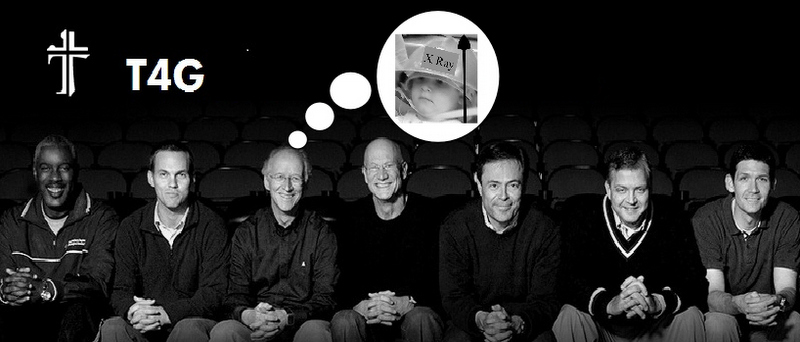
Furthermore, the following spears were found at yet another conference:

Putting it in a way that David Powlison would, X-Ray is kinda, perhaps, like a parody, but then again, kinda not to demonstrate the mindless New Calvinist following of mysticism on the issue of change. As Jay E. Adams well noted in his treatise against Sonship theology, idol hunting seems to be a kissing cousin to species of demons that supposedly cause Christians to sin. Hence, a different demon for each sin, and as Piper noted just prior to his last sabbatical, Tim Keller informs us that some levels of idol hunting are only obtained by fasting and prayer. Yet, someone had to know that the extraction of the “species” that were hounding Piper would only take exactly eight months to extract. PPT was sent a top secret picture of X-Ray, and we neither vouch for this picture nor deny it. Like Big Foot, the jury is kinda still out:
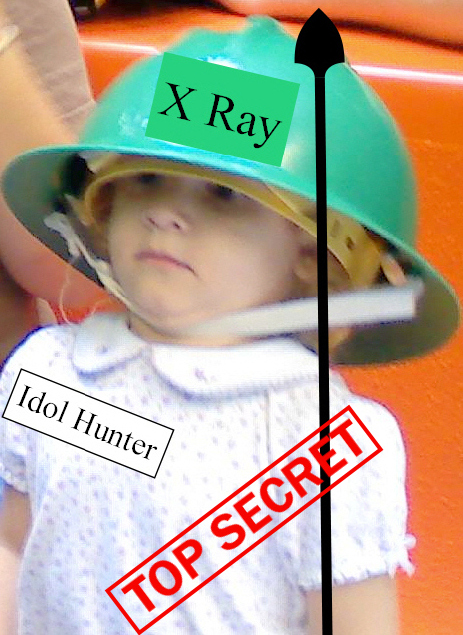
With Powlison, Keller, Tripp, and Piper all coming to this year’s Gospel Coalition conference in Orlando, a manifestation of X-Ray is very possible. As Powlison brings the latest findings from Westminster’s research and development team on idol hunting, it only makes sense that X-Ray would want to be briefed.
Stay tuned.
paul



13 comments