Romans 12:14-13:7; Forgiveness

This will be the last message in chapter 12, and next week we will move on further in chapter 13. Let’s begin by reading our text for tonight:
Romans 12:14 – Bless those who persecute you; bless and do not curse them. 15 Rejoice with those who rejoice, weep with those who weep. 16 Live in harmony with one another. Do not be haughty, but associate with the lowly. Never be wise in your own sight. 17 Repay no one evil for evil, but give thought to do what is honorable in the sight of all. 18 If possible, so far as it depends on you, live peaceably with all. 19 Beloved, never avenge yourselves, but leave it to the wrath of God, for it is written, “Vengeance is mine, I will repay, says the Lord.” 20 To the contrary, “if your enemy is hungry, feed him; if he is thirsty, give him something to drink; for by so doing you will heap burning coals on his head.” 21 Do not be overcome by evil, but overcome evil with good.
13:1 – Let every person be subject to the governing authorities. For there is no authority except from God, and those that exist have been instituted by God. 2 Therefore whoever resists the authorities resists what God has appointed, and those who resist will incur judgment. 3 For rulers are not a terror to good conduct, but to bad. Would you have no fear of the one who is in authority? Then do what is good, and you will receive his approval, 4 for he is God’s servant for your good. But if you do wrong, be afraid, for he does not bear the sword in vain. For he is the servant of God, an avenger who carries out God’s wrath on the wrongdoer. 5 Therefore one must be in subjection, not only to avoid God’s wrath but also for the sake of conscience. 6 For because of this you also pay taxes, for the authorities are ministers of God, attending to this very thing. 7 Pay to all what is owed to them: taxes to whom taxes are owed, revenue to whom revenue is owed, respect to whom respect is owed, honor to whom honor is owed.
I have never done this before, but I deliberately titled this message incorrectly for as you can see there is nothing about forgiveness in this portion of Scripture at all. Primarily, this text deals with the issue of relating to our enemies. Just like last week in regard to meeting the needs of others, something here is conspicuously missing in the discussion. Last week, the “tithe,” a Christian staple, was missing. This week, in regard to relating to our enemies, “forgiveness” is missing.
As you know, I am under the persuasion that Christians today function on a lot of things that are not the truth because they listen to men, and do not search the Scriptures for themselves. Christ majored on the major, and one of His primary concerns was the traditions of men and how that led to people disregarding the law; i.e., the Bible. And there is a lot of tradition afoot regarding the issue of forgiveness that we must address because the error is also applied to instruction regarding our enemies. If we have forgiveness wrong, we will interpret this text with an errant prism.
Now, as stated last week, the apostle Paul plunges the depths of justification in chapters 1-11, and then begins to address sanctification in chapter 12. Stated another way: he plunges the depths of God’s salvation in 1-11, and then he begins to address Christian living in 12ff. God, in saving us, justifies us—He makes us righteous so that we can dwell with Him forever as family members. Justification is a work of God; sanctification is our loving work for God. Sanctification is a word that means to be set apart for godly living. As we grow in our Christian walk, there is a wider and wider gap between who we now are and what we were. The old us that died with Christ is ALWAYS spoken of in the past tense in Scripture. Always.
This is an interpretive construct. When we read our Bibles, we must interpret almost every verse in the context of justification or sanctification. Is the verse talking about our Christian walk, or salvation? Galatians is an example. Up to Galatians 5:16, Paul is writing about justification; starting in 5:16, Paul takes a hard right turn into sanctification. Much of Paul’s writings are divided in this way. When you consider that most Christians today do not understand the difference between justification and sanctification, what does that tell you about their ability to understand the Scriptures? That’s why we make such a big deal out of this issue.
But it speaks even more to how we function as Christians. Many, if not most in our day teach that this interpretive dichotomy should be used in the following way: we meditate on the works of God in the first part, and that results in the majesty of God being elevated in our minds. This results in what they call a “filling of Christ.” The first part shows us how holy God is and how wicked we are leading to what they call “deep repentance.” When we empty the warehouse in our heart that is an “idol factory,” that void is filled with Christ and His works flow out of us as a “mere natural flow.” So, the second part of the dichotomy is a “fruit catalogue” that informs us as to the kind of things God is going to do through us. This is called, “new obedience.” As a result, many of the premier teachers of our day teach that we often obey without possessing the necessary wisdom to do so because it is not us doing the work.
Some years ago, I heard John MacArthur say that we can’t obey what we don’t know, but yet in a recent Q&A, in response to a question regarding his marked departure from practical application, he stated that it was his job to present the text, and the Holy Spirit’s job to apply it. He then informed those attending that if they were perplexed by the effortless flow of obedience in their life, now they know what’s going on. That resulted in a round of applause. Truly, we live in perilous times when people refuse to endure sound doctrine.
In contrast, Paul’s Scriptural dichotomy is meant to instill boldness and freedom in the believer. Justification is FINISHED, and NOTHING we do in sanctification can touch our salvation. We are free to work hard at obeying the law in our Christian life because the law has NOTHING to say to us in regard to our justification. Let me repeat that:
We are free to work hard at obeying the law in our Christian life because the law has NOTHING to say to us in regard to our justification (Romans 3:19).
Not only that, we have the help of the Trinity to boot! This is the difference between fear in sanctification that something we do can affect our justification versus the mentally that justification is a finished work that cannot be affected by the progressive work of our Christian life. That bears repeating as well:
This is the difference between fear in sanctification that something we do can affect our justification versus the mentally that justification is a finished work that cannot be affected by the progressive work of our Christian life.
Justification is the power of God unto salvation, and the revealing of God’s righteousness. Sanctification is the revealing of those made righteous by God through the new birth. This is important because what we are studying in chapter 12ff. is not a fruit catalogue, it’s not a list of credits for a gospel movie, it’s instruction to be learned and obeyed as faithful followers of Christ in a foreign land.
Now, as stated last week, Paul presents a Cliff Notes version of sanctification in 12ff. He states a Christian living category and a short sentence to go along with it. These pithy sanctification statements by Paul connects this letter to the rest of Scripture. If we took each of these statements and used other passages to expound on them, we could easily be in Romans another five years. So, as we did last week, we will give some of these sentences mention while focusing primarily on what Paul instructs concerning our enemies. However, things are a little bit different this week as all of these verses are closely connected to the subject of enemies and have profound implications for the Christian environment that we find ourselves in today.
Let’s begin,
Bless those who persecute you; bless and do not curse them.
Note that Paul says to bless them, and doesn’t say to forgive them. As we will see, this is not theological hair splitting. If you do a word study on “persecute” (diōkō) you find that the idea of a long-term sustained persecution cannot be excluded. But what does it mean to “bless” our enemies? Well, one example is Luke 23:34;
And Jesus said, “Father, forgive them, for they know not what they do.” And they cast lots to divide his garments.
Note that Christ didn’t say, “I forgive them,” but rather asked the Father to forgive them. What’s going on here? Christ is praying for their salvation. Christ is praying that the Father would grant them repentance. Obviously, God is not going to forgive them unless they repent. Likewise, this is one of many ways that you can bless your enemies, by praying for their salvation. From the perspective of a Christian, it is probably why they are persecuting you to begin with. You can consider this one of the put off/put on commands in the Bible; in regard to enemies, put off cursing and put on blessings. Curse (kataraomai) has the idea of wishing doom on a person. Instead, we are to pronounce a blessing, not a curse. This doesn’t mean we hold our nose and ask God to buy them a new car, this is talking about eternal blessings.
Now, verse 15 is closely related to this,
Rejoice with those who rejoice, weep with those who weep.
Here is another principle of interpretation that is good to remember: even though some verses seem to be dropped in out of nowhere, they usually have a relationship to the surrounding verses; in this case, be happy when your enemy is blessed by God in some way. Don’t be like Jonah who got mad at God for blessing the Ninevites. Furthermore, don’t rejoice when they are befallen by tragedy:
Proverbs 24:17 – Do not rejoice when your enemy falls, and let not your heart be glad when he stumbles, 18 lest the LORD see it and be displeased, and turn away his anger from him. 19 Fret not yourself because of evildoers, and be not envious of the wicked,
So, in regard to your enemies, don’t rejoice when they weep, and don’t weep when they rejoice. Why? Because in contrast, we are to take a personal interest in them:
Live in harmony with one another (16).
The word “harmony” is,
g5426. φρονέω phroneō; from 5424; to exercise the mind, i. e. entertain or have a sentiment or opinion; by implication, to be (mentally) disposed (more or less earnestly in a certain direction); intensively, to interest oneself in (with concern or obedience):— set the affection on,
In fitting with context, this is a focus on being concerned with the wellbeing of others. It is a focus on the big picture in regard to the lives of others. What they did to you is the small picture; we are to take an interest in the sum and substance of the lives of others. Deficiencies in the lives of others points directly to how they treat people. A concern for their character and some kind of contribution to changing it circumvents the offences that make them your enemy to begin with. In this endeavor, the following helps, not thinking that you are better than others:
Do not be haughty, but associate with the lowly. Never be wise in your own sight (16).
An attitude of superiority begins a downward spiral of personal conflict. Idiosyncrasies that flow from this mindset starts rubbing people the wrong way and starts a downward spiral of tit for tat. Paul prescribes a practice to circumvent this mindset: make it a point to associate with the lowly, and respect their outlook. Give their perspective a full and fair vetting. When all of this wisdom slips between the cracks, and you are offended in some way,
Repay no one evil for evil, but give thought to do what is honorable in the sight of all (17).
Repayment for evil is always evil. It’s tit for tat, and starts a downward spiral of evil in motion. And returning evil for evil takes many, many, many, different forms. Instead, Paul says to respond by doing what is equitable before all. Let’s look at some examples.
Proverbs 15:1 – A soft answer turns away wrath, but a harsh word stirs up anger.
This is a big one. There are innumerable people in the world who are dead because they didn’t heed the advice of this simple proverb. As a pastor who has done my share of counseling, I can tell you that domestic violence could be cut in half if this advice was heeded. This is not “blaming the victim,” this is the simple fact that tit for tat word battles start a nasty downward spiral in motion. And by the way, ignoring the other person as if they are not alive is not a soft answer. Paul is talking about wise words fitly spoken. We are to grow in our wisdom regarding equitable responses to offences. Equitable responses also set the example for others resulting in less evil in the world. A lot is at stake. But notice that Paul passes on telling you to just simply forgive the offender. Paul has many tempting opportunities here to interject that idea, but he doesn’t. Instead, Paul says,
If possible, so far as it depends on you, live peaceably with all (18).
“If possible”? If we are to simply forgive everyone, why the “if.” Paul is clearly conceding that we will have enemies—how can we have enemies if we are to simply forgive everybody? To the contrary, Paul wrote the following:
Beloved, never avenge yourselves, but leave it to the wrath of God, for it is written, “Vengeance is mine, I will repay, says the Lord” (19). To the contrary, “if your enemy is hungry, feed him; if he is thirsty, give him something to drink; for by so doing you will heap burning coals on his head” (20).
Paul states, “it is written.” This is a reference to Deuteronomy 32:41and Proverbs 25:21,22. The citation of the latter follows:
If your enemy is hungry, give him bread to eat, and if he is thirsty, give him water to drink, 22 for you will heap burning coals on his head, and the Lord will reward you.
Unlike Proverbs, Paul does not mention the “reward” for not taking revenge, but nevertheless, what is this reward? Well, if you remember our citation of Proverbs 24:17-19, if we rejoice in the downfall of our enemies, God will turn away His anger from them. I believe the reward is either reconciliation or revenge. I believe the reward is closure. I believe that we are being taught that as people who have sincere concern for the lives of others, we prefer reconciliation and the “gaining of a brother.” But if reconciliation doesn’t happen regardless of our godly and equitable responses, God will avenge our adversaries. By doing our part in circumventing a downward spiral of evil, and doing good to them, we are in essence pouring hot coals on their head which speaks of God’s future judgment if our enemies do not reconcile. Hence,
Do not be overcome by evil, but overcome evil with good (21).
Our revenge can only result in being overcome by evil ourselves. Our revenge only results in a tit for tat proliferation of evil. We must overcome these downward spirals of evil with good. Doing good to our enemies, or putting off revenge and putting on doing good to our enemies, leaves room for God’s revenge if necessary, but only God can take revenge without a proliferation of evil. God’s revenge ends evil, our revenge increases evil.
Not only that, as opposed to, “forgiving and forgetting,” accepting that person as an enemy and waiting for an opportunity to do good to them can lead to reconciliation. There is much talk about “forgiving others the way God has forgiven us,” but God does not forgive us unless we are reconciled to Him. “Forgiving and forgetting” circumvents the need for reconciliation, and without reconciliation, there is no forgiveness. Not only do we see this in Matthew 18, but it begs the question in regard to Matthew 18, if we are to simply “forgive and forget,” why all the fuss with the four-step process? There is no forgiveness without reconciliation.
Go with me to Exodus 23:4,5;
“If you meet your enemy’s ox or his donkey going astray, you shall bring it back to him. 5 If you see the donkey of one who hates you lying down under its burden, you shall refrain from leaving him with it; you shall rescue it with him.
If there has been carte blanche forgiveness, these acts of goodness do not present opportunities for reconciliation, you just help your enemy and go about your business. And look, I have correspondence with people who were wronged in horrible ways many years ago, and be sure of this, nobody “forgives and forgets.” Per Mathew 18, God demands that we forgive if there is reconciliation, but those who we are not reconciled to are enemies, this would seem evident.
And Romans 13:1-7 is not just parachuted in to the conversation here—it’s connected to the subject at hand. Revenge, and not overcoming evil with good can get us in difficulty with the governing authorities, no? Our revenge proliferates evil, God’s revenge ends it, and besides that, our revenge is usually against civil law, no? And civil law always waits precariously at the end of the downward spiral. In contrast, look at the text, God may use the civil authorities to execute His judgment, and often does. Due to this fact and the other ways God uses the civil authorities that He sovereignly appoints for good, Paul says that we ought to be happy to pay taxes. This raises a peculiar question; if this is the case, why do churches want to be tax exempt? If the civil government is an instrument for good in the hands of God, why not contribute to the ministry thereof?
Passages like this are not designed to show us how bad we needed our original salvation, this passage is typical of the wisdom we desperately need to live our Christian lives. When we practice this wisdom, God is not only glorified, but there is far less evil in the world. Christ came to fulfill His law through us and to put the deeds of darkness to death—that is not accomplished through ignorance of God’s word.
John Piper’s Vine and Branches Conference: A Synopsis of its Heresy
“Take note that Calvin is also confirming the Reformed belief that sins in the Christian life separate us from salvation. Therefore, the same repentance and faith that was needed originally continues to be needed as a way to keep ourselves saved. However, according to Calvin, the same gospel that originally saved us must be continually administered by Reformed pastors.”
John Piper states in the promotional video for his Vine and Branch conference that the union with Christ doctrine could be the most important doctrine that you have never heard of. The blogger Alex Guggenheim responded to that notion this way:
Okay, so here we have Neo-Calvinists who have, for the last 15-20 years and certainly the last 10 years, overwhelming their people and those being assimilated, being offered a conference on “the most important doctrine you’ve never heard of.”
Hmmm…so Neo-Calvinists, what have you been doing all this time if this doctrine is central to all things as your promo says? Suddenly you now offer the most important doctrine. I suggest theological and ecclesiastical malfeasance with such an admission.
If it was and is so important, and it is, why haven’t you made it the centrality of your teaching and articulations all this time or…is this just another gimmick to incite spiritual anxiety in people who now believe they have been missing something and cannot miss this?
Good grief.
The Calvin Institutes of the Christian religion is their playbook, and it is a very thick linguistic droning. This is their bible, and they are continually mining it for new ideas. Sometimes these ideas take a while to find in the book of Calvin. However, I believe it is the same document that will hang them because people are starting to read the document for themselves. Piper begins the promotion for the conference with a statement by Calvin, so let’s start with Calvin.
John Calvin
The crux of the Reformation false gospel is the idea that justification is not a finished work. Therefore, they make the separate work of sanctification the growing, or progression of justification. The saint becomes a colaborer in the finishing of justification rather than a colaborer for the kingdom as an ambassador. The saint is not working towards a reward from his Master, he is working towards the final prize of salvation.
Therefore, the saint must obtain that final prize the same way he received it, by FAITH ALONE. So, he must run the race of salvation by faith alone. This is made possible by the “vital union with Christ.” Our “union with Christ” sanctifies our participation in justification. Let me repeat that:
Our “union with Christ” sanctifies our participation in justification.
It makes running the race by faith alone possible. It enables us to gobble up more and more grace in order to keep ourselves saved—by faith alone of course. James addressed the problem of this very notion in James 2:14-26. It hearkens back to the problem of justification and sanctification not being completely separate; one being a finished work and the other being a progressive work. This is the Achilles’ heel of every false gospel that has ever come down the pike.
So, how do we supposedly run the race by faith alone? The same way we started; by faith alone which entails “living by the gospel.” We live to get more grace. If we keep filling up our gas tank at the salvation filling station, we will be able to “stand in the judgment” that we are driving to. In fact, this is exactly how Reformed theologians frame the issue:
We repeat, Justification is not a thing that we pass and get behind us. As Barth rightly said, it is not like a filling station that we pass but once. As we hold to its eschatological implications, justification by faith can never become static but must remain the dynamic center of Christian existence, the continuous present. We are always sinners in our eyes, but we are always standing on God’s justification and, perhaps more importantly, moving toward it. To be justified is a present-continuous miracle to the man who present-continuously believes, knowing that he who believes possesses all things, and he who does not believe possesses nothing. Such a life is only possible where the gospel of justification is continually heard and where God’s verdict of acquittal is like those mercies which Jeremiah declared were new every morning—”great is Thy faithfulness” (Lam. 3:22-23).[1]
Also…
Rather than obsessing through a checklist of necessary Christian behavior, he argued that it is important to get back to the heart of Christianity. Faith, he says, shouldn’t be based on “our performance” but, instead, it should be predicated upon “God’s performance for us in Jesus.”[2]
But there is no “performance” for us by Jesus in the Christian life that maintains justification. That work is done. In regard to justification, “It is finished” and Christ has sat down at the right hand of the Father. We work together with Christ in our sanctification. Again, at issue is the fusion of a finished work with a progressive work. But since the Reformation sees justification/salvation as progressive, we must continually fill our gas tanks with the same grace that saved us. That is the essence of union with Christ; it enables us to receive perpetual fillings of salvation. There are two primary ways that we “keep ourselves in the love of God”[3] or in union with Christ.
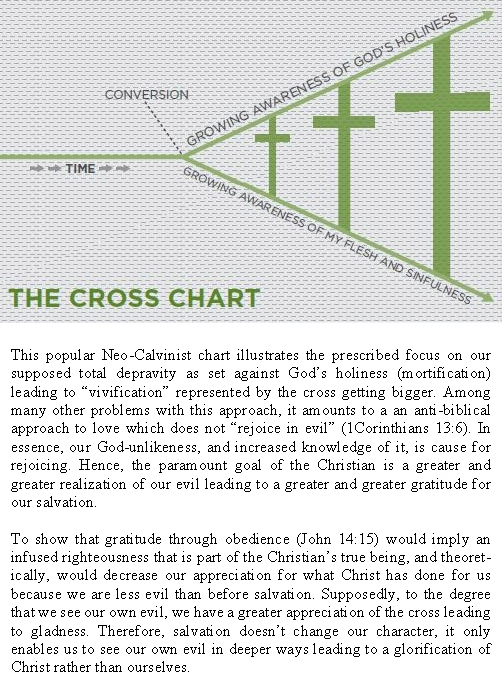
1. Mortification and vivification. According to Calvin, mortification and vivification is obtained through the union with Christ.[4] It is a lifestyle of “constant confession and repentance” that avoids the pursuit of a godly life and embraces a life that is “literally Christ himself.”[5] Simply stated, it is perpetual resalvation through the same repentance and sorrow for sin, and belief in the works of Christ only that saved us. By focusing on our depravity (“deep repentance”), a new need for grace is realized and when embraced results in a refreshing of the soul (vivification); viz, a joy experience.
This is the perpetual reliving of our baptism—a “daily dying and rising.”[6] It also results in EXPERIENCING the works of Christ in our life “subjectively,” but it is not really us doing the work—it is a manifestation of Christ’s work that we only experience [7]. This is otherwise known as “new obedience” in Reformed circles. It can be compared to standing in the rain; you experience it, but you are not participating in the work of it or producing it. This enables us to live our Christian lives by the same gospel that saved us, and resulting in being able to “stand in the judgment.”
2. The Sacraments. We get more saving gospel through the Sacraments. Said Calvin:
It is irrational to contend that sacraments are not manifestations of divine grace toward us… We conclude, therefore, that the sacraments are truly termed evidences of divine grace, and, as it were, seals of the good-will which he entertains toward us. They, by sealing it to us, sustain, nourish, confirm, and increase our faith.[8]
God gathers his people together in a covenantal event to judge and to justify, to kill and to make alive. The emphasis is on God’s work for us – the Father’s gracious plan, the Son’s saving life, death, and resurrection, and the Spirit’s work of bringing life to the valley of dry bones through the proclamation of Christ. The preaching focuses on God’s work in the history of redemption from Genesis through Revelation, and sinners are swept into this unfolding drama. Trained and ordained to mine the riches of Scripture for the benefit of God’s people, ministers try to push their own agendas, opinions, and personalities to the background so that God’s Word will be clearly proclaimed. In this preaching the people once again are simply receivers – recipients of grace. Similarly, in baptism, they do not baptize themselves; they are baptized. In the Lord’s Supper, they do not prepare and cook the meal; they do not contribute to the fare; but they are guests who simply enjoy the bread of heaven.[9]
3. Absolution through church membership. According to Calvin:
Nor by remission of sins does the Lord only once for all elect and admit us into the Church, but by the same means he preserves and defends us in it. For what would it avail us to receive a pardon of which we were afterwards to have no use? That the mercy of the Lord would be vain and delusive if only granted once, all the godly can bear witness; for there is none who is not conscious, during his whole life, of many infirmities which stand in need of divine mercy. And truly it is not without cause that the Lord promises this gift specially to his own household, nor in vain that he orders the same message of reconciliation to be daily delivered to them. Wherefore, as during our whole lives we carry about with us the remains of sin, we could not continue in the Church one single moment were we not sustained by the uninterrupted grace of God in forgiving our sins. On the other hand, the Lord has called his people to eternal salvation, and therefore they ought to consider that pardon for their sins is always ready. Hence let us surely hold that if we are admitted and ingrafted into the body of the Church, the forgiveness of sins has been bestowed, and is daily bestowed on us, in divine liberality, through the intervention of Christ’s merits, and the sanctification of the Spirit.
To impart this blessing to us, the keys have been given to the Church (Mt. 16:19; 18:18). For when Christ gave the command to the apostles, and conferred the power of forgiving sins, he not merely intended that they should loose the sins of those who should be converted from impiety to the faith of Christ;531 but, moreover, that they should perpetually perform this office among believers. This Paul teaches, when he says that the embassy of reconciliation has been committed to the ministers of the Church, that they may ever and anon in the name of Christ exhort the people to be reconciled to God (2 Cor. 5:20). Therefore, in the communion of saints our sins are constantly forgiven by the ministry of the Church, when presbyters or bishops, to whom the office has been committed, confirm pious consciences, in the hope of pardon and forgiveness by the promises of the gospel, and that as well in public as in private, as the case requires. For there are many who, from their infirmity, stand in need of special pacification, and Paul declares that he testified of the grace of Christ not only in the public assembly, but from house to house, reminding each individually of the doctrine of salvation (Acts 20:20, 21). Three things are here to be observed. First, whatever be the holiness which the children of God possess, it is always under the condition, that so long as they dwell in a mortal body, they cannot stand before God without forgiveness of sins. Secondly, This benefit is so peculiar to the Church, that we cannot enjoy it unless we continue in the communion of the Church. Thirdly, It is dispensed to us by the ministers and pastors of the Church, either in the preaching of the Gospel or the administration of the Sacraments, and herein is especially manifested the power of the keys, which the Lord has bestowed on the company of the faithful. Accordingly, let each of us consider it to be his duty to seek forgiveness of sins only where the Lord has placed it. Of the public reconciliation which relates to discipline, we shall speak at the proper place.[10]
…by new sins we continually separate ourselves, as far as we can, from the grace of God… Thus it is, that all the saints have need of the daily forgiveness of sins; for this alone keeps us in the family of God. [11]
Take note that Calvin is also confirming the Reformed belief that sins in the Christian life separate us from salvation. Therefore, the same repentance and faith that was needed originally continues to be needed as a way to keep ourselves saved. However, according to Calvin, the same gospel that originally saved us must be continually administered by Reformed pastors.
John Piper
John Piper is the guru of Christian joy. Most Christians find it strange that he puts so much emphasis on Christian joy; that is, until you understand mortification and vivification. If vivification is not taking place; viz, the upside of mortification and vivification, then you are not in union with Christ. This totally explains the following outrageous statements by him:
“Unless a man be born again into a Christian Hedonist he cannot see the kingdom of God” (Desiring God page 55).
“Could it be that today the most straightforward biblical command for conversion is not, ‘Believe in the Lord,’ but, ‘Delight yourself in the Lord’?” (Desiring God page 55).
“The pursuit of joy in God is not optional. It is not an ‘extra’ that a person might grow into after he comes to faith. Until your heart has hit upon this pursuit, your ‘faith’ cannot please God. It is not saving faith” (Desiring God page 69).
“Not everybody is saved from God’s wrath just because Christ died for sinners. There is a condition we must meet in order to be saved. I want to try to show that the condition…is nothing less than the creation of a Christian Hedonist” (Desiring God page 61).
“We are converted when Christ becomes for us a Treasure Chest of holy joy” (Desiring God page 66).
“Something has happened in our hearts before the act of faith. It implies that beneath and behind the act of faith which pleases God, a new taste has been created. A taste for the glory of God and the beauty of Christ. Behold, a joy has been born!” (Desiring God page 67).
“Before the decision comes delight. Before trust comes the discovery of treasure” (Desiring God, page 68).
Michael Horton
The following statement by Michael Horton is a good summation of the Reformation’s false gospel:
Where we land on these issues is perhaps the most significant factor in how we approach our own faith and practice and communicate it to the world. If not only the unregenerate but the regenerate are always dependent at every moment on the free grace of God disclosed in the gospel, then nothing can raise those who are spiritually dead or continually give life to Christ’s flock but the Spirit working through the gospel. When this happens (not just once, but every time we encounter the gospel afresh), the Spirit progressively transforms us into Christ’s image. Start with Christ (that is, the gospel) and you get sanctification in the bargain; begin with Christ and move on to something else, and you lose both.[12]
Paul David Tripp
Lastly, out of necessity, Calvin’s doctrine must depend on an allegorical interpretation of Scripture. As Rick Holland has stated, “bad grammar makes good theology.”[13] That’s because this doctrine cannot survive a grammatical examination. Tripp, one of the more viral forms of Calvinism, concedes on page 27 of How People Change (2006) that a literal interpretation of Scripture does call us to “change the way we think” (one of the more passive forms of obedience), but that this approach “omits the person and work of Christ as Savior.” In other words, a literal interpretation that circumvents use of the Bible as a tool for returning to the same gospel that saved us cuts off the progressive justification process.
paul
Endnotes
1. “We” are the authors of the theological journal published by the Australian Forum project that launched the present-day Calvinist resurgence: Graeme Goldsworthy, Robert Brinsmead, Geoffrey Paxton, and Jon Zens. Citation from Present Truth Magazine volume 35—article 3, Righteousness by Faith part 4, chapter 8.
2. The Blaze interview with Tullian Tchividjian: Oct. 15, 2013 9:01am | Billy Hallowell.
3. CJ Mahaney has used this theme many times and prescribes “preaching the gospel to ourselves” as the prescription. In reality, this is a means of keeping ourselves saved according to Reformed theology.
4. The Calvin Institutes 3.3.9, first sentence.
5. Paul David Tripp: How People Change Punch Press 2006, p.6
6. Michael Horton’s Systematic Theology for Pilgrims on the Way: p.661
7. Ibid p.661, Ibid note 5, p. 215
8. The Calvin Institutes 4.14.7
9. Michael Horton: Christless Christianity; pp.189-191
10. The Calvin Institutes 4.1.21,22
11. John Calvin: Commentaries on the Catholic Epistles; The Calvin Translation Society 1855. Editor: John Owen, p. 165 ¶4
12. Michael Horton: Christless Christianity; p. 62
13. Rick Holland: Uneclipsing the Son; p. 39


Has a Particular Path Unfolded for TANC?


My journey into the “justification by faith alone” doctrine of the Reformation started in 2006. By 2012, I established that it is far from being a justification by faith alone. I believe the Reformation is the biggest hoax ever perpetrated on mankind by the traditions of men and the kingdom of darkness. This is a simple matter of theological math. Calvin et al knew the doctrine doesn’t add up, so they implemented a system of orthodoxy to keep Christians dumbed down. I believe Calvinism has become the epic evangelistic mission field of our day.
Thanks to my wife Susan who has been the leading supporter of this ministry for three years, I have been able to devote myself to this ministry fulltime since 2011. I am undoubtedly the idea guy, while Susan and others associated with our ministry help me sort through those ideas and categorize them. We have tossed around numerous ideas in regard to getting the word out that we must repent of fearing man and turn to the Chief Shepherd. Glory to His great name. There is NO mediator between God and man other than Christ. As the Calvinist tsunami intensifies in our day, its leaders are becoming bolder in exemplifying Calvin’s power of the keys. This is a major concern.
I am also concerned with how this movement has turned up the heat recently in regard to aggressively promoting this doctrine through conferences that target the bread and butter of Christianity. These conferences draw thousands from all over America who then go back to local churches with these ideas. And these conferences are funded by God’s people. Most of the pastors who go to these conferences do so on the local church’s coin. Never before in church history has so much money been poured into a false cause.
Though seven years of research has been necessary in order to articulate the problems with this doctrine, our Lord also said to “go.” I was motivated to do just that in regard to the “Cross” conference in Louisville that targets Christian youth. I cannot stand by and let that happen without a fuss. This will be a test in regard to a possible path going forward for TANC; an evangelistic/educational ministry that takes this message directly to where people have gathered for these conferences. It’s a start; to make even one pastor stop and think before he takes these ideas back to the local church. And pastors are usually members of local church fellowships; even one pastor could make a huge difference. When will we begin to plead that Chrsitians start applying the brakes in order to think about where they are going? This takes the message from the blogosphere to the streets.
Furthermore, I am concerned with another upcoming pastor’s conference in February of 2014 that focuses on “the vine and the branches.” I believe this conference will turn up the volume on Calvin’s power of the keys doctrine. It will convince many young pastors that they are key mediators between their parishioners and Christ. This is greatly increasing instances of spiritual tyranny in the church. Consider the mentality being conveyed by notable Calvinist leaders to their younger understudies:
The spiritual life of any congregation and its growth in grace will never exceed the high-water mark set by its pulpit.
~ Steven J. Lawson
TANC receives many encouraging letters from people who stand with us. They rightly assess that it must be “a very lonely ministry.” However, that’s changing. People also write that they “feel powerless” to do anything about the tyranny of this movement. That is changing also. Let us be a voice for you in Louisville and Minneapolis.
The truth is a very powerful thing, and a little of it will bring down any formidable stronghold. We need your support for Louisville; ie., the printing of materials and travel expenses for the missionary team. If we can pull this off, Minneapolis is next.
TTANC, a nonprofit LLC
PO Box 583
Xenia, Ohio 45385
PayPal: mail@ttanc.com
Contact: mail@ttanc.com
Join the team!
paul
John Calvin’s Gospel of Works, Fear, and NO Assurance
 “While the soteriology lends uncertainty to one’s eternal destiny, is assurance found more in having the elder’s approval? After all, if he states that you are saved, heaven will bind it.”
John Calvin was pure heretic. The present-day exaltation of him by the who’s who of evangelicals is an abomination before the Lord. For Calvin, the Christian life is lived out in a progression of justification; viz, justification is not a onetime event that is a finished work by God alone. The Christian life starts with repentance and faith, and that not only justifies us in the beginning, it must continue to justify us throughout the course of our life. “Progressive sanctification” is really progressive justification. The Christian life is not lived out as a result of our salvation; we must live in the progression of salvation and stay in its status through faith and repentance alone. We must keep ourselves saved by perpetual repentance. This is the “P” in TULIP, “perseverance of the saints.” No distinction is made between repentance unto salvation and repentance as a son of God. Calvin evokes all Scriptural calls to repentance for salvation as indicative of the Christian life. Calvin cites biblical salvation verses—as verses pertaining to the Christian life throughout the Calvin Institutes.
Furthermore, Calvin insisted that Christian repentance is motivated by fear, and repentance is active, while the results of repentance, a joyful rebirth experience, is the work of God. It is a perpetual revisiting of the gospel that saved us in order to keep ourselves saved. Our only work is repenting of sin while works imputed by God to our Christian life are only experienced, and not performed.
First, Calvin defines repentance in his Institutes. Keep in mind that he is not writing about original salvation, but the Christian life. This will be confirmed after this citation:
Certain learned men, who lived long before the present days and were desirous to speak simply and sincerely according to the rule of Scripture, held that repentance consists of two parts, mortification and quickening. By mortification they mean, grief of soul and terror, produced by a conviction of sin and a sense of the divine judgment. For when a man is brought to a true knowledge of sin, he begins truly to hate and abominate sin… By quickening they mean, the comfort which is produced by faith, as when a man prostrated by a consciousness of sin, and smitten with the fear of God, afterwards beholding his goodness, and the mercy, grace, and salvation obtained through Christ, looks up, begins to breathe, takes courage, and passes, as it were, from death unto life. I admit that these terms, when rightly interpreted, aptly enough express the power of repentance; only I cannot assent to their using the term quickening, for the joy which the soul feels after being calmed from perturbation and fear. It more properly means, that desire of pious and holy living which springs from the new birth; as if it were said, that the man dies to himself that he may begin to live unto God (CI 3.33).
We must now explain the third part of the definition, and show what is meant when we say that repentance consists of two parts—viz. the mortification of the flesh, and the quickening of the Spirit (CI 3.3.8).
And for how long do we partake in this perpetual repentance (mortification) and rebirth (vivification)?
This renewal, indeed, is not accomplished in a moment, a day, or a year, but by uninterrupted, sometimes even by slow progress God abolishes the remains of carnal corruption in his elect, cleanses them from pollution, and consecrates them as his temples, restoring all their inclinations to real purity, so that during their whole lives they may practice repentance, and know that death is the only termination to this warfare…It is not denied that there is room for improvement; but what I maintain is, that the nearer any one approaches in resemblance to God, the more does the image of God appear in him. That believers may attain to it, God assigns repentance as the goal towards which they must keep running [emphasis added] during the whole course of their lives (CI 3.3.9).
Though Calvin wrote of being transformed into the “image” of God, this is part and parcel with the passive and perpetual rebirth experience by the Christian. This does not denote a change or improvement in the Christian’s nature which would lessen the need for repentance. Obviously, if you look at the chart below, raising the trajectory of repentance makes the cross smaller, so repentance leading to real change is not in focus here. Calvin’s idea of transformation regards the birthing of realms which is experienced by the Christian through joy. Hence, the new birth is perpetual through the Christian’s life and is the result of perpetual repentance. We are to repent and dwell on our own depravity, and leave any quickenings or rebirth experiences to God:
He, however, who has emptied himself (cf. Phil. 2:7) through suffering no longer does works but knows that God works and does all things in him. For this reason, whether God does works or not, it is all the same to him. He neither boasts if he does good works, nor is he disturbed if God does not do good works through him. He knows that it is sufficient if he suffers and is brought low by the cross in order to be annihilated all the more. It is this that Christ says in John 3:7, »You must be born anew.« To be born anew, one must consequently first die and then be raised up with the Son of Man. To die, I say, means to feel death at hand (Martin Luther: Heidelberg Disputation, theses 24).
In obedience to God’s word we should fight to walk in the paths where he has promised his blessings. But when and how they come is God’s to decide, not ours. If they delay, we trust the wisdom of our Father’s timing, and we wait. In this way joy remains a gift, while we work patiently in the field of obedience and fight against the weeds and the crows and the rodents. Here is where joy will come. Here is where Christ will reveal himself (John 14:21). But that revelation and that joy will come when and how Christ chooses. It will be a gift… Heaven hangs on having the taste of joy in God. Therefore, it might not be so strange after all to think of fighting for this joy. Our eternal lives depend on it (John Piper: When I Don’t Desire God; p.43, p.34).
It is also important to note that in this construct, for the most part, repentance is something we focus on, and not something we necessarily try to do. The goal is to see our own depravity in a deeper and deeper way, and this results in a joyful rebirth experience that is totally out of our control. But yet, we must fight for this joy, or rebirth experience because “Our eternal lives depend on it.” Not only is this clearly works salvation, but it makes our eternal destiny ambiguous at best. Therefore…
Let us, therefore, embrace Christ, who is kindly offered to us, and comes forth to meet us: he will number us among his flock, and keep us within his fold. But anxiety arises as to our future state. For as Paul teaches, that those are called who were previously elected, so our Savior shows that many are called, but few chosen (Mt. 22:14). Nay, even Paul himself dissuades us from security, when he says, “Let him that thinketh he standeth take heed lest he fall,” (1 Cor. 10:12). And again, “Well, because of unbelief they were broken off, and thou standest by faith. Be not high-minded, but fear: for if God spared not the natural branches, take heed lest he also spare not thee,” (Rom. 11:20, 21). In fine, we are sufficiently taught by experience itself, that calling and faith are of little value without perseverance, which, however, is not the gift of all (CI 3.24.6).
There is danger on the way to salvation in heaven. We need ongoing protection after our conversion. Our security does not mean we are home free. There is a battle to be fought (John Piper: Bethlehem Baptist Church Minneapolis, Minnesota; The Elect Are Kept by the Power of God October 17, 1993).
According to Calvin, fear of future judgment is one of the primary motivations for repentance in the Christians life:
By mortification they mean, grief of soul and terror, produced by a conviction of sin and a sense of the divine judgment [sec.3]… it seems to me, that repentance may be not inappropriately defined thus: A real conversion of our life unto God, proceeding from sincere and serious fear of God; and consisting in the mortification of our flesh and the old man, and the quickening of the Spirit. In this sense are to be understood all those addresses in which the prophets first, and the apostles afterwards, exhorted the people of their time to repentance. The great object for which they labored was, to fill them with confusion for their sins and dread of the divine judgment, that they might fall down and humble themselves before him whom they had offended, and, with true repentance, retake themselves to the right path [sec.5]… The second part of our definition is, that repentance proceeds from a sincere fear of God. Before the mind of the sinner can be inclined to repentance, he must be aroused by the thought of divine judgment; but when once the thought that God will one day ascend his tribunal to take an account of all words and actions has taken possession of his mind, it will not allow him to rest, or have one moment’s peace, but will perpetually urge him to adopt a different plan of life, that he may be able to stand securely at that judgment-seat. Hence the Scripture, when exhorting to repentance, often introduces the subject of judgment, as in Jeremiah, “Lest my fury come forth like fire, and burn that none can quench it, because of the evil of your doings,” (Jer. 4:4)… The stern threatening which God employs are extorted from him by our depraved dispositions [sec.7] [from the CI 3.3.3-7].
Of course, this is all in egregious contradiction to the Scriptures; viz,
1John 4:18 – There is no fear in love, but perfect love casts out fear. For fear has to do with punishment, and whoever fears has not been perfected in love.
Calvin’s false gospel requires us to run a race of perpetual repentance driven by fear of judgment in order to keep ourselves saved. The new birth is not a onetime event known as regeneration, but is only an EXPERIENCE that follows the mortification of repentance. Calvin states that these quickenings that follow mortification are accompanied by joy and subjective manifestations of God’s image. Many are called, but not all have the gift of persevering in the cycle of mortification and vivification. Therefore, assurance of salvation is dubious at best.
Beside the fact that the apostle John wrote the book of 1John so that we can “know” that we are saved, Calvin’s gospel contradicts a mass of holy writ. This subjective gospel also adds a peculiar twist if you consider Calvin’s power of the keys; ie., whatever elders bind on earth will be bound in heaven. While the soteriology lends uncertainty to one’s eternal destiny, is assurance found more in having the elder’s approval? After all, if he states that you are saved, heaven will bind it.
paul

 Paul's Passing Thoughts
6 comments