A Stocking Stuffer From TANC Publishing
Basic Fundamentals of the True Gospel trifold
Print side one, drop back down in paper tray without turning or flipping, print side two. On page 2, fold right edge from right to left, and line-up with vertical line.
John Calvin: Mankind Fallen BEFORE the Fall
For some time I have heard teachings coming from Calvinists that seem to insinuate that man was fallen before the fall. A popular teaching in the Patriarchy movement is the idea that Adam sinned before Eve bought into the idea that she needed a mediator between her and God. In fact, the need for mediation between man and God before the fall is very prevalent in Calvin’s writings. Francos Wendal, in his work, Calvin: Origins and Development of His Religious Thoughts (Presses Universitaires Defrance 1950) states the following on page 216:
Indeed, for any contact to be established between the most holy God and sinful man, it was necessary for God to come right down to man, since man would never, of his own strength, have been able to raise himself up to God. ‘The majesty of God is too high,’ said Calvin,
For us to say that mortal men could attain to it, seeing that they can do no more than crawl over the earth like little worms,*
That, of course. Is the state of man since the Fall. But Calvin had no very high opinion of humanity even before the original sin. It is not so surprising therefore, that he could write:
Even If man had remained in his integrity, still his condition was too base for him to attain to God. How much less could he have raised himself so far, after having been plunged by his ruin into death and hell, after staining himself with so many defilements nay, even stinking in his corruption and all overwhelmed with misery?** [The Calvin Institutes 2.12.1: Henry Beveridge transaltion varies slightly]
The more Calvin is studied, the more it is realized that he sought to upend every element of truth in the Bible. The root of this is Calvin’s Platonist underpinnings that of course would have to see a problem with man before the fall because of his material essence.
Again, in regard to the pastorate of our day, who knew what and when? And in regard to those who didn’t know, why not?
paul
Endnotes
* Inst., 2.6.4. Among numerous similar passages, the Course upon Hosea, Opp. 42, 264: “Deum a nobis quaeri non posse, nisi in mediatore Ghristo. . . . Nisi Christus se medium nobis offerat qua via possemus ad Deum accedere?” Or again, the sermon on I Ephesians 1.1-3: “Without this Mediator, it is certain that we are all foreclosed [by God] and the majesty of God ought to make the hairs of our head stand on end.” Opp.9 51, 256.
** The Institutes 2.12.1.
Four Questions for Contemporary Pastors
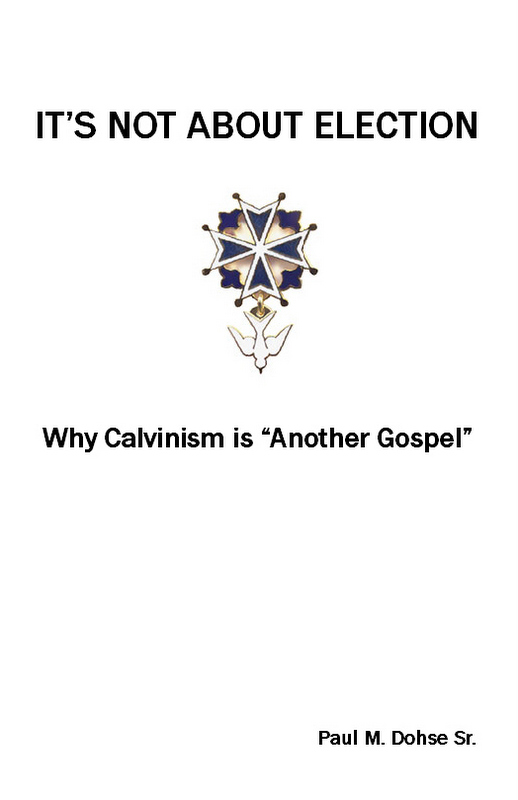
Now Available on Amazon
“Did you know that this is what Calvin believed, and if you did know it, when did you know it, and why didn’t you tell us? And if you didn’t know it, why not?”
This little booklet of 38 pages is the result of seven years of research. It explains Calvin’s egregious false gospel in a way that most Christians can understand. Most Christians would answer the questions following this post, “No” while Calvin would answer them “Yes.” The book contains relevant citations from Reformed literature, an ocean of self-aggrandizing linguistic droning. It is an ocean of Reformed thought that deliberately talks about sanctification in a justification way. It is a mass of literature written from a condescending mentality in regard to the average Christian.
Pastors in our day have a lot to answer for. Most of them know how Calvin would have answered these questions. They believe that the average parishioner is not “ready” for the hard “truth” that reveals why Calvin would answer all of these questions, “Yes.”
The laity has entrusted the institutional church in America with the keeping of the gospel. That trust has been violated.
Come out from among them.
paul
1. Do we keep ourselves saved by preaching the gospel to ourselves every day?
2. Do sins committed in the Christian life separate us from our salvation?
3. Do we need to be reconciled to God daily in a saving way?
4. Are Christians totally depraved?
5. Are Christians still under the law for Justification?
6. Do pastors have the authority to forgive your sins?
7. Do you believe that the New Testament Christian life is the Old Testament Sabbath; i.e., if we do works in our Christian life we will die spiritually?
Seven Questions That Would be Answered “Yes” by John Calvin
Now Available on Amazon
1. Do we keep ourselves saved by preaching the gospel to ourselves every day?
2. Do sins committed in the Christian life separate us from our salvation?
3. Do we need to be reconciled to God daily in a saving way?
4. Are Christians totally depraved?
5. Are Christians still under the law for Justification?
6. Do pastors have the authority to forgive your sins?
7. Do you believe that the New Testament Christian life is the Old Testament Sabbath; i.e., if we do works in our Christian life we will die spiritually?

 Paul's Passing Thoughts
1 comment