The New Calvinist Wide Road to Hell: “Your” Doesn’t Mean, “Your”; Matthew 5:20
 As posted yesterday, accepting any rewriting of history is a very dangerous precedent, especially in regard to the gospel, and the New Calvinist crowd works hard at rewriting history. The Resolved series of conferences sponsored by John MacArthur Jr. focused heavily on rewriting history, often representing Puritans as martyrs when many were executed for political intrigue. The Fox’s Book of Martyrs is a shameful and egregious rewriting of history; specifically, it omits the fact that Protestants were guilty of the exact same persecution towards those who disagreed with them. The book has no credibility whatsoever.
This brings us to the rewriting of history in regard to the Pharisees by New Calvinists. The narrative goes like this:
The Pharisees were really, really good at keeping the law, but at the end of the day, Christ said that you need a righteousness that exceeds theirs! What to do? Answer: cling to faith alone which imparts righteousness to us not our own. When Jesus said “your” righteousness must exceed that of the Pharisees, he was really talking about His own righteousness imputed to us.
So, saving faith is defined as knowing you are wicked. The unregenerate are defined as those who think they possess righteousness. The new birth is therefore defined as a different knowing—not a different person. If you think you are a different person who possesses a righteousness that is part of you, well, you don’t “need a physician.”
Hence, you must see Christ’s role in justification as ongoing and not finished, and you must continue to appropriate the imputation of His righteousness by simply believing and not “anything we do.” The New Calvinists of our day use the exact same lingo as the Australian Forum did, and that is why they are running from that history:
Christ’s doing and dying—not ours.
This truism was uniquely Forum, as well as many other truisms authored by them and used by the New Calvinists of our day. However, let us not miss the fact that this idea of an ongoing need for a justification physician is fundamental Calvinism whether the theologians of our day know it or not. If you are going to call yourself a Calvinist, you really ought to read Calvin for yourself.
So, in Matthew 5:20, when Christ referred to “your” [our] righteousness, “your” really doesn’t mean “your,” He meant “His” [my]. Therefore, according to New Calvinists, a better rendering would be:
For I tell you, unless you have my righteousness which exceeds that of the Pharisees who are really, really good at keeping the law, you will never enter the kingdom of heaven.
Supposedly then, only those who know they are wicked inherit eternal life. Hmmmmm, really? Actually, there are a couple of huge problems here, and what is at stake is the true gospel. First, the Pharisees were not really, really good at keeping the law—they were horrible at keeping the law. Christ said they were “lawless” on the inside and the outside. They also edited the law with their own traditions. This whole, the Pharisees were really, really good at keeping the law is a rewriting of history.
Secondly, the Bible states in many, many places that Christians possess righteousness that is part and parcel with their being. We are not only declared righteous, we are righteous, and only the righteous will inherit the kingdom. Pastors, I warn you: when you hear a fellow Christian say they “have no righteousness of their own,” you better qualify that. Righteousness, albeit a gift, is ours because it is gifted to us, and certain attitudes about works in sanctification reveal what we believe about justification; e.g., the Parable of the Talents.
The reason we are considered righteous, and are righteous regardless of the fact that we still sin is a matter of proper understanding about law and gospel. Suffice to say for purposes of this post that we have this treasure in jars of clay, but yet, that doesn’t take away from the value of the treasure—it is still a treasure. In 1John, we are told God’s seed is IN us. End of argument. Moreover, Paul uses a double emphasis to state the fact that Christians possess a goodness that is part and parcel with their being:
Romans 15:14 – I myself am satisfied about you, my brothers, that you yourselves are full of goodness, filled with all knowledge and able to instruct one another.
What part of “you yourselves” do we not understand? When Christ said “your” righteousness, he meant “your.” Christ said, “You must be born again.” This isn’t a rebirth of mere awareness that James railed against; this is a rebirth of your being.
Another reason New Calvinism wants to separate itself from the Forum is because they lacked the same nuance that New Calvinists like John Piper and Al Mohler have mastered. The Forum wrote an article titled, “The False Gospel of the New Birth” footnoted by one of its participants and leading authority on New Calvinist hermeneutics, Graeme Goldsworthy, who was invited to lecture at Sothern Seminary in 2009. The clear argument of the article was that the new birth was true (as are shadows, but do not have the sun’s life-giving source), but any emphasis on it would take away from the “best thing” which is Christ. In other words, the new birth is true, but irrelevant—even damaging because it puts the focus on us and not Christ. This gets into the whole subjective gospel versus objective gospel that there is no room for here.
I fear that New Calvinism is one of the wide roads that lead to hell that Christ warned us of. It redefines the new birth as a mere awareness devoid of new creaturehood. It is a movement that heralds the total depravity of the saints and denies the new birth.
paul
Not on my Watch Tim | Challies Tries to Rewrite New Calvinist History
 A reader of PPT sent me a timeline chart produced by Tim Challies that supposedly traces the history and source of New Calvinism. The reader sent me the link yesterday because he thought I “might be interested” in it. Yes, he would be correct about that, I am VERY interested.
History is a paramount teacher and a protector of civilization. It protects us from those who are hell-bent on foisting their worldview on the masses because it is the “right way that has never been rightly applied.” If you want to understand how this works, see John Immel’s presentation at the 2012 TANK conference here. Tyrants always want to rewrite history because people might get the wrong idea about how their logic has been inappropriately applied in past history yielding bad results. Hence, an accurate portrait of what happened, in their minds, misrepresents their logic.
That’s a dangerous precedent. The rewriting of history has always been Propaganda 101 for the tyrant. Bottom line: the explosion of discernment blogs, especially those of the spiritual abuse/spiritual tyranny sort are a direct result of the New Calvinist movement; therefore, Tim Challies has now taken his place as the Joseph Goebbels of New Calvinism.
I suppose if nothing else, I have served mankind with an in-depth appraisal of New Calvinism’s TRUE contemporary history, and no Tim, John Piper is not the father of New Calvinism, a Seventh Day Adventist theologian by the name of Robert Brinsmead is the true father of New Calvinism. Colleague John Immel is probably right, that knowledge will more than likely do little to avert people from “New” Calvinism, but just the same, we will keep it on the record for giggles if nothing else. This is why I am abundantly pleased that TTANC 1 will go beyond being self-published in the near future. Immel wonders aloud why New Calvinists care that people know who the real father of the movement is, but obviously, they do care or they wouldn’t be rewriting history. Below is the true illustrative chart that appears on page 92 of TTANC 1. TTANC 2 will delve even deeper into the history as well.
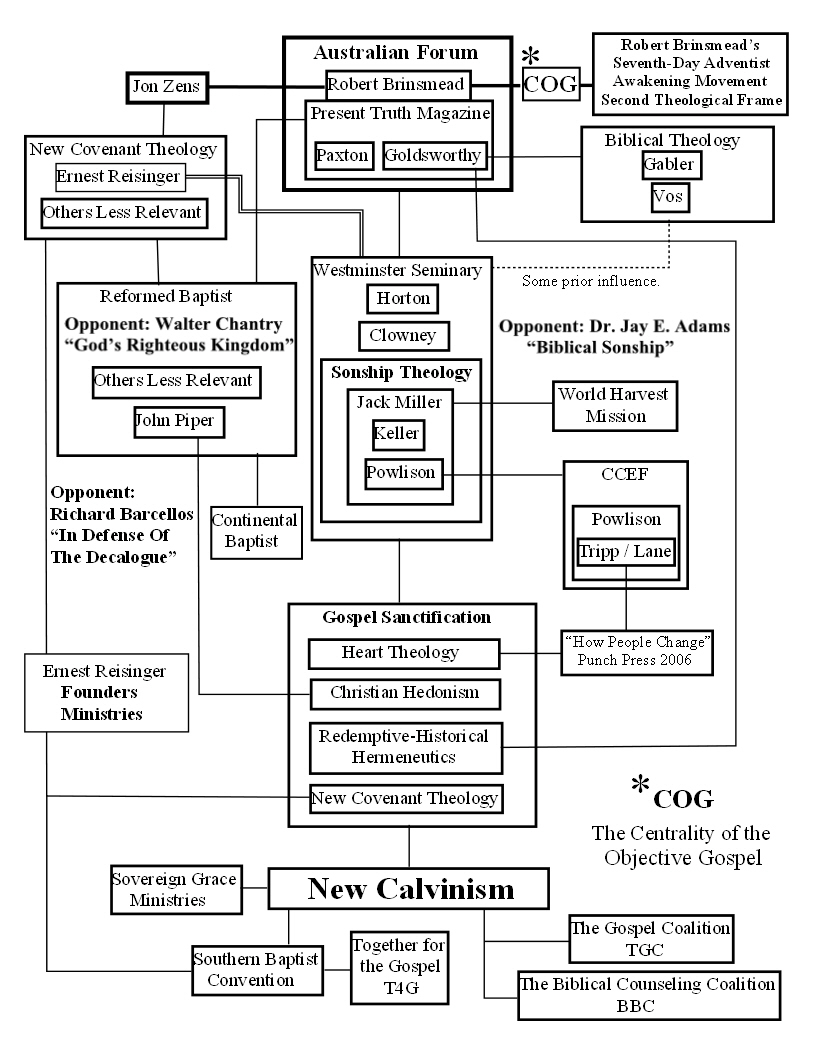
The theological journal written by Robert Brinsmead, Present Truth Magazine, was the most widely published theological journal in the world during the 70’s. The rediscovery/resurgence project that sought to bring back authentic Reformed soteriology to the church was known as the Australian Forum. They had their own core four: Robert Brinsmead, Graeme Goldsworthy, Geoffrey Paxton, and the father of New Covenant Theology, Jon Zens. Brinsmead and Zens worked together on NCT which is a slightly different twist on the law than Covenant Theology, but both hold firmly to Augustine’s Neo-Platonism. That is, those who really understand what the Reformers propagated.
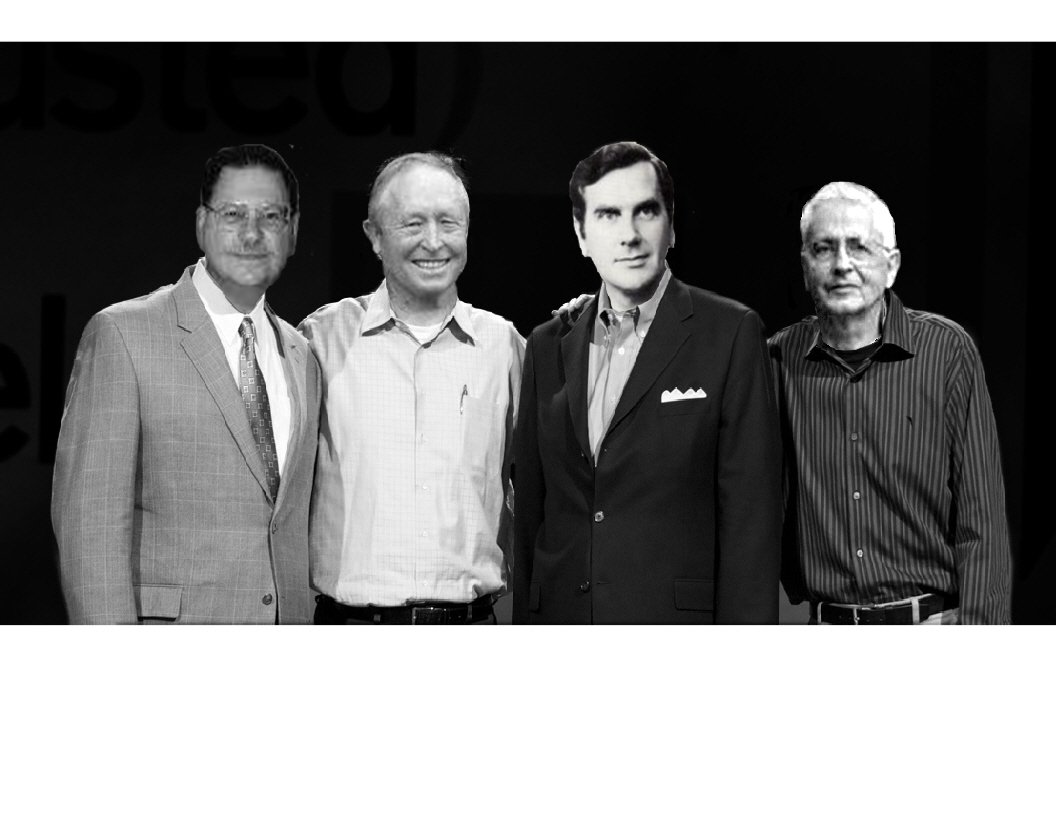 More than likely, John Piper got his theology from Present Truth Magazine. During the 70’s, and regardless of denomination, only pastors who resided on the moon had never heard of the journal or read it. Piper himself uses terminally that was uniquely that of the Australian Forum. In fact, the centrality of the objective gospel outside of us was a Forum distinctive. The Forum also developed the root and fruit/tree paradigm so often used among New Calvinists. They also developed the emphasis hermeneutic as well; i.e., “a good thing is not the best thing and to the degree that you talk about good things, you take away from the best thing.” This is the Gnostic concept of sun versus shadows; shadows are true, but they can’t give life like the sun, so we don’t want to emphasize shadows. The Forum, and Graeme Goldsworthy in particular, used this hermeneutic to redefine the new birth. These four men, whatever you think of them, were master thinkers and able to repackage complex theological ideas in an understandable way.
New Calvinism has not strayed far from the model they established, including a strong focus on pastors’ conferences. As noted in chapter 4 of TTANC 1, when Goldsworthy was invited to lecture at Southern Seminary, John Piper couldn’t help himself and wrote an article about Goldsworthy’s lecture. Until then, Piper’s kinship to the Forum was extremely difficult to establish.
Brinsmead and other notable Adventist theologians hoped to reform the Seventh Day Adventist church with authentic Reformed soteriology. The question of the final judgment has always been a sticky wicket for Adventists, and the Reformed gospel offers a solution: Jesus stands in the judgment for us. The Awakening movement that Brinsmead started in 1969 still lives in Adventist circles, and they archived all 53 volumes of Present Truth Magazine. The Forum also wrote extensively on the fact that Ellen White was a student of Luther’s writings and also wanted to solve the problem of the final judgment with authentic Reformed soteriology. This is what led Brinsmead to research the writings of the Reformers in order to solve the final judgment debate that had plagued Adventism for many years. In both Adventism and Reformed theology, the law is the standard for justification; therefore, the problem with the law being fulfilled is found in Christ fulfilling the law and “covering” the believer with the perfect obedience of Christ.
In contrast regarding the Reformation gospel and Adventism both, the Christian’s sin, in regard to justification, is not covered—it’s ENDED, and we will not stand in any judgment that determines justification.
Truly, a book could be written on the fallacies of this bogus history chart authored by Challies, but in closing I will only mention one more: the following misrepresentation by Kevin DeYoung (2008 on the timeline); the Emergent church isn’t Reformed. Why this is a big fat lie can be explained via this free booklet. Other than that, Challies’ timeline is peppered with the who’s who of the Emergent church movement, while the aforementioned notable event on the timeline denies Emergent connections. I am not sure that there has ever been a movement with more followers with an inability to think.
It’s true: I did think that New Calvinism’s connection to Adventism would be a game changer, but more significant is the fact that New Calvinism is old Calvinism, and that is also a history that has been completely rewritten. The accepted history of the Reformation and its impact on western civilization is propaganda that could only pass in the church or a Communist country.
And for whatever it is worth, and for whatever it might accomplish, that is why we are here, and it is why we do what we do, and we will do it for an audience of One if that is all that ever becomes of it.
But be sure of this: I will not stand silent while yuppie heretics rewrite history. Not while the Lord gives me breathe on this watch.
paul
Romans 13:11 | What’s in the Word “Saved” Part 2: The Other Salvation

Last week we laid a foundation critical for understanding the Bible: the dichotomy of justification and sanctification. Justification is a finished work; sanctification is not a finished work. If this is not understood, a biblical dichotomy is contradiction. Furthermore, sanctification is not a matter of being empowered, or God working “through us” alone, but our new creaturehood makes our colaboring with God possible. In fact, we will be judged according to how we participate in kingdom living:
1 Corinthians 3:1 – But I, brothers, could not address you as spiritual people, but as people of the flesh, as infants in Christ. 2 I fed you with milk, not solid food, for you were not ready for it. And even now you are not yet ready, 3 for you are still of the flesh. For while there is jealousy and strife among you, are you not of the flesh and behaving only in a human way? 4 For when one says, “I follow Paul,” and another, “I follow Apollos,” are you not being merely human?
5 What then is Apollos? What is Paul? Servants through whom you believed, as the Lord assigned to each. 6 I planted, Apollos watered, but God gave the growth. 7 So neither he who plants nor he who waters is anything, but only God who gives the growth. 8 He who plants and he who waters are one, and each will receive his wages according to his labor. 9 For we are God’s fellow workers. You are God’s field, God’s building.
10 According to the grace of God given to me, like a skilled master builder I laid a foundation, and someone else is building upon it. Let each one take care how he builds upon it. 11 For no one can lay a foundation other than that which is laid, which is Jesus Christ. 12 Now if anyone builds on the foundation with gold, silver, precious stones, wood, hay, straw— 13 each one’s work will become manifest, for the Day will disclose it, because it will be revealed by fire, and the fire will test what sort of work each one has done. 14 If the work that anyone has built on the foundation survives, he will receive a reward. 15 If anyone’s work is burned up, he will suffer loss, though he himself will be saved, but only as through fire.
16 Do you not know that you are God’s temple and that God’s Spirit dwells in you? 17 If anyone destroys God’s temple, God will destroy him. For God’s temple is holy, and you are that temple.
18 Let no one deceive himself. If anyone among you thinks that he is wise in this age, let him become a fool that he may become wise. 19 For the wisdom of this world is folly with God. For it is written, “He catches the wise in their craftiness,” 20 and again, “The Lord knows the thoughts of the wise, that they are futile.” 21 So let no one boast in men. For all things are yours, 22 whether Paul or Apollos or Cephas or the world or life or death or the present or the future—all are yours, 23 and you are Christ’s, and Christ is God’s.
This is a long passage, but it speaks much to our subject, especially the other salvation. As discussed last week, there is still a salvation left for God’s people—the salvation from mortally that was previously under law. Though the old us died with Christ, as long as we are mortal, the flesh that once enslaved us can wage war against our minds that are now enslaved to righteousness. Unfortunately, by and large, Christianity defines itself as still enslaved to the flesh—this is perceived everywhere you look as testified to by the following popular Christian placard.
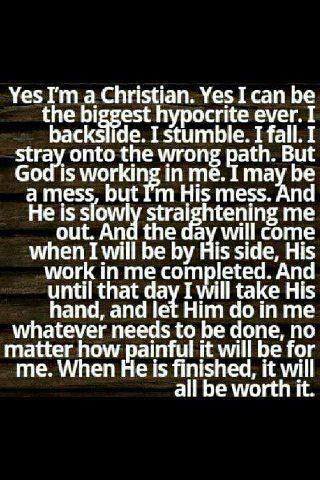
So, as Christians, we are still a “mess.” The only difference is the Jesus label. We were a mess, and we are a mess. Not only does this stand in stark contrast to the corpus of Holy Writ, but it is far from being good news to the world who would normally have one eye towards escaping a world that they know is a mess—why would they want to trade one mess for another one?
Last week, we discussed the fact that Paul made it plain in Romans 7:25 that Christians await a salvation from the weakness of the flesh. Again, in the passage we are starting with today, we see that Christians will stand in a judgment that will determine rewards, and even though we will suffer loss of rewards to some degree, we will be saved “by fire.” There are two different salvations: one from eternal judgment, and a second one for Christians in regard to mortality, or the “flesh.” Let’s establish the fact that two separate judgments coincide with two different salvations:
Revelation 20:4 – 4 Then I saw thrones, and seated on them were those to whom the authority to judge was committed. Also I saw the souls of those who had been beheaded for the testimony of Jesus and for the word of God, and those who had not worshiped the beast or its image and had not received its mark on their foreheads or their hands. They came to life and reigned with Christ for a thousand years. 5 The rest of the dead did not come to life until the thousand years were ended. This is the first resurrection. 6 Blessed and holy is the one who shares in the first resurrection! Over such the second death has no power, but they will be priests of God and of Christ, and they will reign with him for a thousand years.
7 And when the thousand years are ended, Satan will be released from his prison 8 and will come out to deceive the nations that are at the four corners of the earth, Gog and Magog, to gather them for battle; their number is like the sand of the sea. 9 And they marched up over the broad plain of the earth and surrounded the camp of the saints and the beloved city, but fire came down from heaven and consumed them, 10 and the devil who had deceived them was thrown into the lake of fire and sulfur where the beast and the false prophet were, and they will be tormented day and night forever and ever.
11 Then I saw a great white throne and him who was seated on it. From his presence earth and sky fled away, and no place was found for them. 12 And I saw the dead, great and small, standing before the throne, and books were opened. Then another book was opened, which is the book of life. And the dead were judged by what was written in the books, according to what they had done. 13 And the sea gave up the dead who were in it, Death and Hades gave up the dead who were in them, and they were judged, each one of them, according to what they had done. 14 Then Death and Hades were thrown into the lake of fire. This is the second death, the lake of fire. 15 And if anyone’s name was not found written in the book of life, he was thrown into the lake of fire.
These are two different resurrections, and two different judgments. Those in the first resurrection are “holy” and the “second death” has no power over them. The great white throne judgment concerns those who will be condemned under the law. I believe the “first resurrection” spoken of here concerns those who die during the tribulation period. Notice that there will be multiple judges; I believe these are the apostles and this judgment concerns Israel:
Matthew 19:28 – Jesus said to them, “Truly, I say to you, in the new world, when the Son of Man will sit on his glorious throne, you who have followed me will also sit on twelve thrones, judging the twelve tribes of Israel.
I believe the judgment that Paul wrote of in 1Cor 3, what we are presently examining, speaks to what is commonly known as the Bema Seat of Christ. This follows the “resurrection of the just” (Luke 14:12-14) at the end of the “church” age and will be immediately followed by the rapture of the assemblies or “church” (1Cor 15:51,52, 1Thess 4:15-18). It is clear that the next coming of Christ is imminent and will occur at a time when people least expect it—this is hardly the case during the tribulation period. I suppose the Bema Seat of Christ and the first resurrection could be one and the same, but with certainty we can ascertain that the great white throne judgment is a separate event. So therefore, we are saved from the final judgment and also saved from the warfare with the flesh. The Bible must be interpreted in that context.
Justification necessarily encompasses the prophecy issue—it reflects the true gospel and this kind of continuity in the Bible shouldn’t surprise us: separate judgments and resurrections in regard to the finished work of justification versus kingdom living. In both cases we are judged by our works, but Christians escape the judgment of condemnation. As strange as it seems, what we do in our Christian lives will determine what we do for God in eternity (Matt 25;23). Christianity lacks a biblical informed vision of what we will be doing in eternity. Such a study is a wide-open frontier of knowledge. This shouldn’t surprise us either if the main focus of the Christian life is being ready for a judgment that determines our eternal destiny.
In all probability, there are three resurrections and four judgments: a resurrection and judgment at the end of this age regarding believers and including the rapture; a judgment of the nations at the end of the tribulation period; the first resurrection, and the second resurrection which have their own judgments associated with them. There will necessarily be a judgment of the living at the end of the tribulation period because the millennial kingdom will be inhabited by mortals who are left alive at the end of the tribulation period. Many will be those who heed the instruction of Matthew 10:23. Prophecy must be understood in the light of a proper soteriology. It all fits together.
So, we are looking this week at a biblically developed argument for more than one type of salvation that allows for our eternal salvation to be a finished work while the other salvation waits for redemption, or salvation from our mortality. This brings us back to 1 Corinthians. Paul addresses the problem of man-following in the Corinthian church at that time. The assembly at Corinth would have been like most New Testament assemblies at that time, the single assembly was made up of several home fellowships, and some of those fellowships were made up of families only. In Jewish tradition, “small sanctuary” was another term for synagogue, and many were merely extended families that met together for the breaking of bread and Bible study. The primary tenets of a synagogue follow:
• A Jewish “church” is called a synagogue, shul or temple
• A synagogue is a place of worship and study, and a “town hall”
• Synagogues are run by laypeople and financed by membership dues
• There are several important ritual items found in the synagogue
• Non-Jews may visit a synagogue, but dress and should behave appropriately
• The Temple is the ancient center of Jewish worship where sacrifices were performed
This pattern goes all the way back to the exodus, and when the Temple was destroyed, all that remained was the synagogues. This pattern carried over to the New Testament Jewish church. At Corinth, home fellowships that were not following the misguided behavior of the other fellowships reported to Paul what was going on (1Cor 1:11; best translated, a group associated with Chloe or “Chloe’s people” ESV).
Let’s first note that Christians can behave according to the old us that died with Christ, otherwise known as “the flesh” which is the weakness of mortality (Matt 26:41, 1Cor 15:50-58). Paul accuses them of acting like “mere mortals” (NET). We have the treasure of the new birth, the seed of God (1Jn 3:4-9) in jars of clay (2Cor 4:7). Because we are born of God we are in fact holy, our mortality notwithstanding. Hence, Christ came to do two things through us: fulfill the law and put an end to the works of the devil (Matt 5:17-20, Rom 8:1-4, 1Jn 3:8) Why would Christ come to fulfill a law that empowers sin? (1Cor 15:56). Christ came to end the law (Rom 10:4) so that he could fulfill its righteous requirements with us and in us. Christ didn’t come to fulfil the law FOR us, He came to end the law so that He could fulfill it with us and in us. The institutional church doesn’t get this; therefore, the institutional church is a plenary waste of God-given time.
In verses 6-9, Paul explains our role clearly in the sanctification process; it’s no different from farming. The farmer plants and waters, but who is responsible for the miracle of a dead seed bringing forth life? Ultimately, God gets the glory, but we will be judged according to how we plant and water. But Paul also states that we will receive a “wage” for our planting and watering. This couldn’t be talking about justification! Clearly, this must be talking about reward for how we build on the foundation which is Christ. The “foundation” is the gospel of first order (1Cor 15:3-6).
We will clearly “suffer loss” because of “wood, hay, and stubble” (bad behavior), but yet we will be saved in this judgment by “fire.” Debate rages among theologians about what that means exactly, but the definitive point here is that there remains a salvation for Christians that has nothing to do with justification. It is a salvation from mortality, and in both cases, whether the resurrection with Christ via the new birth for our justification, or the resurrection unto immortality, both are a work of God alone. Even when we choose God, the sending of the Holy Spirit to regenerate us in obviously ordered by God Himself and totally out of our control, albeit a promise if we believe.
And this is how the word, “salvation” must be discerned in the Scriptures.
“< Tweet, Tweet

Christ didn’t come to fulfill the law FOR you, He came to end the law so that He could fulfill the law with you.

 Paul's Passing Thoughts
7 comments