Evangelical Intellectual Dishonesty and the Mystery of the Gospel
“Hence, the Reformation was a blatant pushback against the mystery of the gospel revealed in the New Testament.”
As Western Protestants, we despise other cultures that blindly follow, en masse, “ridiculous” myths and superstitions such as emperor worship. However, Protestantism is little different and may be the most intellectually dishonest religion of all time. Never before in human history has a culture invested more time and money, especially money, in pure myth.
In March of 2015, renowned Protestant John MacArthur Jr. will host a shepherd’s summit with the following theme: “we” stand in a long line of faithful men, particularly John Calvin and Martin Luther, who stayed true to the inerrancy and supremacy of the Bible, and now “it is our turn.”
Yearly, young evangelicals spend thousands upon thousands of dollars to receive a diploma in Protestant orthodoxy from MacArthur’s Master’s Seminary, but the foundations of what MacArthur et al believe is a cesspool of contradiction and blatantly anti-gospel orthodoxy. We could discuss their real approach to Bible interpretation which is ancient mythology dressed up in Western intellectualism, but this post will focus on their praise heaped upon those who drove a spear through the very heart of the mystery of the gospel.
What is the mystery of the gospel? We are informed in Ephesians chapter 3:
For this reason I, Paul, a prisoner for Christ Jesus on behalf of you Gentiles— 2 assuming that you have heard of the stewardship of God’s grace that was given to me for you, 3 how the mystery was made known to me by revelation, as I have written briefly. 4 When you read this, you can perceive my insight into the mystery of Christ, 5 which was not made known to the sons of men in other generations as it has now been revealed to his holy apostles and prophets by the Spirit. 6 This mystery is that the Gentiles are fellow heirs, members of the same body, and partakers of the promise in Christ Jesus through the gospel.
After EVERYTHING the Jews did, didn’t do, thought about doing, didn’t think about doing, etc., the mystery of the good news revealed in the New Testament by Paul’s letters is the Gentiles are “partakers” of the promise (the Abrahamic covenant) and “fellow heirs.” The mystery is that Jew and Gentile would be baptized into one body (1 Corinthians 12:13). This is probably why the Holy Spirit was with Old Testament believers and indwelt them from time to time for specials tasks, but now permanently indwells believers until redemption. But admittedly, I lack sufficient study on that particular subject (indwelling in OT versus NT) so that’s not a dogmatic statement. Note “probably.”
We could also discuss, in addition to the Reformed tradition of Bible as narrative (the orthodoxy of mythology; reality as narrative), the progressive justification gospel that the Reformation was founded on, but again, this post only addresses the Reformation’s anti-gospel mystery approach. One of the Holy Spirit’s primary New Covenant objectives was to unite Jew and Gentile into one body. In contrast, the Reformers sought to SEPERATE Jew and Gentile and replace Israel’s place in God’s redemptive plan with the Gentiles. This is known as Replacement Theology and Supersessionism. The fact that this theology is a Reformed tradition is indisputable, and the anti-Semitism of the Reformers is well documented.
Hence, the Reformation was a blatant pushback against the mystery of the gospel revealed in the New Testament. While the Holy Spirit seeks to unit Jew and Gentile into one body with the Gentiles being the “partakers”, clearly, Martin Luther called for a separation between the two and the demarcation of Jews as second class kingdom citizens. To spend thousands of dollars produced on the backs of the laity to uphold Luther as a spiritual hero is the epitome of intellectual dishonesty at best, and a plenary rejection of the gospel at worst.
Intellectual honesty can only call for a complete rejection of Protestantism and everything that came out of it. It is all fruit from the poisonous Reformation tree. The baby needs to be thrown out with the bathwater because the baby is uncleanable. It will only grow up to be the same monster that gave it birth. Protestantism must be repented of, and replaced with a return to the priesthood of believers manifested in home fellowships apart from institutional salvation.
paul
Eight Reasons Why Christians No Longer Need the Same Gospel That Saved Them
Originally published June 16, 2013
1. When we are saved, we are washed and do not need another washing: John 13:9-11.
2. When we drink of the gospel, we never thirst again: John 4:13,14.
3. When we eat of the bread of life, we never hunger again: John 6:35.
4. When we are saved, we receive all of the fullness of God: Ephesians 1:19, 20.
5. We are called to move forward from repentance of dead works and on to maturity: Hebrews 6:1, 2.
6. Reconciliation only occurs once: 2 Corinthians 5:18-21.
7. The gospel is a foundation that we build on—you don’t continue to build the foundation: 1Corinthians 3:10-15, Romans 15:20.
8. Peter said he wanted to spend his last days reminding believers to add certain things to their faith. If PTGTY (preaching the gospel to yourself) is the paramount vessel for sanctification, why would that not be his emphasis in the time he had left? 2Peter 1:5-17.
“Against Church” Free Writing Notes: The Smoking Gun; Church Discipline and the Impartation of Grace
 The idea of salvation via church membership, though vehemently denied in most evangelical circles, is for all practical purposes confirmed by the concept known as “church discipline.” The Catholic version known as “excommunication” needs no discussion here because as previously stated Rome is neither shy nor ambiguous about salvation being found in the Mother Church alone. Membership in the Catholic Church and the practice of its rituals virtually assures one of eternal life.
In the Protestant version called “church discipline,” the subject can be “declared an unbeliever” by church leaders. Unfortunately, many evangelicals assume this to mean that the person is to be treated LIKE an unbeliever (as the text states grammatically) and use of the word declaration is just in a manner of speaking, but such is not the case. In authentic Protestantism from which all of its various stripes come (Baptists, Methodists, Presbyterians, Lutherans, Pentecostals, etc.), the church has the authority to “declare” a person unsaved because they are supposedly God’s authority on earth. The “church” is the God ordained institution that gets people from point A to point B. Salvation is a process, and when people within the church are not behaving according to the salvific process of a particular denomination, or even threatening the salvation vessel with their behavior, they must be ejected from the institution which also removes them from the salvation process. This is why church discipline is referred to as “redemptive church discipline” in some circles.
The Impartation of Grace?
“Grace” is a word in the Bible that is very generic. Primarily, it means “favor.” It also has the idea of “blessings.” Some Bible scholars even suggest that the word merely means “help.”[11] The Reformers incessantly used the word in the strict confines of justification. This gives credence to the idea that Christians must operate within a given orthodoxy in order to receive a perpetual doling out of grace in order to remain saved. It’s justification on the installment plan, and the installments can only be received in the institutional church. As we have observed in former chapters, this boiled down to perpetual forgiveness of new sins committed as Christians in order to remain forgiven, and that forgiveness can only be found in the institutional church. Again, though Protestants have gravitated away from an outward admission of such, the fruit doesn’t fall far from the tree and they function that way accordingly. So-called “church discipline” is one of the practices that exposes this reality. Protestants are very much like professed vegetarians who take meat protein supplements, for practical reasons of course.
Hence, everything in the “Christian” life becomes a question of the continued impartation of justification rather than change. We don’t change to be saved, and the Christian life is still about salvation if you are a good Protestant. This “impartation of grace” covers all of life, viz, the “gospel-driven life,” but the example here will be the impartation of grace via speech. Let’s see how the original Protestant idea of justification on the installment plan manifests itself in contemporary teachings.
John Piper, the “elder statesman” of the Neo-Calvinist movement (which is not new at all), spoke of the impartation of grace through our speech while preaching a sermon on Ephesians 4. The Reformed Charismatic Adrian Warnock wrote about the sermon in an article titled, John Piper Friday – Using Our Mouths to Impart Grace.[12] Piper is quoted in that article as stating,
Instead of proposing clean language, he proposes a whole new way of thinking about language. Instead of saying, “You don’t need dirty language to communicate your intention,” he says, “The root issue is whether your intention is love.” In other words the issue for Paul is not really language at all; the issue is love. The issue is not whether our mouth can avoid gross language; the issue is whether our mouth is a means of grace. You see he shifts from the external fruit to the internal root. He shifts from what we say to why we say it. That’s the issue… This is a revolutionary way to think about your mouth…It is not Christian just to stop swearing. It is not Christian just to put good language in the mouth instead. It is Christian to ask the deeper, internal question: am I speaking now to edify? The issue is not whether our mouth can avoid gross language; the issue is whether our mouth is a means of grace.”
In Sonship Theology circles, this is known as “speaking life into people.” Church is a place where we go to receive life installments, or grace installments on the roadway to heaven. Faithfulness to the institutional church pays our grace toll on the way to heaven and eventually gets us in. Contemporary Protestants state in no uncertain terms the primary means of grace: our original baptism that makes us official church members, and has an ongoing efficacious effect as long as we are faithful to the institution, the Lord’s Table, prayer, the Bible (as long as we see every verse in regard to justification), and sitting under the preaching of Reformed ordained elders:
Then, second, let me state what we do intend by “the ordinary means of grace.” To begin, here is the Shorter Catechism answer 88: “The outward and ordinary means whereby Christ communicateth to us the benefits of redemption, are his ordinances, especially the word, sacraments, and prayer; all which are made effectual to the elect for salvation.” I will unfold this answer in later articles, but for now, note the following: 1) by “grace” we intend the benefits of redemption; 2) only the elect are beneficiaries; 3) the benefits are communicated to the elect, by which we mean that they are appreciably received, for true communication cannot occur in ignorance; 4) the means are instituted by Christ, they are his ordinances; 5) there are three principal means: the Word, Sacraments, and Prayer; 6) by “salvation” we mean not merely the cross of Christ or our individual justification, but the whole work that begins in election and concludes in glorification. The means are of use subjectively, and not all at once, and most extensively in sanctification.[13]
This is set against the supposed Catholic aberration that grace (salvation) is imparted to anyone whose body is dragged within the confines of the Mother Church, and that accusation does have some merit historically, but the Protestant version called “the ordinary means of grace” posits the exact same idea of justification on the installment plan through sacraments within the institutional church. That is the responsibility of church leadership, but according to Piper, and according to Protestant soteriology, parishioners have a responsibility to also impart the means of grace among each other. Therefore, proper sonship or kingdom speech that edifies is not the issue, but imparting salvation to each other is the issue. Let’s remove Piper’s nuance to show clearly what he is really saying:
“The issue is not whether our mouth can avoid gross language; the issue is whether our mouth is a means of [justification].” Or…
“The issue is not whether our mouth can avoid gross language; the issue is whether our mouth is a means of [salvation].”
The replacement word “grace” nuances the point, but Piper’s root and fruit paradigm and his justification instrument construct affirm what he means by the “impartation of grace.” And unequivocally, these are NOT Piperesque ideas, these are accurate portrayals of authentic Protestant soteriology.
The idea that works in sanctification are the “fruits of justification” seems harmless enough, after all, justification makes sanctification possible. But possibility is not what is in view here; what is in view is the idea that sanctification is the fruit of justification. In other words, justification is like a tree that grows. Justification is the root, and sanctification is the fruit of justification. Therefore, justification is a growing tree, and all of its fruit must flow from the roots of the same tree. This is what Piper is talking about in the aforementioned sermon written about by Warnock; if we make a conscience effort to change the way we speak according to Scripture, we are making the fruit the root. We are fruit stapling. We are to merely speak justification to people, viz, “speak life into them,” and experience any fruit produced by the root of justification “subjectively” (see the last sentence of endnote 13).
Another way Piper describes our active obedience as making the fruit the root; i.e., making our own efforts the justification root, is making our own efforts the working of fruits back into the instrument of justification:
One of the concerns that I have about justification, and in particular the biblical understanding of imputation (being counted righteous as distinct from actually becoming behavioral in our righteousness—which are both crucial), is that those who are jealous like I want to be for our holiness, our love, our justice and our mercy in the world can begin to build those fruits into the instrument of justification to make sure that it is not separated. But in the process they undermine the very goal that we are both after.
Here’s what I mean. I’m arguing, as I think historic protestant Christianity and the Bible argues, that the imputation of Christ’s righteousness to me is through union with Christ, where he is for me all that he is, and I am attached to him in that union through faith alone. The only instrument by which I am made a participant in Christ’s righteousness is God’s acting through my faith. I am born into that relationship through faith alone, not through any of its fruits, like mercy and justice and love and patience and kindness and meekness and so on, which turn me into a useful person in the world.[14]
As seen in this citation, Piper is making our fruits in sanctification the same thing as being born into the family of God by faith alone. If we actually do works in sanctification, we are producing justification works, or “build[ing] those fruits into the instrument of justification.” The “instrument” is faith and faith only; it is the instrument of justification that produces its own fruit and not ours. Therefore, all of Christian life is keeping us united to Christ (known as the vital union, or the mystical union) through faith alone which produces the subjective fruit of justification. These works are “subjective” because we really don’t know when they are produced by the root of justification or not. Luther is married to Calvin on this point because Luther defined this subjective experience of justification’s fruit by mortal sin versus venial sin (The Heidelberg Disputation: Theses 3). People are actually damned if they believe they can do works that have merit with God for sanctification or justification, but if one believes that even their good works are evil, they are only guilty of venial sin which is covered by the blood of Christ. And, in the final analysis, Christians have no idea when the works they are experiencing are from the root of justification. That’s the subjective nature of it. This narrows the Christian life down to interpreting everything through salvation, or justification, and leaving the subjective results to God.
This is all a long version of simply saying that any efforts on the part of a Christian are works salvation because we are in the midst of a progressing, or growing salvation. Any effort on our part is an effort to participate in justification. Instead, we must merely partake in the ordinary means of grace administered and qualified by Protestant orthodoxy.
This is where the Protestant version of excommunication comes into play. When people misbehave as members of the church, they are not only jeopardizing the church as the cosmic salvation vessel, they are derelict in their duty to aid the church in imparting grace upon grace unto final grace. In this instance, we are using speech as the example. When people question church authority, or “gossip,” they are actually jeopardizing people’s salvation. Hence, they must be removed for the protection of the salvation vessel and the salvific wellbeing of the other members.
This is also where Protestantism clashes with American individualism. Remember, Protestantism is a European import, and not uniquely American as many errantly believe. The American Revolution invoked the first non-Collectivist government known to mankind. It has been stated in this book that the fruit does not fall far from the tree, but that doesn’t mean there is no distance whatsoever when it does fall. In the 20th century, individualism was in vogue among American Christians and so-called church discipline fell by the wayside. But in 1970, which marked the beginning of a Protestant resurgence in American culture, all of that began to change. Now, many popular evangelicals declare democracy to be “satanic.”[15] By 2009, controversy over heavy handed church discipline became a hot topic even in the secular media, and anti-spiritual abuse blogs began to saturate the internet. By 1986, sixteen years after the beginning of the Protestant resurgence, the problem was large enough that mediatory organizations funded by the institutional church began to emerge in an attempt to keep local churches from being sued in public court.
The primary Bible text offered as a proof for church discipline is Matthew 18:15-20. Nowhere in this text does the idea of “church discipline” appear. Specifically in the Bible, there is a discipline by God within the church (Heb. 12:5-11), and self-discipline that prevents the need for God’s discipline (1Cor. 11:30-32), but a discipline by the “church” is nowhere to be found. There are two primary reasons for this: there is no such thing as formal membership in God’s body, and the assembling of the body together is based on fellowship, not formal membership.
Matthew18:15-20 is based on fellowship issues, not an authority to proclaim someone an unbeliever. It primarily concerns disputes among believers, and a breaking of fellowship with those who are obstinate in regard to wrongdoing. The last resort is to treat the individual like a Gentile or tax collector of whom the Jews would not associate with. Not all Gentiles were unbelievers, and not all tax collectors were unbelievers; so, to make them synonymous with “unsaved” or the authority to declare one unsaved is completely without merit.
“Church discipline” is perhaps the most significant smoking gun in regard to the institutional church being completely without merit. One may notice that elders are not mentioned in this text as well, only “witnesses” and the “assembly.” Even though the steps of resolution in this text are crystal clear, Protestant orthodoxy takes liberties with it for expedient purposes. In the institutional model, it is often barely less than impossible to involve a whole congregation in the situation if the subject will not listen to the offended party or witnesses. In other words, this is obviously not feasible in a church with thousands of members, or campuses in other cities as opposed to a small group meeting in a house.
Also, this discussion between Jesus and His disciples was well before Pentecost, and probably pertained to the existing synagogues which were mostly small gatherings in private homes. Even in our day, synagogues in private homes are a Jewish tradition.[16] Not only that, “witnesses” and “assembly” have been replaced with what appears nowhere in the text, “elders.” According to Protestant orthodoxy, only the elders have the authority to declare someone an unbeliever, but the text clearly assigns that authority, if there is such an authority, to the assembly with no mention of elders at all! Replacing “tell it to the church,” with an announcement to the congregation about what elders have decided to do is nothing more or less than presumptuous. Clearly, added to this text is the idea of formal membership over fellowship, and a supposed authority of those nowhere named to declare people unbelieving.
One can add the following: institutional churches spend thousands of dollars for legal counsel in regard to church discipline issues. If a private home is in view, such issues do not exist. One of the biblical qualifications of an elder is that he is “given to hospitality.” This is because Christian fellowships were in homes. If a group decides not to fellowship with an individual, he/she is simply no longer welcomed in that home which is an indisputable right in any culture; that is, to exclude anyone you want from entering your personal home. If the assembly wrongly sides with the offender, the offended and the two witness can merely start their own fellowship until the assembly repents. That’s the point Christ is making in verses 18-20. In addition, if the offended is being thin-skinned or petty, that can be resolved by the two witnesses before the group is involved. Matthew 18:15-20 fits perfectly into any home fellowship scenario, but in context of an institution, it becomes a convoluted litany of social, personal, practical, and legal controversies.
For instance, in most U.S. states, to humiliate someone publically for something that is not against civil or criminal law is illegal. So-called church discipline in commercial settings is a public announcement and at the very least defamation according to most state laws. A church is especially liable if the subject is employed by someone who is also a member in the same church. If a subject is told that they may not vacate membership because of the church discipline upon pain of public humiliation, that is technically kidnapping in many states. We must remember that the Protestant orthodoxy regarding church discipline was written under the auspices of European church states and will not fit well in a democracy without numerous controversies. Unfortunately, the hard working laity funds the attempt to fit a round peg in a square hole.
Moreover, in regard to membership and church discipline, two questions emerge: What if an unseemly person insists on attending a church, but is not a member, and therefore not under the “authority” of the elders? Also, what if a person vacates membership by letter after first being confronted about an issue to avoid public humiliation? These two questions alone have created a quagmire of controversial debate in the institutional church. Furthermore, the church has applied the text to SIN in general and not what the text specifically addresses: disputes between Christians. The Bible addresses sin issues separately, and the prescription is often different from the Matthew 18:15-20 procedure. The prescription always pertains to an adjustment of fellowship, not an authority to have someone removed from the book of life.
In short, an attempt to fit Matthew 18:15-20 into an institutional setting reveals the folly of Christ’s assembly as an institution of any sort. It replaces simple fellowship with membership, leadership with authority, and aggressive kingdom citizenship with salvation via institution.
Endnotes
11. Dr. Jay E. Adams: Nouthetic .org; Grow By Grace, November 6, 2013.
12. Online source: http://www.patheos.com/blogs/adrianwarnock/2006/05/john-piper-friday-using-our-mouths-to-impart-grace/
13. Rev. Bruce Buchanan: Puritan Board .com; The ordinary Means of Grace | Online source: http://www.puritanboard.com/f87/ordinary-means-grace-19104/
14. Online source: http://www.reformationstudycenter.com/Justification-AConcern-Piper.html
15. One example among many is an article written by Pastor James MacDonald. Online source: http://jamesmacdonald.com/jamestoday/blog/congregational-government-is-from-satan/ which has been scrubbed, but agreed with and restated by another popular evangelical ministry here: http://9marks.org/article/congregationalism-is-used-by-satan-like-he-uses-everything-else/
16. Online sources: http://www.myfoxdfw.com/story/24636702/dallas-man-suing-rabbi-neighbor-over
http://blogs.dallasobserver.com/unfairpark/2014/02/far_north_dallas_rabbi_cries_d.php
JC Ryle Verses John Calvin on the Separation of Justification and Sanctification
Originally published April 20, 2012
“Christ cannot be torn into parts, so these two which we perceive in him together and conjointly are inseparable—namely, righteousness and sanctification. Whomever, therefore, God receives into grace, on them he at the same time bestows the spirit of adoption [Romans 8:15], by whose power he remakes them to his own image. . . Yet Scripture, even though it joins them, still lists them separately in order that God’s manifold grace may better appear to us.” — John Calvin, Institutes of the Christian Religion (Philadelphia: The Westminster Press, 1960), Bk. 3, chap. 11, sec. 6).
“But the plain truth is, that men will persist in confounding two things that differ–that is, justification and sanctification. In justification the word to address to man is believe–only believe; in sanctification the word must be ‘watch, pray, and fight.’ What God has divided let us not mingle and confuse” (JC Ryle, Holiness: Introduction).
When the Truth UnCalvinizes a Calvinist
 Originally published July 18, 2014
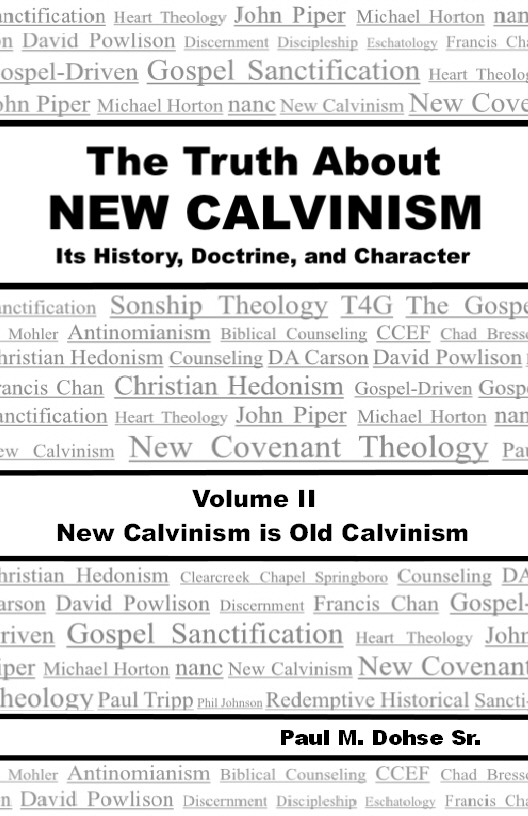
A TTANC 2 Freewriting post and book review of Dr. Robert Congdon’s latest booklet in his New Calvinist series.
Dr. Robert Congdon, according to his own bio, is an “international Bible teacher, conference speaker, author, and radio commentator on subjects relating to current trends in Christianity. He holds a B.S. in mechanical engineering from the University of Illinois, a M.Div. in theology from Grace Theological Seminary, and TH.D in theology from Trinity Theological Seminary.”
Dr. Congdon, according to him, was compelled to write a series of booklets on the New Calvinist movement because he has observed its ill effects on the church*; specifically, the dividing of churches and families, fear in regard to assurance of salvation, and a fatalistic mentality leading to a mindset of irresponsibility.[1]
Correctly, Dr. Congdon also charges that New Calvinism is “traditional Reformed/Covenant theology that has been repackaged in post-modern ‘wrappings.’” This is true in that both New Calvinism and Postmodernism interpret reality from a narrative standpoint. This is meta-narrative in regard to metaphysical narrative. New Calvinists believe that all of reality is a prewritten gospel narrative. Postmoderns believe the same thing, but there is a distinction in how we “enter into the plot,” or “make the Bible story our story—the story of every believer.” New Calvinists believe you participate by living the Christian life the same way you were saved, by faith alone. You then merely watch what unfolds in God’s pre-written narrative with a focus on how He is glorified by what happens. Life events merely make us better see’ers in regard to what “Jesus has done, not anything we do.”
Faith is an eye that can only see outward. Inner light depends on how we see the world, and the payoff is joy regardless of circumstances because circumstances are part of the narrative that increases our faith as we see what God is doing in the world. Also, inner light is a partial experience of the light we will actually experience in heaven. This philosophical** side of Calvinism will be addressed in volume III of The Truth About New Calvinism series.
The Postmoderns believe that you “enter into the plot” by doing what Jesus would do. Both camps see “entering into the plot” as an act of faith, but this brings a charge of works salvation by the New Calvinists against the Postmoderns because salvation is seen as a PROCESS and not a finished work, so what people do or believe in the middle between beginning justification and final justification determines justification by faith alone or works justification. The Postmoderns would cry foul by insisting that they are merely participating in works prepared ahead of time in the metaphysical narrative of reality. By participating, they are merely experiencing the works pre-wrought by Christ—the works are being done to us not by us.
____1______________________________________________________
* Throughout this book, “church” is used in regard to the institutional church, not the called out assembly.
** The metaphysic is a plenary progression of all things from the material to the spiritual in time.
New Calvinists believe the same thing. Seemingly, the difference is that Postmoderns believe participation is a choice which robs God of His sovereignty.*
As a short aside, Congdon’s mention of the divisive nature of New Calvinism needs to be addressed. The so-called “factious” man of Titus 3:10 (ASV) is interpreted in all English Bibles as pertaining to individuals [who question elder authority]. Actually, the Bible has little to say about individuals who cause strife. The overarching concern is groups who divide with a particular false doctrine. The actual word for this so-called divisive individual in Titus 3:10 is…
g0141. αἱρετικός hairetikos; from the same as 140; a schismatic:— heretic (the Greek word itself). AV (1)- that is a heretic 1; fitted or able to take or choose a thing schismatic, factious, a follower of a false doctrine, heretic.
Therefore, New Calvinism takes its place among one of the mountain peak concerns of the Scriptures: sectarian groups that divide with false doctrine (See Addendum A).
Congdon qualifies as the quintessential hybrid Calvinist. Often, he refers to himself as grammatical, premillennial, and dispensational. In the latest booklet of his New Calvinist series[2], he reiterates this and describes himself as a former four-point Calvinist. A grammarian interpretation of reality is mutually exclusive from Calvinism which he apparently now realizes because the theses of his newest addition to the series follows:
- New Calvinism is Old Calvinism.
- Both are false gospels.
- He misunderstood what the five points of Calvinism really represented.
- He is now a Biblicist, not a Calvinist.
His journey into researching New Calvinism has led him to this conclusion: (more…)

 Paul's Passing Thoughts
leave a comment