Pastor Todd Pruitt: When Progressive Justification is Too Pagan
 I am becoming more and more convinced: all theological debates within the institutional church boil down to a call for temperament in heresy. The Protestant/Catholic church is supposedly God’s preordained institution that ferries salvation wannabes from point A in justification to point B in justification. God has supposedly given the institutional church, His authority on earth to “bind and loose, and to kill and make alive.”
Yes, it simply boils down to this: you start at point A, and by submitting yourself to the authority of the institutional church, you receive grace gasoline to get your totally depraved junker to point B. The only place you can get grace gasoline is in the institutional church which is the ONLY place “sacraments” can be received which “impart grace” to the believer. By the way, “grace” does not always refer to salvation in the Bible. More times than not it refers to the love of God in action which of course includes salvation, but many other actions as well.
What are these “sacraments”? Answer: baptism (gets you into the grace club), the Lord’s Table, and public preaching of the word. Calvin and Luther stated this grace gasoline idea albeit by other words in no uncertain terms, and they are the spiritual heroes of the institutional church for that reason.
This brings me to an article written by Pastor Todd Pruitt of Covenant Presbyterian Church in Harrisonburg, Virginia. The article was published on the “Crosswalk” .com blog. The name of the blog in and of itself makes my point completely. Get it? “cross”… “walk.” You walk (Christian living) by the cross. You began by the cross (point A), and now there is only one place where you can get what you need to walk by the same cross that saved you in order to get to point B—the institutional church.
Pruitt has a complaint via the article: music in the church has become one of the sacraments that impart grace. It has been added to the list of grace gasolines. We can’t have that. That’s going too far with progressive justification heresy. C’mon people, let’s show some moderation here! If we go too far with these things, it is “pagan” according to Pruitt.
To make his point, Pruitt states that music has been made a mediator between God and man when there is only one mediator between God and man. Huh? I must ask then, what exactly are “ruling elders” in the institutional church? You know, the ones who have the “power of the keys to God’s kingdom.”
Says Pruitt in the article:
It is also ironic that while many Christians deny the sacramental role of those ordinances which the Lord Himself has given to the church (baptism and the Lord’s Supper) they are eager to grant music sacramental powers. Music and “the worship experience” are viewed as means by which we enter the presence of God and receive his saving benefits. There is simply no evidence whatsoever in Scripture that music mediates direct encounters or experiences with God. This is a common pagan notion. It is far from Christian.
Sigh. So let me get this straight: baptism (the rite of church membership according to Calvin), the Lord’s Table, and one he mentions elsewhere, “God’s word” (elder preaching of the gospel), imparts “saving benefits,” but his beef is that music is included in the sacramental list?
Reality check. We don’t gather together to obtain “saving benefits” to get us from point A to point B. That’s ancient pagan caste to the core. There are NO saving benefits left for God’s people—we received the full package when we believed unto salvation. We do not receive the Holy Spirit on an installment plan. An institution where “saving benefits” can be found is MEDIATION, period!
Organized religion with authority structure is a mediator—this is unavoidable. Christians are called on to fellowship together under one authority and to strive for the “one mind in Christ.” Individual gifts are the focus, and fellowship for the purpose of exploiting those gifts to the fullest is the primary purpose of Christian fellowship. Certainly, in striving for the unity of one mind in Christ, things will be done decently and in order, but Christians don’t meet together for the purpose of “worship” to begin with—that is a way of life. Christians don’t meet together for more salvation; they can’t get themselves anymore saved than they already are. Striving to be more “set apart” is not salvation.
The crux of paganism is spiritual caste which is a structured authority for purposes of mediation…and control. All of the white noise in the institutional church regards the question of balanced paganism.
paul
New Calvinist Terms/Phraseology

Glossary of Gospel Sanctification Terms
_______________________
“Finally, I must deprecate, and I do it in love, the use of uncouth and new-fangled terms and phrases in teaching sanctification. I plead that a movement in favor of holiness cannot be advanced by new-coined phraseology, or by disproportioned and one-sided statements–or by overstraining and isolating particular texts–or by exalting one truth at the expense of another– or by allegorizing and accommodating texts, and squeezing out of them meanings which the Holy Spirit never put in them”
~ JC Ryle
Apostle’s hermeneutic: A supposed pattern of interpretation used by the apostles that replicates redemptive-historical hermeneutics. However, despite numerous challenges from various writers, NCT proponents have never been able to articulate it.
Christian hedonism: Invented by John Piper in 1980. He believes people are completely driven by their desires. Therefore, change the desires and you change the person. Piper believes we can only change our desires by meditating on the gospel as seen in the Bible, with a goal of making Christ our deepest desire. Therefore, a Christian hedonist is one who seeks pleasure in God. He also believes that biblical imperatives only serve to make us dependent on Christ and cherish Him more (because they show us what Christ has done for us, rather than anything we are supposed to do) – we are powerless to keep the Law. He cites Romans 6:17 to make this point, and believes Christians are still “enslaved” to sin (pages 31, 32, essay, pages 89-98).
Deep repentance: Repenting of idols in the heart which are discovered by identifying the desires that they (the idols) produce. The idols can be discovered by asking ourselves “X-Ray questions.” Repenting of the idols (after we discover them) “empties the heart” which leads to us being filled with Christ. This is followed by automatic, joyful obedience because Christ is obeying for us (pages 30, 201).
Good repentance: Repenting of good works, or anything we try to do in “our own efforts” as opposed to yielding to Christ and allowing Him to obey for us. Paul Tripp says this will result in “new and surprising fruit.” Tim Keller teaches that repenting of good works is also necessary for an authentic conversion.
Heart theology: The study and theories of how we discover idols in our heart (essay, pages 145-148).
In-lawed in Christ: The Law is completely fulfilled in Christ because He obeyed it perfectly. Therefore, we have no need to obey it, nor does it have any role in sanctification.
Imperative command is grounded in the indicative event: All biblical imperatives illustrate the work of Christ, not anything God expects us to do. As Paul Tripp states it: All biblical commands must be seen in their “gospel context”(essay, pages 82-86).
Imputed active obedience of Christ: Christ’s perfect life imputed His obedience to us so we wouldn’t have to obey to be justified in sanctification (since there is no difference between the two according to GS proponents). This is also called monergistic substitutionary sanctification
(see new obedience ).
Intelligent Repentance: Another term for deep repentance.
New Calvinism: The expression of New Covenant Theology (NCT) and all of its tenets; heart Theology, gospel sanctification, Christian hedonism, and the redemptive-historical hermeneutic.
New Covenant Theology: Conceived in, or about 1980. The belief that the New Covenant abrogated all aspects of the Old, including, and especially, the Law. The New Covenant replaced the Law with a single “higher law of love”(page 56).
New Legalism: Synergistic sanctification. Any attempt to apply the word of God “in our own efforts.”
New obedience: The result of deep repentance – Christ obeys for us. We know that it is not us obeying in “our own efforts” because when it is Christ obeying through us, the obedience will always be experienced with a willing, joyful spirit, or Christian hedonism (pages 31,194).
Progressive sanctification: Ongoing justification, which isn’t a one time act, but is continually applied to us as needed. Some advocates of NCT acknowledge a daily “re-saving.” Paul Tripp says that Christians need a “daily rescue,” and cites Romans 7: 24 (essay, pages 124-129).
Redemptive church discipline: A redemptive process (rather than a process for resolving conflict between Christians) to eradicate sin in general. It is often used to convert individuals to monergistic sanctification. In many churches, this process has been assimilated into their counseling programs (essays; pages 159-172).
Redemptive-historical hermeneutics: Invented by the liberal theologian Johann Philipp in the 17th century and further developed by Geerhardus Vos. It makes NCT possible by supplying a prism that will always yield redemptive concepts from the text (essay, pages 177-183).
Reorientation of the heart: Replacing idols with right desires. This happens when we repent of idols discovered through interpreting desires, and replacing them with lofty visions of the gospel and Christ, which produces godly desire instead of idols which produce evil desires (page
146).
Rich typology: It’s so rich, that it doesn’t read like typology, but rather seems to be literal, being so rich. Example; “Israel” doesn’t really mean “Israel,” but is always a reference to Christ. God’s word really doesn’t mean “word,” or “Law,” but is also 100% synonymous with “the person of Christ who personifies the Law.”
What does that look like? If your leaders start using this phraseology, again, it’s a red flag. It’s an attempt to eradicate the implication that Christians are supposed to participate in the verb world. Instead of: “what should we do?” It’s: “what does that look like when Jesus is doing it for us?”
What did you want? The most utilized interpretive question among the X-ray questions used to find idols in the heart.
Word pictures: If your pastor starts using this phraseology, it’s a red flag. The insinuation is that the Bible writers were writing a gospel narrative / novel / story rather than a document containing specific ideas / instruction to be drawn from the text by evaluating grammatical construction and historical context.
X-ray Questions: Interpretive questions used to identify idols of the heart.
Controversy Among the Dead; What the Resignation of Jean F. Larroux, III Tells Us About the Institutional Church
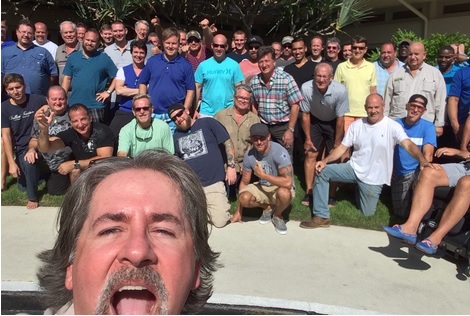 It has been brought to my attention that Jean F. Larroux, III has resigned as “pastor” from Southwood Presbyterian Church. Back when I thought the institutional church, that is, Protestantism and all of its various stripes was a victim of New Calvinism, I wrote something like thirty articles about the hostile takeover of Southwood by the New Calvinist machine.
Yes, if only those good Presbyterians understood what Larroux really believed, the Session would run him out of there and save God’s people from a wolf in sheep’s clothing. Well, I have done a lot of growing up since then.
I invested in the fight at the behest of Southwood members and other Presbyterian pastors because I was in the process of publishing The Truth About New Calvinism. I was sort of the go-to guy at that time for the “Old Calvinists.” I don’t know why Larroux is resigning, but a perusal of Southwood’s website clearly indicates that everything is business as usual. The church is presently “led” by fifteen, count them, fifteen “ruling elders.” It is unclear as to whether or not they are paid staff.
I have paid my dues in documenting Larroux’s outrageous doctrine and behavior, so no more time will be invested here. Suffice to say that Larroux was the topic of a whole chapter in the book “Sin Boldly” (a Luther truism) written by Cathleen Falsani. When Larroux was the overseer of a ministry in Bay St. Louis, Miss., he was known as “The Screaming Frenchman” and such is the title of chapter 8. I received an interesting email from someone who did ministry with him there in a leadership capacity, but refused to divulge the information. Why? Because by that time I realized it was not going to accomplish anything—it simply didn’t matter.
Furthermore, Larroux was recently invited by friend Tullian Tchividjian to speak at a Coral Ridge Presbyterian men’s conference where he furthered Calvin’s dark roast version of justification by faith which is really sanctification by justification through faith alone and faithfulness to the institutional church.
Listen, the institutional magic salvation bus supposedly going to heaven will continue to roll with the Jean Larrouxs’ onboard because…despite all of the fuss, what Larroux believes is at the heart of the Reformation gospel. It’s just that simple. There will always be quarreling and confusion on the way because many do not understand that reasoning from a grammatical interpretation of the Scriptures was contrary to Luther and Calvin’s interpretive approach.
We find a hint of that from this exchange:
Tullian Tchividjian was preaching on Friday night of the conference and his message centered around the need of grace and the preaching of the Gospel as vital in the lives of Christians. The message was moving, helpful and delivered with great passion. When he was done we sat in the pew following worship soaking in the reality of the Gospel. Brock turned to me and said, “We’re not crazy are we?” I said, “Well, we might be crazy, but we are not wrong…”
I had two emotions when Brock said that to me. The first was offense. I was offended. What did he mean, ‘we’re not wrong, are we?’ How dare he insinuate that what I had been preaching was wrong. “WHAT A JERK!” said my heart. But then I thought about his statement, our history at Southwood, the incessant chatter that said over and over again that we had taken grace ‘too far.’ Brock wasn’t making a statement of criticism. He was making a sigh of relief. It was easy to begin to believe the blogs and sidebar comments, but hearing the same exact message from a different voice in a different venue was not only affirming, but very reassuring.
And there you have it my friends; the institutional church, regardless of the stripe, is made up of Progressive Justification Light and Progressive Justification Dark, and sometimes there is disagreement in regard to the essence. If you are old enough like me, you remember the old Miller Light commercials, “Less filling! ‘No, great taste!’” And so it goes, “Not enough justification! ‘No, too much justification!”
This false gospel has circumvented a vast doctrinal body under the auspices of Christian living in sanctification. We must take back that doctrine, but it will only be accomplished by the laity fellowshipping in home fellowships apart from the institutional church.
Let the dead bury their own dead.
paul
A Review of Dr. Jay Adams’ Message to the Mid-America Baptist Theological Seminary Student Body
On February 24, Dr. Jay Adams was the presenter for the student chapel service at Mid-America Baptist Theological Seminary. The message was about 25 minutes long and can be observed here: https://vimeo.com/120670699. The get to the point, make the point, and get out of town approach has become sort of a calling card for Adams in recent years, perhaps due to his age (86). On the other hand, he has written articles on the importance of only using the amount of words necessary to make a point.
The practice of reviewing books and sermons is something I gave up about a year ago because this ministry is past evaluating symptoms, and is focused on resolving the problem. For all practical purposes, it can be assumed that all Protestant sermons are going to be driven by progressive justification, Luther and Calvin’s false gospel. The Reformed deny this; apparently, in 3.14 of his Institutes, Calvin didn’t really mean to say that justification is progressive when he said it is progressive.
If we would only read every literary drone Calvin ever wrote we would understand that “progressive” really doesn’t mean “progressive” in the progressive sense. Justification and progressive sanctification are “never separate, but distinct.” Distinct? How? Well, sanctification is “justification in motion,” or as the brilliant Dr. Lou Priolo states it, “justification is always running in the background” like your Windows program is always running in the background. Thanks Lou. As one Reformed pastor told me, “Any idiot should know that the basis of something isn’t necessarily a progression.” And like Voddie Baucham told me personally, “That road out there is done, but we still use it.” In the exchange, something became very apparent to me: Voddie is a very large man, and not well acclimated to being challenged, so I left it there.
In other words, thou ignorant lay person, thou grasper of material shadows, something “running” isn’t really progressing when you see it in Luther’s “gospel context.” It takes a real metaphysical idiot to think a cat that is running is progressing. Just shut up and put your money in the plate, thou artisan.
So, why write a review on Dr. J’s message at Mid-America? Because he is one of the few pastors, if not the only one left in the institutional church, that is different. Apparently, Mid-America is friendly to Dr. J’s counseling construct and respects him enough to invite him to speak to those who are charged with indoctrinating. This means I must see Mid-America as different from all other seminaries: they are at least road kill that is still moving.
Furthermore, I believe Adams fathered the only real revival that the institutional church has ever seen since the Reformation. And excuse me, but a civil war isn’t a revival, and people executed for treason are not martyrs even if executed by a church state. A heretic executed by a heretic doesn’t make a martyr. What about the “Great Awakening”? That was spawned by the ideology of the American Revolution, not European political refugees. Sorry.
Even though Adams’ groundbreaking biblical counseling construct didn’t go far enough, it was predicated on the idea that Christians can actually do something along the lines of learn and do. Even flirting with the idea that Christians are empowered by obedience unleashed life and light in this Protestant Dark Age. In one of the most profound historical ironies of all time, the movement that returned the institutional church to authentic Protestantism began in the same year that Adams’ groundbreaking book Competent to Counsel was published. As both movements grew at breakneck speed, a contention between the two camps was inevitable.
The contention led to the unmerciful disparaging of Adams who has unfortunately given his entire life to the institutional church. All of his accomplishments are prefaced with the “but…second generation counseling’” from narcissistic, Platonist, psychopathic liars dressed up in Bible verses. And that’s not enough words, or the best words to describe them, but are the most tempered ones. Remember, his crime was to suggest that Christians can do something beyond gospel contemplationism.
I witnessed firsthand the results of the rise and fall of “first generation biblical counseling.” I saw the before and after at a NANC counseling center where I was an elder. The difference between first generation biblical counseling and second generation biblical counseling is the difference between a counselee handing the counselor a razor blade that was going to be used for suicide and a counselor drawing a map of the counselee’s life and then saying, “Here is where you are located in the gospel narrative” lest imperatives be used in counseling. I hope the Mid-America kiddies knew what they had sitting in front of them on Tuesday, but I doubt it. I am sure they would think that my description of second generation biblical counseling is the overuse of exaggerated words. That’s unfortunate. If people think there is something they can do about their situation, and even better yet, that God will help them, we call that “hope.”
And that brings me to the actual content of the message. Adams expounded on Ezra 7:6 and 10: “this Ezra went up from Babylonia. He was a scribe skilled in the Law of Moses…For Ezra had set his heart to study the Law of the Lord, and to do it and to teach his statutes and rules in Israel.” The message was pretty straightforward; as elders, they are to be diligent to learn God’s word through independent study, live the word out in their own lives, and teach others the same. This is no different on any wise in comparison to what Jesus said in His introduction to the Sermon on the Mount.
The fact that an 86-year-old man of God is still actively preaching is in and of itself very powerful, and the need for complete follow-through with the word of God powerful as well, but in our day and age, the message, especially in that venue, lacked additional words.
HOW should one in our day study the word of God? Is every verse about justification? And if sanctification is not the “running” part of justification, how then should our Bibles be read and studied? Sure, seminary students should study the word of God for the right motive, viz, life application, but what do we mean by “life application”? According to the leading evangelicals in our day, we are to only expound on the word of God, and…don’t miss this, “the Holy Spirit applies it” which implies that we don’t actually do the word, it’s done for us. “It’s NOT about what you do, it’s about what Jesus has done.” Do we apply the word ourselves with the help of the Spirit, or are we sanctified by contemplative justification?
In addition, these are clarifications that determine how we will teach others to apply the first two.
My conclusion. Anytime Adams is allowed to come out and play in the institutional church, road kill is closer to not being completely dead, and there is a chance that they will learn to look both ways before they cross the road, but more words are needed.
paul

 Paul's Passing Thoughts
leave a comment