The Potter’s House: Romans 14:2-12; Authority’s Assault on Unity
Originally published December 21, 2014

Last week we talked about the mystery of the gospel. The mystery is God’s intention to bring Jew and Gentile into one body by the Spirit. Undoubtedly, this posed significant unity challenges because of the diverse cultures. When the Romans inquired of Paul as to whether or not they should bother associating with Jews due to these cultural differences, it sent Paul scrambling for his writing utensil because that issue is one of the core values of the gospel itself.
The bone of contention was dietary laws and the observance of days which would have been deeply entrenched traditions for the Jews. In addition, there were a plethora of issues among the Jews concerning the decadent culture of the Gentiles. Some of these issues included the eating of meat and its preparation according to Old Testament law. For sure, pork was out, but there were other issues, apparently, with meat sacrificed to idols and then sold on the open market at a reduced price. Hence, because what had been done with meat would have been ambiguous in many cases as far as its source and preparation, it’s possible that many Jews decided to play it safe and become vegetarians.
As far as convictions concerning the observance of days in this transition from the old covenant to the new, there would have been many days sacred to the Jews that would have had little significance among the Gentiles. So, what is Paul’s solution to these differences for purposes of fulfilling the mystery of the gospel?
In verse 2, Paul identifies the two parties: Gentiles who believe they can eat anything, and the weak Jew who understandably was not yet up to speed on the mystery of the gospel in regard to the law. Also consider, much like today, the Jews had been dumbed down in regard to Scriptural knowledge. The leadership of that day replaced Scriptural truth with the traditions of men. Specifically, like today, the integration of Gnosticism with Scripture saturated Jewish thought and religion.
In verse 3, Paul defines the attitudes that fueled the division between Jew and Gentile: the ones who eat should not “despise” the ones who don’t eat; i.e., the Jews, and the Jews should not “judge” the ones who eat according to what? Right, the law. And why? Because God had come to receive who? Right, the Gentile. Paul shifts his focus to the Jewish responsibility of accepting the ones God received into the one body regardless of the fact that they did not keep or regard much of the Old Testament law. This would have been a really challenging transition of thought for the Jew. But the main point here is that the Jew had a tendency to “judge” because they had the what? Right, the law.
The way Paul addresses this (v. 4) towards the Jew is very interesting. In that culture or the Jewish culture as well, it would have been very uncouth to tell another person’s slave what to do. It would have been absurd. In ancient times there were many types of slaves in regard to social strata, but let me use the types of slaves that were more like today’s employee as an example. It would be like a manager from Wendy’s walking into a Kentucky Fried Chicken and telling those employees what to do. Or, closer to the point Paul is making, openly criticizing them in some way. The absurdity demonstrated in this illustration falls a little short because the servants Paul is talking about only served their own masters whereas in my illustration you could argue that the Wendy’s manager was a customer at KFC and had a right to complain about something. But slaves of Paul’s day only served one master. Christ used the same kind of illustration Paul is using here when he said you cannot serve two masters.
So, what Paul is saying is that ALL Christians, Jew and Gentile, only have one master, Jesus Christ.
4 Who are you to pass judgment on the servant of another? It is before his own master that he stands or falls. And he will be upheld, for the Lord is able to make him stand.
“It is before his own master that he stands or falls” is a reflection of the slave culture. Typically, slaves only answered to one master. This is interesting to think about in our day. First, like most of the New Testament writings, and for that matter the Old Testament writings as well, the letter is addressed to the whole group. It also regards the problem with arguing over what Paul called, “opinions.” In all of this, where is elder involvement discussed? Thirdly, Paul is about to teach us that no one has a right to judge you or others in the Christian realm because everyone answers to one master and one master only—Jesus Christ.
The more one studies the Scriptures independently, the more one notices that elders (or pastors) are conspicuously missing. The context of Romans 14 makes the absence of elders odd in our minds because of what we have been taught about “elder authority.” We see this elsewhere concerning conflict among God’s people. In Matthew 18:15-20, again, elders are conspicuously missing. Often we hear the call to be willing to “place ourselves under the authority of godly men.” What I understand here is that we only have one master. Salvation is not in view here, the authority to pass judgment on another is what is in view. What is in view is a judge who is able to make the Christian “stand or fall.”
What becomes more and more clear is the fact that “pastor” or “elder” is just another gift and has NO element of authority. It has even been suggested that elders are optional for home fellowships where Christians gather together for edification and fellowship. The suggestion is that 1Timothy 3:1 could refer to a fellowship’s desire to have an elder and not necessarily an individual’s desire to be an elder. Practically, this makes sense because wherever God’s people meet there may not be any elders. What I am saying follows: in geographies where there is no sound gathering of professing Christians, saints are not forced to fellowship there because eldership validates an assembly. Clearly, it can be surmised that some 1st century Christian fellowships had elders and others didn’t.
But at any rate, elders are not lords (1Pet 5:3), they are leaders. Even the apostle Paul stated that he was to be followed only as long as he followed Christ (1Cor 11:1).
Putting all of these ideas together, I like the rendering of 1Timothy 3;1 by the Complete Jewish Bible (CJB):
Here is a statement you can trust: anyone aspiring to be a congregation leader is seeking worthwhile work.
Elders lead by example. I believe their oversight is primarily a proper interpretation of the Bible. They are ministers of the word (Acts 6:4). We only have one Lord—Jesus Christ. The apostle Paul continually pointed to the authority of God’s truth as the only authority:
Galatians 1:8 – But even if we or an angel from heaven should preach to you a gospel contrary to the one we preached to you, let him be accursed.
1Corinthians 3:21 – So let no one boast in men. For all things are yours, 22 whether Paul or Apollos or Cephas or the world or life or death or the present or the future—all are yours, 23 and you are Christ’s, and Christ is God’s.
Paul sets forth another rule in verse 5: Each believer should be persuaded (KJV) in their OWN mind. There needs to be space given for everyone to grow in wisdom. See here that we don’t believe certain things just because certain people believe it. We are to be persuaded in our OWN minds through the continued study of God’s word. PERSUASION is a major theme in the New Testament. The idea of persuasion is often translated “obey” in English translations for some incredibly strange reason. Listen, “obedience” is not the heavy emphasis among believers, persuasion is the key. Here is the word for persuaded in verse 5:
g4135. πληροφορέω plērophoreō; from 4134 and 5409; to carry out fully (in evidence), i. e. completely assure (or convince), entirely accomplish:— most surely believe, fully know (persuade), make full proof of. AV (5)- be fully persuaded.
Listen, before I develop this important aspect of persuasion, I am going to jump ahead to Paul’s next principle of motive in verse 6:
The one who observes the day, observes it in honor of the Lord. The one who eats, eats in honor of the Lord, since he gives thanks to God, while the one who abstains, abstains in honor of the Lord and gives thanks to God.
Giving room for motive is huge in our day because we are all so dumbed down theologically. Admittedly, these are difficult waters, but if the home fellowship movement is going to work, we need to chill out on the dogma thing and emphasize the fact that we all need room to grow in God’s word. What we are looking for is honest seekers of truth—people who are persuaded by truth and the one mind of Christ that brings unity. Basically, a genuine love for the truth. That’s THE truth not A truth.
Meanwhile, Paul is saying that the spiritually weak have the right motives and are thankful to God. Other than a love for the truth, even the spiritually weak will have a spirit of thankfulness.
Probably, the beginnings of fellowship should begin with a fundamental agreement on the gospel of first importance and the sufficiency of God’s word. From there, you study the Scriptures together and let all be fully persuaded in their own minds. It boils down to this…
Does the person love THE truth? (2Thess 2:10).
Now, back to developing verse 5. I am going to develop this point by looking at Hebrews 13:17:
Obey your leaders and submit to them, for they are keeping watch over your souls, as those who will have to give an account. Let them do this with joy and not with groaning, for that would be of no advantage to you.
As we can ascertain so far, no one among God’s people can demand that you believe anything—only Christ has the authority to demand that you believe something. Otherwise, it would have been like passing judgment on someone else’s slave which was an absurd notion in that culture. In contrast, what is in vogue in our day is this whole idea of “putting yourself under the authority of godly men” lest you be a spiritual sluggard. A verse often used is Hebrews 13:17.
The word for “obey” is the following word:
g3982. πείθω peithō; a primary verb; to convince (by argument, true or false); by analogy, to pacify or conciliate (by other fair means); reflexively or passively, to assent (to evidence or authority), to rely (by inward certainty):— agree, assure, believe, have confidence, be (wax) conflent, make friend, obey, persuade, trust, yield.
The idea is to be persuaded, or following as a result of being persuaded or convinced. The same word is used about 50 times this way in the New Testament. Here is just one example:
Matthew 27:20 – Now the chief priests and the elders persuaded (peithō) the crowd to ask for Barabbas and destroy Jesus.
There is a Greek word for outright obedience, it is…
g5219. ὑπακούω hypakouō; from 5259 and 191; to hear under (as a subordinate), i. e. to listen attentively; by implication, to heed or conform to a command or authority:— hearken, be obedient to, obey.
Here is one example of about 20 in regard to how the word is used in the New Testament:
Matthew 8:27 – And the men marveled, saying, “What sort of man is this, that even winds and sea obey (hypakouō) him?”
Again, among fellow Christians, we don’t demand obedience, we persuade. Elders lead, but they do not have Christ’s authority. You obey Christ no matter what. Such is not the case with elders or pastors. Notice in all of chapter 14, the key to unity is not the authority of leaders.
Continuing on…
7 For none of us lives to himself, and none of us dies to himself. 8 For if we live, we live to the Lord, and if we die, we die to the Lord. So then, whether we live or whether we die, we are the Lord’s. 9 For to this end Christ died and lived again, that he might be Lord both of the dead and of the living.
Honestly, I am not entirely sure of the point Paul is making in verses 7-9. There is even the transition “For” that links this idea to the previous thought in verse 6, but it’s like Paul just parachutes this idea in here out of nowhere. Each sentence in verses 7-9 link together with verse 6 by a conjunction, “For,” “So then.” Somehow, Christ being the Lord of those who have passed on figures into the equation, but I simply don’t know how.
At any rate, Paul is back to the main point with verses 10-12:
10 Why do you pass judgment on your brother? Or you, why do you despise your brother? For we will all stand before the judgment seat of God; 11 for it is written, “As I live, says the Lord, every knee shall bow to me, and every tongue shall confess to God.” 12 So then each of us will give an account of himself to God.
This is clear, we will all give an account for ourselves regarding what we have done as Christians in the body (1Cor 3:10-15, 2Cor 5:10). Therefore, do not judge a fellow believer who is doing his/her best to honor God with what knowledge they presently have.
Second, let them be convinced in their OWN minds.
Third, stay focused on glorifying God in regard to the purposes of the mystery of the gospel.
Next week, we will look at the consequences of not doing this: causing a fellow Christian to “stumble.” Also, how can an authoritative demand for obedience in contrast to persuasion contribute to this stumbling?
Next week: “Authority’s Stumbling Block.”
 Related:
The James MacDonald White Paper

Post 1 The James MacDonald White Paper: “2 or 3 Elders in Christ’s Name”; Post 1 of 20
Post 2 The James MacDonald White Paper: “Why Not Name the 13 Accusations?” Post 2 of 20
Post 3 The James MacDonald White Paper: Repost from the Elephants Debt .com; Post 3 of 20
Post 4 The James MacDonald White Paper: “Why This White Paper?” Post 4 of 20
Post 5 The James MacDonald White Paper: AUTHORITY, and the New Testament Church Model; Post 5 of 20
Post 6 The James MacDonald White Paper: “MacDonald’s State of Mind”; Post 6 of 20
Post 7 The James MacDonald White Paper: “How Would Jesus Preach?” Post 7 of 20
Post 8 The James MacDonald White Paper: Cult 101; Post 8 of 20
Post 9 Church Historian John Immel Weighs In on MacDonald’s “Vertical Church”; Post 9 of 20
Post 10 HBC Attempts to Expunge Infamous Church Discipline Video, Files Complaint Against PPT, Post 10 of 20
Post 11 HBC Attempts to Expunge Infamous Church Discipline Video, Files Complaint Against PPT, Post 11 of 20
Post 12 The James MacDonald White Paper: Hypocrisy on Steroids; Post 12 of 20
Post 13 Finally! The Full Dope on Counter Notification: Followup on Posts 10 and 11; Post 13 of 20
Post 14 The James MacDonald White Paper: To HBC Parishioners, “Does This Sound Familiar?”; Post 14 of 20
Post 15 The James MacDonald White Paper: The “Vertical Church ‘Experience'”; Post 15 of 20
Post 16 The James MacDonald White Paper: The New Calvinist Big Fat Lie; Post 16 of 20
Post 17 The James MacDonald White Paper: James MacDonald is Just a Symptom; Post 17 of 20
Post 18 The James MacDonald White Paper: Why JMac, Like All Authentic Calvinists, is a Liar; Post 18 of 20
Post 19 The James MacDonald White Paper: Question and Answer; Post 19 of 20
Post 20 The Elephant’s Debt .com: MacDonald the Gambling Man; Post 20 of 20
“Grace” is NOT Salvation, and Why Justification is the Antithesis of Sanctification
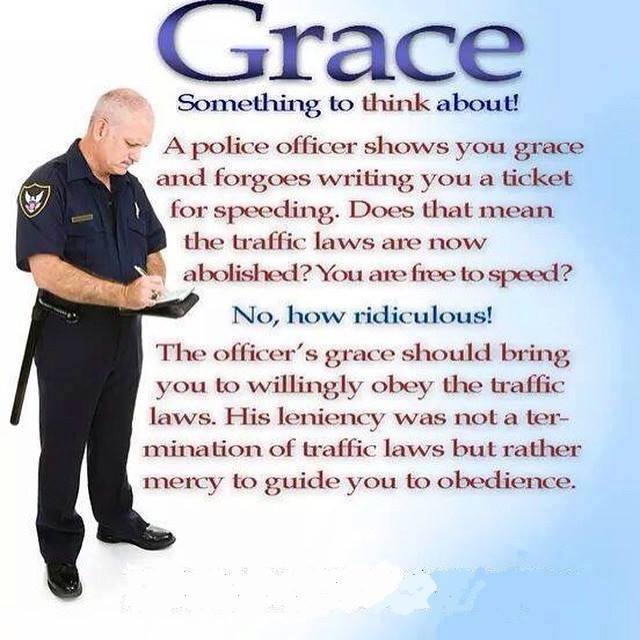 If every verse in the Bible is not about justification, but Protestants believe that, and they do, this will redefine the Bible from cover to cover, and it does. The result is a completely upside down gospel.
For example, the internet placard that inspired this post. How does it define “grace”? Obviously, it defines grace as Christians not getting the punishment they deserve from the “righteous demands of the law.” This “mercy” “guides” you to obedience. But what “obedience”? Well, let me quote the pastor of the person who posted the placard: “You don’t keep the law by keeping the law.”
“You don’t keep the law by keeping the law.” What does that mean in conjunction with “mercy” leading us to this “obedience.” And, do Christians still need “mercy”? According to Protestantism, “yes.” I understand that some Protestants understand this to mean that we are motivated by God’s mercy when we don’t get the punishment that we deserve, but that is a watered down version of the authentic Protestant gospel. And anyway, true Christians no longer need mercy because we are no longer under condemnation; there is “no condemnation” for Christians. But more on the significance of that later.
The crux of the placard and the idea that Christians still need grace is well defined by some comments that were posted in regard to the placard. It starts with the idea that “grace” is synonymous with biblical justification or salvation. And since we still need “mercy” from the law as Christians, we must know how to obtain this mercy leading to keeping the law by not keeping the law. The endeavor is twofold, and exemplified in the following aforementioned comments:
MERCY is when judgement is constrained, and hence is what is being illustrated in this story by the officer letting you off the hook. But GRACE is not that judgement was constrained, but that it was conferred! It’s the picture of the officer, though acknowledging that you were guilty of trespassing the speed limit, determines that he’ll let you go on the premise that he PAID the ticket for you!
And…
What if the police officer decided to jump in the car with you. So every time you drove he’s sitting next to you and just keeps saying don’t worry about speeding I have fulfilled that law. [Viz, I kept the law for you] I’ll whisper to your heart and let you know if you are heading towards the speed limit. I just want to sit and chat with you and get to know you so well that you never ever want to speed again. Because you are forgiven and I love you.
If you think these are armchair theologians, think again. What they are saying is a mirror image of how two heavyweight Protestant theologians stated it in the following video:
What’s the idea here? Since Christians still need mercy from the righteous demands of the law, they must continually receive it by returning to the same gospel that saved them. “Grace” is defined as justification/salvation, so obviously, we must continually return to the same gospel that saved us. To most professing Christians in our day, the idea that Christians still need grace and mercy is a no-brainer and is pontificated with the often-heard, “We must preach the gospel to ourselves every day.”
What is that gospel? It is twofold as exhibited by the two comments. Christ died for our sins which takes care of the penalty of sin (first comment), and then He kept the law perfectly so that His righteousness (perfect obedience) can be imputed to our Christian life. Therefore, as Christians, we continually go back to the salvation well for forgiveness and a righteousness that is not our own. That’s how we keep the law by not keeping the law: Jesus keeps it/kept it for us. The same gospel that saved you also sanctifies you.
Why is this an egregious false gospel? First, we are not under the law for justification. There is no law for Jesus to keep for us. Jesus didn’t come to keep the law for us, He came to end the law… for Justification (Romans 10:4). The fulfilling of the law by Christ does not refer to Him keeping the law perfectly so that His obedience can be imputed to our sanctification.
And “grace” is NOT justification or salvation. “Grace” defines why God saved man; it’s an act of love that expects nothing in return, and of course, we need this same kind of love in our Christian lives, but that doesn’t make our sanctification a progression or specific expression of justification. The love of God is not applied to justification in the exact same way it is applied to our Christian lives (sanctification). Grace, as the reason God justified us (His unmerited love) expects nothing in return because man is utterly unable to justify himself.
However, God also displays His love (“grace” also means “help”) in regard to the purpose for which he saved us: good works…that we actually do in order to please Him. God doesn’t love Himself through us—we are not mere conduits from which God loves Himself; we in fact love God or we do not belong to Him. God’s love towards man in justification has a different application in sanctification. In the former man is completely helpless, in the latter man needs help. Both expressions of love are “grace.”
This is demonstrated by Ephesians 2:8-10…
8 For by grace you have been saved through faith. And this is not your own doing; it is the gift of God, 9 not a result of works, so that no one may boast. 10 For we are his workmanship, created in Christ Jesus for good works, which God prepared beforehand, that we should walk in them.
Grace, or charis, is a Greek word that means “a joyful benevolence.” Actually, the word has a wide variance of applications including, “favor,” “love,” “help,” “dignity,” etc. To define “grace” as synonymous with salvation is inaccurate; grace is the reason God saves, but it is also the reason God does many other things as well. Grace is also the reason that God is our advocate, comforter, co-laborer, and helper in our Christian life. In regard to our Christian life (sanctification), these words are used interchangeably (Heb 13:6, Jn 14:16 Rom 8:26).
Note verse 8: grace is the reason God saved us (John 3:16), but salvation is “the gift.” It is not the result of “works” (v.9), but the result of grace. This is where we have a radical dichotomy between justification (gift) and sanctification (reward). The two are mutually exclusive, and “grace” does not bridge the two. Gift and reward are mutually exclusive. In fact, Hebrews 6:10 says that God would be “unjust” to forget our works in sanctification. Why? Because our works in sanctification is an earned reward that deserves to be recognized. There is no other conclusion that can be drawn from that passage.
The word for “works” in verse 9 is ergon which according to Greek scholar Spiros Zodhiates “stands in direct antithesis” to charis (grace) and the two words are “mutually exclusive” (The Complete Word Study Dictionary, AMG Int. 1992, p.1469). Yet, verse 10 indicates that good “ergon” or works is the purpose of salvation. Salvation is caused by grace, but works is the purpose of salvation. This is why justification and sanctification are mutually exclusive and not bridged by grace. One result of grace is the gift of salvation while the result of the other is reward. Gift and reward cannot be intermingled.
The type and kind of works were predetermined, but we are responsible to “walk” in them with God’s help. In justification, God is a savior; in sanctification, God is a “helper.”
Notice how the professing Christians of our day are obsessed with SIN. Because we are still supposedly under law and need the same “grace” that saved us, our Christianity is obsessed with failure and our dire need for more and more mercy. Life is lived under the cloud of the law, and the focus is how often the holy policemen in the sky does not write a ticket of condemnation.
A pity, because we are not under law and are rather under grace which means we seek to obey God’s law in love. The focus isn’t failure so that we can supposedly glorify God by returning to the foot of the cross, the focus is love which “covers a multitude of sin” (1Pet 4:8). We would sin a lot less if our focus was love, not the expectation of failure under the heavy burden of the law. We are not under the law of sin and death, we are under the law of the Spirit of life (Rom 8:2). We strive to obey that law in love as the primary focus of our life; we dwell on love, not sin.
Moreover, if we glory in more and more mercy that saves us from the law that we are supposedly still under, that will result in a relaxing (lyō) of the law in sanctification that Christ warned us about (Matt 5:19) because after all, we can’t keep it perfectly anyway.
As Christians, our sin is family sin against our Father and can bring chastisement, but it is not sin under the condemnation of the law that requires a return to the same “grace” that saved us. That’s a false gospel. That’s under law, NOT under grace.
So, you do in fact keep the law by keeping the law, because that’s love.
paul


 Paul's Passing Thoughts
leave a comment