What Your Sanctification Says About Your Justification: Is Your Gospel True or False?
 Originally posted February 27, 2015
“The law is the standard for love, not justification. In all of the aforementioned systems of sanctified justification by works, faith doesn’t work because it can’t lest salvation be lost. In the Christian life faith works because it can for the sake of love without condemnation.”
“Knowing that justification is a settled issue that has nothing to do with the law anyway, the true Christian only sees law-keeping as an opportunity to love. Christians not only have the anthropologic law of conscience written on the heart, the new birth writes the Bible there as well. In other words, we love the law.”
“Obviously, those who must focus on faith alone works in order to remain justified cannot focus on aggressive obedience to the law that defines love.”
What do you believe about salvation? Your Christian life will tell you. Therefore, the parable of the talents in Matthew 25:14-30 should not confuse us. The “wicked” servant was not cast into outer darkness because he didn’t put his talents to work, but rather what he thought it meant to be a servant. In other words, in order to be saved, you need to know what a Christian is. That should be fairly evident.
Do you live your Christian life by “faith alone”? That is a statement in regard to what you believe about salvation, or what happened to justify you, viz, justification.
This is not complicated. Don’t complain that I am making your touchy-feely “simple” gospel a theological treatise. I am sure you concur that some Bible words have to be understood in order to be saved. The Bible splits humanity into two categories: saved and unsaved, i.e., “under law” or “under grace” (Romans 6:14).
“Under law” is the biblical nomenclature for the unregenerate lost. Under law means that sin rules you. Not in a plenary sense, because man’s conscience and fear of punishment from civilian law restrains people. Yet, they are under the condemnation of God’s law and every violation is documented. Unless they are saved, they will be judged according to their works in the final judgment. Though some who followed their conscience more than others will receive a lesser condemnation, it is still eternal separation from God. They are under law, and enslaved to sin. The last judgment DOES NOT determine justification; it ONLY determines the degree of eternal condemnation. It doesn’t determine justification; it only determines the wages of sin.
Moreover, sin uses the condemnation of the law to provoke people to sin. Primarily, sin uses desires to tempt people, but sin’s incentive is the law because it condemns. Sin lives for the purpose of condemning people, and uses desire to get people to sin against God’s law. This leads to present and eternal death. Sin’s desire is to bring death. When the Bible speaks of “the desires of the flesh” it is referring to instances when the flesh is serving the desires of sin.
The flesh can also be used to serve the desires of the Spirit (Romans 12:1). The flesh has NO desires; it is used by the dweller for good or evil purposes. We will either use our bodies to serve the desires of sin or the desires of the Spirit. Of course, people have their own desires, but unfortunately, the unregenerate are guided by the desires of sin. They assume sinful desires are their own desire which is true. In contrast, sinful desires are not part and parcel with the regenerate soul.
Said another way: among the lost, the desires of sin are very much the same desires possessed by the individual who are indifferent to the law of God. A desire for God’s law is absent while their life is continually building a death and condemnation dividend. Some of that dividend is paid in this life until the full wages of death are paid at the final judgment.
Under grace is not void of law. The law (same as “Scripture” or same as “Bible”) has a different relationship to the saved, or those under grace. A literal baptism of the Holy Spirit takes place, as symbolized in water baptism, which puts to death the old person under law and resurrects the new person under grace. The saved person is now a new creature created by the Spirit of God. The person under grace is literally born of God—he/she is God’s literal offspring.
Therefore, the old person is no longer under the condemnation of the law in the same way a dead person cannot be brought under indictment for a crime. Consequently, the motivation for sin is gone. The power of sin is the law’s condemnation that leads to death (1Corintians 15:56, 57). In addition, the person under grace has been given a new heart that loves God’s law and its way of life. The book that could only bring death is now a book that brings life. Either way, it is the Spirit’s law; He uses it to condemn those that are under it, or uses it to sanctify those who are under grace (John 17:17).
THEREFORE, how you see the law determines what you believe about salvation. If you believe that you can somehow obey the law in a way that unwittingly seeks to be justified by law-keeping, you are still under law. If you believe justification is defined by perfect law-keeping, you are still under law. Those who believe this also believe they need a salvation system that filters all their works into a category of faith alone. The Christian life is categorized or departmentalized into works that attempt to be counted for justification and faith alone works that qualify as “living by faith alone.” Do not miss the point that this also includes abstaining from certain things that aren’t necessarily sin as defined by the Bible.
Yes, hypothetically, a person would need to keep the law perfectly to be justified by the law, but that doesn’t make perfect law-keeping the standard for righteousness. If that were the case, the law is a co-life-giver with the Holy Spirit, and a death would not be necessary. We are justified APART from the law—law has NO part in justification. The Bible defines justification, but it’s not a standard of justification (Rom 3:21, Gal 2:19, 4:21). Law-keeping by anyone does not justify.
If one is trusting in a system that fulfills the law for justification, particularly if it calls for not doing something in order that the law is fulfilled in our place, that is works salvation through some kind of intentionality whether passive or active. These kinds of systems are always indicative of being under law rather than under grace. One such system that has several variances calls for doing certain things or not doing certain things on the Sabbath which can be Saturday or Sunday depending on the stripe of system. If you follow the system on the Sabbath, all works done by you during the week are considered to be by faith alone.
In Reformed theology, particularly authentic Calvinism, contemplation on your sin leading to a return to the same gospel that saved you imputes the perfect law-keeping of Christ to your life. Notice that a fulfillment of the law is required to keep you saved, but we do faith alone works in order that Christ’s perfect law-keeping is imputed to our account. The problem here is that a fulfillment of the so-called “righteous demands of the law” is the standard for justification. Hence, clearly, this keeps so-called “Christians” UNDER LAW. In addition, a so-called faith alone work is still a work.
Not so with under grace. We are now free to follow our new desire to obey the law out of love without fear of condemnation. The law is the standard for love, not justification. In all of the aforementioned systems of sanctified justification by works, faith doesn’t work (or love) because it can’t lest salvation be lost. In the Christian life (sanctification) faith works because it can for the sake of love without condemnation (Galatians 5:6).
Knowing that justification is a settled issue that has nothing to do with the law anyway, the true Christian only sees law-keeping as an opportunity to love. Christians not only have the anthropologic law of conscience written on the heart, the new birth writes the Bible there as well. In other words, they love the law. Obviously, those who must focus on faith alone works in order to remain justified cannot focus on aggressive obedience to the law that defines love.
This is exactly what the books of James and 1John are about. Faith is not afraid to work because there is no condemnation. Faith without works is dead, “being alone” (James 2:17 KJV).
Are you in a religious system that propagates faith “alone” in the Christian life? Your faith is not only dead, it speaks to what you believe about justification. You believe justification has a progressive aspect and is not completely finished. Secondly, you believe the law has a stake in justification. Thirdly, your system categorizes works as faith alone works (an oxymoron of sorts) or works that are unfiltered in some way and therefore are efforts to “self-justify.”
If you believe the right gospel, you know that it is impossible to unwittingly partake in an endeavor to justify yourself. It’s a metaphysical impossibility—it’s not in the realm of reality. No false religion teaches that you earn your justification by perfect law-keeping—there is always a system that prescribes sanctified do’s and don’ts that in turn fulfill the law for you, otherwise known as “the traditions of men.”
It’s the fallacy of faith alone works for justification. But any work for justification is justification by works whether doing nothing (abstinence is still doing something), something passive (contemplationism or prayer is also a work) or anything active.
Law and justification are mutually exclusive, and true faith is “faith working through love” (Galatians 5:6). Faith works because there is no fear in love (1John 4:18). Don’t be like the servant who was afraid and hid his talents in the ground. Christ said it best:
“If you love me, keep my commandments.”
paul
Hey Bristol, It’s Not About the Law—It’s About Love
 The present 20-40-something generation indoctrinated by the Protestant institutional church keeps on doin’ its thing. Yes, this is the “sinners saved by grace” generation. These are sinners that love on their own terms.
What brought all this up? My present midlife blogger crisis. In 2009 when I started blogging, a Protestant scandal only came along once a year or something like that. What made that blog worthy is that Protestants are supposed to be one-up on the Catholics as far as righteousness goes. Everybody knows Catholics do anything they want to and then go to confession afterwards. Protestants have always been deemed as above such religious wantonness.
Now blogging has become like children who get chocolate too often. It’s no longer a treat; it’s a common occurrence, and the chocolate just doesn’t melt in one’s mouth like it used to. I have watched trending Protestant scandals increase to bi-monthly, monthly, weekly, and now approaching daily. Yawn, we sit at the dinner table and ask the complaining rhetorical question to momma blogger: “Chocolate again?”
It’s hard medicine, but the only thing to blog about now is the why? The what has run its course. However, what most of us do not realize is that there is a new and exciting trail to blaze in our present day: the art of godly living. But first, we must examine why that is possible in the face of this impossible dream.
It’s possible because Protestant tradition has always made Christian living all about our original salvation. Jesus died on the cross to save us from this horrible world that can be fun at times; Jesus will get us through it, so eat and drink for tomorrow we die. After all, we are all just sinners saved by grace. So, eat, drink, and be merry, and when you get caught, or a bad choice actually yields cause and effect, merely pull out your Woe is me a lowly sinner membership card. Jesus is president of the club.
So what’s the why? The why is because Protestantism with all of its pulpit pounding about justification by faith alone is really about keeping people under the law. We remain under law, and keep it when the opportunity matches our desires or when it is convenient, but all in all, it’s impossible to keep the law perfectly so Jesus came to live on earth to fulfill it for us. When we keep the law, we didn’t do it, Jesus did it “through us.” When we get caught, or a bad a choice yields bad fruit, that’s “disappointing,” but thank goodness that’s why Jesus came to LIVE and DIE.
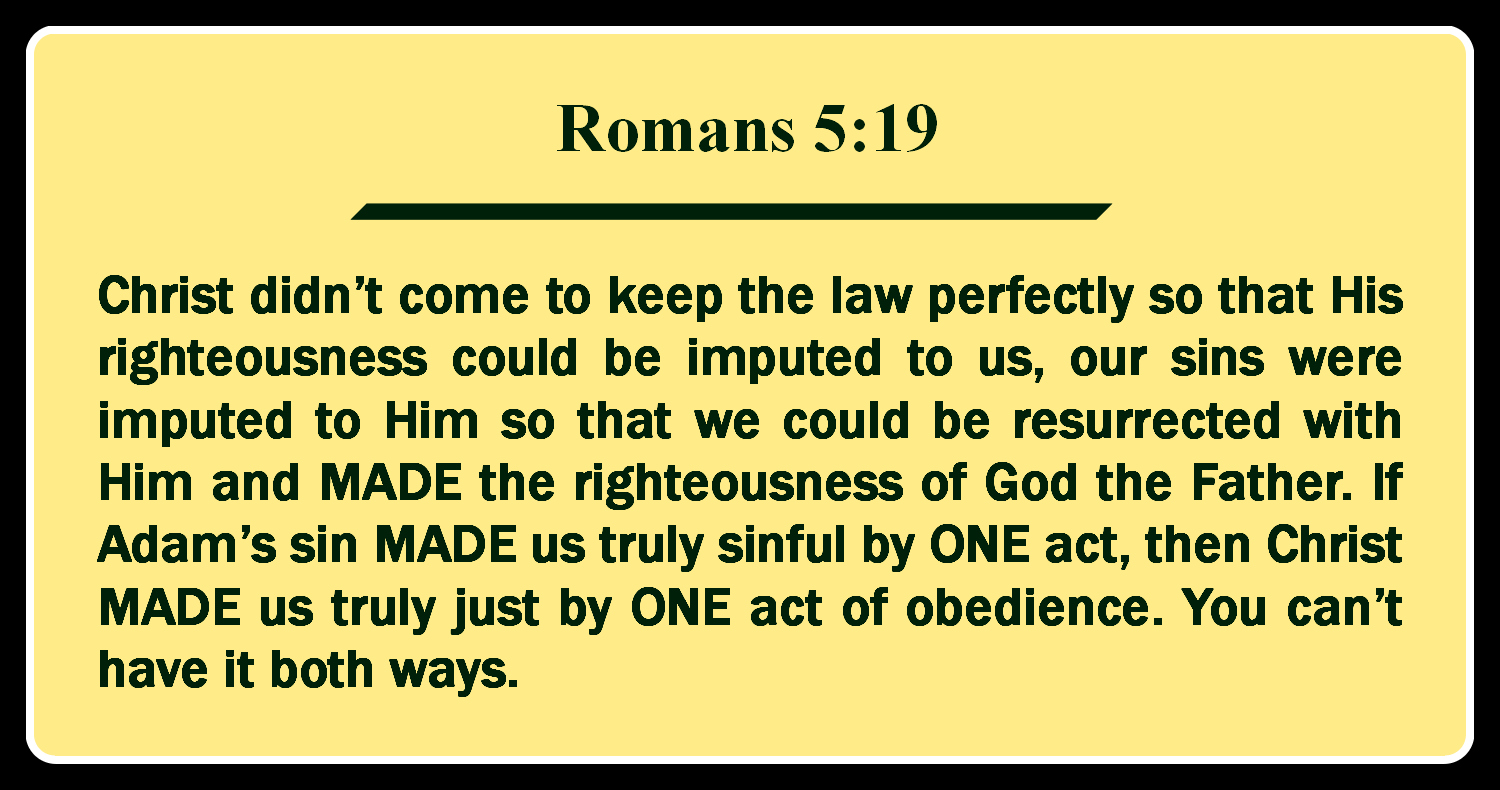
And that is a lie from the pit of hell. Christ came to end the law, not keep it for us. When we believe on Christ, our past sins are forgiven because Christ ended the law that we sinned against, and in regard to the future, there is no law to condemn us. The law of condemnation has been ended.
How? Because Christ died so that you can follow Him in death, and a dead person is no longer under the law of condemnation. Then, Christ was resurrected so that you can follow Him in resurrection as well. More accurately, when you follow Christ in death, the Spirit comes and resurrects you as He did Christ. That’s the new birth. Now you are free from the law in regard to condemnation, for the old you died and is no longer under the jurisdiction of the law’s condemnation. But…your resurrection to new life frees you to love according to the law of love, not condemnation. Same law—different use. Same law, different state of being.
Oops, I almost forgot, the new scandal. “Which one?” This one: Bristol Palin, Sarah Palin’s daughter, is once again pregnant out of wedlock. The family, members of the New Calvinist Wasilla Bible Church, survived the publicity of the first “disappointing” choice, but obviously nothing was learned from the first incident, the blessings of a child being brought into the world notwithstanding.
I am not going to bore you with what she said on her blog about the news; it is the same old Protestant song and dance. In essence, and for all practical purposes: Oops; me, a lowly sinner, once again has sinned. Per the usual, we all fall short of keeping the law perfectly, but praise God for Jesus—it’s not about what we do, but what he has done.
That misses the whole point. Jesus didn’t come to keep the law for us; He came to end the law, and set us free to love. Like all Protestants, Palin confuses law and love. Here is the huge problem: if Christ kept/keeps the law for us, He also loves for us. Like most Protestants, Palin dichotomizes law and love in Christian living because she remains under the law of condemnation and is not free to follow the law as love.
Hence, as she pontificated on her blog, she can dishonor her family while still loving them. As far as dishonoring her family and bringing shame upon them, Jesus died for that, but of course she still loves her family.
Listen, whenever love is something different than obedience to God’s law, whenever a failure to truly love is not called out for what it is, that means one thing and one thing only: that person is still under the condemnation of the law that Jesus supposedly keeps for us.
Listen “sister,” it’s not about the law, it’s about love. Google the following and find out who said it… “If you love me, keep my commandments.” One cannot change until the real problem is diagnosed. Palin failed to love God and her family.
Christ did not come to keep the law for us anymore than He came to love for us—we either love or we don’t love. If we truly understand salvation, “We love Him because He first loved us.” That means He loved us first by dying on the cross to end the law so that we are free to love him through obedience apart from being justified by the law. And as much as we love Him, we love others as well.
It’s not about the law—it’s about love. And that is the new frontier for recovering Protestants.
paul
________________
Visit “The Oligarchy White Paper” for additional perspective.




leave a comment