The Truth About Reformed Metaphysics and Baptist Complicity
 Tonight at 7pm (10/16/2015). Live program Link: The Heidelberg Disputation: Part 14; Theses 26-28, “The Truth About Reformed Metaphysics and Baptist Complicity”
The completion of the theological theses. Call in and talk with the host live. (347) 855-8317
Welcome truth lovers to Blog Talk radio .com/False Reformation, this is your host Paul Dohse. Tonight, part 14 of “The Magnum Opus of the Reformation: Martin Luther’s Heidelberg Disputation” – Theses 26-28.
Greetings from the Potters House and TANC ministries where we are always eager to serve all of your heterodox needs. Our teaching catalog can be found at tancpublishing.com.
If you would like to add to our lesson or ask a question, call (347) 855-8317. Remember to turn your PC volume down to prevent feedback over your cellphone. If you choose to use Skype to listen to the show, my advice is to just dial direct from your Skype account without using any of the Blogtalk links. 347-855-8317.
Per the usual, we will check in with Susan towards the end of the show and listen to her perspective.
Remember, you may remain anonymous. When I say, “This is your host; you are on the air, what’s your comment or question”—just start talking.
If you would like to comment on our subject tonight, you can also email me at paul@ttanc.com. That’s Paul @ Tom, Tony, Alice, Nancy, cat .com. I have my email monitor right here and can add your thoughts to the lesson without need for you to call in. You can post a question as well.
I decided to juice things up a little tonight. Yes, I think it’s high time that Baptists stopped getting a pass on their part in promoting the false gospel of progressive justification. “Hey, you know, Luther was a Lutheran, and that ain’t us, we are Baptists.” So here is what we need to understand: the Protestant Reformation did open up the floodgates of freedom to a point. It is amazing to consider how lost the word of God was in Western culture. The Catholic Church, after all, did everything in their power to keep the Bible out of the hands of the average parishioner.
Why? In their mind, to prevent chaos. First, they saw the masses as those who mistakenly think that they can know reality through experiencing and studying the material world. The Catholic Church saw wholesale availability of the consummate religious document of the ages as apocalyptic. And really, they still do. In my recent conversations with some Catholics, I find their claim that Catholics are scriptorian absolutely absurd.
However, no doubt, chaos did in fact ensue regarding various and sundry ideas about what the Bible teaches, we call that, “denominations,” BUT, the foundational soteriology of the Protestant Reformation remained intact. Again, this series examines the first and foundational doctrinal statement of the Reformation, the HD, and its major tenets can be seen in every Protestant denomination and Baptists in-particular, and we will see that tonight in theses 26-28, especially in the way Baptists function. Specifically, the Baptists parted from the Reformers on the issue of infant baptism, but kept the exact soteriology; progressive justification.
And as we have previously noted, misunderstanding in regard to how the Reformers interpreted reality also comes into play. People naturally tend towards interpreting reality from a historical, literal, experiential, and grammatical perspective. This is not how the Reformers interpreted reality at all. As some of you know, I am gravitating more and more towards this idea that one of the primary characteristics of sin is a need to control others. Hence, as we know, people tend to create gods of their own making—gods that are like them. Is this behind the whole viral idea of God’s sovereignty (?), or more specifically, God being defined as 100% sovereign, and if He isn’t, He’s NOT God! Therefore, God created evil or evil wouldn’t exist.
Stop right there. Most Baptists until recently would vehemently deny that God creates evil. This is where functionality departs from reason and logic. Even though most Baptists would refute the idea that God creates evil, what’s the first thing out of their mouths when something bad happens? Right, “It’s God’s will.” Or, “God is in control.” Or, “God means it for good.” On and on. Most Baptists, on its face, would vehemently deny the principles we are looking at tonight, especially Martin Luther’s previously discussed mortal and venial sin construct, but what are the first words out of their mouths when someone tries to give them credit for doing something that glorified God? Right, “I didn’t do it, the Holy Spirit did it!”
And that brings us to another place I am going more and more, that’s just good old fashioned Hinduism; this whole idea of realm birthing or realm manifestation. We experience what happens, but we are not really doing it. Baptists talk like this all the time!
But back to the whole idea that God creates evil. This belief is a Protestant tradition. Jonathan Edwards, in his Miscellanies: Being of God; tenet 85, states that God creates evil but it’s not really evil because He uses it to create good—only evil for the purpose of evil is evil. Another tenet of Eastern mysticism normally expressed in Hinduism et al is dualism, or the idea that something cannot exist unless it has an opposite or counterpart. In other words, nothing can be self existent. Edwards states in Miscellanies: Trinity 94 that God had to create an idea of Himself in order to exist, and Christ is an expression of His self-love which brings us to how the Reformers truly interpreted reality.
The Reformers interpreted reality redemptively. All of reality is interpreted through the gospel. That’s the HD disputation in a nutshell. This is what Baptists are a party to albeit unwittingly resulting in the same functionality. How does it work? It’s not complicated. Reality is a metaphysical story written by God. Do you like reading stories or novels? Well, when you do, you are a character in God’s story reading a story. What are you doing right now and what are you observing others doing? That’s all part of God’s prewritten metaphysical narrative. The way you experience this story that you live in is experienced like you have freewill which results in cause and effect, but that’s not really the case. In fact, according to the likes of many Reformers like Jonathan Edwards, God recreates the world moment by moment (get citation from Susan) according to His gospel metaphysical narrative. Look, the Reformers even have official names for these doctrines taken from the HD: the historical-redemptive hermeneutic and what they call “Biblical Theology.” And it’s interesting to note that the way God supposedly creates us is to experience life as if we have choice and those choices induce cause and effect.
So why did God decide to write this metaphysical narrative that we supposedly experience as reality? The Reformed are not the least bit shy about stating the reason: God created reality in this way as a redemptive story for His own glory and self-love. Before we get into the theses tonight, let me outline the hypotheses I find myself leaning towards more and more: ALL Protestant orthodoxy flows from and serves the purposes of the control sin. The desire of sin to own and control people drives the doctrine. They are supposedly God’s appointed authority on earth to manage His gospel program. Those who follow their teachings, that is, “God’s anointed” or “men of God” see reality the way it should be seen. In fact, the way you see/interpret reality is considered a definition of saving faith. Is this not the very theme of the HD? Remember, the cross story or the glory story, right? I have previously cited contemporary Reformers as saying that a literal interpretation of the Bible and reality itself is a denial of the person and saving works of Christ.
So, in a big way, saving faith boils down to interpreting reality according to the historical-redemptive hermeneutic. Faithfulness to the institutional Protestant church enables you to see reality as a gospel narrative leading to assurance that you have a shot at salvation. In a way, by your own efforts, you are confirming what God has already predetermined about your life according to the narrative. By being faithful to the institutional church and its hierarchy, you are “putting yourself in the pathway of blessings.” Lest you doubt this Reformed notion, I refer you to a Reformed article written by David Mathis on John Piper’s Desiring God.org blog titled, “Put Yourself in the Path of God’s Grace.”1 The main idea in the post is that we show ourselves saved by being faithful to “the means of grace,” viz, the means of grace found in the institutional church through the sacraments of baptism, sitting under the word, prayer, repentance for condemning sin, and the Lord’s table. And as stated many times before in this series, the word “grace” is used to nuance what is really intended: the means of continued salvation, or in this case, putting yourself in the path of God’s salvation. The switching of these words is deliberate deception.
Where does the Bible fit in? Well, it is the redemptive story that includes your story. When you read your Bible, the fact that you are reading your Bible is part of God’s story that includes your story along with whatever is going on around you. Sort of, let me explain. The Bible documents past history, and what is going to happen in the future, right? Past redemptive history in the Bible is an example, or prototype of how you should interpret your present redemptive life. You are presently living in a story prewritten by God that is about His redemption, and because you are living you are obviously part of the story. If you are reading your Bible grammatically/literally with a cause and effect view of reality, your character in God’s prewritten story is going to hell for His glory and self-love unless you have a change of mind which will only happen if God wrote the story that way. So, whatever happens is prewritten. Therefore, the Bible serves as a means to increase your faith in regard to the redemptive story that you live in. Do you care to really get your mind around how this works? No problem, buy a book by Paul David Tripp titled, “How People Change.” Of course, the title is a lie and Tripp knows it. It should be truthfully titled, “How God Displays His Realm Manifestations Depicting His Gospel Prewritten Metaphysical Story for His Own Glory and Self-Love.”
This simply coincides with the Reformed tradition for anyone who cares to study it for themselves. Jonathan Edwards wrote that all reality is made up of ideas (blatantly Platonist), and that God is the first cause of all ideas. He also saw reality as a massive web of ideas linked together to bring about cause and effect (citation needed from Susan). An act starts with an idea, and God is the first cause of all ideas. As we have learned here in the HD, Luther explained this via the active and passive realm. I wont revisit that, but hope you remember what we learned.
Anyway, the present gospel narrative, or the present part of the story, is not in writing, but is experienced by all of us, “it is also the story of our lives in the narrative.” Yea, we should, as Paul David Tripp puts it, accept God’s invitation to “enter into the plot!” That is, the redemptive plot. In essence, if we do not interpret reality in this way, we believe we have freewill and deny the… “gospel of sovereignty.” As far as Bible prophesy, that’s how the story is going to end. Do you think I have lost my mind? Well then, I invite you to listen to the video trailers for the website, biblemesh.com and listen carefully to what is being said.2 This isn’t merely in a manner of speaking, they mean this literally. This is the story of redemption that is also your story because it is the metaphysical prewritten story of life that is reality itself.
With that let’s get into the final lesson of the theological theses.
Thesis 26: The law says, »do this«, and it is never done. Grace says, »believe in this«, and everything is already done.
The first part is clear from what has been stated by the Apostle and his interpreter, St. Augustine, in many places. And it has been stated often enough above that the »law« »works wrath« and keeps all men under the curse. The second part is clear from the same sources, for faith justifies. And the law (says St. Augustine) commands what faith obtains. For through faith Christ is in us, indeed, one with us. Christ is just and has fulfilled all the commands of God, wherefore we also fulfill everything through him since he was made ours through faith.
This is about as concise as it gets. Actually, let’s just do bullet points on this one:
- St. Augustine is the Apostle Paul’s interpreter. Any questions?
- Christians remain under the law of sin and death.
- Therefore, justification is a continuing process by faith alone.
- Therefore, faith obtains what the law commands…or else it would be works…the Christian life must continue the same way it started, by faith alone. This is what the epistle of James pushes back against and why Luther dismissed it as a “straw epistle.”
- And how does faith obtain what the law commands? Christ obeyed the law for us and His obedience is imputed to our life through realm manifestation. This is the doctrine of “double imputation.” Christ’s obedience to the law is manifested in our life as we live by faith alone.
- Obviously, we don’t really do anything, we only experience what Christ has done. As long as we live by faith alone through gospel contemplationism, we are one with Christ and therefore in “the path of grace” where God may or may not manifest good fruit. This is the Reformed doctrine of the vital union which also finds its roots in Eastern mysticism by the way.
Thesis 27: Actually one should call the work of Christ an acting work (operans) and our work an accomplished work (operatum), and thus an accomplished work pleasing to God by the grace of the acting work.
Since Christ lives in us through faith so he arouses us to do good works through that living faith in his work, for the works which he does are the fulfilment of the commands of God given us through faith. If we look at them we are moved to imitate them. For this reason the Apostle says,»Therefore be imitators of God, as beloved children« (Eph. 5:1). Thus deeds of mercy are aroused by the works through which he has saved us, as St. Gregory says: »Every act of Christ is instruction for us, indeed, a stimulant.« If his action is in us it lives through faith, for it is exceedingly attractive according to the verse, »Draw me after you, let us make haste«(Song of Sol. 1:4) toward the fragrance »of your anointing oils« (Song of Sol. 1:3), that is, »your works.«
Right here is the premise for gospel contemplationism as we know it today. Note: “If we look at them we are moved to imitate them.” He then distorts Ephesians 5:1 to make the point. Also note how St. Gregory promoted the same idea according to Luther: the beauty of Solomon’s lover and her perfume is not really referring to her beauty and perfume, but what? Right, the works of Christ; specifically, His “saving works”…PLURAL. Did you catch that? Even if you want to say, “No, no, you have this all wrong, all Luther is saying is that the Bible inspires us to obey by seeing the works of Christ in the Bible!” Problem is, apparently then, we are being inspired to do what? Right, “saving works.” Either way, we have a serious problem. Besides that, the Bible makes it absolutely clear that we were saved by what? We were saved by the ONE act of Christ’s death on the cross (Heb 9:26, 10:10,14). Also note:
Romans 5:18 – Consequently, just as one trespass resulted in condemnation for all people, so also one righteous act resulted in justification and life for all people. 19For just as through the disobedience of the one man the many were made sinners, so also through the obedience of the one man the many will be made righteous (NIV).
Ok, besides the fact that this verse by itself blows away any notion of saving works in the plural by Christ which also by the way completely discredits Protestantism in totality, that is, this one verse, let’s have some additional fun with this verse. In regard to predeterminism, the Reformed can’t have it both ways. By one act of sin by one man everyone is condemned, right? So why isn’t everyone made righteous by the one act? What am I saying? How is “the world” or “all people,” or “the many” biblically defined here? Clearly, it’s EVERYONE. Let me make a quick point here and we will move on: “many are called” means that EVERYONE is called…the “few chosen” really properly, “few elect” are the one’s that choose God’s means of salvation. That’s why it is called, “the free gift” (Rom 5:15,16,).
Thesis 28: The love of God does not find, but creates, that which is pleasing to it. The love of man comes into being through that which is pleasing to it.
The second part is clear and is accepted by all philosophers and theologians, for the object of love is its cause, assuming, according to Aristotle, that all power of the soul is passive and material and active only in receiving something. Thus it is also demonstrated that Aristotle’s philosophy is contrary to theology since in all things it seeks those things which are its own and receives rather than gives something good. The first part is clear because the love of God which lives in man loves sinners, evil persons, fools, and weaklings in order to make them righteous, good, wise, and strong. Rather than seeking its own good, the love of God flows forth and bestows good. Therefore sinners are »attractive« because they are loved; they are not loved because they are »attractive«: For this reason the love of man avoids sinners and evil persons. Thus Christ says: »For I came not to call the righteous, but sinners« (Matt. 9:13). This is the love of the cross, born of the cross, which turns in the direction where it does not find good which it may enjoy, but where it may confer good upon the bad and needy person.»It is more blessed to give than to receive« (Acts 20:35), says the Apostle. Hence Ps. 41:1 states, »Blessed is he who considers the poor,« for the intellect cannot by nature comprehend an object which does not exist, that is the poor and needy person, but only a thing which does exist, that is the true and good. Therefore it judges according to appearances, is a respecter of persons, and judges according to that which can be seen, etc.
If you read this thesis about a dozen times carefully, and consider that the Bible states that God is love, we have merely come full circle to what Reformed philosophers such as Jonathan Edwards have confirmed all along about the original Reformation tenets: God could not exist without an idea of Himself in reference to an opposite idea. Of course God created evil, or he would be irrelevant. If God is good, there must be evil or good could not exist. As Luther plainly stated in this thesis, “the object of love is its cause.” If something didn’t need love, there wouldn’t be any love. If God is love, this definition of Himself could only be true is there is a need for love, viz, SIN.
The accusation leveled at “theologians of glory” like Aristotle follows: they denied the existence of evil as a necessary component of reality. Now, I know this is rough treading on the mind, but the reality of the matter is that if you want to understand what’s going in the church, and the church is predicated on this stuff, and it is, you have to stop letting others think for you.
In closing, let me say that there might be a way to get me back into the institutional church. Find me a Baptist church that has added the bindi as a sacrament or “means of grace.” That’s the red dot that Hindus sport between their eyes. You can liken it to Jonathan Edwards’ sixth sense. Yep, that’s it; find me a Baptist church where ever one in Sunday morning service has a red dot painted on their head. Because like with all personal problems, you have to admit that there is a problem before you can solve it. You can dress up Protestantism in a business suit all day long, but in the final analysis, it’s just another ancient mythology dressed up in Western formality and pseudo dignity.
Let’s go to the phones.
______________________________________________________________________
1http://www.desiringgod.org/articles/put-yourself-in-the-path-of-god-s-grace
@ Albert Mohler
@rachelheldevans @albertmohler @johnmacarthur Better yet if they repent of progressive justification or will suffer a greater condemnation
— Paul M. Dohse (@PaulMDohse) October 16, 2015
Albert Mohler: “Christians” Retain Their Salvation by Sitting Under Pastoral Preaching
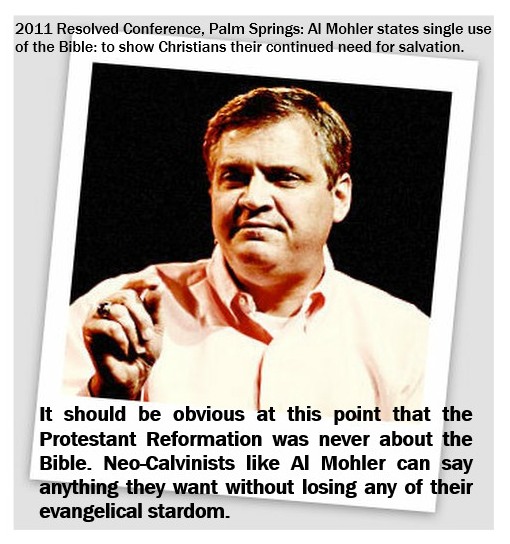 This ministry has documented extensively through the words of Protestant evangelical pundits what the true soteriology of authentic Protestantism is: it is the false gospel of progressive justification. One is saved through the institutional church and its hierarchical priesthood, and then must remain faithful to the institution and its “means of grace” in order to retain salvation. Though evangelicals vehemently deny salvation by church membership, the facts are irrefutable.
Let’s review the major tenets of this false gospel propagated by Protestants and their many offshoots such as Baptists etc. Though they claim salvation by new birth, the biblical definition is denied. In contrast to the biblical definition, justification is a mere “forensic declaration.” Instead of the saint being literally made righteous, they are only declared righteous. This attempts to reconcile their error concerning law and gospel.
In the soteriology of Protestantism, the law only has one purpose instead of two: it only serves to show one’s sin.1 Therefore, the law is justification’s standard. Hence, the simple biblical concept of justification being apart from the law is totally missed.2 Now more error must be added to cover for the fundamental error: their definition of justification as a legal declaration. Now, the law is unwittingly added as something that can give life.3 And since it is seated on a throne beside God and the Son, “its righteous demands must be continually fulfilled.” This necessarily requires even more error: the idea that Christ not only died for our sins, but that He also lived a perfect life in obedience to the law so that His obedience can be continually imputed to the law in the believer’s stead. This is known as “double imputation.”
Enter even more error. Since justification is only a legal declaration and didn’t put the old us to death through Spirit baptism, and we are therefore still under the law’s condemnation instead of Christ’s death ending that aspect of the law, our sins are only COVERED and not ENDED which means continued imputation of Christ’s death and righteousness is needed. However, we don’t need Christ’s obedience to the law imputed to us in order to keep us saved because we were made righteousness in being resurrected with Him4—also in Spirit baptism. This frees us from all condemnation under the law and frees us to serve according to the positive aspects of the law…love.5
And consequently due to this error, “saints” only remain covered by double imputation through faithfulness to the institutional church and its “means of grace” or what really boils down to means of continued salvation.6 These “means of grace” can only be found in the institutional church, and there are many, but one is the hearing of pastoral preaching. Faith comes by hearing the word of God, we know that, but in context of Protestantism, that’s an ongoing need that is only found in the institutional church. If we don’t continually hear the word from those “under the authority of the church” we lose our faith and subsequently our salvation.
In the following video link, Albert Mohler expresses these ideas starting at mark 1:14:00. Yes, he throws in some red herrings in regard to individual study of the word, but take note towards the end regarding his statement that salvation is for the lost as well as the saved. In other words, the “saved” need continued means of salvation that can only be found in the church. This ministry has documented many statements by evangelical leaders plainly stating that Christians continue to need salvation. Where the confusion often comes in is with the citation of verses referring to the saving of the mortal body, viz, redemption which is NOT salvation in the justification sense. Both only happen once.
paul
1Romans 8:2
2Romans 3:21
3Galatians 3
4Romans 5 and 6
5Romans 7 and Galatians 5:6
Albert Mohler Has the Audacity to Lament Bible Illiteracy
 In an article written by Albert Mohler, President of The Southern Baptist Theological Seminary in Louisville, Kentucky and posted on Christian Headlines.com, he bemoans Bible illiteracy among Christians. It begs the question: is he really this blinded by orthodoxy, or is he just gaming the herd?
You can read the article for yourself which chronicles examples of how bad it is, but I think it’s common knowledge for the most part, no pun intended. Even among Christians that are regarded as knowledgeable, including those with university degrees from religious institutions, they know little that is beneficial. Orthodox Christianity is the blind leading the blind and always will be.
First of all, his bemoaning defies the very major tenets of the Protestantism that he claims to represent as a leading authority. Protestantism is predicated on a loathing of human reason and a faith exemplified by blind trust in those whom God has supposedly “appointed to save His people from ignorance”; this according to Mohler at a 2011 pastors conference (mark 1:14:00). This same mentality came from the Catholic Church that gave birth to the Reformers and believes that Bibles in the hands of the great unwashed is like a loaded gun held by a toddler.
Secondly, Mohler’s admission that Protestantism at large is biblically illiterate is a stunning admission and revelation regarding his real belief in the herd’s aptitude. If a vampire is a pastor and says he advocates daylight saving time, that is apparently good enough for the herd, and raises no questions in their minds whatsoever. Mohler knows he can get away with verbalizing these metaphysical absurdities. Al Mohler is a leading figure in the evangelical industrial complex that makes billions of dollars from the massive distribution of Christian teachings via books, church events, conferences, the internet, printed media, recorded media, movies, and radio. How could Christians possibly be biblically illiterate? This is proof positive that content is indeed the issue. REAL knowledge empowers people and would threaten the authority of the Protestant church. The harlot that gave birth to Protestantism merely outlawed knowledge; Protestant leaders have to skin the cat another way because people started printing Bibles upon pain of death.
Go to any Catholic Church, the parishioners don’t have any Bibles with them. Go to any Protestant church and watch the people carefully during the sermon; they refer to their Bibles little if there is any need to open them at all. The general mentality is that they are not qualified to understand it anyway. In fact, there is no reasonable difference between Catholic ex cathedra and elder authority according to the likes of Mohler himself and the Protestant hierarchy in general.
Lastly, Mohler has the audacity to suggest that lack of knowledge is the issue when Protestant academia denies that the Bible is for the express purpose of knowledge to begin with. Pastors continually fustigate those who read the Bible to gain knowledge because “Jesus is a person, not a precept.” Simply stated from a true Protestant perspective, the Bible is a metaphysical narrative about salvation and EVERY verse is about the gospel/justification/salvation. Few parishioners deem themselves as able to see Jesus in every verse, so they merely close their Bibles and listen.
Mohler calls Biblical illiteracy a “scandal.” And why not? After all, a popular mantra in today’s Protestant church refers to their faith as a “scandalous gospel.” And what is the scandal? That God would save sinners and fill His church full of them. But alas, our temptation is to think that we can actually do a good work, and the primary purpose of the Bible is to keep us grounded in faith which seeks to see ourselves more and more for the sinners that we are which results in a deeper and deeper gratitude for our salvation. That’s why every verse in the Bible is supposedly about salvation.
So what knowledge is Al Mohler talking about exactly? With all things Protestant, it depends on what the definition of “is” is.
paul



leave a comment