Romans 12:17-21, More on Forgiveness and Enemies
 I don’t know how many articles I have written for my ongoing attempt to slay the blank check forgiveness evangelical sacred cow, but I continue to chop away at him. Despite all of the blood, the stinkin’ thing still lives.
So, let’s keep trying, but first, where does this “offering grace” blank check forgiveness stuff come from? If you followed our Heidelberg Disputation series, you know. There are two kinds of Protestants: Calvinists, and functioning Calvinists. The former hold to predestination and the soteriology, the latter function according to the soteriology while denying the specific orthodoxy.
Blank check forgiveness comes from the Reformation doctrine of total depravity which results in moral equivalency and a single perspective on justice. Basically, due to the total depravity of man, and the idea that man saved or unsaved possesses no good or righteousness within (Luther’s Alien Righteousness), everybody deserves hell; including Christians regardless of their conversion; anything other than hell or lesser than hell is “grace,” and therefore, being wronged is only valuable for showing forth the same grace that we received. Few Protestants understand the doctrine of mortification and vivification. That’s “deep theology,” so instead, they teach and apply the applications of the doctrine that are too deep for them to understand. Blank check forgiveness is one of them.
Mortification and vivification is the perpetual revisiting of our spiritual baptism. In other words, the new birth doesn’t happen once, but is experienced numerous times throughout our Christian lives. Now, Baptists can moan and cry in denial like alley cats in heat, but that’s Protestant doctrine reflected in the Westminster Confession and London Baptist confessions as well. I will keep saying it; there is no religion more confused nor pathetic than Protestantism. At least even Muslims know what they believe for crying out loud.
But back to mortification and vivification which is the primary model for change in Protestant orthodoxy. The goal is to experience our baptism as much as possible via joy. That’s the vivification part that is totally out of our control—it is the resurrection part. But it begins with our part/role in the Christian life: “dying daily,” or mortification. This is how the whole taking up our cross and dying daily verses are interpreted. According to Luther and Calvin, God helps us out with the dying part by bringing tragedy into our lives. Look, if you are, for example, a rape victim that has been counseled by ACBC or CCEF, lightbulbs are starting to turn on right about now.
Enough of that for now, let’s go to Romans 12:
“17 Do not repay anyone evil for evil. Be careful to do what is right in the eyes of everyone. 18 If it is possible, as far as it depends on you, live at peace with everyone.19 Do not take revenge, my dear friends, but leave room for God’s wrath, for it is written: ‘It is mine to avenge; I will repay, says the Lord.’ 20 On the contrary: ‘If your enemy is hungry, feed him; if he is thirsty, give him something to drink. In doing this, you will heap burning coals on his head.’ 21 Do not be overcome by evil, but overcome evil with good.”
This is one of the many love your enemies verses. I guess I will keep on saying it: why would Paul concede that we will have enemies in spite of our best efforts if we are to simply forgive everybody who offends us? This passage gives instructions for dealing with enemies. Furthermore, the Bible promises rewards for relating to our enemies in the biblically prescribed way; therefore, does blank check forgiveness deprive us of reward? I think it does. And moreover, there is NO forgiveness of enemies with God unless they repent. In the same way that God blesses His enemies who have not repented, we bless our enemies who have not repented, and this is what leads them to repentance (Romans 2:4). Now, I have some learning to do in regard to how this model works itself out, but that IS the model, NOT blank check forgiveness. It would appear that replacing revenge with blessings prevents bitterness and leads to repentance. It would also seem that the goodness unresponded to will lead to a greater judgment in the end by God.
So, all in all, do I think blank check forgiveness keeps people from repenting? Yes.
paul
Let’s Try This Another Way: Forgiveness Only Occurs Among Repentant Believers
 “We want to love the unforgiven as our enemies, not lead them to believe that we love them because they are forgiven. That’s not the gospel and is obviously antithetical to how God loves His enemies daily. Blank check forgiveness does not put the gospel on display.”
Wow, this whole thing with being obligated to forgive people regardless of their unrepentance is a serious sacred cow. I have written many articles on this subject, and continue to approach it at different angles; this post is one more.
First, we do no person a favor, including ourselves, by circumventing the need for repentance. Here is what we have, in essence, because people listen to others and not God: “I forgive you, but remember that God hasn’t forgiven you because you haven’t repented, but we are supposed to forgive the way we have been forgiven, because we repented, but in your case it is different because you sinned against me and not God.” How does that square with Matthew 25:31-46? In that judgment, passive neglect is the issue, how much more active abuse?
Default forgiveness is what subjects people to hopelessness, bondage, and misery, not the biblical prescription. We are to remain angry for offenses while leaving retribution to God. Being righteously angry will not “destroy us,” but will rather continue to hold the offender accountable in hope that reconciliation will occur in the future. Though the obviousness of it annoys me, I will point to the redeemed souls under the alter crying out to God to avenge their blood. Pray tell, is there a way to send them one of these putrid memes lest they destroy themselves via unforgiveness? Maybe an angel has a Facebook account and will send them one.
In fact, opportunities to love our enemies may lead them to repentance (Rom 2:4). When we love our enemies without granting unwarranted forgiveness, we are being like God. Furthermore, blank check forgiveness does not foster indictment of conscience that brings about repentance and subsequent change. On this wise, blank check forgiveness goes against God’s natural order of things. Forgiveness goes hand in glove with a clear conscience. Those who are forgiven should have a clear conscience, but if they haven’t repented, we don’t want them to have a clear conscience. People repent because their consciences indict them. If you hold someone accountable for unrepentant sin, yet do good to them, this is more likely to incite the conscience than blank check forgiveness. When we forgive someone, we declare them no longer guilty; again, this is the same way we are forgiven. We want to love the unforgiven as our enemies, not lead them to believe that we love them because they are forgiven. That’s not the gospel and is obviously antithetical to how God loves His enemies daily. Blank check forgiveness does not put the gospel on display.
All in all, forgiveness only has context among believers. That’s why when people refuse to repent, we are to treat them as unbelievers, break fellowship with them, and continue to hold them accountable. The burden is not on those who have been sinned against, but rather on those who have sinned against others. People only change because they are held accountable by God, others, their own consciences, and consequences. Forgiveness does not lead to repentance, undeserved love does. An offer of forgiveness can only be granted when repentance occurs. When we have opportunity to love our enemies, no opportunity exists to present the gospel if we have already forgiven them. They are God’s enemies and our enemies—that’s why “friendship with the world is enmity against God.” We therefore love our enemies and grant forgiveness when those who have sinned against us repent. If they don’t repent, we are to treat them as unbelievers. If they do repent, we have “gained a brother.”
On the other hand, those who will not forgive those who have repented show themselves to be unbelievers as well. When the Bible talks about forgiveness, repentance is always assumed if not stated outright. If you note the Lord’s Prayer, it is addressed to the “Father.” And this brings me to the main point: true biblical forgiveness is only in context of God’s family. No forgiveness takes place outside of it. When a person repents and is forgiven by God, that is their initiation into the family of God, and after that, the forgiveness/repentance paradigm is assumed, expected, and demanded by God. The offended who don’t forgive, and the offenders who will not repent are assumed to be illegitimate family members. Under the auspices of common decency in the world, we accept apologies, but God has little patience for family schisms. True believers reconcile because we are all members of God’s family.
And reconciliation with God and others MUST ALWAYS have two parts: repentance and forgiveness.
paul
The Elephant in the Room: The Historical-Redemptive Gospel
 Originally published September 3, 2013
How Should We Read Our Bibles?
There isn’t a bigger elephant in the Sunday school room or the sanctuary than the issue of Bible interpretation. The reason for this follows: the method of interpretation that comes natural to us is assumed.
What is that method? This gets into an area of study called hermeneutics (the theory of interpretation), and the two primary theories thereof are exegesis and eisegesis. These are big theological words that the average Protestant is not supposed to know. This is because the Protestant interpretation of the Scriptures is based on authority.
We will get to exegesis and eisegesis, but the crux of the issue is authority. The Reformers came from Romanism and clearly, their interpretive construct was based on authority; i.e., the average parishioner was not free to interpret the Bible and follow it according to one’s own conscience:
Rightfully and nobly did the Protestant Reformers claim religious liberty for themselves; but they resolutely refused to concede it to others. [1]
The very foundation of Protestant interpretation is based on authority; that is, the leaders dictate meaning. Therefore, traditionally, the need for Protestants in general to understand interpretive principles would be unnecessary, and as a result, Protestantism functions that way till this very day. In the early days of the Reformation, private interpretation was outlawed [2]; in our day, education regarding the tools needed to interpret the Bible are merely excluded.
This fact brings us to an interesting word, “orthodoxy.” Traditionally, this word is associated with “truth” as a synonym. This is not the case at all. Orthodoxy is the authority of truth based on counsels of any given sect. [3] The opinions of these counsels regarding the meaning of “truth” are known as “creeds” and “confessions.” These are “truths” (actually, opinions concerning the meaning of any given subject) repackaged for those who have limited understanding, and usually recited and learned through catechisms [4].
Authority Versus Individual Interpretation
Hence, Protestant interpretation is based on authority and not individual interpretation. The structure of this interpretive process is orthodoxy formed through counsels, distributed by creeds/confessions, and practiced through catechisms. In Europe and early Colonial America, it was a matter of civil law, in our day the process is tempered by the freedom to choose your own orthodoxy, but it is still orthodoxy. Once a typical American parishioner chooses who they want to believe, they will follow that leader as an authority. A like tendency caused the Apostle Paul to confront the believers at Corinth (1COR 3:1-9).
Of course, the authoritative method of interpretation is at the root of every cult. Traditionally, when people seek to find God, they begin by finding an authority that they are comfortable with. This is why many people prefer authoritative interpretation in a free society: it allows them to choose their own general truth while leaving the hard task of thinking to others. The Apostle Paul said this would be particularly problematic in the last days (2TIM 4:3-5).
The visible authority structure within the church is known as “church polity” or church government. [5] Again, the whole construct is based on authority. If authority is the interpretive prism, roles in the church are going to be seen as positions of authority rather than gifts. When Christ ministered here on earth, disciples were free to follow Him or not follow Him under their own free volition (JN 6:66-69). Christ made it clear to the disciples that their roles in the kingdom were not that of authority (Matthew 20:20-28).
The word “office” inserted in the English translations when associated with “bishop” or “deacon” were added in to the translations and do not appear in the Greek manuscripts while in other places these roles are spoken of as gifts (EPH 4:11-16). We have been given authority to proclaim the gospel of the kingdom on earth, but that is a vertical authority and not horizontal. Those who protest the gift idea versus the authority idea often cite the following text:
Hebrews 13:17 – Obey your leaders and submit to them, for they are keeping watch over your souls, as those who will have to give an account. Let them do this with joy and not with groaning, for that would be of no advantage to you.
The word for “obey” in this verse is πείθω (peithō) which means to persuade by argument. The word “submit” is ὑπείκω (hypeikō) which means “to surrender.” Here is the best rendering according to a heavy paraphrase:
Be persuaded by your leaders’ arguments from Scripture and don’t be stubborn in regard to the truth for this is no advantage to your own spiritual wellbeing. Besides, they have to give an account for how they led you, and let that account be a joyful recital to the Lord rather than a sorrowful report.
Why is this important? Because every person is personally culpable before God for following the truth, not men. Paul was an apostle, yet the Bereans verified what he taught according to their own understanding of Scripture (Acts 17:11). Paul told the Corinthians that he should only be followed as he followed Christ (1COR 11:1). Every individual will stand before God to give an account of the sum and substance of their own lives, not who they followed among mortals.
The Exegesis and Eisegesis of Hermeneutics
The theological word for the science of biblical interpretation is hermeneutics. The first consideration of hermeneutics must be exegesis and eisegesis. Exegesis draws conclusions from written text depending on the grammatical meaning and arrangement of words. Eisegesis approaches the text with an interpretive prism. One who uses the exegetical approach will even approach the text to learn how the text itself should be interpreted. Eisegesis assumes one must approach the text with a proper presupposition in order to properly understand it.
Therefore, this takes us right back to the basic question of authority versus the freedom of individual interpretation. Eisegesis will approach the text with a prescribed method of interpretation while exegesis will look for the best way to interpret the text from the text itself. The interpretive prism for eisegesis comes from an authority. The common contention from those of the authority camp is that everybody approaches the Bible with presuppositions, and this is unavoidable; so, it is important to use the right interpretive prism. Since we are supposedly incapable of approaching the Bible objectively, we should bow to their authority in regard to the proper interpretive prism.
Historical-Grammatical Versus Historical Redemptive: The Elephant in the Room
Eisegesis and exegesis really boils down to authority versus individualism, and so does the two major methods of interpretation in the church: historical-grammatical method and the historical-redemptive method. This is where we get into discussion about the elephant in the room. These two devices of interpretation yield completely different results. When we sit under any given teacher, he/she will be using one of these hermeneutics. The two different approaches will sound the same because each uses all of the familiar terms, “gospel,” “justification,” etc., but the terms mean different things in each construct. This is the elephant in the sanctuary and the Sunday school room that no one is talking about.
As suggested by the terms themselves, one interprets the Bible grammatically, and the other interprets the Bible through a Redemptive prism. The latter seems perfectly reasonable: “Isn’t the Bible primarily about Redemption?” The former would judge that assertion by a grammatical evaluation of the text. In other words, conclusions are drawn by the arrangement of words, their meaning, and what those words meant to people in that historical context. This is exegesis.
The redemptive method presupposes that the Bible is a gospel narrative about the works and personhood of Christ. It presupposes that this is the dominate theme of the Bible and everything else in the Bible is secondary and points back to Christ. For example, biblical commands aren’t really meant for us to obey, but rather illustrate the works that Christ has accomplished for us and illustrative of what we are unable to do. This bypasses the normal grammatical interpretation of an imperative expectation, and interprets it as a finished work that God in fact does not want us to do. This is assumed because of the redemptive presupposition. As Neo-Calvinist Paul David Tripp has said, biblical commands must be seen in their “gospel context.” [6]
The Gospel Transformation Study Bible and the Redemptive-Historical Gospel
Dr. Kathleen Nielson, in a promotional video for the Gospel Transformation study Bible, stated that the historical-redemptive theme is not imposed on the text, “it’s actually in there!” This, we by no means deny, but are the works of Christ and His personhood something that every verse in the Bible points to? Nielson, like many from the redemptive-historical camp, use the grammatical approach to determine that something is in the text, and then make that an authoritative interpretive prism.
I have talked face to face with pastors who use this hermeneutic. As one stated to me, “You might have to cover multiple chapters in one sermon in order to see the Christocentric theme God is showing you at the time.” Others are even more direct:
At this time, resist the temptation to utilize subsequent passages to validate the meaning or to move out from the immediate context. Remembering that all exegesis must finally be a Christocentric exegesis.
Look for Christ even if He isn’t there directly. It is better to see Christ in a text even if He isn’t, than to miss Him where He is. [7]
Again, we see that a “Christocentric exegesis,” something that is in the text grammatically, becomes the authoritative eisegesis. And this elephant is a big one, because interpreting the Bible this way is intrinsically tied to the gospel that comes part and parcel with the redemptive method. The historical-redemptive method is a tool for enabling the believer to live by faith alone in their Christian walk. The historical-redemptive method is actually a gospel in and of itself. To interpret the Bible grammatically is to conclude that God actually wants us to exert our own will in response to commands in the Bible. To proponents of the redemptive-historical method, this is works salvation because Christ is not obeying for us in our Christian life. This is what the Reformation motto, “Christ for us” means. The Neo-Calvinist John Piper has stated it this way, “[Christ] 100% for us.” [8] Piper has also said that “necessary sanctification” comes from faith alone in the Christian life (Ibid).
Therefore, according to proponents of the redemptive model, a historical-grammatical interpretation of Scripture necessarily leads to works salvation and making what we do in the Christian life “the ground of our justification” (Ibid). For all practical purposes, Paul David Tripp has stated such:
….and the Bible does call us to change the way we think about things. But this approach again omits the person and work of Christ as Savior. Instead, it reduces our relationship to Christ to “think his thoughts” and “act the way Jesus would act.” [9]
Here, Tripp concedes that the Bible can be interpreted grammatically, “and the Bible does call us to change the way we think about things.” Grammatically, one assumes the commandments are to us and that we are called to do them. Again, Tripp clearly recognizes this fact. But what does he say the results are?
But this approach again omits the person and work of Christ as Savior.
What happens if we “omit” Christ as “Savior”? Clearly, Tripp is stating that if we interpret the Bible literally and obey it, we are circumventing Christ’s salvific work. Much more than mere semantics are at stake here. The elephant in the room is absolutely huge! This is about the gospel.
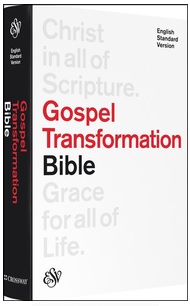
The historical-redemptive method of interpretation is all the rage in contemporary Christianity. Projects and programs that promote this method of interpretation and target all age groups abound. Almost all Christian publishers are on board with the historical-redemptive hermeneutic. The latest project that has been unveiled towards this endeavor is Crossway Publishers’ The Gospel Transformation Bible. It will be available 10/19/13.
The subtitle is, “Christ in all of Scripture, Grace for all of Life.” This is typical of those who promote this method of interpretation and its gospel. Christians will assume that the title only pertains to justification by faith alone, but it doesn’t. “Transformation” or change has to do with the Christian life, and in the subtitle, “Grace” replaces “gospel” to veil the real crux of this doctrine. Basically, it teaches that Christians are transformed by continually revisiting the same gospel that saved them. Not only that, we keep ourselves saved by doing such. This is what is behind the Neo-Calvinist mantra, “We must preach the gospel to ourselves every day.” John Piper has said that the question is not only how one gets saved, but how one must use the same gospel that saved him/her to keep themselves saved. [10] Piper has also said that we must “see” the same gospel that saved us over and over again as a requirement to enter heaven. [11]
Note: This is what’s so critical about the Reformed historical-redemptive interpretative model according to many Calvinists, it enables us to fulfill what is “required of us” to enter heaven (Ibid). In essence, once saved, how we read our Bible determines whether we keep our salvation or not. So therefore, those who promote The Gospel Transformation Bible actually see it as a resource for maintaining one’s salvation.
The “Gospel-Driven” Life
The question that is invariably raised is, “How do proponents of the historical-redemptive model explain obedience and the Christian life?” Primarily, they say Christians must “experience” obedience, but must not be the ones who perform it in the Christian life. By revisiting the gospel afresh, the works of Christ are “manifested” in our lives. When this happens, the obedience is experienced by a willing, joyful spirit. As we use the historical-redemptive model to see how sinful we are (a deeper realization of our sin, the realization that originally saved us), and thereby gaining a greater appreciation for what Jesus did for us, we experience “vivification.” This is some sort of joyful rebirth. Proponents of this hermeneutic, primarily those of Reformed theology, refer to this as “mortification and vivification.” A “daily dying and rising,” a “living out of our baptism.” [12] [13]
The Origin of the Historical-Redemptive Hermeneutic
Where did this hermeneutic originate? Even though Martin Luther’s 95 Theses launched the Reformation, the framework of the Reformation’s doctrine and gospel was articulated by Martin Luther six months later. Essentially, Luther’s Heidelberg Disputation to the Augustinian Order in 1518 is the heart and soul of the Reformation. Calvin’s Institutes of the Christian Religion is a greatly expanded treatise of Luther’s framework. However, every fundamental element of Reformation doctrine can be found in Luther’s Disputation, and this by no means excludes the historical-redemptive hermeneutic. [14]
The primary theme of Luther’s Disputation is known as The Theology of the Cross. It was comprised of the glory story and the cross story. Luther believed that salvation must be maintained by an incessant emptying of self. One’s focus must be OUTWARD only. Any semblance of an inward look was the “glory story.” The outward focus on Christ and His works, and nothing about us whatsoever is the “cross story.” A beginning focus on the cross saves us, and a continued focus on the cross story keeps us saved the same way we were originally saved: by faith alone. Sola Fide also pertains to the Christian walk/life. The historical-redemptive model came from Luther’s Theology of the Cross.
Luther believed the outward focus and utter eradication of self leads to a subjective power displayed by the Holy Spirit that we experience. However, we are not to be concerned with it because there is no way for us to distinguish between our own efforts and those of the Spirit. [15] Mortification and vivification can be ascertained in Theses’ 16 and 17 of the Disputation.
Never have Christians been so oblivious to such a critical issue. What we believe about the gospel and how we convey it to the world is at stake. Every Sunday in America, historical-grammatical parents deliver their children to historical-redemptive teachers while clueless in regard to the ramifications. This reality actually creates mixed families and marriages via two different gospels. One spouse buys into sanctification by faith alone while the other one doesn’t. Eventually, you have a mixed marriage.
The issue with these two hermeneutics is not a matter of semantics and preference—these are two different gospels. This issue is the elephant in the sanctuary and the Sunday school room.
ENDNOTES
1. Nabu Public Domain Reprints: The Principles of the Westminster Standards Persecuting; William Marshall, D.D., Coupar – Angus. Edinburgh, William Oliphant & Co. 1873, p. 13.
2. Ibid., pp. 19-22, 28.
3. Bruce Overton: MacMillan’s Modern Dictionary; The Macmillan Co. New York 1943.
4. Ibid.
5. Ibid. designated as synonymous with “politic” : the science of government.
6. Paul David Tripp: How People Change; Punch press 2006, p. 26.
7. The Biblical Theological Study Center: A Christo-Presuppositional Approach to the Entire Scriptures; Max Strange. Online source: http://goo.gl/5sGjP).
8. John Piper: Desiring God .org blog: Video, If you had 2 minutes with the Pope, what would you say?
9. Paul David Tripp: How People Change; Punch press 2006, p. 27.
10. John Piper: Desiring God .org blog; How Does The Gospel Save Believers? Part 2. August 23, 1998 Bethlehem Baptist Church.
11. Ibid, Part 3.
12. Michael Horton: The Christian Faith: A Systematic Theology for Pilgrims On the Way; Zondervan 2011, p. 661.
13. Paul Washer: The Gospel Call and True Conversion; Part 1, Chapter 1, heading – The Essential Characteristics Of Genuine Repentance, subheading – Continuing and Deepening Work of Repentance.
14. In its fundamental elements. It was not referred to as the historical-redemptive hermeneutic for many years afterward.
15. Heidelberg Disputation: Theses 24.
Why the Hope of Home Fellowship is Desperately Needed
I suppose it shouldn’t surprise me; recent changes in my life have taught me things I need to know as I strive to see a vibrant network of home fellowships come to volition. This week, I was made aware of a vast reality that most of us do not think about often. I found myself in a situation with my new employment were I was subject to a person in the realm of psychosis. Though, in the final analysis, I have choices, in regard to some employees who had to deal with this guy, not so much, if at all. In the realm of unskilled labor in an employer’s market, if you don’t want to endure the hardship, someone is waiting in line to take your place, and the food that you put in the mouths of your children.
So, I endured working for a client with Passive Aggressive Personality Disorder for about four days, and during that time I had the New Testament on my mind. During New Testament times, workers were literally and legally owned by people just like this. Quitting was not an option. If you quit, you were a fugitive—slaves had no rights in that culture. The only known culture where slaves had rights was in Judea during the Old Testament era. By the way, the Sabbath was part of that.
Evil desire is a most unfortunate human reality. The Bible states that sin starts with a desire, and when the desire is obeyed, sin results. Unfortunately, the desire to control others, torture others, and kill others falls into the realm of these desires. Be sure of this: in regard to organizations like ISIS, religion is an excuse to fulfill these types of evil desires. In my situation, I could only imagine what it is like when people like this have the right to flog you.
At some point this week, I exercised my right as a free man and clocked out; the Bible lesson was complete enough in my mind. And by the way, this guy is a member in good standing at a local institutional church. During my time there in his home, he was very inquisitive about my church life. He was incredulous that our home fellowship meetings do not have “praise and worship.”
Full stop…
…this is the difference between true home fellowship, NOT cell groups of an institutional church posing as home fellowship, and the institutional church: what I was doing for him IS our praise and worship. The problem is the placard over many double doors of the institutional church: “Enter to Worship, Leave to Serve.” The single biggest issue with the institutional church is exactly that—the dichotomy between service and worship. And it is also disingenuous if you understand the core ideology of church; it is only our job to worship, and “service” flows naturally from that in the form of manifestations not really performed by us lest we have a “righteousness of our own.” And trust me, this guy had no righteousness of his own. And of course, what church is complete without one or two such as this fellow accused of being a pedophile.
So, what does the institutional church have to offer for slaves? Well, if I was a member of his church, it was clear that I would have been brought up on church discipline, and that according to him. Should we laugh or cry? Neither, we should consider why the home fellowships of the first century turned the whole world upside down. I went with this guy to deliver something at the home of a church member, and of course, he was a totally different person. Church enables people to live double lives, and have their cake and eat it too. Salvation is by being a member in good standing, ie., the elders say your in. If I did go to this guy’s church, I suck it up, repent, and make it “right” or I lose my salvation because the guy tithes more than I do. This is just the way it works.
No, slaves don’t need more slavery, they need people who gather where they live under the authority of truth and not men. They need to gather where the banner over the door is love. In the first century, Christian slaves had hope. There was much need in that culture, and this is probably why Christians assembled every day of the week. In fact, every home probably had an evening meal at roughly the same time and was open for a gathering nightly. The gatherings would have been small, and focused on need. Though the general format was a meal, Lord’s Table, some sort of spiritual discussion around the word, and encouragement towards good works, the method is and was incredibly fluid and adaptive to any situation. Christians in the worst of situations found love, purpose, encouragement, wisdom, hope, and endurance. This is particularly relevant in our culture because people in bondage of all sorts can find encouragement in a system that God designed to meet individual need.
And the last thing we need in that system is what we find everywhere in the world and its evil desires:
more authority.
paul
My Testimony of Freedom
“Is my love perfect? No, but so what? What law will condemn me? Nay, Christ died a horrible death to end it.”
In 1983, I became saved and attended seminary not long after. Until 2010, I was a crippled Christian in the agony of doubt. Why? Because I knew justification was by faith alone. But, in everything I did for God, how could I be sure that my motives were to please my Father only? How could I possibly know for certain that I wasn’t really trying to justify myself? Hence, all of my works for God were tainted with fear and doubt.
In 2010, I got rid of my vast library of Protestant books and prayerfully embarked on a word by word study of the book of Romans. I prayed, “Father, I am done, I only want to hear you now. You are not a God of confusion, please help me to let these words simply say what they say. Your Son promised that we will find you if we seek you, and I believe that promise with all of my heart. Our wonderful brother John said that we can KNOW that we are saved, and his testimony is true and I stake my life on it. Please help me.”
And here is what I found: we are born again by faith alone, and the old us that was under the condemnation of the law died with Christ. He died to end that law, and where there is no law, there is NO sin. I am not under law, and there is NO condemnation. Instead, as one who has passed from death to life, I am under grace, and the Spirit’s law of liberty. Why is it called that? Because it sets us free to aggressively love without fear of condemnation. The law (Bible) is our manual for loving God and others without fear. I have no need to question my motives because all that is left is love. There is no other incentive. Perfect law-keeping is not what makes us righteous; the new birth makes us righteous and our new heart that loves truth. Though our mortality makes us weak our motives are truth and love.
Is my love perfect? No, but so what? What law will condemn me? Nay, Christ died a horrible death to end it.
This is what I have found and want others to have. I want them to pin their ears back and aggressively love without fear because, “there is no fear in love, but fear has to do with condemnation.” You can think of me what you want, and so can everyone else, but let me tell you something about me and my spirit bears witness with the Holy Spirit: I am free. I am free. I am free. At last I am free.
paul

 Paul's Passing Thoughts
leave a comment