
Jane Has a Question: Why Do I Call The Church’s “Justification by Faith” a False Gospel?

Originally posted by Paul M. Dohse Sr. on April 21, 2018. Revised 11/23/2022.
Hi, Paul.
I read your post today called “The Time of Decision is Near: Are You With God or the Church?” I agree with what you had to say, but I’m having trouble understanding one thing. What do you mean by “the false gospel of justification by faith”? I thought we are justified by faith in Christ (Rom 3:28, 5:1-2; Gal 2:16; Eph 2:8-10).
Blessings, Jane Doe
Jane,
“Justification by Faith” is the formal title of the Protestant gospel also known as “Justification by Faith Alone.” Like all cults (defined by combining authority with faith or authority as truth), church uses assumptions to deceive. Here is how it works: specific, tailored language allows listeners to assume agreement during gradual indoctrination. In other words, the assumptions of the listeners (facilitated by carefully crafted words) are used to deceive them, and the official title of the Protestant gospel is a perfect example. Curiously, many now favor the J by F designation while dropping the “alone” word and actually, there is a reason for that as the former is a more accurate term.
Before we move on, let me mention another assumptive deception used by Protestantism, viz, “total depravity.” What is the assumption? That total depravity only pertains to the unregenerate. Nope, according to orthodoxy, “believers” remain totally depraved. However, parishioners are allowed to assume that while they are gradually indoctrinated to believe saints are also totally depraved which is a major lynchpin of the Protestant gospel. That is, the total depravity of the saints.
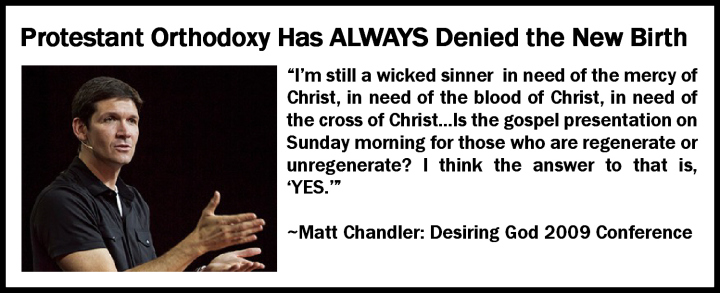
This brings us to another form of assumptive deception; the assumption that specific terms really don’t mean what they mean. In the former, the missing words that would give a more technical understanding are assumed, but in this latter case, technical terms are not taken literally. This assumption is also used to gradually indoctrinate. Example? Certainly, while it is assumed that total depravity only pertains to the unregenerate, the missing information being “saints also,” but assumed that is not the case, we also hear, “We are all just sinners saved by grace.” If parishioners would pay attention, this is an accurate description of Justification by Faith, but it is assumed that it is not saying what it is saying. What is the assumption? That saved people are not perfect, and should therefore show compassion and mercy to the unregenerate because we also fall short of God’s perfection in the present.
What is the term plainly saying per orthodoxy? That we (Christians and unbelievers) are sinners (the biblical designation of the unregenerate) saved (the present perfect assumed, but really present perfect progressive intended) by grace (grace being a replacement word for “salvation” to nuance the true doctrine). Hence, what is really being plainly stated here is that Christians remain unregenerate and still need to be saved from “present sin” by going back to same gospel that saved us for re-salvation. The re-salvation, so-to-speak, is the maintaining of Jesus’ covering for sin since the so-called “believer” is still, clearly, under the condemnation of the law.
Which brings us to another like assumptive term: “We must preach the gospel to ourselves every day.” What is the assumption? That this is a way to not forget the original gospel that saved us leading to a lack of gratitude for our original salvation. Nope, obviously, if we need the gospel every day, it means that we are still sinners who need daily forgiveness (salvation) for present sin, right? Therefore, after all, “We are all sinners saved [daily] by grace [salvation].”
Let me see, we have touched on TULIP, let’s look at one from the 5 Solas. “Christ alone.” What is the assumption? That Christ alone for salvation doesn’t mean that the Father and the Spirit were not equally important participants in salvation. Nope, Protestantism holds to the supremacy of Christ in all things including salvation. When it gets right down to the nitty gritty, orthodoxy teaches that the Father and the Spirit are shadowy manifestations of Christ. Though Protestantism hides behind the trinity versus monotheism debate, the Protestant view of the Trinity is clearly a biblical distortion. It is the supremacy of Christ over the Father and the Spirit.
Now, let’s hone in our your question. Justification by Faith assumes that we are saved by faith in Christ, which is true, but what are the assumptions in regard to this faith in Christ? First, it is assumed that this faith invoked a onetime and complete transformation of the believer from being unregenerate to regenerate. Nope. In Protestantism, as we have discussed, the so-called believer remains unregenerate and must be a member of a local church to obtain continual re-salvation for “present” sin that “removes us from grace requiring daily forgiveness of sins which alone keeps us in the family of God” (John Calvin).
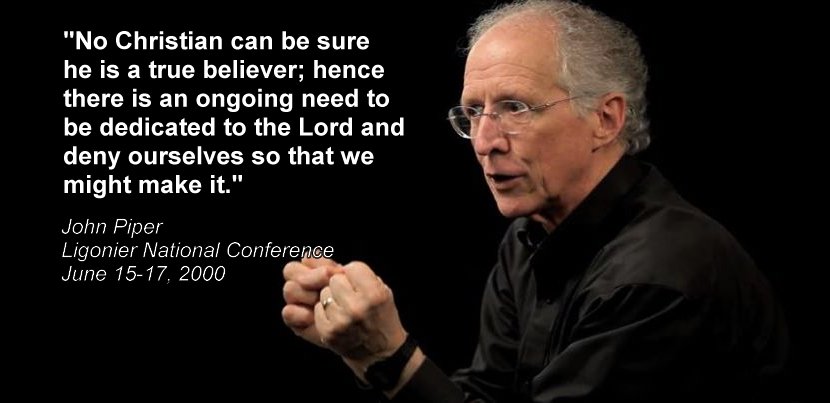
Also, it is assumed that faith in Christ alone is only for our justification, and then we move on with the Christian life (sanctification), and that growth in Christian life is a growing process, but justification is a finished work in the life of the believer. Again, nope. Here is were the term, Justification by Faith, is outright deceptive; justification by faith alone is not the only thing that saves you, but is ONLY “beginning justification.” The progression of justification (and the keeping of salvation), is the definition of sanctification according to orthodoxy. BOTH beginning justification, and progressive justification (what Protestantism calls “sanctification”), must be maintained by “faith alone.” Then, at a one, final judgement, everybody shows up to find out if they were faithful enough to church to get into heaven. This is called, “final justification” and is another official Protestant soteriological term. Backing up a little, I mentioned that “alone” is often dropped from “justification by faith.” This may be because things other than a mental ascent are required to maintain your salvation according to Protestants orthodoxy; primarily, the “ordinary means of grace [salvation], ” which we will discuss further along.
And though it wears you out, this is a yet another assumption; the assumption that “faith alone” is merely believing something in your heart. Nope. When salvation is a process that you are living in the midst of, you must do something, even if it is nothing with intentionality as a decision to not act, which is doing something, being a decision, to keep the salvation process moving in the right direction. And what is that? Their term, not mine; let me repeat that, THEIR term, NOT mine…’The means of grace [salvation].”
And, what are those means of ongoing salvation because it’s stuff we do presently? Prayer, church membership, being faithful to church, viz, “being there every time the doors are open,” tithing, the Lord’s Table, sitting under “gospel preaching,” ect. Because Justification by Faith is really progressive salvation, there must be work works, that do not justify us, and faith alone works that are Protestant works that qualify to be by faith alone, because according to orthodoxy, these are woks “done by the Spirit”…”through us.” Here, we are getting into the complex Gnostic teachings of objective and subjective realm manifestation, which is part of Protestant orthodoxy, but will not be addressed in this post.
A thought: If justification and sanctification are completely separate, one being a finished work and the other being a growing in love in the Christian life, and they are, we are free to obey God’s law aggressively to love God and others without fear of condemnation. That’s true freedom in Christ. Justification by New Birth changes our relationship to the law and gives us this freedom. “Sin,” in this context, is a failure to love that can lead to chastisement by our Father, but does not keep us under the condemnation of the law requiring an ongoing “atonement” for sin. Furthermore, we are slaves to righteousness, not slaves to unrighteousness. Slaves to righteousness is a state-of-being, not a mere legal declaration; a legal declaration is NOT a “manifestation of righteousness APART from the law.”
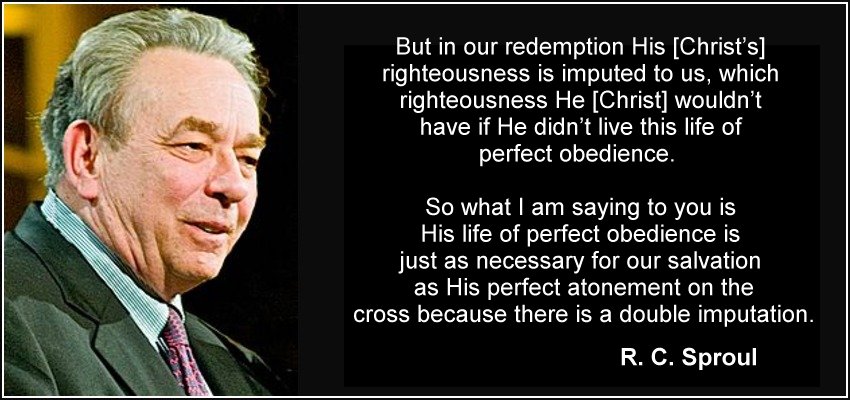
This brings us to the Protestant doctrines of Double Imputation, Mortification and Vivification, and the Vital Union. Double imputation calls for the continual works of Christ’s perfect law-keeping to be imputed to our sanctification to keep us saved through faithfulness to church and its “means of grace.” M and V teaches that our original baptism in the Spirit is repeated over and over again as we return to the same gospel that saved us for forgiveness of present sin. The Vital Union teaches that the benefits of Christ and His works are manifested in us as a result of practicing M and V, or a revisiting of salvation to keep ourselves saved. Remember, these are definitive, stated, church doctrines and most Protestants would be shocked to learn that this is really what the church believes as stated orthodoxy. However, it’s the way they function though they would deny it intellectually. How does this happen? Assumptive Indoctrination.
Now, I like the verses you cited and it has brought something to my attention that I was formally unaware of; there are several versus that actually contain the term, “justification by faith.” And, the fact that these versus add that this justification is not by the law is absolutely perfect for our discussion here. I am sure Protestants are just giddy that the official term for their gospel is biblical wording. BUT, the Protestant JBF gospel is NOT, I repeat, NOT apart from the law. Double Imputation calls for justification to be defined by perfect law keeping. Hence, Christ not only came to die for our sins, but came also to live a perfect life of law-keeping so that these works can be continually imputed to our sanctification IF we are faithful to church. In fact, RC Sproul has said that Christ became righteous through perfect law-keeping. This ministry has stated often why Double Imputation is outright blasphemy. Among the many other reasons, there is no law that can give life, it circumvents the use of the law for love in the Christian life, and “The Promise” made to Abraham and Christ was based on faith alone 430 years before the law came. The real standard for justification is the new birth.
Justification by New Birth changes our relationship to the law and sets us free from any condemnation. In Protestantism’s single perspective on the law in contradiction to Romans 8:2, the so-called “believer” remains under the “righteous demands of the law (Phil Johnson)” and must seek continual “atonement” to remain saved.” Therefore, “sin” has a different context when used in regard to a Christian. It is a failure to love according to the law, not an indictment that can bring condemnation requiring a return to the cross through church ritual. This is the exact same problem that Paul addressed to the Galatians; the law is mutually exclusive to The Promise.
This is a great question and the making of a good post for this morning. Hope you don’t mind, I will keep your real name private.
paul
Like I Said: Protestant Sanctification Requires Remaining Under The Wrath of God
Throughout my TANC 2022 sessions, I argued that assurance of salvation and Protestant sanctification are mutually exclusive. The Reformers argued that assurance of salvation is counterproductive to sanctification, which they believed to be the progression of salvation. When evangelicalism started to return to authentic Protestantism in the early 70’s, the teaching on this was very subtle and nuanced for a number of years. Now, not so much. The following is not arguable: the Protestant definition of a “saved” person is the biblical definition of a lost person. In fact, the likes of John Piper and others state it openly and often. John Piper has stated in no uncertain terms that Christians still need to be saved. And in light of that and many other outrageous things that he has said, he is openly and fully endorsed by John MacArthur Jr. and many other pastor celebrities. This is because Protestant orthodoxy necessarily requires the so-called Christian to remain under the wrath of God; it is a tenet of Protestant soteriology. So, I stumbled upon this Protestant placard this morning and decided to use it to further the point.
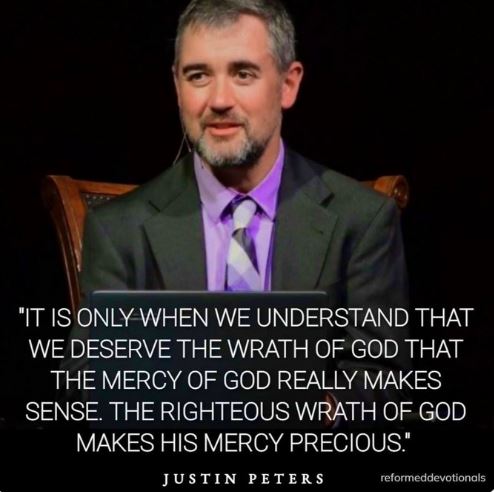
This placard is a prime example of the total lack of understanding that Protestants have concerning salvation. Notice the lack of understanding in regard to transformation from the kingdom of darkness to the kingdom of light. The focus is darkness, not light. According to Protestantism, sanctification is driven by not only remaining in darkness, but acquiring a deeper and deeper understanding of our darkness in order to have a deeper and deeper understanding of what God actually saved us from. Hence, the primary goal of sanctification, and the very definition of spiritual growth, is a deeper and deeper understanding of God’s mercy. Piper et al often state that this appreciation of God’s mercy, which makes the cross bigger, and man smaller, enables us to…”make it” into heaven. This idea is the premise of Martin Luther’s Theology of the Cross, which is the founding principle of the Protestant Reformation. What this brings to mind follows: Jesus said that when the light of the eyes (focus and insight) is darkness, “how deep is that darkness!”
So, if we actually died with Christ, and have been resurrected with him, and as Paul said, “all things are new,” where would our inner source be for discovering this contrast in order to make the cross bigger? Isn’t the primary source for that information, the old us, literally dead? And if we are now slaves of righteousness, wouldn’t the aforementioned endeavor require us to remain slaves of unrighteousness? It just seems to me that a slave to righteousness is going to have difficulty digging up unrighteous fodder. If we are slaves to righteousness, it seems like data for making the cross bigger in our own lives should be harder and harder to find, not easier. And according to this construct, if we are slaves to righteousness, wouldn’t “making it” into heaven be increasingly more difficult?
By the way, why can’t we show our appreciation for being born into God’s family by pleasing our Father, rather than obtaining a deeper and deeper understanding of what we used to be? And if this is the primary endeavor in order to make it into heaven, is time spent loving others diminishing our chances to “make it” into heaven? How does a good slave to righteousness excel at seeing things that are indicative of being enslaved to unrighteousness? It seems to me, on the other hand, that such an emphasis would please our old master, not our new one.
I realize that Martin Luther wanted to make man small and God large through emphasizing the “cross story (glory of God)” versus the “glory story (glory of man),” which encompassed his Theology of the Cross doctrine, but we also need to remember that any kind of striving can be a works salvation; even a striving to make man smaller.
paul

 Paul's Passing Thoughts
2 comments