What is Love?
“Love (agape) suffereth long, and is kind; love (agape) envieth not; love (agape) vaunteth not itself, is not puffed up, doth not behave itself unseemly, seeketh not her own, is not easily provoked, thinketh no evil; rejoiceth not in iniquity, but rejoiceth in the truth; beareth all things, believeth all things, hopeth all things, endureth all things. Love (agape) never faileth:”
~ 1 Corinthians 13:4-8
This passage of scripture is one of the most well-know sections of the Bible. It is most often referred to as the great love chapter, and often the chapter is used in the context of marriage. And while it certainly has application to married couples, the apostle Paul had a much larger context in mind when he began his treatise.
The context actually begins in chapter 12 and extends through chapter 14 of 1 Corinthians. Paul was addressing a specific problem in the assemblies in Corinth and the province of Achaia. The issue was with regard to spiritual gifts among believers, and there were those who regarded certain gifts as more important or of higher esteem than others. More specifically, the Corinthians viewed tongues as the most important gift, and so if you didn’t speak in tongues, then you were considered a lower-class of believer. As a result, everyone wanted to speak in tongues. In 1 Corinthians 12:31 he said you earnestly covet the best gifts (or what they thought were the best). But Paul rebuked them by showing them that this was not loving behavior. This is what prompts the apostle to launch into his in-depth dissertation on the definition and characteristics of love. Let’s consider each one of these characteristics in detail.
“Suffereth long”
μακροθυμει (mak-roth-oo-my) – To be long-spirited. Forbearing or patient. Love hangs in there for the long run.
“Is kind”
χρηστευνεται (chray-styoo-neh-tie) – Derived from the word χρηομαι (chray-oh-my), having to do with the hand in a sense where one is furnishing that which is needed. “Lending a hand”. To show oneself useful. Acting useful. Benevolent. Love does what is needed for another’s benefit.
“Envieth not”
ου ζηλοι (oo dzay-loy) – “oo” being the negative particle meaning “no” or “not”. “Dzay-loy” is derived from the word which means “heat”. To be boiling with heat. Zeal in an unfavorable sense. “Hot headed”; petulant. Love does not behave like a petulant child who doesn’t get his way.
“Vaunteth not itself”
ου περπερευεται (per-per-you-eh-tie) – The prefix “peri” has the meaning of going beyond or further. The double use of “per” in this word gives emphasis of going farther beyond what is necessary, which is what a braggart does. Giving oneself more honor than one should; elevating oneself. Love does not boast, brag, or elevate itself.
“Is not puffed up”
ου φυσιουται (foo-see-oo-tie) – From the root word φυω (foo-oh) meaning to swell up or grow. To inflate or puff up. Used figuratively, to become proud. Love is not proud.
“Doth not behave itself unseemly”
ουκ ασχημονει (ah-schay-mo-nie) – A compound word with the negative particle “a” meaning “no” or “without” and a derivative of two closely related words; εχω (ech-oh) which means to possess some ability, and σχημα (schay-ma) which is some figure, form, or pattern. Literally, it means not being able to possess its form. If someone is behaving in a manner that is considered indecent, he is not behaving the way one would expect him to. Love behaves in a way that would be congruent with what one should expect of love.
“Seeketh not her own”
ου ζητει τα εαυτης (“oo dzay-tie ta heh-ow-tays) – Literally, “not seek of herself”. The key word in this expression is ζητει (dzay-tie), and it has the idea of plotting or making a plan. But it is also used as a “Hebraism” (a Jewish idiom or figure of speech) to indicate worship to God. Either meaning has application. Love does not plan for its own self-interest. Love does not worship itself.
“Is not easily provoked”
ου παροξυνεται (par-ox-oo-na-tie) – A compound word from the prefix παρα (para), meaning along or beside, and οξυς (ox-zoos) meaning keen or sharp or swift. Literally, to sharpen beside. To make “on edge”. If someone is “on edge” they are irritated or frustrated. Love does not become frustrated quickly. Think about how this is related to the first quality of “suffering long”.
“Thinketh no evil”
ου λογιζεται το κακον (oo log-idz-eh-tie to ka-kon). The key word in this expression is λογιζεται (log-id-zeh-tie), and it means to take an inventory. Love does not take an inventory of evil. Or as Paul Dohse says, “don’t keep a sin list.”
Rejoiceth not in iniquity
ου χαιρει επι τη αδικια (oo chai-rie epi tay ah-di-kee-ah) – The word αδικια (ah-di-kee-ah) is a compound word from the negative particle “a” meaning “no” or “without”, and the word δικη (dee-kay) meaning right or just. So this expression literally means “not cheerful about unjustness.” Love does not show joy over unrighteousness.
“Rejoiceth in the truth”
συγχαιρει δε τη αληθεια (soon-chai-rie deh tay a-lay-thie-ah) – The word for truth is interesting. It is a compound word from a negative particle “a” meaning “no” or “without”, and the word “lathano” which means “to lie hidden” or “to be ignorant”. Truth in this sense is literally that which is no longer hidden, or something revealed. Truth is the opposite of ignorance. But notice now that the word “rejoice” translated here has the prefix “soon” before it. The prefix “soon” means “together”. In this one statement, we are to understand that two things are joyful; love AND truth. Each are dependent upon the other. Love shares a joyful symbiotic relationship with truth.
Paul sums up his dissertation on love with four concluding statements.
“Beareth all things”
παντα στεγει (pan-ta steh-geh-ee) – Literally, “to roof over”, that is, “to cover with silence”. In other words, to keep quiet about something. Think about how this relates to “suffering long” and “not taking an inventory of evil”. Love does not bring up past wrongs. It is all-enduring.
“Believeth all things”
παντα πιστευει (pan-ta pis-tyoo-eh-ee) – To have faith in someone or something. To have faith in someone means that you assume the best about them. Love does not automatically think the worst about others. It is all-believing.
“Hopeth all things”
παντα ελπιζει (pan-ta el-pid-zie) – To anticipate with joyful expectation. The Greek word for “hope” does not describe a wishful sort of thinking. It is a looking forward to with absolute certainty, like a child anticipates Christmas morning. He knows it’s going to happen. Love anticipates with certainty the best from others. It is all-expecting.
“Endureth all things”
παντα υπομενει (pan-ta hoo-poh-meh-nie) – A compound word from the prefix “hupo”, meaning “under” and the word “meno”, meaning “to stay or remain”. Literally, “to remain under”. The implications here are both one of submission but also one of support. Love remains supporting even when it has been wronged. It is all-supporting
Something you should notice about chapter 13 is that there is a distinct change in the literary style. To this point, Paul’s style has been logical and conversational. But Paul’s Hebrew cultural influence becomes apparent in chapter 13 as he switches to a very poetic style. One of the most defining characteristics of Hebrew poetry is parallelism. This can be seen in Psalms, where the writer expresses a thought and then restates that same though another way in the next line. The thoughts can either be comparative or contrasting. Paul uses a more complex form of parallelism called inverse parallelism, and you can see it here in 1 Corinthians 13:7. The relationship between these four aspects of love looks like this:
If you go back and consider the commentary we just discussed on each expression, you should notice how closely the inner two characteristics are related and how closely the outer two are related. Another way to see this inverse parallelism is like this:
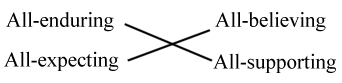
Paul uses parallelism as a poetic way to express his thoughts by restating the same idea in a different way in order to make his point understood. If you look closely at the definitions you will see that the ideas of “bearing” and “enduring” are very much the same thought. Love does not bring up past wrongs (all-bearing/enduring); it remains supporting even when it has been wronged (all-enduring/supporting). It endures those wrongs. Likewise, the ideas of “believing” and “hoping” are also very much the same thought. Love does not automatically think the worst (all-believing), but it anticipates the best with certainty (all-hoping/expecting).
In fact, if you go back and consider the first 8 characteristics of love in verses 4 through 6, they are also arranged in a much larger and even more complex inverse parallelism construct, where one is related to eight, two is related to seven, three is related to six, and four is related to five. Here is a summary of all the characteristics of love just discussed. To help you better see the parallelism just described, I have grouped them accordingly.
Love hangs in there for the long run.
Love does what is needed for another’s benefit.
Love does not behave like a petulant child who doesn’t get his way.
Love does not boast, brag, or elevate itself.
Love is not proud.
Love behaves in a way that would be congruent with what one should expect of love.
Love does not plan for its own self-interest; it does not worship itself
Love does not become frustrated quickly.
Love does not take an inventory of evil.
Love does not show joy over unrighteousness.
Love shares a joyful symbiotic relationship with truth.
Love does not bring up past wrongs. It is all-enduring.
Love does not automatically think the worst about others. It is all-believing.
Love anticipates with certainty the best from others. It is all-expecting.
Love remains supporting even when it has been wronged. It is all-supporting.
Love will never let another down!
Paul’s final statement on love in verse 8 has no parallel line of though with it, but rather it becomes the opening statement to a series of contrasts which we won’t discuss here. Nevertheless, it is still a characteristic of love worth considering.
“Never faileth”
ουδεποτε εκπιπτει (oo-deh-poh-teh ek-pip-tie) – The word for “faileth” is a compound word from the prefix “ek”, meaning “out of” and the word “pipto”, meaning “to fall”, literally or figuratively. In this sense, it does not describe something that comes to an end, but rather something that no longer measures up to a perceived standard of excellence. Love will never let another down.
Think about how these characteristics apply to the use of spiritual gifts among believers. The purpose of gifts is for the mutual edification of the Body of Christ so that each of us may be properly equipped to tell others the good news of the Kingdom. If we are distracted being envious or jealous over each others’ gift or preoccupied over petty disputes or offences toward each other, then we have disqualified ourselves from serving our Father in the mandate He has given us as ambassadors.
Furthermore, think about how love is the antithesis of control. Love does not change behavior by controlling another. It persuades. If we are preoccupied trying to control others, we are not loving them. I am reminded again of the second greatest commandment; love thy neighbor as thyself. Have you ever noticed that it doesn’t say love your neighbor MORE than yourself? No man hates himself. In fact, we are pretty good at loving ourselves. God’s word says to love others JUST AS MUCH AS you love yourself! This means, treat another the same way you want to be treated. That is the definition of love.
Andy
The Gospel of Sovereignty? Romans Series Interlude: Predestination, a Potter’s House Journey; Part 7
Originally posted June 30, 2014

sov·er·eign·ty [sov-rin-tee, suhv-] noun, plural sov·er·eign·ties.
1. the quality or state of being sovereign.
2. the status, dominion, power, or authority of a sovereign; royalty.
3. supreme and independent power or authority in government as possessed or claimed by a state or community.
4. rightful status, independence, or prerogative.
5. a sovereign state, community, or political unit.
“The sovereignty of God” is a phrase that we hear often in Christian circles; in fact, it is a subject that dominates Christian discussion in our day. Moreover, it is an attribute of God that Christians make intrinsic to the gospel itself. In my contention against progressive justification in our day, the argument I hear most is, “You don’t understand the sovereignty of God.”
And no wonder, one of the premier evangelicals of our day, John MacArthur Jr., had this to say in a message titled, “An Explanation of the Sovereign Gospel.”
So we know it has been laid upon us to be faithful in our evangelistic responsibility. At the same time, sometimes we struggle with this reality of divine sovereignty and what it is that we can do when everything is predetermined by God and worked by the Holy Spirit.
Well, the simple answer to the question is God has not only ordained whom He will save, but He has ordained that we in our faithful evangelism would be the means by which He would save His own. To be useful to Him is the purpose in the fulfillment of His sovereign plan, to be an instrument that He can use, to be a vessel unto honor, fit for the Master’s use. To be obedient because that brings, of course, blessing, reward in this life and eternal reward as well (Grace Community Church | Romans 9-11 | September 03, 2011).
Of course, if God has predetermined who will be saved, and uses our evangelism to carry that out, our obedience to evangelism must be preordained as well. As discussed in a previous lesson in this series, this necessarily requires the redefining of the words “obedience” and “reward” as well as many other words and the normative understanding of them. But the main point I want to make here is MacArthur making salvation synonymous with sovereignty which is defined as CONTROL.
Herein is the problem: the word “sovereign” does NOT mean “control,” it means that one has the right to have authority in a given jurisdiction. Even some among the Reformed admit this:
What does it mean to say that God is sovereign? The refrain has become so common, almost clichéd, in Reformed writing and preaching that it sometimes slips away from the reader or listener without lodging meaning in the mind. Worse, we typically hear the phrase to mean something it doesn’t. When Christians affirm that “God is sovereign,” they often mean “God is in control.” Paul Tripp, for example, wrote in his excellent book Lost in the Middle that “God truly is sovereign . . . there is no situation, relationship, or circumstance that is not controlled by our heavenly Father.”
The problem is that the English word sovereignty does not mean control. The U. S. government is sovereign within American territory, but that doesn’t mean the government controls everything within American borders or causes all that happens. If you look up sovereignty in the dictionary you’ll not find control in the definition—nor even as a synonym in a thesaurus.
Sovereignty means “rightful authority.” A dictionary gives “supreme rank” as one definition, and a thesaurus lists jurisdiction and dominion as synonyms. The doctrine of God’s sovereignty tells us God is the rightful ruler of the universe. He has legitimate claim to lordship. His government is just. In fact, justice is defined as his rule. God’s sovereignty doesn’t tell us whether God does in fact rule—just that he ought to, and that we should acknowledge his rule and obey it. (Is “Sovereign” the Best Descriptor for God? Paul D. Miller).
Miller goes on to say…
Once again, it is true God is sovereign. It’s also true he’s in control of everything that happens and he causes all that happens. But that is the doctrine of God’s providence, not his sovereignty.
Does God CAUSE everything to happen? Perhaps, but that’s not what providence means either.
prov·i·dence [prov-i-duhns] noun
1. the foreseeing care and guidance of God or nature over the creatures of the earth.
2. God, especially when conceived as omnisciently directing the universe and the affairs of humankind with wise benevolence.
3. a manifestation of divine care or direction.
4. provident or prudent management of resources; prudence.
5. foresight; provident care.
First, the word “sovereign” appears nowhere in the Bible which should give people pause in regard to the frivolousness of its use in Christian circles. Secondly, it does NOT mean, control, preordination, or predetermination. Certainly, if God wanted to control everything, He could, but does He? Did God know sin was going to come into the world? Yes, so why didn’t he prevent it beforehand? The best answer points to the importance of freewill. God did not cause sin by not preventing it. God tempts no one with sin and is not the creator of evil (James 1:13-18).
When the attributes of God are considered (most theologians name 21 different attributes), absolute deterministic control is not one of them. Even with said attributes, God at times chooses to forfeit the attribute for a period of time. Therefore, if God is predeterminist, He wouldn’t always necessarily choose to predetermine. Some attributes of God are temporarily mutable, and others are NOT ever mutable. An immutable attribute of God is His love towards mankind for all the living. Clearly, an example of an attribute that God has temporarily suspended at times is omniscience:
Genesis 18:20 – Then the Lord said, “Because the outcry against Sodom and Gomorrah is great and their sin is very grave, 21 I will go down to see whether they have done altogether according to the outcry that has come to me. And if not, I will know.”
Mark 13:32 – But concerning that day or that hour, no one knows, not even the angels in heaven, nor the Son, but only the Father.
Also, yes, in regard to some things God is immutable, but in contrast, he can be persuaded by prayer:
Isaiah 38:1 – In those days Hezekiah became sick and was at the point of death. And Isaiah the prophet the son of Amoz came to him, and said to him, “Thus says the Lord: Set your house in order, for you shall die, you shall not recover.” 2 Then Hezekiah turned his face to the wall and prayed to the Lord, 3 and said, “Please, O Lord, remember how I have walked before you in faithfulness and with a whole heart, and have done what is good in your sight.” And Hezekiah wept bitterly.
4 Then the word of the Lord came to Isaiah: 5 “Go and say to Hezekiah, Thus says the Lord, the God of David your father: I have heard your prayer; I have seen your tears. Behold, I will add fifteen years to your life. 6 I will deliver you and this city out of the hand of the king of Assyria, and will defend this city.
2Chronicles 16;12 – In the thirty-ninth year of his reign Asa was afflicted with a disease in his feet. Though his disease was severe, even in his illness he did not seek help from the LORD, but only from the physicians (NIV).
We have established that sovereign would be the wrong word to describe God as causing all that happens, and those things being according to His desired will. It has also been mentioned that the word “sovereign” is not in the Bible. Even if sovereign did mean that all things are predetermined according to God’s pleasure, would it be correct to make that part and parcel with the gospel as most do in our day? Below is yet another version of the infamous Cross Chart that can be applied to this question:

The Problem is defining the gospel according to God’s sovereignty as opposed to God’s love and the good news thereof. Why would the idea that God preordained people to hell be good news? This also speaks to man’s worth. Did Christ die for humanity because it has some kind of worth to God? We can again utilize the cross chart for this question:

To the extent that man has worth, the gospel gets smaller and God’s grace, and the degree of His sacrifice are diminished. A gospel based on the sovereignty of God must completely eliminate man altogether, and John Immel’s point made in this year’s TANC conference is well taken: it eventually boils down to Man having no right to exist.
All of this greatly hinders the proper answering of questions people have about the Bible. Take note of John Piper’s answer to the question, “Why was it right for God to slaughter women and children in the Old Testament? How can that ever be right?”
It’s right for God to slaughter women and children anytime he pleases. God gives life and he takes life. Everybody who dies, dies because God wills that they die.
God is taking life every day. He will take 50,000 lives today. Life is in God’s hand. God decides when your last heartbeat will be, and whether it ends through cancer or a bullet wound. God governs.
So God is God! He rules and governs everything. And everything he does is just and right and good. God owes us nothing.
If I were to drop dead right now, or a suicide bomber downstairs were to blow this building up and I were blown into smithereens, God would have done me no wrong. He does no wrong to anybody when he takes their life, whether at 2 weeks or at age 92.
God is not beholden to us at all. He doesn’t owe us anything.
Now add to that the fact we’re all sinners and deserve to die and go to hell yesterday, and the reality that we’re even breathing today is sheer common grace from God.
I could make the question harder. As it was stated, it doesn’t feel hard to me, because God was stated as the actor.
My basic answer is that the Old and New Testaments present God as the one who has total rights over my life and over my death.
“The Lord gave, and the Lord has taken away; blessed be the name of the Lord” (Job 1:21). How he takes away is his call. He never wrongs anybody.
~ Ask Pastor John | Desiring God .org | February 27, 2010
In essence, you see the mentality in this answer that man does not have the right to exist, and has no worth. Yet…
Malachi 3:17 – They shall be mine, says the LORD of hosts, in the day when I make up my treasured possession, and I will spare them as a man spares his son who serves him.
John Piper has been called out many times publicly for making these kinds of statements in regard to tragedies, but no one seems to understand the ideology behind such statements. Some also notice tacit acceptance of terrorism as well, and the lack of justice in the institutional church for those who have been abused speaks for itself. If the president of the flagship seminary in service to the largest denomination in the world thinks that “One man’s terrorist is another man’s patriot,” what are we to expect?
When one thinks of life past the fatalistic prism of the “sovereign” gospel that saturates today’s church and reads the Bible in the same thinking way, much better answers evolve. Unfortunately, life teaches us that terrorists cannot be reasoned with. I heard a retired high-ranking military official state this week that the only way to deal with terrorists is to eliminate them. Keep in mind, this is because they do not value mankind or life because of the same presuppositions that we are discussing.
When Israel was getting ready to enter the Promised Land, it could very well be that God knew certain cultures in the area would continually harass Israel and were completely unreasonable while having no regard for life. Israel’s lack of obedience in following God’s command to completely wipe out certain cultures came back to bite them for hundreds of years—even until this very day. These were cultures very much like ISIS, the Islamic State of Iraq and Syria who are presently wreaking havoc in the Middle East and mercilessly slaughtering thousands. These people, unfortunately, cannot be negotiated with.
Lastly, another problem with a gospel that is based on deterministic fatalism follows. There is only one person spoken of less in our day than the Holy Spirit: Satan. The Bible warns us throughout to be aware of the devil’s schemes, and that he “deceives” the world. Why would this be relevant and how do you “deceive” someone who is already preordained for eternal punishment? The Bible continually places blame on Satan for leading people into condemnation.
In the final analysis, a “sovereign” gospel devalues prayer, God’s promises, evangelism, sin, justice, hope, life value, future reward, and the belief that what we do in this life is relevant. I have come to believe that people will perish because we have been neutralized by ignorance:
Ezekiel 3:16 – And at the end of seven days, the word of the Lord came to me: 17 “Son of man, I have made you a watchman for the house of Israel. Whenever you hear a word from my mouth, you shall give them warning from me. 18 If I say to the wicked, ‘You shall surely die,’ and you give him no warning, nor speak to warn the wicked from his wicked way, in order to save his life, that wicked person shall die for his iniquity, but his blood I will require at your hand. 19 But if you warn the wicked, and he does not turn from his wickedness, or from his wicked way, he shall die for his iniquity, but you will have delivered your soul. 20 Again, if a righteous person turns from his righteousness and commits injustice, and I lay a stumbling block before him, he shall die. Because you have not warned him, he shall die for his sin, and his righteous deeds that he has done shall not be remembered, but his blood I will require at your hand. 21 But if you warn the righteous person not to sin, and he does not sin, he shall surely live, because he took warning, and you will have delivered your soul.”
John MacArthur claims that Christians should take part in God’s “sovereign” plan, and therefore find blessings in being obedient to evangelism. I have heard this same take from people who equate freewill with an unsovereign gospel/false gospel. Again, God’s “sovereignty” is the attribute that primarily drives the gospel and not love. But the following is irrefutable, such obedience must also be preordained and not really of our own volition. Furthermore, the reward is invalid as well.
I have also come to believe that there are no paradoxes in God’s election. I believe the confusion can be eliminated, and people motivated to labor in God’s ministry field with zeal. But I believe the study will be very hard work.
Nevertheless, let us begin it posthaste.
Protestant and Catholic Progressive Justification
 Both Protestantism and Catholicism hold to progressive justification. This is the idea that salvation is a process, and not a onetime completed event that redirects the believer to focus on representing God’s characteristics in life. Salvation is a gift, life is a reward. Protestantism and Catholicism both make salvation the reward for persevering in church orthodoxy.
With Protestantism and Catholicism, salvation cannot be finished, nor an individual matter between people and God, or the church would have no cause to be supported as an institutional industrial complex. In order for their massive institutions to be supported financially, they must claim God’s authority in overseeing the salvation of humanity.
Protestants claim that the Reformation was necessary because of the issue of “infused grace.” Luther and Calvin believed that all righteousness remains outside of the “believer.” The new birth, as defined by Protestantism, is a mere ability to perceive “truth” while doing no good work. Mortal sin (unforgivable) results if one thinks any person can do a good work. Venial sin (forgivable) results if it is believed that any person, whether saved or unsaved, can do no good work. Venial sin can be forgiven by the “means of grace” found only in the church.
Catholicism believes that the new birth enables the individual to cooperate with the church in finishing salvation. The individual is infused with God’s righteousness and can do good works. Mortal sin is sin committed by those outside of the church. Venial sin can be forgiven through the means of grace found in the church whether Protestant or Catholic. However, in Catholicism, the person actually grows in righteousness. In the end, Purgatory finishes the process, and in fact, makes the person perfect enough to obtain eternal life and enter into heaven. Only members of the Catholic church qualify to enter Purgatory.
Church doctrine is therefore the essence of sin because sin is a master that seeks to control humanity through condemnation (Genesis 4:7). If “believers” still need salvation, they are not free to love without fear of condemnation.
In truth, salvation is finished, and yes, we do “move on to something else” where sin is the exception and not the rule. We are not under law and its demands, but rather under grace and free to fulfill the law through love. The motive of the true believer is love—not law-keeping in regard to orthodoxy.
The Five Lies of the Five Solas: Sola Scriptura
 Originally published October 6, 2014
Once again, as in this post, and this post, we find that people assume much about the clarion call of the Protestant Reformation: the five solas. One assumes that scripture alone means that Christianity draws all of its truth for life and godliness from an exegetical study of the Scriptures. Not so.
Scripture, according to the Reformers, cannot aid the “believer” in wisdom for living life. In fact, living life is not really the business of the believer for that would be works salvation—the Christian life must be EXPERIENCED only through the death and life of Christ.
This is the Reformed doctrine of mortification and vivification. The Christian mustn’t seek to learn the Scriptures and apply the principles to their lives; they must rather use the Scriptures to “gaze” upon the “saving works of Christ in all of the Bible.” This “gazing” upon the salvific works of Christ in all the Scriptures then results in a subjective “reflection” of Christ’s glory. Stars are really just huge chunks of rock floating around in space that reflect the sun’s light; in the same way, we are chunks of dead stones that merely reflect Christ’s light (glory) when we fix our sight on Him alone.
Therefore, according to the Reformed camp, the Bible is merely a tool for gospel contemplationism. Its sole purpose is not to learn more of God’s truth and better ways to love God and others, but rather a gospel narrative that enables us to see our own wretchedness more and more as set against the holiness of God. This results in more and more gratitude for the cross which results in Christ’s glory being REFLECTED from our dead, worthless selves.
This is the crux of the Reformed Redemptive Historical hermeneutic. It calls for seeing and interpreting all reality through the suffering of the cross, or the works of Christ seen in the Scriptures. Biblical imperatives are not anything that we are to do, but rather show us what Christ has already done for us.
Scripture alone for seeing Christ alone, so we can live by faith alone.
paul
Achieving Total Conquest Over Depression, Part 4: Paul and Susan Christian Living Series on Blogtalk Radio Program 6

Live Broadcast link for tonight 2/5/2016 @ 7pm:
Links open in separate pages so you can view without going back and forth reopening pages.
Paul and Susan will have a conversation regarding practical ways to overcome depression. The conversation will focus on the article, “10 Small Steps You Can Take Today to Improve Bipolar Disorder” by Margarita Tartakovsky M.S. Paul will also comment on information sent to him by PPT readers and Blogtalk listeners.
http://psychcentral.com/lib/10-small-steps-you-can-take-today-to-improve-bipolar-disorder/
Of course, everything starts with a proper view of salvation. Assurance of salvation is foundational to “being much more than conquerors” (Romans 8:37). We want to start by discussing these documents sent to us.
1. Justification-Hyper Grace-Trinitarian %231 (1)
3. Justificaton-Hyper Grace-Trinitarian %232
4. Misused Scripture to Support Trinitarian Theology
5. Justification-Hyper Grace-Trinitarian %233
Also in regard to the gospel:
http://www.theologyforwomen.org/2011/01/gospel-defined-part-1.html
Fear and Depression:
http://wutbju.tumblr.com/post/137409149400/on-monday-september-28-2015-at-approximately
Marriage and Bipolar Disorder: 1Corinthians 7:12-14
Self Condemnation and Self Esteem.


 Paul's Passing Thoughts
4 comments