Why David Powlison is a Liar
 Cultists are all the same. First, they believe they understand a higher knowledge that most Christians are not “ready for.” Example: in an interview with John Piper conducted by someone who asked h…
Source: Why David Powlison is a Liar
The Bob Jones DisG.R.A.C.E. Report: Hope for Change if God Cooperates
Editor’s Note: It has been 15 months since the original release of the Bob Jones University G.R.A.C.E. report, and BJU abuse survivors are STILL incredulous that nothing has changed!
bjugrace.com/2015/03/23/an-open-letter-to-bob-jones-university-from-the-survivors-of-the-abuse-response-task-force
Originally Published December 11, 2014
 G.R.A.C.E. stands for “godly response to abuse in the Christian environment.” GRACE is a mediatory organization funded by the institutional church that investigates sexual abuse within Christian environments such as churches, missionary societies, and universities.
Their investigative report process in all cases so far has been slower than mud sliding to the top of Mount Everest. In the case of Bob Jones University, the report will finally be released tomorrow as the Christian community awaits with bated breath. Gag.
I am not going to spend much time on this post because I prefer to let the dead bury their own dead in regard to all of this institutional church drama. GRACE, and their approach, is predicated on Protestant Gnosticism and will not help anyone or do anything towards solving this problem. Boz Tchividjian, the director of GRACE, believes a false gospel and is a blind man leading the blind.
Let me keep this post simple and short because I have written other articles that delve deeply into what the mystical Boz believes, and I will do so by focusing on the closing words of Steve Pettit who read a statement today in regard to the GRACE report. Pettit is the President of BJU. At the end of what he stated must happen as a result of the GRACE report which apparently informed BJU of what was going on in their own university, he said that what must happen will happen by, watch it, here it comes…”the grace of God.”
Right. You see, there is only one thing worse than rape: people bringing about change in their own efforts. The “godly response” must be grounded in what Jesus did, not anything we do. And note that this change comes about by the “grace” of God. Let me rephrase that to clear things up for you: “This will happen by the justification of God,” or “This will happen by the salvation of God,” or “This will happen by the gospel of God.”
They all believe the same thing: we are sanctified by the same gospel that saved us. And you know, this is really “hard work” because of our tendency to do things ourselves, or in our own efforts like you know, Penn State. Sure, they slam-dunked the problem, but God didn’t get any glory. We can’t have that! And as Pettit also stated, the “process” (there is still a process?) is going to take a really, really long time. Hopeful yet?
Apparently, God deliberately takes a long time to deal with these situations so that we will know it has nothing to do with anything we do, but what Jesus has done. That’s the “godly response.”
Now back to the Boz. Why is the mere reporting of all of this such a big deal? Pharisees like us are inclined to say, “A report, so what?” Well, how were you saved? “By faith and repentance.” There you go. The report is designed to elicit deep repentance which results in the manifestation of change brought about by God’s grace, not anything we do. That brings me to the final words of Boz in regard to his statement on the report:
As this historical process comes to an end [no kidding], we continue to pray that the words of this report will fuel hope and healing in the lives of many as well as bring about transformational changes in the life of Bob Jones University. To that end, we look forward to having a front row seat at watching God work.
Right. We only need the GRACE reports to show us how wicked we are, and how much we need God’s grace, then we sit back and watch “God work.” And you know, when it comes to rape God is in no big hurry to stop it lest we believe we did something in the process. If it takes a really, really long time, it must surely be of God.
And these guys are getting paid for this stuff with your hard earned tithe money. You may want to give that some thought.
paul
If You Are a Protestant; i.e., Baptist, Methodist, ect., You Represent a False Gospel
 The Protestant Reformation was never about interpreting the Bible literally, or by its plain sense. The official interpretive policy of the Reformers was historical-redemptive. What’s that? It means the Reformers interpreted the Bible as a salvific metaphysical narrative. This philosophy calls for reality to be interpreted as a prewritten movie of sorts, and the Bible is the script. Bible “stories” are prototypes for interpreting our lives according to redemption, and prophecies foretell how the movie will unfold historically. Supposedly, God decided to write the narrative for His own glory and self-love.
The soteriology of the Reformation is a product of this worldview. That’s why orthodoxy plainly contradicts the plain sense of Scripture or its grammatical sense. Of course, Reformers past and present claim they are grammarians, but that refers to grammatical sentences that explain redemptive-historical state-of -being. In other words, historical-grammatical hermeneutical processes are only a means to explaining historical-redemptive metaphysics which enables them to claim grammatical interpretation. They do this knowingly lest they would be found telling the truth about something.
Before we focus on how Protestant orthodoxy defines itself as biblically unregenerate, let’s answer the question in regard to Protestants being so confused about this very simple truth; how did it happen? From the Reformation moving forward in time, people started interpreting the Bible grammatically from a state-of-being perspective. This was never meant to be, but the natural inclination of people is to interpret reality grammatically, or literally so to speak. This resulted in Protestantism, and all of its various stripes, being half pregnant with “under grace.” The Bible’s definitions of the lost and saved, viz, “under law” or “under grace” became confused.
Actually, it became very confused. Historical-redemptive interpretation enables one to interpret every verse of Scripture as being about salvation while grammatical interpretation demands a dichotomy between Christian living and salvation. The former calls for a salvation process while the latter calls for salvation being a onetime finished work. In 1970, a think tank known as the Australian Forum rediscovered this fact and has brought the church back to its authentic roots via the New Calvinist movement.
Now let’s look at how Protestantism defines the so-called “Christian” as being “under law.” There are myriads of examples, but I will use a select few. John Calvin stated the following in his Institutes of the Christian Religion:
3.14.10 – Even were it possible for us to perform works absolutely pure, yet one sin is sufficient to efface and extinguish all remembrance of former righteousness, as the prophet says (Ezek. 18:24). With this James agrees, “Whosoever shall keep the whole law, and yet offend in one point, is guilty of all,” (James 2:10). And since this mortal life is never entirely free from the taint of sin, whatever righteousness we could acquire would ever and anon be corrupted, overwhelmed, and destroyed, by subsequent sins, so that it could not stand the scrutiny of God, or be imputed to us for righteousness. In short, whenever we treat of the righteousness of works, we must look not to the legal work but to the command. Therefore, when righteousness is sought by the Law, it is in vain to produce one or two single works; we must show an uninterrupted obedience. God does not (as many foolishly imagine) impute that forgiveness of sins once for all, as righteousness; so that having obtained the pardon of our past life we may afterwards seek righteousness in the Law. This were only to mock and delude us by the entertainment of false hopes. For since perfection is altogether unattainable by us, so long as we are clothed with flesh, and the Law denounces death and judgment against all who have not yielded a perfect righteousness, there will always be ground to accuse and convict us unless the mercy of God interpose, and ever and anon absolve us by the constant remission of sins. Wherefore the statement which we set out is always true, If we are estimated by our own worthiness, in everything that we think or devise, with all our studies and endeavors we deserve death and destruction.
3.14.11 – We must strongly insist on these two things: That no believer ever performed one work which, if tested by the strict judgment of God, could escape condemnation; and, moreover, that were this granted to be possible (though it is not), yet the act being vitiated and polluted by the sins of which it is certain that the author of it is guilty, it is deprived of its merit. This is the cardinal point of the present discussion.
Calvin makes two things perfectly clear from the Reformed perspective: “Christians” are still judged by the law and its demand for perfection, and therefore, no “Christian” can please God via a righteous work. Simply stated, “under law.” Anyone reading this post should be familiar with many Bible verses that call us to please God with our works, but nevertheless, I will cite the following:
Romans 8:1 – There is therefore now no condemnation for those who are in Christ Jesus. 2 For the law of the Spirit of life has set you free in Christ Jesus from the law of sin and death. 3 For God has done what the law, weakened by the flesh, could not do. By sending his own Son in the likeness of sinful flesh and for sin, he condemned sin in the flesh, 4 in order that the righteous requirement of the law might be fulfilled in us, who walk not according to the flesh but according to the Spirit. 5 For those who live according to the flesh set their minds on the things of the flesh, but those who live according to the Spirit set their minds on the things of the Spirit. 6 For to set the mind on the flesh is death, but to set the mind on the Spirit is life and peace. 7 For the mind that is set on the flesh is hostile to God, for it does not submit to God’s law; indeed, it cannot. 8 Those who are in the flesh cannot please God.
In this passage, the apostle Paul clearly delineated between the lost and the saved, and in regard to “For the mind that is set on the flesh is hostile to God, for it does not submit to God’s law; indeed, it cannot. Those who are in the flesh cannot please God,” John Calvin would say, “Yep, that’s us!” While Paul clearly stated that Christians are no longer under the law’s demand for perfection; Calvin clearly contradicts him. While Paul defines a true believer as someone who CAN please God, Calvin flatly denies it…in writing.
Calvin defines the Christian as under “the law of sin and death” while Paul defines the Christian as under “the law of the Spirit of life” which is the same as being under grace. If you reread the excerpt from the Institutes, Calvin defines the Christian in nearly the exact same way that Paul described the unregenerate. Paul distinguishes how the Spirit uses the law in regard to the unsaved versus the saved. For those under law, the Spirit uses the law to condemn only. The Reformed concur because they say this continually drives the Christian back to the cross for continued atonement for “present sin.”
In contrast, the Spirit uses the law to sanctify believers (John 17:17), and does not use the law to keep so-called Christians under condemnation. This demands a progressive salvation versus a salvation that is finished. The Australian Forum framed it this way:
The Holy Spirit gives the sinner faith to accept the righteousness of Jesus. Standing now before the law which says, “I demand a life of perfect conformity to the commandments,” the believing sinner cries in triumph, “Mine are Christ’s living, doing, and speaking, His suffering and dying; mine as much as if I had lived, done, spoken, and suffered, and died as He did . . . ” (Luther). The law is well pleased with Jesus’ doing and dying, which the sinner brings in the hand of faith. Justice is fully satisfied, and God can truly say: “This man has fulfilled the law. He is justified.”
We say again, Only those are justified who bring to God a life of perfect obedience to the law of God. This is what faith does—it brings to God the obedience of Jesus Christ. By faith the law is fulfilled and the sinner is justified (Present Truth: Law and Gospel; Volume 7, article 2, Part 2).
John Piper, the contemporary “elder statesman” of the New Calvinist movement stated it this way:
We all sense intuitively-and we are encouraged in this intuition by the demands of God-that acceptance with God requires perfect righteousness conformity to the law (Matthew5:48; Galatians 3:10; James2:10). We also know that our measures of obedience, even on our best days, fall short of this standard (Counted Righteous in Christ: Page 123; 2002).
To be under the righteous and perfect demands of the law to remain justified is clearly… “under law.” Also, note that both contemporary Reformers and Calvin always cite James 2:10 as a proof text:
For whoever keeps the whole law but fails in one point has become accountable for all of it.
But it is no mere oversight that they fail to contrast that with love fulfilling the whole law as well (Gal 5:14, Matt 22:40, Rom 3:10). James 2:10 is “under law” while Galatians 5:14 ect. refers to “under grace” (Rom 6:14).
Those who call themselves Protestants identify with a false gospel, but granted, could be confused enough to be saved. However, confusion in the Christian life is not good and is obviously indicative of what we see in the church.
paul
Paradox?
The good news is that "the promise" (gospel) is a paradox? How can a promise be a paradox?
— Paul M. Dohse (@PaulMDohse) March 16, 2016
John Calvin’s Gospel of Works, Fear, and NO Assurance
…Originally published December 13, 2013
 “According to Calvin, fear of future judgment is one of the primary motivations for repentance in the Christians life:”
John Calvin was pure heretic. The present-day exaltation of him by the who’s who of evangelicals is an abomination before the Lord. For Calvin, the Christian life is lived out in a progression of justification; viz, justification is not a onetime event that is a finished work by God alone. The Christian life starts with repentance and faith, and that not only justifies us in the beginning, it must continue to justify us throughout the course of our life. “Progressive sanctification” is really progressive justification. The Christian life is not lived out as a result of our salvation; we must live in the progression of salvation and stay in its status through faith and repentance alone. We must keep ourselves saved by perpetual repentance. This is the “P” in TULIP, “perseverance of the saints.” No distinction is made between repentance unto salvation and repentance as a son of God. Calvin evokes all Scriptural calls to repentance for salvation as indicative of the Christian life. Calvin cites biblical salvation verses—as verses pertaining to the Christian life throughout the Calvin Institutes.
Furthermore, Calvin insisted that Christian repentance is motivated by fear, and repentance is active, while the results of repentance, a joyful rebirth experience, is the work of God. It is a perpetual revisiting of the gospel that saved us in order to keep ourselves saved. Our only work is repenting of sin while works imputed by God to our Christian life are only experienced, and not performed.
First, Calvin defines repentance in his Institutes. Keep in mind that he is not writing about original salvation, but the Christian life. This will be confirmed after this citation:
Certain learned men, who lived long before the present days and were desirous to speak simply and sincerely according to the rule of Scripture, held that repentance consists of two parts, mortification and quickening. By mortification they mean, grief of soul and terror, produced by a conviction of sin and a sense of the divine judgment. For when a man is brought to a true knowledge of sin, he begins truly to hate and abominate sin… By quickening they mean, the comfort which is produced by faith, as when a man prostrated by a consciousness of sin, and smitten with the fear of God, afterwards beholding his goodness, and the mercy, grace, and salvation obtained through Christ, looks up, begins to breathe, takes courage, and passes, as it were, from death unto life. I admit that these terms, when rightly interpreted, aptly enough express the power of repentance; only I cannot assent to their using the term quickening, for the joy which the soul feels after being calmed from perturbation and fear. It more properly means, that desire of pious and holy living which springs from the new birth; as if it were said, that the man dies to himself that he may begin to live unto God (CI 3.33).
We must now explain the third part of the definition, and show what is meant when we say that repentance consists of two parts—viz. the mortification of the flesh, and the quickening of the Spirit (CI 3.3.8).
And for how long do we partake in this perpetual repentance (mortification) and rebirth (vivification)?
This renewal, indeed, is not accomplished in a moment, a day, or a year, but by uninterrupted, sometimes even by slow progress God abolishes the remains of carnal corruption in his elect, cleanses them from pollution, and consecrates them as his temples, restoring all their inclinations to real purity, so that during their whole lives they may practice repentance, and know that death is the only termination to this warfare…It is not denied that there is room for improvement; but what I maintain is, that the nearer any one approaches in resemblance to God, the more does the image of God appear in him. That believers may attain to it, God assigns repentance as the goal towards which they must keep running [emphasis added] during the whole course of their lives (CI 3.3.9).
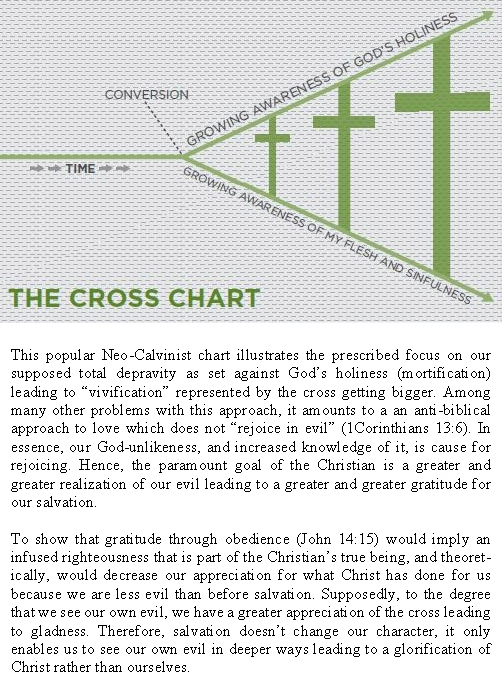
Though Calvin wrote of being transformed into the “image” of God, this is part and parcel with the passive and perpetual rebirth experience by the Christian. This does not denote a change or improvement in the Christian’s nature which would lessen the need for repentance. Obviously, if you look at the chart below, raising the trajectory of repentance makes the cross smaller, so repentance leading to real change is not in focus here. Calvin’s idea of transformation regards the birthing of realms which is experienced by the Christian through joy. Hence, the new birth is perpetual through the Christian’s life and is the result of perpetual repentance. We are to repent and dwell on our own depravity, and leave any quickenings or rebirth experiences to God:
He, however, who has emptied himself (cf. Phil. 2:7) through suffering no longer does works but knows that God works and does all things in him. For this reason, whether God does works or not, it is all the same to him. He neither boasts if he does good works, nor is he disturbed if God does not do good works through him. He knows that it is sufficient if he suffers and is brought low by the cross in order to be annihilated all the more. It is this that Christ says in John 3:7, »You must be born anew.« To be born anew, one must consequently first die and then be raised up with the Son of Man. To die, I say, means to feel death at hand (Martin Luther: Heidelberg Disputation, theses 24).
In obedience to God’s word we should fight to walk in the paths where he has promised his blessings. But when and how they come is God’s to decide, not ours. If they delay, we trust the wisdom of our Father’s timing, and we wait. In this way joy remains a gift, while we work patiently in the field of obedience and fight against the weeds and the crows and the rodents. Here is where joy will come. Here is where Christ will reveal himself (John 14:21). But that revelation and that joy will come when and how Christ chooses. It will be a gift… Heaven hangs on having the taste of joy in God. Therefore, it might not be so strange after all to think of fighting for this joy. Our eternal lives depend on it (John Piper: When I Don’t Desire God; p.43, p.34).
It is also important to note that in this construct, for the most part, repentance is something we focus on, and not something we necessarily try to do. The goal is to see our own depravity in a deeper and deeper way, and this results in a joyful rebirth experience that is totally out of our control. But yet, we must fight for this joy, or rebirth experience because “Our eternal lives depend on it.” Not only is this clearly works salvation, but it makes our eternal destiny ambiguous at best. Therefore…
Let us, therefore, embrace Christ, who is kindly offered to us, and comes forth to meet us: he will number us among his flock, and keep us within his fold. But anxiety arises as to our future state. For as Paul teaches, that those are called who were previously elected, so our Savior shows that many are called, but few chosen (Mt. 22:14). Nay, even Paul himself dissuades us from security, when he says, “Let him that thinketh he standeth take heed lest he fall,” (1 Cor. 10:12). And again, “Well, because of unbelief they were broken off, and thou standest by faith. Be not high-minded, but fear: for if God spared not the natural branches, take heed lest he also spare not thee,” (Rom. 11:20, 21). In fine, we are sufficiently taught by experience itself, that calling and faith are of little value without perseverance, which, however, is not the gift of all (CI 3.24.6).
There is danger on the way to salvation in heaven. We need ongoing protection after our conversion. Our security does not mean we are home free. There is a battle to be fought (John Piper: Bethlehem Baptist Church Minneapolis, Minnesota; The Elect Are Kept by the Power of God October 17, 1993).
According to Calvin, fear of future judgment is one of the primary motivations for repentance in the Christians life:
By mortification they mean, grief of soul and terror, produced by a conviction of sin and a sense of the divine judgment [sec.3]… it seems to me, that repentance may be not inappropriately defined thus: A real conversion of our life unto God, proceeding from sincere and serious fear of God; and consisting in the mortification of our flesh and the old man, and the quickening of the Spirit. In this sense are to be understood all those addresses in which the prophets first, and the apostles afterwards, exhorted the people of their time to repentance. The great object for which they labored was, to fill them with confusion for their sins and dread of the divine judgment, that they might fall down and humble themselves before him whom they had offended, and, with true repentance, retake themselves to the right path [sec.5]… The second part of our definition is, that repentance proceeds from a sincere fear of God. Before the mind of the sinner can be inclined to repentance, he must be aroused by the thought of divine judgment; but when once the thought that God will one day ascend his tribunal to take an account of all words and actions has taken possession of his mind, it will not allow him to rest, or have one moment’s peace, but will perpetually urge him to adopt a different plan of life, that he may be able to stand securely at that judgment-seat. Hence the Scripture, when exhorting to repentance, often introduces the subject of judgment, as in Jeremiah, “Lest my fury come forth like fire, and burn that none can quench it, because of the evil of your doings,” (Jer. 4:4)… The stern threatening which God employs are extorted from him by our depraved dispositions [sec.7] [from the CI 3.3.3-7].
Of course, this is all in egregious contradiction to the Scriptures; viz,
1John 4:18 – There is no fear in love, but perfect love casts out fear. For fear has to do with punishment, and whoever fears has not been perfected in love.
Calvin’s false gospel requires us to run a race of perpetual repentance driven by fear of judgment in order to keep ourselves saved. The new birth is not a onetime event known as regeneration, but is only an EXPERIENCE that follows the mortification of repentance. Calvin states that these quickenings that follow mortification are accompanied by joy and subjective manifestations of God’s image. Many are called, but not all have the gift of persevering in the cycle of mortification and vivification. Therefore, assurance of salvation is dubious at best.
Beside the fact that the apostle John wrote the book of 1John so that we can “know” that we are saved, Calvin’s gospel contradicts a mass of holy writ. This subjective gospel also adds a peculiar twist if you consider Calvin’s power of the keys; ie., whatever elders bind on earth will be bound in heaven. While the soteriology lends uncertainty to one’s eternal destiny, is assurance found more in having the elder’s approval? After all, if he states that you are saved, heaven will bind it.
paul


 Paul's Passing Thoughts
leave a comment