True Christians Are NOT “Under Construction”
 It is one thing to be wrong about the gospel, but it is yet another to be wrong about your understanding of the gospel you identify with which is also an errant gospel to begin with. I guess you could call it double wrongness or something of the sort. This is where Catholics are far less wrong than Protestants; they have a clear understanding in regard to their orthodoxy, though wrong. Most Protestants misunderstand the orthodoxy that is errant to begin with, so they are wrong about what they are wrong about. This is why the world deems Protestantism as stupid…because it is. Nobody respects double wrongness.
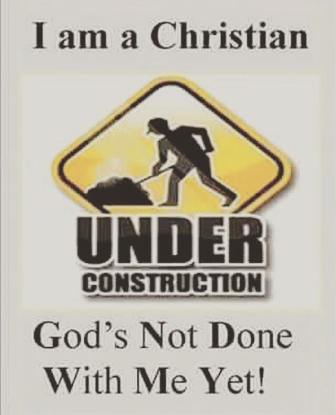
And this meme is yet one more example. It is popular because Protestants think the law is the ground of justification, and of course, no one can keep the law perfectly, so this meme is a Protestant lame attempt to explain to the world why professing “Christians” are not “perfect.” Supposedly, we are “under construction,” viz, we are growing in the Lord and learning to keep the law better and better as we grow.
Well, that is wrong, but also, that’s not Protestantism. So Protestants are wrong about the law being the ground of justification, but they are also wrong about the idea that Protestant orthodoxy holds to a progressive maturity of the believer. NOT. “I” is not under construction; that’s not Protestantism at all.
True Protestant orthodoxy holds to the idea that the “believer’s” ability to merely perceive or “see” a Christocentric metaphysical reality is under construction, but that excludes any possible good work done by the so-called believer. The meme suggests that the believer’s life-testimony improves according to Protestant orthodoxy, but nothing could be further from the truth.
What is in view is an ability to see a greater and greater need for our original salvation and thereby magnifying the gospel. Hence, we are supposedly more and more saved by “seeing” a greater and greater need for the same gospel that saved us. This perception supposedly increases our “gratitude” for salvation which moves our progression of salvation closer and closer to final salvation or what is known as “final justification.” According to authentic Protestantism, what is really under construction is our salvation while many assume the meme is referring to sanctification. But in Protestant thought, sanctification has been redefined to mean progressive justification. The often used term “progressive sanctification” in Protestant circles is a lie.
Some contend that gospel contemplationism increases our gratitude for salvation as we seek to see our sinfulness more and more, and this motivates us to good works. The gratitude supposedly purifies our otherwise evil works. In other words, all of our truly good works must be motivated by our gratitude or else the works are moralistic attempts to justify ourselves. So, whenever we do a deed joyfully, by this we know that the deed flows from gratitude and is not works salvation accordingly.
This idea may give some credence to sanctification by justification, but that’s not Protestantism either. Protestantism excludes the possibility of any good work performed by any human being whether saved or unsaved. The only difference between a lost person and a saved person is worldview/perception. This increased perception increases the “glory of the gospel; not our own glory” which would supposedly be works salvation. According to Martin Luther’s 97 Theses, 95 Theses, and the Heidelberg Disputation; the three foundational documents of the Protestant Reformation, any belief that any individual can do a good work is mortal sin (unforgivable and beyond the scope of salvation).
Therefore, salvation is really under construction and that is defined by an increased ability to see one’s own evil and thereby increasing their salvation. It’s salvation by glorifying the cross, not anything we do as a result of being new creatures. This is the crux of Martin Luther’s Theology of the Cross defined by the cross story versus the glory story. Only two things can receive glory: the cross, or man. Any belief that glorifies man; ie., man can do a good work, is a false gospel. That’s Protestantism plain and simple; nothing more or less.
The following illustrations were taken from a book on Protestant orthodoxy:
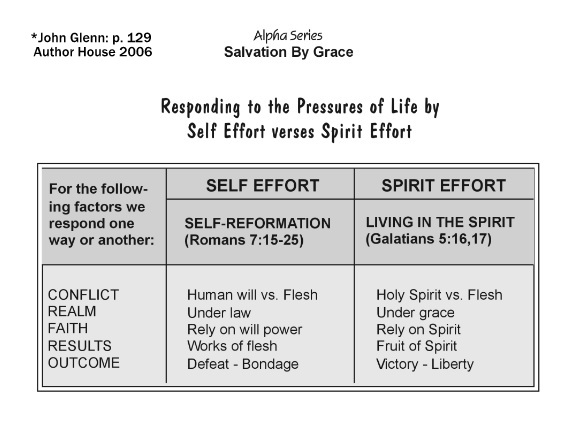
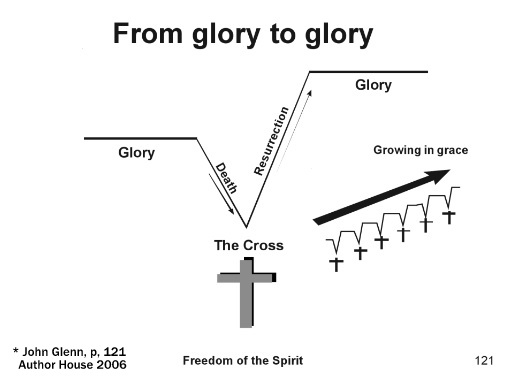
Note that non-salvation and salvation are defined by “realms” not a personal state of being. The person does not change; only one’s ability to see realms which are only experienced. Our own efforts are works of the flesh while the works of the Spirit are manifestations that we only experience. The “death” we partake in is an endeavor to see how evil we are resulting in a resurrection that increases the glory of the cross.
Seeing the glory of the cross more and more which necessarily demands that you see yourself as more and more evil results in one getting closer and closer to final salvation. Salvation is what is under construction, not the person. This is the Protestant doctrine of mortification and vivification (death and resurrection) which is a redefinition of the new birth. Instead of the new birth occurring once and justifying us by a transformation of our being, one partakes in perpetual deaths and rebirths to gain more and more salvation. In essence, finding joy in finding our evil.
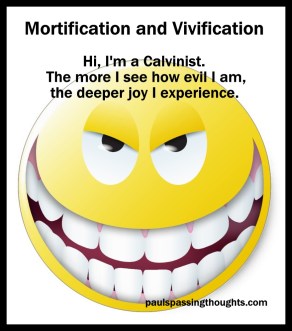
Per the usual, a true understanding of Protestantism is Clintonian; it depends on what you mean by the word “is” when you say something “is.” In the case of this meme and all other words used by Protestants, you must know the actual Protestant definition. In this case, what is under construction?
Well, it depends on what you mean by the word, “I.”
paul
Register for TANC 2016 Conference on Gospel Discernment and Spiritual Tyranny
Registration Link: http://tanc2016.weebly.com/registration.html
TANC 2016: Paul Dohse
 Paul became a Christian in 1983. His salvation experience was powerful and with much assurance. As he began studying the Scriptures for himself, contradictions between the plain sense of Scripture and his church experience increased more and more as each year passed.
Furthermore, though Paul could make some sense out the Bible that encouraged him to a point, for the most part, the Bible seemed to be confusing, mysterious, and contradictory. Paul’s initial salvation experience declined into confusion, doubt, and at times despair. Eventually frustrated by the church’s comfortable coexistence with confusion and contradiction, he set out on a journey to make sense of the chaos.
After publishing a book on the Neo-Calvinist movement in 2011 that was the culmination of four years of research, he abandoned all presuppositions and began studying the book of Romans word by word. The goal was to draw conclusions from the literal grammar alone. In other words, just let the words say what they say regardless of anything.
During this process, a profound pattern in the book of Romans began to emerge: a righteousness completely separate from the law; the idea that justification and law are mutually exclusive. The idea that the ground of our justification is the new birth—not the law or any law-keeping by Christ imputed to our account. Hence, who keeps the law is irrelevant; the law has no part with justification. It’s not just man’s law-keeping that is separate from justification; the law itself is separate from justification which would also include any law-keeping by Christ. Again, who keeps the law is irrelevant—there is no law in justification; “apart,” means just that…APART! (Romans 3:21).
The gravity of this truth is immense because Protestantism and Reformed tradition are founded on the idea that Christ fulfills the “righteous demands of the law” in our stead.
How could the Reformers have missed such a simple point? And how did this blatant error come to define Western orthodoxy? And finally, what is the alternative? This will be the subject of Paul’s three sessions at this year’s Conference on Gospel Discernment and Spiritual Tyranny.
Support Your Local Pizza Guy
This is a great story. I am truly happy for this young man and the love he was shown. This is the sort of thing that we as believers are supposed to do.
“Pure religion and undefiled before God and the Father is this, To visit the fatherless and widows in their affliction, and to keep himself unspotted from the world.” ~ James 1:27
The first century assemblies were characterized by spontaneous benevolence towards those in their assemblies who were in great need. Chief among those were widows and orphans (Acts 6). But consider what was the cost of being a follower of “the way”. For many, it most likely cost them their jobs, their livelihood, their families. Recognizing this great need, other believers, both rich and poor, gladly sold what they had so that the needs of others were met.
“And all that believed were together, and had all things common; and sold their possessions and goods, and parted them to all men, as every man had need.” ~ Acts 2:44-45
“And the multitude of them that believed were of one heart and of one soul: neither said any of them that ought of the things which he possessed was his own; but they had all things common…Neither was there any among them that lacked: for as many as were possessors of lands or houses sold them, and brought the prices of the things that were sold, and laid them down at the apostles’ feet: and distribution was made unto every man according as he had need.” ~ Acts 4:32-35
This is exactly how a Body functions; when one member hurts, the rest of the Body suffers with it and immediately reacts to enable healing to take place.
Even the Gentile believers across Asia Minor and Greece recognized their oneness with Jewish believers back in Jerusalem. The assemblies in Macedonia took up a special offering in order to send relief to those believers when they learned of the tremendous persecution they were enduring.
How is “giving” characterized in the church these days? All revenue collected in the offering place goes to support huge church budgets; churches who have several paid “elders” (associate pastors) on staff, pastors’ benefits, expense accounts, building programs, building maintenance, utility expenses and other operating costs, Christian schools and teachers’ salaries, missionaries, church planting, youth programs, and outreach “ministries”. With all of this infrastructure to maintain, there is very little left, if anything, to help those in need. And the sad part is that even those who are truly in need are expected to hand over their share to support this monstrosity. Yet this is what people willingly pay for their salvation. After all, it’s one of the “means of grace”, right?
With regard to this pizza guy, I can’t help but think that this particular “church” that helped him out has a half-million dollar budget or more, and $700 is a drop in the bucket, all things considered. Even then they probably took a special offering that day just for the purpose of helping this guy. This hardly qualifies as “spontaneous” benevolence. It would have had to be planned ahead of time. In which case, this whole incident ends up being nothing more than a publicity stunt.
Just think how many “pizza guys”, both inside the church and outside, believers could help out if their giving wasn’t tied up in supporting “infrastructural worship”!
Andy

 Paul's Passing Thoughts
3 comments