The Latest Tullian Tchividjian / Tom Chantry Episodes Expose the Folly of Protestant Church
 Paul Dohse for TANC Ministries: a response to the call to a repentance process for Tullian Tchividjian.
Tullian Tchividjian, the great-grandson of Billy Graham and a wildly popular teacher among evangelicals is also a sultan of authentic Protestant orthodoxy in our day. No one, but no one, can articulate Protestant orthodoxy better.
So, it shouldn’t surprise us that his immoral sexual exploits have become public, but it should surprise us that the who’s who of evangelicalism are calling for his complete departure from ministry. The same could be said for many other uber-popular evangelical leaders that have been caught with both hands in the cookie jar. Recent examples include RC Sproul Jr., Rob Turner, and Tom Chantry. Those are the most recent ones as these episodes are becoming un-news-worthy due to frequency.
Why should it surprise us that they are expected to resign from ministry? Because their behavior is the logical outcome of Protestant soteriology. I explained this in a recent post:
The Protestant Reformation was NEVER about individual transformation. Instead, it was about the extreme opposite. The real Protestant gospel was about growing in one’s understanding of how large the gulf is between God’s holiness and man’s depravity. This is a salvation process that begins with basic knowledge concerning man’s evil and God’s good (the knowledge of good and evil), and one grows in their salvation as they see the degree of discrepancy between man’s evil and God’s good. Therefore, one’s growth in salvation is determined by their increased appreciation of what Christ did for us, not anything we do.
True salvation, according to authentic Protestantism, begins with recognizing that man can only be evil, and only God can be good. Growth in salvation is determined by one’s understanding of the following: the degree of difference between the two.
Hence, according to the true Reformation gospel, God’s righteousness is purely substitutionary. This is Martin Luther’s “alien righteousness.” Now, what Protestants ASSUME is the following: “Well, but of course, before we were saved we had no righteousness of our own.” Um, no, the Protestant gospel demands an alien righteousness throughout the salvation PROCESS while salvation (being justified before God) requires a “righteousness outside of us.” Our righteousness (justification) is therefore said to be a mere “legal declaration.”
The new birth is then relegated to a mere gift that enables one to perceive (only) God’s holiness as set against our wickedness. That’s the Protestant gospel plain and simple and it’s not even arguable.
Tom Chantry, son of Reformed icon Walter Chantry, and recently indicted for child molestation, put it this way:
One way to summarize the doctrine of divine sovereignty is this: It is God who acts, not man. How will the lost be saved? God must act. How will sinful Christians overcome the “old man”? God must act. How will the church grow in both holiness and influence? Again, God must act. He is the sovereign; He is the great Actor in every aspect of our spiritual life.
This is the typical verbiage we hear non-stop from evangelical pastors in every kind of church. Yet, in light of further allegations concerning Tchividjian, a group of well-known evangelicals have penned an open letter that further illustrates the decadence of the Protestant Institutional church. While knowing grade-A-well that Protestantism promotes the total depravity of the saints, church leaders continue to advertise the church as a cultural moral compass and society’s moral high ground. This is a deliberate ploy that plays to the expectations of society at large.
This is the church’s cultish approach that draws people in under the pretense of individual transformation and healing, and then uses assumptions to slowly strip them of all individualism and personal identity with God. This eventually makes them slaves of ecclesiological authority. If “believers” have no righteousness infused within as a result of the new birth, they have no right to their own lives or ability to determine God’s will for themselves. The church has always claimed authority over the souls of mankind by proxy.
This is the institutional church scam: the same “behaviorism or moralism” disdained as an affront to God within the church is used to recommend itself to the world. While making any moral performance an act of God alone, they call on Tchividjian to “repent.” Really? Tchividjian is a leading authority on what the Reformers meant by that word and must know that these “teachers” are grandstanding. Obviously, none of them really believe that any person can repent or do any good work. In fact, they say it continually.
Furthermore, why are any of these scholarly reprobates shamed at all? According to their theology it was God who didn’t act to prevent their behavior to begin with. Also, such behavior is inevitable according to their presuppositions concerning mankind.
And lastly, why are sane people giving their hard earned money or time to this gargantuan lie called “church”?
Is Protestantism the Greatest Lie of All Time?
For centuries, Protestants have joined churches and answered the altar calls in order to obtain “salvation.” The assumption has always been that salvation changes people. Pastors of Protestant churches even lament over people who lack commitment and only want “fire insurance.” They also call for a life testimony that matches their confession. Fed up with hypocrisy in the church, millions of Protestants sang the praises of John MacArthur Jr.’s “Lordship Salvation” movement spawned in 1988.
Curiously, this put MacArthur at odds with Bible-thumping Baptists who objected to MacArthur’s suggestion that a true confession requires a commitment to obey the Bible rather than a mere mental assent to gospel facts about Christ. Supposedly, a commitment to good works in one’s confession is tantamount to salvation by works and not faith alone, a Reformation no-no. Because few Protestants really know what the Reformation was really about, the Lordship controversy raged for years with no definitive outcome.
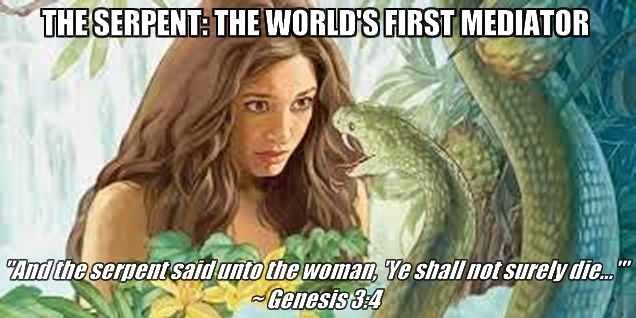
The Protestant Reformation was NEVER about individual transformation. Instead, it was about the extreme opposite. The real Protestant gospel was about growing in one’s understanding of how large the gulf is between God’s holiness and man’s depravity. This is a salvation process that begins with basic knowledge concerning man’s evil and God’s good (the knowledge of good and evil), and one grows in their salvation as they see the degree of discrepancy between man’s evil and God’s good. Therefore, one’s growth in salvation is determined by their increased appreciation of what Christ did for us, not anything we do. Growth in salvation is therefore determined by our “increase of gratitude” regarding the gospel. I believe this to be a form of the very religion that the serpent presented to Eve in the garden; the knowledge of good and evil.
True salvation, according to authentic Protestantism, begins with recognizing that man can only be evil, and only God can be good. Growth in salvation is determined by one’s understanding of the following: the degree of difference between the two.
Hence, according to the true Reformation gospel, God’s righteousness is purely substitutionary. This is Martin Luther’s “alien righteousness.” Now, what Protestants ASSUME is the following: “Well, but of course, before we were saved we had no righteousness of our own.” Um, no, the Protestant gospel demands an alien righteousness throughout the salvation PROCESS while salvation (being justified before God) requires a “righteousness outside of us.” Our righteousness (justification) is therefore said to be a mere “legal declaration.”
The new birth is then relegated to a mere gift that enables one to perceive (only) God’s holiness as set against our wickedness. That’s the Protestant gospel plain and simple and it’s not even arguable. And I do believe it is the “knowledge of good and evil” religion that eventually led to Platonism and Gnosticism. Am I saying that Protestantism is founded on Gnosticism? Well, that’s black and white church history for anybody to read at their convenience.
What are the results of all of this? Church. The message on the digital sign facing the highway in front of the church reads, “Real Christians Act Like Christians,” but inside in the milieu of debauchery we hear, “We are all just sinners saved by grace.” This is Martin Luther’s Simul Justus et Peccator or “simultaneously saint and sinner.” The deliberate deception using people’s assumptions suggests some kind of paradox, but what is really being stated follows: the righteousness of “believers” is only a legal declaration while the “believer” remains totally depraved. Your sainthood status is increased by seeing more of your totally depraved state of being.
Those who believe they are totally depraved will either act out accordingly or tolerate those who do. The church is therefore made up of four groups of people: the reprobate, the confused, the enablers (“But for the grace of God there go I”), and those who haven’t been caught yet.
The answer is a return to the true biblical gospel that recognizes a transformative salvation. This is the meeting together of God’s family in a true family setting as opposed to giving the family model lip service. This is a mutual edification that encourages good works that glorify our Father.
paul
God Is Our Refuge and Strength!
Despite the popularity of the traditional hymn “Rock of Ages”, the expression itself is not found anywhere in the Bible – unless you are using the ever-popular “reformed” Bible, the ESV, where it can be found in Isaiah 26:4. But that expression doesn’t quite capture the full meaning of the verse.
The Hebrew language is “ideomatic”, meaning that it does not necessarily have grammatical structure like noun, verb, adjective, subject, predicate, etc. Much like oriental “ideograms”, Hebrew words create a picture of an idea being expressed. The meme below probably best captures the idea expressed in Isaiah 26:4.

Andy
Believers No Longer in Protective Custody
Originally published May 31, 2016
The ancient Greek cultural practice of “pederasty” was the homosexual relationship between an adult male (the “erastes”) and an early-adolescent male. In the city of Athens particularly, pederasty entailed a formal bond between an adult man and an adolescent boy outside his immediate family, consisting of loving and often sexual relations. As an erotic and educational custom it was initially employed by the upper class as a means of teaching the young and conveying to them important cultural values, such as bravery and restraint.
Athenian society generally encouraged the “erastes” to pursue a boy to love, tolerating behavior such as sleeping on the stoop of the youth’s home and otherwise going to great lengths to make himself noticed. At the same time, the boy and his family were expected to put up resistance and not give in too easily, and boys who succumbed too readily were looked down upon. As a result, the quest for a “desirable boy” was fiercely competitive. (source: wikipedia – Athenian Pederasty)
Often, fathers who wished to protect their sons from such unwanted advances, as described above, would send a household slave to accompany the boy wherever he went, particularly on his way to school. These slaves were known as “pedegogos”. The word literally means a “boy leader”. The pedegogos acted as a “guardian” for the young boy, to protect him.
It is important to understand the cultural use of this word “pedegogos” in the first century, because this is the word that the apostle Paul uses in describing the relationship between Old Testament believers and the Law.
“But the scripture hath concluded all under sin, that the promise by faith of Jesus Christ might be given to them that believe. But before faith came, we were kept under the law, shut up unto the faith which should afterwards be revealed. Wherefore the law was our schoolmaster to bring us unto Christ, that we might be justified by faith. But after that faith is come, we are no longer under a schoolmaster.” ~ Galatians 3:22-25
The King James uses the word “schoolmaster”, but it is this Greek word παιδαγωγος “pedegogos”. It is better translated as “guardian”.
But before we examine that word some more, we need to take some time to clear up a reformed miss-conception about this passage. It has to do with this expression “concluded all under sin”. Traditionally this has been taught to mean that the logical conclusion of scripture’s teaching is that all are under sin. We simply need to look at the grammar to see that this is not what Paul is saying. “All under sin” is a group of people that are the focus of his argument. The word translated “concluded” is the Greek word συνκλειω (soonk-lee-oh). It is a compound word made up of the prefix “soon” meaning “together with” and the word “kleio” meaning “to shut up” or “to enclose”. It has the idea of taking something into custody for the purpose of protection.
What Paul is teaching in this passage is that in the Old Testament, the role of scripture (or Law) was to take all of those “under sin” into custody for the purpose of protecting them. (Please note, that “under sin” is not the same as “under law”.) This is important to understand, and this protection was the “atoning” aspect of the Law. Because Jesus, “the Promise”, had not yet come to end the law and its condemnation, Old Testament believers were actually protected by the law, because sin was imputed to the law and not to the believer. The law took them into protective custody.
Paul repeats this idea in the very next verse:
“…before faith came, we were kept under the law…”
The word “kept” is the Greek word φρουρεω (froo-reh-oh). It means to be a watcher in advance, or to mount a guard or a sentinel, like a guard in a watchtower. Again, the idea is one of offering protection. Notice carefully that the phrase is “kept under the law” and not kept “under law”. To be kept under the law means that it is the law that is performing the “keeping” or “protecting”. This in no way whatsoever means that believers are still “kept (remain) under law” as reformed doctrine would have us believe. It means that the Old Testament believers were protected by the law.
Why was this protection necessary? Because “the Promise” had not yet come. The law, while it did not impart righteousness, in this manner it served as a protection from condemnation. And the law’s ability to condemn would not be ended until Jesus’ crucifixion. Therefore, this protection, this “atonement” was available until that time would come. Paul makes this very point in verse 24.
“Wherefore the law was our schoolmaster to bring us unto Christ…”
Notice that he is NOT saying that the law leads us TO Christ. The reformed interpretation of this is that the purpose of the law is to lead us to Christ to show us how much we are in need of salvation, but that is not the case. In the context of the passage, the law WAS (past tense) a guardian (pedegogos) until the time when Christ came. “Pedegogos” is a very provocative word, knowing what we know about its meaning. Paul could have used any other word do express the idea of a guardian or protector. But he specifically chose to use “pedegogos” knowing full well that his audience would have understood the cultural implications behind it. He was obviously wanting to make a very powerful point on the matter!
But what has happened since Christ died? What happened once “the Promise” came? There is no longer any need of a guardian. Why? Because the law is ended. The law can no longer condemn. Believers are not under law, they are under grace. This is a joyous reality! But there is also a sense of foreboding as revealed by the writer of Hebrews.
“This is the covenant that I will make with them after those days, saith the Lord, I will put my laws into their hearts, and in their minds will I write them; And their sins and iniquities will I remember no more. Now where remission of these is, there is no more offering for sin…For if we sin wilfully after that we have received the knowledge of the truth, there remaineth no more sacrifice for sins, But a certain fearful looking for of judgment and fiery indignation, which shall devour the adversaries.” ~ Hebrews 10:16-18, 26-27
When Christ died to end the law, He also ended its atoning work. Not only are believers no longer in need of a guardian, but there IS no guardian, period. That results in fear. If one is still under law the natural response is fear which comes from the reality of condemnation. No more protection from condemnation is available. Also, the only ones who CAN sin are those still “under law”. Those under grace CANNOT sin because they have been born again, and the law is ended. (1 John 3:8-9) A guardian is not necessary because they cannot be condemned.
I think people intuitively know this. I daresay that the reason so many “christians” are in constant fear of losing their salvation (or just fear in general) is because their theology keeps them “under law”. It is the cognitive dissonance produced when they know in their hearts that the law cannot save them, and they know that it can no longer protect them. This is why a proper understanding of the role of the law is so vital to the true gospel. Any gospel that makes law the standard for righteousness is a false one.
Andy

 Paul's Passing Thoughts
3 comments