An Examination of Colonial Puritan Collectivism
The following is a transcript of Susan Dohse’s second session from the 2014 Conference on Gospel Discernement and Spiritual Tyranny, originally presented on June 21, 2014.
~ Edited by Andy Young
Click here for Part 1
Click here for Part 3
 George Santayana is credited with saying “Those who do not remember the past are condemned to repeat it.” The very popular phrase has taken on several variations. Many moons ago when I taught high school history and social studies, I would sometimes introduce the classes by saying my teacher variation of that quote. For example, on the first day of U.S. History I would begin with, “Welcome to U.S. History. It is important for you to do well in this class, for remember, those who do not learn history are doomed to repeat it.”
One particular year, this one poor guy in the back of the room put his head down on his desk and said, “I’m doomed! I’m doomed!” And his friend, faking compassion patted him on the back and said, “It’s okay, man. She always gives extra credit.” “But you don’t get it. I hate History, and Mrs. St. Dennis is the only history teacher in the school. I’m double doomed!” It was bad enough not only having to repeat history but also having to have me for two years. In the end he did pass the class, and I do believe he still dislikes history.
While the above phrase is impressive and common, it is difficult to disagree with. If it is true and if history is so ugly and objectionable, then this proverbial quote ought to be a guide to public and private policy. For example, couples who do not learn from their fights, break up. People who do not learn from their mistakes do not mature. Revolutions that give an individual absolute power inevitably end up as brutal dictatorships. After repeated wars between Germany and France, France made harsh demands on Germany and their terms of surrender after World War I, setting the groundwork for the Second World War. After Stalin’s brutal regime of secret police and leader worship, Cuban revolutionary has allowed their charismatic revolutionary leader to seize absolute power, and Castro still holds the seat of dictatorial power in Cuba today. History shows that indeed, those who do not learn from history are doomed to repeat it.
 What about those who do learn from history? Are they still doomed to repeat it? If the converse is true, then the saying has no power and adds nothing at all to the discussion. What adds power to that quote is the word “learn”, because with learning and with knowledge there is a hope of change. The question remains, will learning what history taught us provoke us to make the changes necessary to keep it from being repeated? Can it be that all the good and bad things about people and the way we organize ourselves simply creates patterns as we make history? Could it be that we are given to a certain irrationality that leads us down similar paths, some disastrous, again and again?
Consider a different approach. When you look back through history and you see man taking the exact same steps, coming to the exact same conclusions generation after generation, millennia after millennia, what were their root assumptions?
“It does not matter how inconsistent the ideas. It doesn’t matter how insane the rationale. They will act until the logic is fulfilled. Therefore, when you see masses of people taking the same destructive actions, find the assumptions and you will find the cause.”
~ The Gospel According to John Immel, chapter 3, verses 1-3
Knowing the cause should provoke us to take some kind of action, hopefully preventative action, proactive action, and proactive changes. It is one thing to know your ABCs, but what are you going to do with that knowledge? Will you take action and make meaning of the letters, connecting them with sounds and letter combinations that create words and words that build sentences and ideas? Will you take your ABCs to that ultimate conclusion and learn to read and write? Will we learn the lessons of the history past and use that knowledge to take action to stay off those irrational and destructive paths?
Are we like the Calvinists who believe and hold on so tenaciously to the doctrine that we are predestined to live in this time and space with no choice, no say in the direction we are to take and no say in how we stand, no chance for change? Are we to take up that clarion call, to become like the Puritans of old and all things will be set to right? Now why not consider the assumptions and logic and end results of the Puritans? Their patterns of irrationality, their faulty root assumptions, are leading the institutional church down the same disastrous paths once again.
What I have been reading from Christian homeschool blogs and from leaders in the homeschool movement is a desire to return to the Puritan way with the intention of putting our children on the road to better education. I’ve read that more than once. A Southern Baptist seminary professor wrote:
“We can learn from the old, namely the Puritans, for the doing of theology, for the life and health of the church today,”
~ Stephen J. Wellum, Editorial: “Learning from the Puritans,” Theology Professor at Southern Baptist Seminary, Louisville, Kentucky.
But without some understanding of Puritanism, there is no solid understanding of Dominionism, the patriarchy movement, and the downward spiral of our Christian institutions. Without understanding Puritanism, you only have a partial knowledge of New Calvinism. Without understanding Puritanism, there is no solid understanding of America either.
What were we taught in U.S. history?
- That the New England colonies were started under austere circumstances.
- That other colonies with more financial support from their mother country and more material resources suffered collapse.
- That the Puritans faced severe climate and a howling wilderness, yet they made themselves physically secure and began immediately to lay the foundations of government, education, thought, and literature that outdid the achievements of all the other colonies.
- That the Puritans made New England the intellectual leader of the nation at that time.
- That their belief in God’s sovereignty and of divine predestination provided a measure of comfort and stimulus to these early settlers.
Did this consciousness that they were not ultimately responsible but that they were being led by God, have anything to do with their success? Is it a shining example of human discipline and energy that in the face of circumstances would have discouraged and ruined most other adventurers? Could it be that holding fast to a doctrine that man is not free, that he is a not free agent, provided them with a more powerful stimulus to exert extreme effort and a more moral force than any doctrine of human freedom?
 Perhaps this is one of the ironies of history. If you compare American of the 18th and 19th century to the Puritans, one would have to say that the Puritans were theology-minded. I would say they were Calvin-minded. The doctrines of the fall of man, of sin, of salvation, predestination, election, and conversion were their meat and drink. But what distinguished them is that they were less interested in theology than in the application of Calvin’s theology to everyday life and especially to society. They became consumed with making the society in America embody the “truth” that they thought they already knew and less concerned with perfecting how they form truth. Puritan New England was nothing more than a grand and noble experiment in applied Calvinism.
Sidebar: The Puritans did not learn from history past. John Calvin tried this noble experiment Geneva of an enforced theocracy, a holy commonwealth, in Geneva. If you read any part of Calvin’s Geneva experience, they took Calvin’s faulty assumption, they applied a faulty logic and tried to enforce their theology of theocracy, a holy commonwealth, and the end result was the same.
New England offered a rare opportunity for the Puritans in the New World. The Calvinistic theology was their point of departure when they left England, and they did not waver from it. Life in this New World was life in the wilderness, away from the great university libraries and the higher institutions of learning of their motherland. Daily threatened by hardships and the perils of a savage America, elaborating a theology and disputing its finer points was not practical. It was not the writing of books that was impossible for New England. New England flowed with an abundance of sermons, textual commentaries, collections of providences, statutes and works of history, which were of themselves quite remarkable. Cotton Mather wrote 400 books. But with the exception of Roger Williams (who is not in the stream of New England orthodoxy) Massachusetts Bay did not produce a major figure in theology until Jonathan Edwards. And when Edwards arrived on the scene, by then the Massachusetts Bay Colony Puritanism was waning.
During the great days of the New England Puritanism, there was not a single important dispute that was primarily theological. There were arguments over who should rule New England, whether John Winthrop or Thomas Dudley or Harry Vane should be governor, whether the power representation of different classes in the community should be changed, whether the Child Petition Act should be accepted, penalties for crimes by fixed statutes, and whether outlying towns should have more representation in the general court. If they were theology-minded, what they argued about was institutions.
 Consider this comparison. At this time in history, the Puritans in England, the mother country, were discussing the fine points of their theory such as what was the true nature of liberty? When should a true Puritan resist a corrupt civil government? When should diversity be tolerated? The debates of these topics expanded the social classes in England, and it reveals how different the intellectual atmosphere in England was from that of New England. Soldiers and other men of action stopped to debate the theory of revolution and the philosophy of sovereignty. But let us remember this crucial difference: Puritanism in England was more complex than Puritanism in the Massachusetts Bay Colony. The Puritans in good old England had representatives from a wide range of doctrines–Presbyterians, Independents, Separatists, Levellers, Millenarians. So, naturally, Puritanism in England was a matter of dispute.
But consider this. In England, any community they built would have to find some space for the dozens of sects, from Quakers to Papists, because England was their home, too. Massachusetts Bay Colony did not possess this vigor. They possessed orthodoxy. It was organized and ran as a community of self-selected conformists.
In 1637, the general court of Massachusetts passed an order forbidding anyone from settling within the colony without first having his orthodoxy approved by the magistrates. These immigrants were required to be free from contamination. John Winthrop was bold and clear in defending this ruling. This community was formed by free consent of its members. Why should they not exclude dangerous men or men with dangerous thoughts? Take, for example, Reverend John Wheelwright. His brother-in-law’s wife was Anne Hutchinson. He and Anne accused the majority of the colony’s ministers and their magistrates of preaching a covenant of works. So, both he and Anne were banished from the colony. Governor John Winthrop said:
“If we conceive and find by sad experience that Wheelwright’s opinions are such, and by his own profession cannot stand with external peace, may we not provide for our peace by keeping off such as would strengthen him and infect others with such dangerous tenets?”
This was a peculiar opportunity for the Puritans of New England. Why not see what true orthodoxy could accomplish? In one unspoiled corner of the world, declare a truce on doubts and on theological debate. Here at last, man could devote their full energy to applying Christianity, not to clarifying doctrine, not to build Zion. Puritan Nathaniel Ward wrote,
“I dare take upon me to be the herald of New England so fair, as to proclaim to the world, in the name of our colony, that all Familists, Antinomians, Anabaptists, and other Enthusiasts shall have free liberty to keep away from us, and such as will come to be gone as fast as they can, the sooner the better.”
~ taken from the pamphlet, “Simple Cobbler”, 1647
A dissension in England would have created a new sect of Puritanism. In America, dissension simply produced another colony. In England, the Puritans had to find a way to live with dissenters. In New England, the Puritans found ways to live without them. What truly distinguished Massachusetts Bay was its refusal to develop a practice of toleration. Unlike England of the 17th century, the leaders of Massachusetts enjoyed their pure and simple orthodoxy; a conformity with established and accepted Calvinistic standards.
Let us consider another side of the coin. While intolerance was a source of strength for the New England Puritans, this was not a philosophical enterprise in which they were engaging. They were community builders. They were building the New Jerusalem. They were building Zion, a city upon a hill. Their counterparts in England were using all their energy to debate and war over compulsive and restrictive powers in religion and between matters essential and matters indifferent. These are still debated today by political science students. Instead, the American Puritans put all that energy to mark off the boundaries of their new towns, enforce criminal laws, and to fight the Indian menace. Theology and metaphysics were not going to distract them because they had no doubt and they had no dissent. Had they spent as much energy debating with each other as their English counterparts, would they have still had the single-mindedness to overcome the perils of the wilderness and build a nation? I contend that there were three things that held the Massachusetts Bay Colony together that made them successful initially.
No toleration
In England the various sects of Puritanism were daring each other to extend and clarify their doctrines, but there was little of this in America. In New England, the critics, the doubters, and dissenters were expelled from the community. (Roger Williams was expelled for confronting the leaders about separation of Church and State, not doctrinal issues. He agreed in doctrine point by point by point with Calvinistic doctrine, so the colony leaders did not have an issue with his doctrine. Their problem was his relentless preaching from the pulpit and talking to the magistrates and the civil leaders in public and in private that the Church had no business in civil government, that there had to be a separation. He was expelled for confronting the leaders about this issue. Later, he established the colony of Rhode Island.) In England the Puritans had to find ways to live together, which in turn helped to develop a theory of toleration. In New England they transcended theological preoccupation.
The idea that democracy was of the devil
The goal of creating a democracy in Massachusetts had never stirred the leadership except the opposition. The idea that authority and sovereignty came from below, from the governed as opposed to from above, from God was completely foreign. Winthrop believed that the magistrates, even though being elected by “freemen,” had their authority from God. A “freeman” was defined as one who was a member of the Puritan church. If you were not a member, you were not a freeman. Therefore, you could not vote. So, the freemen were an elite few who made the decisions for the entire colony.
“So shall your liberties be preserved in upholding the honor and power of authority among you.”
~ Governor John Winthrop
Winthrop declared democracy “the meanest and worst form of government.” He called it a breach of the Fifth Commandment and noted that history records it has always been of least continuance and fullest of troubles.
“Democracy, I do not conceive that God ever did ordain as a fit government, either for a church or commonwealth. If people be governors, who shall be the governed? As for monarchy and aristocracy, both of them clearly approved and directed by Scripture.” ~ John Cotton
An example of this lack of tolerance practice is witnessed in the life of Roger Williams. He claimed the people were sovereign. I infer that the sovereign origin and foundation of civil power lies in the people. These were hardy and rebellious ideas that ended in Williams being expelled from the community in the dead of winter during the blizzard. Had it not been for the Native Americans who rescued him, he would have perished, and he does pay them tribute for aiding him in his time. He spent the entire winter with them being nursed back to health.
 Community and unity over individual freedom
The Puritans were concerned with the organization of their New Jerusalem society with making their communities effective. Three problems worried them in New England:
- How to select their leaders and representatives. They had to decide who were the fit rulers and how should they be selected.
- The proper limit of power. John Cotton said, “It is therefore more wholesome for magistrates and officers in the church and commonwealth never to afflict more liberty and authority that will do them good and the people good. It is necessary therefore that all power that is on earth be limited.”
- And how power should be distributed between local and central organs.
Are not these same three problems addressed in the U.S. Constitution? While denying democracy as a valid way to address the community’s organizational needs, the Puritans unwittingly used democratic ideas to solve these worrisome problems. To the Puritans, the American destiny was inseparable from the mission of community building. It always sounds good to say we need to build a community. Hillary Clinton was famous for saying “it takes a village to raise a child.” Though Individualism threatened the delicate strings that held the community together, a main component of the emerging American ideology, from the Puritans through the Enlightenment, was focused on keeping the community united while trying to find some place for individualism.
There was the need for community involvement in the church- showing unswerving devotion to the church, performing good works, having unquestioned obedience to the church leaders. Good works and charitable acts would not lead a person to salvation but were necessary to show their natural grace to prove that they might be considered one of the elect.
The concept of unity as a community was communicated. It was sermonized aboard the Arabella on their way over crossing the Atlantic Ocean.
“We must knit together in this work as one man, mourn together, labor, suffer together, always having before our eyes our commission and community in the work, our community as members of the same body.” ~ John Winthrop
If one part of the community was ill, then the entire community would suffer. Each individual was responsible for their actions because it would affect the entire community. A person could not do simple things without harming the community.
Certainly, there are examples of this from the Bible. One example is when Achan took spoil from Jericho in disobedience, as recorded in the book of Joshua. God brought chastisement upon Israel when He declined to help them in the very next battle, and the results were devastating. Nevertheless, no person has ever been commanded to isolate themselves. And though no person in God’s word has been commanded to pursue total individualism, danger comes to a community when control becomes punitive, leadership turns into tyranny, and unity becomes total conformity.
The Puritans felt that conformity was essential to keeping the community together. The leaders not only demanded conformity and enforced it, but dissention and divisiveness were silenced. The community could not thrive if too many independent thinkers attempted to change the power structure of the community. Individual beliefs and liberties would have to be sacrificed in order to promote a strongly linked community. Individual beliefs and liberties would have to be sacrificed in order to promote a strongly linked community, according to the Puritans.
Eventually out of necessity, the role of the individual evolved and was seen as an asset and not a threat. It was not until the Enlightenment and revolutionary of the 1700s that individualism was recognized. The emphasis focused on individuals using their unique abilities to better the community. One of the Founding Fathers, James Madison, warned of absolute individualism in his federalist paper. In essence, he wrote that there was a delicate balance between expressing individuality and hurting another member of the community. But during the Puritan era, individualism was suppressed in order to keep that delicate community balance, and individualism was suppressed to assert the power of the church.
As the colonies grew and prospered, new ideas began to arise, and some individualistic thoughts and ideas were seen as important and necessary for the growth of the community. The puzzle the Puritans had to put together was how to balance individualistic expression and the welfare of the community. Intolerance grew the nation. Distaste of democracy organized their communities, but community building necessitated individualism.
~ Susan Dohse
Three Myths of Colonial Puritanism
The following is a transcript of Susan Dohse’s first session from the 2014 Conference on Gospel Discernement and Spiritual Tyranny, originally presented on June 20, 2014.
~ Edited by Andy Young
Click here for Part 2
Click here for Part 3
The television show, Myth Busters, a popular show at our house, was about a team of men whose goal was to disprove popular myths by using a scientific, investigative approach. Often they would take legend, superstition, or even a stunt that had been done on television to see if it could really happen without the effects of Hollywood. And they would break it up into a scientific investigative approach and determine if the myth was definitely a myth, could probably happen, or that it would occur all the time.
I would like to provoke you to take on the role of a myth buster rather than accept what’s in our textbooks or what you read on your online blog spots or what you hear from the pulpit; rather than accept those things as factual, biblical, or true. This is why we call TANC a discernment ministry. It is a ministry that encourages believers to become Bereans, searching the Scripture daily to verify what is taught from the authority of God’s word.
Using a historical research approach, I have selected three myths that I would like to try to bust. I want to plant a seed and hopefully provoke you to germinate that seed. Take my point of view, look at my references, and then you go and research for yourself and see if you come up with the same or similar conclusions that I have.
There is a plethora of myth surrounding the early history of America. Some is from secular humanist research, and much is from the Christian historians, so you have to be careful. You have to be careful when you elevate historical figures to the rank of hero and you begin hero-worshiping historical figures without knowledge. There is a risk when we hold a group of people in such high regard that we are encouraged to teach our children to emulate them. Therefore, it was important for me to frame any research that I did with dependable historical records, direct quotes from personal writings, sermons, and speeches.
Now when I say “dependable”, I glean that from James Deetz, a colonial historian who wrote the book The Times of Their Lives: The Life, Love, and Death in Plymouth Colony. Deetz said that if three or more historical documentations from firsthand accounts – court and church records, personal diaries, pamphlets and books – agree fully or mostly, then the assumption can be made that that source is probably reliable, or at least more reliable than not. So I try to do the same as Mr. Deetz in preparation for this talk. I looked at historical documents, church and court records, personal diaries, pamphlets, and books.
Today there is a resurgence of interest and emphasis on the Puritans – their beliefs and their practices. In our Christian schools, in our churches, and especially heavy in the homeschool movement there is a push to pattern how we study the Bible, theology, and how to contend for the truth after the Puritans in order to make significant changes that will reap eternal results. I quote from a professor at Southern Baptist Seminary:
“No greater tribute to them [the Puritans] could be made than to follow their example in this regard.”
Well, that emphasis is causing me to have some grave concerns, because there is a lack of foundation based on fact and true historical perspective. Myths are being presented as facts. The same criticism that is heaped upon secular humanists who want to shape America’s history by eliminating and covering its Christian roots need also to apply to those who try to shape America’s history by eliminating and covering its Calvinist roots.
Myth Number One:
“The Puritans came to the New World because of religious persecution and a desire for religious freedom.”
The Puritans immigrated to establish God’s commonwealth on earth, a community of visible saints following the Bible, and to found churches on a congregational model. The king gave permission for the migration in order for England to acquire new materials (particularly gold and silver), to check the power of Spain, to find a new route to the Orient, and to convert the Indians. It is very important to remember what was in the Massachusetts charter that was given to those colonial-minded people.
English history reports that the Puritans back in England wanted to “purify” the Church of England, which is how they got the nickname “Puritans.” The pilgrims, who were called separatists, chose to break away from the Church of England, and many even left England for Holland. The pilgrims of Plymouth are not the same as the Puritans of Massachusetts. Both were Calvinists, but they were not the same. The pilgrims of Plymouth were Puritans, seeking to reform their church, and the Puritans of Massachusetts were innocent pilgrims who moved to this land because of religious conviction, not persecution. The name “Puritan” was initially an insulting moniker, very much like when the believers in the New Testament were first called “Christians.” It was really not a praiseworthy title. It was to make fun of them.
The Puritans believed the reforms being made in the Church of England did not go far enough. The liturgy was still too Catholic, bishops lived like princes, ecclesiastical courts were corrupt, and the king was the head over both church and state. When the Puritans set out for America, they did not break with the Church of England. They sought to reform it and that reformation would happen in America. They couldn’t do it in England. They would come over to New England and reform the Church of England there. They would be a city upon a hill.
“The eyes of all people are upon us, so that if we shall deal falsely with our God in this work we have undertaken and so calls him to withdraw his presence from us, we shall be made a story in a byword through the world,”
~ John Winthrop sermon on board Arabella as they crossed the Atlantic Ocean.
They saw a simpler form of worship, a return to the virtues of primitive Christianity. These included the following:
- The Bible, not the Church hierarchy, was the ultimate authority.
- Membership by choice, and therefore, limited by some degree because of religious motivation.
- An active clergy who carried out teaching, as well as liturgical functions.
The 1620s were a time of political and religious turmoil in England. And during this time, official pressure was applied on religious dissenters, notably the separatists, affectionately called “The Pilgrims,” and pressure was applied on the Puritans. The protracted struggle for supremacy between the monarchy and parliament reached new heights in 1629 when Charles I disbanded parliament and ruled alone for eleven years under the auspices of the Divine Right of Kings.
Official pressure was now applied on these religious dissenters, and some of the Puritan ministers were imprisoned for their non-conformist views. We hear of John Bunyan writing in his book while in prison, and others lost lucrative official positions. There were Puritans in Parliament, and because of their Puritan theology they were dismissed from their official positions, and a financial pinch was made in their pocket book. The separatists who wanted to break away from the Church of England, moved to the Netherlands in search for freedom of worship.
(Having taught for fifteen years in a Christian school, and teaching everything from fifth grade to high school social studies, I had never heard any of this information- never read it, never studied it from secular texts or Christian textbooks. I thought the Pilgrims and the Puritans were the same group of people. I did not know that they were Calvinists. This was all an eye-opener for me.)
 In 1628, a group of distinguished Puritan businessmen formed a venture called “The Governor in company of Massachusetts Bay,” which was initially conceived as a profit-making endeavor in the New World. A land grant was received from the Council of New England, providing rights to the area between the Charles and Merrimack Rivers and westward to the Pacific Ocean. (Did you know that the Massachusetts Bay colony were given the land rights all the way to the Pacific Ocean? From sea to shining sea…) The preliminary voyages were made in 1628 and 1629, and it resulted in the establishment of a small colony on Cape Anne and another smaller colony called Salem. (That name does sound familiar, doesn’t it?)
Here’s a quote from the charter.
“All that part of America, lying and beneath in breadth from 40 degrees north latitude to 48 degrees of the said north latitude, inclusive and in-link of and within all breadth aforesaid, throughout the Main Lands from sea to shining sea.”
In other words, Oregon, along with Massachusetts. The charter also expressed an optimistic view of the prospects of finding gold and silver.
“Yielding and paying unto us our heirs and successors the one-fifth part of the ore, gold and silver, which shall, from time to time, and at all times hereafter, happen to be found, gotten and had and obtained in any of those said lands.”
While still in England, the company members signed an agreement called the “Cambridge Agreement” in which they said,
“We will undertake the rigors of the Atlantic voyage if full authority over the charter and colony will be vested in the members themselves only.”
So the stockholders who did not want to migrate to the New World sold their shares to the immigrants. The members who held the charter held the authority. The careful wealthy Puritan businessmen sought additional protection for their scheme by requesting and receiving a charter from the king, a king who had been misinformed about their religious views. The result was a charter that allowed them to go to the New World and establish a colony with whatever form of government they wanted.

John Winthrop
From this action, the new Massachusetts Bay venture was transformed from a trading company into an organization dominated by staunch Calvinist Puritans and their religious agenda. Political power in the new colony was limited to fellow believers and effectively created a theocracy, a government run by religious officials who would enforce religious principles. Later, they refer to it as a “holy commonwealth.” Beginning in 1630, Governor John Winthrop, with the company charter tightly in hand, guided the arrival of a thousand colonists to the new world. The initial settlers stopped first at Salem but soon established a permanent settlement in the Shawmut Peninsula in Massachusetts Bay, which was later called Boston.
Initially, circumstances were extremely difficult. Many died in that horrible first winter from starvation, cold, and disease. Over time, gradual improvements in living conditions led to an influx of new colonists, mainly English Puritans that totaled more than 20,000 over the next decade. The Puritans arrived in this land of promise. They would be eager to live godly lives. Within a decade of their arrival, they had accomplished a great deal. They controlled more land, they had defeated the nearby native neighbors, troublesome believers had been banished, and radical thinkers have been tamed.
But there was a price for this success. The “godly” saw their neighbor as savages, and evangelism virtually stopped. Radical thinkers were called “heretics” and excommunicated not only from the church but also from the colony itself. In the new land, the Puritan government was becoming more and more established, while a few believers changed its laws and actions. It would appear that becoming rigid and domineering was the only way for the Puritans to survive and prosper. The charter granted to John Winthrop and company through careful planning and engineering was seen as the King’s permission to establish a colony and organize it in any fashion desired by the shareholders listed on the charter, as long as the spirit of the charter was followed. In the background was the future threat of persecution by the king and the archbishop. In the forefront was an agenda to create a theocracy, a holy commonwealth according to the interpretation of Old Testament scripture.
Myth number two:
“God could make any people his chosen.”

Cotton Mather
That is a quote from Cotton Mather, one of the famous Puritan ministers. It is what Puritan ministers preached as a motivational speech to encourage the immigrants to never give up, never give in, and keep going on. This idea was based on their hermeneutic, their method of interpreting Scripture. The Puritans’ hermeneutic was a redemptive-historical one. Like Augustine, they used allegory and symbolism to sanction their existence, their decisions, and their doctrine. That is key. The ministers and leaders of Puritan Calvinism traveled the Atlantic Ocean to establish colonies under charters given to them by the English parliament. They taught the Bible as one story, a meta-narrative about the redemptive plan of God in which every part is organically related and finds its fulfillment in the person and work of Jesus Christ. This hermeneutic does not look at the context, the grammar, or the history of Scripture.
The Puritans took the intended meaning of God’s word and used allegory, symbolism, and typology to justify and gain approval of their cause. If God’s word was a narrative, just put yourself in the narrative. We have heard this from Neo-Calvinist preachers all the time. It is nothing new. It is the same old Calvinism that came over on the Arabella. This is what the Puritans believed and taught. Quoting from Cotton Mather:
“Become the actor in a divine drama. Play a determined role. Ultimately, all deeds are acts of God. A man is but an actor playing the part which has been assigned to him. He cannot miraculously escape the structure of the drama to which he belongs and act on his own freewill.”
Cotton Mather described the leaders of New England as actors in a divine drama. God had elected them from all eternity to play just this role, and none but a supernatural explanation could explain it. These Puritans experienced exuberance and wholehearted devotion in the beginning. If you read accounts of what they went through to establish that colony, you would find it grievous – the hard work, the labor, the sacrifice, children dying, starvation, problems with their neighbors, the Native Americans. Yet they just got into the play and played their part well. When tragedy reared its ugly head, they showed heroic intensity and pride. For you see, the Puritans believe they were God’s chosen people, the Israelites who had been led from Egypt to the Promise Land to build the new Jerusalem, Zion, a city upon a hill. They were the elect of God, selected to build the theocracy, a holy commonwealth.
One of the highly regarded preachers in England was John Cotton. Cotton came to South Compton when the Arabella was getting ready to cast sail across the Atlantic Ocean. He came to give them a “rah-rah” speech and to address the fears, that it’s going to be all right; it’s going to be okay. He charged them with this mission: if they were true to His path, God would aid and protect them. America was a Land of Promise, and Cotton found the proof. The Bible recounts the story of the Jews fleeing slavery in Egypt, wandering in the wilderness, and then finding their destined home in Israel. Cotton told them that under the tyranny of King Charles and Archbishop Laud, they were re-living the Jews’ oppression and bondage, which meant that in leaving the mother country, England (Egypt), they were surely following God’s plan. They were not cowards in leaving England; they were a chosen people on a divine mission.
 John Winthrop raised an interesting question. What of the people already living in America? He really struggled with taking away land that rightfully belonged to original inhabitants. Cotton’s answer and argument to that was:
“The Jews had been right in driving out the Canaanites, so the Puritans were free to do the same with the Indians. The godly deserve the land as long as they lived up to the promises of God.”
Winthrop’s image of this loving community required each person in a colony as a whole to strive endlessly toward perfection. A Puritan’s most basic belief is that no human could ever escape his or her sinful nature. They had to balance these two concepts: labor ceaselessly to live by God’s laws with the constant threat of his justified anger if they failed. Each second of every day as weak human beings, they were sure to fail and fail and fail again. They were told this. Presented with this painful and difficult challenge, it motivated these colonists to overcome every obstacle they faced.
For the New England clergy, the meaning of the continent was an issue of prophetic history. America’s name, they declared, America’s destiny, they declared, is seen to be fairly recorded in Scriptures. And they found that proof text in Isaiah, Zechariah, Daniel and, of course, the Book of Revelation. They believed in Scripture and they believed in history. And history was the fulfillment of Scripture.
For decades, English Protestants in general and Puritans in particular had no doubt that God had chosen England as his own land and themselves as God’s new chosen people. John Foxe in his Book of Martyrs had portrayed England as replacing ancient Israel as God’s chosen and had said that the English had a special covenant with God. The bishop of London said, “God is English.” God had proven his love for England by delivering her.
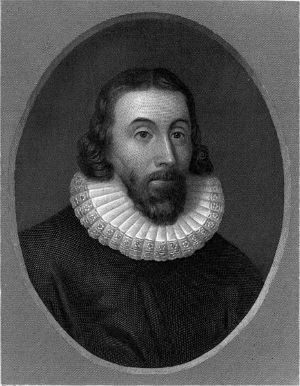
Thomas Hooker
Thomas Hooker, a leading Puritan minister who established the colony of Connecticut after he was asked to leave the Massachusetts Bay Colony, explained:
“Above all other deliverances, in ’88 the Spanish armada was a great deliverance because God worked through covenants. God expected England to abjure sin.”
Hooker preached from Deuteronomy 28 and Leviticus 26. If we, English, keep the law, he will bless us abundantly in all things. When the plague struck, the Puritans believed it was an explicit warning from God. Yet England did not come back to God. England escaped war, but the English hearts did not bow and did not break. The Crown and Parliament grew more corrupt, and attacks were now being made on the Puritan ministers. So Hooker warned them, when the sin of a nation comes to a full rightness and perfection, then the truth is the Lord will save and deliver them no more.
Side bar: We hear similar sermons like this, sometimes around the Fourth of July, sometimes around the time of the National Day of Prayer. God’s going to pull his favor from the nation of America as a judgment for the nation’s sinfulness. And we hear clarion calls for repentance, national repentance here in America. It is an issue to discuss and debate at a later time. But God does bless those who obey and He does judge those who disobey, be it an individual or a nation.
God had made Israel His chosen people, yet the Jews had broken their covenant. This it their logic. The Abrahamic covenant belonged to the Jews, the Jews broke their covenant with God, so God is going to give that Abrahamic covenant to someone more deserving. And they believed that was England.
Now when England went into corruption and sin and did not repent, the Puritans said God is going to judge England and give the Abrahamic covenant to another more deserving group. Hooker begged his audience to repent and rally around the covenant.
“…lest God go into Turkey and say unto them, ‘thou art my people and I will be your God’”
Hooker echoed another Puritan minister,
“God is packing up His gospel because none of you will buy his wares nor come to His price. O therefore, my brethren, lay hold on God. Let Him not go out of your coasts. Let not thy God depart, O England, Lay siege about Him by humble and hearty closing with Him. Suffer Him not to go far. Suffer Him not to say ‘farewell,’ or rather ‘fare ill,’ England.”
In Nehemiah’s time, Jerusalem was to the west of Babylon. New Jerusalem must be to the west of Rome. And what would be westward at this stage of redemptive history, but America? Or when the psalmist spoke of a new nation to be placed at the head of all others in Psalm 18, surely he was offering above all the hope of the Americas. So to the Puritans, the entire story of the New World from beginning to end was Christ’s “magnalia”: the glorious works of Christ.
In a sermon to the passengers aboard the Arabella who were preparing to leave in 1630, John Cotton proclaimed:
“America is the new promised land, reserved by God for His elect people on the actual site for a new heaven and a new earth.”
So as Israel traveled from bondage in Egypt, so these early Puritans followed the same paradigm on their trek to the promised land of North America. Millenniumarianism was a central motivating factor for moving from the old world to the new. England replaced Israel as the people of God. Now New England was replacing England as the people of God. They abandoned England and its acquiescence to the antichrist (Rome) and set off to build the millennial kingdom in North America, literally their “promised land.” It is significant that the imagination of many Puritans were captured by this hope of the new millennium.
Now upon this redemptive-historical hermeneutic of scripture, the Puritans placed themselves in this divine drama which they believed gave divine approval upon all that they did in the new world. From the private to the public church state and economy because why? They were the elect people of God. They were God’s new Israelites. His chosen people. Well I contend that Israel is still God’s chosen people, and the Abrahamic covenant is their covenant today, given to them in the past, fulfilled in the future, and the Gentiles will be blessed through that covenant. God did not take that covenant and give it to England or New England. It is still the covenant of Israel.
Care must be taken when we elevate these groups of people and individuals and then follow their doctrine and ways of life. The early church had the same problem. That was in the book of Acts- I am of Paul, I am of Apollos, I am of Cephas. What should we rather say? I am of Christ.
Myth number three:
“The Puritans had a Biblical worldview.”
A worldview is a framework from which one views reality and makes sense of life and makes sense of the world. A “Biblical” worldview is diligently learning and applying and trusting God’s truth in every area of our lives, because in the end, it is the decisions and actions that will reveal what one truly believes. However the Puritans had a worldview that was in fact NOT “Biblical”. They created a worldview using the Bible to “purify” it.
 One cannot deny that the Puritans did indeed hold God’s word in high regard. Most families were middle and upper class in Massachusetts Bay, and they owned a Geneva Bible, they read daily, and sometimes the Bible was the only book in the home. They wished to be guided by one rule: the word of God most high. That is honorable. However, the Puritans had a habit of calling their convictions “Biblical”, and often this became nothing more than a divine “rubber stamp.” If we can find a proof text, a typology, we can make it law in our commonwealth.
The Ten Commandments were easy. “Thou shalt not kill” was accepted without discussion, but what interested them more was the “how” and “why” an episode in the Bible was like one in their own lives. The great and terrible earthquake in June 1, 1638, and the one in January 14, 1639 reminded Captain Edward Johnson of how “the Lord, Himself roared from Zion as in the days of Amos.” They searched the scripture for texts relevant to their own particular needs, and because of their redemptive-historical interpretation of scripture, they liked finding a portion of scripture that showed similarities between themselves and the ancient Israelites. The Lord had “obviously” chosen them, just as He had chosen the Israelites, to carry out His plan for the redemption of the world.
If you recall the account in Exodus where the Israelites wandered for forty years in the wilderness, with the exception of Joshua and Caleb, that generation was denied entrance into the Promised Land. The Puritans believed that the chief difference between them and the ancient Hebrews was that God had called them to make a promised land out of the wilderness. The belief in their divine election to accomplish a great work in ushering in God’s kingdom ceased to be faith and came to be regarded as fact. Nothing seemed more evident to the minds of the Puritans than that God was taking a hand in establishing His kingdom on earth.
“The God of heaven had carried a nation into a wilderness upon the designs of a glorious reformation.” ~ Cotton Mather
Another example of using scripture to justify Puritan behavior is when John Cotton found a passage of scripture indicating that it was not the will of God that the Indians should be converted. Certain things had to take place first, and he used Revelation 15:8 as his proof text. What the Puritans had developed in New England was a practical, common-law orthodoxy. Their heavy reliance on the Bible was used to justify their preoccupation with platforms, programs, and schemes of confederation rather than using God’s word to shape a Biblical view of life and living.
There are five elements that could be said of developing a true Biblical worldview.
- Culture
- Education
- Religious Beliefs
- Emotions
- The Bible
Culture: the society with its traditions, traits, and ideas. Education: what you have been taught as truth. Religious beliefs: what one has been taught as matters of faith. Emotions: how you feel about others. The Bible: how one believes and adheres to its teachings.
The Puritans had:
- their English traditions
- their Calvinistic ideas
- they had been educated and taught through typology and allegory
- they believed that they had replaced Israel as God’s chosen people
- the covenant God had made with His people had been taken away and given to them
What did this create: an elitist mentality which tolerated no doubt and no dissention. They foisted their own philosophy into scripture. I contend that they developed a “Puritan” worldview rather than a “Biblical” worldview.
When I taught in high school, I encouraged my students to think and not to necessarily accept what the book said and not necessarily accept what I said. They needed to investigate for themselves and judge whether or not that textbook or that teacher was presenting the right view of life and history and God’s word. That is what I want to provoke you to do. After all of my own study, the Puritans are now off of my hero list.
~ Susan Dohse
A Prayer in the Storm: The Reality of the Power of Prayer – Part 2
This article is the conclusion of a story that began in my previous post. You can read part one of that story here. I now pick up where I left off.
I hate to admit it, but it is an unfortunate reality that Christians, myself included, only start “serious” prayer in times of crisis. Once the crisis passes the tendency is to not give much thought to it afterwards. I don’t think that necessarily means we have an unthankful heart. Perhaps it is the way we are naturally wired to just keep on living life as normal. Once God answered my prayer dealing with my own personal crisis, I didn’t give much thought about it either after that…until the very next day.

My concession trailer with the mechanic’s shop in the background
Ashley, Ohio is a small village of about 1,200 people, located about 30 miles north of Columbus. At the time of that storm in 2013, I was operating my concession trailer in front of a mechanic’s shop. The mechanic shared the building with his son who operated a tattoo shop. It was not unusual for me to serve lunch on a regular basis to the guys who worked there.
If you recall from part one of my story, I had prayed something very specific the night before:
“With your mighty hand right now, please reach down and move this tornado away to a safe area where it won’t bring any destruction to anyone.”
Thursday afternoon the guys in the tattoo shop came out to get lunch, and naturally we were talking about the storm from the pervious night. It had been a slow evening for them that night, so they had been outside taking a break and watching the storm as it approached. They saw those same ominous clouds I had seen, and those same clouds were now coming straight towards them. The one who was recalling the events to me said they were just getting ready to head for cover inside the building when something happened. He said that all of a sudden the cloud stopped moving towards them, changed direction, and then headed north and went around Ashley. He told me, “It was as if someone had reached down and moved it.”
Those were his exact words!
I was incredulous. The man from the tattoo shop had used the very same words to describe what had happened that I had used when I prayed to God the night before. Not only did God answer my prayer, but He answered it specifically as I had asked! I stood there dumbfounded. I had never had a prayer answered in this manner before. Immediately I thanked God for not only answering prayer but also for the way that He did it.
To this day I still do not know what to make of all this. How many times have we as believers prayed and asked God for things only to not have them work out favorably, if He even answers at all, whether it be healing for a sickness, financial situation, a choice of career, or some other life-changing event? To me, after having an experience such as the one I’ve just told you, I think it raises more questions than it answers.
We are coming out of a Protestant dark age. What we know about prayer is limited to only what we have been told according to orthodoxy. We read in our New Testaments about the great and mighty works accomplished by the apostles and others and how mightily their prayers were answered, and one should ask the question, “Why don’t those things still happen today?” Is it because, as we are told by pastors and elders, that was just a special time in church history? That God doesn’t work that way any more? Or is it because that we have bought into the notion that asking for such things is “selfish” and outside of the realm of “God’s will”.
With much boldness I will stand and pose this question here and now: Why is it so presumptuous of us to simply ask God for the things we want?
If, as Protestantism asserts, the metaphysical assumption of reality is a deterministic construct, then I will state right now that prayer is pointless, regardless of how much preaching on the power of prayer is done from the pulpit. But what if, as I believe, reality is not deterministic? What if our understanding of what is meant by “God’s will” is not what Protestant orthodoxy has told us? What if we have much more power at our disposal than we realize? What if it is as simple as the apostle James says, “you have not because you ask not?”
Does a loved one have to die of cancer simply because we were never bold enough to ask God, in the name of Jesus, to take away their cancer? Does a close friend have to suffer the remainder of his life with diminished mental capacity due to a traumatic brain injury suffered in a fall? Why do we always couch our prayers with, “…if it be Your will”? Will God actually NOT answer the desires of our heart simply because we didn’t ask for them? Do we limit the potential blessings that could be ours simply because we think it’s wrong to even ask? Are our prayers ineffective because we fail to make them specific and with the boldness of an expectation of getting what we ask for? What about the apostle Paul’s “thorn in the flesh”? Doesn’t God sometimes want us to rely on the “sufficiency of His grace?”
These are very hard questions, and unfortunately I don’t have the answers. I do, however, believe that the answers are knowable, but it is going to take the collective effort of all of God’s people set free from the slavery of religious institutionalism who set out on a journey of discovering the answers for themselves and sharing with others what they have learned. Each one is a piece to the puzzle.
What have I learned? I know that as God’s own righteous offspring, we have a Father who wants to give good gifts to His children. I know that if we ask God for a piece of bread, He won’t give us a stone. I know that if we ask God for a fish, He won’t give us a serpent. He will give us specifically what we ask for. O that we may have the courage to ask it! Amen.
~ Andy
A Prayer in the Storm: The Reality of the Power of Prayer – Part 1
To this day I’m still not quite sure what to make of the events that transpired almost 4 years ago. Perhaps that I’m committing it to words is simply my way of trying to make sense of it all. There is nothing dogmatic in what I am about to tell you. I can only share with you what my own experience was. But I think there is a lesson to be learned in it all.
It was late spring of 2013. My wife and children were spending the week in Pennsylvania visiting family. This had been an annual occurrence for us since our oldest had been a toddler. The church in which my wife grew up held vacation Bible school each year at this time, and the kids looked forward to it every year. I, however, had to stay home alone for the week since I had a business to run. For the self-employed there are no such luxuries like vacations and “sick days”.
Of course this was also before we had made the decision to leave the institutional church once and for all. Having left a church in Columbus that had been taken over by New Calvinists, we were currently attending a small country church about 20 minutes from our house. Granted, it was half-pregnant with authentic Protestantism (yes, I borrowed that expression from Paul), but it seemed to us to be a reasonable alternative at the time.
Like most loyal church-goers, we tried to be there any time the doors were open, and that included the mid-week prayer meeting. On this particular Wednesday evening in June the forecast called for unstable weather. When you live in the mid-west that translates to severe thunderstorms and the risk of tornadoes. It’s a reality you learn to live with, and so you just go about your life without giving much thought to it. Skipping prayer meeting that night never crossed my mind as an option.
The “service” started out pretty uneventful, but around 7:30 when we broke up into groups for prayer it began storming heavily outside. By the time we were dismissed around 8, the storminess and heavy rain had passed, and it looked like it was starting to clear up. But that was just the beginning.
I am an avid listener of talk radio, and consequently the radio in my car is permanently tuned to the local Columbus conservative radio station. I started my car, and as the radio came to life, since I usually just leave it on all the time, I immediately heard the repeating beeping tone every 5 seconds over the broadcast. That meant only one thing: a serious weather warning was in effect.
When the national weather service issues a “tornado warning” that means an actual tornado has been spotted. So when I heard the radio announcer say that a tornado was spotted near Ashley, Ohio, my heart must have stopped twice. Not only was Ashley about ten minutes from my house, but Ashley was where I operated my business, and my concession trailer was currently parked there. All in one instance both my home and my livelihood were at risk of destruction! It was the most helpless feeling in the world. What can you do in a situation like that where everything is completely out of your control?
I did the only thing anyone can do in that situation: I prayed…HARD!
That twenty-minute drive home was probably the longest twenty minutes ever. As I listened intently to the radio report, I kept one eye on the road and one eye to the sky straining to see through breaks in the trees for any signs of a funnel cloud in the general direction of home. Unfortunately, the skies in that direction did not look promising. But I remembered a promise that Jesus gave to His disciples during His ministry on earth.
“And whatsoever ye shall ask in my name, that will I do, that the Father may be glorified in the Son. If ye shall ask any thing in my name, I will do it.” ~ John 14:13-14
“Ask, and it shall be given you; seek, and ye shall find; knock, and it shall be opened unto you: For every one that asketh receiveth; and he that seeketh findeth; and to him that knocketh it shall be opened. Or what man is there of you, whom if his son ask bread, will he give him a stone? Or if he ask a fish, will he give him a serpent? If ye then, being evil, know how to give good gifts unto your children, how much more shall your Father which is in heaven give good things to them that ask him?” ~ Matthew 7:7-11
The reality of those words had a powerful impact on me. As a little child I would never have hesitated to ask my dad for something I wanted, and unless my dad decided that it was not something that was good for me, he would not have hesitated to give me what I asked so long as it was in his power to provide it.
As a child of the Heavenly Father, why would it be any different?
So I claimed those promises right then and there. As the radio blared, I prayed out loud:
“Father, you have promised us in your word that you would give us anything that we asked for in Jesus’ name. I claim that promise right now. I ask in Jesus’ name that you would please help to spare my house and spare my business from damage. With your mighty hand right now, please reach down and move this tornado away to a safe area where it won’t bring any destruction to anyone.”
I emphasized that last sentence because it will become important later.

The view across the road from my house, June 12, 2013
As I got closer to home I could tell that my house was not in the path of the ominous clouds I had seen on the horizon. As my home came into view I gave thanks to God that everything there was safe. I still wasn’t sure about my business in Ashley. I turned my gaze in that direction and saw those same ominous clouds on the horizon. At right is a picture I took from my front porch. Watching that cloud move on, I thought about people I knew who lived in that direction or who might be in the path of that storm. I prayed for them as well, claiming the same promises as before and asking in Jesus’ name that our Father please protect them and their property from harm.
Yet I still had unanswered questions. What had happened in Ashley? Was there any damage there? Do I still have a business left? The nagging uncertainty prompted me to get back into my car and drive to Ashley to survey the aftermath.
As I headed to Ashley I remember asking God to help me to be at peace with whatever damage there might be. I asked Him to help me trust Him to provide for us as He always had, to help us get through picking up the pieces and finding a way to start over. I remember noticing on the way how little damage there actually was, not so much as a tree limb fallen. Driving through the village I saw that all looked the same as it had. The power was even on still. And there was my trailer safe and sound, not a scratch on it.
I praised God right then and there for His answer to my prayer! But that is not yet the end of my story, for HOW God answered my prayer is even more incredible.
~ Andy
Protestantism Re-Crucifies Christ Daily and Holds Him Up to Open Contempt
 However you want to organize the “5 great religions of the world,” Protestantism is one of the 5 and like all 5 is false. These false religions all have one thing in common; human mediators who claim coregency with Christ or some other god of one’s choosing. In contrast, true faith in God holds to one authority and one mediator between God and man; Christ.
But wouldn’t such individualism lead to chaos? Sure it would, and we call that, “church.” Let me explain. When you have a claim of human sub-mediation or under-shepherds, various and sundry “authoritative” claims follow. Said another way; Christ never spoke or attended any church council.
So, what do we have? A mega-smorgasbord of coregency to choose from; viz, an “authority” that suits the individual’s itching ears. And since religious institutions need money to support infrastructure, and they supposedly speak for God, convictions may be adjusted from time to time.
It’s backdoor individualism. Don’t let anybody fool you; individualism is one of the major pillars of metaphysics. In world religion, being under an “authority” of anybody’s choosing becomes the gospel; and a whole bunch of folks are in for an unspeakable tragic surprise on judgment day.
Since individualism is unavoidable and judgment by God is individual, the Bible emphasizes a collective individual agreement to achieve particular goals. This is far from impossible since that’s how it really works in reality and each believer is indwelled by the Spirit who will “lead you in all truth.”
This boils down to home fellowships that operate like families because God’s family is a literal family and therefore functions like one. The family member’s gift and natural abilities are exercised and drives the agenda. The apostle Paul compared it to how a human body functions with Christ being the one head, or the body operating according to the “one mind of Christ.” Therefore, home fellowships strive to “be of the same mind.” The Bible details in various places how that is to be brought to bear.
In the first century, the assembly of Christ suffered an onslaught from several different institutional religions; particularly, Old Covenant Judaism, or what the apostle Paul referred to as the “Judaizers.” Simply stated, this made the Old Covenant an institutional authority of human priests that the New Covenant replaced. There is no new thing under the sun; this institution claimed to have authority over people’s salvation.
Hence, those who initially followed “the way” were being intimidated into turning back to the Judaizers via confiscation of property and prison; you know, because authoritative collectivism has so much more to offer than individual collectivism. Authorities that know best only burn you at the stake or take away your salvation to convince you that God has indeed given them His authority because they say he did which of course in somewhat undocumented or confirmed. The book of Hebrews was written by the apostles to address this problem.
One of the favorite verses twisted by demonic Protestant scholars is Hebrews 7:25.
Consequently, he is able to save to the uttermost those who draw near to God through him, since he always lives to make intercession for them.
“See! See! Christ still intercedes for us in heaven because we don’t keep the law perfectly. This is why you need to be a member of a local church where you can get ongoing forgiveness for imperfect law keeping!”
This is not one iota different from what the Hebrew authors were protesting against with bone-chilling verbiage. In context, the contrast is between earthly priests who cannot supply a once and for all salvation because the law is the basis for their righteousness. Please note: by making the law the basis of saving righteousness, a ritual must be supplied which they oversee that fulfills the law. Therefore, the Hebrew writers categorize these priests synonymously with their mortality and the law. Many of them are needed because they die, and there needs to be a succession of priests to oversee various and sundry rituals that satisfy the “righteous demands of the law.” Protestants call this “the means of grace.” And in Protestantism, “grace” is a soft term for “salvation,” so what they are really saying is… “The means of salvation.”
The Hebrews contention follows: what is needed is a Priest who never dies. Look, Protestants themselves call the means of grace… “The sacraments.” Any questions? What is more evident?
Don’t miss this: it is the difference between law and life.
One requires mortal authoritative priests who must, according to Protestant orthodoxy, reoffer continually what Christ did once on the cross as opposed to one Priest who lives forever. Instead of mortal men who must make a continual intercession in fulfillment of the law, we have an eternal intercession via a Priest who lives forever. This is the cardinal point of Hebrews 7:25, NOT that Christ continues to make intercession for us in heaven to satisfy the law in response to the intercession of mortal priests on earth. It’s a one time eternal intercession because Christ lives forever, and it is His present life that guarantees our salvation; that’s the intercession—and it does not include additional priests of any sort. Christ was resurrected ONCE for our justification. We are saved by His life, not perfect law-keeping via religious ritual.
Another major point of Hebrews follows: this earthly mortal system actually dumbs down the law and circumvents the use of the law for love without fear of condemnation which fulfills the whole law. These systems present themselves as pious, but actually lead to decadence. Read the papers or watch the news much?
Hebrews 6:1 – Therefore let us leave the elementary doctrine of Christ and go on to maturity, not laying again a foundation of repentance from dead works and of faith toward God, 2 and of instruction about washings, the laying on of hands, the resurrection of the dead, and eternal judgment. 3 And this we will do if God permits. 4 For it is impossible, in the case of those who have once been enlightened, who have tasted the heavenly gift, and have shared in the Holy Spirit, 5 and have tasted the goodness of the word of God and the powers of the age to come, 6 and then have fallen away, to restore them again to repentance, since they are crucifying once again the Son of God to their own harm and holding him up to contempt. 7 For land that has drunk the rain that often falls on it, and produces a crop useful to those for whose sake it is cultivated, receives a blessing from God. 8 But if it bears thorns and thistles, it is worthless and near to being cursed, and its end is to be burned.
9 Though we speak in this way, yet in your case, beloved, we feel sure of better things—things that belong to salvation. 10 For God is not unjust so as to overlook your work and the love that you have shown for his name in serving the saints, as you still do. 11 And we desire each one of you to show the same earnestness to have the full assurance of hope until the end, 12 so that you may not be sluggish, but imitators of those who through faith and patience inherit the promises.

 Paul's Passing Thoughts
7 comments