Man’s Inner Court and The Protestant Total Depravity Lie
 Protestantism is a unique religion in that nothing of it is true. It even lacks a body of facts used in the commission of lies. It has redefined every biblical definition regarding the meaning of words; more than likely, there is no other religion that possesses such plenary falsehood. Nothing exemplifies arrogant confusion more than a Protestant.
Moreover, its orthodoxy is the essence of sin because it seeks to control people through condemnation. That’s how sin is presented in the Bible. It is posed as a master that enslaves people through condemnation. In this process, Protestant scholars will spare no heartless lie that tramples the love of God underfoot in its lust to control others.
One such lie is limited atonement. Because Protestantism also distinguishes itself as God’s counselor, this doctrine reminds God that He wouldn’t be stupid enough to die for people that He hasn’t chosen. This vandalizes the beautiful picture of Christ’s lordship. He is the Lord that has purchased the servants of the Sin master with His own blood. They are now free to flee to a new Master whose yoke is light. Christ himself said that He didn’t come to condemn the world, but to save it.
So, in all of their scholarly splendor, Protestants claim that John 3:16 refers to “all kinds of men” rather than the whole world. Therefore, John 3:17 must refer to God sending His Son “into” (for crying out loud, it’s a preposition) all kinds of men rather than the material world through the virgin birth. Really? Brilliant. If you are sent into a place to save a place that must include everyone in the place. Obviously. But you know, you must believe these demonic shills because they wear round wire rim glasses and bowties with tweed jackets.
Oh, and by the way, they also remind God that He is sovereign in all things because, well, they say so. Hence, God is reminded that His gospel is a “gospel of sovereignty.” Don’t you know, the announcement that you might be chosen is good news…for you, if you are chosen. And if you think you are, that’s nice, but the “good news” gets even better; you have no way of knowing whether God has chosen you to persevere till the end. Happy yet?
Reality and the nature of man must be redefined lest salvation be found at the gates of any other religion or heaven itself. When one decides to write a post about Protestant lies, you pick a book off the orthodoxy shelf and turn to any page first, and then examine any sentence comprised of redefined words. Limited atonement (by the way, atonement isn’t salvation to begin with) lacks interest for me this morning, and apparently, we have stumbled upon perseverance as well, but let’s talk about total depravity instead.
Total depravity, also known as total inability, posits the idea that nothing within man enables him to choose God. According to authentic Protestant orthodoxy, it also posits the idea that no person, lost or saved, can do a good work that merits any favor with God. The fact that Protestant orthodoxy states this unequivocally is irrefutable.
Though a cursory observation of the Bible contradicts this view on many points, it may be noted that every person born into the world has the “works of the law” (God’s law) written on their hearts. Furthermore, every person born into the world has an inner judge that either “excuses” or “accuses” the individual based on that law. In history, we see tyrants brought to justice according to a standard that is common and self-evident to mankind in general apart from any universal written law. The Nuremberg tribunal is a good example of this. This fact is difficult to reconcile with total depravity.
Secondly, John 16:8 states that the Holy Spirit, “when he comes, he will convict the world of its sin, and of God’s righteousness, and of the coming judgment.” Again, defining “world” as a place Christ was sent to for a purpose, and a place that the Spirit comes to, as opposed to a group of people, we find that the purpose of the Holy Spirit is to “convict the world.” What we are talking about here is the use of a collective noun. In some cases you can claim a sweeping generalization in regard to a collective noun like, “All Americans are idiots,” but when a collective noun is used in regard to a purpose, it is not a generalization. If God’s stated purpose was to destroy the world that would certainly include everyone in the world. Likewise, if the Spirit’s stated purpose is to convict the world that includes everyone in the world, and it means all people are cable of being convicted which means they aren’t totally depraved.
It also means that humanity is convicted inwardly by God’s law and the inward judge, and the Holy Spirit, and hopefully Christians evangelizing with the word of God which is sharper than a two-edged sword. So, we are asked to believe that this threefold front is a purposeless endeavor unless individuals are preselected. It also requests that we believe the following: the purpose of the Holy Spirit to convict everyone will only be effective for those preselected by God. Now, it’s one thing to say that we don’t know who is elected, but to include the Holy Spirit in that is, well, a little unreasonable. Again, the purpose of the Holy Spirit is not a sweeping generation, but an endeavor that includes everyone described by the collective noun. The Spirit, it would seem, would not try to convict those who can’t be convicted.
Like trying to avoid Protestant error in the same way you try to avoid horse patties in a confined horse stable, we accidently step in the error of “irresistible grace.” Supposedly, regardless of the conviction experienced from God’s threefold purpose, man is unable to choose God unless smitten with “irresistible grace.” This excludes conviction as an act of grace. You have the Holy Spirit flying around convicting everyone while not being privy to who the elect are, but God forbid that Christ would die for those convicted of sin who do not seek God for relief from condemnation and fear of judgement to come.
But to be fair, the Reformed do have an answer for this. God is glorified equally by those who deny Him. The eternal damnation of those who reject God is a “sweet savor” to Him rising up from hell for all eternity. This is the double joy of those God elects for salvation and damnation. In fact, Jonathan Edwards wrote that we will rejoice with God for eternity while watching family members suffer in hell.
Do you feel the love yet?
Lastly, regarding total depravity and the idea that man can earn no merit with God whether lost or saved, the Bible is pretty clear that there are degrees of punishment in hell. Clearly, this means God deems some people deserving of more punishment than others. This necessarily requires merit though in a negative context. But it also means God deems some people better than others according to their deeds.
Funny, the go-to argument by the Reformed against man’s ability to choose follows: “If you chose God and the other guy didn’t, that makes you better than him.” But according to lesser or more punishment, isn’t that a reality recognized by God?
But hold on, are we now talking about election or total depravity? I seem to be lost in the Protestant maze of error.
paul
The Four Types of Protestant Gnostic Dualism and Their Life Application
The Reformation made the Bible accountable to world philosophy. For the most part, Plato was clearly their authority and prism for Bible interpretation. There are four models for how Protestant dualism is applied to life. Andy Young explains one of them here, and aptly explains the right alternative, so I will not have to duplicate that here. Simply stated, this dualism either takes place inside of man or outside of man, and with ability or non-ability. The model explained by Andy takes place inside of man via two natures coupled with an ability to partake in a struggle between the two natures.
First, let’s define dualism. Dualism is the basis for all world religions and was introduced in the garden by the serpent. This shouldn’t surprise us too much if you think about it. Boiled down to the least common denominator, it teaches that God’s creation is evil. It calls that which is good, “evil.” God supposedly created evil to make a cosmic point about His glory. To make His goodness known, He created a contrast to compare it with. Everything material is evil, and everything invisible is good.
Let’s look at the second type of dualism. The “new creature” is given the inner ability to “yield,” and the dualism is two realms that pressure him/her from the outside. At any given point, the “believer” YIELDS to one realm or the other.
The third type is closer to the authentic Reformation philosophy which by the way has rare understanding in Protestant circles. Per the usual, the “believer” remains unchanged, but the Holy Spirit works inside of the believer. So, two of the models have ability to act by the “believer,” and two exclude any ability of the believer to act, but only “see” or perceive. In this third model, everything done that is pleasing to God is performed by the indwelling Spirit. Other than the actions performed by the indwelling Spirit, the “believer” is merely performing his/her usual evil activity. Even in cases where the “believer” seems to do something good there are selfish or evil motives involved.
In the fourth type that is authentic Protestant ideology in its purist form, everything is outside of the “believer” and like the third model the person has NO ability to act, but only to perceive. “Faith” is defined as an ability to perceive the model while denying that any good work can be done by any person lost or saved. In this model, humans are passive in the material realm until acted upon by the invisible realm. This is where all the “we are dead” verbiage comes from. Everything that exists and moves in the material realm is evil, and the only good that takes place is an action by the invisible realm. Regarding good works we are passive until acted upon from the invisible realm. Martin Luther described it as man being like water; it just sits there dormant until acted upon by temperature or gravity. Man is dead in trespasses and sin until God acts.
Of course, Protestant views that attempt to make the believer’s life by faith alone are the epitome of a steroidal salmagundi monstrosity. Once salvation is an unfinished event that must be completed under the auspices of some earthly authority, the downward spiral of confusion begins because it’s like trying to fit a round peg in a square whole. Because salvation is not finished and is a work by God alone, and we are living in the unfinished process, we have to figure out a formula for living a good life without doing anything lest it be works salvation.
paul
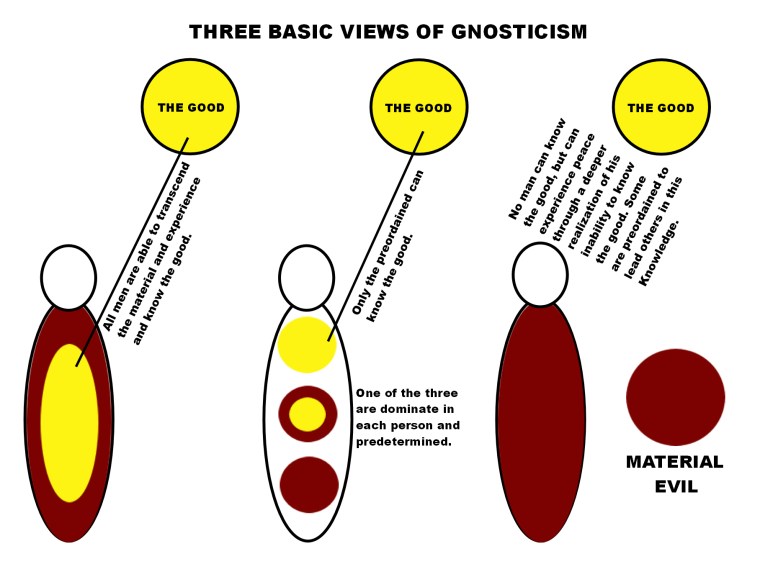
Additional information: the three basic models of Gnostic epistemology; not to be confused with application. This is the difference between how the information is supposedly known and how it is applied.
The New Man is Possible Because the Law Was Ended
Originally published April 25, 2016
The list of Biblical terms that Protestantism has hijacked is lengthy. I am not talking about made-up words that don’t even appear in scripture (and that list itself is lengthy). I mean words that actually appear in scripture, the definitions of which have been twisted to fit the orthodoxy. As we like to say here at Paul’s Passing Thoughts, words do mean things.
“Therefore if any man be in Christ, he is a new creature: old things are passed away; behold, all things are become new.” ~ 2 Corinthians 5:17
Protestantism acknowledges this “new creature”, calling it the “new man”, while at the same time professing that the “old man” never really dies but is still present within man. This is the result of a faulty premise of total depravity (including total depravity of the believer) which in turn results in an incorrect interpretation of the struggle Paul describes in Romans 7.
“For that which I do I allow not: for what I would, that do I not; but what I hate, that do I. If then I do that which I would not, I consent unto the law that it is good. Now then it is no more I that do it, but sin that dwelleth in me. For I know that in me (that is, in my flesh,) dwelleth no good thing: for to will is present with me; but how to perform that which is good I find not. For the good that I would I do not: but the evil which I would not, that I do. Now if I do that I would not, it is no more I that do it, but sin that dwelleth in me. I find then a law, that, when I would do good, evil is present with me. For I delight in the law of God after the inward man: But I see another law in my members, warring against the law of my mind, and bringing me into captivity to the law of sin which is in my members. O wretched man that I am! who shall deliver me from the body of this death?” ~ Romans 7:15-24
Protestantism claims that flesh is “evil”. But the Bible teaches instead that flesh is weak. It describes sin as an entity who seeks to control and master others. It tries to accomplish this by using the law to provoke the flesh to transgress.
Much as Protestantism has unwittingly altered the meaning of the New Birth, it has done the same with the idea of the “new man”. In classic dualistic philosophical fashion, Protestant Gnostic orthodoxy claims that the born again believer actually has “two natures”, the old man and the new man who constantly battle each other for control over the believer. In Protestant orthodoxy, man is nothing more than a spiritual schizophrenic. However, the new birth is a literal death and rebirth. The old man dies (“old things are passed away”, literally, “the old has come and gone”). He is crucified with Christ. This is why the law can no longer condemn him- the law cannot condemn a dead man. In his place is a new creature who is the literal offspring of God!
This same teaching is made clear in Paul’s letter to the believers at Ephesus.
“Wherefore remember, that ye being in time past Gentiles in the flesh, who are called Uncircumcision by that which is called the Circumcision in the flesh made by hands; That at that time ye were without Christ, being aliens from the commonwealth of Israel, and strangers from the covenants of promise, having no hope, and without God in the world: But now in Christ Jesus ye who sometimes were far off are made nigh by the blood of Christ. For he is our peace, who hath made both one, and hath broken down the middle wall of partition between us; Having abolished in his flesh the enmity, even the law of commandments contained in ordinances; for to make in himself of twain one new man, so making peace; And that he might reconcile both unto God in one body by the cross, having slain the enmity thereby: And came and preached peace to you which were afar off, and to them that were nigh. For through him we both have access by one Spirit unto the Father. Now therefore ye are no more strangers and foreigners, but fellowcitizens with the saints, and of the household of God; And are built upon the foundation of the apostles and prophets, Jesus Christ himself being the chief corner stone; In whom all the building fitly framed together groweth unto an holy temple in the Lord: In whom ye also are builded together for an habitation of God through the Spirit.” ~ Ephesians 2:11-22
I want to point out once again how Paul makes reference to the law being ended.
“Having abolished in his flesh the enmity, even the law of commandments [contained] in ordinances…so making peace; … having slain the enmity thereby”
The word translated “enmity” is a word that has to do with hostility. What was the cause of hostility between God and man? Verse 15 tells us plainly; the law! Man was condemned by the law which was ended when Christ was crucified and raised again. The new birth reconciles God and man, putting an end to the hostility.
Not only is the hostility between God and man ended, but Paul makes mention of hostility between two other groups- the hostility between Jews (the “Circumcision”) and the Gentiles (the “Uncircumcision”). Paul also uses two other expressions to describe these two groups- those who were “far off” (Gentiles) and those who were “nigh” or “near” (the Jews). This hostility existed again primarily because of the law and the relationship to the law. For the nation of Israel, the law was a guardian, imprisoning sin until the Promise came which would end the law. (Galatians 3:21-29)
But a wonderful thing is revealed in this Ephesians passage. When Christ died, He ended the law, He ended the hostility between God and man, and He ended the hostility between Jew and Gentile. Why? Because the New Birth brings about the death of the old man, and in his place is a new creature that is NEITHER Jew NOR Gentile. Furthermore, each born again believer is made a part of one spiritual body.
“For he is our peace, who hath made both one, and hath broken down the middle wall of partition between us…for to make in himself of twain one new man… that he might reconcile both unto God in one body by the cross, having slain the enmity thereby: And came and preached peace to you which were afar off, and to them that were nigh. For through him we both have access by one Spirit unto the Father.”
Notice that Paul refers to this one spiritual body as the “New Man”! According to the Bible, the New Man is not the individual believer, but it is the one spiritual body made up of both Jews and Gentiles, of which Christ is the Head, and of which all believers are members together. To further emphasize this idea of “oneness”, Paul uses a metaphor of a building. Christ is the cornerstone, the very first stone set by which all other stones of the building are laid. The teachings of the apostles are the foundation, and each believer is a lively stone set in this building as a spiritual house and a royal priesthood to offer up spiritual sacrifices acceptable to God (Romans 12:1, 1 Peter 2:5). This one New Man is a holy temple wherein God’s Spirit now dwells (1 Corinthians 3:16-17, 1 Corinthians 6:19, 2 Corinthians 6:16).
This teaching of the New Man being the Body of Christ is consistent throughout the New Testament. It is the reason believers are given spiritual gifts, for the purpose of maturing the saints to do the work of the ministry, to edify (or build up) the Body of Christ (Ephesians 4:12). It is the reason why believers are to assemble together for fellowship, for the purpose of mutual edification so that we can perform works pleasing to God and show love to others (Hebrews 10:24). All of this is possible because Christ ended the law on the cross.
Andy
“For ye are all the children of God by faith in Christ Jesus. For as many of you as have been baptized into Christ have put on Christ. There is neither Jew nor Greek, there is neither bond nor free, there is neither male nor female: for ye are all one in Christ Jesus.” ~ Galatians 3:26-28



 Paul's Passing Thoughts
5 comments