Paul's Passing Thoughts

Come Out From Among Them and Be Separate

Posted in Uncategorized by Paul M. Dohse Sr. on December 8, 2024

Mr. Dohse,

For your consideration:

Romans 6:7 says, were it translated consistently from the Greek, “For he that is dead is JUSTIFIED from sin.” The ASV is one of the few translations that renders the Greek word there the same way–“justified”–as it is rendered everywhere else (about 39 times) in the New Testament. The KJV went off script here, and many others followed its lead.

In the argument of Romans 6, the one who has died with Christ, who has died as the old self he was, is justified from sin according to Romans 6:7.

If one has died with Christ, one is justified from sin.

Galatians 3:21 says that no law was given that could impart life, and that is why righteousness could not come through the law. Put aside for the moment any arguments concerning why the law could not give life–focus on the implication that if there is no new life, there is no righteousness or justification. Because the law had no capacity for imparting new life, the law could not justify or cause a man to be righteous.

If there is no new life, there is no justification.

Putting those verses together, the moment of justification is when God regenerates and transforms a man from being an old self into a new self, at the moment the old self dies and is transformed into or raised again as a new creation, a new spiritual man, this transformation being a gift from God and accomplished by His creative power.

A man is justified in the moment he is born again.

This regeneration is promised to everyone who turns away from any contrary belief to believe instead the Gospel as stated in 1 Corinthians 15:3-4.

Does that sound about right?

Exactly right. This is what makes justification by faith wrong x 14. First, the born again believer is justified because he/she is righteous as a state of being because of the new birth recreation. We are not merely “declared” righteous, we are righteous. When God looks at us, he sees us, his children. There is no need to see Jesus instead of us, we are his literal children.

Hence, the second point: salvation is NOT a covering of sin, which is atonement, but it is an ending of sin. Shockingly, MacArthur et al routinely call salvation “atonement.” According to JBF, grace is a covering for remaining under law.

Which brings us to the third point. You can’t be both, you are either under law or under grace. CLEARLY, JBF teaches that the believer remains under the condemnation of the law. Phil Johnson is fond of saying that “Christians remain under the righteous demands of the law.”

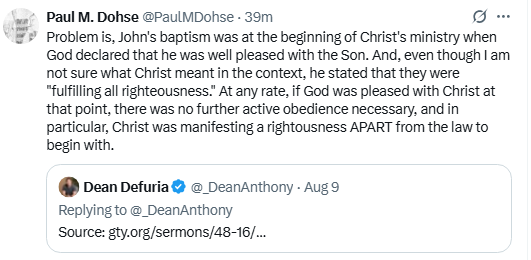
Fourthly regarding one of your points: there is no law that can give life. If the law can give life, it is a fourth member of the Trinity. The law has no role in the new birth recreation. Paul flogs the proverbial dead horse on this in Galatians. Why then the law? Well, according to Galatians, all sin is imputed to the law. Then, when a person is born again, the law is vanquished along with all sin under the old covenant. The believer was protected from condemnation by way of imputation to the law…”until faith came.” Viz, Christ, who did NOT come to fulfill the law through the perfect keeping of it, but rather came to fulfill “The Promise,” which is a primary name for the gospel that is ignored in most church circles and replaced with JBF.

Which brings us to a 5th point: Christ was righteous by virtue of who he is, NOT through perfect law-keeping. Shockingly, JBF teaches that Christ earned his righteousness through perfect law-keeping so he could then impute that earned righteousness to us. This is the Protestant doctrine of double imputation, which is overt blasphemy. Why would Christ fulfill a law that cannot give life? No, the new birth gives life, not the law.

Which leads us to point six: JBF has a single perspective on the law denying the Spirit’s two uses of the law (to convict the world of sin and the judgment to come; and sanctification) per Romans 8:2. Protestantism, therefore, teaches that Romans 8:2 refers to two realms, not law. By redefining nomos as a realm, they make a case for the law of the Spirit being a covering for the law of condemnation.

Which brings us to point seven: JBF conflates Fatherly chastisement with condemnation/wrath, and conflates the definition of sin in sanctification (better stated as a failure to love) with sin under the law. This makes a ritualistic perpetual atonement necessary.

Which brings us to point eight: we contend that salvation cannot be a process in which the believer is still living. This demands a role for the believer in a salvation process. Protestant scholars state this openly making a distinction between salvation and justification. Supposedly, salvation is a process while justification is the onetime act. This is a deliberate word shell game meant to confuse the issue. Supposedly, God only declares us righteous as a mere “legal declaration” (how can a legal declaration be righteousness apart from the law, being a legal declaration?) one time. But hark, then we must “participate in Christ” by perpetually returning to the same gospel that saved us for re-justification, which is supposedly the onetime act. Clearly, regarding this, Protestantism teaches that our original Spirit baptism is reapplied to the salvation process, keeping us justified, when we partake in a “lifestyle of repentance” (participation in Christ). Actually, Calvin and Luther taught that the power of baptism was in the water baptism. This is the Protestant doctrine of mortification and vivification and closely related to the doctrine of the vital union as well. This blog has posted hundreds of citations on this point from Calvin, Luther, and Michael Horton and will not belabor the point here. Protestantism teaches a beginning justification, what they call progressive sanctification, but is really progressive justification, and then a final justification. Calling the progression of justification “progressive sanctification” is deliberate deception. Calvin referred to justification and sanctification as a “twofold grace.” What does that mean? Well, both have to do with salvation. But, “Wait a minute!” you say, “I thought justification was the onetime act!” Right…you get it. Protestantism is a morass of confusion. Furthermore, to make progressive justification feasible, JBF splits works into two categories: faith alone works (the “ordinary means of grace” done at church), and works that are works. I kid you not. People listen to this stuff and don’t even blink.

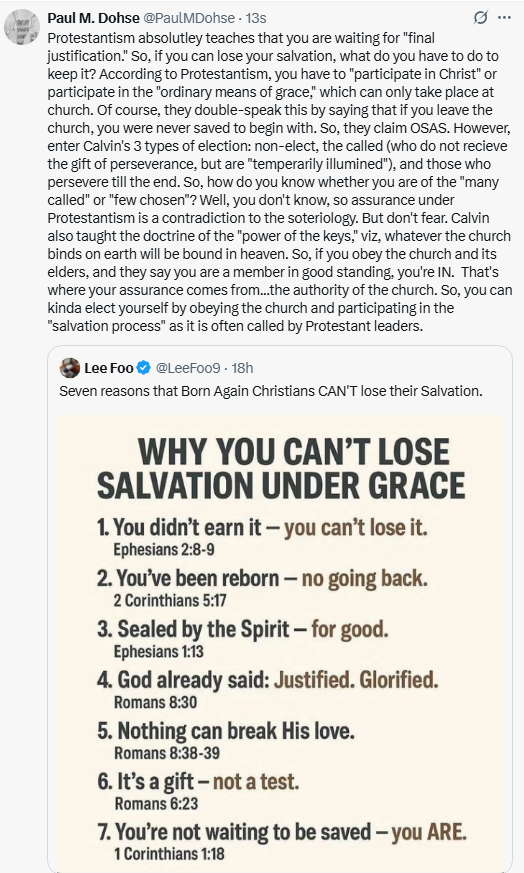
This brings us to point nine: though Protestants claim a doctrine of assurance, obviously, they are lying. According to original Protestant soteriology, perseverance is a gift of God that is not given to all those who are “illumined” (Calvin). Hence, no one who is a professing Protestant can know whether or not they are predetermined to have the gift of perseverance until “final justification.” But, absurdly, there is also the doctrine of the “power of the keys,” which teaches that whatever the church elders bind on earth will be bound in heaven. In other words, if the church elders like you, you’re in. We have citations from the likes of Kevin Deyoung saying this in no uncertain terms, and of course Calvin states it in many of his writings. In contrast, assurance is grounded in the fact that there is no law to judge us. A dead man cannot be indicted. Even if the court dug up our dead body and presented it to the judge, the judge has no law to condemn us with. We contend that someone who is born again cannot be unborn, which leads us to the next point.

Point 10: We deny with prejudice that “believers” remain unregenerate and still need to be saved by revisiting the same gospel that originally “saved” us, as stated by many Protestant theologians including Calvin, Luther, and John Piper et al. This coincides systemically with points 1-9.

Point 11: We deny the idea that a “believer” is sanctified through a greater and greater appreciation for our salvation as amplified by realizing more and more how far we are from our Father, rather than the true goal of sanctification to be more and more like our Father. Hence, we deny that salvation is strictly “confessional” and wholly agree with the truism, “Preach the gospel always, and if necessary, use words.” Indeed, we believe that a “tree is known by its fruit.” We are to let our light shine through deeds, not words only.

Point 12: We affirm salvation through justification by new birth per 1John 3, and not through perfect law-keeping by anyone, including Christ.

Point 13: We reject “semper reformanda” or “always reforming.” This is a blank check for making up soteriology as you go. You don’t have to be right about anything. This is identical to the JW doctrine of “increasing light.”

Point 14: We deny that the family of God is an authoritative institution, or a living body with more than one head. We deny additional mediators other than Christ, and affirm the priesthood of believers.

In view of all of this, what should we do? We should wholly reject Protestantism and its JBF soteriology and come out from among them. All the drama regarding church is attributed to one thing: a false gospel. When I was a young aspiring pastor going to seminary, the vision was to “return to the power of the first century church.” Well, first of all, it wasn’t church. Church as we know it today doesn’t come along until the 4th century, with its infant beginnings in the 3rd century. And by the way, “church” is NOT a biblical word. Walk away, and begin informal weekly fellowships with those who are like-minded. A model for such fellowships could be the last supper in John and other related passages. Between Acts and other NT passages, there is a clear model for such gatherings. Like in the NT, these are informal gatherings. What determines a fellowship? Well, fellowship. People who show up are fellowshipping with the body. The gathering should function as a cooperative body with each organ practicing gifts, no authority needed.

I hear a lot about the home fellowship movement being sparsely scattered all over the U.S. I think we are seeing the beginning of change regarding that. Little by little, people are starting to get it. It’s wrong to merely leave church, you must replace it with the real item. Merely meet informally as many times a week as you want to. Share a meal, and the word of God in some type of format. Give time for gifts to be manifested as time goes on. As you grow, split into additional fellowships. Its not complicated.

Church is a lie: come out from among them and be separate.

paul

Protestantism is False Because of Romans 8:2

Posted in Uncategorized by Paul M. Dohse Sr. on December 3, 2024

Most false gospels are based on interpreting soteriology from a single perspective on the law. Protestantism is included in this error as well. Romans 8:2 discusses two laws, “the law of the Spirit of life in Christ” and “the law of sin and death.” Both words for “law” in this passage are “nomos,” meaning a written law or moral code. Many Protestant theologians try to interpret nomos in this passage as two spiritual realms, which of course, is overt hermeneutical error. The word for a spiritual realm is a totally different word.

In addition, the correct interpretation of Romans 8:2 is confirmed by several other passages in scripture, particularly the Spirit’s two uses of the law to convict the world of sin and the judgment to come, and the Spirit’s use of the law to sanctify God’s children.

Because of Protestantism’s single perspective on the law, perfect law-keeping is the standard for righteousness, not the new birth. The so-called believer remains under the condemnation of the law, and being under grace is a covering for remaining under law. In other words, according to the Protestant gospel, a believer is both under law and under grace, or in other words, a “sinner (defined in the Bible as being under condemnation) saved by grace” (actually, being saved by grace because Protestantism teaches that salvation is a “process”).

Consequently, Protestantism denies a biblical definition of the new birth that plunges us into Jesus’ death resulting in the law of sin and death no longer having jurisdiction over us (because the old us is dead, and dead people cannot be indicted), and raising us together with Christ resulting in us being under the power of the Spirit’s use of the law for sanctification.

This doesn’t mean that a born-again Christian is free from all consequences concerning a poo-pooing of the law’s moralism. But, there is a clear biblical demarcation between condemnation and fatherly chastisement that is done from love and not wrath. Protestantism denies this distinction, and conflates condemnation with chastisement in the same way that it conflates all other distinctions between under law and under grace.

The unavoidable result of this is a salvation process that involves church. And by the way, 99.99% of all churches teach from a single perspective on the law. Church isn’t an option. No surprise then that the New Testament ekklesia is not church as we know it; church as we know it comes along about 300 years later.

paul

It’s All About the “O” – Mohler, DeYoung, Lucas: We Own You

Posted in Uncategorized by Paul M. Dohse Sr. on November 28, 2024

Death is NOT OK

Posted in Uncategorized by Paul M. Dohse Sr. on November 27, 2024

If you are struggling with the death of a loved one, human or pet, please be free. You are not in bondage to “accepting it” or moving on. You are free to never accept it. Don’t worry, the body and mind will adjust and you will adapt through a new homeostasis because part of you is gone that you will never get back. You can be happy again because your body and mind will create a new normal for you.

This is because God doesn’t accept death. The Bible never states that “death is a normal process of life.” That’s pure nonsense. In fact, the Bible states that death is God’s “enemy” and will be the “last enemy that He will defeat.” This is one reason I love being a nurse; I am fighting God’s enemy. When we lose the fight, it’s not ok, but we know that we will eventually win the war through Christ. My father was a Mason, and I am not advocating for Free Masonry, but during their memorial service for my dad, the speaker, arrayed in his Mason uniform with a sword at his side, said, “We are here today to celebrate the life of Harry Dohse who has been struck down by this world.” I love that. That is so true. Death is not a natural process of life, it’s a homicide committed by a fallen world.

Of late, my favorite Bible verse is Hebrews 2:14,15, “Since therefore the children share in flesh and blood, he himself likewise partook of the same things, that through death he might destroy the one who has the power of death, that is, the devil, and deliver all those who through fear of death were subject to lifelong slavery.” It’s ok to fear an enemy, though we overcome that fear in order to defeat them. Christ died to free us from enslavement to fear. But that doesn’t make death a part of life; death is God’s enemy. If you are not ok with death, that’s ok because God isn’t either. As nurses, we see it all the time with families and even doctors: requests or orders that reflect denial concerning the inevitable, and I am totally ok with that because death should be denied. Absolutely, I will reorder those eyedrops or Atorvastatin right away. This reflects last vestiges of hope, and is part of the mourning process. The patient is 100 years old and is Full Code? Why is that not ok? Too much life? Why would death be given permission at all? Has death become our friend because our life isn’t what it was?

We should never be in a hurry to surrender to death. In the dying process, dealing with it holistically and embracing God’s enemy is a fine line.

paul

Tagged with: , , , ,

Confused Calvinist

Posted in Uncategorized by Paul M. Dohse Sr. on November 25, 2024
