Steve Lawson Sloppy Hermeneutics: Will Christ Personally Torment Unbelievers in Hell for Eternity?
 Something has been on my mind for some time that I have never written about. During the 2009 Resolved conference, “Pastor” Steve Lawson preached a sermon on the Great White Throne Judgment. In that message, Lawson claimed that Christ Himself will “be in hell”… “personally inflicting the wrath on unbelievers” for eternity. I know that Calvinism is heavily predicated on fear so I wasn’t surprised that Lawson said it. Rob Bell committed the unpardonable sin among New Calvinists by removing the fear factor in his book, “Love Wins.” Calvin himself taught that fear and terror of judgment was efficacious to the mortification and vivification process that enables Christians to stand in the final judgment (CI 3.3.3-7). Bell didn’t merely violate Scripture, he dissed a Reformed mainstay: fear and its kissing cousin control.
Hell, in and of itself, is sobering enough, but apparently Lawson thought the reality of it needed some embellishing. The idea that Christ Himself will be in hell inflicting the punishment personally is a bit unsettling to me. It seems to picture Christ as a hateful God whose wrath never ceases. Instead of punishment being meted out in a hell prepared for the devil and his angels, we have Christ in hell inflicting the torment personally for all of eternity. Christ always spoke of hell as a PLACE of torment, and any idea of Him being the personal tormentor is conspicuously missing. Lawson used the following passage from Revelation for his proof text:
Revelation 14:10 – he also will drink the wine of God’s wrath, poured full strength into the cup of his anger, and he will be tormented with fire and sulfur in the presence of the holy angels and in the presence of the Lamb.
This is really sloppy hermeneutics for many reasons, but let me discuss a few. The context of Rev 14:10 is the tribulation period. Revelation 14:6ff. predicts the final wrath of God being poured out upon the earth. This is preceded by a final warning heralded via three angels. The first proclaims the gospel; the second announces the final judgment of Babylon the great, and the third announces the primary woe that will befall those living in Babylon—this is specifically what Rev 14:10 is about. That verse describes the specific woe that the inhabitants will suffer in the presence of Christ and the angels; i.e., fire and sulfur.
This is exactly what happens when the judgment is executed upon Babylon:
Revelation 18:9 – And the kings of the earth, who committed sexual immorality and lived in luxury with her, will weep and wail over her when they see the smoke of her burning. 10 They will stand far off, in fear of her torment, and say, “Alas! Alas! You great city, you mighty city, Babylon! For in a single hour your judgment has come.”
…And all shipmasters and seafaring men, sailors and all whose trade is on the sea, stood far off 18 and cried out as they saw the smoke of her burning, “What city was like the great city?”
In verse 11 of Revelation 14, the angel also warns that the inhabitants of Babylon will seal their eternal fate by accepting the mark of the beast. That verse begins with the transition And which adds information. In the same way they are burned with fire when Christ and the angels execute judgment on Babylon, they will suffer for eternity. But the point is the following:
And the smoke of their torment goes up forever and ever, and they have no rest, day or night, these worshipers of the beast and its image, and whoever receives the mark of its name.”
The judgment in the presence of Christ and the angels regards the judgment on Babylon during the tribulation period, verse 11 speaks of their eternal judgment as a consequence of accepting the mark of the beast. And apparently, they are warned beforehand by the third angel not to do so. This is the theses of the third angel’s message and it has two parts: receiving the mark of the beast will lead to a present judgment by Christ and the angels upon Babylon, and a sealing of their eternal fate:
Revelation 14:9 – And another angel, a third, followed them, saying with a loud voice, “If anyone worships the beast and its image and receives a mark on his forehead or on his hand,
Hence, verse 12 calls for the endurance of the saints because not receiving the mark of the beast will cost them their lives. Verse 13 promises a blessing for those who die in the Lord thereafter. Right before the judgment on Babylon, God calls for his people who have not received the mark to come out of Babylon before the judgment (Rev 17:4,5).
Furthermore, the subject is clearly not EVERY person who will be condemned to hell, but rather those who receive the mark of the beast. Any other conclusion from the context is presumptuous at best.
A suggestion: make the Bible your authority and not men. Such a rendering of Revelation 14:10 constructs a certain image of Christ in our minds. And it is not a good idea that such images are founded on iffy interpretations of God’s word.
Moreover, there is no other verse in the Bible that supports this view by Lawson. His manly academic credentials do not trump common sense.
paul
An Open Letter to the Board of Trustees of Southern Seminary

Paul M. Dohse
TTANC L.L.C.
PO Box 583
Xenia, Ohio 45385
To Dr. Walter Price and the Board of Trustees of Southern Seminary:
Gentlemen,
It is no surprise that truth is of low value in our day; the apostle Paul informed Timothy that in the latter days people would not tolerate sound doctrine, and we are in those days. Hence, there are no expectations in regard to this letter, but nevertheless, it is a duty to proclaim the truth.
Southern Seminary now offers academic credits for attending seminars at conferences sponsored by various organizations connected with the present-day resurgence of authentic Calvinism. Though the traditions of men and antinomianism was of primary concern as stated by Christ during His earthly ministry, the evangelical academia of our day follows the crowds in wholesale acceptance of any doctrinal name brand that sells.
This blitzkrieg of resurgent conferences targets youth specifically. The resurgence seeks to turn a whole generation of youth to this doctrine. This represents the future of the American church. Evangelicals, and its academia in particular, seem indifferent to the gravity of future accountability attached to this reality.
Our organization researches the Calvin Institutes, and the trustees of Southern Seminary would do well in following our example rather than the opinions of men like Albert Mohler. Calvin’s gospel, as stated in the Institutes, is a call to keep ourselves saved through the practice of antinomianism, and has a distinctive Gnostic application. It is works salvation by Christ plus antinomianism, and reduces obedience to only experiencing the imputation of Christ’s perfect obedience to the Christian life. An example of this would be on page 215 in How People Change (2006), a book written by Paul David Tripp, a speaker at the recent Cross Conference endorsed by Southern Seminary. He states the following:
When we think, desire, speak, or act in a right way, it isn’t time to pat ourselves on the back or cross it off our To Do List. Each time we do what is right, we are experiencing what Christ has supplied for us. In Chapter 11, we introduced some of the fruit Christ produces. We will expand the discussion here.
Calvin, as well as Luther, believed that all reality is interpreted through the works of Christ in the gospel, or the “objective” gospel and the imputation of those works are experienced “subjectively” in order to remove our works from sanctification. Hence, “the subjective power of an objective gospel” and other such mantras often heard among evangelicals today. This necessitates, in a manner of speaking, interpreting every verse in the Bible as a justification verse; i.e., “Biblical Theology,” a buzz word at Southern. This way of interpreting the Bible was introduced by Christian mystic Geerhardus Vos circa 1938.
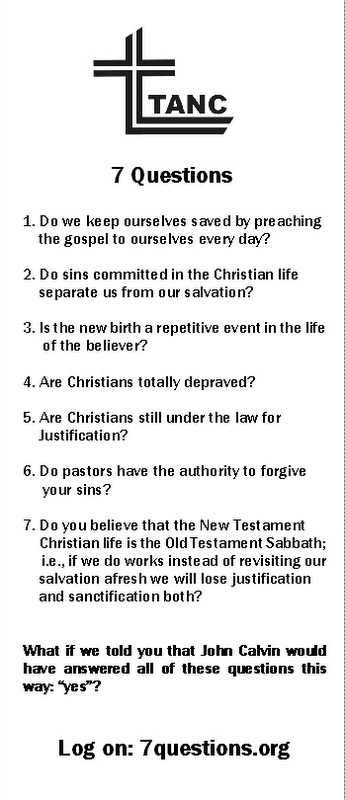
Calvin also redefined the new birth as an experience of perpetual rebirth in order to keep ourselves saved by the same gospel that originally saved us. So, the new birth is not a one-time event, it is a perpetual cycle of the same repentance and new birth experience that originally saved us—that’s why we must, “preach the gospel to ourselves every day.” This is the doctrine of mortification and vivification. It is part of Calvin’s systematic theology. This is factually indisputable. The Christian life focuses on our total depravity and repentance only, leading to the experience of vivification, or a joyful experience.
Therein, the human “heart” is redefined as something that is transformed only by its increased ability to experience vivification. This is why John Piper states that joy is essential to the Christian life; if vivification is not being experienced; perpetual rebirth is not taking place:
The pursuit of joy in God is not optional. It is not an ‘extra’ that a person might grow into after he comes to faith. Until your heart has hit upon this pursuit, your ‘faith’ cannot please God. It is not saving faith (Desiring God: p. 69).
Likewise, Southern Baptist Paul Washer states the following:
This cycle simply repeats itself throughout the Christian life. As the years pass, the Christian sees more of God and more of self, resulting in a greater and deeper brokenness. Yet, all the while, the Christian’s joy grows in equal measure because he is privy to greater and greater revelations of the love, grace, and mercy of God in the person and work of Christ. Not only this, but a greater interchange occurs in that the Christian learns to rest less and less in his own performance and more and more in the perfect work of Christ. Thus, his joy is not only increased, but it also becomes more consistent and stable (Paul Washer: The Gospel Call and True Conversion; Part 1, Chapter 1, heading – The Essential Characteristics Of Genuine Repentance, subheading – Continuing and Deepening Work of Repentance).
The new birth is redefined as a “cycle” rather than a one-time event like our physical birth. It is redefined as a perpetual rebirth experience as we focus on our saintly total depravity. We are only righteous positionally; regeneration is a mere experience of Christ’s perfect obedience to the law. This not only keeps Christians under law, but inadvertently calls for a rejoicing in our own supposed total depravity.
This is why authentic Calvinism dies a social death within Christianity every 100 years or so. God’s people eventually catch on to the fact that it is a false gospel. Lighter forms of it survive the rejection while maintaining the label. We are presently within the fifth resurgence since Calvin’s Geneva, and the trustees of Southern are mindless participants accordingly.
We had the wonderful privilege of meeting many, many young people at the recent Cross Conference where you promoted this false gospel. We realize that there will only be a remnant that loves the truth enough to reject this latest academic novelty. But this is a generation of young people capable of great things, and smart enough to know that they only need God Himself to accomplish His mission. We believe that American Christianity has become a mission field in and of itself; namely, YOUR resurgence movement, a movement that bears your name, and we are seeking to reach that remnant of God that loves His truth. This is our duty and calling. A gospel promoting a justification that is not finished cannot save.
Meanwhile, as stated by the apostle Paul, let those who teach another gospel be accursed whether they be angels or men of renown.
Because only truth saves and sanctifies,
Paul M. Dohse
John 17:17
Matthew 4:4



3 comments