Who Knew? Discipleship After the Institution
 I am presently in the midst of writing the second volume of The Truth About New Calvinism and have a good start accordingly. Those who have agreed to do editing have requested a full manuscript when it is done rather than installments (that’s why some of you have not received scripts lately). And, John Immel has agreed to write the forward!
However, I have taken a short break to write a booklet on the New Testament assembly model. I am compelled to do this because the institutional church versus something else motif seems to be gaining serious traction. It’s the something else I am concerned with; we can’t just stop doing things, we need to replace what we have put off with the right replacement. Christians fellowshipping together is extremely important. Folks, we can’t just stop assembling together while going to “Echurch.”
Consider a comment I read yesterday on another blog:
Members of institutional churches are slaves. The Pharoes want their pyramids (institutional religious themed businesses) built, and they need slaves (members) to do the labor. The slaves go on visitation hoping to recruit new slaves (members). The slaves go into the community not with the gospel, but with cards telling what time Sunday School starts, etc.
The slaves have to gather their own straw (pay into the pot in order to use their spiritual gift), as many Pharoes will not let you serve in their “church” unless you pay into the pot, all the while they will not use their gifts without being paid out of the pot. Tell me that the children of God today are not taken bondage by a spiritual Egypt (institutional churches) and serve a Pharoe (clergy employed pastor), and needs a Moses to lead them out of this slave system. Look at the lies told to church members at this link here: [link has some great ideas, but don’t care to indorse it].
The parable is a little raw, but as we blush, we have to admit that it is technically all true. The link that was cited supplies resources/ammunition for those who are anti-institutional church, but again, no alternatives. That is why I am compelled to write this booklet. I want to at least get the ball rolling with some foundational challenges and a place to start. For those not assembling with other believers, it’s time to decide on a course of action IMO. I hope this booklet will encourage you to do so.
And in regard to the book, I am finding myself in the midst of some very interesting research. I have been able to conclude that the New Testament has left us an objective, definitive, Assembly model. And here is something cool: even though this will entail massive research of which I am able to do almost full time, the booklet is being kept to 50 pages; I am only hitting the high points.
I also want to put some history in there. When and how did the New Testament Assembly become an institution? Clearly, the apostles did not leave an institutional model. And, in the New Testament model, all, I repeat, ALL authority is in Christ. Unity is predicated on agreement regarding what Christ said. Fellowships are predicated on various degrees of agreement and cooperation—not horizontal authority. Vertical authority, horizontal agreement and a co-op of gifts occupied by each member. Leadership is a gift, not a position of authority.
This is what my research is beginning to reveal: a contention over what constitutes unity took place very early in the apostolic church era; authority versus fellowship. The idea that persuasive leadership leads to agreement and unity versus blank check submission to ecclesiastic authority. While some of the apostles were still living, bishops located in Rome start showing up and trying to tell the church what to do. At this point, I am not sure what their connection with the Roman government was, if any. The first Romish bishop was installed (by what means presently not known) circa during the same time that Jerusalem was sacked by Titus.
During this time (64-100 AD), controversies arise between Roman bishops and the Christian assemblies at large. The Roman bishops must have had some influence as the regional bishops (which were an aberration of earlier elders), at least argued with them. One controversy is striking. It resulted in the first Roman counsel and reveals that the early church observed Passover until at least 200 AD. Rome insisted that the “church” should observe Passover on Sunday rather than other days that fall on the 14th day of Nisan. Rome eventually won that battle, and hence today we observe Easter on “Easter Sunday.” Who knew? This is by no means tradition, but documented history:
Bishop Victor apparently felt that he had the authority to impose his will on the churches of Asia Minor. But they refused. It is also important to recall that Irenaeus told Victor that he should not have tried to impose Roman traditions on the Asia Minor churches.
The Orthodox Church reports this brief explanation of events in one of its timelines:
193 A.D. – Council of Rome, presided over by Bishop Victor, condemns the celebration of Pascha on Nisan 14, and addresses a letter to Polycrates of Ephesus and the Churches in Asia.
193 A.D. – Council of Ephesus, presided over by Bishop Polycrates, and attended by several bishops throughout Asia, reject the authority of Victor of Rome, and keep the Asian paschal tradition (Markou, Stavros L. K. An Orthodox Christian Historical Timeline. Copyright © 2003 OrthodoxFaith.com).
The Catholic writer Eusebius recorded that Polycrates of Ephesus, around 195 A.D. wrote the following to the Roman Bishop Victor who, as the previous writing showed, wanted all who professed Christ to change Passover from the 14th of Nisan to Sunday:
We observe the exact day; neither adding, nor taking away. For in Asia also great lights have fallen asleep, which shall rise again on the day of the Lord’s coming, when he shall come with glory from heaven, and shall seek out all the saints. Among these are Philip, one of the twelve apostles, who fell asleep in Hierapolis; and his two aged virgin daughters, and another daughter, who lived in the Holy Spirit and now rests at Ephesus; and, moreover, John, who was both a witness and a teacher, who reclined upon the bosom of the Lord, and, being a priest, wore the sacerdotal plate.
He fell asleep at Ephesus. And Polycarp in Smyrna, who was a bishop and martyr; and Thraseas, bishop and martyr from Eumenia, who fell asleep in Smyrna. Why need I mention the bishop and martyr Sagaris who fell asleep in Laodicea, or the blessed Papirius, or Melito, the Eunuch who lived altogether in the Holy Spirit, and who lies in Sardis, awaiting the episcopate from heaven, when he shall rise from the dead? All these observed the fourteenth day of the passover according to the Gospel, deviating in no respect, but following the rule of faith.
And I also, Polycrates, the least of you all, do according to the tradition of my relatives, some of whom I have closely followed. For seven of my relatives were bishops; and I am the eighth. And my relatives always observed the day when the people put away the leaven. I, therefore, brethren, who have lived sixty-five years in the Lord, and have met with the brethren throughout the world, and have gone through every Holy Scripture, am not affrighted by terrifying words. For those greater than I have said ‘ We ought to obey God rather than man’ (Eusebius. Church History, Book V, Chapter 24. Translated by Arthur Cushman McGiffert. Excerpted from Nicene and Post-Nicene Fathers, Series Two, Volume 1. Edited by Philip Schaff and Henry Wace. American Edition, 1890. Online Edition Copyright © 2004 by K. Knight).
Notice that Polycrates said that he and the other early church leaders (like the Apostles Philip and John, and their successors like Polycarp, Thraseas, Sagaris, Papirius, Melito) would not deviate from the Bible, and that they knew the Bible taught them to keep the Passover on the correct date, and not on a Sunday. Polycrates also reminded the Roman bishop that true followers of Christ “obey God rather than men”.
Hence it is clear that throughout the second century, the churches in Asia Minor continued to observe the Passover on the 14th of Nisan (and for doing so, they were labeled as Quartodecimans by the Romans), unlike the Romans, and they refused to accept the authority of any Roman bishop over scripture (Bob Thiel, Ph.D.: Victor of Rome; online source | cogwriter.com/victor.htm).
Another interesting controversy arose very early in church history between Clement, the third bishop of Rome, and the church at Corinth. These early bishops constitute the beginning of the Catholic Church. The church at Corinth disfellowshipped several bishops. This happened circa 90 AD, and was the subject of a lengthy letter to Corinth by Clement (1Clement). The letter is a lengthy linguistic drone that addresses no specific issues whatsoever. The long and short of Clement’s appeal is bishop authority. Were these bishops sent by Rome to replace the unity of fellowship with authority? And what was the relationship between the bishops of Rome and the Roman government? Did their pressure result in the one city, one church, one bishop model? Prior to that, there were several home fellowships in each city or region led by several elders. It will take more research to answer these questions.
paul
“< Tweet Tweet

What Calvinist/Puritan ever invented anything except a dunking stool? What have they ever funded without the government? What have they ever accomplished socially other than civil wars?
“< Tweet Tweet
 Paul M. Dohse @PaulMDohse22s
Hug your Reformed pastor today. His “power of the keys” punches your ticket to heaven if you keep your mouth shut and ask no questions.
Calvin’s Get Out of Hell Free Card: The “Power of the Keys”
Is Calvin’s gospel really good news? Not so much. It entails running a race of faith alone in sanctification and then appearing at one final judgment where everyone who has ever lived finds out whether they made it or not; where the children of God will be “made manifest.” Because Calvin’s gospel fuses justification and sanctification together, it involves a complicated system of determining what IS works in sanctification and what IS NOT works in sanctification because justification and sanctification are the same thing. Hence, no works can be done in sanctification (the Christian life). Calvin stated that New Testament sanctification is the succession of the Sabbath Day rest (CI 2.8.29).
Calvin stated unequivocally that Christians shouldn’t have any security (CI 3.24.6) because living by faith alone is indeed tricky business, but followers of Calvin do have an ace-in-the-hole: the power of the keys. This is the idea that Reformed elders have been given the authority to speak for God, and whatever they bind on earth will be bound in heaven, and along with that comes the authority to forgive sins that unjustify (CI 4.1.22).
So, if the elders like you, you’re in. The doctrine creates fear, but assurance can be found in supporting your local Reformed elder.
paul
The Reality of Reformed Theology
 “Reformed theology, or if you will, Calvinism, is not a theological debate; it is a philosophical debate concerning the question of how we interpret reality itself.”
The philosopher Friedrich Wilhelm Nietzsche, a proponent of ideas that I find disturbing, once stated the following: “In Christianity neither morality nor religion come into contact with reality at any point.” Perhaps he confused Christianity with the Reformation.
The fact that I agree with Nietzsche on this point is completely beside the point; the Reformers themselves stated exactly what Nietzsche said. To say that Luther stated in his Heidelberg Disputation that mankind in general, and Christians in particular are unable to understand reality or morality is beyond fair. Obviously, no belief touches anything it doesn’t believe in.
You don’t have to be a rocket scientist to figure any of this out, you only need to listen carefully: “The centrality of the objective gospel outside of us.” “The subjective power of an objective gospel.” “The Objective gospel.” “The objective gospel experienced subjectively.” These are all contemporary restatements of Luther’s Heidelberg Disputation. This is only complicated to those who have lost the art of asking themselves questions and knowing that words mean things.
When God created the earth and reality, he also created the epistemology to go along with it. He created light and said, that’s light. The word, “light” interprets what light is. Therefore, when someone talks about light, we understand what they are talking about. God even colabored with man to develop much of the epistemology by asking him to name the animals.
Then the serpent came along and in essence said to Eve, “Yea, has God really said, ‘That’s a cow’? Eve, you can’t draw conclusions through mere words, you need to go beyond that and see the knowledge of good and evil.” Likewise, Reformed teachers like Paul David Tripp teach that the literal meaning of words cannot interpret a “gospel context.” The likes of Rick Holland state that good grammar makes bad theology. Grab your metaphysical wallet and hold on to it tightly lest your philosophical pockets get picked.
The “objective gospel” (for instance, see objective gospel .org) is Luther’s cross story, and the subjectivity of it (how we experience the gospel) is Luther’s glory story.
Objective: (of a person or their judgment) not influenced by personal feelings or opinions in considering and representing facts.
Subjective: based on or influenced by personal feelings, tastes, or opinions.
One of the major tenants of the Heidelberg Disputation and Reformed theology in general is the idea that it is impossible for mankind in general and Christians in particular to approach ANY truth WITHOUT presuppositions; ie., subjectivism. Also, only the gospel is objective. ALL reality must be interpreted through redemption. Hence, the first tenet of New Covenant Theology which is a spinoff from Neo-Calvinism:
New Covenant Theology insists on the priority of Jesus Christ over all things, including history, revelation, and redemption. New Covenant Theology presumes a Christocentricity to the understanding and meaning of all reality.
Any questions? In case you do, consider this quote by the father of contemporary Reformed hermeneutics, Graeme Goldsworthy:
If the story is true, Jesus Christ is the interpretative key to every fact in the universe and, of course, the Bible is one such fact. He is thus the hermeneutic principle that applies first to the Bible as the ground for understanding, and also to the whole of reality (Graeme Goldsworthy: Gospel-centered Hermeneutics; p.48).
This is why the objective gospel, according to Reformed thought, must remain outside of us and only experienced through faith in it alone. This gospel alone must define who we are. The only thing man can know is that he is evil and God is good, EVERYTHING else is conformed to his own distorted individualist presuppositions. His life must be guided completely by something outside of him. Everything within is subjective. The idea that man can know anything objectively is Luther’s glory story. It’s all about the glory of man and not God. It’s either everything or nothing at all. If man has any merit or worth at all, he has ravaged God’s image. He must trust completely in the cross story. This is the foundation of the Calvin Institutes stated in 1.1.1. The Institutes are not only based specifically on Luther’s metaphysics, but the premise is eerily similar to the knowledge of good and evil propagated by the serpent.
The staple assertion during the infancy of the present Neo-Calvinist movement was the often heard idea that this new resurgence was needed because Evangelicalism was drowning in a “sea of subjectivism’:
Now, if the Fathers of the early church, so nearly removed in time from Paul, lost touch with the Pauline message, how much more is this true in succeeding generations? The powerful truth of righteousness by faith needs to be restated plainly, and understood clearly, by every new generation.
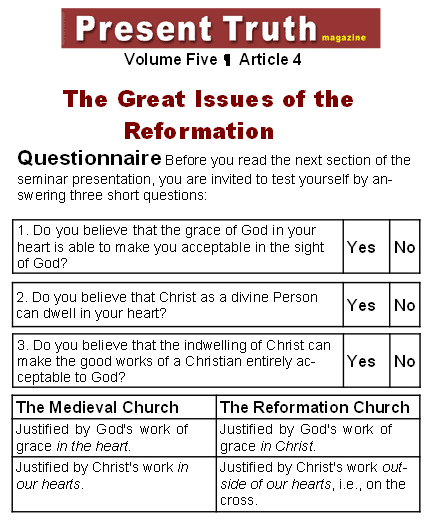
In our time we are awash in a “Sea of Subjectivism,” as one magazine put it over twenty years ago. Let me explain. In 1972 a publication known as Present Truth published the results of a survey with a five-point questionnaire which dealt with the most basic issues between the medieval church and the Reformation. Polling showed 95 per cent of the “Jesus People” were decidedly medieval and anti-Reformation in their doctrinal thinking about the gospel. Among church-going Protestants they found ratings nearly as high (The Highway blog: Article of the Month, Sola Fide: Does It Really Matter?; Dr. John H. Armstrong).
And what was the gist of that survey specifically? An illustration from the cited article follows:
 Reformed theology, or if you will, Calvinism, is not a theological debate; it is a philosophical debate concerning the question of how we interpret reality itself. This is a question of whether or not man can comprehend reality, and the structuring of society accordingly. Throughout history, this debate has always ended up in an arena where life and death are determined. This is not a theological debate this is a debate that determines what kind of world we will be living in. Nietzsche was right in regard to a “Christian” nomenclature of Reformed thought; it holds to the idea that truth and morals are objective and unattainable while in this subjective world.
paul



2 comments