2014 “Shepherds” Conference: Jerry Wragg Calms the Herd in Regard to Sanctification; Part 1
 I was recently made aware of the astounding title of Jerry Wragg’s seminar at the 2014 “Shepherds” Conference: “The New Antinomianism, Evaluating the Implications of Cross-centered Sanctification.” I posted some preliminary thoughts on the title a few days ago, and I am waiting for the mp3 to be posted in the 2014 archives. The mp3 will be transcribed and evaluated in part 3.
It’s just a title, so what’s the big deal? The title is indicative of the unavoidable; more and more, Reformed cronies are going to have to explain away the severe problems with authentic Reformed soteriology. The crux of the problem can be seen in Wragg’s title and characteristic of what the seminar MO will have to be, viz, a lot of tiptoeing around the gators. Wragg couldn’t title the seminar, “The New Antinomianism, Evaluating the Implications of Sanctification by Justification” because as a Calvinist that’s what he believes.
As God’s people get up to speed on the subject of law/gospel, Calvinism will be progressively exposed for the rank heresy that it is. For now, Calvinist lackeys like Wragg continue to employ various and sundry deceptive communication techniques. Their favorite technique is to portend that a singular idea is something different when they don’t want to be rightly identified with the singular idea. This is done by using synonyms of words that identify the main idea, and then associating the synonyms with different ideas that they supposedly disagree with.
Example: In part 2, I will be evaluating Wragg’s 2013 seminar that was on the same subject; A Biblical Response to Current Forms of Free Grace Theology. In that seminar, he affirms the well-traveled justification is the ground of our sanctification. But yet, the 2014 title implies that he is against Christ-centered sanctification. This is affirmed by the corpus of his 2013 message as well; i.e., “Gospel Sanctification” is errant. But it is the exact same thing as justification being the ground of our sanctification or “sanctification is grounded in justification.” Do you see what he has done? “Christ” has been exchanged for “justification,” and “centered” has been exchanged for “grounded.” They also exchange “justification” for “grace” in order to blur distinctions between justification and sanctification.
So, one idea is identified with multiple synonyms, and then they make the synonyms different ideas. This enables them to call something error while continuing to teach the same as truth. Another example is “justification and sanctification are never separate, but distinct.” This is a staple mantra among the Reformed. They actually say it with a straight face. It enables them to suggest that justification and sanctification are separate while making applications that imply the two are the same thing…while saying they are different.
As I deconstruct Wragg’s 2013 and 2014 seminars in parts 2 and 3, I will clearly demonstrate that Calvin held to the same Gospel Sanctification that Wragg criticizes. I will use several citations from the Calvin Institutes. The Neo-Calvinist movement has Calvinism right despite ignorant protestations from the likes of Wragg and John MacArthur. Wragg, in the 2013 seminar, criticizes the idea that sanctification is a “rest.” John Calvin and his view of the Scriptures will be a main focus of the 2015 Shepherds conference; therefore, Wragg should get on board with Calvin as far as sanctification being a “Sabbath rest” in which Christians will die a spiritual death if they work. Calvin’s Sabbath rest theology will be cited numerous times in parts 2 and 3.
Sooner or later, the theological math is going to catch up with these charlatans. This is probably one of the reasons authentic Calvinism, which fuses justification and sanctification together, dies a social death every 100 years or thereabouts.
Meanwhile, as inquiring Christians want to know, the herd will have to be continually calmed by Reformed doublespeak, and apparently, that’s Wragg’s role among the theological felons of our day.
paul
Addendum:
In addition, in Wragg’s 2013 seminar he touts the Reformed the imperative command is grounded in the indicative event. This teaches that all obedience in the Christian life flows from justification (which is a finished work while sanctification is progressive). See how they change the word “justification” for “indicative” to nuance the point? I will be discussing the question, “What powers our obedience in sanctification, the new birth or justification?” We will see how the Reformers redefined the new birth as a realm and attributed the fruit of sanctification to justification through the “vital union.”
A very good summary of Romans 6

From Paul’s Passing Thoughts, The Problem with Wartburg:
ALL people on the earth are slaves. They are either slaves to unrighteousness or slaves to righteousness. AND, all people upon the earth are also free, and the freedom corresponds to the slavery. The unregenerate are enslaved to disobedience and free to obey (Romans 6:20)—the regenerate are enslaved to obedience and free to sin. No unbeliever sins perfectly, and no believer obeys perfectly.
The Problem with Wartburg
“Deb and Dee” author one of the more popular discernment blogs in our day. They have always seemed fairly cognizant to me and I have always found their newsreel informative. They report and comment on Christian trends, primarily in regard to the Neo-Calvinist movement.
I began having problems with Wartburg when they selected Wade Burleson as the pastor of their online Echurch. Burleson, as I have often documented on PPT, is a rabid follower of Jon Zens who is a forefather of the Neo-Calvinist movement. While referring to the leaders of said movement as the Calvinistas, they embrace and give credence to the most rabid advocates of the movement. This has also resulted in the ignoring of the very victim-blaming by Burleson that they claim to disdain.
Hence, they have been called “hypocrites” by some. But don’t forget merciful either as they continue to give Burleson a stage when he is arguably the Barney Fife of pastors. PPT has documented his embarrassing teaching snafus such as drawing biblical principles from word analysis using words with 17th and 19th century etymology.
This post is about the definitive problem with Wartburg. I didn’t really know what it was until someone brought it to my attention a week ago. And that problem is their gospel. And that gospel is the same EXACT gospel that drives New Calvinism. It is antinomian, Platonist, and a doctrine of control. The first step of controlling a culture anyway you want to is gun confiscation. The first step of controlling people in the church is self-esteem confiscation. What I mean by self-esteem is biblical self-esteem which is simply a truthful assessment of oneself.
And total depravity is not a biblical assessment of man. Even a child can see this from Romans 2:14 ff.
For when Gentiles, who do not have the law, by nature do what the law requires, they are a law to themselves, even though they do not have the law. 15 They show that the work of the law is written on their hearts, while their conscience also bears witness, and their conflicting thoughts accuse or even excuse them.
Even unbelievers at times clearly do what the law requires, a fact that Calvin denied. Calvin insisted that no man, lost or saved, has ever done any deed that was acceptable to God (CI 3.14.10,11). Augustine, Luther and Calvin were avowed Platonists, and total depravity finds its philosophical foundation there. It later became Gnosticism which was the primary ideology that wreaked havoc on the first century church.
Before I address the source of my conclusion in regard to Deb and Dee, let me first state what they are in league with while priding themselves as victim advocates: Burleson often brags about his admiration for the Puritans; some of their activities included executing people who reduced the pain of those bearing children. The Puritans were also the framers of the genocidal attempt to eradicate the American Indians from the face of the earth. International Religious Freedom Day was founded on the remembrance of three Quakers executed in Boston by the Puritans for believing in the new birth. Indeed, the ignorant hypocrisy is breathtaking.
Now the source of my conclusion. In the midst of the present-day tyranny tsunami in the church, Dee chose to criticize a virtually extinct rendition of biblical obedience. The post can be read here and is one of the best posts I have ever read since the conception of my blogstration. The piece practically shell-shocked me. This slice of steroidal sanity also came from a teacher of women which is also extremely rare in our day. I think the author is a member of The Village Church. Isn’t that Matt Chandler’s gig? Well, if it is, she needs to get out of there with what she has in her cranium case.
I find Dee’s commentary on this piece most telling. First of all, it would take a book to unravel Dee’s fundamental misunderstanding of the gospel as revealed by her commentary, so I am only going to hit the points that make her nothing less than a pure authentic New Calvinist. I will begin by using a slight criticism of the aforementioned post. In it, the author states:
The gospel sets us free from sin, but it does more than that. It sets us free to obey (Rom 6:16).
She uses Romans 6:16 to make her point and her point is a good one among MANY in the post, but that verse doesn’t say that we have been freed to obey, it in fact states that we are enslaved to obedience.
As TANC has been discussing lately, there must be three exchanges in true salvation:
1. An exchange of the old us for the new us.
2. An exchange of law.
3. An exchange of slavery.
Shockingly, the author actually touched on one and two, but gets three slightly wrong. ALL people on the earth are slaves. They are either slaves to unrighteousness or slaves to righteousness. AND, all people upon the earth are also free, and the freedom corresponds to the slavery. The unregenerate are enslaved to disobedience and free to obey (Romans 6:20)—the regenerate are enslaved to obedience and free to sin. No unbeliever sins perfectly, and no believer obeys perfectly. The author got it right: it’s not the perfection—it’s the direction.
That brings us to the necessary exchange of law which the author also gets right via other words. It is the exchange of the law of condemnation for the law of love, or the motives issue that the author spoke of. Before salvation when we are “under law,” yes, perfection is the standard that we would be judged by and it determines eternal destiny. But those “under grace” love the law, and therefore perfection is not the standard, but it is the goal. Yes, when Christ stated, “be ye perfect,” He was stating the goal of the Christian life, not a standard for salvation.
Also, this could be a play on words in regard to “be ye saved” as demonstrated by a change of life direction. Why? Because the saved are NOT “under law” and “where there is no law there is no sin” and “we know that the law has nothing to say to us” etc. The Deeian New Calvinist gospel will not even get a contractor hired if he states, “Well, no job is ever perfect,” and it will not impress the world either unless they want to be saved with their sin. Like all New Calvinists, Dee uses the following well-traveled argument:
She is correct when she says that we should not live a life of ecstatic disobedience. But, she also failed to discuss Paul who viewed his sins in this way in Romans 7:19 (NIV-Gateway)
For I do not do the good I want to do, but the evil I do not want to do–this I keep on doing.
Paul got it. We will continue to sin and we will continue to seek forgiveness. I do not believe that most Christians are ecstatic over their sin and disobedience. They are ecstatic over the great grace which has resulted in the forgiveness of sins. We do not need to live like many people in certain ministries loved by Calvinistas. Such people live in constant condemnation. Their sins are dissected and pointed out by both pastors and sin hounds who relish “making observations.”
In context, the passage that Dee uses makes the original point of the aforementioned author. In Romans 7:13-25, Paul addresses all three exchanges and states that he is persevering against his old nature that was under the law. The way that law formally provoked him to sin is still free to do so (Rom 7:5, 9). But the word for “wretched” in verse 24 is a Greek word that carries the idea of persevering or overcoming affliction. Paul is crying out to God to be saved from his mortal body so that he will no longer have to fight against sin that is presently part of his being. Unfortunately, until Christ comes for us, we have to carry the old us that is dead. We carry around with us the “death of Christ”; ie., those things imputed to Christ that He put to death. The old us died with Christ, but we were also resurrected with Him to new life. So, there is still a salvation left for the believer—salvation from our mortality and its sin. This is not to be confused with the salvation that is a finished work. New Calvinists make the finished salvation and progressive sanctification, and glorification the same thing.
And so does Dee; albeit, perhaps unwittingly.
In her misguided and out-of-school argument against the truthful post, she states:
We will continue to sin and we will continue to seek forgiveness. I do not believe that most Christians are ecstatic over their sin and disobedience. They are ecstatic over the great grace which has resulted in the forgiveness of sins.
That is the very doctrine that is a hallmark of New Calvinism known as mortification and vivification. Dee’s argument is classic Neo-Calvinism: we don’t rejoice over the sin, only the forgiveness that we experience when we are forgiven. Conspicuously missing is any kind of joy that we receive through obedience because there isn’t any—the New Calvinist’s life is a “lifestyle of repentance” and exemplified by being “repenters.” My point is made by adding Dee’s statements to the following well-traveled New Calvinist illustration.
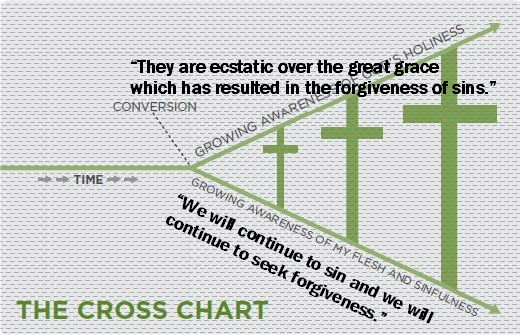
To further the point, consider this statement by New Calvinist Paul Washer:
At conversion, a person begins to see God and himself as never before. This greater revelation of God’s holiness and righteousness leads to a greater revelation of self, which, in return, results in a repentance or brokenness over sin. Nevertheless, the believer is not left in despair, for he is also afforded a greater revelation of the grace of God in the face of Christ, which leads to joy unspeakable. This cycle simply repeats itself throughout the Christian life. As the years pass, the Christian sees more of God and more of self, resulting in a greater and deeper brokenness. Yet, all the while, the Christian’s joy grows in equal measure because he is privy to greater and greater revelations of the love, grace, and mercy of God in the person and work of Christ. Not only this, but a greater interchange occurs in that the Christian learns to rest less and less in his own performance and more and more in the perfect work of Christ. Thus, his joy is not only increased, but it also becomes more consistent and stable. He has left off putting confidence in the flesh, which is idolatry, and is resting in the virtue and merits of Christ, which is true Christian piety” (Paul Washer: The Gospel Call and True Conversion; Part 1, Chapter 1, heading – The Essential Characteristics Of Genuine Repentance, subheading – Continuing and Deepening Work of Repentance).
Moreover, Dee’s confusion regarding the fact she is a New Calvinist and doesn’t know it is reflected in this statement:
We do not need to live like many people in certain ministries loved by Calvinistas. Such people live in constant condemnation. Their sins are dissected and pointed out by both pastors and sin hounds who relish “making observations.”
Her argument regards the idea that “grace” makes all of that unnecessary, but where is her argument for untruthful assessment; viz, biblical self-esteem which circumvents tyranny and control? In Calvinism, the root of all sin is the refusal to recognize our sin ONLY. The express purpose of sin sniffing is to bring more joy to people through “deep repentance.” Dee is criticizing a method that enhances the very construct she endorses.
“Calvinistas” my…uh, foot Dee—look in the mirror.
paul



leave a comment