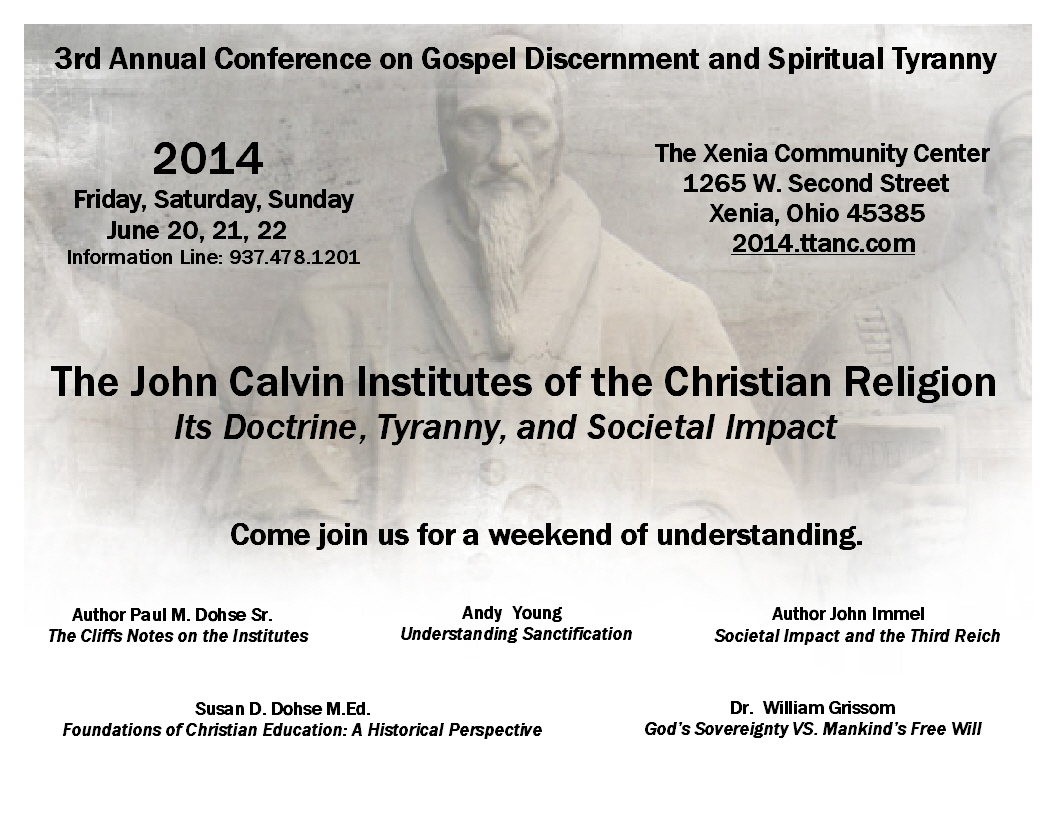
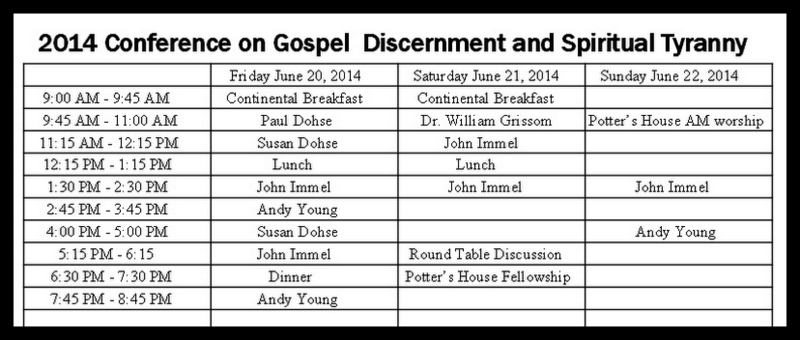
Purpose Statement: The 2014 Conference on Gospel Discernment and Spiritual Tyranny
2014.ttanc.com
There are two reasons why we hold these conferences every year and the reasons are reflected in the title.
First, “gospel discernment.” In the book, Quitting Church, written by Washington Times religion editor Julia Duin, she states the following on page 13:
…plenty of people in this country are interested in spiritual matters. They are simply not going to church to feed this interest.
Why? I have sensed for several years something is not right with church life, especially with evangelical church life. It’s been reported many times that most Americans have fled mainline Protestant churches in the past half century, cutting denominations such as the Episcopal Church and Presbyterian Church USA by half. But in the past decade, it’s the evangelical churches that are losing ground.
Duin then documents many symptoms of the problem in her book, and seems to suggest that correcting the symptoms is the answer. We disagree. We think the fundamental problem that she has sensed all of these years, and many with her, is rooted in a false gospel. The problem is simply this: the original gospel of the Protestant Reformation is patently false, and the fruit has not fallen far enough from the tree to affect a vibrant Christian life within the church.
Our ministry is twofold, and this first side contends that the errant Protestant gospel is a matter of simple theological math; Martin Luther and John Calvin proffered the continuance of the law of sin and death as the definition of justification for the believer. Instead of the new birth ending the law of sin and death for the believer and eradicating it as a standard for justification, their gospel calls for the perpetual fulfilment of it by Christ in our stead.
But the law of sin and death is not fulfilled by the imputation of Christ’s obedience to the law of sin and death—Christ came to end that law altogether. Hence, it is a false gospel that defines believers as under law and not under grace. Under grace does not exclude law, but obligates the Christian to the perfect law of liberty for sanctification—not justification. Sanctification by justification is a gospel that keeps people under law while yet calling them Christians. This is an egregious false gospel.
You can nuance this fact with the word-crafting of, “living by the gospel [living by justification],” “Christ-centered [justification-centered],” “cross-centered [Ibid],” “transformed by the resurrection of Christ [transformed by justification rather than regeneration],” “disciplined by grace [disciplined by justification],” etc., but we will not be deceived with subtle word replacement.
How did this happen? It happened because the Reformers did not approach the Scriptures exegetically as opposed to the narrative promoted by the shameless traditions of men. The Reformers were first and foremost philosophers, and they foisted their philosophical worldview onto the Scriptures. Reformed “orthodoxy” is nothing more than dignified mythology and philosophical eisegesis.
This brings us to the critical second purpose of the conference. Understanding the particular philosophy of the Reformers enables us to understand the results of their integration: their gospel, and its abhorrent fruit… this part of the conference shows how specific ideologies always produce the same behavior throughout history regardless of being clothed in Bible verses. Not understanding the philosophy of the Reformers results in endless Scripture-stacking debates in the midst of perpetual carnage. Ignorance of philosophy enables the Reformers to hide behind, “secondary issues.”
The results are detrimental to both discipleship and secular quality of life. Justice is no less important whether in the church or outside of it. An indifference to quality of life will not endear the world to Christianity by any means whatsoever. Christians who are knowledgeable about life simply reflect that they are children of the God who created it. Faith is a friend of reason, and by no means a license for ignorance.
Press release version pdf: 2014 Purpose Statment
Calvinism and a Humbleness that Leads to Hell
The Sovereign Lord is my salvation from beginning to end and everything in between. I could not keep myself one day without Him. He is my Saviour, Lord and Keeper! He has promised to perfect all that which concerns me and it is HE that works in me to will and to DO of His good pleasure according to the scriptures.
He says in the gospel of John that…”All that the Father gives me I shall lose NONE but shall raise him up at the last day! Praise His name.
Sandi
Sandi,
Like all Calvinists, you dress up evil in a “humbleness” that totally depends on God and gives Him ALL the credit for your Christian walk as well as salvation. Like the “wicked lazy” servant in Matthew 25:14-30, you propose to merely give back what Christ has given you. You hide the gospel of “God does it all” in the ground for fear that anything you do in your Christian life is an attempt to fulfill the law of sin and death rather than walking in obedience to the law of the Spirit of life. You do not see yourself as free from the law of sin and death; therefore, your true role of loving Christ is relegated to the Holy Spirit. Like the wicked lazy servant, there is fear in your love because you are still under the law of sin and death.
Therefore, you are not a true friend of Christ, or a brother, but a parasite; viz, in the words of Calvinist Paul David Tripp we are only to “rest and feed on the living Christ.” That’s what a Calvinist is: a parasite that only “rests and feeds on Christ” instead of offering one’s body as a living sacrifice. Christ died for you, and you offer nothing in return but your blemished totally depraved self that is still under the law of sin and death. You are not free to…”if you love me, keep my commandments.” You must make those commands to the Holy Spirit because you are still under the law of sin and death.
Worse yet, like all Calvinists, and antithetical to love, you rejoice in this evil. As you plunge the depths of your own depravity (mortification), you experience the joy which is a gift from heaven (vivification). The doctrine of mortification and vivification is official and well documented Reformed orthodoxy. Clearly, it is a joy that results in the reality of our own depravity, and makes God a rewarder of such, but love “does not delight in evil.”
Granted, there is to be fear in sanctification as we look for the redemption of the body, but you make that the same as a fear of judgment in regard to justification because you are still under the law of sin and death, and not freed by the perfect law of liberty. You are not free to love Christ as a “doer of the word.” Your “love” is therefore full of fear.
I beseech all Calvinists to cry out to Jesus and affirm that His death has ended the law of sin and death, and freed us to love Him with the Holy Spirit as our counselor resulting in a life that is built upon a rock.
paul

Galatians 2:20 – Does Christ Live Our Life For Us?
pdf Trifold: Gal 2.20 trifold
A passive approach to Christian living has not served the Western church well. Few will disagree that Protestantism is predicated on the idea that the Christian life should be lived out in the same way we were saved, by faith alone. By far, the most popular proof text for this is Galatians 2:20;
I have been crucified with Christ. It is no longer I who live, but Christ who lives in me. And the life I now live in the flesh I live by faith in the Son of God, who loved me and gave himself for me (ESV).
On its face, the verse does seem to say that we are dead and unable, and Christ is living out our lives for us and through us. The English Standard Version, a Neo-Reformed translation, adds to the idea by excluding the following words that are underlined:
I am crucified with Christ: nevertheless I live; yet not I, but Christ liveth in me: and the life which I now live in the flesh I live by the faith of the Son of God, who loved me, and gave himself for me (KJV).
The apostle Paul is saying that there is a sense in which we are dead, but also alive. How can we be both alive and dead? The crux of the problem in interpreting Galatians 2:20 is a Protestant propensity for confounding justification and the Christian life. Galatians 2:20 is not addressing the Christian life, it is addressing justification. This should be evident because Paul addresses the subject of justification specifically in the immediate context several times (three times alone in Galatians 2:16, Galatians 2:17, 2:21, 3:8, 3:11, 3:24, 5:4). Note what Paul states in the verse immediately following verse 20:
I do not nullify the grace of God, for if righteousness were through the law, then Christ died for no purpose.
The word for “justified” (dikaioō) and the word for “righteousness” (dikaiosynē)mean the same thing. Paul’s point is that Christ “died” in vain if justification is by the law. By “law,” Paul is not referring to an astute observation of the finer points of the law, but the traditions of men that propagate salvation by some ritual, and a dumbing down of the finer points of the law for maintaining salvation through additional rituals (Gal – 2:3, 2:12, 2:17, 2:19, 4:10,11, 4:21, 5:2, 5:3, 5:6, 5:11, note 5:2-5:5 as a summary of these ideas).
Paul is not saying that Christians are dead in the Christian life, and it is Christ alone living through us, he is saying that Christians are dead to the law for justification. Christians died with Christ, but are also resurrected with Christ. Hence, Galatians 2:20 begins with… “I have been crucified with Christ.” Christ died to end the law’s ability to condemn us (Rom 4:15, 5:13, 6:8, 8:1,10:4). We are no longer under its jurisdiction (Rom 7:1-6).
In regard to our justification only, we are, and remain dead while Christ lives, but this does not include the Christian life in which we are alive and new creatures. The usual rendering of Galatians 2:20 makes justification and the Christian life the same thing. Justification is a finished work, while we are continually separated from our old self by learning God’s law and obeying it. That’s commonly referred to as “sanctification.”
Gal 2:20 is ONLY talking about justification. Making Gal 2:20 about the Christian life is tantamount to rejecting half of the gospel pictured in baptism:
Romans 6:3 – Do you not know that all of us who have been baptized into Christ Jesus were baptized into his death? 4 We were buried therefore with him by baptism into death, in order that, just as Christ was raised from the dead by the glory of the Father, we too might walk in newness of life.
And frankly, it also keeps the believer under law instead of under grace (Rom 6:14). If we are not now able to keep the law as a way of loving Christ and others, the law of the Spirit of life has not set us free from the law of sin and death:
Romans 8:2 – For the law [nomos] of the Spirit of life has set you free in Christ Jesus from the law [nomos] of sin and death.
The law now becomes the Spirit’s instrument of changing us (Jn 17:17, Gal 5:7 Rom 6:6). Our death with Christ stripped the law’s ability to condemn us for we are no longer UNDER it, but what many miss is the fact that being under grace means that we are now able to obey the law in order to please God (Romans 8:1-8).
To be under grace is to be under the law of the Spirit of life. The aforementioned rendering of Galatians 2:20 makes the law of the Spirit of life and the law of sin and death the same thing, and rejects the freedom from the law of sin and death made possible by the new birth (regeneration, or quickening).
This is why Galatians 2:20 is rendered that way accordingly: the “Christian” is still under law (being yet dead), and Jesus must therefore keep the law of sin and death for the believer. This is what drives the idea that Galatians 2:20 applies to the Christian life, BUT the law of sin and death has been ENDED by our death with Christ. We are no longer under its jurisdiction (Rom 7:1-4)—Christ does not need to fulfill the law of sin and death for us, that law was ended by Christ (Rom 10:4). Said rendering turns the gospel completely upside down and rejects the new birth. If the law of the Spirit of life and the law of sin and death are the same, “Christians” are still under the law of sin and death.
Moreover, take note as well that Paul doesn’t say the Galatian error was trying to be sanctified by the law; the error is an attempt to be “justified” by the law (5:4). If Paul’s primary issue with the Galatians was an attempt to apply the law to sanctification in order to justify themselves, why wouldn’t he simply state it plainly?
The real issue in Galatians was a justification by ritual, and a ritualistic dumbing down of the law in order to maintain salvation. This is necessary when the law of sin and death is not properly understood as ended, and replaced with the law of the Spirit of life.
The real issue in Galatians is a justification by ritual, and a ritualistic dumbing down of the law in order to maintain salvation. This is necessary when the law of sin and death is not properly understood as ended, and combined with the law of the Spirit of life.
In fact, the law of the Spirit of life is redefined as something done by Christ instead of the Spirit using the “perfect law of liberty” to change us (James 1:25, Matthew 7:24-27).



leave a comment